
Ali Raza, London
I must say that the first few episodes of the new Messiah series give you goosebumps, especially for those who believe in the second coming of the Messiah. Hindus, however, believe in the second coming of Krishna and Buddhists in the second coming of Buddha. Every major religion, in some sense, is waiting for a messiah or a saviour. But this Netflix series only covers three major religions: Islam, Christianity and Judaism.
The traditions following the coming of the Messiah within Islam are mentioned throughout the ahadith, and the gist of one such narration is as follows:
He will come out of nowhere, at a specific place, and people will instantly recognise him. He will save the world within days and will restore world peace. (Sahih al-Bukhari)
With this essence in mind, millions of Muslims still await this dramatic appearance of a messiah and that is exactly what this Netflix series shows.
Let me summarise the first series in a paragraph, so that the readers may get an idea of what picture the series paints.
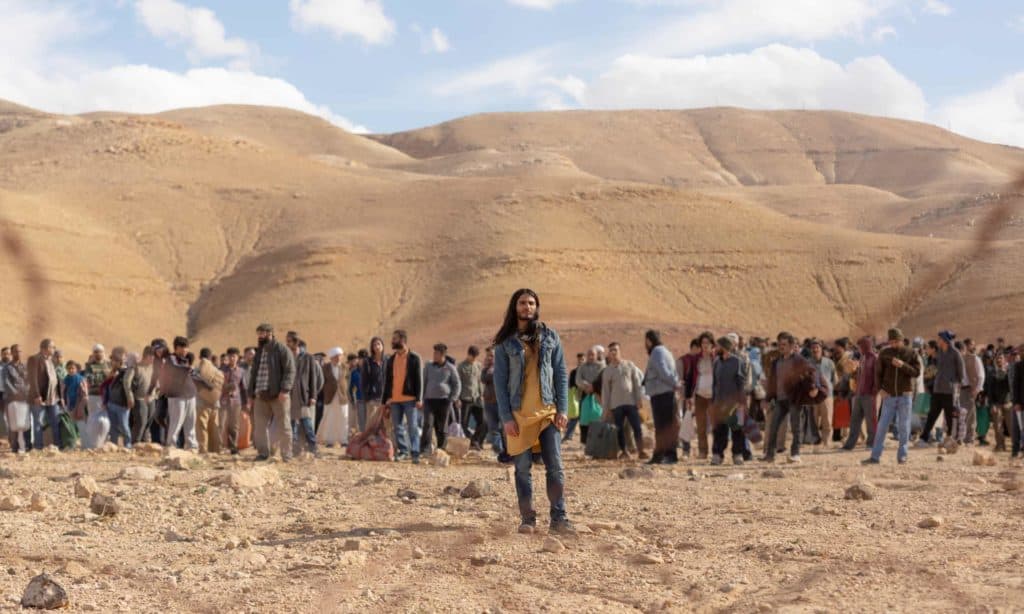
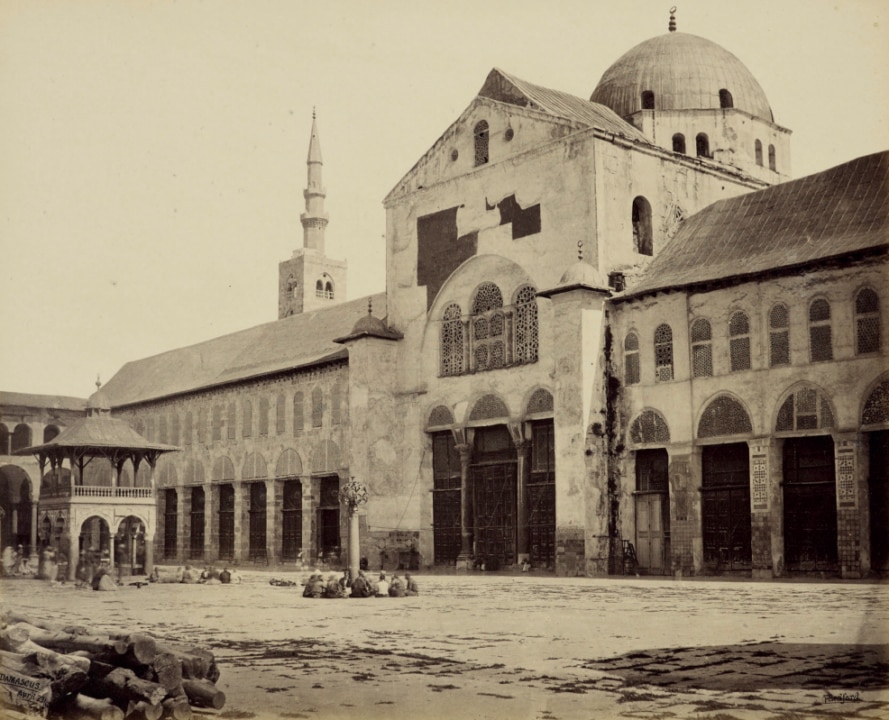
It sets the environment in Damascus, where Daesh are trying to recapture war-torn Damascus. The man named “Al-Masih” appears near the minaret of Isa (a minaret built in the ninth century by Muslims, for the descent of Jesus’ second coming) in Damascus, clothed in a yellow robe (as the hadith also foretold). Addressing a large crowd of Muslims, who are war-torn, Al-Masih preaches that Allah will soon wipe out their problems. He quotes the ahadith and Quranic verses and a sandstorm overtakes Damascus, which becomes an obstacle for Daesh to recapture Damascus. Due to the sandstorm, Daesh is defeated and people start referring to the man in the yellow robe as Al-Masih. Al-Masih quickly gains followers within a day and takes his 2,000 Muslim followers to the Israeli border, where he is arrested and jailed while his followers wait by the border for his return.Interestingly, the agent who interviews Al-Masih becomes spell-bound when Al-Masih discloses the agent’s personal information to him.
Viewers get the impression that “a hidden power”, perhaps God, is revealing things to him. Later, he mysteriously disappears from the prison cell and catches the eye of CIA surveillance. The next place Al-Masih visits is the Temple Mount (al-Aqsa mosque, Jerusalem) where he addresses the gathering again and is confronted by security officials. A gunshot is heard and a small boy is killed, but Al-Masih revives him back to life by just touching him and then disappears.
Mysteriously, he then visits a small town in Texas where he saves a daughter of a priest from a tornado and the only building that stands the tornado is this church. He slowly gains followers in America as well and also performs a miracle that is written in the Bible.
He walks on water in Washington DC and later confronts the president of USA, telling him to remove all the American troops from different countries. Before the president can make this decision, Al-Masih is arrested by the same Israeli agent who interviewed him in Jerusalem, but the plane they aboard crashes and Al-Masih survives and also revives the dead Israeli agent back to life. This is where the season ends.
Since this character depicts a Muslim messiah, viewers are left waiting for this character to visit Mecca and Medina, but this is a confusion they have deliberately created. At first, he is shown as a Muslim messiah who descended according to the literal Islamic traditions. While he is in jail in Jerusalem, they portray him as a messiah for the Jews as he calls himself “the Word” and then in America, he literally resembles (biblical) messianic qualities as he walks on water.
During the first few episodes, viewers feel that maybe he is the real Messiah and that is how he was supposed to come, but the target audience includes “rational thinkers” who are mostly atheists, including the CIA agent who pursues this “messiah” in the series.
They believe that it is all a hoax and no messiah will come and after the fifth episode; that is what the series tells us. The person who appeared out of nowhere, is actually a human being, who was a student in an American university and studied under Oscar Wallace.
Oscar Wallace is a character in the series who writes a book on social disruption and its solution. He was labelled a terrorist due to his ideologies and had to flee to Russia. This, however, is the interesting part.
Wallace’s ideology was that “in order to bring peace, a social disruption is necessary filled with fear and terror and only then will people look towards a specific community that could save them”. Following suit, the Messiah causes disruption while also seemingly uniting faiths; for Muslims, he quotes the Quran; to Jews, he quotes the Torah and before Christians, he quotes the Bible.
The character they have portrayed as Al-Masih is extremely calm and polite. His words are his best weapon. On one occasion, he says, “Weapons are not the solution.”
He only performs three miracles in the series: reviving the boy to life, walking on water and reviving a Jewish agent back to life at the end. He does not disclose his plan as he keeps saying, “I only do what God wants.”
The messiah in the series is no doubt of Muslim descent as he comes according to the literal Islamic traditions. He is said to be a Persian as mentioned in the Islamic traditions, that the Messiah would be of Persian descent.
One of the main flaws in this series is that Al-Masih is taken as a literal descension of a messiah from the skies, but he does not perform those literal tasks that have been preserved in scriptures.
The Muslim world, for instance Jordan, has reacted strictly towards this series and called for a ban. They called it “anti-Islamic” and many Muslims have said that the Al-Masih is actually the portrayal of the Dajjal (antichrist). (The Independent, Jordan calls on Netflix to ban controversial ‘anti-Islamic’ drama series)
In fact, Muslims began flooding Twitter and commenting on how the series creates confusion, with one tweet advising fellow Muslims to first correct their beliefs regarding the Dajjal before they go on to watch the series.
In Islamic traditions, it has been noted that when the Messiah comes, he will wage a war against the Dajjal, kill the swine, destroy all crosses and restore peace. In Judaism, the Messiah is to liberate Jews and make them the true leaders over the world (Messiah in Rabbinic Thought, Prof Dr Gerald J Blidstein). In Christianity, the Messiah is supposed to bring humanity back to peace and also fight against the antichrist, much like the prevalent Muslim belief (2 Thessalonians 2:7–10)
This series is based on atheistic theory, portraying the messiah as a complete fantasy or a bogus belief. I believe it has only confused Muslims even more and ridiculed the whole concept of the second coming. Though a gripping series, the whole edifice of the belief in a messiah has been brought down to tatters.
Social media is overflowing with viewers commenting on the series; more comments agreeing with the whole belief as nothing but a farce. The producers seem to have attained their objective.
Lucy Mangan said in The Guardian:
“I have no saviour to turn to, and if one appeared I would probably be among the very last converts, sitting canker-hearted as water jug after water jug was turned to wine. But I believe in television, and I believe in Netflix’s latest offering to us. Salvation from the outside world for at least 10 hours lies within.” (The Guardian, 3 January 2020)
This is one of many reviews by critics that undermines religion as a whole and leans towards spirituality without the so-called “constructs” of religion.
Fortunately, as Ahmadi Muslims, the whole concept of a second coming and the arrival of the anti-christ has been made extremely clear and easy to grasp.
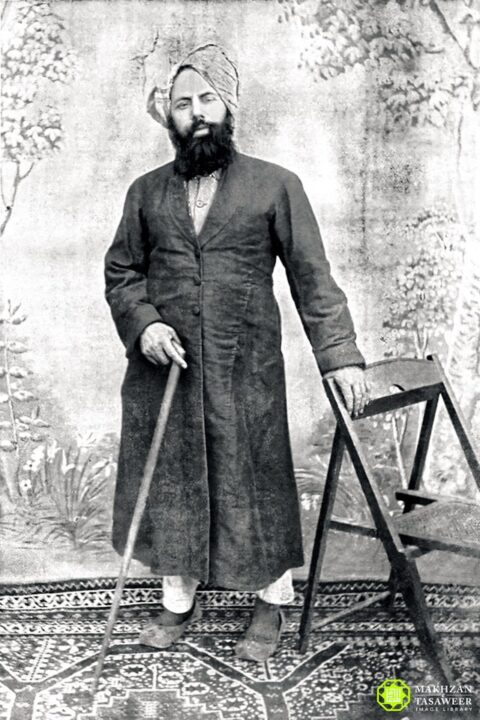
The actual Promised Messiah, Hazrat Mirza Ghulam Ahmad, peace be upon him, removed all misconceptions and fantasies regarding the second coming and unveiled its true reality while unpacking the erroneous beliefs of someone appearing in a supernatural manner with magical powers. As the fictional character in Dan Brown’s book Origin, Robert Langdon says, “Sometimes, truth is stranger than fiction.”
With regard to this, the truth is stranger than fiction. The truth is that the Messiah has already come and passed away. The truth is that he did not have powers like people assert to their future messiah. The reality is that he was not supposed to come from the skies or just “appear”.
The truth is that world peace cannot be attained within days and is a process driven by divine guidance through one leader and a community of believers. The fact is that those traditions regarding the coming of the Messiah are mostly metaphors.
However, the reality we see today is that half of the world is still looking towards the skies for a saviour to come and many of them have lost faith in this pursuit. One of the main reasons for this loss of faith or belief in the descension of a messiah from the skies is because of literal interpretation of traditions.
As discussed above, almost all of them are metaphors, but there is a way to decode those metaphors in a very logical and rational way. Let me state one example from another hadith.
Hazrat Huzaifah ibn Usaid al-Ghifari said, “The Prophetsa of Allah came to us all of a sudden as we were (busy in a discussion). He said, ‘What are you discussing?’ We said, ‘We are discussing the Last Hour. Thereupon, he said, ‘It will not come until you see ten signs before it’ and (in this connection) he made mention of the smoke, the Dajjal, the beast, the rising of the sun from the west, the descent of Jesusas son of Maryam, Gog and Magog and landslides in three places, one in the East, one in the West and one in Arabia at the end of which fire will burn forth from Yemen and drive people to the place of their assembly.” (Sahih al-Bukhari)
The smoke in this hadith does not mean literal smoke that people will see in one day. It signifies transportation, railways and aeroplanes. The Dajjal (antichrist) and the beast in the hadith do not mean a literal monster will take over the world and the Messiah and his followers will literally fight with him. It signifies international powers, the rise of materialism and the powers behind it that are making sure to dry out spirituality, religion and God from the face of the earth.
The Promised Messiahas spoke about the concept of the Dajjal or antichrist on a number of occasions. One such statement is:
“Then understand, my dear ones, that it has been disclosed to me that the reference to the antichrist as one individual is not designed to indicate his personal individuality, but his unity as a species, meaning thereby that in that species there will be a unity of ideas as is, indeed, indicated by the word Dajjal [antichrist] itself and in this name there are many signs for those who reflect. The meaning of the word ‘dajjal’ is a chain of deceptive ideas, the links of which are so attached to each other as if it was a structure of equal-sized bricks of the same colour, quality and strength, some of them firmly overlapping others and further strengthened by being plastered from outside.” (Aina-e-Kamalat-e-Islam, Ruhani Khazain, Vol. 5, pp. 554-555)
This also falls under the next statement, “The rising of the sun from the west” as the West became the forerunners of inventions. “The sun” also means the rise of Islam in the West. The descent of “Jesus” does not mean a literal descent from the skies, but it means the descension of the message and revival of Islam through a man who would be in the disposition and circumstances of Jesusas.
Gog and Magog are not to be taken as monsters or aliens but as two international powers in the world and once those powers have surfaced in the world, there will be worldwide tensions described as “landslides”. This is the manner in which everyone should analyse these prophecies made by the Holy Prophetsa. And as a matter of fact, if we put this explanation before us, it accords with the claim of Hazrat Mirza Ghulam Ahmadas.
Regarding the interpretation of such prophecies, Hazrat Mirza Ghulam Ahmadas said:
“My dear people! These are but metaphors. Those who are blessed by God with insight will realise their true significance, not only with ease, but also with some relish. Literal interpretation of such subtle and profound metaphors is like distorting beauty into monstrosity.” (Elucidation of Objections, p.12)
The second coming, the Muslim messiah, “the Word” and other versions of a “saviour” can be seen in the man who claimed to be the Messiah and Mahdi, to the east of Damascus, in Qadian. Hazrat Mirza Ghulam Ahmadas showed that in reality, the Messiah was to stop the Jihad of the sword and begin the Jihad of the pen.
Hazrat Ahmadas also proved himself to be the Messiah of every religion. He not only addressed Abrahamic religions, but every other religion, including Hinduism and Buddhism, which tells us that he was sent for everyone and was the one that everyone was waiting for. The Promised Messiahas further cleared the misconceptions of a literal interpretation of the coming of the Messiah that everyone is waiting for.
“It is wrong to infer from this hadith that the Messiah would be a sorcerer that would remove people’s hearts just by looking at them. What it really means is that wherever his pure breath – i.e. his teachings – would spread in the world, people would deny him, reject him and abuse him; so much so, that their rejection shall become a cause of chastisement for them … the Messiahas will be vehemently opposed, with the result that a great many people shall die in the land, the most severe earthquakes shall take place and peace shall disappear altogether. It would otherwise be irrational to think that pious and righteous people should be subjected to various punishments without any reason.” (Divine Manifestations, p. 9-10)
His writings, prophecies and the divinely guided Khilafat that ensued after his demise are the ultimate proofs that he was the real saviour and peacekeeper who God sent. Under divine guidance and under one leader, Ahmadi Muslims are expanding his mission of peace through promoting the rights of God and the rights of humans.
The Promised Messiahas also explained his purpose beautifully in the following extract:
“The actual mission for which God has appointed me is to remove the estrangement that has come between man and his Creator and re-establish a relationship of love and sincerity between him and his Lord. He has also appointed me to put a stop to religious wars by proclaiming the truth, to create religious harmony, to reveal the religious truths that have long remained hidden from mortal eyes and to display the true spirituality that lies submerged under the darkness of selfish passions.” (Lecture Lahore, p.42)
Modern day films and dramas can reach billions within days and it is a very strong tool to portray a message or set an image about a certain concept as this series “Messiah” did. As I was researching into this, in the first few days, the searches into the word “Messiah” were trending on Google. People were researching and studying to find out the truth behind this concept. This is the power the media holds.
I truly hope that people, after watching this series, do not turn away from religion altogether, rather it should give them a reason to research more into the concept of a messiah and a saviour. If someone is sincere in their research, I believe they will come to know and accept the logical and accurate understanding of the “Messiah” held by the Ahmadiyya Muslim Jamaat.