
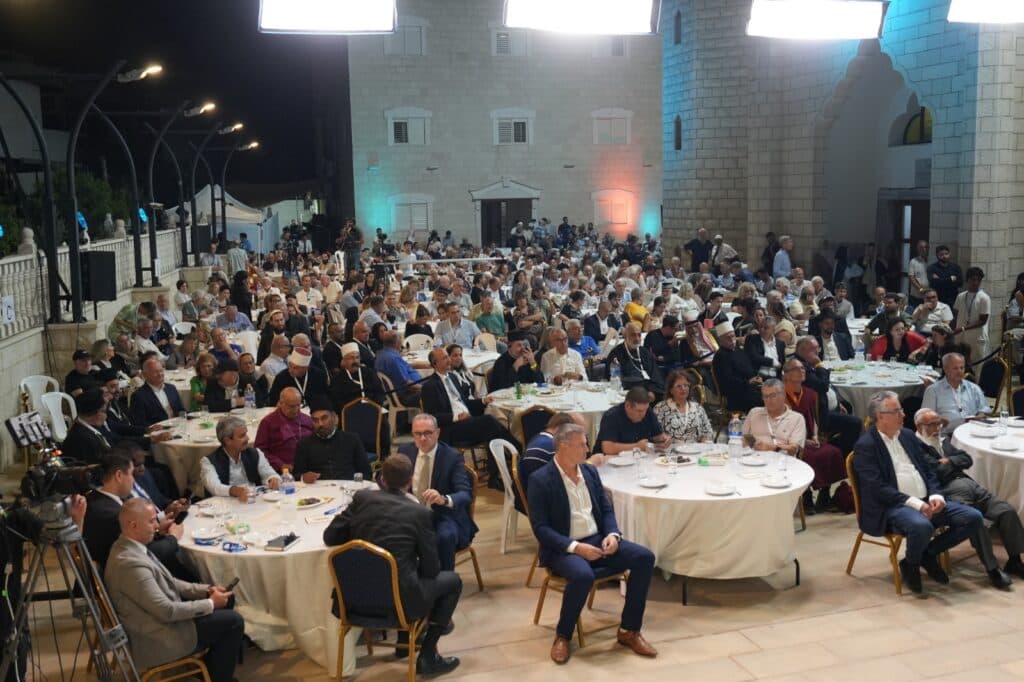
Jamaat-e-Ahmadiyya in the Holy Land held its 29th Jalsa Salana in Kababir, Haifa, on 17-18 September 2026. Around 1,300 people attended the two-day convention, including guests and delegations from Israel, the West Bank, Jordan and other countries.
The central theme of this year’s Jalsa was “The Charter of Medina: A Model of the Holy Prophet’s (sa) Relationship with the Jews”, examining the principles established by the Holy Prophet Muhammad (sa) in Medina and their relevance to contemporary societies.
Among the distinguished guests were the President of the State of Israel, the Mayor of Haifa, members of the Knesset, former mayors of Haifa, religious scholars, academics, cultural and social figures, ambassadors and other international guests.
The Charter of Medina and the question of citizenship
The Hebrew-language session was a highlight of the first day’s programme. Following a recitation from the Holy Quran, two addresses spoke about the historical background of the Charter of Medina and its relevance in the modern world. The first address presented the Charter as a model of shared citizenship, examining its historical foundations and the principles through which different communities could live together within a common social framework.
A strong reminder
The second address was delivered by Muhammad Sharif Odeh Sahib, Amir Jamaat-e-Ahmadiyya in the Holy Land. His address explored the Charter’s principles in relation to peace, justice and coexistence between Muslims and Jews. He began by asking whether another war could truly bring peace and security and whether violence, injustice and the denial of rights merely perpetuate cycles of hatred and destruction. He distinguished between a temporary peace imposed through force and a lasting peace founded upon mutual trust and justice. Quoting the Holy Quran, he reminded the audience:
“Let not a people’s enmity incite you to act otherwise than with justice. Be [always] just; that is nearer to righteousness.” (Surah al-Ma‘idah, Ch.5: V.9)
Amir Sahib then turned to the example of the Holy Prophet Muhammad (sa) in Medina. He emphasised that the Holy Prophet (sa) did not establish a religious state in which belief was imposed upon others, drawing attention to the Quranic principle, “There should be no compulsion in religion.” (Surah al-Baqarah, Ch.2: V.257)
He further cited the Quranic declaration, “Wherefore let him who will, believe and let him who will, disbelieve” (Surah al-Kahf, Ch.18: V.30), stressing that no individual has the right to impose his beliefs or way of life upon another.
He explained that the Islamic concept of citizenship is rooted in the recognition of the equal dignity of human beings. Citing the Holy Prophet’s (sa) teachings against racism and his declaration that human beings are equal, he connected these principles with the Ahmadiyya Muslim Jamaat’s slogan: “Love for All, Hatred for None.”
Amir Sahib also emphasised that justice is only the beginning. Beyond justice lies a higher moral standard in which a person may relinquish his own right for the sake of peace and ultimately show mercy without expecting anything in return. He illustrated this through the unconditional love of a mother for her child.
A message to both Muslims and Jews
Amir Sahib then spoke about the question of the land. Drawing upon the account of Abraham (as) in the Torah and the Quran, he argued that the question cannot be reduced simply to blood ties or ancestry. He pointed out that Abraham (as) was promised the land at a time when he had neither Ishmael (as) nor Isaac (as) and therefore both branches of his progeny are connected to the Abrahamic heritage. Yet, he stressed, blood ties alone are not sufficient. He cited the Biblical teaching that the righteous shall inherit the land (Psalm 37:29), alongside the Quranic declaration that God’s covenant does not extend to the wrongdoers. (Surah al-Baqarah, Ch.2: V.125)
Amir Sahib then addressed the Jewish audience directly, referring to Surah Bani Isra‘il and its prophecy concerning the gathering of the Children of Israel in the Latter Days. He presented the fulfilment of this prophecy as a sign that the Islamic scripture itself recognises the return of the Children of Israel to the land. His message to Muslims was equally direct: opposing what he described as God’s decree through continued violence would only bring further suffering and loss.
He then turned to the responsibilities accompanying the blessings of the land. Referring to the Torah, Amir Sahib noted that the Children of Israel are repeatedly warned concerning the treatment of the stranger. He quoted its command not to wrong or oppress the stranger, reminding the audience that the Israelites themselves had once been strangers in Egypt. (Exodus 22:20)
He further quoted the Torah’s teaching concerning “a full and just measure”, linking justice with the promise of long life upon the land. (Leviticus 19:35-36) He then placed this alongside the Quranic teaching: “And already have We written in the Book of David, after the exhortation, that My righteous servants shall inherit the land.” (Surah al-Anbiya’, Ch.21: V.106)
Amir Sahib stressed that the question of the Holy Land was also connected with responsibilities of justice, righteousness and the treatment of others.
The President addresses the Jalsa
The President of the State of Israel also addressed the gathering, speaking about the importance of meeting people of different faiths and commending the Ahmadiyya Muslim Jamaat’s efforts to promote peace, tolerance and Jewish-Muslim dialogue. He described the gathering as an example of people coming together despite differences and highlighted the value of dialogue that respects disagreement while seeking to bring people closer together.
His participation presented an opportunity for the Islamic message presented at the Jalsa to be heard directly by a broad audience from Israeli public life.
Voices from across Israeli society
The programme also brought together speakers from different religious and social backgrounds. Haifa Mayor Yona Yahav spoke about Haifa as a city where coexistence is not merely discussed but experienced as part of everyday life. Sheikh Tawfiq Halabi described the members of the Ahmadiyya Muslim Jamaat as a “bridge of peace and hope”, while India’s Ambassador to Israel, JP Singh, highlighted the Jamaat’s slogan and referred to the Jamaat’s historic roots in India.
A panel, titled “From Faith to Shared Responsibility: The Role of Religion in Establishing Peace”, brought together Muslim, Jewish and Christian religious figures. It was moderated by Professor Uriel Simonsohn of the University of Haifa. The panel discussed the responsibility of religious communities to protect human life and maintain dialogue during times of conflict.
A message beyond the historical example
The Jalsa’s concluding message clarified that the Charter of Medina was not being presented as a ready-made political formula to be mechanically imposed upon contemporary circumstances. Rather than viewing it as merely a historical document, its principles of justice, religious freedom and shared responsibility were discussed in relation to the challenges facing society today.
The speakers also stressed that coexistence does not mean agreeing on everything. People may disagree, but those disagreements should not lead to conflict. The discussions focused on how people with very different views can still live together with justice and mutual respect.
Impressions from guests
Several guests later shared their impressions of the Jalsa.
Dr Kamal Abdel-Malek, who had studied the Charter of Medina at McGill University in Canada, reflected on its contemporary relevance. He wrote:
“We studied this document at McGill University in Canada. How much our contemporary world needs such elevated teachings that call for coexistence and cooperation among human beings.”
Mahmoud Darwish of Palestine particularly appreciated the way Amir Sahib brought together Islamic and Jewish scripture in presenting universal moral principles. He wrote:
“You succeeded, as usual, in using texts from the Holy Quran, the Old Testament and the Psalms to establish the values of justice, mercy and human equality and to affirm the rejection of compulsion in religion.”
He also noted that the reference to Haifa itself strengthened the address:
“Citing the city of Haifa and the model of coexistence among its different communities added vitality and realism to the presentation.”
He further praised the emphasis on “Love for All, Hatred for None” and the concept of lasting peace founded upon mutual trust rather than force.
Dr Abdullah Kumail, Governor of Tulkarm in Palestine, offered a particularly direct response to the message, writing: “This is the correct approach. I agree with every word. I listened to it twice.”
Dr Muhammad Abu Rashid focused on the scale and organisation of the event and on the spirit with which it was conducted. Reflecting on its wider purpose, he expressed the hope that the effort would contribute “to easing tension and hatred between people and to helping us all choose the path of life, development and building a better future for all people.”
For filmmaker and television director Murad Nassar, the experience of the Jalsa extended from the smallest details of hospitality to the intellectual and spiritual content of the programme. He was particularly struck by the conduct of the volunteers, writing:
“What I saw can best be described as a divine organisation and providential care […] a complete system providing a genuine service without any mistakes, in complete calm, without showing any signs of fatigue or complaint from the team.”
He also praised the intellectual programme for its “organisation, order, calm, valuable information, transparency and complete freedom to ask questions.”
His reflection concluded with a broader appreciation of the spiritual character he perceived in the gathering: “You are an extraordinary phenomenon, giving lessons in your relationship with God and reliance upon Him.”
Bringing the message of Islam Ahmadiyyat to Arabs
The second day included a dedicated tabligh session for Arab guests. Speakers presented the beliefs of the Ahmadiyya Muslim Jamaat and the status of the Promised Messiah (as), followed by an extensive question-and-answer session which continued until the evening.
Media coverage in several languages
The Jalsa also received broad coverage from local television, radio and print media. Various outlets reported on the activities of the convention and conducted interviews with Muhammad Sharif Odeh Sahib and the missionary.
Television coverage included Makan, i24NEWS, Musawa, Kan and Hala TV, with coverage in Arabic, English, Hebrew and French. Newspapers and news websites including Haipo, Walla, Kul Al-Arab, Bukra, Panet, News of Haifa and the North and Davar1 also covered the Jalsa and its activities. Radio coverage included AshShams, An-Nas and Kan 11.
The coverage appeared in several languages, allowing the message and activities of the Jalsa to reach audiences across different linguistic and social communities.
From Kababir to the wider society
The Jalsa concluded with addresses on the Promised Messiah’s (as) love for his master, the Holy Prophet Muhammad (sa), the institution of Khilafat, contemporary challenges and the role of the Ahmadiyya Muslim Jamaat in promoting peace and security.
For the Ahmadiyya Muslim Jamaat in the Holy Land, however, the significance of the 29th Jalsa Salana extended beyond its two days. The gathering demonstrated how an Islamic convention can become a forum in which Muslims, Jews, Christians and people of other backgrounds meet without requiring uniformity of belief. The Charter of Medina provided the historical starting point. The central message was that justice, human dignity, freedom of religion, mutual respect and shared responsibility remain essential principles for societies seeking to live together despite profound differences.
In the Holy Land, where questions of religion, identity, citizenship and belonging are deeply intertwined, the Ahmadiyya Muslim Jamaat sought to place these principles before a diverse audience – not merely as historical teachings, but as subjects worthy of serious discussion in the present day.
The Jalsa thus became an occasion to present the message of Islam from the Holy Land itself: a message that calls for faith without compulsion, justice without discrimination, dialogue without surrendering conviction and peace founded upon respect for the dignity of every human being.