
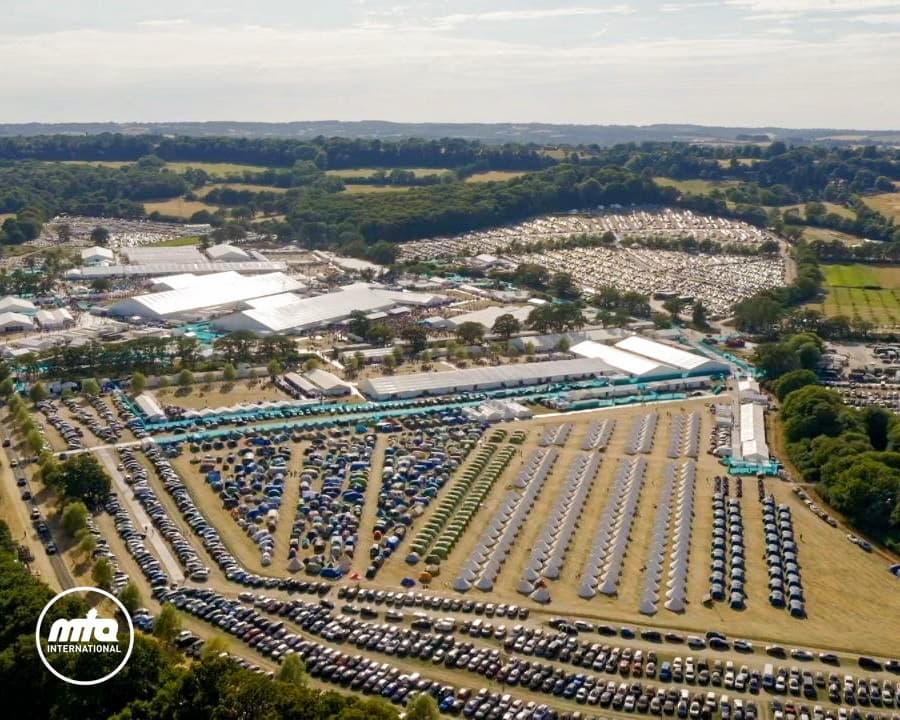
Looking back at the enormous success of Jalsa Salana UK this year, we bring you a brief overview of the activities and organisation of Jalsa Salana UK from the Lajna side.
The morning session on the second day of Jalsa always features a series of speeches delivered by members of Lajna Imaillah. This year’s Jalsa theme, “muhabbat-e-ilahi” (divine love), played an instrumental role in how the topics of the speeches were chosen.
The first speech, “The Life of the Holy Prophet (sa): Living Proof of Divine Love”, was delivered by Dr Maleeha Mansur Sahiba. Drawing upon the life of the Holy Prophet Muhammad (sa), she explained the many ways in which Allah the Almighty manifested His love for His beloved messenger and how the Holy Prophet (sa) reciprocated that love with complete devotion.
Dr Maleeha Sahiba observed that people often associate love with wealth, status or worldly influence. Yet the Holy Prophet (sa), orphaned at a young age and without worldly power, attained the highest rank through Allah’s love. She highlighted how Allah established his truthfulness among his people, who universally recognised him as the truthful and trustworthy.
Concluding her address, she encouraged attendees to emulate the Holy Prophet’s (sa) yearning for Allah, explaining that true success lies in following his perfect example so that believers may also become recipients of Allah’s Divine love.
Dr Fariha Khan delivered the next speech. Her Urdu address was titled “Attaining Allah’s Love Through Following the Holy Prophet (sa).” She began by reciting the Quranic verse: “Say, ‘If you love Allah, follow me: then will Allah love you and forgive you your faults. And Allah is Most Forgiving, Merciful.’” (Surah Aal-e-Imran, Ch.3: V.32)
Dr Fariha Sahiba explained that this verse establishes complete obedience to Holy Prophet (sa) as the means through which Allah’s love is attained. She reflected upon the Holy Prophet’s (sa) life before prophethood, noting that he already believed firmly in the Unity of God and was widely recognised for his honesty, integrity and trustworthiness. She described how he would withdraw to “Jabal an-Nur” (mountain of light) in search of his Creator, devoting himself to worship in solitude despite the hardship involved.
Even today, she observed, climbing the mountain presents a physical challenge despite modern facilities. Yet the Holy Prophet’s (sa) profound love for Allah enabled him to endure every difficulty in pursuit of communion with his Lord. Encouraging the audience to reflect upon these examples, Dr Fariha Sahiba reminded attendees that the Holy Prophet (sa) demonstrated that true closeness to Allah is attained through sincere worship and prayer, which he himself described as the delight of his eyes.
The final address of the session was delivered by Farzeen Qureshi Sahiba, who spoke on “Guided by the Light of Khilafat to True Islam.” Sharing her personal journey to Islam Ahmadiyyat, Farzeen Sahiba spoke movingly about the passing of her mother in 2001, which prompted her to reflect deeply upon faith and the purpose of life. At just seventeen years of age, she began questioning whether she had truly found the right path as a Muslim.
After meeting members of the Ahmadiyya Muslim Jamaat, she undertook extensive research into Ahmadiyyat, which ultimately led her to accept Islam Ahmadiyyat.
Following her conversion, she faced significant opposition and immense hardships. During this difficult period, she experienced a series of profound dreams and spiritual experiences relating to the Holy Prophet (sa), the Promised Messiah (as) and his khulafa, which she understood as signs from Allah the Almighty encouraging her to persevere. She explained that these experiences strengthened her faith and reassured her that she should continue steadfastly on the path she had chosen.
Although her decision brought significant opposition from members of her Sunni Muslim family, she explained that every hardship proved worthwhile, as Allah the Almighty continued to strengthen her faith and guide her at every stage of her journey.
International bai‘at

On 26 July 2026 – the third and final day of Jalsa Salana UK – the marquee was filled with thousands of women representing every corner of the globe, all waiting for the highlight of the Jalsa: the international bai‘at ceremony. Each had travelled a unique path to reach this moment, whether a physical journey across countries or a spiritual journey guided by Allah the Almighty towards Ahmadiyyat.
Among them was Molly Garnett, who was only moments away from entering Ahmadiyyat. This was her third Jalsa Salana UK. Her journey towards Islam began through her work supporting refugees. Drawn towards the faith, she spent the past two years learning about Islam, praying regularly and observing Ramadan. Now, she felt ready to take bai‘at.
Also awaiting the ceremony were Zulfata Salifu and Sophia Hamamat Yanful from Ghana, both attending Jalsa Salana UK for the first time. Although they participated in previous bai‘at ceremonies from Ghana by following Huzoor (aa) through MTA, this was the first time they experienced it in person.
No announcement was needed for silence to descend upon the vast marquee when Huzoor (aa) entered at 1:10 pm. Despite containing thousands of ladies, it became so still that even the smallest sound seemed magnified as the bai‘at ceremony began.
Traditionally, the bai‘at is recited first in English and then in Urdu. This year, however, the English recitation was repeated a third time to allow interpreters to translate into the many languages represented among those taking bai‘at across the world. Far from diminishing the atmosphere, each repetition only intensified it.
The ceremony concludes with a silent prayer led by beloved Huzoor (aa). Through the microphone, the emotion in his supplication is unmistakable, prompting quiet sobs throughout the main ladies’ marquee. Across the wider Jalsa Gah – in the Mothers and Children’s marquee, the First Aid tent and every other area – women raise their hands in prayer, tears falling as hearts unite before Allah the Almighty.
Exhibitions
The exhibitions department continues to be one of the most popular attractions at Jalsa Salana UK, offering guests and volunteers the opportunity to explore a diverse range of historical Islamic artefacts, learn more about Islam and participate in interactive activities. This year, 15 volunteers have been guiding Lajna members through the exhibitions, an increase from 10 volunteers last year.
Throughout the Ladies’ Jalsa Gah, long queues of thousands of women could be seen eagerly waiting to explore the various displays. One of the most popular new additions this year has been the Virtual Reality (VR) exhibition showcased by Waqf-e-Nau International, for which many visitors queued for over an hour.
The VR experience allows guests to take a virtual tour of Qadian. Wearing a headset, visitors are immersed in exploring the historic town while listening to an audio narration describing significant locations, including Darul Aman, Baitul Dua and the blessed grave of the Promised Messiah (as).
The beauty and historical significance of Qadian were further showcased through a detailed 3D model of the city, recreated according to the original blueprints documented by Hazrat Mirza Bashir Ahmad sahib (ra) and shown at the Ahmadiyya Archive and Research Centre (ARC) exhibition.
Remarkably, the model was not constructed in a factory or workshop but in the home of a young member of Lajna Ima’illah over the course of almost three months before Jalsa Salana. Reflecting on the project, the creator said:
“Building this model became my own way of connecting with it. As I recreated every street and every little detail, I found myself appreciating it even more. The stories and memories of Qadian that beloved Huzoor (aa) shares now feel even more meaningful to me because I’ve taken the time to understand the place where they unfolded. This is precisely what I kept in mind while creating this model. I pray and hope that everyone can connect with Qadian in the same way, insha-Allah.”
Drawing upon her background in graphic design, the mother of two painstakingly assembled every aspect of the model. Each wooden component was laser cut, the pools of water were handcrafted using resin, and every tree and piece of greenery was individually placed by hand. The finished model not only preserves a rich legacy of Islamic history but also highlights the remarkable capabilities and dedication of Ahmadi women.
The exhibitions department has also provided engaging activities for children. Interactive explorer sheets encourage young visitors to search the exhibitions for answers to questions such as, “Which pioneer Muslim woman was a librarian?” Children who complete the activity are rewarded with a sticker.
Children’s name tags
The Children’s Name Tags department performs a vital role across the Ladies’ Jalsa Gah by providing children with wristbands displaying their mother’s name and contact details.
Given the vast size of the Jalsa site and the thousands of attendees present, it can be easy for children to become separated from their families, creating distress for both mother and child. This department therefore provides reassurance to mothers, enabling them to participate in Jalsa Salana with greater peace of mind, knowing that if their child becomes lost, they can be reunited quickly and efficiently.
On the first day alone, approximately 700 wristbands were issued. The initiative was also promoted in advance of Jalsa Salana UK through Lajna auxiliary groups.
Amenities
The amenities department serves as a welcoming space for ladies attending Jalsa, providing a wide range of practical facilities and support, particularly for mothers and elderly guests. Facilities include seating areas, drinking water, milk for mothers, emergency provisions like needles and thread for clothing repairs, charging ports, car pumps in case of tyre deflation and female hygiene products.
The department also offers a private nursing area where mothers can feed their children in comfort while young children rest. In addition, there is a snack corner catering for mothers, children and those with specific health or dietary requirements, including low blood pressure, high cholesterol or other dietary needs. Seventeen duty holders served within this department, expressing a heartfelt desire to serve the guests of the Promised Messiah (as) in every possible way.
Nappy changing
With so many mothers and young children attending the Jalsa, dedicated nappy-changing facilities remain an essential service. This department provides mothers with a hygienic, private and comfortable environment to change their children’s nappies.
A notable addition this year has been an adjacent marquee specifically designated for SEND children and elderly guests requiring changing facilities. This thoughtful provision caters to individual needs while promoting privacy, dignity and inclusivity across the Ladies’ Jalsa Gah.
New converts
The New Converts department provides a welcoming and supportive environment for those who have recently embraced Ahmadiyyat. Volunteers assist new members in navigating Jalsa Salana while providing opportunities to meet others, ask questions and strengthen their understanding of Islam Ahmadiyyat.
The marquee is filled with faith-inspiring accounts as converts share the journeys that led them to join the Jamaat, with one lady explaining that she witnessed the humanitarian efforts of Humanity First in Gaza last year, which deeply inspired her and ultimately led her to accept Ahmadiyyat.
Many new converts also expressed their appreciation for the exhibitions, particularly those showcasing the history of Islam Ahmadiyyat and the devotion of individuals who dedicated their lives to the service of faith.
Bookstall
The bookstall caters to both Lajna and Nasirat, offering a wide selection of literature including children’s books, children’s audiobooks and educational flashcards. A distinctive feature is the collection of books written and published by Lajna Imaillah, which are available exclusively at the Lajna bookstall.
The significance of the bookstall was further underscored following Hazrat Khalifatul Masih V’s (aa) address to Lajna on Saturday, in which Huzoor (aa) emphasised the importance of increasing religious knowledge. In the wake of this address, many women visited the bookstall, seeking to act upon Huzoor’s (aa) blessed instruction by purchasing literature to further their religious knowledge. The bookstall thus became not only a place to acquire books, but also a means through which Lajna could respond practically to the guidance of their beloved Imam.
Visitors are drawn to the bookstall for many different reasons. Some seek to strengthen their faith, others wish to begin learning as new Ahmadis, while many simply enjoy reading or discovering new books with family and friends. Regardless of their motivation, all are united by a shared desire to increase their knowledge.
Recognising the diverse backgrounds of attendees, the Bookstall also offers literature in multiple languages, enabling those facing language barriers to access knowledge that might otherwise be less readily available.