
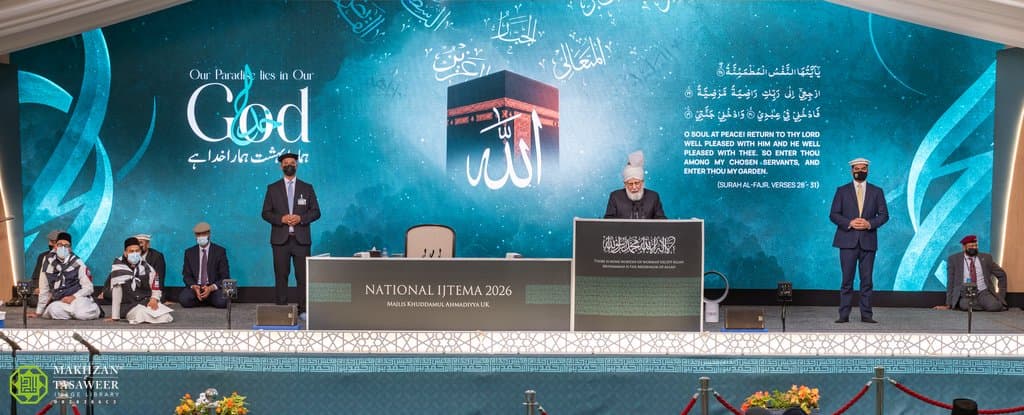
This year’s annual ijtema of Majlis Khuddam-ul-Ahmadiyya UK was held on 25-27 September 2026 at Hook Lane, Puttenham in Guildford. On its final day, Hazrat Mirza Masroor Ahmad, Khalifatul Masih V (aa), graciously chaired the final session and delivered an address to formally conclude the ijtema.
At 3:16 pm, Huzoor (aa) raised the flag of Majlis Khuddam-ul-Ahmadiyya and made his way into the marquee to lead Zuhr and Asr prayers. The session began at 3:49 pm with the recitation from the Holy Quran (Surah an-Nur, Ch.24: V.36-39) along with its English translation. Hazrat Khalifatul Masih V (aa) then came to the podium and led all those present in taking the Khuddam-ul-Ahmadiyya pledge. Afterwards, an Urdu poem written by the Promised Messiah (as) was presented as well as its English translation. (Surma Chashm-e-Arya, Ruhani Khazain, Vol. 2, p. 52)
Huzoor (aa) then asked Farhad Ahmad Sahib, Sadr Majlis Khuddam-ul-Ahmadiyya UK, to present the ijtema report. Sadr Sahib said that the theme for this year’s ijtema, graciously given to them by Huzoor (aa), was “Our Paradise Lies in Our God”.
He then mentioned key highlights of the ijtema, which included exhibitions, interactive quizzes and education games. There was also a live audience voting for tilawat, nazm and speech competitions. The total attendance at this year’s ijtema was 8,138. After thanking all the volunteers and khuddam who helped make the ijtema successful, Sadr Sahib expressed his gratitude to Hazrat Khalifatul Masih V (aa) for honouring the event with his presence and for his continuous prayers.
Thereafter, a short video presentation was shown to Huzoor (aa) with highlights of the ijtema. Naib Sadr Sahib Majlis Khuddam-ul-Ahmadiyya UK was called to announce the Alam-e-In‘ami prize for Atfal-ul-Ahmadiyya and Khuddam-ul-Ahmadiyya, which Huzoor (aa) awarded to the winning qiadats.
At 4:15 pm, Hazrat Khalifatul Masih V (aa) took to the podium to address the khuddam. A brief summary of this address is as follows:
Huzoor (aa) stated that khuddam are of an age where they attain a good standard of education, acquire skills and enter professions that can be directly harnessed for the service of the Jamaat and humanity. Although having an education or gaining skills is very important, they must always remember the success of divine religious communities is not contingent on the capabilities of its members. Rather, it is contingent upon the grace of Allah and its members acting with taqwa (righteousness) and establishing a close bond with Allah the Almighty.
Here, naturally, the question arises: “how does a person attain the nearness of Allah?” Huzoor (aa) answered that it requires a person to fulfil the rights of Allah’s worship, to act upon His commands and to discharge the rights of mankind. Huzoor (aa) stated that a religious community cannot move forward and attain success if its members are weak in this regard.
Recognise your good fortune
As Ahmadis, we must never underestimate how fortunate we are to have been born and raised in this blessed era of the Promised Messiah (as) whose advent was foretold by Allah the Almighty. The Holy Prophet (sa) also prophesied that the initial rise and advancement of Islam would be followed by a sustained period of religious decline. During this time, countless pious people fervently prayed and desperately searched for the prophesied Messiah so that they may accept him and serve his mission. Yet they came and left this world without finding what their hearts yearned for.
Ahmadis are those fortunate people who have recognised the one foretold in these prophecies and have pledged their allegiance to him. At the same time, this immeasurable blessing carries a profound responsibility. Having taken the bai‘at of the Promised Messiah (as), we have pledged to always give precedence to our faith over all worldly matters. It requires us to obey the commands of Allah, His Messenger (sa) and the Promised Messiah (as) and to set a noble example of peace and compassion before the world.
As Ahmadis, we must regularly reflect upon the ten conditions of bai‘at so that our faith becomes stronger and so we may fully grasp our religious duties. Huzoor (aa) stated that he shall focus on two specific conditions of bai‘at in his address.
Offering Salat saves one from sin and evil
Huzoor (aa) stated that a faith that is bereft of the worship of Allah and a connection with Him is no faith at all. Thus, if a person claims to be a Muslim yet fails to fulfil the rights of Allah’s worship, their claim remains hollow and nothing more than empty words.
The paramount form of worship is set forth in the third condition of bai‘at which states that he or she shall offer the five daily prayers without fail in accordance with the commandments of Allah the Almighty and the Holy Prophet Muhammad (sa). With regard to Salat, Allah the Almighty says in the Holy Quran:
“Surely, Prayer restrains [one] from indecency and manifest evil.” (Surah al-‘Ankabut, Ch.29: V.46)
Elaborating on this, the Promised Messiah (as) states:
“Salat is such a virtue through which satanic weakness is eliminated and this is what is called true prayer and supplication. Therefore, Satan desires for a person to exhibit weakness in Salat because he knows that to whatever extent a person is able to reform, it will be through this means.” (Malfuzat [Urdu], Vol. 4, p. 59)
Regarding the blessings of Salat, the Promised Messiah (as) further says: “Keep the love and majesty of Allah forever flowing in your hearts. For this, there is no greater means than namaz.” (Ibid., p. 61)
How to pray before Allah
He explains that while other forms of worship, such as fasting and paying Zakat, are essential, Salat is supreme because the period of fasting in Ramadan lasts for just one month in a year, while Zakat is obligatory only for those with sufficient wealth in a year. Salat, however, is a universal obligation – something that every person, regardless of their circumstances or status, is required to offer five times a day.
The Promised Messiah (as) thus emphasised that Salat must be offered with intense concentration and a firm conviction that one is standing before that All-Powerful Being who can answer and accept prayers instantly if He so wills. While worldly leaders are constrained by finite resources and remain always in fear that their treasuries may become depleted, the treasury of Allah is limitless and can never be exhausted. (Ibid., pp. 61-62)
Thus, perform your prayers with complete conviction, trust in Allah and with absolute humility instead of just repeating the words out of habit.
However, it should also be remembered that the acceptance of prayer is conditional – we must first obey His commands. If one is not acting upon Allah’s commands, then complaining that Allah does not hear their supplications is a baseless and unjust allegation against Him. Allah responds favourably to those who pray with a firm belief in His supreme power and who realise that if they ignore His commands, their prayers will be worthless and even a means of His displeasure.
Regarding the power of prayer, the Promised Messiah (as) said, “It is a well-known truth that namaz is a powerful instrument for safeguarding a person from sin. It is the intrinsic quality of namaz that it repels a person from sin and immorality.” (Malfuzat [Urdu], Vol. 4, p. 232)
Salat is vital for faith
Many people offer the excuse that their busy schedule and demanding workloads make it difficult to perform prayer at the prescribed times. Huzoor (aa) stated that the Promised Messiah (as) once recalled an incident when a group of new converts to Islam sought the permission of the Holy Prophet (sa) to be exempted from Salat, he replied that faith without worship is no faith at all. Elaborating on this, the Promised Messiah (as) said, “What is namaz? It is to submit with complete humility your weaknesses and frailties before Allah and seek His help to fulfil all of your needs.” (Malfuzat [Urdu], Vol. 4, p. 340)
Regarding how to pray, the Promised Messiah (as) says, “A supplicant should praise Allah by proclaiming His greatness and majesty in order to bring forth His mercy. We often see that when a person wants help from someone, they offer praise to win their favour. Similarly, when we seek Allah’s help, we should praise Him in order to draw His mercy.” (Ibid.)
The Promised Messiah (as) states: “Man is utterly needy and dependent on the grace of God; he should continually seek the pleasure of Allah the Almighty.” (Ibid.) He further says only through His grace and mercy can a person accomplish anything. So a person should pray that, “O Allah, grant us the ability to become wholly Yours. May we walk only on the path that leads to Your pleasure and favour and may Your love enter our hearts.” (Ibid., p. 341)
The Promised Messiah (as) continues by saying that the person who seeks to free himself from Salat is no better than an animal as he spends his life eating, sleeping and pursuing vain desires. That is not faith – it is the way of the disbelievers. Thus, a true believer can never be negligent in fulfilling the rights of Allah.
Allah says in the Holy Quran: “Therefore remember Me, and I will remember you; and be thankful to Me and do not be ungrateful to Me.” (Surah al-Baqarah, Ch.2: V.153)
The Promised Messiah (as) elaborates on this verse by stating that Allah will never abandon those who remain engaged in His remembrance and who remain ever grateful to Him. He will always care for and protect such people and fulfill their needs. Conversely, neglecting Allah’s remembrance and exhibiting ingratitude are indicative of disbelief. (Malfuzat [Urdu], Vol. 4, p. 341)
The five daily prayers are the bare minimum of what is required. Otherwise, a true believer should remember Allah at all times so that he may be inspired to give precedence to his faith over all worldly matters. Only then will he recognise that Allah is watching his every deed and abstain from violating His teachings and commands.
Allah promises that if a person reaches this spiritual state, their Salat and remembrance of Allah shall protect them from all forms of indecency and immorality. Thus, Salat offered with true devotion becomes a powerful catalyst for moral reformation. It shields believers from the worldly vices and temptations that surround us, whether online, on television, across social media or anywhere else.
Pay attention to Salat despite worldly distractions
Generally, young people enjoy good health and physical vigour, so khuddam cannot plead physical infirmity or frailness as an excuse to avoid going to the mosque. Thus, offer your prayers in congregation at all possible times. If there is no one else to pray with, you should still offer your prayers at the correct times. If your intention is pure, Allah can bestow upon you the same reward as those who pray in congregation, since the Holy Prophet (sa) taught that deeds are judged by intentions.
In this day and age, many are becoming consumed by worldly pursuits, so it is important to pay special effort to our prayers and fulfil the rights of Allah’s worship as observing prayer is the very foundation of faith. The Holy Prophet (sa) said that on the Day of Judgment, Salat will be the first thing Allah calls us to account for. If a person’s record in prayer is complete, they will succeed and attain salvation. However, if their record is deficient, they will fail and suffer the consequences of that failure. (Tirmidhi, Kitab as-salat, Hadith 413)
In today’s world, wherever one turns, he is confronted with widespread immorality and vice. To shield yourself from these influences, you must prioritise worshipping Allah above all else. Otherwise, the world is hurtling rapidly towards an ever deeper moral decay – those who fail to protect themselves from such corruption will incur Allah’s displeasure.
On one occasion, the Promised Messiah (as) said, “O ye people who consider yourselves members of my community! You will be counted as such in heaven when you truly tread upon the ways of righteousness. So, offer the five daily prayers in such fear and with such complete attention as though you were actually beholding God Almighty.” (Noah’s Ark, pp. 24-25)
How to find pleasure in Salat
People sometimes struggle to find pleasure or devotion in prayer. This is why the Promised Messiah (as) instructed that when we pray, we should acknowledge our weaknesses, the fleeting nature of this world and recognise that we shall all return to Allah. He taught that we must continuously pray that Allah does not take us from this world while we remain spiritually blind and ignorant of His mercy, grace and majesty.
Thus, we should plead with Allah to bestow our hearts with such a flame of divine light that it may become filled with love and longing for Him. If one worships and supplicates in this manner, those prayers that once felt like a mere formality or burden will be infused with spiritual light. And that light shall ignite a profound emotion, divine love and pure joy within one’s worship. (Malfuzat [Urdu], Vol. 3, p. 481)
Therefore, from a young age, ensure that five daily prayers remain your constant and lifelong companion. Huzoor (aa) stated: “Never assume that you are too young or that you have many years ahead to build your connection with Allah. Instead, I hope and pray that every one of you departs from this ijtema with a firm resolve to strengthen your bond with your Creator and to worship Him with unwavering sincerity and devotion.”
Obedience to Khilafat
Huzoor (aa) also drew attention to the tenth and final condition of bai‘at, which states that those who enter into a bond of brotherhood with the Promised Messiah (as) must pledge obedience to him in everything good and remain faithful to it until their death. Huzoor (aa) stated:
“This bond of fidelity and brotherhood is no ordinary bond. Rather, it is a means of demonstrating that we have accepted that Messiah and Imam Mahdi who has been sent to the world by Allah according to His promise and according to the prophecies of the Holy Prophet (sa).”
Huzoor (aa) further stated, “If a person is sincere in this pledge, their connection with the Jamaat will naturally grow stronger and they will be shielded from negative thoughts and satanic influences. Their faith in the Promised Messiah (as) and Khilafat-e-Ahmadiyya will always remain firm and resolute, even if they observe shortcomings in certain office bearers or individuals, it will neither shake their faith nor turn them against the Jamaat or the Promised Messiah (as).”
What does ‘ma‘ruf’ mean?
The Quran requires a believer to obey all “ma‘ruf” decisions of a prophet or his successor, i.e., any instruction or decision based upon the command of Allah, the teachings of the Holy Prophet (sa) and the Holy Quran must be obeyed. Naturally, every decision of the Promised Messiah (as) is ma‘ruf because he was the most devoted follower of the Holy Prophet (sa). Neither he nor his true successors could ever direct mankind towards anything that departs from goodness and truth.
Hazrat Khalifatul Masih I (ra) observed that some people mistakenly assume that if an order appears wrong in their estimation, they are free to reject it. But if all members of the Jamaat take this attitude and decide for themselves what is ma‘ruf, the unity of the Jamaat will break down and obedience will become impossible to achieve.
He explained that the word ma‘ruf has been used in the Holy Quran in relation to the Holy Prophet (sa) and the believing women who took his bai‘at. In this regard, Hazrat Khalifatul Masih I (ra) asked whether the women mentioned in the verse had formed (God forbid), a list of faults or mistakes of the Holy Prophet (sa) that they would not obey? Clearly not. Similarly, the Promised Messiah (as) has used this term in the condition of bai‘at which means that all those who take the bai‘at are bound to obey all of his instructions and those of the Khalifa of the time. (Khutbat-e-Nur, pp. 420-421)
Regarding the limits to obedience, the Holy Prophet (sa) stated that if a leader is appointed over a people and he gives an instruction that is contrary to the commands of Allah or against the teachings of the Holy Prophet (sa), it should not be implemented. However, in our Jamaat, with the grace of Allah, we are blessed with the institution of Khilafat-e-Ahmadiyya and the Khalifatul Masih will never give an instruction that contravenes the Shariah.
Where Khilafat is mentioned in the Quran, Allah states in one of the verses that:
“And they swear by Allah their strongest oaths that, if thou command them, they will surely go forth. Say, ‘Swear not; [what is required is actual] obedience in what is right. Surely, Allah is well aware of what you do.’” (Surah an-Nur, Ch.24: V.54)
In this verse, Allah states that there is no value in just making empty vows or swearing oaths. Here at the ijtema and at other events, our members recite emotional poems or nazms, expressing their loyalty and making grand proclamations of faith. However, proclamations on their own are meaningless. What actually counts is obedience in practice.
Responsibilities of Khuddam-ul-Ahmadiyya
Huzoor (aa) said that it is the promise of the Holy Prophet (sa) that the Khilafat of the Promised Messiah (as) shall endure so long as his followers continually seek to excel in taqwa and remain obedient to what is good and are ever ready to defend and uphold the true teachings of the Holy Prophet (sa) of Islam. Only then can we truly claim to be living in accordance with the teachings of Islam.
Huzoor (aa) stated:
“Therefore, as members of Khuddam-ul-Ahmadiyya who pledge to be ready for every sacrifice to protect and safeguard Khilafat, you must especially strive to understand and act upon the guidance of the Promised Messiah (as) – and in this era – the directive of the Khalifa of the time. Every step you take must lead towards righteousness and draw you ever closer to Allah [the Almighty].
“The means of achieving this lie in observing taqwa, fulfilling the rights of Allah [the Almighty] and the rights of His creation and discharging the solemn demands of your bai‘at. […] At the end, I pray all of you recognise that it lies upon you to be at the forefront of bringing about a true and everlasting spiritual revolution in the world and to live your lives as faithful and devoted servants of the Promised Messiah (as) and bring the world under the banner of the Holy Prophet (sa). May Allah [the Almighty] enable all of you to rise to this noble challenge. Amin.”
Then, Hazrat Khalifatul Masih V (aa) led everyone in silent prayer and the ijtema concluded.