
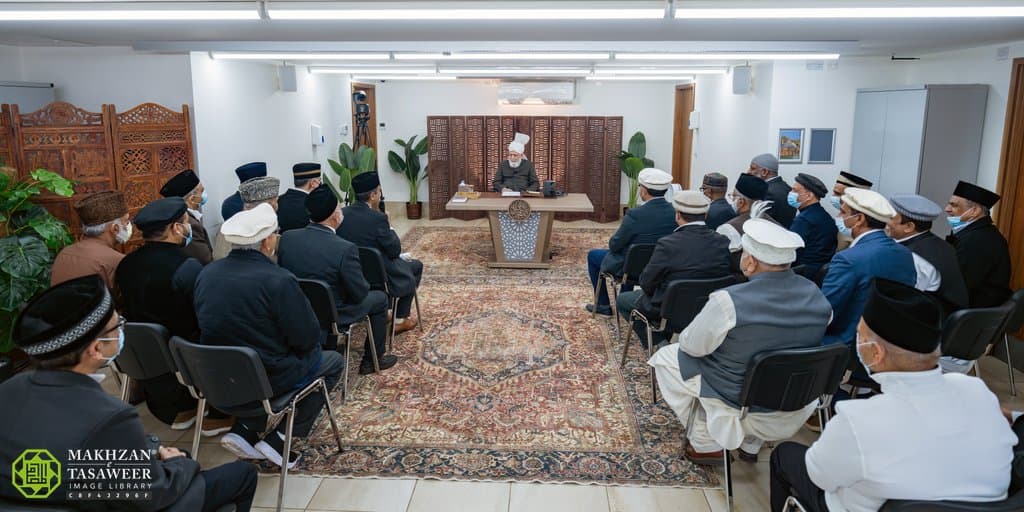
Islamabad, Tilford, UK, 6 April 2026: A delegation of ansar from the Central East Region of the United States had the honour of a mulaqat with Hazrat Mirza Masroor Ahmad, Khalifatul Masih V (aa).
During the mulaqat, the ansar had the opportunity to introduce themselves and present various questions before Huzoor (aa), seeking guidance on a range of matters. In the course of these introductions, Huzoor (aa) also briefly spoke with some of them regarding their responsibilities and efforts in Jamaat service.
One nasir mentioned that he had recently been appointed to serve in the Tabligh Department at the local level. Upon hearing this, Huzoor (aa) remarked that one’s target should be a strong one. When the nasir mentioned that he had only been appointed around two months earlier, Huzoor (aa) said that within two months he should already have prepared a full plan so that the remaining 10 months could then be spent implementing it. Huzoor (aa) further emphasised that the task was to convey the message to every person; whether others accepted it or not was their own choice. Huzoor (aa) added that the work of tabligh needed to be made more active and that there was a great need for this.
Another nasir mentioned that he was serving in the External Affairs Department. Huzoor (aa) asked whether he was in contact with politicians, councillors, congressmen and senators and whether they attended Jamaat functions. When the ansar explained that such contacts did exist and that political representatives had also attended a recent iftar event, Huzoor (aa) asked about the nature of their response. The nasir explained that the response had been better before Covid-19, but that efforts were now being rebuilt and relations were improving again.
Another nasir from Central Jersey mentioned that he ran a business and that much of his day-to-day effort was devoted to tabligh. He explained that he operated a billboard truck through which, by the grace of Allah, the message was being conveyed daily to around 20,000 to 25,000 people. Huzoor (aa) prayed that Allah the Exalted place blessings in this effort. On hearing that the wider population of the area was around four to five million, Huzoor (aa) observed that if 25,000 people were being reached each day, this amounted to around 750,000 in a month and approximately 8.4 million over the course of a year. Huzoor (aa) remarked that by now the message should have reached the whole population of the area and that everyone ought to know the message of Islam and Ahmadiyyat.
This was followed by a question-and-answer session.
Guidance on moral training and the issue of delayed marriages
One nasir asked how members of Majlis Ansarullah should guide children who were delaying marriage or refusing it altogether.
In response, Huzoor (aa) said that he had repeatedly given guidance on this matter and explained that the issue should be addressed from the perspective of parents. Huzoor (aa) stated that children should be given moral training from a young age and referred to the example of Hazrat Nusrat Jehan Begum (ra), who would advise even very young girls to start praying for a pious match.
Huzoor (aa) explained that when parents provide proper moral training from an early age, children come to understand their responsibilities and also begin praying regarding their future. In some cases, highly educated girls are unable to find suitably matched boys, while boys, owing to their own expectations and the excessive freedom of modern society, may develop unrealistic demands and reject many potential matches.
Huzoor (aa) said that ansar should focus on the moral training of their households. He added that this process should begin from the age of Khuddam-ul-Ahmadiyya and continue thereafter, so that young people may properly recognise their responsibilities. Huzoor (aa) also pointed out that, for this reason, Markaz has appointed more than one Secretary Rishta Nata in various jamaats and that Rishta Nata committees have also been formed, comprising representatives from Ansarullah, Lajna Imaillah, Khuddam-ul-Ahmadiyya and the Jamaat administration. If all such office-bearers and bodies work together in a spirit of cooperation and collaboration, Huzoor (aa) said, much good work can be achieved.
Nevertheless, Huzoor (aa) emphasised that the most important factor remains moral training within the home. Parents, he said, should help their children realise their responsibilities from an early age. Referring to the wider environment in the West, Huzoor (aa) observed that children attend colleges and universities where the atmosphere is very open and free, while parents are often preoccupied with their work and livelihood and therefore fail to spend sufficient time with their children. Huzoor (aa) remarked that many ansar may now be retired and able to give time to their children, but perhaps were not able to do so in earlier years. Even so, if they had succeeded in helping their children understand these matters from a young age, that would have been beneficial.
Huzoor (aa) also addressed the issue of marrying outside the Jamaat, noting that sometimes both boys and girls wish to do so. In such cases, Huzoor (aa) explained, permission is at times granted if the proposed spouse is Muslim and that such permission is often given. However, he stressed that the Ahmadi party must remain firm in its faith. If proper moral training has been given and faith has been accorded due importance, then such problems do not usually arise.
Huzoor (aa) said that these kinds of issues arise in many places and urged the ansar to pray and also work actively in this regard, adding that this too formed part of the duty of Ansarullah.
Preserving the sanctity of the mosque and its premises
Another nasir asked about the practice, common in some mosques in the United States, of setting up fundraising activities on mosque property. He explained that while such stalls were not placed in the main prayer area, they were sometimes set up in overflow prayer spaces and halls, especially during the winter months.
Huzoor (aa) instructed that where there is an actual prayer hall in a purpose-built mosque, such arrangements should not be made there. However, if there is a room, lobby or some separate outer space, arrangements may be made there for the collection of donations. Huzoor (aa) also said that if people are arriving for salat and a fundraising setup has been placed in the mosque at that time, this should not be done.
Referring to the practice of non-Ahmadi Muslims, Huzoor (aa) observed that in many of their mosques, donation boxes are placed outside and worshippers place their contributions in them as they leave. Since in the Jamaat there is also a need to issue receipts, Huzoor (aa) said that notices or posters may be placed at the entrance or on the outside walls, encouraging donations. However, he made clear that tables should not be placed inside the mosque for the collection of donations, except perhaps on a particular occasion that has been specially organised and not during prayer times and even then only very briefly.
When it was clarified that the question related to bazaar-like setups, such as ladies’ stalls for henna, bangles and clothes, Huzoor (aa) stated plainly that such activities were not permissible inside the mosque. He said that if such arrangements were to be made, they should be made within the mosque premises but outside the mosque building itself. If the weather were cold during winter, Huzoor (aa) said that a small tent, gazebo or some other arrangement could be made outside instead.
Huzoor (aa) reiterated that if there is an outer area or courtyard, such things should be kept there. He further stated that even when the matter concerns mosque donations, the system of physical collection should remain outside. Announcements, however, may be made where they relate to religious service, because the general principle is that worldly announcements are not to be made in mosques. Huzoor (aa) explained that if ordinary worldly announcements are not permitted in a mosque, then conducting business there is likewise not permissible. (Jami‘ at-Tirmidhi, Kitab an-nahyi ‘ani l-bay‘i fi l-masjid, Hadith 1321)
Guidance on organised economic support and professional mentoring
A nasir asked how Ahmadis in the United States could establish systems of collective economic cooperation and guidance, similar to those seen in other communities, while remaining in harmony with Jamaat values and Islamic principles.
In reply, Huzoor (aa) said that this was one of the very purposes for which the department of Sanat-o-Tijarat had been established in the Jamaat as well as in the auxiliary organisations. Huzoor (aa) explained that such departments should organise this work properly and maintain complete data regarding members of the Jamaat, including which skills they possess, which professions they belong to and what kind of work they do.
Huzoor (aa) said that, on this basis, proper counselling and guidance should be provided to those who are newcomers so that they may be directed towards suitable fields of study and professions in which they could succeed. Likewise, if some among the newcomers are educated and are to be guided towards business, they should be advised regarding those forms of business that are more suitable in that environment and are likely to produce good results.
Huzoor (aa) further stated that where there are experienced professionals and knowledgeable individuals within the Jamaat, they should be asked to help guide and advise others. As for financial assistance, Huzoor (aa) said that if funds are not available on a large scale, then at least a limited number of people may be helped with small amounts so that they can begin a small business. Beyond this, they may also be guided regarding how to obtain financing through banks or other agencies and how such loans may be repaid in a manageable way over time. Huzoor (aa) emphasised, however, that such matters should not be pursued in an overly high-risk manner that could later lead people into serious financial difficulty or liquidation.
Making the years after retirement beneficial
A nasir asked what advice Huzoor (aa) would give regarding the best way to spend time after retirement, especially since many ansar of Asian background do not tend to have hobbies.
In reply, Huzoor (aa) remarked that most such people do not truly retire in any case and often continue working for as long as they remain physically able. He further observed that in America, many people cannot really afford to retire in the same way as they might in some other countries, because the kind of social support available elsewhere is not present there to the same extent.
Huzoor (aa) said that ansar should consider each person’s individual interests and capacities and then utilise such people in Jamaat work accordingly. If a person is free and has a source of income, Huzoor (aa) said, then he may use that freedom sensibly for the benefit of his household and in the service of faith. Where homes have become fully paid off and there is no mortgage or similar burden, some may be in a position to devote more time. Others may even choose to move to a smaller house if circumstances require it.
In any case, Huzoor (aa) said that if someone is no longer able to perform physical work but can still undertake light intellectual, administrative or desk-based tasks, the Jamaat should assign such work to him so that he remains engaged. If a person possesses knowledge and expertise, Huzoor (aa) suggested that he could be given responsibilities such as translation work. Referring to the committees that had been formed, Huzoor (aa) said that one of their purposes was precisely to consider how the abilities of elderly members could be properly utilised.
Huzoor (aa) added that extensive guidance had already been given in previous years regarding the need to spread the true message of Islam Ahmadiyyat more widely. He said that if elderly members can do little else, they can at least take part in such work, since it is a matter of spiritual reward and preparation for the next life. Having earned what they needed to earn for this world, Huzoor (aa) said, they should now use the additional years granted by Allah the Exalted in a correct and beneficial manner for the service of faith.
Artificial Intelligence and the limits of reliance in medicine
A doctor then sought guidance regarding the growing use of Artificial Intelligence in healthcare. He explained that as an infectious disease specialist, he increasingly encountered situations in which patients consulted AI and then challenged a doctor’s diagnosis or prescription, even to the extent of questioning whether an antibiotic was correct or needed at all.
Huzoor (aa) responded by drawing attention to the fact that Artificial Intelligence itself is fed by human beings, including doctors and specialists and therefore does not possess any independent wisdom of its own. He pointed out that even within the medical profession, different specialists may suggest different courses of treatment for the same illness. Thus, disagreement is not something unique to AI, but part of the reality of human expertise as well.
Referring to the period of Covid-19, Huzoor (aa) remarked that many medical professionals advocated particular injections and treatments and that some companies appeared to have acted primarily for profit. He observed that public reaction later developed against some of those measures, particularly where side effects and complications became apparent. Yet, Huzoor (aa) noted, the medical profession often responds by saying that a treatment worked successfully for a high percentage of people and that unfavourable outcomes affected only a smaller proportion. Even where more than 70% of results are considered professionally promising, Huzoor (aa) indicated that the smaller percentage of adverse outcomes often creates the louder public reaction, while those who experienced benefit remain silent. He further noted that even within the medical field, some doctors themselves opposed such measures.
Turning specifically to AI, Huzoor (aa) said that its limitations had also been demonstrated in religious questions. He referred to an instance in which a question had been fed into AI and it produced an answer based on a hadith reference. When it was then challenged and told that the relevant hadith in fact contradicted its conclusion, it admitted that its answer had been wrong. Through this, Huzoor (aa) illustrated that AI can produce an answer and then accept the opposite when challenged, which shows that it cannot be relied upon uncritically.
Huzoor (aa) said that doctors should explain to patients that AI does not possess the full clinical picture. It does not examine the patient, nor does it necessarily have access to all the laboratory tests, scans and other investigations on which a diagnosis is based. He also observed that modern medicine itself now relies heavily on diagnostic tests such as blood tests, urine tests, MRIs and scans, whereas in earlier times, doctors often diagnosed illnesses more directly through close examination of symptoms. Huzoor (aa) mentioned older physicians and also referred to Hazrat Khalifatul Masih I (ra), regarding whom it is mentioned that he could often identify illness through the pulse alone.
By contrast, Huzoor (aa) said, contemporary doctors should tell patients that their recommendations are based on actual clinical examination and medical tests, while AI may speak without possessing all the facts. He also highlighted the psychological reassurance that patients derive from personal medical attention. He noted that when a doctor examines a patient carefully, even that careful manner itself can contribute towards relief.
In this connection, Huzoor (aa) narrated an incident from Rabwah concerning a lady who had become unwell and was seen by Dr Mirza Munawwar Ahmad Sahib. After he checked her blood pressure and prescribed medicine, she later returned asking for the same injection she believed had been given to her previously, even though no injection had in fact been administered. Through this example, Huzoor (aa) showed that a patient may at times derive relief from the sense of being examined and cared for. He said that when a doctor listens attentively to a patient’s concerns, much of the patient’s anxiety is already reduced, whereas AI cannot provide that kind of reassurance.
Huzoor (aa) concluded by noting that some people are naturally very inclined towards believing in AI, just as some patients become alarmed when they read the lengthy warning leaflets included with medicines. Pharmaceutical companies include such information to protect themselves, but if patients were to focus only on those warnings, many would refuse even beneficial treatment. In the same way, Huzoor (aa) indicated that AI should not be treated as an unquestionable authority over the judgement of a careful and conscientious doctor.
Equal treatment of sons and daughters
Another nasir observed that many young women seem to excel in education and remain focused, while some young men appear less engaged. He asked what advice Huzoor (aa) would give to motivate young men towards better education.
In reply, Huzoor (aa) said that in many families, boys are given greater importance, while girls are not valued to the same degree. As a result, boys sometimes grow up with the mindset that they are already favoured and need not strive, whereas girls often work harder because they realise that they must build their own futures.
Huzoor (aa) said that this pattern is especially found in certain cultural settings, including within many families of Pakistani background. However, he also noted that there are many families in which both sons and daughters are given their due rights and responsibilities. In such homes, he said, it is common to find boys attaining higher education, including PhDs and professional qualifications, just as girls do.
Huzoor (aa) emphasised that even a small degree of discrimination between boys and girls can begin to produce serious problems. Therefore, such discrimination should not be allowed to develop at all. He further said that this matter is not confined to worldly education but extends into religious life as well.
As an example, Huzoor (aa) referred to a recent letter from a girl who explained that her mother was regular in prayers and encouraged her daughters to pray and that the daughters also offered their prayers, but their brother had stopped praying after reaching a certain age. According to the girl, when the brother was reminded to pray, he responded by suggesting that prayer was for girls and not for boys. Huzoor (aa) explained that this attitude had arisen in a home where the father himself was not regular in prayer. He said that if such mindsets are present in one place, they are likely present elsewhere too. Thus, Huzoor (aa) stressed the need for equality, consistent moral training and the absence of discrimination in the upbringing of both boys and girls.
Helping those unable to store three months of food
A nasir then mentioned Huzoor’s (aa) repeated guidance to store up to three months’ worth of food supplies in case of emergency. He asked what should be done in the case of those who cannot even afford daily necessities such as food, gas and medicine.
Huzoor (aa) replied that those who are able should certainly store sufficient food for a few months. As for those who are unable to do so and are Ahmadis, the Jamaat should organise itself and make arrangements for them. Huzoor (aa) mentioned that at Islamabad itself, provisions such as rice, flour and other essentials have been stored for nearly three months in order to feed those who are needy or cannot afford such supplies.
Huzoor (aa) explained that this is the responsibility of the Jamaat. He then referred to the example of the Holy Prophet (sa) after the migration from Mecca to Medina, when many migrants were in severe hardship and some could barely secure their daily bread. Huzoor (aa) said that it was then that the Holy Prophet (sa) established the system of brotherhood, through which the residents of Medina were asked to take responsibility for those who had migrated from Mecca. (The Life & Character of the Seal of Prophets [sa], Vol. 2, pp. 22-24)
Huzoor (aa) said that the same principle should be adopted today. Those who can afford to store food for themselves should also help their neighbours and brothers in faith. Even if someone can only contribute 10 or 15 days’ worth of food to another person and others do the same, then through collective effort, the end result will be that those in need also come to possess sufficient provisions for a substantial period. In this way, Huzoor (aa) explained, the wider objective of preparedness and mutual support can be achieved through cooperation and brotherhood.
Conclusion
As the mulaqat came to an end, the ansar had the honour of having a photograph taken with Huzoor (aa).
(Summary prepared by Al Hakam)