
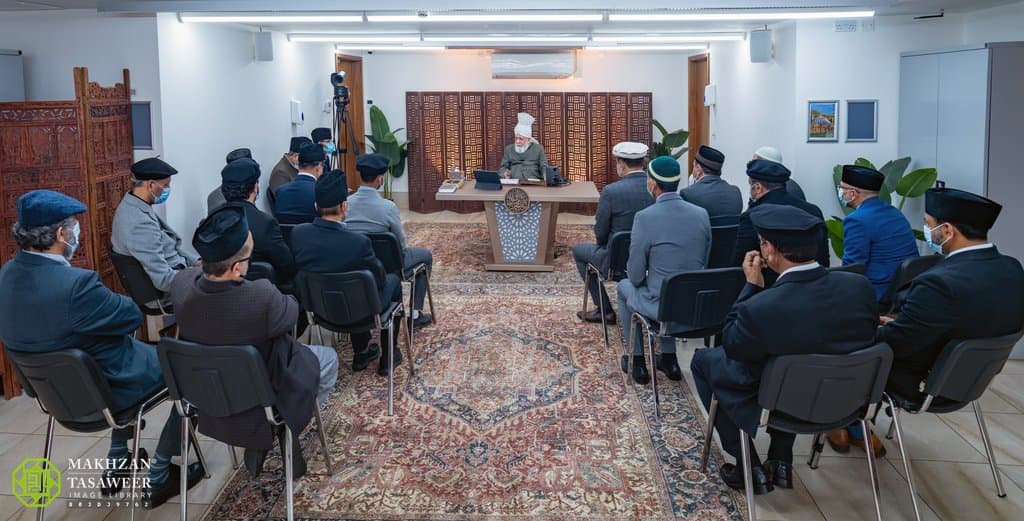
Islamabad, Tilford, UK, 21 April 2026: Members of Majlis Ansarullah from the Gulf States Region of the United States were blessed with a mulaqat with Hazrat Mirza Masroor Ahmad, Khalifatul Masih V (aa).
During the meeting, all attendees had the opportunity to introduce themselves before seeking guidance from Huzoor (aa) on matters relating to spiritual love, humility, Jumuah, brotherhood, civic duties, peaceful protest and personal reform.
True love for the Holy Prophet (sa) lies in obedience
A member asked how one could develop deep love for Allah, the Holy Prophet (sa), the Promised Messiah (as) and the Khulafa, in the way one feels love for parents and sometimes sees them in dreams after their passing.
Huzoor (aa) explained that the bond with parents develops naturally over many years, from childhood onwards and that this personal attachment brings comfort. However, he said that seeing someone in a dream is not the real objective. Referring to the guidance of the Promised Messiah (as), Huzoor (aa) explained that even seeing the Holy Prophet (sa) in a dream is not, in itself, the highest virtue; the real virtue is to act upon his commandments, teachings and blessed example.
Huzoor (aa) advised that if a person wishes to increase in love for the Holy Prophet (sa), they should abundantly invoke durood, give attention to salat and strive to act upon the Sharia that Allah revealed through him. This practical obedience is what brings a person close to Allah and His Messenger (sa). If Allah so wills, He may also grant good dreams, but such experiences are a matter of His grace and belong to a high spiritual rank. Huzoor (aa) said that if a person is acting upon the teachings and finds peace in the heart, then that itself is a sign of success. Any good dream should be considered a blessing from Allah, linked to one’s love, prayers, durood and desire for nearness.
Humility, istighfar and recognising the subtle traces of arrogance
Another member asked how one can recognise and overcome the subtle traces of arrogance that may exist unknowingly in the heart, so that one may be accepted by Allah and attain His love.
Huzoor (aa) explained that Allah alone knows the true condition of hearts. A person’s duty is to sincerely seek forgiveness, ask Allah for pardon, strive to avoid sin and protect oneself from arrogance. If a person does this with sincerity, Allah is Most Forgiving. Whether and when such efforts are accepted lies with Allah; human beings cannot know that fully.
Huzoor (aa) advised keeping in mind the couplets of the Promised Messiah (as), especially the one in which he taught that a person should consider themselves lower than everyone else, for perhaps through such humility they may gain entrance into the abode of nearness to Allah (Barahin-e-Ahmadiyya Part V, p. 26):
بدتر بنو ہر ایک سے اپنے خیال میں
شاید اِسی سے دخل ہو دارالوصال میں
Huzoor (aa) explained that whenever a thought of arrogance arises, this teaching should come to mind.
Huzoor (aa) also referred to an incident in the life of the Promised Messiah (as), when, during a discussion, he accepted that the opposing party was correct on a certain point for the sake of Allah’s pleasure. Upon this, Allah revealed to him that He was pleased with how he acted with humility. (Barahin-e-Ahmadiyya Part IV, p. 400) Huzoor (aa) said that when a situation arises in which one’s ego may become inflamed, a person should pause, reflect and suppress it rather than let it grow. Regular istighfar, repeated throughout the day, helps to empty the mind of arrogance.
Huzoor (aa) warned that when a person achieves success, receives praise or gains an award and begins to attribute it to their own knowledge, greatness or special qualities, this gradually leads towards arrogance. Instead, one should remember that they are a humble human being. He also referred to the Quranic teaching that no matter how much one may walk with pride, one cannot reach the height of the mountains. (Surah Bani Isra’il, Ch.17: V.38) Thus, humility should always be adopted.
Missing Jumuah due to genuine compulsion
A question was asked about cases where one is unable to attend Jumuah due to unavoidable circumstances or an emergency and feels deprived of both the prayer and the special time of acceptance of prayers on Friday.
Huzoor (aa) said that Allah is not unjust and He knows a person’s constraints. If, at the time of Jumuah, someone becomes ill or is genuinely unable to attend despite having the intention to do so, Allah knows that person’s state. Huzoor (aa) referred to the fundamental Islamic principle taught by the Holy Prophet (sa), that actions are judged according to intentions. (Sahih al-Bukhari, Hadith 1) If a person’s intention is pure, the matter is different; accountability arises when the intention itself is faulty.
Huzoor (aa) clarified that the hadith warning about the heart being darkened does not apply to missing a single Jumuah due to compulsion. (Sunan Abi Dawud, Kitab as-salat, Bab at-tashdidi fi tarki l-jumu‘ah, Hadith 1052) The warning is for one who knowingly and repeatedly misses Jumuah without excuse. If a person is prevented due to genuine circumstances, then even during that time, they can remember Allah, pray and seek forgiveness.
Huzoor (aa) said that Allah is Forgiving and also grants reward. He gave the example of a king who once missed Fajr, but then spent the day in istighfar and was granted a far greater reward. (Mathnawi, Book II, sections 62-75; Mecmûa-i Sâz ü Söz, BL Sloane MS 3114, c. 1650, p. 248; cf. BnF Turc 292, fol. 298r) In the same way, if someone misses Jumuah due to genuine compulsion and spends that time remembering Allah and seeking forgiveness, Allah can grant reward from His grace.
Digital communication can strengthen brotherhood if hearts are sincere
A member said that members of the Jamaat increasingly rely on WhatsApp, text messages and email for communication. Although these tools provide ease, he asked how personal connection and heartfelt closeness could be maintained and strengthened.
Huzoor (aa) explained that digital communication, when used with sincerity, could become a means of increasing love rather than diminishing it. He drew a parallel with the earlier practice of writing letters, spoke of the thousands of letters he receives from members around the world and emphasised that love is strengthened through prayer, sincere concern and brotherhood for the sake of Allah. Huzoor (aa) said:
“This is your own way of thinking, is it not? If I send someone a text message or I am compelled to do so, or I remain in contact with someone, then their value increases even more in my heart when they reply and when loving replies come. Or when I respond to someone with love. Or there is correspondence. You are speaking of text messages. There was once an age of correspondence through letters; hence, a saying developed in Urdu that letters are half a meeting. In the same way, a text message is even quicker than that. A letter, in earlier times, would arrive after 15 days or a month. Nowadays, you write a text message, send it and it reaches the other person in the very next second. A loving reply comes from them. They develop the feeling: ‘Yes, my brother remembered me; my friend remembered me.’ So, to say that love is decreasing because of this – that may be your thought, but it is not mine. Alright? I do not feel that any love is decreasing.
“People write countless letters. Now the Jamaat has grown so large; it has reached hundreds of thousands and tens of millions. People write letters; I receive thousands of letters every day. Now, regarding those whom I have not seen, what do you think – is there no love for them? They ask for prayers. Prayers are offered for them at that very moment when I am reading the letter. And later, at the time of prayer, prayers are also offered for them. I do not remember everyone’s names, so prayers are offered generally. This is how love increases.
“At night, when you go to sleep, imagine: ‘These are my brothers and sisters. I must pray for them before I sleep.’ Then love will remain established in the heart. So, to say that love only increases by meeting is not correct. Of course, love is gained through meeting and one should certainly meet. And it is mentioned in the hadith that you should invite one another; this, too, increases love. [Al-Tabarani, Al-Mu‘jam al-Kabir, Vol. 13, p. 70, Hadith 173; Al-Albani, Sahih al-Jami‘, Hadith 3568]
“You live in one city. You hold functions; there are Ansar meetings. You go there, do you not? Meet there. You go for Jumuah; meet there. There are five daily prayers. Develop the habit of attending them and attention will turn towards meeting one another. Through this, the bond of love will remain established.
“Allah the Almighty says that you should love for My sake and you will receive reward. If you love for the sake of the world, there is no reward. So, when you are doing this for the sake of Allah, you will also have love for those who come for prayers; there will be love for those who come for Jumuah. On Eid, you even embrace one another.”
Huzoor (aa) further said:
“Therefore, the feeling should always arise in the heart that believers are brothers to one another and a brother should care for his brother. And remember the hadith that whatever you desire for yourself, desire the same for your brother. [Sahih al-Bukhari, Kitab al-iman, Hadith 13] When your thoughts are like this, when these are the ideas you hold, then the virtuous thoughts that arise in your heart, the noble thoughts that arise in your heart for your own children, should also arise for your brother and for your brother’s children and for your friend’s children too. Then they become a means of love.
“Then, when you meet, even if you meet after two months, after six months or after a year, they weep. There are countless people in Africa; they live in villages, in remote areas. They write letters to me. And when our people go there, if someone goes as my representative and conveys my salaam, they become emotional and begin to weep. They have love in their hearts, do they not? Allah the Almighty has created that love in their hearts.
“Therefore, one should pray to Allah the Almighty that Allah the Almighty may create love in our hearts and that distance may not arise because of these small matters and worldly grievances.
“So, to say that [mutual love diminishes] merely because of sending text messages – I believe that text messaging has become an easy means of expanding love. Previously, a letter would take a month; now, in a single day, you can do this, you can speak to one another, you can speak on FaceTime and you can even show your face. You also receive a reply to your text. In fact, you should have asked, ‘Love has increased through this; now, how can we increase it even further?’”
When it was mentioned that some newly arrived ansar from Pakistan may not be used to such means of communication, Huzoor (aa) observed that people in such countries often know even more about texting and mobile phones. However, if there are some who do not have access to phones or cannot afford them, then they should be met personally, invited to the mosque and included in different functions.
Huzoor (aa) advised that gatherings need not always be formal meetings. Weekend picnics, meals and informal get-togethers can also be arranged. He referred to the tradition of eating together called Kuloo Jami‘an and said that such programmes can also be organised in Ansarullah, just as they are arranged in other auxiliary organisations and local settings. Such gatherings can include food, conversation and religious discussion. He said that if one has the intention to do a good deed, then it can be done; but if one keeps delaying it in pursuit of worldly matters, then it does not happen.
When a member said that they had considered arranging a monthly meal together, Huzoor (aa) encouraged this and added that those who can afford it should bring extra food for those who may not be able to prepare or bring anything themselves.
Military draft, obedience to law and the question of just cause
A member asked about discussions in some circles regarding a possible military draft in the United States and how Jamaat members between the ages of 20 and 25 should respond if such a situation arises.
Huzoor (aa) said that as long as one lives in a country, one must follow its laws. Either one migrates from that country or one takes part in the service required by law. He explained that this is the principle: wherever one lives, one must abide by the law and fulfil the obligations of citizenship.
Huzoor (aa) referred to the example of the Holy Prophet (sa), who did not take up arms during the 13 years in Mecca, because the Muslims were living under another authority. Later, when they had their own government and were attacked, they took up arms in self-defence. Thus, the law of the land must be obeyed, whether the government is Christian, secular or otherwise, so long as one chooses to live there.
At the same time, Huzoor (aa) advised that members should explain matters to people around them. He said that Ahmadis should create awareness within their society, surroundings and environment. Many people are now recognising that certain attacks and policies, whether by America or Israel, involve oppression. Ahmadis should explain these matters to others.
Huzoor (aa) said that if a war is being fought for a just cause, then the matter is different. He referred to the Second World War, when the British government recruited many people from India, including for different regiments and later offered benefits to some. He mentioned that the Jamaat also had a territorial force at that time and that Hazrat Mirza Sharif Ahmad Sahib (ra) was connected with it in a command capacity. Huzoor (aa) also referred to the Furqan Battalion, which was formed after the partition of India, and took part at the front. Huzoor (aa) said that the cause must be examined; if it is a just cause, one may serve, but if there is oppression, then one should strive against oppression.
When the member asked whether this meant he should move his family to Canada, Huzoor (aa) said that this was his own choice and that there was no need to move unless compulsory service actually arose. He then emphasised the power of prayer and said:
“Prayer has great power. Allah the Almighty has great power. If Allah the Almighty is asked sincerely, then Allah the Almighty accepts your prayers for the benefit of humanity. It may be that He does not do so for your personal matter, but if you are doing it for humanity, for the purpose of Allah the Almighty or for some noble purpose, then it is accepted.”
The positive effect of travelling for mulaqat
During the discussion, reference was made to the large number of khuddam from Germany and Norway who had visited over the weekend.
Huzoor (aa) said that, just as this meeting was being held with them, similar meetings had been held with those khuddam as well. He mentioned that 104 had come from Germany and 91 from Norway and that they had also been seated in the hall for their mulaqats. Huzoor (aa) said that, insha-Allah, such visits leave a positive effect. Even if nothing else, those who come to Islamabad have to offer the five daily prayers, which itself is beneficial.
Huzoor (aa) added that the khuddam had expressed that their faith was refreshed by seeing members who had travelled from America. Those from Germany and Norway were comparatively close, travelling by bus or short flights, whereas the American members had travelled much farther. This, too, became a source of encouragement for them.
Participation in peaceful protests
A member asked about protests in America against the current political situation and mentioned that he had been invited to attend.
Huzoor (aa) said that if a protest is peaceful, then one may attend it. However, there must be no violence, no destruction of government property and no physical assault. If one participates peacefully, then protest is permissible.
When the member mentioned that he had prepared a banner bearing the Jamaat’s message of love for all and hatred for none, Huzoor (aa) approved of this approach. He said that peaceful participation of this nature takes place in the UK and Germany as well.
Huzoor (aa) also referred to the time when the Maharaja of Kashmir committed injustices and Hazrat Musleh-e-Maud (ra) instructed Ahmadis to organise and participate in peaceful protest against that oppression. Thus, peaceful protest against injustice is permissible when conducted within proper limits.
Acting upon the commandments of the Holy Quran
At the end of the mulaqat, one member requested prayers that he may act upon all the commandments of the Holy Quran and remain away from all evils.
Huzoor (aa) advised him to make a list of those commandments and then strive to act upon them. When the member referred to the many commandments of the Holy Quran, Huzoor (aa) said that he should prepare the list and then act upon it and prayed that Allah may grant His grace.
Remembering the simplicity of the Holy Prophet (sa)
During the final moments, Huzoor (aa) also gave guidance regarding accommodation and personal comfort.
He said that if any member were to complain that a bed was comfortable or uncomfortable, they should think of how the Holy Prophet (sa) used to sleep. If one reflects on that example, complaints about the comfort or discomfort of beds will disappear.
Conclusion
At the conclusion of the mulaqat, the attendees had the honour of a group photograph with Huzoor (aa). Huzoor (aa) also gave pens as gifts to the members and the mulaqat came to an end.
(Summary prepared by Al Hakam)