
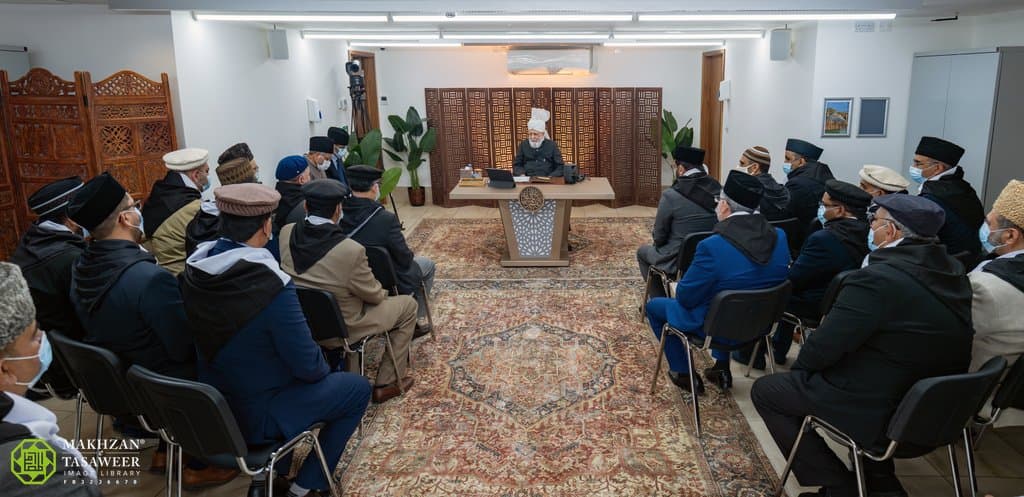
Islamabad, Tilford, UK, 9 May 2026: Ansar from the Muqami Majlis and Gulf States Region of the United States were blessed with a mulaqat with Hazrat Mirza Masroor Ahmad, Khalifatul Masih V (aa).
During the mulaqat, the ansar introduced themselves and then had the opportunity to seek guidance from Huzoor (aa) on matters relating to lifelong learning, the nature of questioning, the evil eye, reflecting upon Allah’s creation, strengthening ties between office-bearers and members and the promised progress of Islam Ahmadiyyat.
Lifelong learning and keeping the mind active
A question was asked about the decline in the ability to learn and retain knowledge as one grows older, whether in worldly or religious matters. Guidance was sought for those ansar who, despite advancing age, wish to continue increasing in knowledge so they may better serve the Jamaat.
Huzoor (aa) smiled and said that he did not consider himself old. He acknowledged that the ability to memorise and retain information may reduce with age and referred to the writings of the Promised Messiah (as), who stated that what is memorised in youth tends to remain in the mind, whereas in later age a person may forget what they once knew. (Malfuzat [English], Vol. 1, p. 68)
However, Huzoor (aa) explained that if a person continues striving and repeatedly revises and refreshes what they have learned, knowledge can remain with them. He referred to the teaching of the Holy Prophet (sa) that one should seek knowledge from the cradle to the grave, explaining that this means a person must continue increasing in knowledge throughout life. (Jami‘ at-Tirmidhi, Hadith 2686) If one continues to make effort, Allah the Almighty creates and sharpens the relevant faculties; but if one abandons the effort, those faculties begin to decline.
Huzoor (aa) said that in many parts of the world, people retire around the age of 60, after which they may consider their active life to be over. Yet professionals, including doctors and engineers, often remain effective in later years because they combine experience with new learning and new technology. He observed that in America, many doctors continue working into later age because they keep their knowledge fresh.
Huzoor (aa) said that although memory may weaken with age, if one leaves the mind unused, it becomes rusty. Therefore, one should not allow the mind to rust, but should continue increasing knowledge, developing oneself and making progress. A person should not become tired of learning. When one’s thinking becomes tired, decline begins. Ultimately, he said, the real matter is Allah’s grace.
Asking questions with wisdom and knowledge
A member referred to the common saying in Western societies that there is no such thing as a foolish question. He contrasted this with the Quranic account of Prophet Noah (as), who prayed concerning his son, after which Allah informed him of the true nature of the matter. (Surah Hud, Ch.11: V.42-48) The member asked which kinds of questions are displeasing to Allah and should be avoided.
Huzoor (aa) explained that Prophet Noah (as) did not know the unseen condition of his son’s heart. When the flood came, his son was sitting at a high place and refused to join Prophet Noah (as), saying that he would climb a mountain and be saved. Prophet Noah (as) warned him that nothing would save him that day and then a wave overtook him and he was drowned. When Prophet Noah (as) asked Allah about His promise to save his family [ahl], Allah explained that true family, in this context, meant those who were obedient to him and followed his teaching. His son was rebellious and, therefore, was not counted among his true spiritual family.
Huzoor (aa) explained that Allah did not prohibit all questions. Rather, He corrected Prophet Noah (as) regarding a matter whose reality he did not know. Huzoor (aa) further explained that the Holy Quran also warns believers not to ask certain questions during the revelation of Sharia, because if detailed answers were given and additional obligations imposed, people might then fail to fulfil them and become liable to punishment. (Surah al-Ma’idah, Ch.5: V.102-103) In such religious matters, believers should act upon what Allah and His Messenger (sa) have clearly commanded, for therein lies spiritual safety.
At the same time, Huzoor (aa) made clear that this principle should not be wrongly extended to worldly learning. In worldly matters, one should seek knowledge and continue increasing in it. He said that today, children often ask why something is so and if they are not given reasoned answers, they may begin to think that religion lacks evidence. Therefore, children’s questions should be answered with knowledge and reasoning.
Huzoor (aa) said that parents and ansar in particular should increase their religious knowledge so they can answer the questions of the younger generation. He said it would be wrong simply to tell children not to ask. Many people write questions to him, including difficult or critical questions and suitable answers are given according to what is appropriate. The caution is against questions that create spiritual stumbling or lead one away from faith, not against sincere efforts to understand religion or acquire knowledge.
The evil eye, envy and false claims of magic
A question was asked about people who believe in the evil eye, amulets, magic and related practices. Guidance was sought on how to explain these matters in light of the Holy Quran and how to deal with a person who believes they are affected by such things.
Huzoor (aa) said that the evil eye can have an effect and that this reality is reflected even in common expressions used to ward off harmful looks. He explained that when a person looks at something good, whether their crop, child or possession, they should remember Allah, say Masha-Allah and seek Allah’s protection. A person’s own gaze can also have an effect if they begin attributing blessings to themselves rather than to Allah.
Huzoor (aa) said that the effect of the evil eye is also mentioned in relation to parents and children. A mother may begin thinking that she herself has raised the child in such and such a manner and this can have an effect on the child. Therefore, one should always seek Allah’s protection from every evil.
Huzoor (aa) also explained that some envious people do not merely cast an evil glance, but may also try to harm others through certain actions. For this reason, Allah has taught prayers in the concluding chapters of the Holy Quran for protection from the mischief of the envious.
Regarding magic and ta‘wiz-related claims, Huzoor (aa) explained that many such practices are used to frighten less-educated people. He referred to the writings of Hazrat Khalifatul Masih I (ra), who explained that some so-called pirs would have agents hide objects in people’s homes and later claim that those objects were the cause of a spell. The person would then be told to go to the pir, who would identify the hidden item and claim to remove the effect of magic. In this way, people were deceived. (Haqaiq-ul-Furqan, Vol. 4, p. 571)
Huzoor (aa) also mentioned accounts relating to Hazrat Maulvi Ghulam Rasul Rajeki (ra), where people believed someone was affected by jinn or magic and the matter was addressed through prayer. (Hayat-e-Qudsi, pp. 617-618) Huzoor (aa) said that he had written a detailed response on this subject, explaining the reality and limits of such matters, what the Holy Quran says and what is permissible or impermissible. He advised that this detailed response should be studied from Al Hakam when it is published. (Also see: Answers to Everyday Issues, Part XVII, www.alhakam.org)
Travelling the earth to reflect upon Allah’s creation and the fate of past nations
A member referred to Quranic verses that command people to travel through the earth, observe the fate of those who rejected Allah’s word and reflect on how creation began. (Surah an-Naml, Ch.27: V.70; Surah al-‘Ankabut, Ch.29: V.21) He asked how these commandments could be fulfilled during routine travel, appreciating the wonders of Allah’s creation.
Huzoor (aa) explained that when Allah says to travel through the earth, it means that one should look at the blessings Allah has placed in the world: mountains, forests, seasons, oceans and rivers. One should reflect upon Allah’s creation and recognise the Creator through what He has created.
In this context, Huzoor (aa) referred to Allama Iqbal’s well-known appeal in Bang-e-Dara, “کبھی اے حقیقتِ منتظر نظر آ لباسِ مجاز میں” – “O long-awaited Reality, appear in the garment of metaphor” – and then cited the response written by Hazrat Syeda Nawab Mubaraka Begum (ra): “مجھے دیکھ رفعتِ کوہ میں، مجھے دیکھ پستیِ کاہ میں” – “Behold Me in the heights of the mountains; behold Me in the depths of the valleys.” (Durr-e-Adan, 2008, p. 62) Through this, Huzoor (aa) explained that Allah’s signs are manifest throughout His creation and that by reflecting on mountains, valleys, forests, rivers and the vastness of the universe, one comes to recognise the power and majesty of Allah.
He then addressed the Quranic instruction to travel and see the fate of the guilty. He said:
“Here, Allah the Almighty is speaking about the wrongdoers; that is, travel through the land and observe those who stood against Allah the Almighty. Look at the history of the Prophets. You see ancient ruins, do you not? Observe how nations were destroyed by God. And nowadays, Israel is acting with great intensity. In Surah Bani Isra’il and Surah al-Anbiya, Allah the Almighty has already described their condition that these people were destroyed twice before because of their oppression and if they commit oppression a third time, they will be utterly destroyed by God. And this history lies before us. Learn lessons from it and see what the end of such people becomes. Therefore, fear Allah the Almighty, associate nothing with Him and do not become a Pharaoh, as it were, yourself. Pharaoh was destroyed. Moses (as) arose against Pharaoh, but when his people committed excesses, they were destroyed by God. Likewise, the Muslims too can meet the same fate. Therefore, one ought to derive lessons from everything; this is what Allah the Almighty says. He states: ‘Travel and observe wherever you see signs of destruction.’ It is mentioned in the hadith that the Holy Prophet (sa) said that when you recite the Holy Quran and come across verses containing glad tidings from Allah the Almighty, pray to Allah that He may make you among those who inherit those blessings and grant you those favours as well. And where punishment is mentioned, recite istighfar and pray to Allah the Almighty to protect you from such things. [Sunan an-Nasa’i, Kitab al-iftitah, Bab mas’alati l-qari idha marra bi ayati rahmah, Hadith 1009] Thus, these matters are there in order to impart lessons. This is their purpose and meaning. It does not simply mean travelling for sightseeing and enjoyment alone.”
Huzoor (aa) explained that travel should not be merely for enjoyment or sightseeing. If one visits places of beauty and wonder, one should not simply enjoy the scenery. Rather, one should reflect on how Allah created these places, how earlier settlements may have existed there, how populations rose and fell and how earthquakes, floods, rains and other natural processes shaped or destroyed human habitation.
He referred to the explanation of Hazrat Musleh-e-Maud (ra) that the verse about seeing how Allah originates creation and then brings it again does not mean that the dead physically rise again in this world before one’s eyes. Rather, it points also to the rise and fall of nations: how peoples and powers emerge, flourish, decline and are replaced. In this way, the believer learns from history, fears Allah and turns towards Him. Huzoor (aa) said:
“[Those nations] attained great renown and possessed a mighty kingdom. Pharaoh would say, ‘Look, all these systems are operating under me. Tell me, is there anyone above this?’ So Allah the Almighty destroyed them. He destroyed them by drowning them in water.
“In the same way, there are other nations too. As for what Mr Trump thinks, that ‘I am everything’ and [his claims regarding] the Second Advent and Jesus Christ (as), as he says at times – though I do not know to what extent this is accurate – Allah the Almighty will likewise break the pride of such people.
“You live in these countries, so what should you do? By living in these very places, you are yourselves witnessing the meaning of سِیۡرُوۡا فِی الۡاَرۡض [‘travel through the earth’]. Hence, fear Allah the Almighty and be mindful of Him and warn the people as well. He even says, does he not, that ‘I have come from God.’ By invoking the name of God while engaging in wrongful conduct, he is himself inviting his own ruin.
“In the Holy Quran, Allah the Almighty has stated in various other places: ‘There were people more powerful than you. I destroyed them, so what are you?’ (Surah al-Mu’min, Ch.40: V.22)
“So the purport [of the verses] is this: look at how great their kingdoms were, how immense their power was, how long they ruled and how much strength they possessed. Despite all of this, they came to an end. There, only ruins are now seen. If you go to many countries in the Middle East, you find ruins – in Syria, in Iraq and in other places. Or if you look elsewhere in the world, too, ancient ruins are found. They are found for this very reason, are they not? The ruins that you are searching for – geologists [or archaeologists] know how those who study such things uncover them. So this is what it means.”
Office-bearers must build relationships before making demands
A question was asked about a lack of alignment between office-bearers and Jamaat members, which can sometimes push members away from the Jamaat. Guidance was sought on how this relationship can be improved.
Huzoor (aa) asked why such a lack of alignment exists. He said that if office-bearers are fulfilling their responsibilities properly, speak with gentleness and explain matters with love, then such problems should not arise. He said he had repeatedly advised office-bearers to become more compassionate and build relationships.
Huzoor (aa) explained that many office-bearers only visit or contact members when they need something: when there is a jalsa, ijlas or meeting; when they want someone to attend an event; when chanda has to be collected; or when funds are needed for a plot or land for a jalsa or an ijtema or some other project. Instead, office-bearers should maintain ordinary personal contact with members even when they have no administrative demand to make.
Huzoor (aa) said that if there is closeness, a friendly atmosphere, brotherhood and sincere concern, then such distances do not arise. He gave the example of family relationships, where people generally maintain regard for one another despite differences and relationships are not easily broken except in rare cases. Similarly, if members know that their office-bearers are sincere well-wishers, they will maintain a relationship with them and listen to what they say.
Huzoor (aa) referred to the Quranic account in which Prophet Abraham (as) was taught how the dead are brought to life and the birds came back to him when called after being trained. (Surah al-Baqarah, Ch.2: V.261) Huzoor (aa) explained that training should be carried out with love and affection. If members are trained from the beginning in this way, they will respond positively. However, if office-bearers merely display authority, members will distance themselves and tell them to keep their status within their own homes. Thus, office-bearers must work with love, sympathy and humility.
The promised progress of Islam Ahmadiyyat and the lesson of patience
The final question referred to the writings of the Promised Messiah (as), in which he stated that Islam Ahmadiyyat would become dominant within 300 years. The member asked how it could be ensured that the spread of Islam Ahmadiyyat would remain based on true doctrine and the real teachings of Islam, unlike Christianity, which spread widely but became mixed with false doctrines.
Huzoor (aa) explained that the Promised Messiah (as) gave the example of the first Messiah (as) and his followers, who passed through severe trials. The People of the Cave also endured a long period before conditions changed and later the Roman Empire accepted Christianity in whatever form it then existed. The Promised Messiah (as) said that Ahmadis would not have to wait that long and that before 300 years passed, Ahmadiyyat would achieve dominance. (Tazkirat-ush-Shahadatain, Ruhani Khazain, Vol. 20, pp. 66-67)
Huzoor (aa) clarified that an analogy does not mean that every detail of the earlier example must repeat itself exactly. He gave the example of the Khilafat of the Promised Messiah (as) and said that Hazrat Musleh-e-Maud (ra) wrote that just as attacks took place upon Hazrat Umar (ra), Hazrat Uthman (ra) and Hazrat Ali (ra), similar trials could occur in the Khilafat after the Promised Messiah (as). However, similarities in events do not mean the same results must follow in every respect.
In the same way, Huzoor (aa) explained that the example of Christianity was given to show that the Jamaat would progress, not to suggest that a corrupted form of Islam would be spread. The image of true Islam had already been distorted and the Promised Messiah (as) came for its restoration and rejuvenation. Therefore, during the prophesied era of progress, the Jamaat will not be spreading a distorted form of Islam; rather, it will be progressing upon the true teachings.
Huzoor (aa) said that the example was primarily to encourage patience. The People of the Cave endured for a long period, spanning many generations. Ahmadis, however, have been told that they will not have to wait that long before seeing good results. The point of the example is not that Ahmadiyyat will become like corrupted Christianity, but that believers should show patience and remain steadfast, for success will come before such a long period passes.
Conclusion
As the mulaqat concluded, the ansar had the opportunity to have photographs taken with Huzoor (aa). They also received pens as gifts.