
Guidance regarding basic Islamic issues that Hazrat Amirul Momineen, Khalifatul Masih Vaa, has given on various occasions in his written correspondence and during MTA programmes is being published officially below for everyone’s benefit.
What is the meaning of the hadith on souls being marshalled troops?
A lady from Germany wrote to Hazrat Amirul Momineen, Khalifatul Masih Vaa, asking about the meaning of the following hadith of the Holy Prophetsa:
الْأَرْوَاحُ جُنُودٌ مُجَنَّدَةٌ فَمَا تَعَارَفَ مِنْهَا ائْتَلَفَ وَمَا تَنَاكَرَ مِنْهَا اخْتَلَفَ
[“Souls are troops arranged in ranks: those among them who recognise one another grow harmonious and those among them who are estranged fall into variance.”]
Huzoor-e-Anwaraa, in his letter dated 2 November 2023, provided the following answer to this question:
“This hadith has been recorded by Imam Bukharirh on the authority of Hazrat Aishara and by Imam Muslimrh on the authority of Hazrat Abu Hurairahra in their respective sahih collections. The general meaning of this hadith is that souls are like troops, arranged in distinct groups. Those among them that recognise one another become attached to one another and those that do not recognise one another differ.
“Scholars have provided various interpretations of this hadith. Explaining this hadith, Hazrat Syed Zain-ul-Abidin Waliullah Shahra writes:
“‘A person of virtuous nature finds peace in the company of the virtuous and one of corrupted nature in the company of the wicked. It is a daily observation that those of similar dispositions naturally gravitate towards one another. Moreover, it has been observed that an evil person becomes good in the company of the righteous. This matter is not contrary to the aforementioned rule, because goodness has been ingrained in human nature. According to a hadith, every child who comes into this world brings with him a true nature [fitrah sahihah]; thereafter, his parents make him a Jew or a Christian. (Sahih al-Bukhari, Kitab al-jana’iz, Bab iza aslama s-sabiyyu fa-mata hal yusalla ‘alayhi) Thus, this innate inclination towards goodness shines through righteous company and becomes muddied through evil company. A person who apparently seems evil to us but then becomes reformed through good company, his soul is certainly from among those souls that possess an inherent capacity for righteousness. The Prophets, peace be upon them, […] belong to the same group of the righteous by birth; they are united in faith and alike in character.’ (Sharh Sahih al-Bukhari, Vol. 6, pp. 174-175)
“However, in my view, one meaning of this hadith is also that in this world, people’s natures resemble one another in terms of religion and faith. Jews are inclined towards Jews, Christians are inclined towards Christians and Muslims feel an affinity with Muslims. Similarly, the inclination of righteous people is towards the righteous and the tendency of evil people is towards evil people. That is why the Holy Quran commanded its followers: ‘كُونُوا مَعَ الصَّادِقِينَ’ i.e., ‘Keep company with the righteous.’ (Surah at-Taubah, Ch.9: V.119) The Promised Messiahas states in this regard:
“‘If a person desires to see, let him look upon those who have severed their attachment to worldly things and have turned towards God and whom God brings to life. Seeing them removes afflictions. He who comes to the one possessing mercy will draw closer to mercy and he who goes to an accursed one will draw closer to the curse. In this world, this is indeed the matter worthy of reflection. God Almighty says, ‘كُونُوا مَعَ الصَّادِقِينَ’; meaning, ‘O servants, your safety lies in this alone: that you remain with the truthful.’” (Al Badr, No. 11, Vol. 1, 9 January 1903, p. 86)
“Furthermore, if this hadith is interpreted in the context of life in the Hereafter, it would mean that regarding a husband and wife whom Allah the Exalted has united in this world, if they wish to remain together in the Hereafter as well, both must strive to attain Paradise. If both are righteous, they will inherit Paradise together in the Hereafter. Therefore, both husband and wife should continue striving in this world to guide their partner onto the path of righteousness and taqwa.”
How to calculate zakat on trading stock and real estate?

Someone from Jordan asked Hazrat Amirul Momineen, Khalifatul Masih Vaa: “Is zakat payable on trading stock [amwal-e-tijarat]? If so, how is it to be calculated? Also, if a person is in the business of buying and selling land and property, is zakat payable on that?”
Huzoor-e-Anwaraa, in his letter dated 3 November 2023, provided the following guidance:
“According to the majority of jurists [jumhur], zakat is obligatory on trading assets and this is also the position of Fiqh-e-Ahmadiyya. One method stated in Fiqh-e-Ahmadiyya for calculating zakat on trading assets is as follows: ‘Multiply each amount of capital by the number of months for which it remained deployed in the business. Add these amounts together, then divide the total by 12. Pay one-fortieth (2.5%) of the resulting figure as zakat.’ (Fiqh-e-Ahmadiyya, ‘Ibadat, p. 361)
“In my view, a simpler method is to fix one date in the year as an annual valuation date and to value one’s trading assets at that time. If the [zakatable] assets reach the nisab threshold, zakat should be paid at the rate of 2.5%. In this regard, the Promised Messiahas states:
“‘No zakat is payable on merchandise held as stock-in-trade when it is merely kept in one’s dwelling. Hazrat Umarra used to take accounts at six-monthly intervals and zakat was assessed on cash holdings.’ (Badr, No. 7, Vol. 6, 14 February 1907, p. 8)
“It means that there is no zakat on the [unsold] trade goods themselves; rather, zakat will be levied on their value, as Hazrat Umarra used to do.
“Similarly, a gentleman enquired: ‘In trading assets, a large portion consists of amounts due from customers and remains outstanding as receivables; is zakat payable on this or not?’ Huzooras replied:
“No Zakat is payable on suspended or outstanding assets until they come into one’s possession. However, a trader ought not to defer zakat by resorting to excuses and contrivances. After all, he also meets his expenses, according to his means, from this very wealth. With taqwa, he should keep in view both the assets in hand and those outstanding and continue to seek the pleasure of Allah the Exalted by paying an appropriate zakat. Some people make excuses even with God; this is not right.” (Badr, No. 28, Vol. 6, 11 July 1907, p. 5)
“Accordingly, zakat is obligatory in relation to trade and the best method is to draw up an annual account of one’s assets and of income and expenditure at the end of the year and then discharge zakat accordingly.
“The same method applies to a business engaged in buying and selling land and property: once a year, account for income and expenditure; any remaining surplus upon which a year has passed (whether held as cash or reinvested in the business) will be subject to zakat at the rate of 2.5%.”
What is the difference between the Sacred Months and the Hajj months?
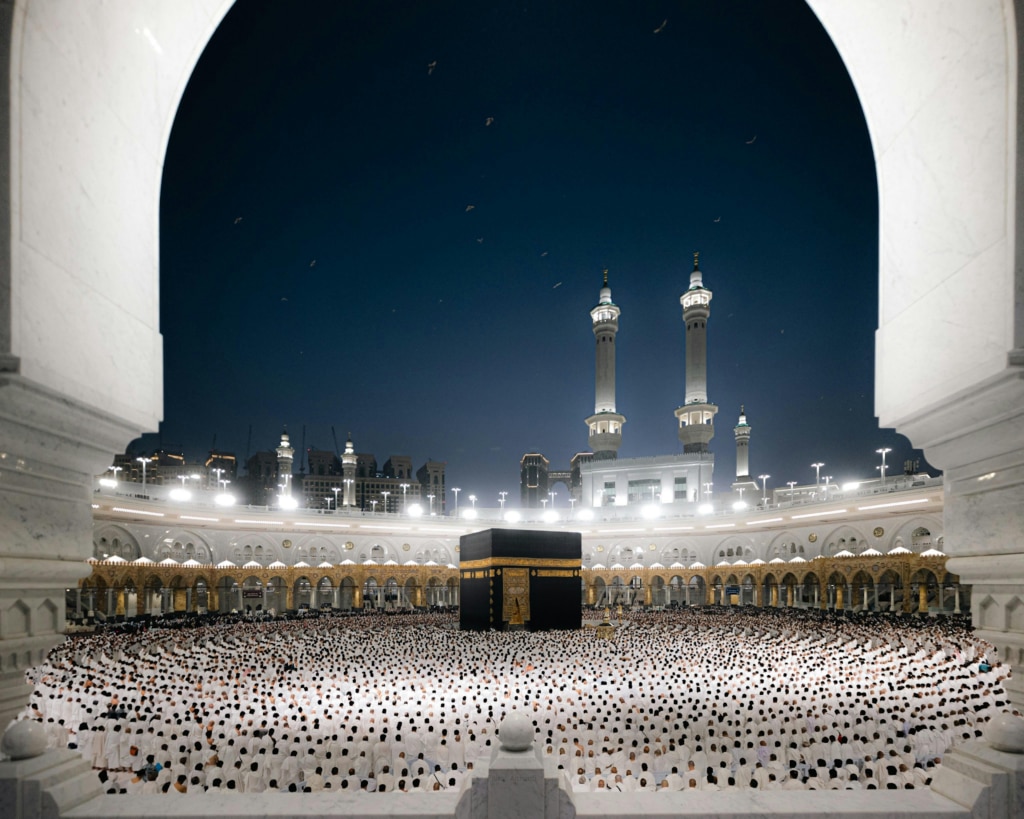
Someone from France asked Hazrat Amirul Momineen, Khalifatul Masih Vaa, about the difference between the Sacred Months [al-ashhur al-hurum] and the Months of Hajj.
Huzoor-e-Anwaraa, in his letter dated 4 November 2023, provided the following answer to this question:
“Both the Sacred Months and the Months of Hajj are mentioned in the Holy Quran and ahadith. Thus, Allah states:
“‘The number of months with Allah has been twelve months by Allah’s ordinance since the day He created the heavens and the earth. Of these, four are known as sacred.’ (Surah at-Taubah, Ch.9: V.36) He also states: ‘The months of Hajj are well known.’ (Surah al-Baqarah, Ch.2: V.198)
“The details of these months – which ones are the Sacred Months and which are the Months of Hajj – have also been laid out in ahadith. Regarding the Sacred Months, there is a narration by Hazrat Abu Bakrara that the Holy Prophetsa said, ‘The year is of 12 months, out of which four months are sacred: Three are in succession – Dhul-Qa‘dah, Dhul-Hijjah and Muharram – and (the fourth is) Rajab of [the tribe of] Mudar, which is between Jumada [al-Thani] and Sha‘ban.’ (Sahih al-Bukhari, Kitab al-maghazi, Bab hajjatu l-wada‘) Regarding the Months of Hajj, Hazrat Abdullah bin Umarra says that these refer to Shawwal, Dhul-Qa‘dah and the 10 days of Dhul-Hijjah. (Sahih al-Bukhari, Kitab al-hajj, Bab qawlillahi ta‘ala ‘al-hajju ashhurun ma‘lumat’)
“One objective of both the Sacred Months and the Months of Hajj is to provide safe passage on the routes for those coming to Mecca and returning, for the sake of such a major act of worship as Hajj, so that they may visit the House of Allah the Exalted and perform the related rites with full concentration. Accordingly, the two months of Dhul-Qa‘dah and Dhul-Hijjah are common to both the Sacred Months and the Months of Hajj. Furthermore, the Sacred Months include the month following these two, i.e., Muharram, while the Months of Hajj include the month preceding these two, i.e., Shawwal. In this way, pilgrims have been provided with an open timeframe of four months so that those who have to travel from far-off regions may have ample time for Hajj preparations, etc., within these four months. However, by specifically mentioning the Months of Hajj, it was also clarified to those coming for Hajj that the rites related to Hajj, such as ihram, etc., can only be entered into during the Months of Hajj (Shawwal, Dhul-Qa‘dah and Dhul-Hijjah), but the return journey can also be undertaken in the Sacred Month, i.e., Muharram. Hence, Hazrat Syed Zain-ul-Abidin Waliullah Shahra states:
“‘A prima facie reading of the expression ‘اَلۡحَجُّ اَشۡہُرٌ مَّعۡلُوۡمٰتٌ’ [‘The months of Hajj are well known.’ (Surah al-Baqarah, Ch.2: V.198)] may suggest that Hajj may be performed at any point within the [three] designated months. However, [although ihram for Hajj may be assumed within these months, the essential rites of Hajj are fixed to specific days in Dhul-Hijjah]; thus, it cannot be performed before or after that. Imam al-Bukharirh elucidates the purport of the verse by citing hadith 1560 (which describes the Holy Prophet’ssa departure from Medina for Hajj, his entry into ihram and his directives to the Companions concerning Hajj and Umrah), making it clear that the ihram for Hajj may be assumed in any one of these months. It is in consideration of pilgrims’ travelling from far-off lands that three months have been specified. It is precisely on account of forming the intention for Hajj and entering into ihram for it that Shawwal and Dhul-Qa‘dah have also been designated as the Months of Hajj.’
“Hazrat Khalifatul Masih Ira, in his commentary on ‘اَلۡحَجُّ اَشۡہُرٌ مَّعۡلُوۡمٰتٌ’, states:
“‘Some people infer from ‘إِنَّ عِدَّةَ الشُّهُورِ عِنْدَ اللَّهِ اثْنَا عَشَرَ شَهْرًا فِي كِتَابِ اللَّهِ’ [‘The reckoning of months with Allah has been twelve months.’ (Surah at-Taubah, Ch.9: V.36)] that the entire year is for Hajj, but I have seen among the four Imams that they do not approve of assuming ihram throughout the year.’ (Haqaiq-ul-Furqan, Vol. 1, p. 335)
“Thus, the purpose of the Sacred Months was to suspend war and bloodshed – which was a pastime of the Arabs – and maintain peace so that those coming to the House of Allah the Almighty would not face any difficulty. Then, by specifically mentioning the Months of Hajj, attention was drawn to the fact that matters related to Hajj should be performed within these months.
“As for the question of why the month of Rajab was included in the Sacred Months, the answer is that among the Arabs, Umrah was greatly disliked during the Months of Hajj; rather, it was considered afjar-ul-fujur, meaning the greatest of all sins (Sahih al-Bukhari, Kitab al-hajj, Bab at-tamattu‘i wa l-iqrani wa l-ifradi bi l-hajj). The Holy Prophetsa reformed this and, through his own example, demonstrated to the Companions that performing Umrah along with Hajj is not only not forbidden but is entirely permissible. However, as I mentioned, since the performance of Umrah during the Months of Hajj was considered a grave sin among the Arabs, Allah the Exalted declared the month of Rajab also a Sacred Month so that those who wished to come to the Kaaba for Umrah at a separate time could have safe passage on the routes during this month.
“Here, it is also necessary to remember that Islam has maintained certain commandments just as they were before Islam. Accordingly, Islam has followed the same principle regarding the Months of Hajj and the Sacred Months. Thus, Hazrat Musleh-e-Maudra states in this regard:
“‘In ‘اَلۡحَجُّ اَشۡہُرٌ مَّعۡلُوۡمٰتٌ’, it has been pointed out that the Holy Quran has not given any new commandment regarding Hajj, but has maintained the same commandment that has been in practice since the time of Prophet Abrahamas. For this reason, the Months of Hajj are also known to all people, i.e., Shawwal, Dhul-Qa‘dah and Dhul-Hijjah.’ (Tafsir-e-Kabir, Vol. 3, UK, 2023, p. 251)”
Is investing in profit-only schemes halal?

Someone enquired from Hazrat Amirul Momineen, Khalifatul Masih Vaa, referring to various investment arrangements and enquiring whether he may invest his money in them.
Additionally, in one letter, he wrote regarding the disease of AIDS that Hazrat Khalifatul Masih IVrh had stated that the disease of AIDS would become worse, whereas the peak of this virus was in 1994 and with the invention of many medicines, deaths caused by this disease have decreased. In this regard, the questioner also attached various graphs with his letter. Furthermore, in one letter, the questioner mentioned his mulaqat experience and wrote that he was given very little time.
Huzoor-e-Anwaraa, in his letter dated 6 November 2023, provided the following guidance:
“Regarding the various arrangements you have mentioned for investing money: those in which capital is deployed on the basis of participation in both profit and loss are permissible. However, where only profit (i.e., a return) is indicated and the agreement contains no provision for sharing in loss, such a return is treated as interest [riba], which is not permissible in Islam. In explaining the definition of riba, the Promised Messiahas states:
“‘In the Sharia, interest is defined as follows: a person lends money to another for his own benefit and stipulates an [additional] gain. Wherever this description applies, it is interest [riba]. However, if the borrower makes no undertaking – neither promise nor commitment – but, of his own accord, pays back more, then this falls outside interest. Thus, the Prophets have always been scrupulous regarding stipulated conditions. Likewise, if a king takes a sum and, of his own accord, returns more and the giver does not advance it with the intention of interest, then it too does not fall within interest; rather, it is a benefaction from the sovereign. The Prophetsa of God did not take a loan from anyone, but that, at the time of repayment, he would return something additional; yet it must be borne in mind that there should be no desire or expectation for the excess. Any increase received contrary to one’s desire is not included within interest.’ (Al Badr, No. 10, Vol. 2, 27 March 1903, p. 75)
“However, if there is a financial institution that is wholly state-owned (such as National Savings and the National Bank in Pakistan) which deploys its funds in various public welfare endeavours and uses this money for the broader benefit of the public – thereby contributing to economic development, creating employment opportunities and increasing the state’s revenue – then the benefit is not confined to the depositors alone; rather, the wider public also benefits through those welfare endeavours. In such circumstances, if that state institution includes its depositors in its surplus and labels the payment ‘profit’ and depositors may withdraw their funds when required, then the additional amount paid to depositors under the name of ‘profit’ does not fall within the category of riba. Instead, it is to be regarded [as a discretionary favour on the part of the state,] akin to a benefaction from the sovereign. Accordingly, such an amount may be utilised for one’s personal needs.
“As for the existence of elements of interest in various types of businesses in the current age, the following saying of the Just Arbiter [Hakam ‘Adl] of this age, the Promised Messiahas, holds fundamental status for understanding this matter. Huzooras states:
“‘In recent times, most jurisprudential issues in this country have become convoluted. There is one or the other element of interest [riba] involved in every trade. This is why renewed ijtihad is needed in this age.’ (Al Badr, Nos. 41 & 42, Vol. 3, 1 & 8 November 1904, p. 8)
“This matter is currently being deliberated upon in the Jamaat. When a definite opinion is formed, the members of the Jamaat will, insha-Allah, be informed of it.”
Will AIDS continue to spread despite advancements in medicine?

“Regarding what you mentioned about the disease of AIDS: it is true that, at present, owing to advances in treatment, it does not inflict harm in the way it did in the past. However, as far as the spread of the disease is concerned, your own graphs show a sustained increase. Viewed in that light, the statement of Hazrat Khalifatul Masih IVrh is borne out as true: that it would spread further – and it has, to this day, continued to do so.
“Furthermore, it should also be remembered that as a result of Allah the Almighty’s mercy, epidemics sometimes subside. Thus, in the time of the Promised Messiahas, the plague outbreak began in India in 1898 and, after some time, abated to some extent; yet in 1905 it resurged, resulting in many deaths. Some epidemics, therefore, continue to spread quietly beneath the surface and then, at a later point, regain momentum. For this reason, one should always beseech mercy from God Almighty and abstain from deeds that provoke His displeasure. Yet it is a human weakness that when a person is afflicted by calamity, the fear of God arises in their heart and they turn towards Him to some degree; but as soon as the signs of that affliction begin to fade, they revert to their former ways. Whereas a person should at all times remain humbly bowed before their True Creator – repenting and seeking forgiveness.
“Our lord and master, Hazrat Muhammad al-Mustafasa, said: ‘By Allah! I seek forgiveness from Allah and turn to Him in repentance more than 70 times a day’ – the number ‘70’ being used in Arabic to denote abundance. (Sahih al-Bukhari, Kitab ad-da‘wat, Bab istighfari n-nabiyyi fi l-yawmi wal l-laylah) And yet he also said: ‘My Satan has become a Muslim.’ (Sahih Muslim, Kitab sifati l-qiyamah wa l-jannati wa n-nar, Bab tahrishi sh-shaitan) Thus, the import of this hadith is that a person must not become heedless in seeking the mercy of Allah the Almighty.
“Regarding what you mentioned about being given little time in the mulaqat, this is an unavoidable constraint on our part, as some time must be given to everyone. Therefore, in such circumstances, you should not take offence.”
(Compiled by Zaheer Ahmad Khan, Head of Records Department, Private Secretariat, London and translated by Al Hakam)