
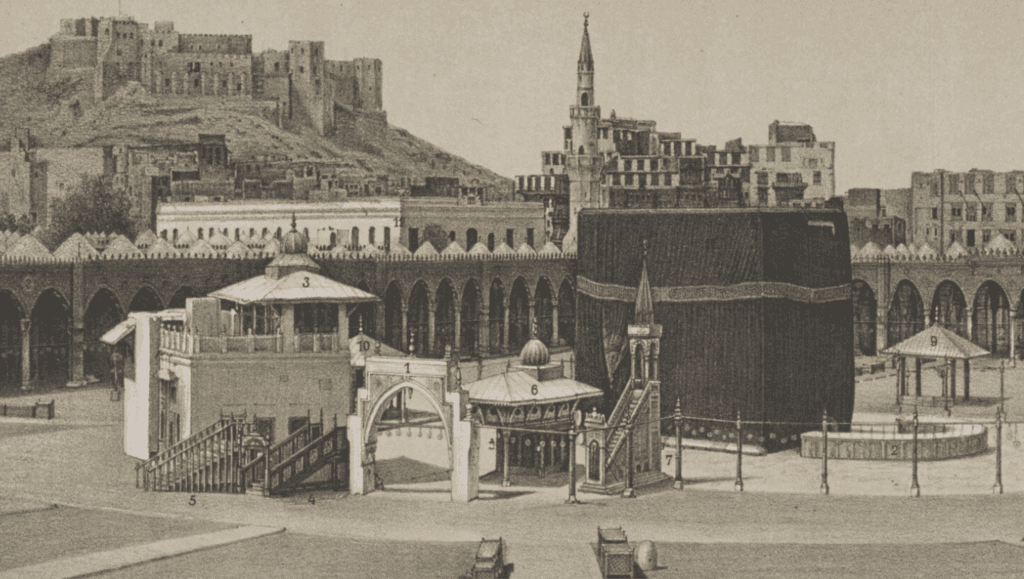
Who struck the ground to create the spring of Zamzam?
Someone from Kerala, India, wrote to Hazrat Amirul Momineen, Khalifatul Masih V (aa), stating that Hazrat Sahibzada Mirza Bashir Ahmad (ra) has written in Sirat Khatam-un-Nabiyyin [The Life & Character of the Seal of Prophets] regarding the incident of Hagar and Prophet Ishmael (as) that the spring of water gushed forth as a result of the angel striking his heel. However, since childhood, I have always read that the spring emerged due to Prophet Ishmael (as) striking his feet against the ground.
In his letter dated 17 December 2023, Huzoor-e-Anwar (aa) provided the following guidance regarding this question:
“There is no cause for confusion in this matter. Both of these narratives are found in the books of Hadith, history, biographical accounts [sirah], and exegesis [tafsir]. Accordingly, it is written that this spring emerged where the angel scraped the earth with his heel or his wing or arm. (Sahih al-Bukhari, Kitab al-anbiya, Bab [‘yaziffuna’ an-naslanu fi l-mashy]) It is also written that this spring gushed forth from the place where Prophet Ishmael (as), weeping from extreme thirst, was striking his heels. (Tafsir at-Tabari, Vol. 13, Dar Ihya al-Turath al-Arabi, Beirut, Lebanon, 2001, Surah Ibrahim, Verse 38, p. 272; Al-Kamil fi at-Tarikh by Muhammad Ibn al-Athir al-Jazari, d. 630 AH, Vol. 1, Dar Al-Kotob Al-Ilmiyah, Beirut, Lebanon, 1971, p. 80)
“Therefore, since both traditions exist in classical sources, both accounts have therefore been presented in the literature of the Jamaat. In one place in Tafsir-e-Kabir, Hazrat Musleh-e-Maud (ra) states that he [the angel] said, ‘Go Hagar and see that God Almighty has caused a spring to gush forth beneath the feet of Ishmael.’ (Tafsir-e-Kabir, Vol. 3, UK: 2023, p. 73) In another place, he stated that the name ‘Isma‘il’ is derived from the Arabic root sami‘a. This signified that God would hear his prayer. Consequently, Prophet Ishmael (as) struck his feet and a spring gushed forth. (Tafsir-e-Kabir, Vol. 7, UK: 2023, p. 324) And as you wrote in your letter, Hazrat Sahibzada Mirza Bashir Ahmad (ra) has written concerning this incident in Sirat Khatam-un-Nabiyyin that when Hagar’s anguish reached its peak, after the seventh circuit, she heard a voice from the unseen saying, ‘O Hagar, Allah has heard your voice and the voice of your child.’ Upon hearing this voice, she returned and found an angel standing exactly where the child had been writhing in restless agony due to extreme thirst. He was striking his heel against the ground as though unearthing something. When Hagar stepped forward, she found a spring gushing with water at the very spot where he was striking his heel. (Sirat Khatam-un-Nabiyyin, p. 75)
“Thus, both accounts of this incident are found in the traditions. From this, it can be deduced that the angel likely struck his heel at the exact spot where Prophet Ishmael (as) was striking his heels out of extreme thirst and thus, the spring emerged from the very place where both had struck their heels.”
Is the eclipse prayer mandatory in Islam?

Someone from the United States sent an enquiry to Hazrat Amirul Momineen, Khalifatul Masih V (aa), asking about the expiation or kaffarah for failing to offer the prayer during a solar eclipse. He further stated, “I am due to visit my [non-Muslim] friend to observe the solar eclipse. If I am unable to offer the solar eclipse prayer [salat al-kusoof] there, can this expiation be discharged through almsgiving [sadaqah], voluntary prayers [nawafil] and seeking forgiveness [istighfar]?”
In his letter dated 17 December 2023, Huzoor-e-Anwar (aa) provided the following answer to this question:
“The solar and lunar eclipse prayers are not obligatory [fardh] prayers, the omission of which constitutes a sin that necessitates an expiation as a remedy. Rather, this prayer is a sunnah of the Holy Prophet (sa) such that offering it merits reward, but if one is unable to offer it, there is no sin.
“This prayer can be offered both individually and in congregation. Therefore, when you visit your friend, you may offer this prayer individually there. The recitation in this prayer is lengthier than in regular prayers and there are two or more ruku‘ in each rak‘at.”
What is the difference between permissible profit and forbidden interest in Islam?

Someone from the UK submitted various questions regarding interest [riba] to Huzoor-e-Anwar (aa), referencing some statements of Hazrat Musleh-e-Maud (ra), a letter of Hazrat Amirul Momineen, Khalifatul Masih V (aa) and a note published in The Review of Religions.
In his letter dated 19 December 2023, Huzoor-e-Anwar (aa) provided the following guidance regarding these questions:
“In reality, the definition of interest formulated by Hazrat Musleh-e-Maud (ra) in Islam Ka Iqtisadi Nizam [Islam’s Economic System] pertains not solely to loan transactions, but rather he has included within it several other financial dealings that are detrimental to mankind. This is why, before setting out this definition, he observes that Islam has defined interest in such a manner that certain practices not conventionally considered interest also fall within its purview, thereby rendering them impermissible for mankind. (Islam Ka Iqtisadi Nizam, Anwar-ul-Ulum, Vol. 18, p. 49) Thereafter, he elaborated upon the Islamic teachings against these matters by mentioning various types of trusts that cause harm to others, illicit business manoeuvres, commercial systems detrimental to small businesses, hoarding and intentionally undercutting the price of one’s goods to inflict loss upon competitors. However, where he has defined interest specifically in the context of loan transactions, he states:
“‘In the Sharia, the definition of interest is that a person lends money to another for their own benefit and stipulates a gain that is acquired solely in exchange for the money and with which there is no rational possibility of loss. This financial benefit is determined in advance for a fixed period, either in the form of a quantity of goods or cash.’ (Al Fazl, Rabwah, No. 50, Vol. 50/15, 2 March 1961, p. 4)
“Thus, this definition applies to any loan where the lender, at the time of advancing the loan, imposes a condition to receive an additional sum upon repayment. Therefore, according to Islam, any loan upon which profit is derived through interest is impermissible. However, if the borrower, without any prior stipulation, voluntarily gives something extra at the time of repaying the loan, this does not fall under the category of interest. Accordingly, the Promised Messiah (as) states in this regard:
“‘In the Sharia, interest is defined as follows: a person lends money to another for his own benefit and stipulates an [additional] gain. Wherever this description applies, it is interest [riba]. However, if the borrower makes no undertaking, neither promise nor commitment, but of his own accord pays back more, then this falls outside interest. Thus, the Prophets have always been scrupulous regarding stipulated conditions. Likewise, if a king takes a sum and, of his own accord, returns more and the giver does not advance it with the intention of interest, then it too does not fall within interest; rather, it is a benefaction from the sovereign. The Prophet (sa) of God did not take a loan from anyone, but that, at the time of repayment, he would return something additional; yet it must be borne in mind that there should be no desire or expectation for the excess. Any increase received contrary to one’s desire is not included within interest.’ (Al Badr, No. 10, Vol. 2, 27 March 1903, p. 75)
“As for your mention of receiving an additional amount by investing money in government schemes, that is a separate matter.
“If there is a financial institution that is wholly state-owned (such as National Savings in Pakistan) which deploys its funds in various public welfare endeavours and uses this money for the broader benefit of the public, thereby contributing to economic development, creating employment opportunities and increasing the state’s revenue, then the benefit is not confined to the depositors alone; rather, the wider public also benefits through those welfare endeavours. In such circumstances, if that state institution includes its depositors in its surplus and labels the payment ‘profit’ and depositors may withdraw their funds when required, then the additional amount paid to depositors under the name of ‘profit’ does not fall within the category of riba. Instead, it is to be regarded [as a discretionary favour on the part of the state,] akin to a benefaction from the sovereign. Accordingly, such an amount may be utilised for one’s personal needs.
“Similarly, purchasing government bonds and the like and utilising the prize money received from them for one’s personal needs is not prohibited, because purchasing bonds involves no form of gambling, nor does the prize received on them fall into the category of interest.
“As for the matter of simply buying the shares of various companies, there is no harm in that, because this too is a form of business with a partnership in profit and loss, although a great deal of caution is required in it, as there is a high possibility of deceit in this business. However, if this business is conducted with integrity, then even though share prices fluctuate, the shares themselves remain intact and the investment is maintained. And if you wish to exit, you can also sell these shares. The only exception is if the company whose shares were purchased becomes bankrupt, in which case the value of its shares also vanishes.
“However, in this business of stocks and shares, if one is buying shares one moment and selling them the next, with their gaze fixated on the stock market index from morning till evening, this would resemble a lottery, the prohibition of which no one denies.
“As for the other contemporary financial transactions, the Promised Messiah (as) has said:
“‘In recent times, most jurisprudential issues in this country have become convoluted. There is one or the other element of interest [riba] involved in every trade. This is why renewed ijtihad is needed in this age.’ (Al Badr, Nos. 41 & 42, Vol. 3, 1 & 8 November 1904, p. 8)
“In light of this directive, the matter is currently being deliberated upon by a Markazi committee. When a definite opinion is formed, the members of the Jamaat will, insha-Allah, be informed of it.”
What is the meaning of the words of durood (salawat)?

Someone from Canada wrote to Hazrat Amirul Momineen, Khalifatul Masih V (aa), asking about the correct meaning and essence of the prayer ‘سُبْحَانَ اللَّهِ وَبِحَمْدِهِ’ and durood.
In his letter dated 28 December 2023, Huzoor-e-Anwar (aa) provided the following answer to this enquiry:
“In the prayer of ‘سُبْحَانَ اللَّهِ وَبِحَمْدِهِ’, the holiness and praise of Allah the Exalted are articulated; it signifies that the Being of Allah the Exalted is free from all kinds of flaws and shortcomings and all forms of praise and glorification belong solely to Him and befit Him alone. The ahadith ascribe profound merit to this prayer. Accordingly, there is a narration from Hazrat Abu Hurairah (ra) that the Holy Prophet (sa) said there are two phrases that are deeply beloved to Allah the Exalted; these phrases are very light on the tongue (meaning they are very easy to utter), but on the Day of Judgement, they will be very heavy on the scales of deeds. And those blessed phrases are:
سُبْحَانَ اللَّهِ وَبِحَمْدِهِ، سُبْحَانَ اللَّهِ الْعَظِيمِ
“[‘Holy is Allah and worthy of all praise; Holy is Allah, the Great’]. (Sahih al-Bukhari, Kitab ad-da‘awat, Bab fadli t-tasbih)
“Furthermore, the Promised Messiah (as) was also taught this prayer through revelation, alongside which a portion of durood is also included. Thus, he states:
“‘Just as God Almighty taught prayers to certain of His Prophets to attain deliverance from afflictions, God has also taught me a prayer through revelation and it is this:
سُبْحَانَ اللَّهِ وَبِحَمْدِهِ، سُبْحَانَ اللَّهِ الْعَظِيمِ اللّٰھم صلّ علٰی محمّد وآل محمّد
“‘[“Holy is Allah and worthy of all Praise; Holy is Allah, the Great. Allah, bestow Your blessings on Muhammad and the people of Muhammad.”]’ (Tiryaq-ul-Qulub, Ruhani Khazain, Vol. 15, p. 208, footnote)
“As for the prescribed durood established by the sunnah, it is a supplication before Allah the Exalted for mercy and blessings to descend upon the holy personage of the Holy Prophet (sa). Allah the Exalted has commanded us to do so in the Holy Quran, as He states:
اِنَّ اللّٰہَ وَمَلٰٓئِکَتَہٗ یُصَلُّوۡنَ عَلَی النَّبِیِّ ؕ یٰۤاَیُّہَا الَّذِیۡنَ اٰمَنُوۡا صَلُّوۡا عَلَیۡہِ وَسَلِّمُوۡا تَسۡلِیۡمًا
“[‘Allah and His angels send blessings on the Prophet. O ye who believe! you [also] should invoke blessings on him and salute [him] with the salutation of peace.’ (Surah al-Ahzab, Ch.33: V.57)]
“The translation of the masnoon durood is: ‘O Allah, send mercy upon Muhammad (sa) and upon the people of Muhammad (sa), just as You sent mercy upon Abraham (as) and upon the people of Abraham (as); indeed, You are Praiseworthy and Glorious. O Allah, bless Muhammad (sa) and the people of Muhammad (sa), just as You blessed Abraham (as) and the people of Abraham (as); indeed, You are Praiseworthy and Glorious.’
“I have previously explained in various Friday sermons and addresses the significance of ‘اَللّٰھُمَّ صَلِّ عَلَی مُحَمَّدٍ’ and ‘اَللّٰھُمَّ بَارِکْ عَلَی مُحَمَّدٍ’ appearing separately in this durood. I will outline it here in summary. The prayer of ‘اَللّٰھُمَّ صَلِّ عَلَی مُحَمَّدٍ’ means: ‘O Allah, grant greatness to Muhammad (sa) in this world by exalting his name, by granting success and triumph to his message and by decreeing endurance and eternity for his Sharia. And in the Hereafter, grant him greatness by accepting his intercession in favour of his followers [Ummah] and by multiplying his reward and recompense manifold.’ And the meaning of ‘اَللّٰھُمَّ بَارِکْ عَلَی مُحَمَّدٍ’ is: ‘O Allah, establish for him whatever honour, greatness, magnificent stature and eminence You have decreed for the Holy Prophet (sa) and grant it eternal permanence. May it endure forever.’
“Thus, the summary is that in ‘اَللّٰھُمَّ صَلِّ عَلَی مُحَمَّدٍ’, there is a prayer for the triumph and everlasting endurance of his Sharia and for his followers to be graced by his intercession. And in ‘اَللّٰھُمَّ بَارِکْ عَلَی مُحَمَّدٍ’, there is a prayer for the honour, greatness, stature and eminence of the Holy Prophet (sa) to remain established forever.
“Immense excellence has been attributed to durood in the ahadith. Accordingly, it is narrated by Hazrat Ubayy bin Ka‘b (ra) that he submitted to the Holy Prophet (sa), ‘I invoke blessings upon you abundantly. So, what portion of my supplication should I dedicate to you?’ He replied, ‘As much as you wish.’ I submitted, ‘A quarter?’ He replied, ‘As much as you wish, but if you do more, it will be better for you.’ I submitted, ‘A half?’ He replied, ‘As much as you wish, but if you do even more, it will be better for you.’ I submitted, ‘Two-thirds?’ He replied, ‘As much as you wish and if you do even more, it will be better for you.’ I submitted, ‘Henceforth, I shall dedicate my entire supplication exclusively to you.’ He replied, ‘In that case, all your desires of this world and the Hereafter will be fulfilled and your sins will be forgiven.’ (Sunan at-Tirmidhi, Kitab sifati l-qiyamati wa r-raqa’iqi wa l-wara‘, Bab ma ja’a fi sifati awani al-hawd)
“Elucidating the excellence of durood, the Promised Messiah (as) states:
“‘On one occasion, it so happened that I remained very much occupied with calling down blessings on the Holy Prophet, may peace and blessings of Allah be upon him, for a long time, for I believed that the ways leading to God are very fine and cannot be discovered except through the agency of the Holy Prophet, as Allah says too:
وَابْتَغُوا إِلَيْهِ الْوَسِيلَةَ
“‘[“And seek the way of approach unto Him.” (Surah al-Ma’idah, Ch.5: V.36)].
“‘After a time, I saw, in a vision, that two water carriers came and entered into my house, one by the outer entrance and the other by the inner entrance, carrying on their shoulders water-skins full of divine light and they said:
هٰذَا بِمَا صَلَّيْتَ عَلٰى مُحَمَّدٍ
“‘[“This is on account of the blessings you invoked upon Muhammad”].’ (Haqiqatul-Wahi, Ruhani Khazain, Vol. 22, p. 131, footnote)
“I have also extensively discussed the excellence and importance of durood on multiple occasions in my Friday sermons and addresses in light of the Holy Quran, the ahadith and the pronouncements of the Promised Messiah (as) and Hazrat Musleh-e-Maud (ra). You may read these sermons and addresses in Al Fazl and you can also listen to them on the Jamaat’s website, alislam.org.”
(Compiled by Zaheer Ahmad Khan, Head of Records Department, Private Secretariat, London and translated by Al Hakam)