

What are the various modes of talaq (divorce) in Islam?
A lady from Canada wrote to Hazrat Amirul Momineen, Khalifatul Masih V (aa), stating that 20 years ago, her husband had repeatedly pronounced divorce [talaq] to her and on one occasion had also given it to her in writing. However, when she told him that she had thereby become divorced, he replied that talaq does not take effect in this manner and that the procedure in the Jamaat is different. He further said that if a husband revokes the talaq after pronouncing it, that pronouncement carries no legal effect. She requested guidance regarding the correct legal position.
In his letter dated 20 February 2024, Huzoor-e-Anwar (aa) provided the following guidance in this regard:
“I had previously written to you that you should set out all the details of this matter before Mufti Sahib and seek a fatwa regarding it.
“As for the Islamic teaching regarding talaq [in principle], Islam grants a man three occasions on which he may divorce his wife. In the first two instances, the law leaves room for revocation [ruju‘], whereas after pronouncing divorce for the third time, the right of revocation no longer remains.
“Furthermore, some people utter the words ‘three divorces’ or ‘talaq, talaq, talaq’ in a single sitting, thinking that in this way they have exercised all three of these rights. This method is incorrect and three divorces do not take effect in this manner; rather, it counts as only one talaq. Evidence for this is also found in the Hadith. (Sunan Abi Dawud, Kitab at-talaq, Bab naskhi l-muraja‘ati ba‘da t-tatliqati th-thalath)
“The Promised Messiah (as) has also guided us in this regard. Thus, he states:
“‘If three divorces are pronounced at one and the same time, the husband is granted this concession: that even after the expiry of the ‘iddah, he may contract marriage again with that woman, for such a divorce is unlawful and was not pronounced in accordance with the command of Allah and His Messenger (sa).’
(Malfuzat, Vol. 5, UK: 2022, p. 14)
“He further states:
“‘A divorce cannot be completed all at once. For divorce to be completed, three periods of purity [tuhr] are necessary. The jurists have deemed it permissible to pronounce three divorces at one time, yet alongside this, they have also allowed the concession that, after the expiry of the ‘iddah, if the husband wishes to resume the marriage, the woman may marry that same husband, or she may marry another man.’
(Malfuzat, Vol. 5, UK: 2022, pp. 16-17)
“However, if a person divorces his wife and pronounces a separate talaq during each period of purity within the three-month waiting period, then, after the third pronouncement, that woman becomes unlawful for him. In jurisprudential terminology, this mode of divorce is called talaq hasan. The basis for this mode of divorce is found in the Hadith of the Holy Prophet (sa). (Sunan ad-Daraqutni, Kitab at-talaq wa l-khul‘i wa l-ila’i wa ghayrih, Hadith 4019)
“Seyyiduna Hazrat Mirza Ghulam Ahmad, the Promised Messiah (as), states in this regard:
“‘It is incumbent that those women who have been divorced should wait through three menstrual courses in the hope of ruju‘. During these three courses, which amount to approximately three months, there are to be two pronouncements of talaq – that is, after each menstrual course, the husband should pronounce talaq to the woman. Then, when the third month arrives, the husband ought to realise that he must now do one of two things: either pronounce the third talaq, thereby effecting a permanent parting and severance of ties in a gracious manner or refrain from the third talaq and retain the woman in his home with kind and honourable treatment. Furthermore, it shall not be lawful for him to take back anything of the wealth he had given her before the talaq. However, if he pronounces the third talaq, which comes after the third menstrual course, then that woman is no longer his wife and a fresh marriage with her cannot take place unless she first marries another husband (that is, such is the punishment of one who, despite the above-mentioned guidance, still fails to understand; and since she is now no longer his wife, she is entirely free to marry another man).’
Arya Dharam, Ruhani Khazain, Vol. 10, pp. 52-53)
“Moreover, the jurists have mentioned another mode of divorce, which is called talaq ahsan. This mode is based on its having been favoured by the noble Companions and its procedure is that a single talaq be pronounced and the woman then be left until three menstrual courses have passed. Since this affords greater ease to both parties, the jurists have termed it talaq ahsan.
“Seyyiduna Hazrat Musleh-e-Maud (ra) states regarding this mode of divorce:
“‘The words of the Holy Quran, اَلطَّلَاقُ مَرَّتٰنِ [“Revocable divorce can only be pronounced twice” (Surah al-Baqarah, Ch.2: V.230)], are unequivocally clear. The preceding verse, makes it clear that the period of divorce extends to three menstrual courses [quru’]. It states:
وَالۡمُطَلَّقٰتُ یَتَرَبَّصۡنَ بِاَنۡفُسِہِنَّ ثَلٰثَۃَ قُرُوۡٓءٍ ؕ وَلَا یَحِلُّ لَہُنَّ اَنۡ یَّکۡتُمۡنَ مَا خَلَقَ اللّٰہُ فِیۡۤ اَرۡحَامِہِنَّ اِنۡ کُنَّ یُؤۡمِنَّ بِاللّٰہِ وَالۡیَوۡمِ الۡاٰخِرِ ؕ وَبُعُوۡلَتُہُنَّ اَحَقُّ بِرَدِّہِنَّ فِیۡ ذٰلِکَ اِنۡ اَرَادُوۡۤا اِصۡلَاحًا
“‘[“Divorced women shall wait, concerning themselves, for the space of three courses. It is not lawful for them to conceal what Allah may have created in their wombs, if they believe in Allah and the Last Day. If their husbands should desire reconciliation during this period, they would have the stronger right to the continuation of the marriage than that it should be irrevocably dissolved.” (Surah al-Baqarah, Ch.2: V.229)]
“‘During this period, a man may resume the marriage by ruju‘ without a fresh nikah. Furthermore, the verse appearing shortly after اَلطَّلَاقُ مَرَّتٰنِ shows that, after the expiry of the period of divorce, the husband may contract a fresh nikah with her. It states:
وَاِذَا طَلَّقۡتُمُ النِّسَآءَ فَبَلَغۡنَ اَجَلَہُنَّ فَلَا تَعۡضُلُوۡہُنَّ اَنۡ یَّنۡکِحۡنَ اَزۡوَاجَہُنَّ اِذَا تَرَاضَوۡا بَیۡنَہُمۡ بِالۡمَعۡرُوۡفِ
“‘[“When you divorce your wives and they reach the end of their waiting period and the divorce becomes irrevocable, do not hinder them from marrying their chosen husbands, if they agree between themselves in an approved manner.” (Surah al-Baqarah, Ch. 2: V. 233)]
“‘The intervening verse, اَلطَّلَاقُ مَرَّتٰنِ, refers to this first category of divorce and this first category of divorce is precisely that in which ruju‘ is permissible up to three quru’ and after the expiry of the three quru’, nikah is permissible.
“‘In short, the verse اَلطَّلَاقُ مَرَّتٰنِ indicates that such a divorce may occur twice. Its plain meaning is that, if the ‘iddah expires after a divorce, the husband retains the right, on two occasions, to contract marriage with her anew. After two such occurrences, if the man divorces her yet again, he no longer retains the right to nikah with her, nor does he retain the right of ruju‘ during the ‘iddah. Thereafter, this right can accrue to him only if that woman formally marries another man and that man subsequently divorces her for some reason.’
(Tafsir-e-Kabir, Vol. 3, UK: 2023, pp. 353-354)
“Both of these modes of talaq are authoritatively established. Therefore, whichever of these methods a person adopts in divorcing his wife, the rulings relating to revocation and the waiting period shall apply to him in accordance with that particular mode of divorce.”
Is it forbidden for women to wash their hair during menstruation?

A lady from the USA asked Hazrat Amirul Momineen, Khalifatul Masih V (aa), “Someone told me that there is a hadith stating that women cannot wash their hair during their monthly courses. Is this correct?”
In his letter dated 20 February 2024, Huzoor-e-Anwar (aa) replied as follows:
“I am not aware of any such hadith which mentions that women cannot wash their hair on their heads during their monthly courses. However, it is possible that, from a medical standpoint, using excessively cold water in this condition might cause some degree of harm. But even regarding this, only a doctor or physician can offer the best advice.”
Can a woman act as a witness on a Wasiyyat form?

A lady from Canada wrote to Hazrat Amirul Momineen, Khalifatul Masih V (aa), stating that two witnesses are required on the Wasiyyat form. She asked why a woman cannot serve as one of those witnesses. If, where women are to testify, two women are required, why is no such condition mentioned on the form? Moreover, why has no space been allocated on the form for two female witnesses?
In his letter dated 20 February 2024, Huzoor-e-Anwar (aa) provided the following guidance in this regard:
“Since men are generally more involved in matters of financial transaction, preference has been given to male testimony in such matters. However, if in a particular case men are not available to serve as witnesses and the matter is urgent, Islam has permitted the testimony of a woman in such a case of necessity as well. In that event, as a precaution, another woman is included alongside the female witness, so that if the witnessing woman forgets, the other woman may remind her of the actual matter.
“Previously, only male witnesses were entered on the Wasiyyat form and if a woman had to be included as a witness in some place, the signature of one additional woman was also obtained alongside hers. However, this has now been changed and, where men are not available, the testimony of one woman is also deemed equivalent to that of one man.
“Besides this, one should not create needless confusion in every matter and then try to link it to the Sharia. Filling in a form is not a command of the Sharia. Indeed, in the time of the Holy Prophet (sa), there were no forms or the like even for nikah. Rather, the process of proposal and its acceptance took place verbally and the witnesses also testified verbally. Moreover, people’s standard of truthfulness, righteousness [taqwa] and integrity was very high. Thus, a woman came to the Holy Prophet (sa) and requested khul‘ from her husband and she herself also stated that whatever her husband had given her was still with her. The Holy Prophet (sa) said that, in that case, she would have to return the mahr she had received from her husband. The woman replied that she was willing to give even more than that. Upon this, the Holy Prophet (sa) said, ‘No more than that – simply return what you have taken.’ (Sahih al-Bukhari, Kitab at-talaq, Bab al-khul‘i wa kayfa t-talaqu fih; Sunan Abi Dawud, Kitab at-talaq, Bab al-khul‘; As-Sunan al-Kubra, Al-Bayhaqi, Kitab al-khul‘i wa t-talaq, Bab al-wajhi l-ladhi tahillu bihi l-fidyah, Part 7, p. 314)
“However, people no longer possess that standard of truthfulness and taqwa and many resort to falsehood in order to secure the most trivial worldly gains. Therefore, forms and written documents are prepared in order to avoid legal complications, so that in the event of disagreement or dispute, these documents may be presented as evidence.”
When did the Holy Prophet (sa) leave Medina for the Battle of Uhud?

Someone from Canada wrote to Hazrat Amirul Momineen, Khalifatul Masih V (aa), pointing out what they believed to be an apparent contradiction between the time the Holy Prophet (sa) left his home for the Battle of Uhud, as mentioned in Huzoor’s (aa) Friday sermon and the time mentioned in verse 122 of Surah Aal-e-‘Imran of the Holy Quran. They set out three possible explanations and suggested that the matter be investigated further.
In his letter dated 20 February 2024, Huzoor-e-Anwar (aa) provided the following guidance in this regard:
“I was surprised by your question that, despite being educated, you have said such a thing. You have conflated two separate matters and thereby created a supposed ‘contradiction’ of your own.
“I stated in my sermon that on Friday, after the Friday prayer, the Holy Prophet (sa) set out from Medina for the plain of Uhud and it is recorded in all the books of history and particularly in the meticulously researched work The Life and Character of the Seal of Prophets by Hazrat Sahibzada Mirza Bashir Ahmad (ra), that news of the arrival of the Quraish army had spread in Medina on Thursday and the report of the attack carried out by the Quraish at a place called Urayd had also become widely known. Therefore, a state of severe fear and danger prevailed in Medina that night and certain leading Companions stood guard around the house of the Holy Prophet (sa) throughout the night.
“The following day, which was Friday, the Holy Prophet (sa) gathered the Muslims and sought their counsel regarding the Quraish army, asking whether they should remain in Medina or go out to confront the enemy. The Holy Prophet (sa) also mentioned his dream. Then, after the Friday prayer, the Holy Prophet (sa) made a general appeal to the Muslims to join this expedition in jihad in the cause of Allah. After this, Hazrat Abu Bakr (ra) and Hazrat Umar (ra) had the honour of assisting the Holy Prophet (sa) in his military preparations.
“The Holy Prophet (sa) appointed Hazrat Abdullah bin Umm Maktum (ra) to lead the prayers in Medina and, accompanied by a large body of Companions, set out from Medina after the Asr prayer. Mount Uhud lies about three miles to the north of Medina. At the halfway point, at a place called Shaikhain, the Holy Prophet (sa) halted, reviewed the army and sent the underage boys back to Medina. The Holy Prophet (sa) assigned the duty of the night watch to Hazrat Muhammad bin Maslamah (ra), who, along with 50 Companions, stood guard around the Muslim army throughout the night.
“The following day, Saturday, 15 Shawwal, 3 AH, corresponding to 31 March 624 CE, the Muslim army advanced before dawn, offered the Fajr prayer on the way and reached the foot of Uhud just as morning broke. At this point, the chief of the hypocrites, Abdullah bin Ubayy bin Salul, abandoned the Muslim army with his 300 followers and returned to Medina. However, relying upon the help of God, the Holy Prophet (sa) advanced and pitched camp at the foot of Uhud in such a manner that Mount Uhud lay to the rear of the Muslims. To guard a pass located in this mountain, he appointed fifty archers from among the Companions under the command of Hazrat Abdullah bin Jubair (ra) and likewise drew up the remainder of the army.
“The Holy Prophet (sa) made all these arrangements for the army in the morning, which the Holy Quran has alluded to:
وَاِذۡ غَدَوۡتَ مِنۡ اَہۡلِکَ تُبَوِّیٴُ الۡمُؤۡمِنِیۡنَ مَقَاعِدَ لِلۡقِتَالِ ؕ وَاللّٰہُ سَمِیۡعٌ عَلِیۡمٌ
“‘And [remember the time] when thou didst go forth early in the morning from thy household, assigning to the believers their positions for battle. And Allah is All-Hearing, All-Knowing.’ (Surah Aal-e-‘Imran: Ch.3: V.122)
“Thus, by conflating the events of Friday and Saturday in your mind, you have created a ‘contradiction’ of your own making, which is in fact no contradiction at all, but rather the events of two separate days. This is corroborated by the Holy Quran, as well as the books of history and Hadith. Therefore, there is no need for any further investigation in this matter.”
In Islam, is it forbidden to shake hands with the opposite gender?
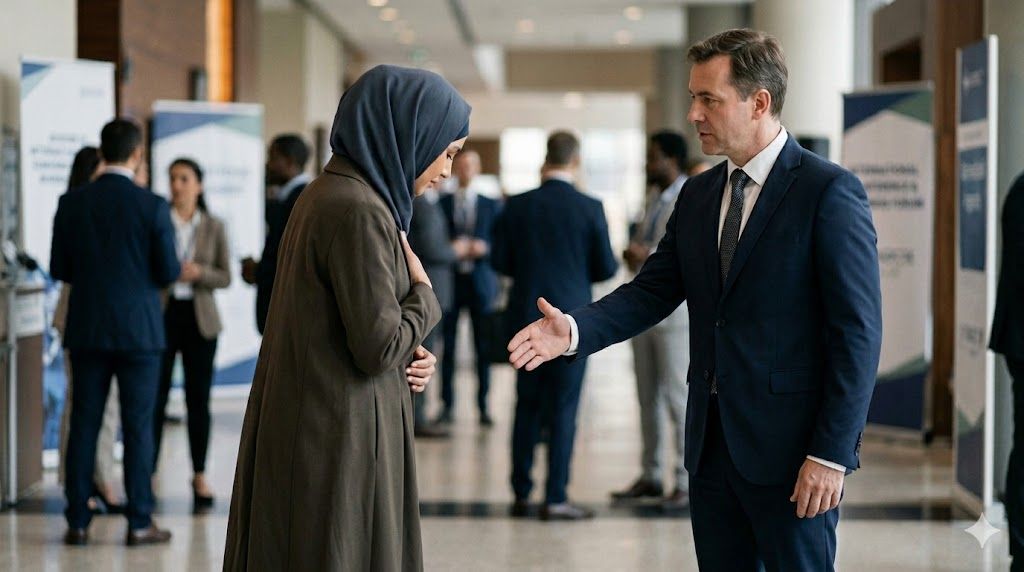
A gentleman from Morocco sent an enquiry to Hazrat Amirul Momineen, Khalifatul Masih V (aa), asking whether shaking hands with women is haram. If it is haram, with which relatives is it haram to shake hands?
In his letter dated 23 February 2024, Huzoor-e-Anwar (aa) provided the following instructions in this regard:
“Islam does not permit a man and a woman who are outside the prohibited degrees of marriage [non-mahram] to shake hands with one another. Therefore, such a man and woman should not shake hands with each other. It is also mentioned in the ahadith that the Holy Prophet (sa) would not shake hands with non-mahram women. (Sunan an-Nasa’i, Kitab al-bay‘ah, Bab bay‘ati n-nisa’)
“The Promised Messiah (as) states in this regard:
“‘Look at the righteousness of our Lord and Master, the Greatest of the Prophets, Best of the Virtuous, Muhammad, the Chosen One, peace and blessings of Allah be upon him! He would not shake hands even with chaste and pious women who came to pledge allegiance to him. Instead, he would seat them at a distance and exhort them only verbally regarding repentance.’
(Nur-ul-Quran, Ruhani Khazain, Vol. 9, p. 449)
“Hazrat Maulvi Sher Ali (ra) relates, ‘Once, the late Dr Muhammad Ismail Khan submitted to the Promised Messiah (as) that an English lady doctor worked with him in the hospital and she was an elderly woman. She would sometimes shake his hand; what was the ruling regarding this? Hazrat Sahib (as) replied, “This is not permissible. You should excuse yourself by saying that this is not permissible in our religion.”’
(Sirat-ul-Mahdi, Part 1, Narration 404, p. 362)
“Thus, Islam forbids handshaking between a non-mahram man and woman. However, where a mahram relationship exists, there appears to be no objection to a man and woman shaking hands.”
(Compiled by Zaheer Ahmad Khan, Head of Records Department, Private Secretariat, London and translated by Al Hakam)