
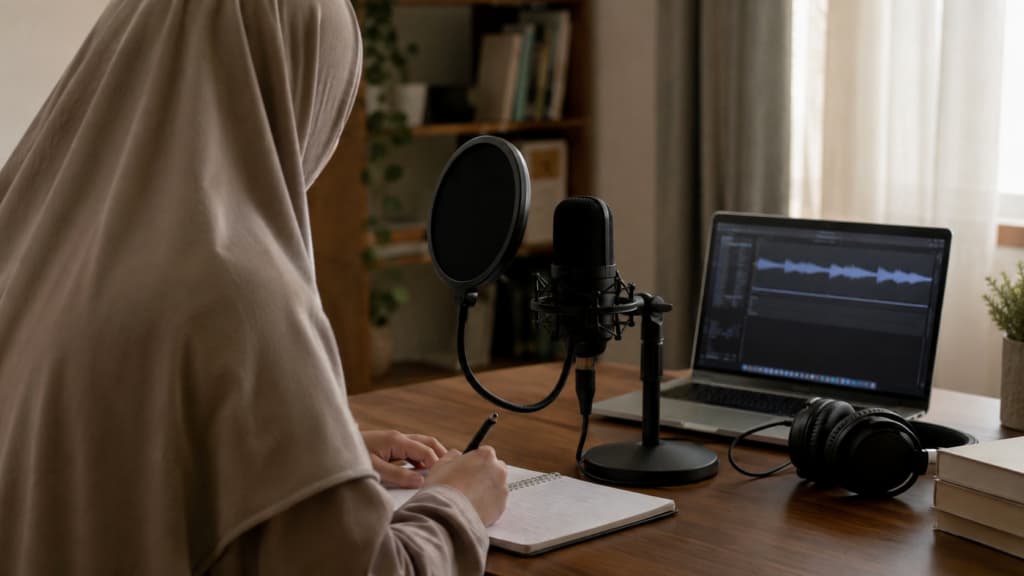
Does Islam prohibit men from hearing a woman’s voice?
A lady asked Hazrat Amirul Momineen, Khalifatul Masih V (aa), whether, in Islam, a woman’s voice is also subject to purdah. Nowadays, working as a voice-over artist or making YouTube videos using only one’s voice in the background has become very common and girls are able to benefit from this while remaining at home. She asked whether Ahmadi girls could do this kind of work.
In his letter dated 25 March 2024, Huzoor-e-Anwar (aa) provided the following guidance in this regard:
“I am not aware of any injunction in Islam that makes it categorically unlawful merely to hear a woman’s voice. If that were the case, why would the Holy Quran instruct the wives of the Holy Prophet (sa), ‘So be not soft in speech, lest he in whose heart is a disease should feel tempted; and speak a decent speech’? (Surah al-Ahzab, Ch. 33: V. 33)
“It is clear from this verse that a woman may speak to men, but her speech should be good. Even then, a woman should remain fully mindful of her purdah. She should not speak to men in a soft or alluring tone; rather, she should speak to them in a firm tone. By firmness, I mean that her voice should not be such that it unnecessarily attracts a man towards her, because this may lead men to improper thoughts.
“Furthermore, it is also mentioned in the ahadith that women used to take part in battles in the early days of Islam, where people would hear their voices. Similarly, the Companions and their successors, the Tabi‘un, would ask Hazrat Aisha (ra) and the other blessed wives of the Holy Prophet (sa) religious questions and they would answer them.
“Today, too, we see women working in various walks of life and reading the news on television channels, while men hear their voices. Therefore, as for the claim made nowadays that a woman’s voice must not be heard and that, if one hears it, molten lead will be poured into one’s ears, as some clerics narrate in a hadith, if that hadith is authentic, its meaning is that the Holy Prophet (sa) warned us against listening to the indecent voices of women engaged in singing and dancing, which incline people towards nudity, indecency and filth. However, if the voice is used for the sake of faith, such as when women recite religious poems or speak about Allah and His Messenger (sa) and such a voice reaches a man’s ears, it does not give rise to thoughts of indecency. Therefore, there is no harm in it.
“Thus, there is no harm in a woman working as a voice-over artist or providing background narration for a programme on YouTube, provided it is for a good, noble and religious purpose. However, if such use of her voice is for something indecent or satanic, it is not permitted.”
Is online forex trading halal or haram in Islam?

Someone wrote to Hazrat Amirul Momineen, Khalifatul Masih V (aa), asking whether forex trading, involving the online trading of gold and currencies, is permissible.
In his letter dated 26 March 2024, Huzoor-e-Anwar (aa) provided the following answer to this question:
“If forex trading remains confined to the buying and selling of the relevant assets, there is no harm in it and it is permissible. However, if it turns into speculative betting, as frequently happens in forex trading nowadays, then, since this is a form of gambling and gambling is forbidden in Islam, such forex trading is not permissible. Similarly, if interest-based transactions are carried out at any point or interest-based dealings become involved in forex trading, then such forex trading is also not permissible.
“Some contemporary scholars argue that forex trading is forbidden because the buyer does not obtain possession of the assets and the entire business is merely verbal and is therefore impermissible. However, if one considers the matter, most business nowadays is conducted online: A person purchases an item online from one place and sells it online elsewhere. The nature of business has completely changed in this age. The hand-to-hand transactions of earlier times can no longer take precisely the same form in most modern businesses. Instead, business dealings today are conducted through correspondence and written communication by email, which, in one sense, is itself compliance with the Islamic injunction to put business transactions into writing. Therefore, there is no harm in conducting business online when it is recorded in writing through emails and the like.
“Thus, in my view, there is no harm in forex trading so long as it does not involve interest or gambling. However, if any element of interest or gambling becomes involved in it, then it is not permissible.”
Does the Holy Quran state that the earth is flat or round?

Someone from Singapore wrote to Hazrat Amirul Momineen, Khalifatul Masih V (aa), stating, “I do not think the earth is round or that it rotates. The Holy Quran has also described the earth as flat. Similarly, I do not think the Americans went to the moon. If my view about the earth is correct, please guide me.”
In his letter dated 26 March 2024, Huzoor-e-Anwar (aa) provided the following answers to these questions:
“Where matters have already been established through knowledge and observation, have been confirmed by learned people and experts in the relevant field and are accepted by the majority of the world, a mere conjectural statement concerning those established and proven matters, such as, ‘I do not think this is so’, carries no weight. Thus, when scientists throughout the world agree that the earth is round and revolves in its orbit, on what evidence can you say that the earth is neither round nor revolves?
“Moreover, in Surah al-Anbiya, after mentioning various celestial bodies and things associated with them, such as the earth, sky, mountains, night, day, sun and moon, the Holy Quran states: كُلٌّ فِي فَلَكٍ يَسْبَحُونَ (Surah al-Anbiya, Ch. 21: V. 34), meaning, ‘each gliding along smoothly in its orbit.’
“Hazrat Khalifatul Masih IV (rh), in his book Revelation, Rationality, Knowledge and Truth, has discussed at considerable length the movements and states of various things in the universe, particularly celestial bodies. You should read the entire discussion there.
“The Promised Messiah (as) has also discussed these matters in various places. Thus, in one place, regarding the shape of the earth and its diameter, he states:
“‘The earth is spherical in shape and its diameter, according to the estimate of some, is approximately 4,000 standard kose [a kose being approximately two English miles].’ (Barahin-e-Ahmadiyya, Part IV, Ruhani Khazain, Vol. 1, p. 515, sub-footnote no. 3)”
Can a woman become a Prophet in Islam?

Someone from the USA asked Hazrat Amirul Momineen, Khalifatul Masih V (aa), with reference to verse 70 of Surah an-Nisa, whether a woman, while progressing in faith, can reach the station of prophethood, in which Allah the Exalted grants her abundant revelation, visions and true dreams, a state referred to as prophethood. Or, if a woman cannot become a prophet, what is the reason for this? Can a woman, while advancing in faith, surpass ordinary men?
In his letter dated 26 March 2024, Huzoor-e-Anwar (aa) provided the following guidance in this regard:
“Allah the Exalted has created two distinct sexes among human beings, male and female, making their physical conditions similar in some respects and different in others. He has given them some commandments that are the same and some that are different. He has also prescribed for both religious and worldly rights and duties that are similar in some respects and different in others.
“Given the difficult and important responsibilities associated with the station of prophethood, Allah the Exalted has made only men capable of bearing it and has not placed the burden of this responsibility upon women, because a woman cannot bear the burden of this office on account of her weaker faculties in comparison with a man. Accordingly, Allah the Exalted states in the Holy Quran: ‘And We sent not [as Messengers] before thee but men to whom We sent revelation, so ask those who possess the Reminder, if you know not.’ (Surah an-Nahl, Ch. 16: V. 44)
“Yes, a woman can advance in spirituality, attain nearness to Allah the Exalted and surpass many men. Thus, in the Holy Quran, Allah the Exalted has described such a lofty station for Hazrat Maryam (as) that thousands, even hundreds of thousands, of men cannot even imagine it. Accordingly, when, upon her birth, her mother expressed regret that she had given birth to a girl, Allah the Exalted stated that this girl would be far better than the boy her mother had in mind. (Surah Aal-e-Imran, Ch. 3: V. 37)
“Regarding why a woman cannot be a prophet, Hazrat Musleh-e-Maud (ra) writes:
“‘A woman is not appointed to this office for certain wise reasons. The fact is that Allah the Exalted has created men and women for different tasks. Since the office of prophethood lies outside a woman’s sphere of activity, only men are appointed to it. As for the remaining rewards, since they do not lie outside women’s sphere, women share them with men. A woman can be a siddiqah [a woman of outstanding truthfulness] and women have attained this rank. She can be a waliyyah [a saintly woman] and women have attained this rank. She can be a qanitah [a devoutly obedient woman] and women have attained this rank. In short, apart from prophethood, which is an office, women can receive all other rewards and have continued to receive them.’ (Tafsir-e-Kabir, Vol. 4, UK, 2023, p. 529)
“A question was presented to the Promised Messiah (as), the Hakam and Adl [Judge and Arbiter] of this age, as to whether a woman could be a prophetess. He replied:
“‘No. Allah the Exalted states, الرِّجَالُ قَوَّامُونَ عَلَى النِّسَاءِ, “Men are guardians over women” (Surah an-Nisa, Ch. 4: V. 35) and وَلِلرِّجَالِ عَلَيْهِنَّ دَرَجَةٌ, “but men have a rank above them” (Surah al-Baqarah, Ch. 2: V. 229). Women are, in fact, subordinate to men. When a door has been closed to those who possess rank and status, then where do these poor women, who are weaker in mental strength, stand?’ (Malfuzat, Vol. 5, UK, 2022, p. 65)
“Thus, prophethood is an office that carries many responsibilities. Therefore, in view of men’s stronger faculties, Allah the Exalted has chosen them for this office. A woman, being of a more delicate physical constitution, cannot bear the burden of discharging the duties of this office and so she has not been charged with it.”
Feminism, letters to Huzoor (aa), piety, Surah Bani Isra’il, Surah Fil, music
Someone from Canada sent the following enquiries to Hazrat Amirul Momineen, Khalifatul Masih V (aa):
(1) What does Islam say about feminism and is there any connection between Islam and feminism?
(2) When people are told to write to Huzoor (aa) about their problems, some say that Huzoor (aa) does not have time for such matters. What should one say in response?
(3) I write one or more letters to Huzoor (aa) every day. Does this displease you?
(4) When people say that, in order to establish a relationship with Allah, a person must give up their own desires and wishes, what does this entail?
(5) Is verse 5 of Surah Bani Isra’il about the current situation in Palestine?
(6) Is there a prophecy in Surah al-Fil?
(7) Why does Islam discourage music?

In his letter dated 31 March 2024, Huzoor-e-Anwar (aa) provided the following guidance in this regard:
“1. The answer to your first question is that Islam has explained in great detail the rights and duties of both men and women in accordance with their respective responsibilities. Regarding this worldly life, it states: وَلَهُنَّ مِثْلُ الَّذِي عَلَيْهِنَّ بِالْمَعْرُوفِ (Surah al-Baqarah, Ch. 2: V. 229), meaning, ‘And they [the women] have rights similar to those [of men] over them in equity.’ Furthermore, men have been commanded concerning women: وَعَاشِرُوهُنَّ بِالْمَعْرُوفِ (Surah an-Nisa, Ch. 4: V. 20), meaning, ‘and consort with them in kindness.’ However, alongside this, because of certain responsibilities assigned to men in this worldly life, Islam also recognises that they have a degree of advantage over women, as it states: ‘Men are guardians over women because Allah has made some of them excel others and because they [men] spend of their wealth.’ (Surah an-Nisa, Ch. 4: V. 35) Similarly, it states that men have a rank above them. (Surah al-Baqarah, Ch. 2: V. 229)
“Regarding the life of the Hereafter, it states: مَنْ عَمِلَ صَالِحًا مِنْ ذَكَرٍ أَوْ أُنْثَى وَهُوَ مُؤْمِنٌ فَلَنُحْيِيَنَّهُ حَيَاةً طَيِّبَةً وَلَنَجْزِيَنَّهُمْ أَجْرَهُمْ بِأَحْسَنِ مَا كَانُوا يَعْمَلُونَ (Surah an-Nahl, Ch. 16: V. 98), meaning, ‘Whoso acts righteously, whether male or female and is a believer, We will surely grant him a pure life; and We will surely bestow on such their reward according to the best of their works.’
“Thus, both men and women have their respective station in Islam and each has an important role in society. This is why Islam has explained in great detail the rights and duties of both women and men. If both men and women act upon these teachings of Islam, their life in this world also becomes a paradise and no conflict over rights arises between them.
“In several of my addresses at the annual conventions of the UK and Germany, I have discussed these subjects in great detail in relation to the rights and duties of men and women, in light of the Holy Quran, the ahadith of the Holy Prophet (sa) and the statements of the Promised Messiah (as). You should listen to those again.
“2. The answer to your second question is that people continue to write to me about various matters and I reply to them. Many of these replies are also published in Al Fazl and Al Hakam in Urdu and English. If you have a serious matter in mind, you may write as well. The answer will benefit you and others will also be able to benefit from it.
“3. Regarding your question about writing to me, it is very important to observe moderation in writing letters. If there is an important matter, you should certainly write. However, as for an ordinary letter requesting prayers, you should write one once a month.
“4. Your next question is that when people say that, in order to establish a relationship with Allah, a person must give up their own desires and wishes, what does this entail? The answer is that the most important and fundamental thing in establishing a relationship with Allah the Exalted is to live in accordance with His pleasure. Therefore, one should act upon what God the Exalted has commanded and must abandon the evils He has forbidden.
“5. The answer to your next question is that the Holy Quran is a complete and comprehensive Book. It contains spiritual teachings for humankind until the Day of Judgement and events that are to occur in future ages have also been indicated allusively in the form of prophecies. Surah Bani Isra’il describes the future circumstances of the Jews and the Muslims in accordance with their respective conditions. Hazrat Musleh-e-Maud (ra) has explained this in detail in Tafsir-e-Kabir. That is why I instructed the jamaats throughout the world to deliver durus on this section of Tafsir-e-Kabir in their respective jamaats, so that members of the Jamaat may become aware of it and strive to mould their state of faith in accordance with Islamic teachings.
“6. The answer to your question regarding Surah al-Fil is that there certainly is a prophecy concerning a future age in Surah al-Fil. It states that in the Latter Days, anti-Islam powers will once again rise in strength and attempt to destroy Islam. However, just as in the past Allah the Exalted protected His House and utterly destroyed the enemy that attacked it, in the future too Allah the Exalted will protect His religion and thwart its opponents. But for this, Muslims need to change their own condition. Until Muslims mould their conditions in accordance with Islamic teachings and respond to the call of the Messiah of Muhammad (sa), sent by God the Exalted, they will continue to suffer defeat at the hands of anti-Islam powers.
“Hazrat Musleh-e-Maud (ra), in his commentary on Surah al-Fil in Tafsir-e-Kabir, has discussed this prophecy in detail. You can read the details there.
“7. The answer to your question about music is that music has been discouraged because when a person becomes immersed in music, they become heedless of Allah the Exalted and wrong thoughts arise in their heart. Islam has included it among vain pursuits. The Holy Quran has stated that one of the signs of a good believer is that they ‘shun all that which is vain’. (Surah al-Mu’minun, Ch. 23: V. 4) However, there is no harm in occasionally listening to good, wholesome music.”
(Submitted by Ehsan Ahmad, Murabbi-e-Silsilah, Private Secretariat, Islamabad and translated by Al Hakam)