
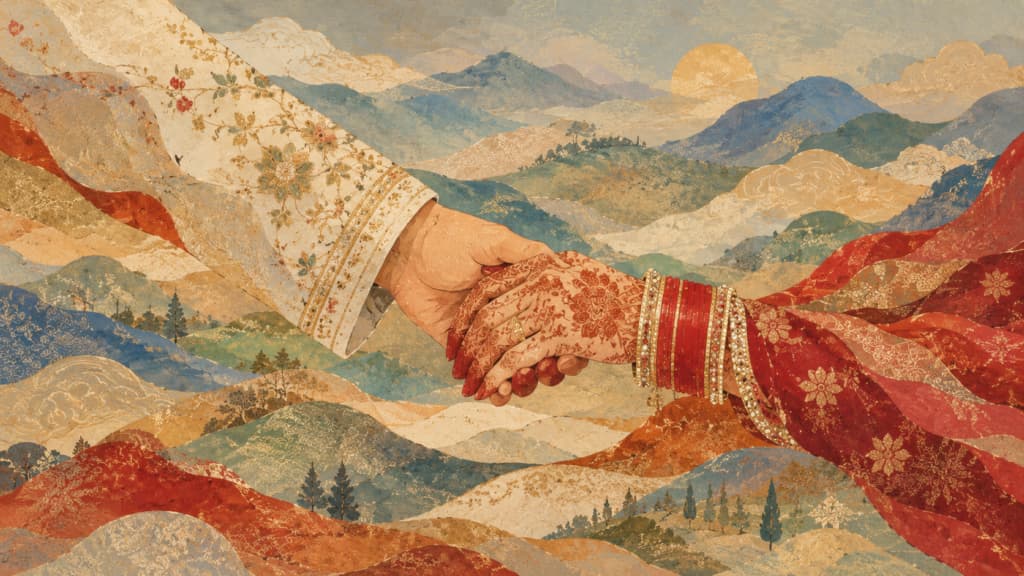
Among the many misconceptions spread about Islam today, one stands out as particularly persistent: the claim that “Islam permits forced marriage.” There is only one right answer – Islam does not permit forced marriage. Yet the misconception continues, often because it is tangled up with cultural practices that have little to do with the religion itself. Untangling that knot is the purpose of this article.
Islam is a religion rooted in logic and reasoning. When God prescribes a rule for believers, He does so because, being All-Knowing and All-Wise, He knows what is best for them, and the rule therefore carries divine guidance. With this in mind, it is worth understanding why Islam discourages dating between men and women in the first place. In the Holy Quran, Allah says, “And come not near unto adultery; surely, it is a foul thing and an evil way” (Surah Bani Isra’il, Ch.17: V.33). He also says, “Say to the believing men that they restrain their eyes and guard their private parts. That is purer for them. Surely, Allah is well aware of what they do” (Surah an-Nur, Ch.24: V.31). While dating is not named explicitly in these verses, the underlying principle is clear: when a man and woman enter a private relationship without the knowledge or involvement of others, it can open the door to sin. The Five Volume Commentary explains this further, noting that the Quran does not merely prohibit adultery itself but seeks to close off every avenue that leads to it, including the free and promiscuous intermingling of the sexes. (Five Volume Commentary, Surah Bani Isra’il, Ch.17: V.33)
This is the context in which Islam encourages arranged marriage, a practice that should never be confused with forced marriage. Arranged marriages aim to protect men and women from illicit relationships that can lead to heartbreak, emotional harm and dishonour to their families. In practice, this is fairly simple: the family of a prospective groom may express interest to the prospective bride’s family – or vice versa – and the two families get to know one another within Islamic boundaries, all while praying for the success of the union through istikharah – the prayer for guidance towards the best outcome in any matter. Only once the man and woman freely and happily consent does the relationship move towards engagement or nikah, the Islamic marriage ceremony.
That word consent is the crux of the matter. In the 12 June 2026 episode of This Week With Huzoor, Hazrat Khalifatul Masih V (aa) addressed this directly: “One blessing that Allah the Almighty has granted to us as Muslims is that we can pray so that Allah the Almighty makes that proposal good for us […]. However, if a clear feeling of aversion develops in your heart, then regardless of what your parents may say, you should say ‘I do not wish to proceed.’” (“This Week With Huzoor – 12 June 2026”, mta.tv, 12 June 2026) This guidance is clear. It does not merely permit refusal as a technicality; it instructs the individual to act on their own conscience, even in the face of parental wishes. A religion that builds this instruction into its guidance for marriage cannot, in the same breath, be said to endorse forced marriage.
It would be easy to stop here and simply say that forced marriage is “culture, not Islam” and move on. But that response, while true, does not fully address why the misconception persists in the first place. The honest reality is that in some communities across the Middle East, South Asia and beyond, the line between “arranged” and “forced” becomes blurred in practice. A young woman may technically have the religious right to say “I do not wish to proceed”, but if exercising that right means facing social shame, family conflict or being ostracised, then the freedom granted to her in principle is not always the freedom she experiences in practice. This is precisely the gap that critics are pointing to – and it is a real gap, even if it is a cultural failure rather than a religious one. Islam’s teaching is unequivocal that no marriage is valid without genuine, free consent from both parties. (Sahih al-Bukhari, Kitab an-nikah, Hadith 5136) Where that teaching is not honoured, the fault lies with the people and cultures who have layered their own customs and pressures on top of the religion, not with the religion itself.
The Holy Prophet (sa) further guided believers on what to prioritise in marriage, saying, “A woman is married for four things, i.e., her wealth, her family status, her beauty and her religion. So you should marry the religious woman (otherwise) you will be a loser.” (Sahih al-Bukhari, Kitab an-nikah, Hadith 5090) By favouring arranged marriage over dating, Islam encourages a person to choose a spouse based on character and faith rather than appearance or wealth alone, recognising that a relationship built on trust, love and the fear of Allah is far more likely to succeed than one built on looks or money.
Some in wider society view the avoidance of dating and the preference for arranged marriage as evidence that Muslims are “backwards” or stuck in outdated traditions. In reality, this system exists to shield both men and women from unnecessary stress, heartbreak and pressure while ensuring that no marriage proceeds without the genuine, mutual consent of both parties. Far from enabling forced marriage, it is precisely this emphasis on consent that protects individuals from being pushed into a union for the sake of family or societal expectations, leaving the marriage free to serve its true purpose: to please Allah and to build a bond of love and companionship between two people who choose, of their own free will, to become each other’s life partners.
So the next time someone claims that Islam permits forced marriage, the answer should be clear: because of Islam’s teachings, no Muslim is ever meant to be forced into marriage.