
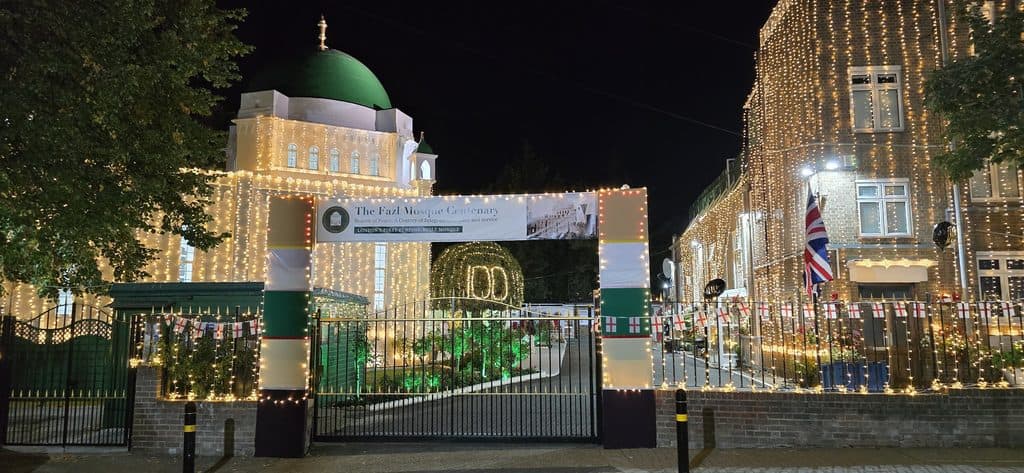
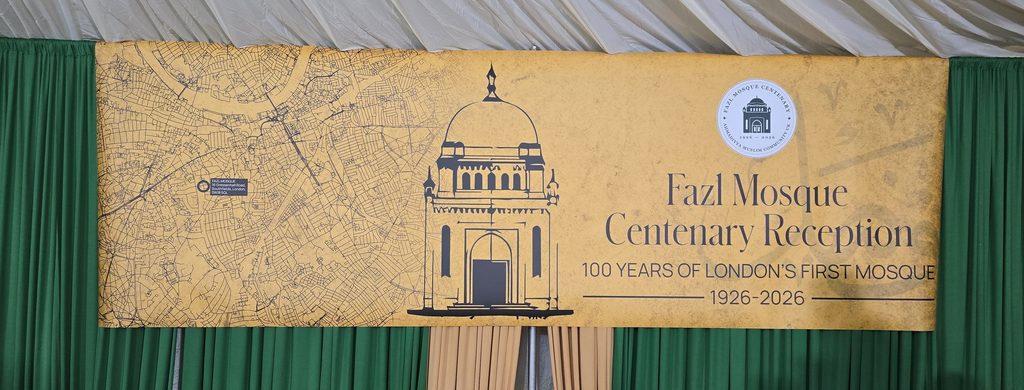
The Fazl Mosque, London’s first mosque, reached its historic centenary on 3 October 2026. A special event titled “Fazl Mosque: Beacon of Peace” was held to commemorate this milestone.
Two years earlier, the mosque had commemorated the historic visit of Hazrat Khalifatul Masih II (ra) to the UK in 1924, during which he laid the foundation stone of the Fazl Mosque. On 3 October 1926, exactly 100 years earlier, the mosque was formally inaugurated by Sheikh Sir Abdul Qadir, with Hazrat Maulvi Abdur Rahim Dard (ra) serving as the Jamaat’s missionary and imam in London at the time.
Street party
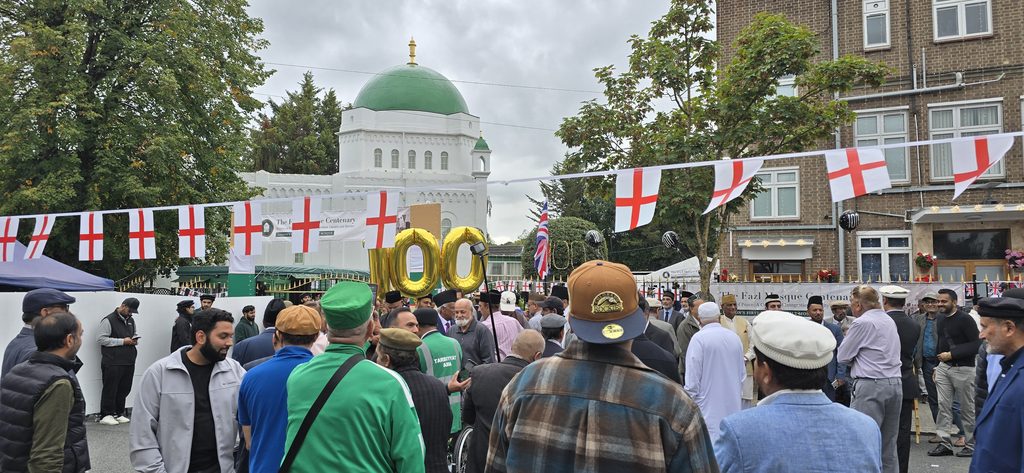
The event started early in the morning with congregational Tahajjud prayer at 4:45 am. In the afternoon, a street party took place from 2:00 pm to 4:40 pm and both community members and neighbours were encouraged to attend. The street party featured a variety of activities organised in separate areas for men and women.
External guests
As the street party came to an end, the next programme commenced. Around 5 pm, external guests began arriving. Upon entering the complex, the guests were registered, received an overview of the programme and were led on a tour by guides. Light refreshments were served during this time. The guides provided a detailed introduction to the Jamaat and took the guests to an informative exhibition set up in Mahmud Hall.
Exhibition
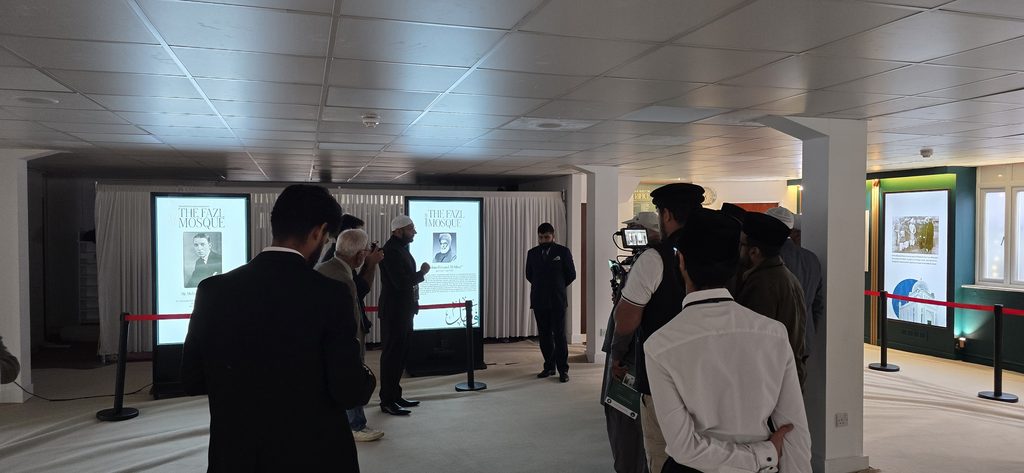
The exhibition was beautifully organised and explored the deep historical roots of the Fazl Mosque. New screens have been installed on either side of Mahmud Hall and some rare relics are also being displayed. For those who were unable to attend the event, you’ll be pleased to know that the exhibition will be open from 4 to 31 October 2026.
Main event
The formal session commenced at approximately 7:15 pm with the recitation of the Holy Quran by Usman Shehzad Butt Sahib. The English translation was presented by Bilal Atkinson Sahib.
Rafiq Hayat Sahib, Amir Jamaat UK, welcomed the guests and introduced the event. He spoke about the significance of the mosque and the history of the complex. He highlighted the contributions of Sir Chaudhary Zafrulla Khan Sahib (ra) to the mosque, particularly the construction of the Mahmud Hall. He described how the mosque transformed with the arrival of Hazrat Khalifatul Masih IV (rh) and how the role of the building evolved, including the establishment of MTA.
He noted that Hazrat Khalifatul Masih V (aa) was elected as the Khalifa in this very mosque in 2003 and resided here until moving to Islamabad, Tilford, in 2019. The mosque has been the centre of 150 branches in the UK, each stemming from this building and has served as a hub for dialogue long before any similar space existed.
He concluded by expressing gratitude to the neighbours, guests, council members and volunteers.
Amir Sahib read a message from the Prime Minister and a message from King Charles’s office. This was followed by a video showcasing the history of the mosque.
The first guest speaker was Colleen Harris, MVO DL, the Deputy Lieutenant of Greater London. She spoke on the mosque’s role in uniting people. Stating that the mosque was a reminder that Islam and muslims have been a part of British life for generations. Additionally, she highlighted that King Charles had spoken many times of the importance of understanding between different faiths. She ended by saying that may the London Mosque continue for another 100 years to be a house of prayer, learning and friendship.
The second guest was Councillor Emmeline Owens, the Mayor of Wandsworth. She expressed her delight that the council had recently recognised the history of the mosque by awarding it the Green Heritage Plaque. The Mayor then highlighted the various humanitarian services provided by the members of the community, reflecting the community’s motto: “Love for all, hatred for none.” She concluded by thanking the Jamaat on behalf of Wandsworth.
The third speaker, Dhruv Patel, OBE, CVE, serves as the High Sheriff of Greater London. He holds a non-political office; one of its modern purposes is to recognise contributions made quietly by individuals and organisations. Mr Patel awarded the High Sheriff Special Recognition Award to the Ahmadiyya Muslim Community, which was received by Amir Rafique Hayat Sahib.
Luke Taylor MP, the fourth speaker from the Liberal Democrat Party, emphasised the importance of defending the rights of others. He highlighted the persecution faced by the Jamaat Pakistan and described how the mosque has served as a refuge for those fleeing oppression. He also shared his opportunity to meet Hazrat Kahlifatul Masih V (aa) in Islamabad. Additionally, he spoke about Huzoor’s (aa) message of peace, justice and compassion and expressed gratitude to the Jamaat for its contributions.
The final speaker was Dame Siobhain McDonagh, DBE, MP, the Member of Parliament for Mitcham and Morden. She reflected on the challenges and achievements of establishing a mosque in this part of London 100 years ago. This ties into the rich history, particularly as her own church is approaching its 60th anniversary, prompting thoughts about all those who have played a role, including family and loved ones. She emphasised that it was the sacrifices made by the women in the community that led to the creation of the mosque and she concluded by congratulating the Jamaat.
Keynote address by Hazrat Khalifatul Masih V (aa)

The event took place at the historic mosque, where external guests and members of the Community gathered to commemorate this significant milestone. Hazrat Mirza Masroor Ahmad, Khalifatul Masih V (aa), delivered the keynote address from Islamabad, UK. The recorded video of the address was played at 20:15 GMT. A brief summary of Huzoor’s (aa) address is as follows:
A true mosque
Huzoor (aa) drew attention towards the history of the mosque and how, 100 years ago, there were certain reservations in relation to Muslims. Regrettably, after a century, such fears about Islam and Muslims have only increased.
“This is a source of grief and deep regret for true Muslims, because the purpose of a mosque is simply to serve as a place where people can gather to worship God Almighty and draw closer to Him. A mosque inspires those who enter its doors to serve others and fulfil the rights of all mankind. Consequently, rather than being a source of conflict, a true mosque is built to foster peace and harmony in the local community and the wider world ”
True teachings of Islam
Huzoor (aa) recalls how allegations are made against Islam for being a religion of extremism and terrorism. Critics allege that early Muslims fought battles to achieve their interests. However, the true historical context is lacking.
Highlighting the history of the early Muslims, Huzoor (aa) relates how they were brutally persecuted and had to migrate after many years to worship in peace. The persecutors pursued the Muslims and it was only then that Allah permitted the Muslims to fight back against the aggressors.
God Almighty granted this permission since the aggressors desired to eliminate Islam and end religious freedom for all. The Quran states that had the Muslims not defended themselves, no mosque, church or synagogue would have been safe.
“No true mosque can ever be a source of harm or disorder. Any mosque used to spread extremism or fuel intolerance directly violates Islam’s teachings and is to be condemned in the strongest possible terms.”
Huzoor (aa) relates how a mosque-like structure was established in early Islam to incite division and rebellion in society. That building was demolished by the Holy Prophet (sa).
The Ahmadiyya Muslim Community
Hazrat Amirul Momineen (aa) spoke about the Ahmadiyya Muslim Community and how we always sought to spread peace. These efforts are not limited to words, as we have been friendly with all nations and faiths around the world.
“Islam teaches us that religion and belief is a matter of the heart. No one has the right to force or coerce another person to adopt their faith, beliefs or values.”
Huzoor (aa) continued that we believe in the right to worship for all religious people and, as such, will always be grateful to the people of this nation for allowing us to open mosques in various towns and cities. The first of these mosques is the Fazl Mosque, where you are gathered today.
Upon laying the foundation of the mosque in 1924, the second Khalifa of our Community reiterated that:
“All mosques are built for the worship of the one God and expressed his hope that the love of God Almighty would infuse the hearts of those who entered its doors.”
True peace
Delving into the rights of a believer, Huzoor (aa) spoke about how Muslims are taught to respect all religions and to defend all faiths and beliefs. True peace cannot be established without acting upon the principles of all major religions. Every prophet, Prophet Moses (as), Prophet Jesus (as) and the Holy Prophet Muhammad (sa), brought a message of peace to the world.
Huzoor (aa) again expressed his profound respect for all religions and our belief that all people should have the right to worship and practice their religious teachings
Hazrat Khalifatul Masih II (ra) stated regarding the Fazl Mosque: “That any person who desired to worship God was permitted to do so in the Fazl Mosque as long as they did not violate the rules of the premises or did not seek to interfere with the religious worship of those who had built the mosque.”
World War
Huzoor (aa) then reminded people of the looming world crisis and how people have forgotten the horrors of the first two world wars.
“With all my heart, I pray that instead of hurtling toward such a calamitous war, the world governments and leaders see sense before it is too late and do whatever they can to bring about peace.”
The spirit of our mosques
Huzoor (aa) highlighted that when we build mosques, we do so with the intention of fostering peace and mutual sympathy in the local community. We believe that, irrespective of differences, people should live with respect and understanding. The Holy Quran states:
“There should be no compulsion in religion.” (Surah al-Baqarah, Ch.2: V.257)
The 100-year history of the Fazl Mosque bears witness to this fact and so does all of our mosques. This spirit of openness is inherent to who we are. Huzoor (aa) then gave the example of the Jalsa Salana, a 3-day convention that takes place once a year in Hampshire. The Jalsa breaks down the barriers between people and fosters peace.
Rights of our children
Regrettably, many world leaders are taking the world towards destruction. Remember the horrors of the previous world wars and how they came to an end. Given technological advancement, one can not estimate the level of suffering and bloodshed if conflicts were to escalate.
“Today we must not think only of fulfilling our objectives or desires, but we must consider and prioritise the rights and needs of our children and future generations.”
Followers of all religions should seek to follow their original teachings, since all prophets of God sought to bring mankind towards peace and tolerance.
Fazl Mosque
Huzoor (aa) then reiterated that all of our mosques, be it in any part of the world, are a symbol of peace and compassion.
“With the grace of God, for the past century, the Fazl Mosque has always manifested peace and compassion and, God willing, shall forever continue to reflect these noble values.”
Huzoor (aa) then reminded the Ahmadis to conduct themself in a way that testifies to Islam’s teachings.
At the end, attendees were led in silent prayer, after which dinner was served.
(Report prepared by Al Hakam)