
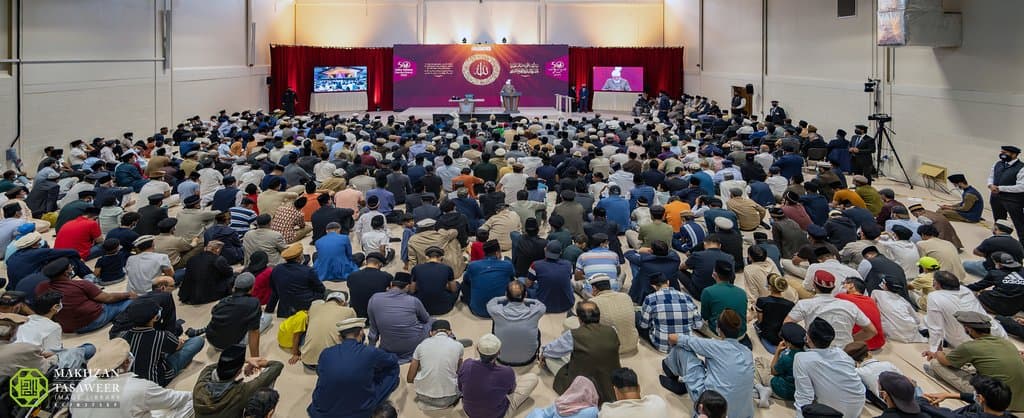
Islamabad, Tilford, 6 September 2026: At 14:35 GMT, Hazrat Mirza Masroor Ahmad, Khalifatul Masih V, may Allah be his Helper, entered Masroor Hall to chair the final session of Jalsa Salana Germany 2026, which is taking place in Mendig, Germany this weekend.
Huzoor (aa) invited Hafiz Awais Qamar Sahib to recite a portion of the Holy Quran (Surah al-Mu’minun, Ch.23: V.1-12), marking the beginning of the session. Safwan Ahmad Malik Sahib presented the Urdu translation of the Quranic verses recited and Danny Söder Sahib read out their German translation. After this, Ahmad Kamal Sahib presented an Urdu poem of the Promised Messiah (as). (Barahin-e-Ahmadiyya Part V [English], p. 155)
Huzoor (aa) then asked the National Secretary Talim to announce the names of Ahmadi students who had exceptional academic and educational achievements.
Huzoor (aa) then began his address, a summary of which is presented below.
Reflect on the conditions of bai‘at
The conditions of bai‘at are 10 in number, but if one looks at the matters toward which attention has been drawn in them in detail, they amount to approximately 34 important points. They draw attention to everything from shirk to all the fundamental religious matters. They also direct attention towards removing moral weaknesses, eliminating spiritual weaknesses and raising the standards of obedience.
The Promised Messiah (as) stated in very clear terms that if one has taken bai‘at, then an Ahmadi should be bound by these matters. Only then will we be able to establish a pure Ahmadi society – a society that acts upon the true teachings of Islam. Otherwise, our claim of being Ahmadi will remain nothing more than a claim.
Today, in the developed world, where the existence of Allah the Almighty is given a secondary status and in some places even denied; where the outward glitter and material progress of the world are given greater importance, we need to forge a special relationship with Allah the Almighty and reflect deeply upon these conditions of bai‘at and act upon them in order to improve our religious and spiritual condition.
Avoid shirk
Shirk is a very great sin. Without safeguarding oneself against it, one cannot attain perfect faith, nor can a person be called a true Muslim or a muwahhid – i.e. one who believes in the Oneness of Allah the Almighty.
Allah the Almighty states in the Holy Quran:
“Surely, Allah will not forgive that any partner be associated with Him; but He will forgive whatever is short of that to whomsoever He pleases. And whoso associates partners with Allah has indeed devised a very great sin.” (Surah an-Nisa, Ch.4: V.49)
Then it becomes evident that when – out of fear of society – we begin to feel ashamed of acting upon the teachings of Islam, the ultimate result of that shame is that we continue to drift farther away from Allah the Almighty and do not act upon His teachings. Due to worldly concerns, we forget our religious obligations and even fail to offer our prayers on time.
Once, a man asked the Holy Prophet (sa) which deed would lead one to paradise. He (sa) replied, “Worship Allah and do not associate anyone with Him, offer the prescribed prayers, pay the obligatory Zakat and observe the fasts of Ramadan.”
Upon hearing this, the questioner swore to abide by these teachings and do no more. When the man had left, the Holy Prophet (sa) said, “Whoever wishes to see a man from among the people of Paradise should look at him.” (Sahih Muslim, Hadith 8)
We should examine ourselves: if we do not observe these deeds, then this is a matter of great concern.
The Holy Prophet (sa) once said, “There is no servant who affirms that there is none worthy of worship except Allah and then dies steadfast upon that affirmation but he will enter paradise.” Upon being asked whether this would also apply to someone who committed adultery or theft, the Holy Prophet (sa) replied in the affirmative. (Sahih al-Bukhari, Hadith 5827)
The teaching of kalimah is precisely this: raise your spiritual standards, elevate your moral standards and purify yourself from every kind of evil. This declaration in its true sense means that the one who professes it has subdued his own self and its desires before the commandments of Allah the Almighty; at the time of death, no trace of shirk remains in his soul.
Such a person is steadfast upon perfect tawhid only when he has the fear of Allah the Almighty and certainty in Allah the Almighty, because such a person certainly cannot commit sin, because as soon as he understands the true spirit of tawhid, he abandons evil.
A Christian priest once raised an objection that the teaching of the Holy Prophet (sa) is that merely saying the kalimah removes sins. The Promised Messiah (as) replied to this allegation and wrote:
“This indeed is the truth that whosoever considers only God to be One without partner, and believes that Muhammad, the Chosen One, peace and blessings of Allah be upon him, has been sent by the same Omnipotent and Unique God, then without any doubt if such a person meets his end upholding this belief, he will surely attain salvation. There is absolutely no salvation under the heavens through the suicide of someone else.” (The Light of the Holy Quran, p. 118)
He further said:
“However, to hold the belief that God is One and has no partner, and that He is so Compassionate that – showing great mercy – He sent His Messenger, whose name is Muhammad, the Chosen One, peace and blessings of Allah be upon him, to deliver the world from its error is such a doctrine that believing in it dispels the darkness of the soul, egotism is eliminated, and Tauhid [Oneness of God] takes its place. And, ultimately, the passion of Tauhid so engulfs the heart that the life in Paradise begins in this very world.” (Ibid.)
The Promised Messiah (as) said:
“Just as you see that darkness cannot survive when light arrives, in the same way, when the luminosity of لا إلهَ إِلَّا الله falls upon a person’s heart, all the passions of the darkness of the ego become, as if, extinct. The reality of sin is none other than that there should be a cacophony of egoistic passions mixed with rebellion, and a person is labelled a sinner when he is in the state of subservience to them. And the meanings of لا إلهَ إِلَّا الله that we understand from the usage of Arabic lexicons are:
لَا مَطْلُوبَ لِي وَ لَا مَحْبُوبَ لِي وَلَا مَعْبُودَ لِي وَ لَا مُطَاعَ لِي إِلَّا اللهُ
“Meaning that, with the exception of God, there is none whom I desire, or whom I love, or whom I worship, or whom I obey. Now, it is clear that these meanings are completely at odds with the essence of sin and the real source of sin. Therefore, the person who allows these meanings to occupy his soul with heartfelt sincerity, the meaning counter to it [i.e. submitting to false idols] will, of a necessity, leave his heart, because two opposites cannot coexist at one place.
“Thus, when egoistic passions get purged, then this is precisely the state that is called true piety and real righteousness. And the need to believe in the one sent by God – which is the purport of the second part of this declaration of faith – is that faith in God’s word should also be attained. This is because it is necessary for anyone who declares that he wishes to become obedient to God, that he should also believe in His commandments. And it is not possible to believe in His commandments without believing in the person through whom the commandments came into the world. This is the true purport of this declaration of faith.” (Ibid.)
Safeguard yourself from unlawful glances
Nowadays, opportunities for lustful glances have become extremely widespread and immodesty has reached an extreme that whether online or in real life, there are avenues at every step which can cause a person to look at inappropriate things and immoral content. By watching such wrong things, a person eventually becomes immersed in that evil.
The Holy Prophet (sa) said that a person commits adultery with the eye as well as with the tongue. The adultery of the eye is looking at improper things and the adultery of the tongue is engaging in improper talk. (Sahih al-Bukhari, Hadith 6243)
Thus, every Ahmadi needs to protect himself from these things and reflect upon them very carefully.
Regarding guarding oneself from lustful glances, the Promised Messiah (as) writes:
“Whosoever does not repent of every vice and every evil deed, such as drunkenness, gambling, lustful glances, deceit, bribery and every misappropriation, is not of my community.” (Noah’s Ark, p. 31)
Fulfill the rights of your spouse
The Promised Messiah (as) also stated:
“Every husband who deceives his wife, and every wife who deceives her husband, is not of my community.” (Ibid.)
It is the husband’s duty to fulfil the rights of his wife and it is likewise the wife’s duty to fulfil the responsibilities of the home. Likewise, the Holy Prophet (sa) once said that a woman who fulfils the responsibilities of her home, looks after her children and takes care of her husband’s household is worthy of reward in the same way that one who strives in Jihad becomes worthy of reward through that striving. (Shu‘ab al-Iman, Hadith 8742, Vol. 6, p. 420)
Suppress carnal passions
Once, two men were sitting in the presence of the Holy Prophet (sa) when one of them began angrily abusing the other and his face had turned red with anger as they quarrelled. The Holy Prophet (sa) was witnessing this and said that if they sought refuge with Allah from Satan, their anger would certainly dissipate.
Thus, this is also a remedy that every Ahmadi should try and see how we can be delivered from the hold of Satan.
Shun wickedness and immorality
“Thus is the word of thy Lord proved true against those who rebel, that they believe not.” (Surah Yunus, Ch.10: V.34)
Similarly, the Holy Prophet (sa) stated:
“No person should accuse another person of fisq (wickedness) nor accuse him of disbelief. If the person who has been accused is not as he has been accused, then that accusation returns upon the one who made it.” (Sahih al-Bukhari, Hadith 6045)
To safeguard oneself from this evil, the Promised Messiah (as) stated at one place:
“So remember that perfect love of God can only be developed through voluntary acts of worship. As a result of this, God states: ‘I become the sight of My believing servants who are close to Me’, that is to say that the sight of such people is directed exactly in the direction that God wills.
“One who is sincere and true to God does not wait for death and is never heedless of the Divine. Then God Almighty states that He becomes the ears of such people. This means that wherever Allah, His Messenger or His Book are being dishonoured and denigrated, they become averse and displeased with such gatherings and leave at once. They cannot hear such things and do not pay heed to anything that is contrary to the will of Allah Almighty or against His command. They do not sit in the sorts of gatherings aforementioned.” (Malfuzat [English], Vol. 3, pp. 92-93)
Therefore, we need to examine ourselves – do we try to protect ourselves from such vain and useless things? If not, then these things will lead us towards wickedness and immorality. Only when we remain within the protection of these teachings and safeguard ourselves from sins will Allah the Almighty hear our prayers.
Speaking about the acceptance of prayers and the reformation of one’s deeds, Hazrat Musleh-e-Maud (ra) once explained this in detail, stating that although people deceive other people, it is astonishing that some people even try to deceive Allah the Almighty. They do not realise that Allah the Almighty is the Knower of the Unseen. He knows everything.
People do not fulfil the covenant they have made with Allah the Almighty, yet they expect Allah to fulfil His covenant with them. Allah the Almighty has indeed said that He accepts prayers. But before saying that, He also asks that we purify ourselves and become righteous. (Khutbat-e-Mahmud, Vol. 4, p. 82)
Therefore, it is not enough to say, “We are Muslims, so it has become Allah’s duty to listen to everything we ask.” This is neither the case nor can it be. Indeed, Allah the Almighty is ar-Rahman – the Gracious. By virtue of His attribute of Rahmaniyyat, He provides everyone with the necessities of life, even if they are disbelievers or atheists.
But beyond that are the manifestations of His attribute of Rahimiyyat – His Mercy. Those are shown only to the people who not only listen to Allah the Almighty but also act upon His commandments. It cannot be that we harbour malice, resentment, enmity and all kinds of evil towards people; and still expect Allah the Almighty to treat us as He treats righteous Muslims.
Avoid betrayal and fulfill covenants
Allah states in the Holy Quran:
“O ye who believe! Do not betray Allah and the Messenger, lest you knowingly become traitors to your own trusts.” (Surah al-Anfal, Ch.8: V.28)
The Promised Messiah (as) writes that “‘Libasut-taqwa’ [raiment of righteousness] is an expression of the Holy Quran, and this is an indication that spiritual beauty and adornment are indeed born out of taqwa. And taqwa means that man should abide by all of God’s trusts and pledges of faith, as well as all one’s trust and pledges towards God’s creatures to the best of one’s capability, which is to say that he should firmly adhere to their subtlest and minutest aspects.” (Barahin-e-Ahmadiyya Part V [English], pp. 290-291)
The covenant we have made with Allah the Almighty is the bai‘at of the Promised Messiah (as), in which we pledge to be regular in offering our prayers; not commit shirk; observe voluntary prayers; speak the truth; keep ourselves pure from sins; guard against lustful glances; not engage in wickedness and immorality. These are all the covenants and trusts that we are required to fulfil. Otherwise, we will be counted among those who do not honour their covenants and safeguard their trusts.
Pay back loans
A loan is also a trust and it is necessary to repay it. That is why Allah the Almighty has commanded that debts should be repaid promptly.
The Holy Prophet (sa) himself would not lead the funeral prayer of a person who had an unpaid debt when no one took responsibility for paying it. Rather, he would tell the Companions to offer the funeral prayer. (Sahih al-Bukhari, Hadith 2298)
In the sight of Allah the Almighty, a debt is also a trust, and fulfilling it is essential. By failing to fulfil a trust, by disobeying the command of Allah the Almighty, by neglecting our duty and by failing to repay our debts, we become a cause of disorder in the world.
Allah the Almighty says in the Holy Quran:
“And who are watchful of their trusts and their covenants.” (Surah al-Mu’minun, Ch.23: V.9)
This indicates that those who safeguard their trusts and fulfil their covenants are the truly perfect believers.
Maintain purdah
Likewise, in relation to women, there are improper opportunities that arise for men. That is why Islam has also commanded purdah (modesty and veiling). In Western society, some people object to this command. They ask why Allah the Almighty has instructed women to observe the veil and segregate from men.
The reason is that when such mixing takes place, situations arise in which men’s thoughts gradually become impure. If these limits are not observed, impure thoughts continue to develop. Then such situations arise through which we have seen even well-established families destroyed and marriages broken apart.
Therefore, both men and women need to exercise caution.
Establish salat (prayer)
The Holy Quran commands:
“And enjoin Prayer on thy people, and be constant therein.” (Surah Taha, Ch.20: V.133)
Sometimes, husbands are not regular in offering their prayers, while the women themselves are observing them. It should be clear that Allah the Almighty has placed the responsibility upon men to not only be regular in offering their own prayers, but also ensure that their wives and children are regular in offering prayers.
Regarding this, Allah the Almighty says in the Holy Quran:
“Recite that which has been revealed to thee of the Book, and observe Prayer. Surely, Prayer restrains one from indecency and manifest evil.” (Surah al-‘Ankabut, Ch.29: V.46)
Thus, the only solution for protecting oneself from evils is to worship Allah the Almighty, fulfil His rights and leave worldly matters behind. Keep in mind that the distinction between a believer and shirk and disbelief is the abandonment of prayer. Therefore, we should examine ourselves: To what extent are we fulfilling the rights of prayer?
In a hadith, the Holy Prophet (sa) said that the first deed for which a servant will be called to account on the Day of Judgment will be his prayer. If it is sound, he will succeed and attain salvation. If it is deficient, he will fail and suffer loss. The deficiency in his obligatory prayers will be made up through his voluntary prayers. After that, the rest of his deeds will be judged in the same manner. (Tirmidhi, Hadith 413)
Many other narrations speak of the blessings of establishing prayer.
In one hadith, the Holy Prophet (sa) stated that a believer who walks towards the mosque purely with the intention of praying will find that one rank is raised for him and one sin is removed from him. He continues to be considered in prayer for as long as prayer keeps him there and the angels continue praying for every person who remains in the place where he offered prayer. (Sahih al-Bukhari, Hadith 2119)
In another narration, Hazrat Abdullah bin Mas‘ud asked the Holy Prophet (sa) which deed was the most excellent, to which he replied: “Offering prayer at its appointed time.” (Sahih al-Bukhari, Hadith 527)
Thus, even if it is not possible to go to the mosque because it is far away, prayer can still be offered at home on time or wherever one is working or conducting business. Wherever a person is working, he should make every effort to offer prayer at its appointed time, because offering prayer on time is essential.
The Promised Messiah (as) states:
“Prayer is also a means of safeguarding oneself from sins. It is a quality of prayer that it restrains a person from sin and immorality. Therefore, seek such a prayer and strive to make your prayer like that. Prayer is the soul of blessings. The bounties of Allah the Almighty come through this very prayer. So offer it in a well-adorned manner so that you may become heirs to the blessings of Allah the Almighty.” (Malfuzat [Urdu], Vol. 4, p. 232)
Offer Tahajjud (Pre-dawn voluntary prayer)
In the Holy Quran, Allah the Almighty says:
“And wake up for it (the Quran) in [the latter part of] the night as a supererogatory service for thee. It may be that thy Lord will raise thee to an exalted station.” (Surah Bani Isra’il, Ch.17: V.80)
The Holy Prophet (sa) had a Companion named Abdullah who was not regular in offering Tahajjud. Once the Holy Prophet (sa) said: “Abdullah is indeed an excellent man – if only he would offer Tahajjud at night.” After this, Hazrat Abdullah would sleep very little at night; rather, he would regularly offer Tahajjud. (Sahih al-Bukhari, Hadith 1122)
The Promised Messiah (as) was also greatly regular in offering Tahajjud, thus we should also try to do the same.
Glorify Allah
In the Holy Quran, Allah states:
“So glorify the name of thy Lord, the Great.” (Surah al-Waqi‘ah, Ch.56: V.75)
Hazrat Mu’adh bin Jabal (ra) relates that the Holy Prophet (sa) took his hand and said, ‘O Mu’adh, by Allah, I truly love you.’ Then he said, ‘O Mu’adh, I urge you never to omit saying after every prayer:
اللَّهُمَّ أَعِنِّي عَلَىٰ ذِكْرِكَ وَشُكْرِكَ وَحُسْنِ عِبَادَتِكَ
“‘O Allah, help me to remember You, to thank You, and to worship You in the best manner.’” (Sunan Abi Dawud, Kitab al-witr, Hadith 1522)
The Holy Prophet (sa) also said:
“Whoever says after every prayer ‘subhanallah’ 33 times, ‘alhamdulillah’ 33 times and ‘Allahu-akbar’ 33 times – making a total of 99 – and then to complete 100, says:
لَا إِلَٰهَ إِلَّا اللَّهُ وَحْدَهُ لَا شَرِيكَ لَهُ، لَهُ الْمُلْكُ وَلَهُ الْحَمْدُ، وَهُوَ عَلَىٰ كُلِّ شَيْءٍ قَدِيرٌ
“That is: ‘There is no god but Allah. He is One and has no partner. His is the Kingdom, and His is all praise, and He has power over all things,’ then all his sins will be forgiven, even if they are as abundant as the foam of the sea.” (Sahih Muslim, Hadith 931)
Therefore, engaging in tasbih and tahmid is of great importance.
Recite Durood Sharif
Allah the Almighty says in the Holy Quran:
“Allah and His angels send blessings on the Prophet. O ye who believe! you also should invoke blessings on him and salute him with the salutation of peace.” (Surah al-Ahzab, Ch.33: V.57)
The Holy Prophet (sa) said that the people who will be closest to him on the Day of Resurrection will be those who sent the most blessings upon him. For this reason, the Promised Messiah (as) said that every Ahmadi should make the recitation of Durood Sharif a permanent habit.
The Promised Messiah (as) states:
“So send blessings upon this Beneficent Prophet who is the manifestation of the attributes of the Most Gracious God, Who is exceedingly Beneficent. And the recompense of beneficence is nothing but beneficence. The heart that is unaware of his beneficence is faithless, or else it is wasting away its faith.” (Ijaz-ul-Masih, Ruhani Khazain, Vol. 18, pp. 5-6)
The Promised Messiah (as) prayed:
“O Allah! Send blessings upon this Messenger, the Unlettered Prophet, who gave the people of the Latter Days to drink from the same cup from which he gave the people of the Earlier Days to drink. And he coloured them in his own colour, and admitted them among the pure ones.” (Ibid.)
Therefore, when we remember the favours of the Holy Prophet (sa) and send durood upon him, the Holy Prophet (sa) in turn does us an even greater favour by asking Allah the Almighty to let us benefit from this durood and grant us peace and blessings as well.
Recite istighfar
A Hadith states that the Holy Prophet (sa) said:
“Allah the Almighty accepts the repentance of His servant as long as he has not reached the agony of death.” (Sunan Ibn Majah, Hadith 4253)
On another occasion, he said: “The one who repents from sin is like the one who has never committed a sin.” (Sunan Ibn Majah, Hadith 4250)
The Promised Messiah (as) states:
“Seeking forgiveness from God (istighfar) and repentance (taubah) are two distinct things. However, in one respect, seeking forgiveness from God takes precedence over repentance. For seeking forgiveness from God means to seek help and strength from God, whereas repentance means to stand on one’s own feet.
“The eternal way of Allah is that when a person seeks help from Him, He will grant them strength; and with this strength, a person will then be able to stand on their own feet and will develop the strength to perform good deeds, which is called ‘turning to Allah’ or ‘repentance, as alluded to in the words: تُوبُوا إِلَيْهِ (Turn to Him, i.e. God).
“Therefore, in natural sequence, seeking forgiveness from God comes before repentance. […] The strength to turn to God in repentance comes through seeking assistance from God, by begging for His forgiveness. If there were no seeking forgiveness from God, know for certain that the ability to turn to God in repentance would die as well.
“However, if you engage in seeking forgiveness from God, and then turn to him in repentance, the result will be as stated in the following verse:
يُمَتِّعُكُمْ مَّتَاعًا حَسَنًا إِلَى أَجَلٍ مُّسَمًّى
“‘He will provide for you a goodly provision until an appointed term.’
“The way of God is that if you seek forgiveness from God and turn to Him in repentance, you will attain to lofty grades. Every individual has a scope of their own, within the bounds of which they advance in grades of progress. Everyone does not have it within them to be a Prophet and Messenger, [… but] a seeker who persistently remains engaged in these efforts shall progress in ranks and stations to the degree of their individual ability.” (Malfuzat [English], Vol. 2, pp. 242-243)
On one occasion, the Promised Messiah (as) said:
“You ought to recite the prayer for God’s forgiveness. There are only two states of man: either that he does not sin or that Allah Almighty saves him from the bad outcome of that sin. Hence, when a person invokes the forgiveness of God, they ought to keep both these concepts in mind.
“Firstly, one ought to beg God Almighty so that He covers and hides one’s past sins and secondly, one ought to seek from God the ability so that one may be saved from committing sin in the future. However, seeking forgiveness through a mere verbal recitation will not suffice; rather, one should seek forgiveness from their heart. One ought to supplicate in the Prayer in their own tongue as well; this too is necessary.” (Malfuzat [English], Vol. 3, pp. 235-236)
People ask how they can know whether their istighfar has been accepted. The answer is that if istighfar is sincere, from the heart and Allah the Almighty has accepted it, then a person cannot return to sin.
Forgive faults
In the Holy Quran, Allah the Almighty says:
“And who eschew the more grievous sins and indecencies, and, when they are wroth, they forgive.” (Surah ash-Shura, Ch.42: V.38)
A Hadith relates that the Holy Prophet (sa) said:
“Do not envy one another. Do not artificially raise prices in order to deceive. Do not harbour malice against one another. Do not turn away from one another. Let none of you make an offer over the bargain of another. Rather, become servants of Allah who are brothers to one another. A Muslim is the brother of another Muslim. He neither oppresses him, nor abandons him helpless, nor humiliates him.”
Then, pointing towards his chest three times, the Holy Prophet (sa) said: “Taqwa is here. Taqwa is here. Taqwa is here. It is evil enough for a person that he should despise his Muslim brother. The blood, the wealth and the honour of every Muslim are sacred to another Muslim.” (Sahih Muslim, Hadith 4636)
Unfortunately, today it is Muslims themselves who are bent upon shedding one another’s blood, while they continue to recite the kalimah with their tongues.
He also said on another occasion:
“Do not harbour malice or hatred against one another. Do not hate one another, do not boycott one another, and do not turn your faces away from one another. O servants of Allah, live as brothers among yourselves. It is not lawful for a Muslim to cut off relations with his brother for more than three days.” (Sahih al-Bukhari, Hadith 6076)
Those people who remain upset with one another should reflect that Allah the Almighty has forbidden severing relations for more than three days. It is necessary to live together as brothers.
On another occasion, the Holy Prophet (sa) said, “Give to the one who deprives you. Forgive the one who wrongs you. And maintain ties with the one who cuts off relations with you.” If we do this, the Holy Prophet (sa) stated: “Your reckoning will be made easy and Allah the Almighty will admit you into Paradise through His mercy.” (Al-Mustadrik, Kitab at-tafsir, Hadith 3842)
Therefore, we should always strive to adopt these qualities.
The Promised Messiah (as) says:
“I observe that disputes and disagreements sometimes arise within the Jamaat. Mutual resentments develop and from a minor dispute a person begins attacking the honour of his brother and quarrelling with him. This is a most inappropriate behaviour. It should not happen. Rather, if one person admits his mistake, what harm is there in that?
“Some people do not leave another person alone until they have forced him to admit humiliation over the smallest of matters. It is essential to avoid such behaviour. Allah the Almighty’s name is Sattar (the One Who conceals faults). Then why does a person not show mercy to his brother? Why does he not forgive and cover his faults?
“A person should conceal his brother’s shortcomings and should not attack his honour and dignity.” (Malfuzat [Urdu], Vol. 6, p. 65)
Thus, we need to raise our standards of forgiveness. Only then will the beautiful society be established that the Ahmadiyya Muslim Jamaat seeks to establish. Only then will the society be established for which the Promised Messiah (as) came. If this is not so, then our claims that we will bring about a revolution in the world are false claims.
A revolution can come about only when we reform our own conditions, when we strive to improve ourselves in our beliefs, in our spirituality, in our actions and when we establish that pure society which eliminates disorder from the world, which spreads love and affection in the world, which establishes the sovereignty of the Holy Prophet (sa) in the world and which establishes the Oneness of Allah the Almighty in the world.
Huzoor (aa) prayed that Allah should enable us to act upon these teachings and truly fulfil the pledge of bai‘at. Afterwards, he led everyone in a silent prayer. Groups from Germany recited choral poems, then Huzoor (aa) announced that this year’s Jalsa Salana Germany had a total attendance of 48,330 from 88 countries. Afterwards, Huzoor (aa) said Salaam and the Jalsa came to an end.
(Report prepared by Al Hakam)