
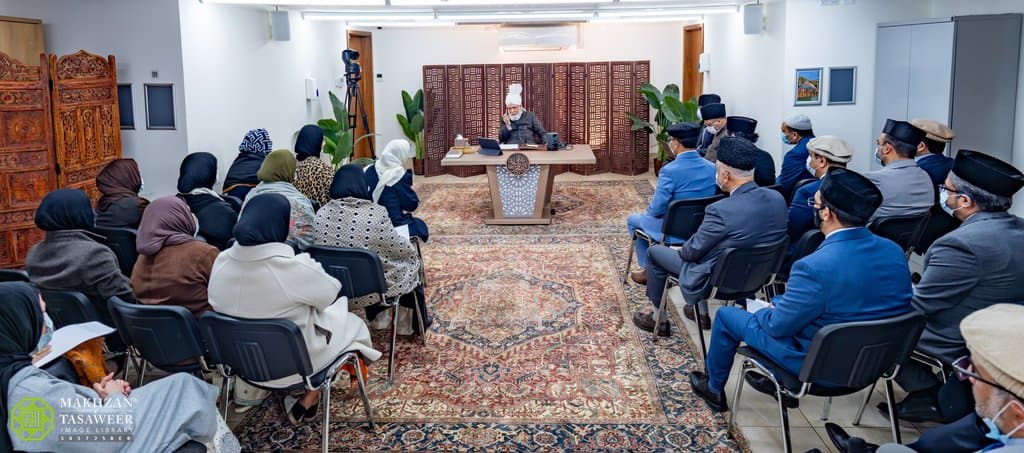
Islamabad, Tilford, 29 March 2026: 34 doctors and medical professionals from the United States of America and Canada were blessed with a mulaqat with Hazrat Mirza Masroor Ahmad, Khalifatul Masih V (aa).
All members of the delegation had the opportunity to introduce themselves before a question-and-answer session commenced, during which they sought guidance on matters relating to medicine, waqf, mental health, patient care and faith.
Huzoor (aa) encourages doctors to undertake Waqf-e-Arzi
During the mulaqat, Huzoor (aa) guided the delegation regarding the importance of Waqf-e-Arzi. He said that doctors and medical professionals should participate in Waqf-e-Arzi and should also encourage others, especially specialists, to do the same.
Huzoor (aa) acknowledged that those travelling from abroad sometimes find it difficult to adjust to the local environment and that, at times, suggestions made by visiting professionals cannot be implemented in the same way owing to local limitations and circumstances. Nevertheless, he emphasised that the first matter of importance was to take part in Waqf-e-Arzi.
Huzoor (aa) then reminded the delegation that Allah the Almighty is the True Healer. Huzoor (aa) also referred to the following guidance he had given in his Friday sermon of 27 March 2026:
“Just observe the subtlety with which the Holy Prophet (sa) would instruct the establishment of the Oneness of God [Tawhid]. In one narration, Abu Rimsah (ra) relates that his father said to Allah’s Messenger (sa), ‘Show me the mark upon your back,’ meaning the Seal of Prophethood, ‘for I am a physician.’ The Holy Prophet (sa) replied, ‘The true Physician is Allah. You are merely a Companion who gives comfort and reassurance. The Physician is He who created him and He alone grants healing.’” (“The Prophet’s [sa] Protective Zeal for Tawheed”, www.alislam.org)
Huzoor (aa) reiterated that while doctors treat and console patients, healing comes from Allah. He instructed that whenever a doctor examines a patient, they should first pray to Allah the Almighty.
Huzoor (aa) further said that every doctor should have a distinctive way of treating patients. If they travelled to countries such as Pakistan for service, they should not concern themselves with whether they considered themselves more competent than local doctors. Rather, they should focus on the grace of Allah the Almighty and benefit from one another’s experience. He explained that doctors serving locally have their own experience of the environment there, while those coming from abroad bring their own clinical experience from elsewhere.
In this context, Huzoor (aa) drew attention to the fact that patients in Pakistan may differ from the kinds of patients doctors are used to treating in North America. Their treatment and the way they are counselled must therefore take local circumstances and temperaments into account. He also said that such patients may ask many questions or disagree or debate and even doctors may differ among themselves. For that reason, he advised the delegation to work with patience, composure and forbearance. He concluded by again urging that as many people as possible should be encouraged to go for Waqf-e-Arzi.
Guidance for Waqf-e-Nau medical students
A question was then asked about what guidance Huzoor (aa) would give to medical students, especially those who were members of the Waqf-e-Nau scheme, so that they might become not only competent doctors, but also attain closeness to Allah the Almighty and Khilafat and be inspired to serve through Waqf-e-Arzi and, where applicable, Waqf-e-Zindagi.
Huzoor (aa) replied that the essential principle was to remember Allah at all times and to keep firmly in mind that Allah is the Healer. He said that when examining a patient, a doctor should always remember that it is Allah the Almighty Who grants recovery.
Huzoor (aa) recalled that he had once advised doctors that they should write Huwa ash-Shafi at the top of their prescriptions so that they remain mindful that health and healing come from Allah. He said that doctors should keep this reality before them at all times, observe the five daily prayers and, in critical cases, pray even more for their patients.
He further mentioned that senior doctors and elders, including Hazrat Dr Mir Muhammad Ismail Sahib (ra), used to offer extra nawafil for their patients. Huzoor (aa) said that Waqf-e-Nau doctors should be even more mindful in this regard. He concluded by reiterating that the key matter was to remember Allah constantly, while the worldly affairs of life would continue alongside this.
Building confidence in mental health care
A psychiatrist then mentioned that many members of the Jamaat still hesitate to speak openly about emotional and psychiatric difficulties and sought guidance on how such individuals might be encouraged to open up.
Huzoor (aa) observed that people respond in different ways: some are hesitant and shy, while others speak with excessive openness. He said that many people hold back because they fear their personal matters may not remain confidential, especially when they are consulting someone from a familiar cultural background. He acknowledged that some individuals are more accustomed to discussing matters within the family and therefore hesitate before a psychiatrist from their own community.
Huzoor (aa) said that the key was to build confidence in patients by assuring them that what they disclose will remain confidential. He stated that it is the duty of a psychiatrist to keep such matters private and not share them with others. Once a patient develops confidence in the doctor, treatment can proceed more effectively.
At the same time, Huzoor (aa) noted that when some patients consult doctors outside their own linguistic or cultural setting, they may face language barriers and find it difficult to express themselves properly. He also cautioned that at times, psychiatrists can misguide patients by encouraging them to discuss certain matters in an unnecessarily open manner, which may embolden them in vice rather than lead to treatment and reform.
Huzoor (aa) therefore advised that treatment should be administered with wisdom, within the moral limits laid down by faith and in a manner consistent with the responsibilities of the medical profession.
Balancing professional duties with Jamaat responsibilities
One of the attendees then asked what guidance Huzoor (aa) would give to doctors and medical professionals regarding balancing their non-medical Jamaat service roles with their professional responsibilities.
In response, Huzoor (aa) asked what additional responsibilities the questioner had and was informed that she was involved in Tahir Academy as well as Lajna work. Huzoor (aa) said that her primary responsibility remained her profession. As for Lajna work, he noted that such duties generally required only a limited number of hours each week and could ordinarily be managed over the weekend.
Regarding Tahir Academy, Huzoor (aa) said that one should assess one’s own capacity and determine how much time could reasonably be given. When told that there were only two or three classes a month, he indicated that this did not amount to an unmanageable burden. Even when additional related work was included, he suggested that this was still something that people generally managed without major difficulty.
Huzoor (aa) explained that the real difficulty often arises when a person overthinks matters and places unnecessary burdens on themselves. He said that some people feel that whatever they do must be done with complete perfection, whereas no worldly task can ever be entirely perfect. Minor shortcomings always remain and one should learn to overlook them.
He therefore advised the questioner to do as much as could be done comfortably and with ease, to create ease for herself, to pray to Allah the Almighty for guidance and not to burden herself unnecessarily. He added that people should work in a relaxed manner and not worry excessively.
Conveying Islam through patient care and good character
A family physician then asked how doctors could effectively convey Islam’s message of peace, compassion and service through clinical practice and patient interactions with people of different religious and social backgrounds.
Huzoor (aa) said that whether patients were atheists, Christians, Buddhists, Sikhs or from any other background, the first and foremost duty of a doctor was to display good moral character. If a doctor’s conduct was exemplary, their treatment of people was kind and their interactions were positive, patients would naturally be drawn to them.
Huzoor (aa) said that, as he had mentioned earlier, a significant part of a patient’s illness is alleviated through this very approach. Patients who are treated with kindness and competence go on to tell others and a doctor’s good reputation spreads. Referring to the modern age, he noted that many doctors now receive reviews and recommendations through social media and other means and that a practitioner who treats patients effectively and with good conduct becomes widely known. He remarked that while some misuse social media, others use it beneficially.
Despite this, Huzoor (aa) said that the fundamental principle remained unchanged: an Ahmadi doctor should combine good moral conduct with prayer. Patients may come from any background, but if a doctor’s character is good, they will be influenced by that character. He said that along with treatment, doctors also bear the responsibility of praying for their patients.
Huzoor (aa) further explained that sometimes the effect is simply psychological and that this in itself can be very strong. Where a person has trust in someone, even that can bring about an effect. In this connection, Huzoor (aa) narrated an incident concerning Hazrat Mirza Sharif Ahmad (ra). In Qadian, there was once a patient suffering from severe stomach pain who was crying out loudly. Although two or three doctors were present, he had found no relief. When Hazrat Mirza Sharif Ahmad (ra) was informed, he went to see the patient, placed his hand in his pocket for a short while and prayed. He then asked the patient to open his mouth, placed what appeared to be a pill inside it and told him to drink some water. Within fifteen minutes, the patient experienced relief. When people later asked Hazrat Mirza Sharif Ahmad (ra) what medicine he had given, he explained that it was nothing more than a small piece of paper that he had shaped like a pill and given after prayer. Huzoor (aa) said that this showed that sometimes there is also a psychological effect.
The true spirit of Waqf and Waqf-e-Arzi
Another questioner asked about the true spirit of Waqf and Waqf-e-Arzi and how these could become a means of lasting self-reform and nearness to Allah, rather than remaining only a temporary form of service.
Huzoor (aa) replied that the foundation of this lay in establishing a relationship with Allah the Almighty. He explained that Allah has instructed believers to pray five times a day and that this system itself regulates life and creates discipline.
Huzoor (aa) elaborated that the daily prayers organise the whole day: one rises for Fajr, offers prayer, recites the Holy Quran and may even exercise before beginning the day’s work; then, throughout the day, Zuhr, Asr, Maghrib and Isha continue to regulate one’s routine and maintain one’s connection with Allah. He said that this is the proper way to bring discipline into life. Huzoor (aa) said:
“You require something to regulate your life and establish discipline. […] Allah the Almighty has created a system whereby you can regulate your life through the five daily prayers; you wake up in the morning for Fajr, offer prayer and recite the Holy Quran and exercise. If you have some time before your office time begins, then you can take a short nap. People do sleep in the morning and become well-rested. Then, as you work all day, there are the Zuhr, Asr, Maghrib and Isha prayers. This helps establish discipline in one’s life and enables one to establish a connection with Allah the Almighty. This is the proper manner.”
He then turned to the acquisition of knowledge and said that, alongside salat, one must also study the Holy Quran. It is not enough merely to listen to the Friday sermon once a week or to read the Holy Quran occasionally. He said that educated people should study and reflect upon it regularly for at least 30 to 45 minutes.
Huzoor (aa) gave the example of Hazrat Dr Mir Muhammad Ismail Sahib (ra), who was a doctor and surgeon of remarkable range and accomplishment. He said that although modern doctors often specialise in only one area, Hazrat Dr Mir Muhammad Ismail Sahib (ra) worked in multiple fields, including ENT, gynaecology and general surgery and was highly successful. At the same time, he also composed fine Persian and Urdu poetry. Huzoor (aa) added that even today, many doctors around the world combine professional accomplishment with broader intellectual and spiritual development.
He then said that an Ahmadi doctor should first establish a connection with Allah, then acquire knowledge from the Holy Quran, remain humble, place full reliance on Allah the Almighty and possess good morals. If these qualities are found in an Ahmadi doctor, Huzoor (aa) said, they can become truly successful and can please Allah while also serving people well.
Islamic guidance on assisted dying
One of the doctors then asked about medically assisted dying, mentioning that many elderly patients, including those suffering from dementia or Alzheimer’s disease, sometimes raise this matter.
Huzoor (aa) asked whether this referred to “mercy killing” and, upon hearing that it did, said that this was not acceptable in Islam. He drew attention to the state of many elderly people in increasingly secular societies, where parents are often placed in care homes and rarely visited. He said that in such circumstances, it is understandable that some people lose morale and, as a result, begin to desire death.
Huzoor (aa) said that the correct response in such situations was not to end life, but to show compassion, raise morale and give people the will to live. As for those suffering from dementia and similar conditions, he explained that such individuals often are not fully aware of their own state and may forget what they themselves have said after a short time. In such a case, the question arises as to who is truly making the decision. If their children are insisting on such a course, then this amounts to cruelty.
Huzoor (aa) therefore stated clearly that this concept was wrong and that Islam does not permit it. Those who are ill should be cared for and looked after. He further observed that among Asian and African cultures, there remains a stronger ethos of serving and caring for elders and that a religious outlook does not support ending the life of the elderly for convenience.
At the same time, Huzoor (aa) acknowledged that there are patients with severe illnesses such as advanced cancer who may express the wish that their life should end. In such cases, he said, measures such as an induced coma may be used for pain management, but life itself should not be deliberately ended. So long as a person is breathing, they should be allowed to continue breathing.
Memories of Waqf-e-Zindagi doctors in Ghana
Towards the end of the mulaqat, Huzoor (aa) was asked to share his memories of the Waqf-e-Zindagi doctors who had served in Ghana, along with a few accounts of their sacrifices.
Huzoor (aa) said that, by the grace of Allah, the Jamaat’s hospitals in Ghana became widely renowned. He recalled how doctors who had been physicians in Pakistan would become surgeons in Ghana, adapting to the needs before them. At times, when an operating table was not available, they would even perform operations on a dining table and Allah the Almighty would bless their efforts.
Huzoor (aa) also recalled, in a light-hearted manner, that during his time in Africa, when he would occasionally fall ill, some doctors would prescribe medicine and say that it had benefited other patients. Yet, he noted, it would not always bring him relief. He would then remark to them that they had the prayers of the Khalifa of the Time for their service to the African people and thus, by the grace of Allah, they were able to become a means of treatment for the Africans, but that their treatment did not appear to work on him.
Huzoor (aa) said that those life-devotee doctors served with great devotion and sincerity, working day and night. They treated the poor and also took fees from wealthier patients, which enabled them to live and continue their service there successfully. Huzoor (aa) then conveyed his salaam and took his leave.
(Summary prepared by Al Hakam)