
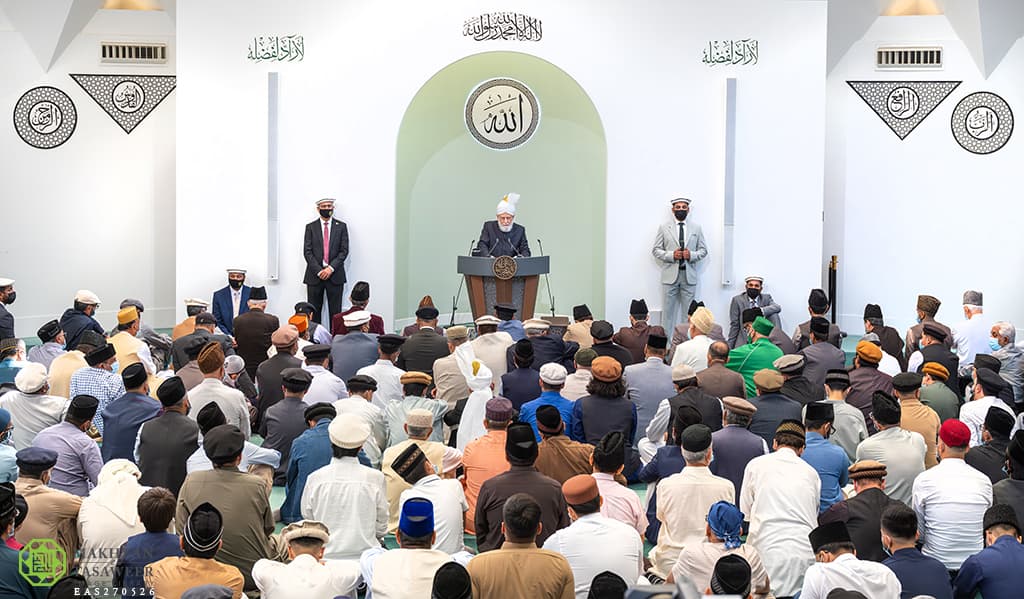
Wednesday, 27 May 2026, Islamabad, UK: Hazrat Mirza Masroor Ahmad, Khalifatul Masih V (aa) arrived at the Mubarak Mosque in Islamabad, UK to lead the congregation in the Eid-ul-Adha prayer.
Following the Eid prayer, Hazrat Amirul Momineen, may Allah be his Helper, addressed the congregation and the viewers of MTA International with his Eid-ul-Adha sermon.
After tashahhud, ta‘awwuz and Surah al-Fatihah, Hazrat Amirul Momineen (aa) recited the following verse of the Holy Quran and proceeded with the Eid-ul-Adha sermon.
لَنۡ یَّنَالَ اللّٰہَ لُحُوۡمُہَا وَلَا دِمَآؤُہَا وَلٰکِنۡ یَّنَالُہُ التَّقۡوٰی مِنۡکُمۡ ؕ کَذٰلِکَ سَخَّرَہَا لَکُمۡ لِتُکَبِّرُوا اللّٰہَ عَلٰی مَا ہَدٰٮکُمۡ ؕ وَبَشِّرِ الۡمُحۡسِنِیۡنَ
“Their flesh reaches not Allah, nor does their blood, but it is your righteousness that reaches Him. Thus has He subjected them to you, that you may glorify Allah for His guiding you. And give glad tidings to those who do good.” (Surah al-Hajj, Ch.22: V.38)
True righteousness through Divine recognition
The Promised Messiah (as) stated that all these spiritual excellences are attained only after acquiring perfect recognition (ma‘rifat) of Allah the Almighty. In other words, the highest standard of righteousness (taqwa) is granted only after a person attains true and complete recognition of God. Whoever is granted the fear and love of Allah the Almighty is also delivered from every sin that arises from recklessness and irreverence.
The need for inner sacrifice
There are many seemingly minor mistakes and sins which, if a person becomes careless and persists in them, gradually increase and ultimately incur the punishment of Allah the Almighty. Therefore, for salvation we are neither dependent upon any blood sacrifice, nor in need of any cross, nor do we require any form of atonement. Rather, we are in need of only one sacrifice: the sacrifice of the inner self (nafs). Human nature itself recognises the necessity of such a sacrifice. In other words, the very name of this sacrifice is Islam.
The true meaning of Islam
Islam means to place one’s neck forward willingly to be sacrificed – that is, to lay down one’s soul completely at the threshold of Allah the Almighty with perfect submission and contentment. All of this requires perfect love and complete devotion. Such love is attained only when one acquires true recognition of Allah the Almighty.
The true meaning of righteousness
The Promised Messiah (as) stated that no one holds a monopoly over Allah the Almighty. Allah desires righteousness and whoever adopts taqwa will attain nearness to Him. Taqwa means acting in accordance with the commandments of Allah the Almighty.
Some people assume that because their forefathers were righteous, they too will automatically receive the reward of their ancestors’ virtues. The Promised Messiah (as) explained that no one will be rewarded on account of the deeds of their forefathers. In fact, the one who claims greater closeness to Allah will also be held to greater account by Him.
The need for self-reformation
Therefore, we must pledge that since we have accepted the Promised Messiah (as), acknowledged the truth of the prophecies of the Holy Prophet Muhammad (sa) and firmly believe that he was indeed the Promised Messiah sent for the reformation of the world, we must also strive to reform ourselves.
We must elevate the standards of our worship. To achieve this, we must put worldly concerns behind us and, with a spirit of sacrifice and by giving precedence to faith over worldly matters, endeavour to improve the quality of our worship. Similarly, we must also improve our moral standards, for worship and morality are inseparable.
The importance of the Holy Quran
The Promised Messiah (as) stated that if one desires lasting reformation, seeks the pleasure of Allah the Almighty, wishes for progress and desires true guidance, then one must read the Holy Quran, act upon it and follow its commandments. Merely sacrificing an animal on Eid days will not by itself bring the desired results of one’s deeds.
True sacrifice and practical righteousness
If we wish to spread the message of faith, then we must develop righteous actions within ourselves. There are many who merely speak and even make sacrifices, but the question remains whether their sacrifices are accepted.
It has been said that on one occasion the pilgrimage of many people was not accepted, while the pilgrimage of all was accepted because of the sincerity and righteousness of one individual. Thus, if purity does not exist within hearts, then there is no benefit in such a life or in merely celebrating Eid.
Moral excellence and the rights of others
The essence of true piety is taqwa. The principle of taqwa is that one should cultivate high moral qualities within oneself, improve one’s standard of speech, and fulfil the rights owed to fellow human beings. Taqwa means that if someone behaves harshly, one should respond with gentleness. A person should continuously examine himself to determine to what extent he is following the commandments of Allah. This is what the Promised Messiah (as) expected from us.
Some people complain that their prayers are not accepted. The Promised Messiah (as) explained that until a person treads the path of taqwa, he will not witness the acceptance of his prayers. Taqwa means fulfilling the rights of Allah the Almighty as well as the rights of His creation. Moral excellence is essential for attaining taqwa, because without good morals neither can one achieve righteousness nor fulfil the rights of others.
Building a pure and harmonious society
If good morals become established among us, then a beautiful and virtuous society can emerge. The Promised Messiah (as) explained that when it is said that taqwa reaches Allah the Almighty, it means that taqwa reaches Him when a person’s conduct towards his neighbours is righteous and upright. Such conduct not only elevates a person’s standard of righteousness, but also enables him to fulfil the pledge of his bai‘at (initiation).
True taqwa therefore requires controlling one’s anger, treating people with high moral conduct, refraining from violating the rights of others and avoiding disputes and quarrels. Even if resolving conflicts requires bearing a minor loss or relinquishing some personal rights, one should be willing to do so.
The distinction of a true believer
The Promised Messiah (as) stated that merely claiming an outward relationship with him is not sufficient. A person must bring about a clear and visible transformation within himself so that the world may witness that his standards of worship and morality are elevated. Only then can one become a true Ahmadi.
He further explained that taqwa means purifying one’s heart and soul from every form of open and hidden idol. One should acquire righteousness and spread it among others. This too is a part of taqwa.
Worship, prayer and fear of Allah
As far as the fear of Allah the Almighty is concerned, one should not only safeguard the obligatory prayers but also offer voluntary prayers (nawafil). Therefore, if we desire spiritual progress, we must become righteous, safeguard our prayers, preserve our morals and mutual relationships and cultivate the fear of Allah within our hearts. Particularly those individuals who are subjected to oppression should turn even more fervently towards Allah the Almighty.
Responding to opposition with righteousness
One must cultivate righteousness (taqwa) within oneself and also respond to the objections raised by opponents. However, it should always be remembered that while responding, one must never descend into immoral or abusive conduct. Such behaviour causes harm rather than benefit.
The Promised Messiah (as) stated that it is contrary to taqwa for a person to respond merely out of personal pride or ego. Rather, the intention should be that the glory of Allah the Almighty may become manifest.
Divine help accompanies a community only when it is righteous. He further stated that Allah the Almighty repeatedly revealed to him that the members of his Jamaat should become righteous and tread upon the subtle paths of taqwa; only then would Allah be with them.
The constant need for taqwa
At that time there were many Companions (ra) who were highly righteous, yet the Promised Messiah (as) still expressed concern that true taqwa should be developed within the Jamaat. Huzoor (aa) said that if, despite the presence of such righteous individuals, the Promised Messiah (as) still felt concern, then how much greater should our own concern be today.
If we are to fulfil the pledge of bai‘at to the Promised Messiah (as), then we must remove this deficiency. That deficiency is the absence of the true fear and love of Allah the Almighty within our hearts. If this is lacking, then we should regard it as a spiritual illness and strive to cure it.
Just as one takes medicine when suffering from physical pain, similarly the remedy for this spiritual ailment is to cultivate taqwa. Only then will our sacrifices become beneficial; otherwise, they remain fruitless.
The reality of sacrifice
The Promised Messiah (as) stated that one should not become arrogant merely because one offers prayers, observes fasting and refrains from adultery and theft. Even some idolaters possess such qualities and there are people lacking high moral standards who also exhibit these traits. The truly important matter is to understand the reality of taqwa and to become ready for every sacrifice for the sake of Allah the Almighty.
When people sacrifice goats and cows, they should also reflect upon whether they are prepared to sacrifice their own selfish desires for the sake of Allah. For this, it is essential to cast worldly attachments behind one’s back and make the pleasure of Allah one’s true objective. A person should always remain prepared for great sacrifices in pursuit of His pleasure.
Giving precedence to faith over the world
In our pledge, we also declare that we shall give precedence to faith over worldly matters. Therefore, if we are truly to place faith above worldly interests, sacrifices will inevitably be required. This is the true philosophy of sacrifice. If we understand this reality, only then are we worthy of truly celebrating Eid-ul-Adha; otherwise, our claims remain mere words.
Trials faced by the righteous
The Promised Messiah (as) explained that a righteous person is granted a special manifestation of divine grace. The suffering endured by the beloved servants of Allah comes through divine wisdom. Otherwise, even if the whole world were to unite, it could not inflict the slightest harm upon them. Such individuals are sent into the world to establish exemplary models. These trials also come because Allah the Almighty wishes to test whether the spirit of sacrifice truly exists within them. This indeed is taqwa.
Therefore, it is necessary to endure hardship in the way of Allah and to set practical examples. Allah does not desire that His chosen servants should suffer unnecessarily; rather, such trials reveal whether they are prepared for every sacrifice for His sake.
Moral excellence through sacrifice
True moral excellence is demonstrated precisely at the time of sacrifice and trial. An example was given from the life of the Holy Prophet Muhammad (sa), who during the Battle of Uhud stood almost alone. The wisdom behind this was that the bravery of the Holy Prophet (sa) might become manifest. He stood alone before thousands and no other prophet was granted the opportunity to demonstrate such extraordinary courage.
Sincerity and freedom from ostentation
The Promised Messiah (as) stated that if even the slightest trace of ostentation enters a person’s deeds, Allah the Almighty rejects those deeds and does not accept them. Becoming truly righteous is difficult. For example, if a slight accusation is made against someone and he immediately becomes angry, this is far removed from taqwa. Becoming enraged over trivial matters, engaging in quarrels or indulging in needless arguments and disputes are all qualities that distance a person from righteousness. The conduct of a truly righteous person is that he endures every hardship solely for the sake of Allah, displaying patience, courage and great forbearance. Vastness of heart and endurance are found abundantly within him.
Until a person undergoes repeated spiritual struggles and sacrifices, he cannot become truly righteous. Some people assume that seeing dreams or receiving revelations automatically makes them highly righteous. However, the true criterion is taqwa and this becomes evident through a person’s outward actions and conduct.
The lesson of Eid-ul-Adha
These are a few principles that we should always keep before us. This is the very lesson taught by Eid-ul-Adha. If we fail to develop these qualities within ourselves, then the sacrifices of cows, goats and camels will bring no real benefit.
As mentioned earlier, there were occasions when the pilgrimage of many people was rejected, but because one individual possessed righteousness and true piety, Allah the Almighty accepted the pilgrimage of all. Alongside these outward sacrifices, we must also develop the spirit that makes us ever ready to sacrifice our lives, wealth, time and honour for the sake of Allah.
Raising moral and spiritual standards
We must elevate the standards of our speech and our morals. We must improve our relationships with others and win over even our opponents through noble conduct. In the field of preaching as well, divine guidance teaches that if one displays true moral excellence and treats even enemies with kindness, they too may become friends. Therefore, we must pay attention to these matters and should not merely feel content that we have offered a sacrifice.
May Allah the Almighty enable us to celebrate Eid in its true spirit and grant us the understanding of the real essence of sacrifice.
May Allah the Almighty enable us to become the kind of people whom the Promised Messiah (as) desired us to become in the light of Islam.
Prayers for Ahmadis facing persecution
Remember the Ahmadis of Pakistan in your special prayers, who, due to oppressive laws, continue to face restrictions despite sacrificing their lives and wealth. Restrictions have been imposed upon their worship, their offering of sacrifice and even their prayers within the confines of their own walls.
Even those who possess the means to offer sacrifice are deprived of this opportunity. The authorities become active in suppressing them and initiate arrests, while the true perpetrators who spread disorder within the country remain untouched and continue acting freely.
May Allah the Almighty improve the conditions of the Ahmadis in Pakistan, deliver them from these oppressions and accept their sacrifices.
Similarly, prayers should also be offered for those imprisoned in way of God, that Allah the Almighty may soon create the means for their release and enable them to honour the sacrifices of their forefathers.
Prayers should also be offered for Ahmadis throughout the world, that Allah the Almighty may strengthen their faith and elevate their standards of righteousness.
Eid greetings
At the end, Huzoor (aa) extended “Eid Mubarak” to everyone. There are many places in the world facing difficult circumstances. Therefore, since we celebrate Eid-ul-Adha in the spirit of sacrifice for the sake of Allah the Almighty, we too should be prepared to make sacrifices in these conditions. Even if some people have been compelled to offer Eid prayers in secrecy, may Allah the Almighty accept these sacrifices.
Hazrat Amirul Momineen (aa) then led everyone in silent prayer.
(Summary prepared by Al Hakam)