
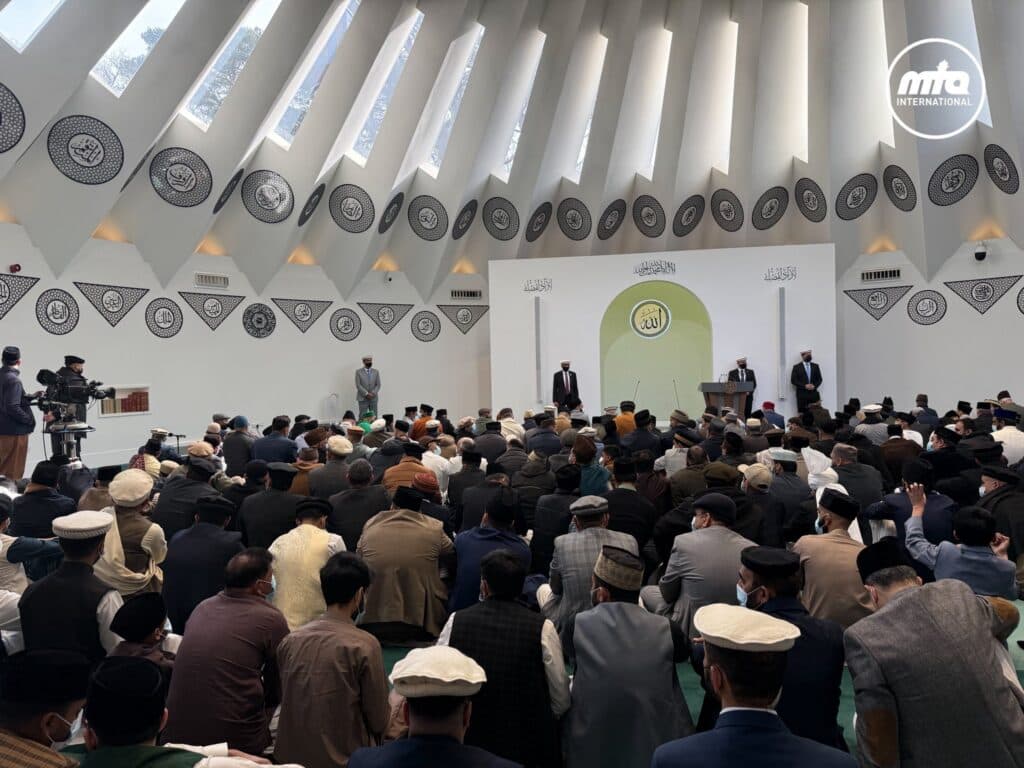
Islamabad, Tilford, UK, 20 March 2026: At approximately 10:30 am local time, Hazrat Mirza Masroor Ahmad, Khalifatul Masih V, may Allah be his Helper, made his way into the Mubarak Mosque to lead the congregation in Eid-ul-Fitr prayer and deliver the Eid sermon.
Following the Eid prayer, Hazrat Amirul Momineenaa recited tashahhud, ta‘awwuz and Surah al-Fatihah, and said:
“Today, upon completing the month of Ramadan, we are celebrating Eid. This Eid should be an opportunity to express gratitude to Allah the Almighty for enabling us to fast during this month. Many people were blessed to partake in the Tahajjud and Tarawih prayers. Likewise, to read the Quran on a daily basis and to complete. Additionally, to listen to dars of the Holy Quran, to remember Allah and some were also able to sit i‘tikaf.”
To sit i‘tikaf is possible, Huzooraa said, in countries where we have freedom; however, in countries like Pakistan, Ahmadis are not allowed to openly worship and express their faith. On the contrary, they are prosecuted for doing so. We should pray that such restrictions are lifted and Ahmadis are able to practice their faith openly.
If, during Ramadan, there was no real attention towards these spiritual elements, then for such people, Eid is just a festival where people merely gather together, wearing new clothes, to have a laugh and a good time. However, Eid is not just for this purpose. It is a means of expressing gratitude to Allah the Almighty for enabling us to worship Him and make all these sacrifices.
Huzooraa said that he hopes most Ahmadis strove to reap the benefits of Ramadan, so that they may have increased in their taqwa, worship of Allah the Almighty, and doing good deeds. He said to continue to always pray to Allah the Almighty and ask Him for His help – that just as He allowed us to do good in this month, He may make such deeds a consistent and permanent feature of our lives. In this way, the benefits and blessings will not just be limited to Ramadan but extend to our daily lives.
We recite Surah al-Fatihah multiple times every single day – in it, we are reminded to strive to worship Him in the best way possible and to fulfil his commandments. In this Surah, the foundational attributes of Allah the Almighty are mentioned. We are taught to be grateful to Him in relation to these attributes. Also, to pray to become a part of those people who attained Allah’s pleasure, and not be like those who incurred His wrath and anger.
In the verse “Thee alone do we worship and Thee alone do we implore for help”, Allah the Almighty emphasises that the first step should be from us. We should strive in the way of Allah and try our best to worship Him in the best way possible, but the true power and ability to do so comes from Allah alone.
The Holy Prophetsa said that the one who takes a step towards Allah, Allah takes two steps towards him, and the one who walks to Allah, Allah runs to him. But we must remember that the first step should always come from us, and we should pray that Allah blesses our efforts. If we want to continue to benefit from the blessings of Ramadan, we must strive to continue our good deeds and pray for Allah’s help.
Huzooraa said he will present some enlightening points of tafsir of the Promised Messiahas on the verse “Thee alone do we worship and Thee alone do we implore for help.”
The Promised Messiahas writes:
“In the verse: We worship Thee alone and we implore only Thy help; We worship Thee; takes precedence over: We implore only Thy help; for, man approaches God, the Supreme, in prayer, after having involved all his faculties in the subject matter of the prayer. It would be impertinent and insolent on his part to come to Him without using his faculties and without observing the requirements of the Law of nature. For instance, if a cultivator were to pray to God to bless his field with a plentiful harvest without preparing it and sowing any seed in it, he would be guilty of insolence and mockery. This is what has been called testing and trying God and that is forbidden.
“[…] It is, therefore, necessary to employ all one’s faculties before submitting one’s petition and this is the real significance of this prayer. It is necessary that one should first take stock of one’s beliefs and effort. It is the way of God to bring about a desired change through change in the means. He creates some factor which becomes the means of the desired improvement.”
Huzooraa mentioned that some people question: if prayer exists, what is the point of using means? Addressing this, the Promised Messiahas wrote:
“Those who consider that if prayer is available then means become irrelevant should ponder this seriously. They should realise that prayer is in itself a means which activates other means. The precedence of: We worship Thee alone; over: We implore only Thy help; which is a supplication, emphasises this.”
Huzooraa said that the Promised Messiahas emphasised that man’s effort should never decrease. We should not aim to do good deeds in Ramadan only and think that now it is incumbent upon Allah the Almighty to give us all we want – if not for the rest of our lives, then at least until the next Ramadan. This is an erroneous thought. A true believer must always strive to carry out these good deeds, and only then will they attain the true grace of Allah the Almighty.
Hazrat Musleh-e-Maudra gave the example of such a person. Once, during the month of Ramadan, he heard a man praying to Allah – he was telling Allah about all the hardship, pain and suffering he had endured in order to fast. Huzoorra said that, in reality, a believer does not feel pain when sacrificing or enduring hardship in the way of Allah. Even if the person’s intention was good, his choice of words could have been better. He explained that by enabling us to fast, Allah has actually done a favour upon us rather than us putting ourselves through pain for the sake of Allah.
Huzoorra said that had he himself made such a prayer, he would first pray: O Allah, you enabled us and gave us the ability to do all this; now make this grace complete for us on Eid, so that these blessings remain constant and permanent. Had the person prayed in such a way, it would have been a beautiful prayer.
Hazrat Khalifatul Masih Vaa said that in a like manner, we should make such a prayer regarding Eid, that Allah allowed us to fast and carry out such good deeds in this month, now Allah show us the blessings attached to Eid – our true Eid will be when we see your oneness established in the world, and the message of the Holy Prophetsa and his devoted servant, the Promised Messiahas, and when we see the powers of dajjal be destroyed. This will be our haqiqi (true) Eid.
The Promised Messiahas writes:
“Allah, Lord of Honour and Majesty, has placed the phrase: We worship Thee alone; before the phrase: We implore only Thy help; as a reminder of the grace of Rahmaniyyat (Divine Graciousness) before supplication. Thus the worshipper begins, as it were, with: Lord, I thank Thee for Thy bounties with which Thou hast favoured me long before my petitions and prayers and my deeds and efforts and my seeking help from Thy Providence (Rabubiyyat) and Graciousness (Rahmaniyyat) that precedes the supplication of a suppliant. Now I beg of Thee the strength, virtue, prosperity, success and aims that are bestowed only on supplication, prayer and begging for help, for Thou art the most munificent Bestower of bounties.”
The Promised Messiahas continues:
“These verses urge towards grateful appreciation of gifts that have been granted and towards steadfast supplication for that which is needful and towards eagerness for whatever is perfect and excellent so that the worshipper may be steadfastly grateful. They also urge towards non-reliance on one’s own competence and ability and towards throwing oneself before the Holy One in hope and expectancy, persisting in supplication and prayer in humility with glorification and praise, in a state between fear and hope, like a suckling infant in the arms of the wet-nurse, dead to the rest of creation and everything on earth.”
Another meaning highlighted by the Promised Messiahas is regarding humility:
“These verses also urge towards confession and acknowledgement that we are weak and cannot carry out the duties of Thy worship without Thy help and cannot seek the ways of Thy pleasure without support and that we can act only with Thy help and can move only with Thy succour and hasten to Thee like mothers pining over the deaths of their children and like lovers who are on fire with love.
“They urge also towards discarding pride and arrogance and towards holding fast to the power and might of Allah when affairs become involved and hardships pile up and towards joining the company of those who are lowly of heart as if the Lord of glory were saying: O My servants, regard yourselves as corpses and ever seek strength from Allah. Let not a youth take pride in his vigour, nor an old one rely on his staff, nor a wise one feel elated with his intelligence nor a scholar trust in the accuracy of his knowledge, or the soundness of his understanding or the keenness of his intellect, nor let a recipient of Divine revelation depend for support on his inspiration and revelation and the fervour of his prayers. Allah does what He pleases, rejects whom He pleases and admits among His chosen ones whom He pleases.”
The Promised Messiahas continued:
“The phrase: We implore only Thy help; warns of the great wickedness of the evil-prompting ego which frisks away from virtue like the unbroken she-camel from its would-be rider, or which is like a vicious reptile who cleans up its victim like a bleached bone, emitting venom all the time, or is like a lion who is not diverted once it leaps. There is no power, no strength, no earning and no substance except with the help of Allah Who annihilates the satans.”
Huzooraa said that this is the state of the Muslim world at large nowadays. They must turn to Allah alone and seek his help.
The Promised Messiahas states:
“There are other implications in placing: We worship Thee alone; before: We seek only Thy help; which we propose to set down here for the benefit of those who are enamoured of the verses of the Fatiha, and not of the music of guitars, and run to them like eager devotees. Allah here teaches His servants a prayer which is a source of happiness for them and says, in effect: O My servants, beg of Me with humility and in lowliness of spirit: Our Lord, we worship Thee alone, but we have to struggle hard and have to grapple with affectation and remorse and distractions and satanic insinuations and confusing ideas and superstitions and dark thoughts like the muddy waters of a flood, and like one who gathers fuel in the dark we follow only conjecture and we are not firmly anchored in faith. In this situation we seek only Thy help. We beg Thee for the gift of keenness, eagerness and readiness of heart and overflowing faith and spiritual response and joy and light and for embellishing our hearts with the decor of truth and the garments of delight, so that, by Thy grace, we may win through to certainty of faith, and achieve our highest goals and arrive at the ocean of Reality.”
An additional meaning is regarding complete obedience of Allah the Almighty. The Promised Messiahas writes:
“In the phrase: We worship Thee alone; Allah, the Supreme, urges His servants to put forth, in their obedience to Him, the utmost energetic effort, standing upright, constantly responding to His call, with: Lord, we spare no pains in our striving and in observing Thy commands and in seeking Thy pleasure; but we seek Thy help and Thy protection against pride and self-esteem and beg of Thee to grant us the strength that would lead us to Thy guidance and to winning Thy pleasure. We are firm in our obedience to Thee and in Thy worship; so write us down among those who submit to Thee. There is yet another point to be noted in this context. The worshipper declares: Lord, we have adopted Thee alone for worship, preferring Thee over all else and we adore nothing save Thy countenance and we believe in Thy Unity.”
In these verses, to remember one’s brethren in prayer is also emphasised:
“In this verse, Allah, the Lord of Glory and Majesty, has instructed the use of the first person plural, conveying thereby that this prayer is for the benefit of all brothers and not only for the benefit of the supplicant. Thus Allah urges the Muslims towards mutual accord, unity and love and requires that a supplicant should put himself to hardship for the promotion of his brother’s welfare as he would put himself to hardship for the promotion of his own well-being and should concern himself with and strive to meet his brother’s needs as he is concerned with and strives to meet his own needs, making no distinction between himself and his brother, and should be his brother’s well-wisher, with all his heart as if Allah, the Sublime, had commanded: O My servants, give one another gifts of prayer as brothers and friends exchange gifts, and widen the scope of your prayers and your motives and your aims, making room in them for your brethren and become like brothers and fathers and sons in mutual affection.” (Karamatus Sadiqeen, pp. 77-80)
Hazrat Khalifatul Masih Vaa said that we should all aim to widen the scope of our prayers in this manner, and when this happens, it will create a beautiful atmosphere and society.
It is the desire of opponents and enemies of Islam that Muslims continue to fight with each other – we must unite to escape this. Huzooraa said he mentioned this two weeks ago, and that when Muslims do unite, this will be our haqiqi (true) Eid.
Huzooraa narrated an incident of Hazrat Musleh-e-Maudra, when he was returning from Hajj on a ship. The captain told him that his assistant was interested in Islam and wanted to convert, and hence he wanted Hazrat Musleh-e-Maudra to speak to him. Huzoorra went to the captain’s room, where he showed Huzoorra around and served him tea also. In the conversation, Huzoorra sensed a hint of jest in his voice. The captain said to Huzoorra: Now that you have done your Hajj, you can do whatever you wish. Huzoorra asked how that was possible, to which the captain replied that his first slate (of sin) is now clear. Hazrat Musleh-e-Maudra asked the captain: When a person wears a new suit, does he take care of the new suit more, or his old, worn-out clothes? The captain answered the new suit, to which Huzoorra said: So then, how are you giving this advice? The new suit I have received from doing Hajj, shall I ruin it or continue to do more good?
Hazrat Musleh-e-Maudra, mentioning this example, explained that when Allah enables man to do some good, he must tread very carefully. Robbers only go after treasure – something which is worth robbing. If during Ramadan you have performed good deeds, be prepared for Satan’s attack. Satan is relentless in this attack, and like robbers, if he cannot steal your treasure, he desires to burn the entire house down so that the treasure is destroyed.
Now we must strive to protect our good deeds even more, instead of becoming complacent and thinking we have done enough. We must ask Allah for help so that Satan never attacks us in such a way, and that no robber may ever take this treasure away from us. If we pray for this and strive to implement this habit of constantly protecting our good deeds, then this will be a successful Eid for us.
In the end, Hazrat Khalifatul Masih Vaa said, while we celebrate Eid, we must remember those Muslims who are doing Eid in circumstances where their houses have been destroyed, children have lost parents, parents have lost children, and they are living in constant fear for their lives.
Huzooraa prayed that may Allah improve their circumstances and enable them to turn solely to Allah and rely on Him alone, rather than on worldly powers. What is happening in Arab countries today is a result of this reliance on worldly powers. May Allah protect everyone, including the Ahmadis suffering for their faith, from oppression.
Huzooraa said we must remember the prayer “Thee alone do we worship and Thee alone do we implore for help”. Our true Eid will be when we see the world turning towards monotheism, and towards the message of the Holy Prophetsa and his servant, the Promised Messiahas.
Huzooraa prayed, “May Allah make this Eid blessed, in both a worldly and spiritual sense, and make this Eid truly mubarak (blessed) for us. Amin.