
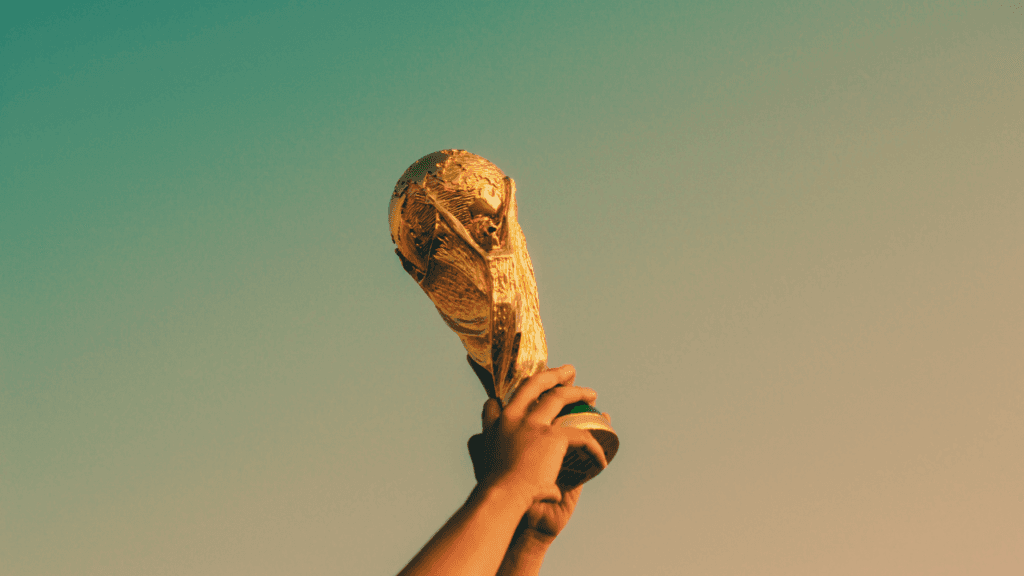
As the 2026 World Cup nears its climax, we can all agree that the standard of football on display has been breathtaking. Yet off the pitch, a series of incidents involving players, officials, journalists and supporters has cast a shadow over this year’s tournament.
Getting déjà vu? This is not the first time controversy has surrounded this global tournament.
When Qatar hosted the World Cup four years ago, there were concerns raised around freedom of expression and the appalling exploitation of workers, some of whom had died while building the tournament’s infrastructure. The Times dubbed it “the most controversial World Cup ever.”1 Front pages and social media feeds were flooded with discussions about Qatar’s hosting of such a prestigious event. The German national team made global headlines by covering their mouths before their opening match in protest.
The message seemed clear and cogent enough. Host nations should expect to be held to the highest standards. Alas, this year has not lived up to those standards.
Intriguingly though, it has failed to garner comparable or arguably sufficient outrage. In fact, I would hazard a guess that many of those watching the games would not be aware of the succession of troubling incidents that have unfolded.
The incidents
Uncomfortable reports have emerged regarding the treatment of certain nations and officials. The Iraqi national team, returning to the World Cup for the first time in four decades, arrived in Chicago, only for star striker Aymen Hussein to be detained and questioned for almost seven hours at O’Hare Airport. The team’s photographer, Talal Salah, was also held for more than ten hours before ultimately being refused entry, with no comprehensive explanation.2
The Iranian delegation suffered even greater disruption. More than a dozen members of the team’s support staff, including senior football officials, were denied US visas, forcing the squad to base itself in neighbouring Mexico and creating the logistical absurdity of commuting into the US on matchdays.3 Iranian players were reportedly not permitted to remain in the country overnight.
Even FIFA officials have not been absolved. Omar Artan, the Somali referee selected by FIFA after being named Africa’s Referee of the Year in 2025, was denied entry into the United States despite holding a valid visa and official tournament accreditation.4
On the topic of visas, prior to the tournament the International Sports Press Association reported5 that accredited African journalists were unable to secure visas to cover the tournament.6 This was despite a record 10 African nations qualifying this year.
Meanwhile, US State Department data shows that tourist and business visa refusal rates exceeded 40% for citizens of several World Cup-qualified nations, including Senegal, Ghana, Iran, Uzbekistan and Egypt, raising concerns that many supporters would struggle to attend.7
FIFA’s response
Taken individually, each of these incidents might be explained away by the optimists among us. Viewed together, however, it is difficult to be so sanguine, as they seem to reveal a pattern.
Let it be clear. Apprehension stems not from the existence of criticism of Qatar in 2022, but from the apparent lack of outrage this year, despite the aforementioned incidents. Ostensibly, this dichotomy suggests an astonishing double standard.
The President of FIFA, Gianni Infantino, has claimed there is nothing he can do because all of this comes within US legal jurisdiction. For example, in the case of Iran, frequent appeals to FIFA were ignored.
But before any country is allowed to host a World Cup, FIFA requires the host government to guarantee freedom of movement for players, officials, media and everyone involved in organising the tournament. After all, why host a big global sporting event if you’re not ready to welcome the world?
FIFA has a no-tolerance promise to combat racism in football, known as Global Stand Against Racism.8 So why does it appear unwilling to confront situations where some countries are being treated differently to others? Even to the layman, it is clear that FIFA’s weakness is not a lack of legal jurisdiction, but rather a lack of impetus to stand up for its principles. The very same principles it claims to champion.
The optics are difficult to ignore, especially for an organisation that has repeatedly insisted that football is a vehicle for inclusion and equality. FIFA cannot have it both ways.
The bigger picture
As a football fan, I do not want the World Cup to become another geopolitical battleground for those with vested interests on either side. I want it to remain what it has always aspired to be: a celebration of sporting excellence, an exhibition of the beautiful game.
The World Cup is one of the few truly global events that has the capability to unite billions of people, cutting across political and cultural divides. But FIFA allowing the hosts to act in such an unchecked manner risks weakening this power.
I hope other avid football fans will share my hope that football serves, as it has done in the past, as a catalyst for change and improvement. Perhaps this year’s experience will prompt FIFA to rediscover the courage to enforce its own principles consistently, regardless of who happens to be hosting.
Endnotes
1. (“Qatar 2022: inside the most controversial World Cup ever”, www.thetimes.com)
2. (Iraq World Cup striker Hussein questioned for hours at Chicago airport, source says”, www.reuters.com, 6 June 2026)
3. (“World Cup 2026 visa chaos: from referee Omar Artan to Iranian officials – who is affected?”, www.theguardian.com, 9 June 2026)
4. (“Who is the Somali referee barred from entering the US for the World Cup?”, www.bbc.co.uk, 9 June 2026)
5. https://x.com/AdamCrafton_/status/2063245472643355085?s=20
6. (“World Cup 2026: Journalists must be able to report unhindered”, www.ifj.org, 11 June 2026)
7. https://www.instagram.com/p/DZVEVGhIHRn/?img_index=3&igsh=MWQ1cGRtYXZ6M3RtMQ%3D%3D
8. (“No Racism”, www.inside.fifa.com)