

Imagine a man steals some bread to feed his starving family. A small act of kindness, which is nevertheless still a crime. Should he still deserve punishment? What about a thief who meticulously and carefully schemes to rob a person as revenge? Is he deserving of punishment? In the Holy Quran, God states,
وَالسَّارِقُ وَالسَّارِقَۃُ فَاقۡطَعُوۡۤا اَیۡدِیَہُمَا جَزَآءًۢ بِمَا کَسَبَا نَکَالًا مِّنَ اللّٰہِ ؕ وَاللّٰہُ عَزِیۡزٌ حَکِیۡمٌ
“And as for the man who steals and the woman who steals, cut off their hands in retribution of their offence as an exemplary punishment from Allah. And Allah is Mighty, Wise.” (Surah al-Mai’dah, Ch.5: V.39)
One question is whether the punishment fits the crime. Moreso, the question arises: Is Islam not a peaceful religion with the perfect teaching? Does the Holy Quran encourage violence and aggression in all circumstances of a crime? Amidst the chaos in the world, can the world truly benefit from the millennia-old laws introduced by the Holy Quran?
Often misunderstood, the Sharia is not a violent Muslim law which permits killing, violence, bloodshed and fighting. The word Sharia is taken from Arabic, which has a list of meanings, including “the straight path,” “the religion” or “the path to the watering place.” Water in the Arabic language denotes life, survival & purity (Lisan al-‘Arab, Ibn Manzur, root: [ش ر ع]). The Sharia is a balanced way of life for people to attain the worldly and spiritual provisions in a balanced and pure manner.
Understanding whether it is applicable today requires an insight into its core teachings. It ought to be remembered that the Sharia is a timeless law and teaching which serves to the benefit of both believers and non-believers in all realms, including social, economic and spiritual aspects. Moreover, the Quran states that it is din al-fitrah (Surah ar-Rum, Ch.30: V.31). Meaning such a law which has been designed by God, according to the nature of humans and their psyche. Consequently, how then can such a law fail to be permanent and universal?

The Promised Messiah (as) states in regards to Surah ar-Rum, verse 31 that “[…] the religion which provides understanding of God and prescribes His true worship is Islam. Islam is inherent in man’s nature and man has been created in accord with Islam. That is the everlasting faith. This means that God has desired that man should devote himself to His worship and obedience and love with all his faculties. That is why He has bestowed on man all the faculties that are appropriate for Islam.” (Philosophy of the Teachings of Islam, p. 159)
The entire foundation of this law rests upon the essential teachings of huquq-Allah (the rights owed to God) and huquq al-ibad (the rights owed to His creation), taught in the Holy Quran and perfectly implemented and exemplified by our beloved Master, the Holy Prophet (sa), who presented, taught and established the Sharia in Mecca over 1400 years ago. Turning the people of Arabia from beasts into godly men.
One such example is found in the life of the Holy Prophet (sa) when he migrated to Medina. The muhajireen [migrants]from Mecca had a difficult time adapting to the new way of life in Medina. The Medinites were farmers and were excellent at work in the field. Whereas the Meccans were famously known for trading and having business relations with excellent negotiation skills. For a trader, it was hard to suddenly adopt the lifestyle of a farmer to achieve ends meet for their family. Therefore, the Holy Prophet (sa) created a system of brotherhood, a brotherly bond between the ansar and muhajireen, which they all agreed to, by which it was decided to divide the land the ansar had in Medina, between the muhajir amongst the pair, in order to earn a basic living. Thus, the ansar would work on the fields and the Muhajireen would work in selling livestock as they were businessmen. An example of this brotherly relationship was between Hazrat Abdur Rahman Sa‘d bin Auf (ra) and Hazrat Sa‘d bin Rabi’ (ra).(Sirat Khatam-un-Nabiyyeen, p. 308)
Another example is found with the establishment of zakat. Such a system allowed the poor, orphans, debtors and travellers to be uplifted and aided financially in order to bring them up to the standards of the society. The sole purpose of zakat was to ensure that the progression of society was based on equality, opportunity and fairness, wherein all citizens possess equal rights to rise and live as standard citizens. Rather than the rich hoarding wealth, the wealth could be distributed and properly utilised in order to uplift the entire society from a lower state to a more progressive and developed state.
The Sharia is not only meant to uplift and support Muslims, but rather all citizens of a society. Though in order to fully enact the teachings of the Sharia, that is, finding the perfect balance in achieving the best of worldly and spiritual provisions, it is essential that one adopts the perfect religion in order to guide their principles, actions and mindset towards a perfect society. To enact the Sharia perfectly, the majority of the population should not only be Muslims, but also be ideal Muslims. The example is present before us, when looking at the blessed model of the Holy Prophet (sa) when he enacted the Sharia in Mecca and Medina. The change did not come about in one day. Rather, over the course of 23 years. The Holy Prophet (sa) moulded and introduced laws which, as the society and its citizens were ready, they would adopt them, and thus it would further perfect the society.
When determining whether the Sharia is applicable in the modern age, Hazrat Mirza Tahir Ahmad (rh) notes:
“Every prophet – not only Prophet Muhammad (sa) – first created that healthy climate for the law of God to be imposed, willingly not compulsorily. And when the society was ready, then the laws were introduced and stiffened further and further, until the whole code was revealed. That society was capable of carrying the burden of the law of religion, whether you call it Sharia law or any other law.” (The Relationship between Religion & Politics in Islam, 2017, pp. 13-14)
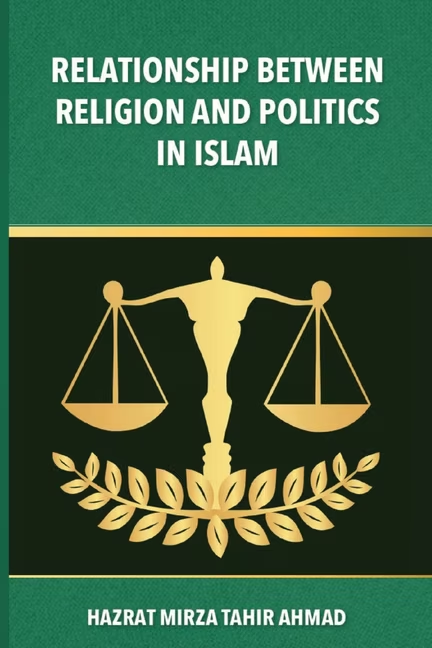
He further states, “The entire world would become a world of not only political conflict but also of a politico-religious conflict, whereby all the laws would be attributed to God, yet they would contradict each other diametrically. There would be such a confusion that people would begin to lose faith in a God who speaks one thing to one people and another thing to another people, and who tells them to enforce this law on the people or ‘they will be untrue to Me.’” (Ibid., p. 6)
“[…] India for instance, if the law of the Hindu majority is imposed on the Muslim minority […]. What would happen to the Muslims and other minorities of India? Moreover, this is not a question of India alone. What if Israel enacts the law of Judaism – the law of the Talmud? I have read it and I know it will be impossible for any other non-Jew to live there normally and decently.” (Ibid.)
Islamic law is that, “anyone born in a state has a right to participate in its legislation […]. Everybody’s wish is not fulfilled or carried out, but, in principle, everybody has a fair chance and an equal chance to make his say heard – at least by the opposition – on matters of common principle” (Ibid., p. 7)
In order for the Sharia to be enacted, it requires a special atmosphere. Just as the tree does not bear fruit lest they are under the right circumstances. A society where theft is common, for instance, cannot have Sharia law. It is only when a pious society has been created that the Sharia can be introduced over a period of time. The extremist religious organizations who claim to follow the Sharia, follow nothing but their own conjecture. Because the Quran clearly states, “There should be no compulsion in religion.” (Surah al-Baqarah, Ch.2: V.257) Even the Holy Prophet (sa) was told by God Almighty that “Admonish, therefore, for thou art but an admonisher; Thou hast no authority to compel them.” (Surah al-Ghashyiah, Ch.88: V.22-23) It is evident that according to the Holy Quran the true objective of Muslims is to admonish, or give advice of goodness, and peacefully preach. They are not allowed to use force on anyone. This principle applies to a Muslim government as well. Living under Sharia law does not mean that the government possesses the right to force a person to follow a certain religion or act a certain way. This is contradictory to what the Quran teaches us.
The Quran promotes a secular society on the sole basis of absolute justice. When it states, “Verily, Allah enjoins justice.” (Surah an-Nahl, 16:91) “Be Always Just that is nearer to righteousness.” (Surah al-Mai’dah Ch.5: V.9) Islam establishes the basis of the Sharia solely on justice, not creed, caste, race, religion or gender.
And when hearing that the Quran deals out punishments of death, amputation, stoning beheading, the question arises as to whether the Quran permits harsh punishments? As discussed earlier, this Law and these punishments can only be enacted in a society which has moulded into an ideal society, not one which is corrupt.
In the situation where one steals and his hands have been ordered to be cut off, it is considered a valid punishment in an ideal society where such a crime is looked down upon. Because the moral values and ethical heights of the people are so high that to commit such a lowly and petty crime is out of the norm. The entire philosophy of the law is to protect the innocent.
In the scenario presented in the beginning. This exact event takes place in a book by Victor Hugo – Les Misérables. In which the man stealing the bread for his family happens to be a fellow named Jean Valjean. He is imprisoned for 19 years as a result of his crime, and after his release, he is hardened – until a bishop shows him mercy instead of punishment. That singular act transforms him into a compassionate man who spends his life helping others, despite the hardship he faced in the earlier part of his life.

The Quran presents a similar teaching to this, stating that “And the recompense of an injury is an injury the like thereof; but whoso forgives and his act brings about reformation, his reward is with Allah. Surely, He loves not the wrongdoers.” (Surah ash-Shura: Ch.42: V.41) It states that forgiveness in the right situation – where the other party also shows change, reformation and remorse for their actions – is closer to righteousness rather than meting out cruel punishments. It does not diminish the wrongful act committed. Rather sets an example that the Sharia encourages reformation, repentance and forgiveness among believers, wherein they help their weak brethren rise from a lower status to a higher one. Rather than condemning them to a lifetime of prison or any other cruel punishment. Thus, in a society where a hungry man steals to quench his appetite, Islam does not allow any punishment for him. (Audio Answer, Hazrat Mirza Tahir Ahmad (rh), Is amputation of a thief’s hand the Islamic punishment for theft?, 28 May 1984)
Hazrat Musleh-e-Maud (ra) regarding meting out the punishment of cutting the thief’s hand states that this punishment is an extreme punishment and is not meant for every thief. Rather, it has eight conditions. In short:
- The theft must be important
- He steals without necessity, and it is a habitual theft
- He is caught before he repents
- Steals someone’s property
- His theft should not be suspected
- A person should not be a minor
- A person should have common sense and understanding, not be foolish
- The term “thief” can be applied to him (Anwarul Ulum, Vol. 19, p. 428)
Hazrat Mirza Tahir Ahmad (rh) was once asked whether Sharia law can be implemented in the Western world today, to which he responded that the current world cannot adopt the Sharia. He states, “What we are discussing is whether it is possible to adopt religious law as the law of the country by any state, or any other religion for that matter. I believe it is not possible. It is not possible even if you genuinely and fervently so desire; in the name of God, even then it’s not possible. We have gone so far away from religion. We have become hypocrites. The whole human society has become hypocritical. There is hypocrisy in politics and society everywhere. And hypocrisy does not permit honesty to flourish. It does not permit the word of God to take root. That is the main problem.” (The Relationship between Religion & Politics in Islam, 2017, pp.17-18)
The reason the Sharia law is seen negatively in the Western world is that erroneous examples and false notions have crept into the countries that have attempted to call themselves “a Muslim country” and enact the Sharia. Take the example of Pakistan, for instance. They take pride in referring to themselves as a Muslim country; in fact, the core reason for the 1947 partition of India was due to the growing enmity between the Hindus and Muslims, where Muslims were calling for a separate state. Their attempt to enact even a fraction of the Sharia after its creation was poorly done. The vast majority of its population is Muslim; aside from this, there are still minorities of Hindu, Christian and other religious communities in Pakistan, who during the partition decided not to leave their ancestral land. But despite the Sharia allowing all backgrounds of people to live in peace and abide by their own respective teachings, Pakistan, till today, is still not religiously tolerant and does not grant rights to minorities. This, in fact, is against the teaching of the Holy Prophet (sa), who magnificently showed that Islam is not a ruthless, violent and discriminatory religion.
When the Holy Prophet (sa) was declared the King of Medina, there were still Jewish residents from the tribes of Banu Nazir, Banu Qainqa‘ and Banu Qurayza present in Medina. The Holy Prophet (sa) did not usurp their rights, exile them, mistreat them or intentionally tear down any synagogue or place of worship they had. Rather, he let them live in peace and established a treaty with them for maintaining that peace. Even when an individual from among the Jews committed crimes, he did not act insolently against the whole Jewish community in Medina. Rather, he saw it as a crime of a single individual and punished him according to the Torah, not the Quran.
This is the Sharia. A government so refined and intricate that they understand the moral and spiritual role it must uphold. A government whose principles are ones that create the perfect breeding ground for a perfect citizen and a perfect civilisation. A populace which contains exemplary high faculties which looks down upon perpetrators who seek to diminish a society. The Sharia aims to achieve and grant its citizens the very best society by keeping justice and equality at the centre of its framework. When selfishness, ego, jealousy, desires and an agenda don’t become the objectives of a nation or government, great things can be achieved. This is the perfect law which the world itself is neglectful and ignorant of. The real question is not whether the Sharia is relevant in today’s age, but whether we are ready to rise to its standard.