
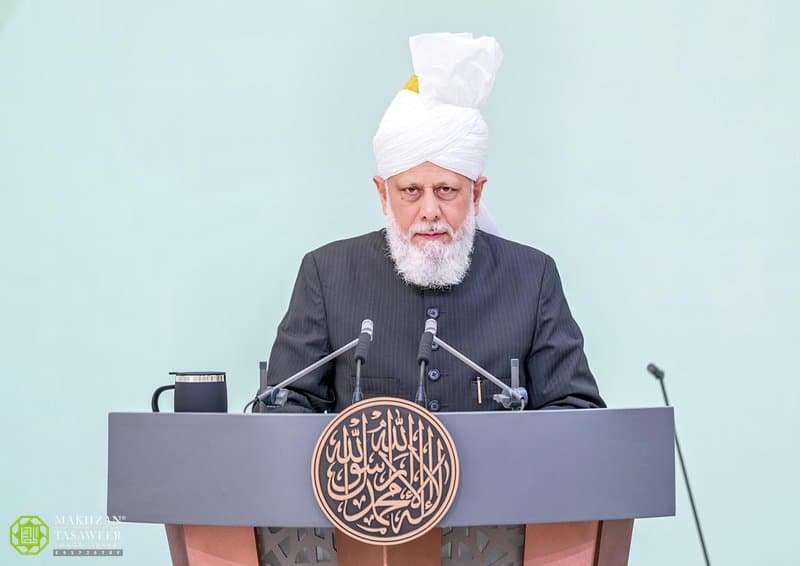
After reciting the tashahhud, ta’awwuz and Surah al-Fatihah, Hazrat Khalifatul Masih V (aa) said:
Today, I will present some accounts from the life and character of the True Servant of the Holy Prophet (sa) – the Promised Messiah (as) – which demonstrate how he upheld truth at all costs, remained firmly upon the truth and even challenged his opponents in this regard.
First, I will present the response of the Promised Messiah (as) to one of his major opponents, Muhammad Hussain Batalvi Sahib, who accused him of being a disbeliever and a liar. The reply to this allegation given by the Promised Messiah (as) was such a clear and open answer and challenge that anyone judging with fairness could never accept such allegations. However, when one’s eyes are veiled, light cannot be seen – and this is the condition of the clerics today as well.
On one occasion, Muhammad Hussain Batalvi Sahib wrote a letter to the Promised Messiah (as), in which he described him as an opponent of Islam, a disbeliever and a liar, God forbid. In response, the Promised Messiah (as) wrote a detailed reply, stating that:
“If you cast a glance upon my life with the mindset of a seeker after truth, you will find conclusive evidence that Almighty God has always safeguarded me from the filth of falsehood to the point that sometimes, in the British courts, my life and honour were subjected to such perilous risk; no lawyer gave me any advice except lying. (All of them said that if he lied, the case would naturally be resolved in his favour.) But Allah, glorified be His eminence, granted me the ability to disregard my life and honour for the sake of truth. Hence, by the grace of Allah the Almighty, I chose truth over my life and honour. I often suffered hefty losses in pecuniary suits merely for the sake of truth. And many a time, I deposed against the interests of my father and brother, simply out of the fear of Almighty God, but I did not abandon the truth.”
He continues, “I have lived a lifetime in this village and also in Batala (i.e., in Qadian and Batala), but who can prove that a lie was ever spoken out of my mouth? So, when I have refrained from lying about people since the very beginning merely for the sake of Allah, and I have repeatedly sacrificed my life and property for the sake of truth, then why would I lie about God Almighty?”
Batalvi Sahib had also written in that letter that lying and deception had become such an ingrained trait in him that it was as if it were part of his very nature, God forbid.
Whereas in reality, this was clearly a falsehood and a fabrication on the part of Maulvi Sahib himself, an allegation for which he had no evidence whatsoever.
Accordingly, the Promised Messiah (as), in responding to him, wrote:
“Sheikh Sahib! Anyone who is God-fearing and of pure birth would not, in the first place, dare accuse his brother of any transgression and disbelief without full investigation. But if he were to make any such accusation, he would furnish such perfect proofs about it that would make the day dawn upon those looking on. So, if you possess both of these above-mentioned qualities, I adjure you in the name of the Powerful God Who is the Lord of Glory, the invocation of Whose oath elicited a considered reply even from the Holy Prophet (sa) to prove that I have these two types of evils in me that you think I possess; that firstly, I am hostile to the religion of Islam and am a kafir, and secondly, that I am given to lying.”
He levelled two allegations: first, that he is a disbeliever and not a Muslim – very well, he must prove that. Second, if he claims that he was a liar – then he must prove that as well. The Promised Messiah (as) continues:
“The Holy Prophet (sa) has said that: ‘Most truthful indeed are the dreams of the one who is most truthful in all that he says.’ In this hadith, the Holy Prophet (sa) has appointed this as a sign of the truthful; that truth should be dominant in their dreams.
“You have just made the claim that you (i.e., Maulvi Sahib) believe in the Holy Prophet (sa). Thus, if you have not said this by way of hypocrisy, and you really, truly believe in the Holy Prophet (sa), knowing that the Holy Prophet (sa) is true in his sayings, then come, let us examine each other on the basis of this standard, and see who is proven to be truthful and who is innately given to lying. Similarly, Allah, glorified be His eminence, says in the Holy Quran:
لَھُمُ الْبُشْرٰی فِی الْحَیٰوةِ الدُّنْیَا
“‘For them are glad tidings in the present life.’
“Meaning that, it is a special quality of the believers that, as compared with others, their dreams turn out to be true. You have also just claimed that you, too, believe in the Holy Quran. Very well! Let us also test from the perspective of the Noble Quran as to who possesses the sign of a believer.
“Both these examinations can be conducted as follows: A gathering can be held at Batala, Lahore, or Amritsar, to be attended by witnesses of the dreams of both parties, and then whoever between the two of us is proven to be most true in his dreams on the basis of conclusive and convincing evidence, his opponent shall right there and then be given to wear the ‘medal’ of the epithets kadhdhab [arch-liar], dajjal [deceiver], kafir [disbeliever], akfar [the greatest of disbelievers], and mal‘un [the accursed], or whatever names are deemed appropriate. And if you are unable to prove the truthfulness of your past [dreams], I agree and allow you up to six months to publish in a few papers such dreams of yours which may embody news of the unseen. As for myself, I shall not only furnish proof [from my dreams] of the past but shall also, insha-Allah, publish present dreams of mine against yours.
“And just as you profess to have faith in the Quran and the Prophet (sa), so do I believe with all my heart and soul in that beloved Prophet (sa) and in that beloved Book, the Noble Quran. Now these tests, therefore, would determine who is true and who is false in his claim.
“In case I lose according to the test appointed by the Holy Prophet (sa) and the Noble Quran, you would be the truthful one; and I, according to you, would be considered to be a kafir [disbeliever], a dajjal [deceiver], an infidel, Satan, kadhdhab [the greatest liar], and a fabricator. Moreover, in that case, all your mischievous doubts would become true and justified (that is, whatever evil doubts you have about me will all be justified), namely, that I defrauded the people through Barahin-e-Ahmadiyya, cheated them of their money by holding out promises of acceptance of prayers, and lived on ill-gotten wealth. However, if the munificence of God Almighty, which accompanies the believers and the truly righteous, establishes my truthfulness, then tell me yourself whether all these epithets would apply to your claimed pretentious priestly stature or whether there would still be a way of escape left for you. (This was his challenge.)
“You have caused me great pain and distress; I continued to exercise patience, but you did not show an iota of fear of that All-Powerful Being Who is aware of your very essence. He has informed me by way of a prophecy regarding you and those of your bent of mind that:
اِنِّیْ مُھِیْنٌ مَّنْ اَرَادَ اِھَانَتَکَ
“‘I shall humiliate him who designs to humiliate you.’
“So rest fully assured that the time is now close at hand when Almighty God will prove that you have lied in making all these accusations. He will send down upon you all those humiliating punishments that slanderers and liars face by way of disgrace and shame. You claim to profess belief in the Quran and the Prophet, may the peace and blessings of Allah be upon him. (i.e., Maulvi Sahib). Thus, if you are true in this claim of yours, come into the battlefield for a test, so that Almighty God may Himself judge between you and me and so that he who is a liar and a dajjal may be disgraced. At this moment, something in support of the truth arises from my heart. I cannot suppress it, for it does not proceed from myself. It is an overwhelming inspiration from my Lord. It is that as you consider me to be a disbeliever and declare lying to be a special trait of my character, I adjure you in the name of Allah, glorified be His eminence, to immediately come and compete with me in the above-mentioned manner so that it be seen who is proven to be the liar, dajjal, and a disbeliever according to the Noble Quran and the sayings of the Prophet, may peace and blessings of Allah be upon him.” (Aina-e-Kamalat-e-Islam, Ruhani Khazain, Vol. 5, pp. 289-295; Mirror of the Excellences of Islam, pp. 332-338)
In this regard, the Promised Messiah (as) states:
“There is another thing also with this by means of which the truthful ones can be tested, and which God Almighty Himself brings into existence. Namely, that sometimes a man is involved in such a calamity from which no way of escape or success can be seen by him except that he should tell a lie. It is at such a time that he is tested as to whether there is truth or falsehood in his nature. (Maulvi Sahib had written that it was in the Promised Messiah’s (as) nature to lie. The Promised Messiah (as) wrote that during a trial, one finds out whether one’s nature is infused with truth or falsehood.) One finds out whether, at such a delicate time, his tongue utters the word of truth or whether, fearing for his life, honour, and wealth, he starts uttering falsehood.
“My humble self has had to face many such experiences, the details of which will only lengthen this account. However, I proceed to relate three such examples, and I do so with this objective: if you have ever had similar occasions to test your love of truth, I hereby adjure you in the name of Allah, His eminence be glorified, to publish them along with their proof, so that it might be known that you are not making an empty claim and that even in the grip of trials and tribulations you have not violated the truth.”
That is, if he claims that he has never uttered a lie, then he should accept the challenge. The Promised Messiah (as) has presented his own examples and stated that he would present three. He states:
“One of these is that after the death of my father, my brother, the late Mirza Ghulam Qadir and I were sued in the District Court by the joint proprietors of the Qadian estate at the instance of Mirza Azam Baig of Lahore, for proprietary possession of the estate. I knew that these co-proprietors had apparently nothing to do with the ownership of the estate, for it had been lost to the family and had ceased to exist in the time of the Sikhs. In an effort to retrieve it along with other estates, my father had alone borne an expense and loss of approximately 8,000 rupees, which these people had not shared so much as a single penny. In the course of this litigation, on praying for the success of the suit, I had the revelation:
اُجِیْبُ کُلَّ دُعَائِکَ اِلَّا فِیْ شُرَکَائِکَ
“‘I shall accept all your prayers but not in the matter of your collaterals.’ (i.e., this prayer will not be accepted.)
“After this revelation, I invited my brother, along with all the men and women of the family, some of whom are still alive, to gather at a place, and I clearly explained to them not to defend the joint proprietors’ suit as it was against God’s will to do so, (Allah did not wish for them to pursue this case) but they did not accept my suggestion and were ultimately unsuccessful. As for myself, I bore the loss of thousands of rupees with courage. (The Promised Messiah [as] remained steadfast as God decreed for it to stop, and he did not pursue the case.) All those who are now my enemies are witnesses to this. As all affairs of the estate were in the hands of my brother, I counselled him again and again, but he refused and ultimately bore the loss.”
The second example he gave was as follows: “Approximately fifteen or sixteen years ago, or perhaps a little more, my humble self dispatched an article for printing in a press owned by a Christian by the name of Rallia Ram, who was also a lawyer and lived in Amritsar. He was also the owner and editor of a newspaper. This article was in support of Islam and was a response to the Aryas. The article was sent in a postal packet open on both sides, and I also placed a letter in the packet along with the article. Because this letter contained statements in support of Islam and in refutation of other faiths and insisted that the article might be printed, the Christian [editor] became upset on account of religious differences. And quite by chance, he got this opportunity to make a hostile attack because the placing of such a separate letter in a postal packet was an offence under the law, which my humble self was not aware of at all. And such a crime was punishable under the postal laws with a fine of up to 500 rupees or imprisonment for up to six months. Accordingly, he became an informant and got the postal authorities to file a case against me.
“Even before I received intimation of this case, Allah the Exalted showed me in a vision that Rallia Ram, the lawyer, had sent a serpent to me so that I might be bitten by it, but I fried the serpent as one fries a fish and sent it back to him. I know that this was an indication that the decision in that case, by virtue of the way it came about, might set a precedent that would prove helpful to lawyers [in such cases]. In short, I was summoned to the headquarters of the District of Gurdaspur for this crime and all the lawyers, with whom I consulted regarding the case, advised that there was no other way than to employ falsehood and counselled that I should make a statement to the effect that I had not put the letter in the packet and that Rallia Ram himself might have put the letter in the packet. Moreover, the lawyers said to me by way of assurance that by giving such a statement, the case would be decided upon by witnesses and that I would be acquitted by producing two false witnesses. Other than this, the case was very difficult, and there was no hope of my deliverance, but I told all of them that I did not want to abandon truth under any circumstances, so let whatever happens, happen.
“Thus, that very day, or the next, I was made to appear in the court of an English magistrate, and the Superintendent of Post Offices appeared as the complainant on behalf of the Government against me. The magistrate of the court proceeded to record my statement with his own hand and, before anything else, asked me this very question: ‘Did you put this letter in the packet and is this letter and this packet yours?’ I answered without any hesitation: ‘This is indeed my letter, and this is indeed my packet, and I had dispatched this letter by placing it in the packet, but I did not put the letter in the packet with any ill-intent to cause loss of revenue to the Government. (I did not seek to harm the government by avoiding paying for postage.) I did not consider the letter as being distinct and separate from the article enclosed in the packet, nor did the letter contain any personal matter.’ Immediately upon hearing this statement, Allah the Almighty inclined the heart of this magistrate (who was an Englishman) in my favour.
“My opponent, the Superintendent of Post Offices, created a great uproar and made very lengthy statements in English, which I could not follow except that each time the Superintendent made a point, the magistrate would reject it, saying: ‘No, no,’ (in the English language). Thus, finally, when the plaintiff Superintendent had concluded his submission and finished venting his anger, the magistrate wrote his order in a couple of lines and said to me:
“‘You may leave.’
“Upon hearing this, I came out of the courtroom deeply grateful to my Real Benevolent Lord (that is Allah the Almighty), Who had bestowed victory upon me even in opposition to a European officer. (The complainant was an Englishman.) And I know full well that God Almighty delivered me at that time from that misfortune on account of my adhering to the truth. Before this case, I had also seen a dream that a man had stretched forth his hand to take away my cap, whereupon I said: ‘What are you up to?’ On this, he left the cap on my head and said, ‘That is all right, that is all right.’”
Then, the Promised Messiah (as) presents a third example as follows:
“Another one of these incidents transpired as follows: My son, Sultan Ahmad, brought an action against a Hindu for the demolition of a building which the latter had built on land belonging to our family. In the plaint, a fact had been inaccurately stated, and the proof of this rendered the action liable to dismissal, in which case not only Sultan Ahmad, but I as well, would have to suffer the loss of proprietary rights. The defendant, seizing the opportunity, cited me as a witness. (They said that the Promised Messiah (as) would be a witness, and what he stated would be accepted.) I went to Batala and stayed at the residence of Babu Fateh Din, Sub-Postmaster, which was situated close to the Batala courts. The case was in the court of a Hindu judge whose name I no longer recall, but who was afflicted in one of his legs. Sultan Ahmad’s lawyer came to me and said, ‘The case is about to be called; what statement are you going to make?’ I said my statement would be in accordance with the facts and the truth, whereupon he said, ‘Then there is no need for you to go; I will go myself to withdraw the case.’ (There was no point in going to court, because if he told the truth, then the case would end.) So, I ruined that case myself, with my own hands, merely for the sake of truth; I preferred truth to gain God’s pleasure and did not mind the material loss at all. (The Promised Messiah [as] desired only God’s pleasure.)
“These last two examples are not without proof either; witnesses to the first are Shaikh Ali Ahmad, Lawyer, Gurdaspur, and Sardar Muhammad Hayat Khan, C.S.I. Moreover, the file must be preserved in the Gurdaspur District records. Witnesses to the second incident are Babu Fateh Din and the lawyer himself, whose name I do not remember at this time, and also the judge whom I have already mentioned and who has now perhaps been transferred to Ludhiana. The suit was brought about seven years ago. Also, I recall that Nabi Bakhsh, Patwari [Village Land Revenue Accountant] at Batala, was also a witness to what happened in this case.”
Now, whilst addressing the cleric, the Promised Messiah (as) states:
“Now, Hadrat Shaikh Sahib! If you also have any instance of a trial of this degree of seriousness, in which you had seen your life, honour, and property at risk in the event that you had spoken the truth, yet you stuck to the truth caring not for your property or life, I would beseech you in the name of Allah to come forward with that incident along with the full proof thereof. It is, however, my belief that most of the mullahs or maulawis of this age are just talk; they are ready to sell their faith for a single penny, for our Noble Prophet, may peace and blessings of Allah be upon him, had declared the maulawis of this Latter Age as the worst of creation.
“Moreover, the late Nawwab Siddiq Hasan Khan, whom even you believe to be a Mujaddid [Reformer], has acknowledged in Hijaj-ul-Kiramah that that Latter Age is this very period of time. Thus, to acknowledge the piety and righteousness of such maulawis without proof would mean falsifying the saying of the Holy Prophet, may peace and blessings of Allah be upon him. Therefore, let us have instances of your experience, but if you fail to present any, it will be established that you only possess a claim to piety, but no claim is worthy of acceptance without evaluation.
“The state of your inner being is known only to God Almighty as to whether you ever soiled yourself with the filth of lies and fabrication (I do not know; only Allah would know Who possesses knowledge of the unseen), or it might be known to those who are acquainted with your affairs. The man who emerges as truthful at a time of trial and does not abandon the truth earns the seal of truthfulness. If you possess this seal, come forward and show it. Otherwise, fear God Almighty lest He may expose your flaws.” (Aina-e-Kamalat-e-Islam, Ruhani Khazain, Vol. 5, pp. 296-301; Mirror of the Excellences of Islam, pp. 339-344)
Regarding the case that was mentioned – the suit filed by Mirza Sultan Ahmad concerning the demolition of a property – it is recorded in its details that a Hindu deputy by the name of Shankar Das had held a government post in the state of Jammu. In Qadian, he seized a vacant plot of land on the eastern side of Masjid Aqsa and constructed a house upon it, which later came to house the offices of the Sadr Anjuman Ahmadiyya. Mirza Sultan Ahmad had filed a suit for the demolition of this house; however, there was within the framing of the case a certain assertion contrary to fact, and it was on account of this that the case stood to be dismissed – causing harm not only to Mirza Sultan Ahmad himself, but to the Promised Messiah (as) as well, for the proprietary rights over that land would thereby have been lost. The land did not belong to the opposing party – that is, to Shankar Das – yet his physical possession of it was an established reality. He was not its owner, but he had taken possession of the land nonetheless. It was precisely this possession that his adversaries, whether through legal means or outright opposition, sought to exploit to their advantage. They accordingly had the Promised Messiah (as) summoned to give testimony – for despite being fierce opponents, they knew full well that the Promised Messiah (as) would not speak falsehood and that he would declare before the court that possession of the property did indeed belong to the opposing party and that this possession was of long standing. And so it came to pass that when Sahibzada Mirza Sultan Ahmad learned that the opposing party had arranged for the testimony of the Promised Messiah (as) to be called, he too knew that the Promised Messiah (as) would never utter a lie – and so he withdrew the case altogether. (Hayat-e-Ahmad, Vol. 2, Part 1, pp. 102-103; Ashab-e-Ahmad, Vol. 6, p. 42, [footnote])
In any case, the history of that tall and high mansion is this: it was known as the mansion of Deputy Shankar Das, who, as I have mentioned, was a man of extreme bigotry and hostility. From the height of his towering residence, the private quarters of the Promised Messiah’s (as) household were left exposed and open to view. This, too, was among the reasons for the legal battle fought over it. As a further expression of his enmity, it was his practice to sit at the entrance of his house and hurl abuse at those passing to and fro on their way to offer prayers at Masjid Aqsa. He adopted every manner of means to cause distress and torment. When those afflicted by his persecution would come before their master, the Promised Messiah (as), to lodge their complaints, he would reassure them with great resolve and a dignified firmness, saying:
“Have patience; no one can stand up to a royal camp. He has established his own base, his own encampment – but our camp too is a royal camp; it is the camp of Allah the Almighty. None shall be able to stand against it.” Then those who were destined to witness it indeed saw, and those who were meant to hear it indeed heard, that the flourishing and prosperous household of that Deputy Sahib began to fall into ruin. In the end, he too departed from there, whether due to illness or some other cause. Thereafter, this very property was purchased by Hazrat Sheikh Yaqub Ali Irfani Sahib, and in 1932, the offices of Sadr Anjuman Ahmadiyya were established in that building, which was inaugurated by Hazrat Musleh-e-Maud (ra). This is among the manifestations of Divine power: that the name of the very individual who, in his arrogance, would not even permit a worshipper to pass before his house on the way to the mosque has now, by the decree of God, been completely erased, and that entire house, that entire area, has been transformed into a mosque, as it has become part of Masjid Aqsa. (Tarikh-e-Ahmadiyyat, Vol. 2, p. 215, Vol. 5, pp. 298-299; Hayat-e-Ahmad, Vol. 5, Part 2, p. 230; Al Fazl Qadian, 3 May 1932, p. 5; Mujaddade-e-A’zam, Part 1, p. 38 [footnote])
Such were the esteemed blessings of the testimony borne by the Promised Messiah (as), founded upon truthfulness and integrity: that he did not abandon the truth, nor did he care for familial honour and status, nor for the loss of land and property. It was as though he sacrificed all these things with his own hands. Yet God accepted this sacrifice in such a manner and granted it such grandeur and blessing that today, directly beneath Minarat-ul-Masih, it stands populated as a place of worship devoted to the One and Only God.
Hazrat Musleh-e-Maud (ra), speaking about the lawyer who was pursuing this case, states:
“In those days, Sheikh Ali Ahmad Sahib, advocate of Gurdaspur, would often represent the Promised Messiah (as) in legal matters. Observing his pure life, even after the claim, though he himself was not an Ahmadi, he held the Promised Messiah (as) in great esteem. He once said to him that there was no other witness and that the letter in question pertained to the same topic (relating to the earlier-mentioned postal case) and thus could be considered part of the published announcement (Hazrat Musleh-e-Maud [ra] is detailing the proceedings of the postal case). Thus, without resorting to falsehood, he could say that he had only sent an announcement and not a letter. However, the Promised Messiah (as) refused to adopt such a course and said, ‘This cannot be done. This subtle distinction would violate the truth. I had indeed placed a letter within it; although it was part of the original publication, it was nevertheless a letter. Therefore, I will state that I sent a letter. How can I deny what I have done?’ Accordingly, when he appeared before the court and was asked whether he had included any letter in the packet, he replied, ‘Yes.’ This truthfulness naturally had an effect upon others, but it further had such a profound effect upon the court itself that he was acquitted. The judge remarked that for a mere technical offence, such a truthful man could not be punished. (Khutbat-e-Mahmud, Vol. 17, p. 543)
Regarding this same postal case and its lawyer, Hazrat Sheikh Yaqub Ali Irfani Sahib (ra) writes:
“Sheikh Ali Ahmad Sahib himself narrated these events to me. (This is the lawyer’s own statement, which he gave to Hazrat Sheikh Yaqub Ali Irfani Sahib [ra]). He said: ‘The case was last heard in the court at Dina Nagar. I made every effort to persuade Mirza Sahib to deny that he had placed the letter inside the packet. In my view, there was no proof that the letter had been recovered from that very packet, nor was there any testimony to that effect. Owing to religious differences, even the testimony of Lala Ralya Ram would not have been considered reliable. Yet, the more I insisted, the more Mirza Sahib refused.
“‘I repeatedly cautioned him that the outcome would not be favourable and that, for no reason, the stigma of conviction in a criminal case would attach to a respectable family. I told him that everything was turning against him. However,’ he continues, ‘The Promised Messiah (as) did not accept my advice.’
“He further relates: ‘I was apprehensive that if the case were lost while I remained his counsel, it would bring great disrepute upon the family. Therefore, when Mirza Sahib firmly declared that he shall not deny it, I decided to take advantage of this and thus resolved to withdraw. I said, “If you do not accept my counsel, then I cannot continue to represent you.” My expectation was that a conviction would ensue, and the blame would fall upon him for acting contrary to his lawyer’s advice.’
“The lawyer was convinced that the Promised Messiah (as) would be given a punishment for this. Moreover, if such a verdict were passed, people would say that the counsel had failed to present the case properly. Thus, out of fear for his own reputation, he absented himself after expressing displeasure, and the case proceeded in his absence.
“The lawyer concludes: ‘To my utter astonishment, the case was dismissed. It was then that I was filled with regret, for I realised that I might have shared in the credit of this success, but by then the opportunity had passed.’
“While recounting this incident, Sheikh Ali Ahmad Sahib would greatly praise the steadfastness and truthfulness of the Promised Messiah (as). His relations with this family endured until his last breath. The Promised Messiah (as) generally preferred to seek his counsel in legal matters and treated him with great respect. (Hayat-e-Ahmad, Vol. 1, Part 2, pp. 363-364)
Referring to various such cases, Hazrat Sheikh Nur Ahmad Sahib (ra) relates that his father and uncle would often say that their village fell under the estate of Mirza Sahib. For a period, the Promised Messiah (as) served as his father’s representative, and they accompanied him to court on several occasions. He would invariably adopt the course of truth, even if it entailed some disadvantage in the case. Indeed, he would never relinquish truthfulness, nor allow falsehood even to approach him. (Sirat-e-Ahmad, Qudratullah Sanuri Sahib, p. 63)
Hazrat Mian Allah Yar Sahib narrates that when the Promised Messiah (as) was about 25 to 30 years of age, his respected father became involved in a dispute with those who were employed to live and work on the land over the cutting of trees. His father held the view that, as proprietors of the land, the trees also belonged to them. Accordingly, he instituted legal proceedings and sent the Promised Messiah (as) to Gurdaspur to pursue the case, accompanied by two witnesses.
On the way, after crossing a canal and reaching a nearby village called Patnawala, he paused briefly to rest and addressed his companions, saying: “My father insists unnecessarily. Trees are like crops. These are poor people; if they have cut them, what harm is there? In any case, I cannot state in court that they belong entirely to us. At most, we may have a share in them.”
The tenants of the land had complete confidence in him. Thus, when the magistrate enquired of them (i.e., those who had been living there for many generations) regarding the actual matter, they replied without hesitation: “You may ask Mirza Sahib himself.” Those who worked and lived on the land, they said that he should ask the Promised Messiah (as) himself, for we know that he does not speak a lie. And so, when the magistrate posed this question to the Promised Messiah (as), he stated: “In my view, trees are like crops; just as we have a mutually agreed share in the crops, so too we have a mutually agreed share in the trees.” Upon this statement, the magistrate decided the case in favour of those who were employed to live and work on the land.
When the Promised Messiah (as) returned to Qadian, Hazrat Mirza Ghulam Murtaza Sahib enquired of one of the individuals who accompanied him to court about the outcome. He replied that he was outside [of the court], and Mirza Sahib went inside, so he would only know. When the Promised Messiah (as) was called, he related the entire incident as it was. Upon hearing this, his father became greatly displeased. (Tarikh-e-Ahmadiyyat, Vol. 1, pp. 72-73 and 78)
In any case, these are but a few incidents illustrating the truthfulness of the Promised Messiah (as). One particular case has been described at length in response to an allegation made by an errant cleric. In all circumstances, the Promised Messiah (as) gave precedence to truth and never approached falsehood. He consistently enjoined his followers to adhere to truthfulness; in fact, among the conditions of Bai‘at is the pledge to abhor falsehood and to remain firmly established upon truth. (Majmu‘ah-e-Ishtiharat, 2019, Vol. 1, p. 206)
Therefore, it is incumbent upon us to adopt truthfulness as a distinguishing hallmark of our character. May Allah the Almighty grant us the ability to do so.
(Official Urdu transcript published in the Daily Al Fazl International, 22 May 2026, pp. 2-6. Translated by The Review of Religions.)