
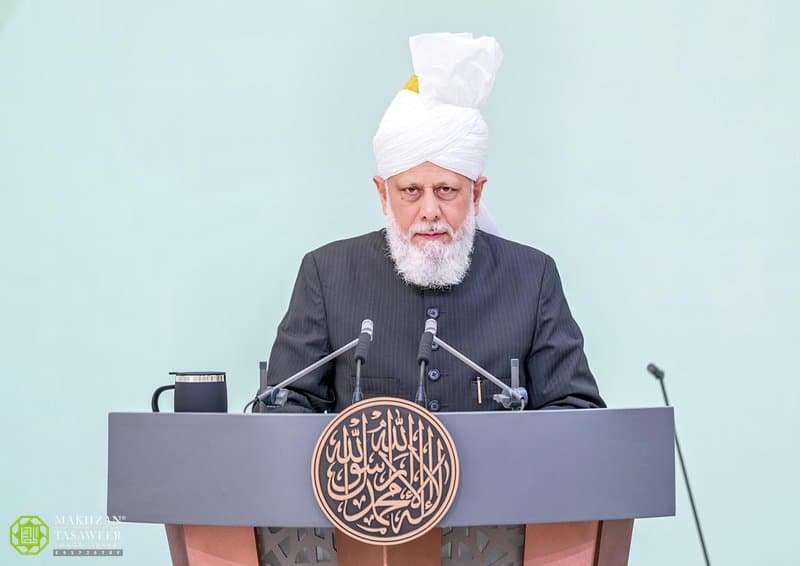
After reciting the tashahhud, ta‘awwuz and Surah al-Fatihah, Hazrat Khalifatul Masih V (aa) stated:
I will present some incidents of the Promised Messiah’s (as) efforts, following in the footsteps of his Master (sa), for the establishment of Tawhid [oneness of God]; his practical examples, his advices to his followers and the manner in which he saw to their moral training.
Hazrat Musleh-e-Maud (ra) states:
“The Promised Messiah (as) used to say that the son of an individual had passed away, and one of his friends went to console him. The man cried out loudly and said, ‘God has been unjust towards me.’ In other words, he thought that God had deprived him of some right that was due to him.”
Hazrat Musleh-e-Maud (ra) continues narrating this incident told by the Promised Messiah (as) and says:
“One should reflect as to what right an individual has over God. It always amazes me that those people who take pride in their prayers, fasting, Zakat, Hajj and their righteousness and purity cry out at the time of hardships that God Almighty has been unjust towards them. Yet there was an alcoholic Indian poet, who was completely ignorant of religion; yet in a moment of clarity, despite being an alcoholic received a divine intimation in his heart from Allah the Exalted and he exclaimed: ‘We have given our lives to the One Who gave us life; yet the truth is we have not fulfilled the rights we owe to Him.’” (The Secrets to Success in This World, Anwar-ul-Ulum, Vol. 12, pp. 311-312)
As such, a person should always bear in mind that whatever bounties and children we have received are purely due to the grace of Allah the Almighty. This demands that we remain ever submissive to Him, manifest His oneness in our every word and action and that we never allow even the slightest trace of shirk [associating partners with God] to develop within us. We should never assume that we have any right over Allah the Almighty. We have not fulfilled any right by worshipping a small amount. In fact, we do so for our own benefit. Thus, the poet that he mentioned says that Allah the Almighty gave us life and created us, and as a result, we came into this world. However, we are unable to fulfil the right that is due to Him in order to express our gratitude towards Him.
Hazrat Musleh-e-Maud (ra) also relates an incident regarding the reaction of the Promised Messiah (as) at the demise of his own son. He says:
The Promised Messiah (as) dearly loved Mubarak Ahmad, and during his illness, he took great care of him. Due to this, even Hazrat Khalifatul Masih I (ra) was concerned that if Mubarak Ahmad were to pass away, it would cause immense grief to the Promised Messiah (as).
At the final moments, when Hazrat Maulvi Sahib was checking his pulse, he requested the Promised Messiah (as) to bring musk. As the pulse of the child was fading, the thought of how much grief his demise would cause the Promised Messiah (as) impacted him so greatly that Hazrat Khalifatul Masih I (ra), collapsed to the ground (he collapsed) due to the mere thought of how much grief this would cause the Promised Messiah [as]). However, when the Promised Messiah (as) came to know that Mubarak Ahmad had passed away, he immediately, with utmost patience, started writing letters to his friends saying that Mubarak Ahmad had passed away, but that they should not become distressed by this. This was the will of Allah the Almighty and patience must be shown upon this.
Following this, the Promised Messiah (as) came out and started delivering an address with a smiling countenance, saying that the revelation of God Almighty in relation to Mubarak Ahmad had been fulfilled. There is also a couplet of the Promised Messiah (as), which is as follows: “The Caller is the most Beloved. O my heart, sacrifice yourself for Him.” (Salvation, Anwar-ul-Ulum, Vol. 7, pp. 65-66)
Similarly, whilst writing about the life of the Promised Messiah (as), Hazrat Musleh-e-Maud (ra) once stated:
“I have heard the Promised Messiah (as) say something many times. While mentioning the Sultan of Turkey, Abdul Hamid Khan – who had been deposed – he would say that there was one thing about Sultan Abdul Hamid Khan which he liked very much. (Despite the fact that many of his actions were wrong, he would say that there was one thing he greatly appreciated. What was it?) When the question of war with Greece arose, the ministers presented many excuses. In reality, Sultan Abdul Hamid wished that the war should take place, but the ministers did not wish for it, so they presented many excuses. Finally, they said that the various preparations for war were in place, but they mentioned some important matter and said arrangements for such-and-such a thing had not been made. (In other words, they claimed that everything was ready, yet because of a certain deficiency, it would be very difficult to wage war.)
“For example, you may suppose that they said (and perhaps this is exactly what they said) that all the European powers were united in supporting Greece and that they had no means of countering this. The Promised Messiah (as) used to say that when the ministers offered their advice, mentioned the difficulties and said that such-and-such arrangement had not been made, Sultan Abdul Hamid replied: ‘One should leave at least some room for God as well.’
“The Promised Messiah (as) would take great delight in this remark of Sultan Abdul Hamid and would say that he liked this statement very much because it showed that he had placed his trust in God.” (Tafsir-e-Kabir, Vol. 9, pp. 163-164)
While describing an incident illustrating the Promised Messiah’s (as) sense of honour for the oneness of God, Hazrat Mirza Bashir Ahmad Sahib (ra) writes:
“Munshi Zafar Ahmad of Kapurthala wrote to me, saying that the Promised Messiah (as) suffered from vertigo (causing him dizziness). It was known that there was a certain physician so specialised in treating this condition (He was an expert in treating vertigo.) He was therefore summoned, and travel expenses were sent to him so that he could undertake the journey from a distant place.
“When he examined the Promised Messiah (as), he said, ‘I will give you relief within two days.’ (He said the condition was nothing serious and that he would cure the Promised Messiah (as) in two days.)
“Upon hearing this, the Promised Messiah (as) went inside and wrote a note to Maulvi Noor-ud-Deen Sahib (ra) saying: ‘I do not wish to receive treatment from this person at all. Does he claim divinity? Send him back with the travel expenses along with an additional twenty-five rupees.’
“Hence, he was sent back as instructed.” (Siratul Mahdi, Vol. 2, p. 38, Narration 1038)
Similarly, Mufti Muhammad Sadiq Sahib (ra) states, while writing about the life of the Promised Messiah (as), that he used to say:
“God loves those who possess zeal for His greatness and honour. Such people walk upon a very narrow path, and not everyone can walk upon it. Until one has zeal for God, a person cannot attain true delight.
“Until a person’s heart possesses a personal zeal for Allah Almighty, and until he becomes free from the contamination of the ego and from thoughts of worldly gains and benefits, none of his worship or charity is accepted. (This is a very important matter: until a person frees himself from the contamination of the ego and from considerations of worldly benefit, none of his worship or charity is accepted.)
“The one who possesses zeal for God surpasses others of his kind. Such people receive blessings from God.” (Zikr-e-Habib, p. 182)
Therefore, for the acceptance of prayer, it is also necessary that one possess complete conviction in the oneness of God and true faith. One should first pray to attain the love of Allah the Almighty. Those who write that they prayed greatly, offered voluntary prayers, and gave charity, but their prayers were not accepted, should reflect upon this point, for this is the method that the Promised Messiah (as) has taught.
Hazrat Mirza Bashir Ahmad Sahib (ra), while recounting the life of the Promised Messiah (as), writes at one instance:
“God also honoured this love of the Promised Messiah (as) with such appreciation as befits His boundless mercy and His unparalleled recognition.
“Thus, addressing him, Allah the Almighty said:
اَنْتَ مِنِّیْ بِمَنْزِلَةِ تَوْحِیْدِیْ وَ تَفْرِیْدِیْ۔ اَنْتَ مِنِّیْ بِمَنْزِلَةِ وَلَدِیْ۔ اِنِّیْ مَعَکَ یَابْنَ رَسُوْلِ اللّٰہ
“That is, since in this age you are the standard-bearer of My Oneness and are re-establishing in the world the lost treasure of Tawhid, therefore, O Messiah of Muhammad (sa), you are as dear to Me as My unity and My uniqueness. And since the Christians have, falsely and by way of fabrication, made their Messiah the literal son of God, My honour required that I should love you with such love as is due to a son, so that it may become manifest to the world that even a disciple of Muhammad (sa) can attain the station of becoming among the children of God. And since you are day and night absorbed in the service of the faith of My beloved Muhammad, the Chosen One (sa), and are immersed in his love, therefore I bestow upon you – in the capacity of the spiritual son of My beloved – the badge of My everlasting love and My perpetual companionship.” (Sirat-e-Tayyibah, pp. 13-14)
This is the meaning of the revelation I have just presented which was revealed to the Promised Messiah (as).
Similarly, chronicling the life of the Promised Messiah (as), Hazrat Mirza Bashir Ahmad Sahib (ra) further writes:
“A crucial purpose for the advent of the Promised Messiah (as) was the service of Islam and the establishment of Tawhid [oneness of God]; and in this era, Tawhid faces the greatest opposition from Christianity (this opposition that existed then continues to exist even today in certain regions), which, under the guise of Tawhid, teaches a dangerous form of shirk by declaring, God forbid, Jesus to be the Son of God and seating him beside the One God.
“For this reason, the Promised Messiah (as) possessed great zeal in opposing Christianity. Moreover, according to the traditions of the Holy Prophet (sa), the principal task of the Messiah was described as breaking the cross. Therefore, he placed great emphasis on the matter of Jesus’ (as) death, because if this one matter is established, Christianity itself collapses.
“Once the death of the Messiah is accepted, neither his alleged divinity remains, nor does the doctrine of the Trinity survive, nor can the concept of atonement stand upon its weak foundations.
“Indeed, the belief in the death of the Messiah also naturally serves as a first step in proving the truthfulness of the Promised Messiah (as) himself. However, the real importance of this matter – which is why he stressed it so greatly – relates to the ‘Khandan’ (this is a Hindi word which means ‘to refute’. Hence, the refutation […]) of modern Christianity.
He would often say:
“‘Let the Messiah die, for in his death lies the life of Islam.’
“(If only our Muslim brethren could understand this point and at least stand with us in opposition to Christianity. Whether they accept or reject the claim of the Promised Messiah [as] is another matter, but here at least they should agree, where the superiority of Islam becomes evident.)
“The false doctrines of Christianity and their worldwide spread at that time weighed so heavily upon the heart of the Promised Messiah (as) that at one place, in great anguish and pain, he declared with intense passion:
“‘I am constantly anxious that some decisive judgement be made between the Christians and us. My heart bleeds from [observing] the mischief of worshipping the dead, and my soul is in great distress. What greater sorrow of heart can there be than that a helpless human being should be made into God and a man should be regarded as the Lord of all the worlds? I would long ago have perished in this grief had my Master and my All-Powerful God not consoled me with the assurance that Tawhid will ultimately prevail.’” (Sirat-e-Tayyibah, pp. 106-108)
The Promised Messiah (as) states:
“God Almighty knows this fact – and He is the Best of Witnesses over every single thing that the first thing which was granted to me in His path was a rightly-inclined heart; that is, such a heart that had no real attachment with anything except the God of Honour and Glory.
“There was a time when I was young and now I have grown old, but at no time in my life have I had any real attachment to anyone except the God of Honour and Glory.
“[…] Owing to this very heat of love, I was not reconciled to any religion, the doctrines of which were in conflict with the Majesty and Oneness of God, or imputed any kind of insult. That is why I did not approve of the Christian faith, for in its every step, there is insult to the God of Honour and Glory. It had deified a humble man who could not even help himself, and considered him to be the Creator of the heavens and earth.” (The Philosophy of Divine Revelation, pp. 73-74)
Hazrat Mufti Fazl-ur-Rahman Sahib Muhajir (ra) narrates that, “Two daughters were born to me, one after the other, who, by the grace of God, are still alive (at the time when he wrote this). Thereafter, a son was born, but he could neither speak nor hear. The first boy generally remained ill. Then another son was born, who was intelligent and healthy. (The first boy, as mentioned, remained ill and could not speak or hear. Then the second boy was born, who was healthy.)
“His habits and appearance were so charming that at a very young age, he would carry out all the household tasks, and he would understand things with the slightest indication. (He says that the boy was very intelligent and exceptionally bright.) For these reasons, my love for him became very strong.
“The first boy passed away at the age of four. (The son who remained ill passed away at four years old.) When the second boy, (who was intelligent) reached four and a half years, he developed a severe fever. I sought out many treatments, but there was no sign of recovery. When fifteen days had passed in his illness, he developed Sarsaam (This is an illness similar to Meningitis, which causes swelling of the meninges of the brain.) I wrote a request to the Promised Messiah (as) for prayers (saying that this child was very beloved to him and requested prayers that he may survive).
“The Promised Messiah (as) wrote in response ‘I will, insha-Allah, pray, but (the Promised Messiah [as] also stated) if God’s divine decree in this matter is absolute, then it cannot be averted.’ Upon reading this, I became convinced the child would not survive. Thus, on the fourth day, his condition became very critical, and on that very day, the Promised Messiah (as) was about to depart for a court appearance in Gurdaspur. Since I used to accompany the Promised Messiah (as) on every such occasion, I also presented myself (to accompany him). When he came out of the house, he first addressed me and said, ‘How is your child?’ I submitted, ‘You Holiness, please come and see him.’ (He said his house was nearby and his child’s condition was very bad.)
“When the Promised Messiah (as) came to the house and saw the child, he said, ‘He is very ill. Do not go to Gurdaspur today (do not come with us).’ He then departed on his journey, and the next day, around four o’clock, the child passed away. The following day, around ten o’clock, His Holiness (as) returned from Gurdaspur. When I heard this, I came forward to greet him, and I had my small daughter in my arms, who was younger than that boy. Seeing me, he said, ‘I am deeply grieved at the passing of your child, but I felt that your love for him had reached the level of associating partners with God, and, therefore, his staying alive seemed impossible. In any case, I prayed greatly for your child. God will grant you someone in his place, and he will be one who can hear and speak.’ (Meaning he will be able to hear and speak and will be healthy.)
“Thereafter, a son named Fazal Karim was born (one of his sons was named Fazal Karim) and then Abdul Hafeez. Then there were two miscarriages, both of which were boys. (There were miscarriages. However, two children were born alive thereafter. He says another son was born, then […]) Muhammad Abdullah and Abdul Karim were born, after whom Ahmad was born. By the grace of God, all five children (in total who were born [after the loss]) remain alive to this day.”
They lived long lives. Thus, the Promised Messiah (as) would constantly teach his companions about the oneness of God, and at the same time, he prayed to console them; God accepted his prayers and even granted him five sons. (Qudratullah Sinauri (ra), Sirat-e-Ahmad, pp. 168-170)
The Promised Messiah (as) states:
“God Almighty desires to draw all those who live in various habitations of the world, be it Europe or Asia, and who have a virtuous nature, to the Oneness of God and unite His servants under one Faith. This indeed is the purpose of God for which I have been sent to the world. You, too, therefore, should pursue this end, but with kindness, moral probity and fervent prayers.” (The Will, pp. 8-9)
Then, the Promised Messiah (as) states:
“All my contentment, and the true purpose of my advent lies in establishing the Unity of God Almighty’s unity and the honour of the Holy Prophet’s (sa) throughout the world.” (Malfuzat [2022], Vol. 3, p. 85)
Hazrat Pir Iftikhar Ahmad Sahib (ra), whilst detailing the life of the Promised Messiah (as), states:
“One of the helpers of the Promised Messiah (as) was named Piran Ditta [granted by the Pirs]. We all used to call him by this name (Piran Ditta), but when the Promised Messiah (as) would call him, he would say ‘Piri Ditta’ (not Piran Ditta, but Piri Ditta), meaning, ‘gift of Allah, Who is my Pir.’ This is that unity which God Almighty taught the Promised Messiah (as), saying:
خُذُوالتَّوْحِیْدَ اَلتَّوْحِیْدَ یَااَبْنَاءَ الْفَارِسِ
“‘Hold fast to the oneness of God, O children of Persia.’” (Iftikhar-ul-Haq Ya Khudawandi, p. 229)
Thus, this revelation should be kept in sight by the Promised Messiah’s (as) progeny, and by every follower, and by everyone who enters into the pledge of allegiance, for one’s continued success and inner progress. By pledging allegiance to him, all have become included in his ‘Abna’’ i.e., among his children, included in his lineage. If they hold firmly to the unity of God, they will attain honour in both faith and worldly life; otherwise, neither blood relations bear any benefit, nor does merely pledging allegiance to him bear any benefit.
Hafiz Muhammad Ibrahim Sahib (ra) narrates:
“The first time when I, along with Hakim Abdul Aziz and Hakim Ata Muhammad Sahib, presented ourselves in the blessed presence of the Promised Messiah (as), was during the time when he was residing in Gurdaspur. When he was about to come out of the room, the three of us were standing by the door. Hakim Abdul Aziz and I said ‘Assalamu alaikum’ [Peace be upon you] and shook hands with him, but brother Ata Muhammad Sahib fell at his feet. The Promised Messiah (as) lifted him up by the arms and said, ‘Allah the Almighty has sent me in this age to remove this very practice of associating partners with Him. Kissing the feet is to associate partners with God.’ Then he also shook hands with him.” (Riwayat Ashab-e-Ahmad, Vol. 2, p. 172)
Similarly, Hazrat Mirza Bashir Ahmad Sahib (ra) narrates:
“Qazi Muhammad Yusuf Sahib of Peshawar informed me by letter: ‘When I first went to Qadian, a man presented his son before the Promised Messiah (as) to meet him. When the boy came forward to shake hands, he tried to touch His Holiness’ feet as a sign of respect. The Promised Messiah (as) stopped him from doing this with his blessed hands, and I saw that his face became red, and he remarked with great passion, “Prophets come into the world to eradicate associating partners with God, and my task is also to eradicate it, not to establish it.”’” (Sirat-ul-Mahdi, Vol. 1, Narration 319, p. 295)
The Promised Messiah (as) states:
“I am vehemently opposed to anyone taking a photograph of me.”
This also clarifies the matter pertaining to photographs. Many people keep photographs – their own, those of the Promised Messiah (as), and those of their relatives and loved ones – in improper ways. That is why I am mentioning this.
The Promised Messiah (as) states:
“I am vehemently opposed to anyone taking a photograph of me and keeping it with him as idolaters do, or publishing it. I have absolutely not given any such instruction that someone should do this. No one could be more opposed to idol-worship and image-worship than I. However, I have noticed that when the people of Europe want to read someone’s book, they desire to see a picture of its author first. This is because knowledge of physiognomy is quite developed in Europe, and most of them can tell just from looking at a picture whether the claimant is truthful or a liar. Those people, on account of the distance of thousands of miles, cannot come to me, nor can they look at my face. Therefore, the sagacious people of that land reflect upon my inner condition by looking at my picture. There are many who have written letters to me from Europe and America, and in their letters, they have written that they had looked at my picture carefully and, on the basis of the art of face reading, they were forced to admit that it was not the picture of a liar.
“One American woman, upon seeing my picture (she wrote this in a letter to the Promised Messiah [as] after seeing his picture), said that it was the picture of Yasu‘ [Jesus]; that is, ‘Isa, may peace be upon him. It is for this purpose, and to this extent, that I have purposely remained silent about the initiation of this practice. (This is why he allowed photography. But if idol-worship spread as a result, it would be categorically prohibited.”
وَاِنَّمَا الْاَعْمَالُ بِالنِّیَّاتِ
“‘Actions are judged by their intentions.’
“Also, I do not believe that the prohibition of drawing a portrait is absolute. (The Promised Messiah [as] does not claim that taking photographs is unlawful.) It is evident from the Holy Quran that a sect of the Jinn used to draw portraits for Hazrat Sulaiman (ra). The Israelites, for a long time, possessed portraits of prophets, including that of the Holy Prophet, may peace and blessings of Allah be upon him.
“Also, Gabriel, may peace be upon him, showed the Holy Prophet, may peace and blessings of Allah be upon him, a portrait of Hazrat Aisha (ra) on a silk cloth. And the images of animals become naturally imprinted on some stones underwater. (In mountainous areas or due to earthquakes, the images of animals that are buried appear as fossils in stone.)
“Moreover, the instrument (or camera) now used to take photographs had not been invented at the time of the Holy Prophet (sa). It is a very useful tool for diagnosing some diseases. (It is not merely a matter of photographs. Rather, the Promised Messiah [as] stated that diseases can be diagnosed through imaging. Today, this science has become even more advanced. This was only referring to the X-ray at that time.) Another instrument has been introduced by which the image of all the bones of a person is taken (the X-ray) to help diagnose diseases such as rheumatism and gout, and determine the nature of the illness.”
Today, we have access to scanning, MRIs and many other technologies. The Promised Messiah (as) has referred to the technology available during his time. He explained that it is wrong to completely prohibit the use of imaging technology because it is so useful. The purpose underpinning its usage should be righteous.
اِنَّمَا الْاَعْمَالُ بِالنِّیَّاتِ
It is permitted if the intention is pure; however, it should not lead to idolatry. The Promised Messiah (as) continues:
“Similarly, many scientific benefits have been realised by means of photographs (benefits have come about from ordinary photographs as well). Some Europeans have published the images of all the known living things, including many kinds of insects, and all varieties of birds and animals, etc., in their books, which have fostered knowledge.”
Today, there are various channels, such as National Geographic and others, that provide detailed information about animals through their images. The Promised Messiah (as) continues:
“Is it then conceivable that God – who encourages the acquisition of knowledge – would prohibit the use of an instrument that helps to diagnose difficult diseases and which helps sagacious people to attain guidance? All these are senseless notions that have become widespread.”
To deem such things as impermissible or unlawful is wrong. Your intention must be pure. He continues:
“Why don’t the maulawis [religious clerics] of our country throw away from their pockets and homes all the coins, rupees, two annas, four annas, and eight annas that bear the image of the royal visage? (Why don’t these clerics, as extreme as they are, discard the coins and bills which have images of kings printed on them? Why do they carry them around in their pockets?) Do not these coins bear pictures on them? It is a pity that, by uttering unreasonable things wantonly, they give the opponents an opportunity to laugh at Islam. Islam has forbidden frivolous pursuits and such pursuits as foster idolatry, and not the pursuits that foster human knowledge, help in diagnosing diseases, and draw sagacious people closer to guidance.
“Despite all this, however, I do not like it at all that people of my Jamaat should, without an unavoidable desperate need, make it an occupation of publishing my photo routinely (unless the purpose is pious and it is not to make an earning) because this is how innovations slowly take root and culminate into idolatry. I, therefore, admonish my Jamaat here, too, to refrain from such deeds as far as is possible for them. I have seen cards of some people, on the back of which I have noticed my picture in a corner. I am vehemently against such publication. I do not want anyone in my Jamaat to be guilty of such an act. It is one thing to do something for a legitimate and useful cause, and quite another to be like the Hindus who hang the pictures of their elders on the walls everywhere. It has always been observed that such frivolous deeds end up in idolatry (they lead to idolatry) and grave errors, like those which found their way among the Hindus and the Christians.
“And I expect that anyone who views my admonitions with honour and deference and is my true follower will henceforth abstain from such acts; otherwise, he will be deemed to conduct himself against my instructions and interfere in the Shariah with insolence.” (Barahin-e-Ahmadiyya, Part V, pp. 490-492)
Thus, we must carefully consider what our purpose is in displaying pictures. It must in no way lead toward shirk. Saluting pictures and bowing before them are all actions derived from polytheism. Among Hindus, pictures of deceased persons are displayed and garlanded.
Sometimes, even among our own people, it has become customary in certain places that when people take a group photograph of their family, they place a large framed picture of a deceased elder with them, so that it appears as though that elder who has passed away is also included with them in the photograph. Such practices are forms of shirk and are innovations, as the Promised Messiah (as) has said, and must be avoided. Some people take such pictures even during weddings, according to reports that I have received. If pictures are taken for a virtuous purpose, or for the sake of memories in albums, then it is permissible. But turning them into innovations and treating them with reverence by saluting them upon waking is wrong, as the Promised Messiah (as) stated.
Hazrat Sufi Ghulam Muhammad Sahib (ra) relates:
“Some people in America and England desired to see the photograph of the person who claims to be the Promised Messiah. For that reason, a photograph of the Promised Messiah (as) was taken.
“An Arab named Abdul Muhyi printed many cards bearing a photograph of the Promised Messiah (as). When the Promised Messiah (as) learned that his photograph had been printed on postcards, he became very displeased and said, ‘I had my photograph taken for a religious necessity. I do not approve that my photograph be turned into a means of livelihood or anything that may lead toward shirk.’ Those cards were then destroyed.” (Riwayat Ashab-e-Ahmad, Vol. 3, p. 408)
Hazrat Maulana Ghulam Rasul Rajeki Sahib (ra) relates:
“When I pledged allegiance to the Promised Messiah (as), I wrote that I used to practice certain devotional exercises and that among my former spiritual guides, disciples were instructed to hold the image of their spiritual leaders in their imagination. I reasoned that if followers of lesser leaders hold their images in contemplation, then why should I not hold the image of my own spiritual guide, the Promised Messiah and Mahdi in my contemplation. (In other words he wished to keep the image of the Promised Messiah [as] in his heart and seek fulfilment of his purposes through that contemplation.) The image of the Promised Messiah (as) is far more blessed, lofty and impactful than that of other spiritual guides.” Maulana Ghulam Rasul Rajeki (ra) said he was the Promised Messiah (as) whereas whether there was no telling whether the other spiritual leaders were even lawful; however, if others observed the practice of imagining them, then why should he not keep the Promised Messiah (as) in his heart and mind at all times?
Rajeki Sahib (ra) says:
“When I wrote this letter to the Promised Messiah (as), I received a reply in the handwriting of Hazrat Maulvi Abdul Karim Sahib on behalf of the Promised Messiah (as), stating:
“‘Contemplation of any created being results in nothing but shirk. (The only result of his contemplation would be the development of shirk.) The name of Allah the Almighty itself is sufficient for His remembrance. As for durood sharif one should recite that which bears the seal of the Holy Prophet’s (sa) practice.’
“Upon receiving this letter, I immediately abandoned the practice of contemplation and ceased my former devotional exercises at once.” (Riwayat Ashab-e-Ahmad, pp. 329-330)
Hazrat Master Syed Nazir Ahmad Sahib (ra) relates:
“The late Syed Fazal Shah Sahib, a migrant of Qadian, once told me:
“‘On one occasion, someone asked the Promised Messiah (as) about alchemy. In response, the Promised Messiah (as) said: “Alchemists wander about restlessly in search of sustenance, yet they do not employ the rightful means which Allah the Almighty has ordained for the attainment of provisions. Alchemists are deprived of the station of Tawakkul [trust in God]; hence they abandon the proper and permissible means and carve out their own path. They do not realise that God declares:
فِی السَّمَآءِ رِزْقُکُمْ وَمَا تُوْعَدُوْنَ
“‘“[And in the heaven is your sustenance, and also that which you are promised. (The Holy Quran, 51:23)]
“‘“We consider such ill-fated people to be among the greatest of those who associate partners with God. In His Holy Word, God grants the believer a formula of alchemy. Allah bestows sustenance from the heavens, as He has promised. But this is granted only to those who incline towards Him.”
“‘He further said: “God teaches the believer a formula of alchemy by implementing which, a person becomes a true alchemist, and God Himself fulfils all his needs. Thus, God says:
وَمَنْ یَّتَّقِ اللّٰہَ یَجْعَلْ لَّہٗ مَخْرَجًا وَّ یَرْزُقْہُ مِنْ حَیْثُ لَا یَحْتَسِبُ
“‘“[And he who fears Allah – He will make for him a way out, and will provide for him from where he expects not. (The Holy Quran, 65:3-4)]
“‘“Reflect upon the fact that when a righteous person is granted the bounties of all the worlds, then who would he be dependent upon? (For a person who adopts righteousness, Allah creates such means and grants sustenance from places that one could never conceive of. The Promised Messiah [as] says that when a person is given the provisions of the entire world, then who would they need to be dependent upon?) I say that if the alchemists were to devote the time they waste in alchemy to their Creator, they would attain all their cherished desires, provided they establish themselves firmly upon righteousness.”’” (Riwayat Ashab-e-Ahmad, Vol. 3, p. 179)
Regarding how the discourse of divine unity and the personal example of the Promised Messiah (as) impacted pure-hearted individuals, Hazrat Mirza Bashir Ahmad Sahib (ra) narrates an account of a sincere elder:
“Mir Abdur Rahman Sahib, a Range Officer from Baramulla, Kashmir, wrote to me:
“‘My father was originally a Hanafi, then became Ahl-e-Hadith. During that period, he would often say to his friend, the late Maulvi Muhammad Hasan Sahib of Asnor, “We may claim to be firm monotheists, but it is possible that another community comes about which declares us to be polytheists.”
“‘My father would say, “That is exactly what happened, for we believed that Jesus (as) (gave life to the dead and) created birds. But I came to my senses when I heard the following couplets of the Promised Messiah (as):
“‘“He alone is the true God of all birds,
“‘“Bravo for having come to this realisation.
“‘“O cleric, is this God’s unity
“‘“Tell me truthfully, which deity do you follow?”
“‘I left both your brothers in Srinagar with your maternal uncle and set out on foot for Qadian. There, I was blessed with the opportunity of pledging allegiance.’” It was this very message that guided him. (Sirat-ul-Mahdi, Vol. 2, pp. 160-161, Narration 1229)
Hazrat Maulana Ghulam Rasul Rajeki Sahib (ra) relates:
“It was perhaps 1901 when, on one occasion, I was present in the blessed company of the Promised Messiah (as) when he delivered a discourse on the Unity of God. In it, he stated:
“‘Some people, upon receiving a favour from someone, say JazakAllah [may Allah reward you] without first saying Alhamdulillah [all praise belongs to Allah]. However, upon deeper reflection, even this expression contains a subtle trace of associating partners with God. This is because the person who bestows a favour, and the means through which he is able to do so, are themselves creations of Allah the Almighty. Therefore, the recipient of a favour should first praise and glorify Allah, saying Alhamdulillah, and then say JazakAllah to the individual. From the standpoint of true understanding of God, it is essential that gratitude be offered first to the Creator of all means.’” Thereafter, one can say JazakAllah to the person. (Hayat-e-Qudsi, p. 134)
Hazrat Bhai Abdur Rahman Sahib Qadiani writes in an account detailing the final journey of the Promised Messiah (as) to Lahore:
“As the day began, the organisers began arrangements for a reception, and soon distinguished guests and dignitaries began to arrive. However, the Promised Messiah’s (as) health was weary and weak (the Promised Messiah [as] was scheduled to deliver an address there), to such an extent that there was no expectation whatsoever that he would be able to deliver a speech. For this reason, the Promised Messiah (as) instructed Hazrat Maulvi Noor-ud-Deen Sahib (ra) to address the guests and provide spiritual nourishment.
“Accordingly, at the appointed time, Maulana Noor-ud-Deen Sahib (ra) began his address. But shortly thereafter, that radiant moon and resplendent sun (the Promised Messiah [as] himself) appeared among us. (That is, the Promised Messiah [as] himself came shortly after.) Maulana Noor-ud-Deen Sahib (ra) ceased speaking, and the Promised Messiah (as) stood and addressed the attendees for about three hours. (Despite his health being so poor that it was even difficult to attend. He says that he came and) delivered a powerful, profound, and deeply intellectual and insightful speech to the gathering. Along with his followers, even those outside his Jamaat were deeply moved, listening with rapt attention, as though spellbound. They enjoyed this spiritual nourishment so much that they forgot any need for physical nourishment.
“His speech flowed in such a manner that it was difficult to take notes, and his words carried such power and majesty that in the packed gathering, it seemed as though everyone was holding their breath. So fervent was his delivery that in the intensity of his address, the Promised Messiah (as) gradually moved closer and closer to his audience. I personally observed and made note of the fact that the Promised Messiah (as) moved several steps ahead of the table multiple times (the Promised Messiah [as] was not standing behind the table; rather, the table remained behind him as he spoke. Thus, during the course of his speech, he would even end up a few steps ahead of the table.)
“This address was delivered in the courtyard of Dr Syed Muhammad Husain Shah Sahib’s residence, at most ten days before the Promised Messiah’s (as) demise. It came to be known as ‘The Completion of Propagation and the Decisive Argument.’ Prior to this, he had also held a dialogue with an English expert in astronomy at the residence of Khwaja Kamaluddin Sahib. (It was indeed a period of intense missionary activity.) Besides these engagements, the Promised Messiah (as) delivered numerous other profound addresses.”
He further writes that during this time:
“A delegation of Hindu women came to visit the Promised Messiah (as), desiring to see him while he was engaged in writing A Message of Peace as he stayed at the home of Dr Syed Muhammad Husain Shah Sahib. Seeing as the Promised Messiah (as) was extremely occupied, he initially intended to excuse them quickly. However, they insisted earnestly and requested some words of guidance.
“They made this request in such a manner that, despite his busy schedule, the Promised Messiah (as) accepted their request and enjoined them regarding the unity of God, forbade idol worship, and urged them to turn to God in prayer. This incident occurred in the final day or two of his life. In reality, those women wished to stay longer and hear much more of his blessed words, but due to his overwhelming commitments, they were compelled to depart reluctantly.
“Similarly, one of his final discourses became especially well-known due to certain striking phrases. In it, he declared:
“‘You must let Jesus die, as there is life in this for Islam. Similarly, let the Muhammadan Messiah come instead of the Mosaic Jesus for the glory of Islam lies in it.’” (Sirat-ul-Mahdi, Appendix, Vol. 2, pp. 391-394)
Such was his burning passion for establishing the Unity of God. Despite illness and immense preoccupation, he showed no concern for his personal condition when it came to conveying the message of Islam and the unity of God.
Thus, it is this very effort to propagate the message of the Unity of God and to make it a living part of our own lives that is the duty of the servants of the Muhammadan Messiah today. May Allah grant us the ability to fulfil this responsibility.
Everyone is aware of the state of the world, especially the condition of the Muslim world. There is a great need for prayers.
Although a ceasefire has been announced, it does not appear to be lasting. In fact, cracks have already begun to appear in it. The Israeli government is trying, in some way, to launch an attack on Lebanon in order to provoke the Iranians so that they respond.
Now, even some European leaders have condemned this action. At least some have raised their voices and displayed some level of morals. However, it will likely remain limited to this. This is the extent of their morality. They neither wish to do more than this, nor do they have the courage or strength to do so.
In any case, we must continue to pray. May Allah Almighty have mercy on the Muslim world.
(Official Urdu transcript published in the Daily Al Fazl International, 1 May 2026, pp. 2-8. Translated by The Review of Religions.)