
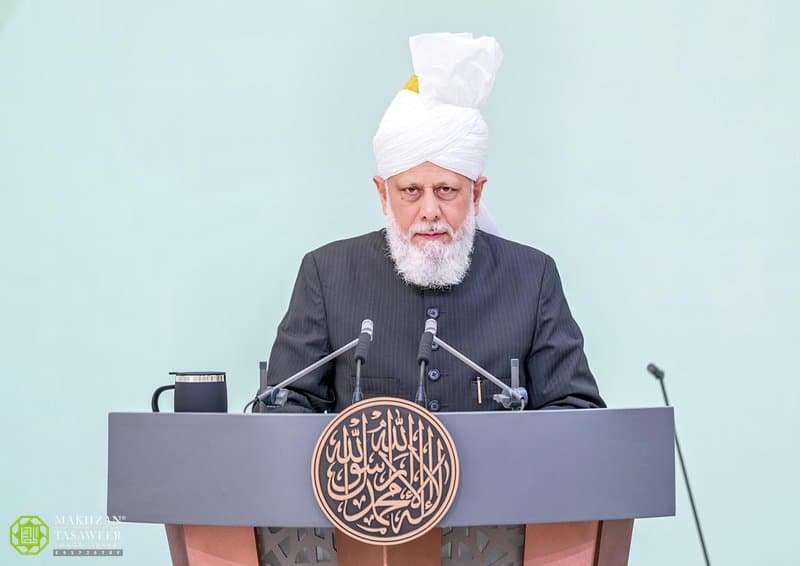
After reciting the tashahhud, ta’awwuz and Surah al-Fatihah, Hazrat Khalifatul Masih V (aa) recited verse 275 of Surah al-Baqarah and verse 20 of Surah adh-Dhariyat:
اَلَّذِيْنَ يُنْفِقُوْنَ اَمْوَالَهُمْ بِالَّيْلِ وَ النَّهَارِ سِرًّا وَّ عَلَانِيَةً فَلَهُمْ اَجْرُهُمْ عِنْدَ رَبِّهِمْ ۚ وَ لَا خَوْفٌ عَلَيْهِمْ وَ لَا هُمْ يَحْزَنُوْنَ۔ (2:275)
وَ فِيْۤ اَمْوَالِهِمْ حَقٌّ لِّلسَّآىِٕلِ وَ الْمَحْرُوْمِ۔ (51:20)
The first verse that I recited is from Surah al-Baqarah, and the translation is as follows: “Those who spend their wealth by night and day, secretly and openly, have their reward with their Lord; on them shall come no fear, nor shall they grieve.”
The second verse is from Surah adh-Dhariyat, where Allah the Almighty states: “And in their wealth is a share belonging to the beggar and the destitute.”
Today, I will present some narrations in relation to the generosity and munificence of the Holy Prophet (sa). These narrations demonstrate how he repeatedly drew the attention of the believers towards this, as well as his own practical example in this regard. As I mentioned, in the verses that I recited, as well as many other verses, Allah the Almighty has drawn attention towards fulfilling the rights due to Allah and the rights due to His creation, as well as fulfilling religious needs and the rights of those who are in need. In accordance with this injunction, the Holy Prophet (sa) also drew the attention of true believers towards this and, above all, he set a personal example, through which he practically demonstrated to us how to fulfil the commandments of Allah the Almighty.
Hence, the Holy Prophet (sa) did not possess merely one moral quality. Rather, every moment of his life was completely in accordance with the Holy Quran. This is why Hazrat Aisha (ra) said in relation to his character:
کَانَ خُلُقُہُ الْقُرْآن
That is, his morals were a complete embodiment of the Holy Quran. (Musnad Ahmad bin Hanbal, Vol. 8, Hadith 25108, Maktaba A’lam-ul-Kutub, Beirut 1998, p. 144)
Take any moral quality, and he was a most perfect example of it, beyond which no greater example could be presented.
In any case, as I mentioned, today I will present some narrations concerning his moral qualities of generosity and munificence.
Hazrat Anas (ra) relates that the Holy Prophet (sa) would supplicate in the following words:
اَللَّھُمَّ اِنِّیْ اَعُوْذُبِکَ مِنَ الْبُخْلِ وَالْکَسَلِ وَاَرْذَلِ الْعُمُرِ وَعَذَابِ الْقَبْرِ وَفِتْنَةِ الْمَحْیَا وَ الْمَمَاتِ۔
“O Allah! I seek refuge with You from miserliness, laziness, reaching a senile age, the punishment of the grave and from the trials of life and death.” (Sahih Muslim [Urdu Translation], Vol. 14, Kitab Al-Zikr Wa Al-Dua Wa Al-Taubah, Hadith 4865, Noor Foundation, p. 79)
Similarly, there is the following supplication in this regard. Hazrat Anas (ra) relates that the Holy Prophet (sa) would pray the following:
اَللّٰهُمَّ إِنِّي أَعُوذُ بِكَ مِنَ الْهَمِّ وَالْحَزَنِ وَالْعَجْزِ وَالْكَسَلِ وَالْجُبْنِ وَالْبُخْلِ وَضَلَعِ الدَّيْنِ وَغَلَبَةِ الرِّجَالِ۔
“O Allah! I seek refuge with You from distress and sorrow, helplessness and laziness, miserliness and cowardice, from being heavily in debt and from being overcome by men.” (Sahih al-Bukhari [Urdu Translation], Vol. 15, Kitab-ul-Da’wat, Hadith 6369, Nazarat Ishaat, p. 109)
Likewise, in relation to spending in the way of God Almighty and helping His servants, the Holy Prophet (sa) gave the following advice to the believers. Hazrat Asma (ra) relates that the Holy Prophet (sa) said to me: “Do not keep your money pouch tightly closed. Open it; otherwise blessings will be withheld from you.” In other words, do not close wherever your wealth is stored. Rather, spend from it as needed and help others.
The following words are found in another narration: “Do not keep counting it; otherwise Allah the Almighty will also give to you only in measured amounts.” (Sahih al-Bukhari [Urdu Translation], Vol. 3, Kitab-ul-Zakat, Hadith 1433, Nazarat Ishaat, pp. 55-56)
That is, if Allah the Almighty has blessed you, then you should do justice to expressing your gratitude towards Him. And doing justice to expressing one’s gratitude towards Him entails helping others. As a result, Allah the Almighty will give you even more.
Hazrat Abu Hurairah (ra) reports that the Holy Prophet (sa) said:
“A generous person is close to God, close to paradise, close to people, and far from the fire. Whereas a miserly person is far from God, far from paradise, far from people, and close to the fire. And a generous but unlearned person is more beloved to God Almighty than a miserly worshipper.” (Jami’ at-Tirmidhi, Abwab-ul-Birr Wa Al-Silah, Hadith 1961)
In other words, even if someone worships a great deal but is miserly, while another person may not possess much knowledge yet is generous, God Almighty loves the generous person more.
Similarly, Hazrat Abu Bakr (ra) narrated that the Holy Prophet (sa) said:
“A deceiver, a miser, and a person who constantly reminds others of his favours will not enter paradise.” (Jami’ at-Tirmidhi, Abwab-ul-Birr Wa Al-Silah, Hadith 1963)
These are three traits of those who will not enter paradise, namely, a deceiver, a miser and one who repeatedly makes others feel indebted because of favours done for them.
In another narration, Hazrat Abu Hurairah (ra) reported that the Holy Prophet (sa) said:
“A believer is simple and generous, whereas a wicked person is deceitful and low in character.” (Jami’ at-Tirmidhi, Abwab-ul-Birr Wa Al-Silah, Hadith 1964)
Here, having simple disposition does not mean unintelligent, as some people understand it in common usage in our language. In fact, believers are described as possessing deep insight and discernment, and their insight carries great weight. (Jami’ at-Tirmidhi, Kitab Al-Tafsir-ul-Quran, Hadith 3127)
They should always remain alert. Here it means that a believer avoids unnecessary conflict, is noble, open-hearted, pleasant to be around and respected.
Thus, this is the sign of a believer and a standard against which we should evaluate ourselves.
In another narration, Mutarraf relates from his father:
“I came to the Holy Prophet (sa) while he was reciting:
اَلْھٰکُمُ التَّکَاثُرُ
“[‘Mutual rivalry in seeking worldly increase diverts you from God.’]
“The Holy Prophet (sa) then said:
“‘The son of Adam says, “My wealth, my wealth.” (That is, a wealthy person says that this is my wealth. He then states:) But, O son of Adam, your wealth is only that which you consumed by eating, wore out by using, or gave in charity and thereby sent ahead.’” (Sahih Muslim [Urdu translation], Vol. 15, Hadith 5244, Noor Foundation, p. 155)
The Holy Prophet (sa) explained that your wealth is indeed that which you spend, but the best wealth is what you give in charity and present before Allah the Almighty by fulfilling the rights of His creation and spending in His cause. That wealth will be returned to you many times over in the next life.
That is why God Almighty has said, as I recited in the verse previously, that such people shall have no fear, nor shall they grieve, because the sacrifices they made, the generosity they showed, and the wealth they spent on others will return to them in the hereafter.
Hazrat Abdullah bin Mas’ud (ra) narrated that the Holy Prophet (sa) said:
“Envy is permissible only in two cases: one is a person whom Allah has granted wealth and then given the ability to spend it freely and appropriately; and the other is a person whom Allah has granted wisdom, who judges according to it, acts upon it, and teaches it to others.” (Sahih al-Bukhari [Urdu translation], Vol. 1, Kitab-ul-Ilm, Hadith 73, Nazarat-e-Ishaat, pp. 144-145)
Then Hazrat Abu Umamah (ra) narrates that on another occasion, while giving advice, the Holy Prophet (sa) said:
“O son of Adam, spending your surplus wealth [in the way of Allah] is better for you.”
The wealth that Allah Almighty has given you should first be used to meet your genuine needs, but anything beyond that should be spent.
“Keeping it back is harmful for you. You will not be blamed for retaining what is necessary for yourself. (You will not be questioned about why you kept aside wealth for fulfilling your needs.) And begin spending on those whose care is your responsibility.”
This means that the way to spend your wealth is that your children, your spouse, your dependants, poor relatives and anyone entrusted to your care, have the first right to benefit from your wealth.
Then the Holy Prophet (sa) said, “The giving hand is better than the receiving hand.” (Sahih Muslim [Urdu translation], Vol. 4, Kitab-ul-Zakat, Hadith 1704, Noor Foundation, p. 209)
Hazrat Abdullah bin Mas’ud (ra) also narrated that the Holy Prophet (sa) said, “Which one of you loves the wealth of his heirs more than his own wealth?” Is there anyone who would say that the wealth they are leaving for their heirs is dearer to them than that which they already possess and spend on themselves?
The companions replied, “O Messenger (sa) of Allah, there is none among us who loves the wealth of his heirs more than his own.” What they already possessed was, of course, dearer to them.
The Holy Prophet (sa) said: “Your wealth is only what you have sent ahead, and the wealth of your heirs is what you leave behind.” (Sahih al-Bukhari [Urdu translation], Vol. 15, Kitab-ul-Riqaq, Hadith 6442, Nazarat-e-Ishaat, pp. 206-207)
Meaning that what you send forth, spend in the cause of God and in helping the needy, is the best, and you will be rewarded for it in the end, just as Allah Almighty has stated in the Holy Quran.
Regarding the personal example of the Holy Prophet (sa) in spending freely and trusting completely in Allah Almighty, Hazrat Abdullah bin Mas’ud (ra) narrates:
The Holy Prophet (sa) once came to Hazrat Bilal (ra) and saw that he had gathered a heap of dates. He asked, “Bilal, what is this?” Hazrat Bilal (ra) replied, “O Messenger (sa) of Allah, I have stored this for you and your guests.” The Holy Prophet (sa) said, “Do you not fear that this stockpile may become fuel for the heat of hell?”
Then he advised Hazrat Bilal (ra): “Bilal, keep spending and do not fear poverty while the Lord of the Throne is your Provider.” (Mu’jim-ul-Kabir, Al-Tabrani, Vol. 1, Hadith 1020, Maktaba ibn Taiymiyyah Al-Qahirah, p. 340)
Another example of the Holy Prophet’s (sa) own practice in this regard is narrated by Hazrat Aisha (ra). She relates that she had a goat slaughtered and distributed its meat among the poor, while keeping some at home for eating. The Holy Prophet (sa) then asked how much meat remained. Hazrat Aisha (ra) replied that only the foreleg remained (the front leg of the goat).
Upon hearing this, the Holy Prophet (sa) said:
“All of it has remained except this foreleg.”
Meaning that what had been distributed in charity had in reality been preserved, whereas the portion kept for themselves had not truly remained, because it served only a temporary worldly use. What will benefit a person in the next life is only that which has been spent in the way of Allah. (Jami’ at-Tirmidhi, Kitab Sifat-ul-Qiyamah, Hadith 2470)
Whilst delivering an address, Hazrat Mu’awiyah (ra) said, “I heard the Holy Prophet (sa) say, ‘I am only the distributor, and it is Allah alone Who gives.’” (Sahih al-Bukhari [Urdu translation], Vol. 15, Kitab-ul-Ilm, Hadith 71, Nazarat-e-Ishaat, pp. 206-207)
The quality of generosity was completely imbued within the blessed person of the Holy Prophet (sa) even before his prophethood. As we read, testimony to this was given by his wife, Hazrat Khadija (ra), when the first revelation descended upon the Holy Prophet (sa); he came home in a state of anxiety. At that time, Hazrat Khadija (ra) said, “There is no need to be worried. By God, Allah will never disgrace you. You maintain ties of kinship, you bear the burdens of the weak, you perform virtues that have disappeared, you show hospitality to guests and you help people in genuine hardships.” (Dairah M‘arif Sirat Muhammad Rusoolullah (sa), Vol. 11, Bazam Iqbal Lahore, p. 48)
Then there is a narration in which Hazrat Abu Sa’id al-Khudri (ra) related that the Holy Prophet (sa) said, “Two qualities cannot be found together in a believer: miserliness and bad character.” (Jami’ at-Tirmidhi, Abwab-ul-Birr Wa Al-Silah, Hadith 1962)
That is, a believer will neither be miserly nor ill-mannered. This too is a measure by which one can analyse their own standard.
Then, while instructing people to avoid miserliness, as narrated by Hazrat Jabir bin Abdullah (ra), the Holy Prophet (sa) said: “Abstain from injustice, for indeed injustice will become darkness on the Day of Resurrection. And beware of miserliness and greed, for indeed miserliness destroyed those who came before you. It enticed them to shed blood and to declare unlawful things to be lawful.” (Sahih Muslim [Urdu Translation], Vol. 13, Kitab-ul-Birr Wa Al-Silah, Hadith 4661, Noor Foundation, p. 242)
Hazrat Abu Hurairah (ra) narrated that the Holy Prophet (sa) said, “The dust gathered in the way of Allah and the smoke of hell can never come together in a person. Likewise, greed, miserliness and faith can never come together in a person’s heart.” (Sunan an-Nasa‘i, Kitab-ul-Jihad, Hadith 3112)
As was mentioned earlier in another narration, a greedy, covetous and miserly person can never be a true believer. These are the standards. If one wishes to become a believer, one must avoid greed, covetousness and miserliness.
Hazrat Abu Hurairah (ra) narrates that the Holy Prophet (sa) said, “There is no day on which two angels do not descend when people rise in the morning. One of them says, ‘O Allah, grant reward to the one who spends.’ The other says, ‘O Allah, destroy the wealth of the miser.’” (Sahih al-Bukhari [Urdu Translation], Vol. 3, Kitab-ul-Zakat, Hadith 1442, Nazarat Ishaat, p. 66)
In other words, grant more to the person who is spending, but waste the wealth of the miserly and greedy person. Even in this world, the wealth of such a person is not blessed. We see this, and many, many people express this as well. And in the next world, that wealth will be of no benefit to such a person. Allah the Almighty has stated in one place that those who spend in His cause and out of love for Him, He grants them the reward for it.
Hazrat Anas bin Malik (ra) narrates, “The Holy Prophet (sa) was the most beautiful among the people, he was the most generous among people, and he was the bravest among people.” (Sahih Muslim [Urdu Translation], Vol. 12, Kitab-ul-Fazail, Hadith 4252, Noor Foundation, p. 217)
Likewise, there is a narration in which Hazrat Anas (ra) states that the Holy Prophet (sa) said, “Shall I not tell you about the most generous of all who are generous?” He then said, “Allah is more generous than all those who are generous, and among the children of Adam, I am the most generous.” (Majma-ul-Zawahid, Vol. 8, Kitab Alaamat Al-Nabuwwah, Hadith 14178, Dar-ul-Kutub Al-Ilmiyyah, Beirut, 2001, p. 409)
In other words, he was the most generous person in the world.
Similarly, Hazrat Ibn Abbas (ra) narrates that the Holy Prophet (sa) was the most generous of all people in doing good and showing kindness. He was especially generous during the month of Ramadan. The Angel Gabriel (as) would meet him every year during Ramadan until the month would come to an end. The Holy Prophet (sa) would recite the Quran to him. Whenever Gabriel (as) would meet him, the Holy Prophet (sa) would become even more generous in goodness and kindness than a strong, swiftly blowing wind. (Sahih Muslim, [Urdu Translation], Vol. 12, Kitab-ul-Fazail, Hadith 4254, Noor Foundation, pp. 218-219)
He would spend so abundantly that it was as though a powerful windstorm or gale were sweeping through.
Hazrat Musleh-e-Maud (ra) explained this very point in one of his sermons in the following way:
“When the Holy Prophet (sa) showed generosity, he did so to the utmost degree. The companions stated that especially during Ramadan he would become as generous as a powerful gust of wind. And at the same time, his practice abided by the command, ‘And do not squander extravagantly.’ In other words, he never regarded generosity as wastefulness, nor did he spend inappropriately or without purpose.” He was generous, but Allah the Almighty has also commanded that wealth should not be wasted or spent uselessly. Allah has forbidden extravagance.
“Hatim Ta’i was known for his generosity, but it was often misplaced. (Hatim Ta’i is known for being generous, but his generosity was not always exercised with time or place; it was done without thinking.) It was the open generosity of a grandfather at a sweet shop.” (This is an idiom.) “The wealth was not his own. What right did he have (to distribute) his father’s wealth? It is related that Hatim Ta’i possessed a generous nature from childhood. Eventually, his father observed that he was squandering his wealth, so he sent him away to look after the camels.
“One day, he saw three men approaching who were famous poets travelling. When he encountered them, he slaughtered three camels to entertain them as guests. They said, ‘There are only three of us, one camel would be sufficient.’ He replied, ‘No. If I slaughter only one, the other two guests would become dependents upon that one.’ Since it was his father’s wealth and free of cost, he slaughtered all three camels for them.” Whatever remained was either wasted or distributed to others. His father was very upset that his wealth was being given away in this manner. “However, the wealth that came to the Holy Prophet (sa) belonged to him, and he spent it according to the guidance of the Quran, considering the proper time and place.”
This clarifies those narrations in which the Holy Prophet (sa) enjoined spending without hesitation. The meaning is: spend according to what the occasion calls for, and then have no reservations whatsoever. It does not mean, for instance, that three men have come into the desert and you slaughter three camels – only for the meat to go to waste afterwards, since there is no one else around to eat it. Surely, in the middle of the desert, there would have been few others to be found; even if a few people did happen to be nearby, a considerable amount of meat would still have been left over and wasted. There is no benefit in that. Thus, one must spend in proportion to what the situation requires. But if you are spending in the way of Allah the Almighty and you are spending appropriately for the occasion, then be at ease – for Allah’s promise, as He states in the Quranic verse, is that such people shall have no fear nor shall they grieve.
In any case, Hazrat Musleh-e-Maud (ra) says that, “alongside all of this, the Holy Prophet (sa) was on the one hand so generous that – as has been narrated – the companions say that during the days of Ramadan he would give so freely it was as though a strong wind was blowing; yet on the other hand, he was a man who spent with wisdom and discernment.” (Khutbat-e-Mahmud, Vol. 18, p. 641)
It is narrated from Hazrat Abdullah bin Umar (ra) that the Messenger (sa) of Allah said: “If I had gold equal to the mountains of Tihamah (a coastal mountain range in Arabia) I would distribute it all among you, and you will not find me to be a liar or a miser.” (Subul Al-Huda Wa Al-Rishad, Vol, 7, Dar-ul-Kutub Al-Ilmiyyah, Beirut, 1993, p. 53)
There is another narration in which Hazrat Abu Dharr (ra) relates: I was walking with the Holy Prophet (sa) through the outskirts of Medina when the mountain of Uhud came into view before us. He said: “Abu Dharr!” I replied: “At your service, O Messenger (sa) of Allah.” He said: “It would not please me to have gold equal to this mountain of Uhud, and for a third night to pass upon me with even a single dinar remaining with me – except for something I had set aside to repay a debt. Rather, I would most certainly distribute it among the servants of Allah – like this, and like this, and like this” (gesturing to his right, his left, and behind him as he walked.)
He then said: “Those who have the most wealth are those who will be the most destitute on the Day of Resurrection” – that is, those who accumulate wealth and do not spend it on those in need and on the poor. They will be destitute on the Day of Judgment – “except for one who spends like this, and like this, and like this.” The one who gives will not be destitute on the Day of Judgment – i.e., one who to his right, to his left, and behind him. And he said: “those who give so freely in the way of Allah are very few. As for the wealthy among the believers – they do not hoard; rather, they spend in the way of Allah without fear or hesitation, and Allah in turn continues to shower His blessings upon them all the more.” (Sahih al-Bukhari [Urdu Translation], Vol. 15, Kitab-ul-Riqaq, Hadith 6444, Nazarat Ishaat, pp. 211-212)
It is narrated from Hazrat Anas (ra) that a man asked the Holy Prophet (sa) for all the sheep that were grazing between two mountains and the Holy Prophet (sa) gave them all to him. The man then went back to his people and said: “O my people, embrace Islam – for by God, Muhammad (sa) gives so generously that poverty holds no fear.” Hazrat Anas (ra) adds: “there were times when a man would accept Islam purely for worldly gain, yet the moment he entered Islam, it would become more beloved to him than the whole world and everything in it.” (Sahih Muslim [Urdu Translation], Vol. 12, Kitab-ul-Fazail, Hadith 4262, Noor Foundation, pp. 223-224)
Hazrat Anas bin Malik (ra) says that the Holy Prophet (sa) never set anything aside for the next day. (Shamail-ul-Nabi, Hadith 339, p. 148)
Hazrat Utbah bin al-Harith (ra) narrates: The Holy Prophet (sa) led us in the Asr prayer and afterwards he quickly went home, returning outside only a short while later. The narrator says: I asked him – or someone else asked him – and he replied: “I had left behind a piece of gold from the charity funds at home. I did not want it to remain with me through the night, so I had it distributed.” (Sahih al-Bukhari, [Urdu Translation], Vol. 3, Kitab-ul-Zakat, Hadith 1430, Nazarat Ishaat, pp. 53-54)
Hazrat Umm Salama (ra) says: “The Messenger (sa) of Allah came to me and the colour of his face had changed.” She says, “I thought it must be due to some pain or discomfort.” I said: “O Messenger (sa) of Allah, I see that the complexion of your face has changed; is it because of some discomfort?” He replied: “No, it is because of seven dinars that came to us yesterday evening. The night passed, and we had not spent them. I had forgotten them in the corner of the bed, and when I remembered, it weighed heavily upon me.” (Musnad Ahmad bin Hanbal, Vol. 8, Hadith 207, Maktaba A’lam-ul-Kutub, Beirut, 1998, pp. 630-631)
It is narrated from Hazrat Uqba (ra) that he said, “I prayed Asr behind the Holy Prophet (sa) in Medina.” When he concluded the prayer, he rose quickly and made his way through the rows of people to a quarter belonging to his wives. The people were alarmed by his haste. He then came back out to them and, seeing their bewilderment, said: “I remembered some gold I had, and I disliked the thought of it distracting my attention from the remembrance of Allah – so I have given the order for it to be distributed.” (Sahih al-Bukhari [Urdu Translation], Vol. 2, Kitab-ul-Adhan, Hadith 851, Nazarat Ishaat, pp. 252-253)
The Promised Messiah (as) says that the state of the Holy Prophet (sa) was such that he would give away whatever he had out of generosity. On one occasion, there was a gold coin in his home, and he took it and had it distributed. (Malfuzat, 2022, Vol. 3, p. 323)
Recounting the same incident, Hazrat Musleh-e-Maud (ra) writes in one place: “On one occasion some charity funds arrived and while distributing them, a single dinar fell into a corner, and it slipped the Holy Prophet’s (sa) mind to pick it up. When he remembered after the prayer, he stepped over the rows of people and hurried home. The companions asked: ‘O Messenger (sa) of Allah, what was the matter?’ He replied: ‘A dinar had been left undistributed in such-and-such a way – I wanted to distribute it as quickly as possible.’ In short, despite whatever wealth passed through his hands, he displayed such a freedom of spirit and detachment from it all that one can only marvel – whatever came to him, he would distribute it in the way of God.” (Tafsir-e-Kabir, 2023, Vol. 7, pp. 478-479)
Hazrat Anas (ra) narrates: wealth was brought to the Holy Prophet (sa) from Bahrain. He said: “Spread it out in the mosque.” It was the largest sum ever brought to the Messenger (sa) of Allah. He went out for prayer and paid no attention to it – did not so much as glance at it. When the prayer was finished, he came and sat by the wealth, giving to whoever he saw before him. In the midst of this, Hazrat Abbas (ra) came and said: “O Messenger (sa) of Allah, give me too – for I paid my own ransom on the Day of Badr, as well as the ransom of Aqil” – who was his nephew, Aqil bin Abi Talib. The Messenger (sa) of Allah said to him: “Take from it.” So he filled both hands and poured it into his garment, then tried to lift it – but could not. He said: “O Messenger (sa) of Allah, instruct someone to help me carry it.” The Holy Prophet (sa) said: “No, that I cannot do.” He said: “Then at least lift it and place it on me yourself.” He said: “No.” So he took some out and tried again to lift it – but still could not manage. He said: “O Messenger (sa) of Allah, instruct someone to help me carry it.” The Holy Prophet (sa) said: “No.” He said: “Then you place it on me yourself.” He said: “No.” So, he took some more out, lifted it, hoisted it onto his shoulder, and went on his way. As he walked off, the Messenger (sa) of Allah continued to watch him until he was out of sight.
At every opportunity, the Holy Prophet (sa) would counsel the companions to observe moderation. The spirit of it was: I will give – take, by all means – but with measure. Even if the person is a close relative, there must be moderation. Take what you need, and no more.
At the end of this hadith, the narrator adds his own observation: that the Holy Prophet (sa) was astonished at Hazrat Abbas’ (ra) greed. (Sahih al-Bukhari [Urdu Translation], Vol. 1, Kitab-ul-Salat, Hadith 421, Nazarat Ishaat, pp. 517-518)
This, however, is the narrator’s own impression. It may be that the Holy Prophet (sa) was not looking at them because he was surprised by their eagerness. Rather, the Holy Prophet (sa) may have been reminded of the period of poverty that the companions had once endured and of their former condition. Reflecting upon this, he continued gazing into the distance, thinking about how these people had continued to make sacrifices, how difficult and impoverished their circumstances once were and how today Allah the Almighty was blessing and providing for them.
Various commentators have also attributed this remark to the narrator’s personal reading of the moment, and have offered other explanations – not that the Holy Prophet (sa) was taken aback by any show of greed, but that quite different thoughts were passing through his blessed mind. (Al-Ifsah An Ma’ani Al-Sahah, Vol. 5, Dar-ul-Watan, p. 323)
Hazrat Jabir bin Abdullah (ra) relates that it was never the case that the Holy Prophet (sa) was asked for something and he refused. (Sahih Muslim [Urdu Translation], Vol. 12, Kitab-ul-Fazail, Hadith 4260, Noor Foundation, pp. 222-223)
Hazrat Sahl bin Sa’d (ra) says that the Holy Prophet (sa) was extremely modest; whenever something was asked of him, he would grant it. (Subul Al-Huda Wa Al-Rishad, Vol. 7, Dar-ul-Kutub Al-Ilmiyyah, Beirut, 1993, p. 50)
Ibn Abi Khaithamah narrates from Hazrat Ali (ra) that whenever Hazrat Ali (ra) would describe the qualities of the Holy Prophet (sa), he would say that the Holy Prophet (sa) was the most generous of all. (Subul Al-Huda Wa Al-Rishad, Vol. 7, Dar-ul-Kutub Al-Ilmiyyah, Beirut, 1993, p. 52)
Hazrat Sahl bin Sa’d (ra) relates that a woman came with a Burdah – a type of outer garment – and said, “O Messenger (sa) of Allah, I have woven this with my own hands so that you may wear it.” The Holy Prophet (sa) accepted it, as he needed an outer garment. He then emerged wearing that very cloth as a lower garment. A man from among the people said, “O Messenger (sa) of Allah, please give me this garment for me to wear.” The Holy Prophet (sa) said, “Very well.” He remained seated in the gathering for a short while, then went inside, folded the garment, and sent it to that man after changing into another garment. The people said to the man, “What you have done is not right, by asking this of him. You know that he never turns away anyone who asks.” The man replied, “By Allah, I only asked for it so that when I die, it may serve as my shroud.” Hazrat Sahl (ra) says that later, that very piece of cloth was used as his burial cloth. (Sahih al-Bukhari [Urdu Translation], Vol. 4, Kitab-ul-Buyoo’, Hadith 2093, Nazarat Ishaat, pp. 58-59)
In another narration, Hazrat Miswar bin Makhramah (ra) relates that the Holy Prophet (sa) distributed some cloaks, but did not give one to Makhramah. Makhramah said to his son, “My son, come with me to the Messenger (sa) of Allah.” His son, Miswar, narrates, “I went with him. He said to me, ‘Go inside and call him to me.’” Miswar says, “I was young at the time. I went inside, called the Holy Prophet (sa), and told him that my father had come. The Holy Prophet (sa) came out to him with one of those cloaks in his hand and said, ‘I had kept this aside for you.’” In other words, before Makhramah could even express his complaint, the Holy Prophet (sa) gave him the cloak and said that he had kept it aside for him. The narrator says that when the Holy Prophet (sa) saw Makhramah, he said that this cloak was for him, and Makhramah was pleased. (Sahih Muslim [Urdu Translation], Vol. 4, Kitab-ul-Zakat, Hadith 1736, Noor Foundation, p. 229; Fath-ul-Bari, Vol. 10, Kitab-ul-Libas, Hadith 5800, Maktabul Malik Fahd, Riyadh, 2001, p. 281)
In another narration, it is mentioned that the Holy Prophet (sa) recognised Hazrat Makhramah’s (ra) voice and came outside himself. Instead of waiting for the son to go in and call him, he came out on his own. He had a cloak with him and began to show him its qualities, saying he had set it aside for him. (Sahih Muslim [Urdu Translation], Vol, Kitab-ul-Zakat, Hadith 1737, Noor Foundation, 4, p. 229)
Hazrat Anas bin Malik (ra) relates, “I was walking with the Messenger (sa) of Allah. He was wearing a cloak from Najran with a coarse border. A Bedouin came up to the Holy Prophet (sa) and pulled his cloak very harshly. I looked at the side of the Holy Prophet’s (sa) neck and saw that the cloak had been pulled so that its border had left a mark upon his neck. The Bedouin then said, ‘O Muhammad, give the order for me to be given a portion from the wealth of Allah that you possess.’ The Holy Prophet (sa) turned towards him, smiled and then instructed that something be given to him.” (Sahih Muslim [Urdu Translation], Vol. 4, pp. 227-228, Kitab-ul-Zakat, Hadith 1735, Noor Foundation)
This incident is explained in a narration by Hazrat Abu Hurairah (ra) who relates that the Holy Prophet (sa) would sit with them at a gathering and speak to them. When he stood to leave, they too would stand, until he entered one of the homes of his wives. He says, “One day, while he was speaking to us, he stood up, and we also stood. We then saw a Bedouin who pulled him by his cloak, causing his neck to become red.” Hazrat Abu Hurairah (ra) explains that the cloak of the Holy Prophet (sa) was very coarse.
When the Holy Prophet (sa) turned towards him, the Bedouin said, “Load these two camels of mine with wealth, for you will not be loading them from your own wealth, nor from your father’s wealth.” He spoke in an extremely rude manner.
The narrator says that the Holy Prophet (sa) replied, “No, and I seek forgiveness from Allah. No, and I seek forgiveness from Allah. No, and I seek forgiveness from Allah.” He continued seeking forgiveness from Allah and refused his request.
The Holy Prophet (sa) then said, “I will not give you anything until (the Holy Prophet (sa) did not outright refuse; rather, he placed a condition) you compensate me for pulling my cloak in this way.” In other words, he asked him to make amends for having pulled his cloak and injuring his neck. Each time, the Bedouin would say, “By Allah, I will not compensate you for it.” He said, “No, I will not give any compensation, because you do not repay evil with evil.” The Bedouin used this argument, and he was clever in doing so. In other words, he meant: “Since you do not respond to evil with evil, there is no question of my compensating you. I have done wrong, but you will not do wrong in return.” Upon this, the Holy Prophet (sa) smiled. Then he instructed Hazrat Umar (ra) to load one of the Bedouin’s camels with barley and the other with dates. Thus, not only did he grant him wealth, but he also forgave his harshness. (Sunan Abi Dawud, Kitab-ul-Adab, Hadith 4475)
Hazrat Jabir bin Abdullah (ra) relates that the Holy Prophet (sa) said, “If I receive the wealth of Bahrain, I shall give you this much, and this much, and this much,” gesturing with both hands joined together. However, the Holy Prophet (sa) passed away before the wealth of Bahrain arrived. After his demise, that wealth went to Hazrat Abu Bakr (ra). He instructed a caller to proclaim that anyone with a promise or debt owed to him by the Holy Prophet (sa) should come forward.
Hazrat Jabir (ra) says, “I stood up and submitted, ‘The Holy Prophet (sa) had said that if the wealth of Bahrain came, he would give me this much, and this much, and this much.’ Hazrat Abu Bakr (ra) then filled both his joined hands and asked me to count them. I counted it, and it amounted to five hundred dirhams. He then said, ‘Take twice as much again.’” This wealth had been sent by Hazrat Ala bin Hadrami (ra), whom the Holy Prophet (sa) had appointed as governor over Bahrain. Hazrat Ala (ra) continued to hold that office even after the demise of the Holy Prophet (sa). (Sahih Muslim [Urdu Translation], Vol. 12, Kitab-ul-Fazail, Hadith 4264, Noor Foundation, pp. 224-225)
Harun bin Riyab relates that on one occasion, seventy thousand dirhams were brought to the Holy Prophet (sa). According to this narration, this was the largest amount of wealth that the Holy Prophet (sa) had ever received. The wealth was placed upon a mat. The Holy Prophet (sa) then stood to distribute it, and whoever came asking was not sent away empty-handed. He continued giving until the entire amount had been distributed. (Akhlaq-ul-Nabi Wa Aadabihi, Hadith 97, Maktaba Dar-ul-Lu’Lu’, pp. 103-104)
This narration states that it was the largest amount of wealth brought to him, though greater amounts did come later. Perhaps this was the largest amount according to the narrator’s knowledge, or perhaps, at the time this narration was being related, it was the largest amount that had been received. The previous narration concerning the wealth from Bahrain refers to an amount far greater than this.
It is narrated by Hazrat Abu Hurairah (ra) that a man came to the Holy Prophet (sa) and asked him for something. The Holy Prophet (sa) borrowed half a wasq of grain and gave it to him. One wasq is approximately sixty sa’, and one sa’ is roughly equal to two and a half sair. Later, the person from whom it had been borrowed came to demand repayment. The Holy Prophet (sa) gave him a full wasq and said, “Half of this is repayment of the debt, and the other half is a gift for you.” (Al-Shifa Bi Ta’reef Haqooq Al-Mustafa, Qadhi Ayaz, Dar-ul-Kutub Al-Ilmiyyah, Beirut, 2002, pp. 77-78; Lughat-ul-Hadith, Vol. 2, p. 648 and Vol. 4, p. 487)
This is the best way to repay a loan. He had borrowed half a wasq of grain in order to give it to someone in need, but when repaying the person from whom he had borrowed it, he gave him a full wasq. This is the excellent way to repay a debt. One should not delay repayment, make excuses, or hesitate to return the original amount owed.
Hazrat Sahl bin Sa’d Sa’idi (ra) relates that a black woollen cloak was made for the Holy Prophet (sa). One day, the Holy Prophet (sa) came before his companions wearing that cloak.
The Holy Prophet (sa) stated, “Do you not see how beautiful it is?”
A Bedouin then submitted, “O Messenger (sa) of Allah, may my father and mother be sacrificed for you, kindly bestow this cloak upon me.”
It was never the practice of the Holy Prophet (sa) to refuse anyone who asked him for something. Therefore, he removed the cloak and presented it to him. (Subul Al-Huda Wa Al-Rishad, Vol. 7, Dar-ul-Kutub Al-Ilmiyyah, Beirut, 1993, p. 53)
There is a very beautiful narration in which Hazrat Ibn Umar (ra) relates that the Holy Prophet (sa) purchased a shirt from a cloth merchant for four dirhams.
Having put on the shirt, the Holy Prophet (sa) came out, whereupon a man from among the Ansar said, “O Messenger (sa) of Allah, kindly grant this shirt to me. May Allah clothe you with the garments of Paradise.”
The Holy Prophet (sa) removed the shirt and gave it to him. Thereafter, he returned to the merchant and purchased another shirt for four dirhams. Out of the ten dirhams he originally possessed, two dirhams remained. Four had been spent on the first shirt and four on the second, and two dirhams remained.
As the Holy Prophet (sa) was returning, he saw a young maidservant weeping by the roadside. He asked her the reason for her distress. She replied, “O Messenger (sa) of Allah, my family gave me two dirhams to buy flour, but I have lost them.” The Holy Prophet (sa) gave her the remaining two dirhams. She turned to leave, but then began to weep again. The Holy Prophet (sa) asked, “Why are you crying now? You have the two dirhams; go and purchase the flour.” She replied, “I am afraid that my family will punish me because I have been away for so long. They will ask where I have been.”
Upon hearing this, the Holy Prophet (sa) accompanied her to her home. When they arrived, he greeted the household with Salaam. They recognised his voice but remained silent. The Holy Prophet (sa) greeted them with Salaam a second time, yet they again remained silent. He greeted them a third time with Salaam and only then did they return his greeting. The Holy Prophet (sa) asked, “Did you not hear my greeting of Salaam the first time?” They replied, “Indeed, we heard it, but we desired that you should continue invoking peace [Salaam] upon us repeatedly.” Such was the eagerness and devotion of the companions.
They then asked, “O Messenger (sa) of Allah, may our fathers and mothers be sacrificed for you, what has brought you here?” The Holy Prophet (sa) replied, “This young girl was afraid that you might punish her.”
The master of the maidservant then said, “Because you have graciously come here on her behalf, I set her free for the sake of Allah.” The Holy Prophet (sa) gave them glad tidings of goodness and of Paradise. He then stated:
“Allah has placed great blessing in these ten dirhams. Through them, Allah clothed His Prophet, clothed an Ansari, and caused a maidservant to be granted her freedom.” (Mu’jim-ul-Kabir, Al-Tabrani, Vol. 12, Hadith 13607, Maktaba ibn Taiymiyyah Al-Qahirah, pp. 441-442)
It is related that Hazrat Usman (ra) presented a cluster of grapes to the Holy Prophet (sa) as a gift. In another narration, it is mentioned that it was a cluster of dates rather than grapes. In one narration, it states grapes, and in the other, it is dates. In any case, the narration states that a beggar came to the Holy Prophet (sa), whereupon he gave the gift to him.
Hazrat Usman (ra) then purchased that cluster from the beggar for one dirham. It appears that it may have been of a particularly fine quality, whether grapes or dates. Having bought it back, Hazrat Usman (ra) presented it to the Holy Prophet (sa) once again.
The beggar returned, and the Holy Prophet (sa) again gave the cluster to him. This occurred three times in the same manner. Hazrat Usman (ra) would purchase the cluster from the beggar and present it once more to the Holy Prophet (sa), and each time the beggar would return and ask for it again, whereupon the Holy Prophet (sa) would graciously give it to him.
Eventually, the Holy Prophet (sa) addressed the man with great kindness and wisdom, saying:
“O so-and-so, are you a beggar or a merchant? Have you come to ask for help, or are you engaged in trade? This is not the manner in which a needy person ordinarily asks. You seem to be earning dirhams and conducting business through this practice.” (Tafsir Ruh-ul-Ma’ani, Vol. 15, Dar-ul-Kutub Al-Ilmiyyah, Beirut, p. 376)
The Holy Prophet (sa) did not refuse the man’s request. Rather, he counselled him in a gentle and wise manner, indicating that such conduct was not appropriate.
Hazrat Abdullah bin Salam (ra) relates that when Allah the Exalted intended to guide Zaid bin Sa’nah, he said:
“All the signs of prophethood were evident to me in the blessed countenance of Muhammad (sa), except for two characteristics regarding which I had not yet determined whether they were present in him or not.
“The first was that the kindness of this Prophet would always prevail over his anger.
“The second was that the more harshly and ignorantly people behaved towards him, the more he would increase in forbearance and clemency.
“I continued to look for an opportunity through which I might test and verify these two signs as well.
“In any case, an opportunity arose in the following manner:
“(Zaid bin Sa’nah relates:)
“One day, the Holy Prophet (sa) came out of his house, and Hazrat Ali bin Abi Talib (ra) was with him. During this time, a man came on a mount who appeared to be a Bedouin. He submitted, ‘O Messenger (sa) of Allah, the people of such-and-such a village near Busra have accepted Islam. I had told them that if they embraced Islam, they would be granted abundant sustenance. Now, due to a lack of rainfall, they are suffering from famine and hardship. O Messenger (sa) of Allah, I fear lest they revert from Islam out of greed and covetousness, just as they entered Islam in the hope of worldly prosperity. If you would be gracious enough and deem it appropriate, kindly send something to assist and comfort them.’”
The Holy Prophet (sa) looked towards the man. Hazrat Ali (ra), who was with him, also submitted, “At present, there is nothing available that can immediately be sent for their assistance.”
Zaid bin Sa’nah says:
“I was standing nearby and observing this. I came closer and said, ‘O Muhammad (sa), would you sell me the dates of the orchard of such-and-such tribe for a specified quantity to be delivered at a specified time?’
“The Holy Prophet (sa) replied:
“‘O Jew, (Sa’nah was a Jewish man) I can sell dates for a specified quantity and a specified term, but I cannot agree to the condition that they must come from the orchard of such-and-such a tribe.’
“I replied, ‘Very well.’
“Thus, the Holy Prophet (sa) agreed the transaction with me. I opened my pouch and paid him eighty mithqal of gold in advance on the understanding that he would deliver to me a specified quantity of dates at the appointed time. (One mithqal is approximately 4.25 grams.)
“The Holy Prophet (sa) then gave that gold to the man who had come seeking assistance and instructed him:
“‘Distribute this equally among those who are afflicted and help them through it.’”
Zaid bin Sa’nah continues:
“Two or three days remained before the appointed term was due when I came to the Holy Prophet (sa), seized him by the collar, pulled at his cloak, and, in an angry tone, said, ‘O Muhammad! Will you not pay me what is due? By God, I know the habits of Banu Abdul Muttalib well. They are extremely negligent when it comes to repaying debts, and I am also aware of your habit of delaying payment.’” Even though [for the Holy Prophet (sa)] this was out of the question, he was an enemy, and at the time he harboured hatred in his heart, or perhaps he wanted to test him. Nonetheless, this is what he did, and he says he had experienced his dealings. He further says:
“At that moment, I looked towards Umar (ra), who was standing nearby. His eyes were revolving with anger like a spinning wheel. He cast a fierce glance at me and said:
“‘O enemy of Allah! Do you address the Messenger (sa) of Allah in the manner that I hear, and do you behave towards him with such insolence as I see? By Him Who sent him with the truth, were it not for my regard for him, I would strike off your head with my sword!’”
Zaid says:
“Meanwhile, the Messenger (sa) of Allah was looking at Umar (ra) with complete calmness and composure, and was smiling. Then the Holy Prophet (sa) said:
“‘O Umar, instead of this anger, both he and I are more deserving of your good counsel; for me to fulfil my obligation properly and for him to make his demand courteously. O Umar, take him and pay him what is due to him. Rather, give him twenty extra “Sa’a” of dates.’
“I asked, ‘O Umar, why this additional amount?’ He replied, ‘The Holy Prophet (sa) instructed me to compensate you for the harshness with which I addressed you.’ I then asked Umar (ra), ‘Do you know who I am?’ Umar (ra) replied, ‘No. Who are you?’ I said, ‘I am Zaid bin Sa’nah.’ Hazrat Umar (ra) asked, ‘The great Jewish scholar?’ I replied, ‘Yes, the scholar of the Jews.’
“Hazrat Umar (ra) then said, ‘Despite being such a great scholar, why did you adopt such a disrespectful manner towards the Messenger (sa) of Allah (sa)?’ I replied, ‘O Umar, when I saw the Messenger (sa) of Allah, all the signs of prophethood became evident to me except for two signs which I had not yet verified. One was whether the forbearance of this Prophet would indeed prevail over his anger. The second was whether the more harshly and rudely people treated him, the more he would respond with forbearance and patience. I have now tested both these matters.
“O Umar, I make you my witness that I am pleased to accept Allah as my Lord, Islam as my religion, and Muhammad (sa) as my Prophet. I also make you my witness that half of my wealth, for I am a wealthy man, is given in charity for the Ummah of Muhammad (sa).’
“Umar (ra) replied, ‘Say, “for some of the Ummah of Muhammad (sa),” for the entire Ummah is beyond estimation. How could your wealth suffice for all of them?’ I said, ‘Very well, then for some of them.’”
Thereafter, Zaid came before the Holy Prophet (sa) and submitted:
“I bear witness that there is none worthy of worship except Allah, and I bear witness that Muhammad (sa) is His servant and His Messenger. I believe in him.”
Thus, Zaid accepted Islam, affirmed the truth of the Holy Prophet (sa) and entered into his pledge of allegiance. He subsequently participated in several expeditions alongside the Holy Prophet (sa) and remained with him until he passed away, on the return journey from the expedition of Tabuk. (Al-Mustadrak ala al-Sahihayn, Hakim, Vol. 4, Kitab Ma’rif Al-Sahabah, Hadith 6665, Dar-ul-Fikr, Beirut, 2002, pp. 328-329)
He was a Jewish scholar and had a noble disposition. Having witnessed all the signs, he accepted Islam.
Such was the noble character of the Holy Prophet (sa): not only did he secure a loan in order to save an entire people from hunger, but through the excellence of his moral qualities he also brought a Jewish scholar into the fold of Islam.
اَللّٰھُمَّ صَلِّ عَلٰی مُحَمَّدٍ وَّعَلٰی آلِ مُحَمَّدٍوَ بَارِکْ وَسَلِّمْ اِنَّکَ حَمِیْدٌ مَّجِیْدٌ۔
[“O Allah, send blessings upon Muhammad and upon the progeny of Muhammad, and bestow blessings and peace. Verily, You are Praiseworthy and Glorious.”]
(Official Urdu transcript published in the Daily Al Fazl International, 3 July 2026, pp. 2-8. Translated by The Review of Religions.)