
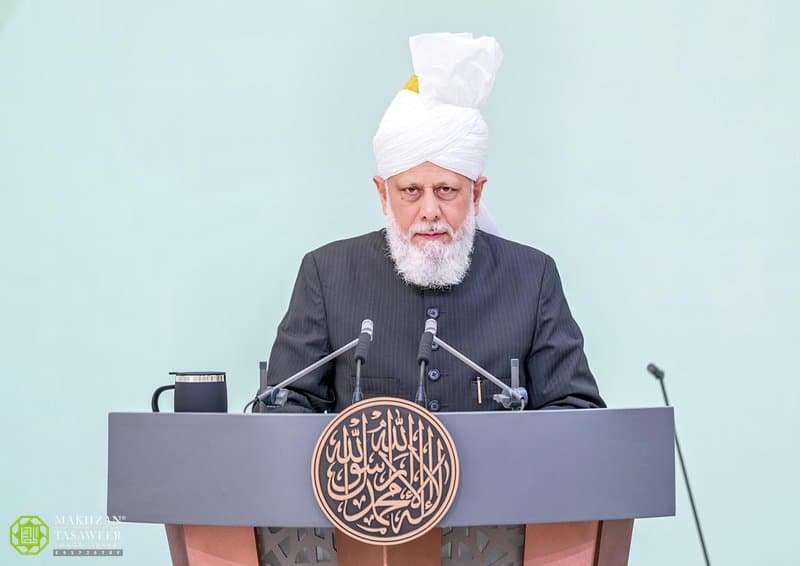
Friday Sermon
14 November 2025
Muhammadsa: The great exemplar
After reciting the tashahhud, ta‘awwuz, and Surah al-Fatihah, Hazrat Khalifatul Masih Vaa stated:
The expeditions of the Holy Prophetsa and his blessed conduct during these expeditions were mentioned in the previous sermons. In this regard, the details of the Battle of Tabuk were being mentioned. Further details of this are as follows.
It is recorded that on this occasion, a lady expressed her earnest zeal and passion [to participate in the battle]. It is recorded in the following manner that, for battles, even women did not refrain from offering sacrifices in some way or form. They remained at the forefront in offering financial sacrifices as well, for which they took off their jewellery and presented it to the Holy Prophetsa. (Kitab al-Maghazi, Vol. 2, Ghazwah Tabuk, Dar Al-Kotob Al-Ilmiyah, 2013, pp. 380-381)
We also find in the books of history an incident with regards to sacrificing one’s sentiments. Mentioning this incident, Hazrat Musleh-e-Maudra states:
“Since the army was heading towards Syria, and the scenes from the Battle of Mu’tah were still before them, the thought of every Muslim to protect the life of the Holy Prophetsa prevailed over all other thoughts. Even women could sense this danger and encouraged their husbands and sons to participate in the battle. This sincerity and zeal can be gauged by the following: a Companion who had left home for work returned when the Holy Prophetsa had already departed from Medina along with his army.
“Having been away [from home] for a while, he entered his home with the thought of seeing his wife and rejoicing. He saw his wife sitting in the courtyard and advanced affectionately (in order to demonstrate his love). When he approached his wife, she pushed him away with both hands. This Companion looked at the face of his wife in astonishment and asked: ‘Having met after so long, what is the reason for this treatment?’ The wife replied: ‘Are you not ashamed that the Messengersa of God is heading towards this dangerous place and you dare to be affectionate to your wife? First go and fulfil your obligations, and after that, we can see to such matters.’ The Companion immediately left the house, saddled his mount and met with the Holy Prophetsa after a three-day journey.” (Dibacha Tafsir-ul-Quran, Anwar-ul-Ulum, Vol. 20, pp. 361-362)
Hazrat Musleh-e-Maudra has related this incident on another occasion as well. The first [extract] has been mentioned in the Introduction to the Study of the Holy Quran, and the second mention was made during a speech at the ijtema of Khuddam-ul-Ahmadiyya. Hazrat Musleh-e-Maudra states:
“Once, the Holy Prophetsa sent a Companion away from home for some work. Following that, the Battle of Tabuk occurred. This was an extremely dangerous area. At that time, the Roman Empire was as powerful as the United States and Russia are today. Yet, the Holy Prophetsa had to encounter such a powerful empire with an insignificant army. There were very few Muslims in Medina, and the people in the surrounding areas were not united either. However, even if they were united, they would be insignificant in comparison to the Emperor of Rome. As such, the Holy Prophetsa instructed that everyone should join the battle. When the Muslim army had departed, this Companion, whom the Holy Prophetsa had sent away from home for some work, returned. He was a young man, newly married. After a long separation, when he entered his home, he saw his wife sitting in the courtyard. He went straight towards her and wished to embrace her, but instead of responding to his affection, she struck his chest firmly with both hands, pushed him back, and said:
“‘The Messengersa of Allah is out on the battlefield, and you are thinking of showing affection to your wife? By God, until Muhammad, the Messengersa of Allah, returns safely, I will not even look at your face!’
“That Companion immediately left the house and travelled until he caught up with the Muslim army at a distance of a three-day journey from Medina. He only returned home once the Holy Prophetsa himself returned to Medina along with his other Companions. Such were those people who, at every moment of danger, unhesitatingly put their lives at risk. No hardship or pain ever came upon them that they considered too great; rather, whenever an opportunity for service arose, they joyfully offered their lives.” (Majlis Khuddam-ul-Ahmadiyya Markaziyyah Ke Salana Ijtema Se Khitab, Anwar-ul-Ulum, Vol. 26, pp. 214-215)
In any case, further details mention that after stopping at 15 – or, according to some narrations, 19 – different stations, the Holy Prophetsa and his Companions reached the place of Tabuk. The specific details of the locations where the army halted during this journey are not recorded, but later, mosques were built at those sites and named after those locations. From this, historians deduced that the Holy Prophetsa likely stayed at those spots. The names of these places are also recorded in books, ranging from 15 to 22 locations.
In Sirat Ibn Ishaq and Ibn Hisham, seventeen places are mentioned where mosques were constructed. These are:
Dhu Khushub, Faifa’, Dhu al-Marwah, Ruqqa‘, Wadi al-Qura, Sa‘id, Hijr, Sadr Hawda, Dhu al-Jifah, Shiqq Tara, al-Batra’, Ala’, Dhat al-Khitmi, Akhdar, Dhat al-Zirab, Thaniyyat Madran, and Tabuk. (Al-Lu’lu’ al-Maknun Sirat Encyclopaedia, Vol. 9, Dar al-Salam, p. 499; Da’irah Ma’arif Sirat Muhammad Rasulullahsa, Vol. 9, Bazm Iqbal, Lahore, p. 485; Ibn Hisham, Al-Sirah al-Nabawiyyah, Vol. 2, Part 3-4, Dar Al-Kotob Al-Ilmiyah, Beirut, 2000, pp. 449-450; Ibn Ishaq, Al-Sirah al-Nabawiyyah, Vol. 2, Dar Al-Kotob Al-Ilmiyah, Beirut, 2004, p. 609; Wafa Al-Wafa Bi Akhbar Dar-ul-Mustafa, Vol. 3, Al-Maktabat-ul-Asriyah, 2011, pp. 174-176)
In one narration, it is related that Hazrat Uqbah bin Amirra reported: “We set out with the Messengersa of Allah during the Expedition of Tabuk. One night, the Messengersa of Allah fell asleep. (The journey was long, and there was exhaustion from travel.) He only awoke when the sun had risen high, about the height of a spear. The Holy Prophetsa said, ‘O Bilal, did I not tell you to stay awake for us (to wait for the Fajr prayer and awaken us)?’ Hazrat Bilal submitted, ‘O Messenger of Allah, sleep overtook me just as it overtook you. (I was overcome with sleep as well.)’”
The narrator states, “The Messengersa of Allah ordered the army to resume their journey. After travelling some distance, he dismounted, offered the Sunnah prayers, and then led the Companions in the (Fajr) prayer. Thereafter, the Holy Prophetsa continued travelling the entire day and night until the next morning, he reached Tabuk. Although it is not explicitly written, naturally, the prayers would have been offered at their respective times during this period.
“Upon arriving at Tabuk, the Holy Prophetsa addressed his Companions. He praised and glorified Allah and then said:
“‘O people, the truest word is the Book of Allah, and the strongest bond is the bond of righteousness. The best religion is the religion of Abraham, and the best guidance is the guidance of Muhammadsa. The loftiest matter is the remembrance of Allah. The best story is this Quran. The best of deeds are those performed with firm resolve. The worst of affairs are harmful innovations. The best guidance is the guidance of the prophets. The most excellent form of death is martyrdom. After guidance, the greatest blindness is misguidance. The best deeds are those that are beneficial. The best guidance is that which is followed. The worst blindness is the blindness of the heart (not the eyes, but the heart being blind when one fails to understand the words of Allah).’
“Then he said:
“‘The upper hand is better than the lower hand. A little that suffices is better than an abundance that leads to heedlessness. The worst apology is the apology made at the time of death. The worst shame will be the shame on the Day of Resurrection. Some people come very late for the Friday prayer, and some only remember Allah intermittently. Among the greatest sins is a lying tongue. The best form of wealth is the wealth of the heart.’ (Meaning: the Holy Prophetsa did not approve of those who pray intermittently or come late – he said it is a very bad habit.)
“He continued:
“‘Among the greatest sins is a lying tongue. The best form of wealth is the wealth of the heart. The best provision is righteousness. The height of wisdom is fear of Allah. The best word is that which instils certainty in the hearts. Doubt is part of disbelief. Wailing over the dead is an act of ignorance. Betrayal is a spark of the Fire of Hell. Evil poetry is inspired by the Devil. Wine contains all sins. Women can become snares of Satan. Youth contains a portion of madness. The worst earnings are earnings gained through usury. The worst food is the devouring of an orphan’s property. Blessed is the one who learns a lesson from others. Wretched is the one who is wretched even from his mother’s womb.
“Every one of you will ultimately reach four cubits of earth’ – meaning every person must eventually die and enter the grave. ‘Matters depend on the Hereafter, and actions are judged by their end. The worst narrators are the liars. Everything that is coming is near. To abuse a believer is wrong. To fight a believer is disbelief. To backbite a believer is disobedience to Allah. The sanctity of his wealth is like the sanctity of his blood. Whoever swears by Allah falsely will be denying Him. Whoever seeks forgiveness from Him, He will forgive him. Whoever forgives his brother, Allah will forgive him. Whoever restrains his anger, Allah will reward him. Whoever remains patient in trial, Allah will grant him its reward. Whoever desires fame, Allah will grant him that. Whoever is patient, Allah will double his reward. And whoever disobeys Allah, Allah will punish him.’
“Then he continued:
“‘O Allah, forgive me and my Ummah. O Allah, forgive me and my Ummah. O Allah, forgive me and my Ummah.’
“He repeated this three times.
“Then he said: ‘I seek forgiveness from Allah for myself and for all of you.’” (Ibn Kathir, Al-Bidayah Wa Al-Nihayah, Vol. 5, Dar Al-Kotob Al-Ilmiyah, Beirut, 2001, pp. 14-15; Kitab al-Maghazi, Vol. 3, Alim-ul-Kotob, 1984, pp. 1015-1016; Subul al-Huda wa al-Rashad, Vol. 5, Dar Al-Kotob Al-Ilmiyah, Beirut, 1993, p. 451)
During the journey to Tabuk, the Holy Prophetsa also gave advice to the Companions. On the journey to Tabuk, the Holy Prophetsa gave advice to the Companions on numerous occasions, either individually or collectively, from which some are mentioned as follows.
Hazrat Abu Sa’id Khudrira narrates, “During the year in which Tabuk occurred, the Holy Prophetsa addressed the people whilst leaning on his mount. He said, ‘Shall I not tell you about the best and the worst of people? Surely, the best person among the people is he who – while riding on the back of his horse or camel, or even on foot – strives in the way of Allah until death comes to him. And surely, the worst person among the people is that sinful person who reads the Book of Allah, but does not leave aside his ignorance nor turn towards any of its words [to heed them].’” (Sunan Nisai, Kitab al-jihad, Hadith 3108)
We find that there are many people nowadays who claim to read the Holy Quran, but they don’t apply it.
It is narrated from Hazrat Ibn Abbasra, “The Holy Prophetsa addressed the Companions during Tabuk and said, ‘Among the people, that man is unparalleled who, whilst mounted on his horse, performs Jihad in the way of Allah the Almighty, and remains safe from the evil of the people. And the second man who is incomparable, is he who is exemplary in his generosity and open-heartedness, and is hospitable and respectful to his guest, and grants the guest their due right.’” (Musnad Al-Imam Ahmad bin Hanbal, Vol. 1, Musnad Abdullah bin Abbas, Hadith 1987, Alim-ul-Kotob, Beirut, Lebanon, 1998, p. 602)
On this occasion, the letter to Heraclius inviting him to Islam is also mentioned. When the Holy Prophetsa reached Tabuk, Heraclius, i.e., the Caesar of the Roman Empire (Heraclius was his name), was in Homs at that time. The Holy Prophetsa said, “Whoever takes my letter to Caesar, Paradise is guaranteed for him.” A man submitted, “Even if he does not accept the letter?” He said, “Even then, so go and deliver it.”
So that man took the Holy Prophet’ssa letter and went and gave it to Heraclius. Heraclius read it and said, “Go back to your Prophet and tell him that I am his follower, but I do not want to abandon my kingship.” [Heraclius] also sent some dinars to be presented to the Holy Prophetsa.
The man returned and informed the Holy Prophetsa about it, upon which the Holy Prophetsa said, “He has lied.” [Meaning] he has not spoken truthfully, and the Holy Prophetsa distributed the dinars among the people. (Subul al-Huda wa al-Rashad, Vol. 5, Dar Al-Kotob Al-Ilmiyah, Beirut, 1993, p. 457)
This letter was taken to Heraclius by Hazrat Dihyah. This is besides the other letter which the Holy Prophetsa had sent through Hazrat Dihyah at the end of 6 AH, which Heraclius received in Muharram, 7 AH. (Sharh Al-‘allamah Al-zarqani ‘ala Al-mawahib Al- Ladunniyyah, Vol. 4, Dar Al-Kotob Al-Ilmiyah, Beirut, 1996, p. 94)
Imam Ibn Hajar has – with reference to the narrations within biographies and books detailing these battles – expressed the view that when the Holy Prophetsa was in Tabuk, he wrote letters to Caesar and others for a second time. (Fath al-Bari, Vol. 8, Qadimi Kutub Khanah, p. 161)
The confirmation of his view is also established from these letters, which were published in book form in 1941. The collection of these letters, meaning the name of this book, is Majmu‘ah al-Watha’iq al-Siyasiyyah li al-‘Ahd al-Nabawi wa al-Khilafah al-Rashidah. Its author is Dr Hamidullah.
In this, the historical and political documents are mentioned from the time of the Holy Prophetsa to the era of the Rightly Guided Caliphsra. This book was first published in Egypt in 1941. Nonetheless, this is a reference from that book, and according to it, two letters were sent to the Roman Emperor. In the first letter, it stated that he should not become a barrier in the acceptance of Islam by his subjects, otherwise the burden of the sins of his subjects would also fall upon him; this letter was sent to Caesar at the end of 6 AH through Dihyah Kalbi, while it was written in the second letter, “Accept Islam, otherwise if you refuse, Jizyah must be offered.” The Holy Prophetsa also sent this letter through Hazrat Dihyah to Caesar at the time of the Battle of Tabuk. (Majmu‘ah al-Watha’iq al-Siyasiyyah li al-‘Ahd al-Nabawi wa al-Khilafah al-Rashidah, Vol. 1, Dar-ul-Nafais, 1987, pp. 107-110; Muhammad Hameedullah, Rasool-e-Akramsa Ki Siyasi Zindagi, Dar-ul-Isha’at, Karachi, 2003, pp. 158 and 166)
In history, treaties with the people of Ailah are mentioned. It is detailed regarding this that when the Holy Prophetsa reached Tabuk, the Christian rulers of the surrounding areas became frightened, and Allah the Almighty cast such awe upon them, that those who were planning conspiracies against the Muslims only a short while earlier, now became worried about their survival, and began presenting themselves in the service of the Holy Prophetsa and began asking for peace. The first person among them to present himself was the ruler of Ailah.
Ailah is a small city situated on the coast of the Red Sea near Syria. It is the last boundary of Hijaz and is located at the beginning of Syria. During the stay in Tabuk, the ruler of Ailah, Yuhanna bin Ruba, presented himself in the presence of the Holy Prophetsa. With him came the people of Syria, the people of Yemen, the people of the [Red] Sea, and the people of Jarba and Azruh, and they also requested peace treaties. The Holy Prophetsa wrote a treaty of protection for them. The Holy Prophetsa wrote, “In the name of Allah, the Gracious, the Merciful. This is a treaty of protection on behalf of Allah the Almighty and His Prophet and Messenger, Muhammadsa, for Yuhanna bin Ruba and for the people of Ailah, their boats that travel in the sea, and their caravans that travel on land. They are granted complete security from Allah the Almighty and from Muhammad, the Messengersa of Allah. In this way, complete security will also be granted to the people of Syria, the people of Yemen, and the people of the [Red] Sea. Whoever commits any violation, it will be permissible to seize his property. Whoever takes the property of such a person (meaning of the one who rebels), it will be lawful for him. Neither will anyone be stopped from using the water of any spring or well, nor will they be prevented from any route of sea or land.” (Ibn Sa’d, Al-Tabqat Al-Kubra, Vol. 1, Dar Al-Kotob Al-Ilmiyah, Beirut, 1990, p. 221; Da’irah Ma’arif Sirat Muhammad Rasulullahsa, Vol. 9, Bazm Iqbal, Lahore, 2022, pp. 542-543; Furhang-e-Sirat, Zawar Academy Publications Karachi, 2003, p. 50)
This treaty of protection for the people of Ailah and for Yuhanna bin Ruba was transcribed by Hazrat Juhaim bin Salt and Hazrat Shurahbil bin Hasanah under the command of the Holy Prophetsa. (Ibn Sa’d, Al-Tabqat Al-Kubra, Vol. 1, Dar Al-Kotob Al-Ilmiyah, Beirut, 1990, p. 221)
Yuhanna presented a white mule as a gift to the Holy Prophetsa and presented a garment for him to wear. (Sahih al-Bukhari, Kitab-ul-Zakat, Hadith 1481)
The Holy Prophetsa garbed him in a Yemeni cloth and instructed him to stay with Hazrat Bilal. (Sharh Al-‘allamah Al-zarqani ‘ala Al-mawahib Al- Ladunniyyah, Vol. 4, Dar Al-Kotob Al-Ilmiyah, Beirut, 1996, p. 91)
Then, a treaty of peace was established with the people of Maqna. The people of Maqna were Jews, and this settlement was located near the coast of the sea, close to Ailah. (Furhang-e-Sirat, Zawar Academy Publications Karachi, 2003, p. 283; Subul al-Huda wa al-Rashad, Vol. 5, Dar Al-Kotob Al-Ilmiyah, Beirut, 1993, p. 494)
They too came before the Holy Prophetsa. The Holy Prophetsa granted them a written covenant of security which stated:
اَنَّھُمْ آمِنُوْنَ بِاَمَانِ اللّٰہِ وَ اَمَانِ مُحَمَّدٍ وَ اَنَّ عَلَیْھِمْ رُبْعَ غُزُوْلِھِمْ وَرُبْعَ ثِمَارِھِمْ
“They are in the protection of Allah and in the protection of Muhammadsa, and they are liable to pay as Jizyah one-fourth of their spun yarn and woven cloth, and one-fourth of their fruits.” (Ibn Sa’d, Al-Tabqat Al-Kubra, Vol. 1, Dar Al-Kotob Al-Ilmiyah, Beirut, 1990, p. 221)
Similarly, a covenant of protection was also granted to the people of Jarba’ and Adhruh. These were two towns in the district of Balqa, in the region of Syria, situated very near to each other – at a distance of only three miles, while according to another narration, even less than a mile apart. (Mu’jam-ul-Buldan, Vol. 1, Dar Al-Kotob Al-Ilmiyah, p. 157; Sharh Al-‘allamah Al-zarqani ‘ala Al-mawahib Al- Ladunniyyah, Vol. 4, Dar Al-Kotob Al-Ilmiyah, Beirut, 1996, p. 91)
The Holy Prophetsa granted the people of Jarba’ and Adhruh a written covenant, which read:
ھٰذَا کِتَابٌ مِّنْ مُحَمَّدٍ النَّبِیِّ لِاَھْلِ جَرْبَاءَ وَ اَذْرُحَ اَنَّھُمْ اٰمِنُوْنَ بِاَمَانِ اللّٰہِ وَ اَمَانِ مُحَمَّدٍ وَاَنَّ عَلَیْھِمْ مِائَةَ دِیْنَارٍ فِیْ کُلِّ رَجَبٍ وَ افِیَةً طَیِّبَةً وَاللّٰہُ کَفِیْلٌ عَلَیْھِمْ
“This is a letter from Muhammad, the Prophetsa of Allah, to the people of Jarba’ and Adhruh. They are in the protection of Allah and in the protection of Muhammadsa. It is incumbent upon them to pay one hundred dinars of pure gold every year in the month of Rajab as Jizyah. And Allah is their Guarantor.” (Ibn Sa’d, Al-Tabqat Al-Kubra, Vol. 1, Dar Al-Kotob Al-Ilmiyah, Beirut, 1990, p. 221)
In connection with the Battle of Tabuk, a particular expedition is also mentioned – the expedition of Hazrat Khalid bin Walid, which was directed against Ukaidir bin Abd al-Malik.
The Holy Prophetsa dispatched Hazrat Khalid bin Walid during his stay at Tabuk, in Rajab 9 AH, with a contingent of four hundred and twenty cavalrymen, towards Ukaidir bin Abd al-Malik, who resided in Dumat al-Jandal.
Dumat al-Jandal was a fortified town located between Syria and Medina, approximately 15 to 16 days’ journey from Medina. (Furhang-e-Sirat, Zawar Academy Publications Karachi, 2003, p. 123)
And roughly 400 kilometres from Tabuk. (Al-Lu’lu’ al-Maknun Sirat Encyclopaedia, Vol. 9, Dar al-Salam, p. 526)
Ukaidir belonged to the tribe of Banu Kindah and was the ruler of that region. He was a Christian. (Ibn Sa’d, Al-Tabqat Al-Kubra, Vol. 2, Dar Al-Kotob Al-Ilmiyah, Beirut, 1990, pp. 125-126)
The Holy Prophetsa said to Hazrat Khalid:
“You will see him at night when he goes out to hunt wild cattle. When you see him in that state, capture him.”
That is, Allah the Almighty had shown this vision to the Holy Prophetsa that Ukaidir would be seen in that condition, and the Holy Prophetsa instructed that when that moment came, he should then be seized.
He further said:
“Allah the Almighty will grant you victory over Dumat al-Jandal. When you overpower him [Ukadir], do not kill him; bring him to me. But if he resists and fights, then you may kill him.”
It is written regarding Hazrat Khalid’s departure that he set out in that direction until he reached so near the fortress that it became visible before him. It was a bright moonlit night. Ukaidir was on the roof of his palace with his wife, Ribab bint Naif al-Kindiyyah, when suddenly a wild cow came near and began striking the fortress gate with its horns. Ukaidir’s wife said to him, “Have you ever seen such a sight before – that a cow should come from the wilderness and strike the palace gate with its horns?” Ukaidir replied, “By Allah, I have never seen anything like this!” She said, “Who could let it escape?” He said, “No one!” Then the king said, “I will go and hunt it right now.”
So he came down and ordered his horse to be saddled. A group from his household also mounted with him – among them was his brother Hassan. They all rode out together, pursuing the wild cow without hesitation.
Suddenly, from the opposite direction, the cavalry of Hazrat Khalid appeared. They surrounded and captured them. Ukaidir was taken prisoner, but Hassan refused to be captured and resisted. A skirmish ensued, and he was killed. (Subul al-Huda wa al-Rashad, Vol. 6, Dar Al-Kotob Al-Ilmiyah, Beirut, 1993, pp. 220-221)
Hassan, who was killed, was wearing upon his head a robe of dibaj – a thick silk cloth interwoven with golden threads. Hazrat Khalid sent this robe to the Holy Prophetsa as a gift, and then he departed, bringing Ukaidir along in captivity. (Tarikh al-Tabari, Vol. 2, Dar Al-Kotob Al-Ilmiyah, Beirut, 1987, p. 185)
Further detail is given that after Ukaidir had been captured and his brother Hassan slain, Hazrat Khalid said to Ukaidir, “Shall I not grant you protection on the condition that I present you before the Holy Prophetsa, and that you surrender Dumat al-Jandal to us?” Ukaidir said, “Yes.”
Thus, Hazrat Khalid took him along until they came close to the fortress. Ukaidir then called out to his family to open the gate.
When they intended to open it, Ukaidir’s brother Muzad refused, saying they had seen the shackles upon Ukaidir’s hands. Ukaidir said to Hazrat Khalid: “You see, they are not opening the gate because they have seen the chains you have bound me with. Release me, and I swear by Allah the Almighty and by honour and trust that I will open the fortress for you – provided you make peace with me concerning my family.” Hazrat Khalid replied, “I shall make peace with you.” Ukaidir said, “If you wish, I will make you the arbiter, or if you prefer, make me the arbiter.” Hazrat Khalid said, “We shall accept from you whatever you offer.”
Then Hazrat Khalid released him. Ukaidir opened the gate of the fortress, and his brother Muzad was also captured. All the items agreed upon in the terms of the covenant for peace were obtained. (Subul al-Huda wa al-Rashad, Vol. 6, Dar Al-Kotob Al-Ilmiyah, Beirut, 1993, p. 221)
In this campaign, the Muslims gained two thousand camels, eight hundred slaves, four hundred coats of mail, and four hundred spears. One-fifth of the spoils was set aside for Allah and His Messengersa, and the rest was distributed among the soldiers who had participated in the expedition.
It is also recorded that Ukaidir and his brother were later presented before the Holy Prophetsa. Hazrat Jabirra relates:
“When Hazrat Khalid brought Ukaidir, I saw him wearing a golden cross and a garment of silk. When he met the Holy Prophetsa, he fell down in prostration before him. The Holy Prophetsa said twice, ‘No, no – this is not a prostration that is permissible.’
“Ukaidir then presented some gifts – among them a decorated cloth and a few mules. The Holy Prophetsa made peace with him on the payment of Jizyah.”
According to Ibn al-Athir, the amount of his Jizyah was three hundred dinars. The Holy Prophetsa pardoned both him and his brother and set them free. He instructed that a written covenant of security be prepared, recording the terms of peace. The covenant read:
“In the name of Allah, the Gracious, the Merciful. This is a document from Muhammad, the Messengersa of Allah, for Ukaidir, issued through Hazrat Khalid. He has renounced idolatry and severed all ties with the worship of idols, and he has accepted Islam. (According to this letter, he had also accepted Islam.) This decree applies to the people of Dumat al-Jandal and its surrounding areas. For us shall be the land that is barren and uncultivated, the unknown and unclaimed tracts, the weapons, the camels, and the fortresses (these were the things the Muslims received); and for you shall be the inner date-groves of the city, the irrigated lands with springs, and the inhabited areas. Separate livestock shall not be counted among the spoils. You shall not be prevented from grazing your animals therein. You shall establish prayer at its proper time and pay the full Zakat. This is Allah’s covenant upon you, and truthfulness and faithfulness are binding upon you. Allah and every Muslim are witnesses to this.” (Ibn Sa’d, Al-Tabqat Al-Kubra, Vol. 2, Dar Al-Kotob Al-Ilmiyah, Beirut, 1990, p. 126; Subul al-Huda wa al-Rashad, Vol. 6, Dar Al-Kotob Al-Ilmiyah, Beirut, 1993, pp. 221-222)
There is also mention about the demise of a Companion and of his burial on the occasion of Tabuk. Upon seeing this, some elder Companions expressed the wish that they themselves had been in the place of the one being buried.
Hazrat Abdullah bin Mas‘ud relates, “I was with the Holy Prophetsa during the Battle of Tabuk. On one occasion, in the middle of the night, I awoke and saw light emanating from a fire which had been lit on one side of the army. I went toward it to see what it was. When I arrived, I saw the Holy Prophetsa, Hazrat Abu Bakrra, and Hazrat Umarra. I also saw that Hazrat Abdullah Dhu al-Bijadain Muzani had passed away, and they had dug his grave. The Holy Prophetsa was standing inside the grave while Hazrat Abu Bakrra and Hazrat Umarra were lowering the body to him as the Holy Prophetsa said, ‘Bring your brother closer to me.’ Thus, they both handed the body of Hazrat Abdullah Dhu al-Bijadain to the Holy Prophetsa. The Holy Prophetsa placed the body into the grave with his own hands and then prayed:
اَللّٰہُمَّ اِنِّیْ اَمْسَیْتُ رَاضِیًا عَنْہُ فَارْضَ عَنْہُ
“‘O Allah, I have spent this evening in a state of being pleased with him; may You also be pleased with him.’” Hazrat Abdullah bin Mas‘ud states, “At that moment, I wished that it was I who was being lowered into that grave and receiving such prayers.” (Ibn Hisham, Al-Sirah al-Nabawiyyah, Dar Al-Kotob Al-Ilmiyah, Beirut, 2001, p. 822)
Hazrat Abdullah Dhu al-Bijadain belonged to the Banu Muzainah tribe. He was still young when his father passed away and he received nothing in inheritance. His uncle was wealthy and took him into his care until he himself became wealthy and they both began a business together. Abdullah Dhu al-Bijadain accepted Islam after the Conquest of Mecca. Once he accepted Islam, his uncle took everything away from him, to the point that he snatched away his lower garment. His mother then came and divided her sheet into two parts; Hazrat Abdullah used one part as a lower garment and covered himself with the other. He then went to Medina and lay down in the mosque and then offered the morning prayer with the Holy Prophetsa.
He says that when the Holy Prophetsa would complete the morning prayer, he would look attentively at the people to see who they were, and if there was anyone new present. The Holy Prophetsa looked at Hazrat Abdullah and, finding him unfamiliar, asked, “Who are you?” Hazrat Abdullah replied by mentioning his lineage. In one narration, it is mentioned that he said, “My name is ‘Abd al-Uzza.” Upon this, the Holy Prophetsa said, “You are Abdullah Dhu al-Bijadain”, meaning the one with two sheets. Then he said, “Stay near me.” Thus, he joined the guests of the Holy Prophetsa, and he would teach him the Holy Quran until he memorised a large portion of it.
When the Holy Prophetsa set out toward Tabuk, Hazrat Abdullah submitted, “O Messengersa of Allah, pray that I attain martyrdom.” The Holy Prophetsa prayed, “O Allah, I make his blood forbidden upon the disbelievers.” He said, “O Messengersa of Allah, this was not what I intended.” The Holy Prophetsa said, “If you go forth to perform jihad in the cause of Allah and you are afflicted with fever causing your death, you will be a martyr. And if your mount throws you and your neck breaks, you will be a martyr. Do not be concerned with the manner in which martyrdom is attained.” A few days after reaching Tabuk, he passed away due to illness. (Usd al-Ghabah, Vol. 3, Dar Al-Kotob Al-Ilmiyah, Beirut, 2003, p. 229; Subul al-Huda wa al-Rashad, Vol. 5, Dar Al-Kotob Al-Ilmiyah, Beirut, 1993, pp. 459-460)
There is also mention of the funeral prayer of Hazrat Mu‘awiyah bin Mu‘awiyah Muzani during this journey. Hazrat Anas bin Malik relates: “The Holy Prophetsa was in Tabuk when Gabriel came and said, ‘O Messengersa of Allah, Mu‘awiyah Muzani has passed away in Medina (Allah the Almighty informed the Holy Prophetsa through Gabriel.) Offer his funeral prayer.’ Then, the Holy Prophetsa was shown a vision in which the bed upon which his body lay was being raised into the air until it was eye-level with the Holy Prophetsa. Then, the Holy Prophetsa offered his funeral prayer, and rows of angels stood before him. The Holy Prophetsa asked Gabriel how Mu’awiyah attained this rank, whereby he was brought before him in this manner, and he was instructed to offer his funeral prayer. Gabriel replied that it was because of his love for the chapter of the Holy Quran [which states:], ‘Say He is Allah the One…’ Whether sitting, standing, riding on a mount, or walking, he would always be reciting it. (Usd al-Ghabah, Vol. 5, Dar Al-Kotob Al-Ilmiyah, Beirut, 2003, pp. 206-207; Subul al-Huda wa al-Rashad, Vol. 5, Dar Al-Kotob Al-Ilmiyah, Beirut, 1993, p. 456)
It is also mentioned that after reaching Tabuk, the Holy Prophetsa consulted the Companions about advancing further. The details are that the Holy Prophetsa sought consultation from the Companions about proceeding forward. Hazrat Umarra submitted, “O Messengersa of Allah, if you have been commanded to advance, then certainly proceed, and we will go with you.” The Holy Prophetsa replied, “If I had been commanded by Allah to advance, I would not be consulting you.” Upon this, Hazrat Umarra said, “O Messengersa of Allah, the Byzantines have vast armies, and none among them are from among the Muslims. We have drawn close to them, and your presence alone has struck fear into them. Let us return this year until an opinion becomes clear, or Allah the Almighty procures some circumstance.” (Subul al-Huda wa al-Rashad, Vol. 5, Dar Al-Kotob Al-Ilmiyah, Beirut, 1993, pp. 461-462)
After hearing this, the Holy Prophetsa decided to leave Tabuk after staying there for 20 days. (Sunan Abi Daud, Kitab-ul-Salat, Hadith 1235)
According to another narration, the Holy Prophetsa remained in Tabuk for less than twenty days. These two narrations have been reconciled as follows: in the narration mentioning twenty days, the two days of arrival at Tabuk and preparing to depart are included, whereas the other narration does not include these two days. (Sharh Al-‘allamah Al-zarqani ‘ala Al-mawahib Al- Ladunniyyah, Vol. 4, Dar Al-Kotob Al-Ilmiyah, Beirut, 1996, p. 96)
The time between the Holy Prophet’ssa departure from and return to Medina was two months or more. According to Ibn Sa’d, the Holy Prophetsa set out for this expedition in Rajab 9 AH and returned to Medina in Ramadan 9 AH, between which lies the month of Sha’ban. Thus, the Holy Prophetsa remained away from Medina for two months or more. Allah knows best. (Ibn Sa’d, Al-Tabqat Al-Kubra, Vol. 2, Dar Al-Kotob Al-Ilmiyah, Beirut, 1990, pp. 125-126)
Hazrat Musleh-e-Maudra has also explained this, saying:
“When the Holy Prophetsa reached Tabuk, which is near Syria, he stopped and sent his men in different directions to report on the state of affairs. The men returned and unanimously reported there were no Syrian concentrations anywhere. (This is what Hazrat Umarra had referred to – no one was stepping forward for battle, and the surrounding areas were frightened, so there was no need for a battle.) The Holy Prophetsa decided to return, but stayed for a few days during which he signed agreements with some of the tribes on the border. There was no war and no fighting. The journey took the Holy Prophetsa about two and a half months.” (Dibacha Tafsir-ul-Quran, Anwar-ul-Ulum, Vol. 20, p. 362)
Further explanations and details of the return journey to Medina will be mentioned in the future, insha-Allah.
I have previously drawn attention towards prayers for Bangladesh; the clerics there and those who are opposed to Ahmadiyyat are creating great disorder. It seems they have also planned a rally for tomorrow. Pray especially that may Allah the Almighty keep every Ahmadi safe and protect them from their evil.
Likewise, pray for Ahmadis in Pakistan; may Allah the Almighty keep them safe as well. Indeed, greater prayers are needed. Whenever opponents are suppressed in any way, even through legal measures, Ahmadis ultimately become the target of their frustration. Therefore, Ahmadis must turn more toward prayers and take caution.
Similarly, pray for the Palestinians; despite agreements and despite the ceasefire, they are still being massacred just the same. May Allah the Almighty have mercy.
Likewise, pray for Ahmadis in Africa; in some places, governments are persecuting them, and in other places, terrorists carry out attacks, and at times, Ahmadis are also affected.
May Allah the Almighty establish peace and security throughout the world.
After the prayers, I will also lead a funeral prayer in absentia. It is for Muhammad Husain Sahib, son of Muhammad Ismail Sahib of Rabwah, who passed away a few days ago at the age of eighty.
اِنَّا لِلّٰہِ وَاِنَّآ اِلَيْہِ رٰجِعُوْنَ
[“Surely, to Allah we belong and to Him shall we return.”]
The deceased was a musi, and he had paid his Hissa Jaidad during his lifetime. He is survived by his wife, three daughters and four sons. One of his sons, Muhammad Imran Sahib, is serving as a missionary of the Jamaat in Niger, West Africa, and due to being in the field of service, he was unable to attend his father’s funeral. Another son is also a life-devotee, Muhammad Luqman Sahib, who is serving as a mu‘allim.
Ahmadiyyat entered their family in 1956 through their father, Muhammad Ismail Sahib, and the family moved to Rabwah two years later. The deceased was regular in fasting and prayers. He recited the Quran daily, offered Tahajjud, and was a pious, sincere and prayerful person.
Mu‘allim Sahib, Mohsin Tayyib, writes:
“I had the opportunity to serve in his neighbourhood for five years. One prominent quality I observed in him was his great zeal for financial sacrifice. Whenever a new year began, he would always strive to ensure that the first receipt issued for any scheme would be his. At times, he would bring his contribution even before the formal announcement was made. Likewise, whenever extra contributions were encouraged near the end of a financial year, he would, according to his capacity, offer additional sacrifice again.”
May Allah the Almighty bestow His forgiveness and mercy upon him. May He grant patience and strength to the bereaved family, especially his sons who are away from home. May Allah the Almighty grant them steadfastness and enable them to continue the deceased’s good deeds.
(Officially published in the Daily Al Fazl International, 5 December 2025, pp. 2-7. Translated by The Review of Religions.)