
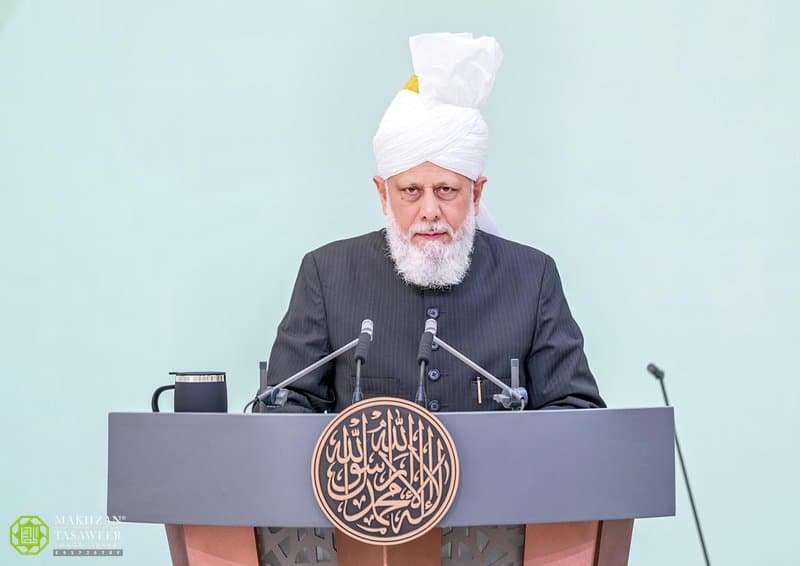
After reciting the tashahhud, ta‘awwuz and Surah al-Fatihah, Hazrat Khalifatul Masih V (aa) stated:
We firmly believe and have complete faith that if there has ever been a perfect human being in this world, it was Hazrat Muhammad Mustafa (sa). Neither before him was there any human being as perfect as he, nor can there ever be after him.
The highest standards in fulfilling the rights owed to Allah the Almighty, fulfilling the rights owed to mankind and exhibiting every noble moral quality and every excellent human attribute were all perfectly embodied in the person of the Holy Prophet (sa). Whichever moral quality one may consider, the highest possible standard of it was found in him – a standard that no other human being possessed, nor possesses now, nor ever will possess.
Among these noble qualities and characteristics is the quality of humility and meekness, the most perfect example of which was found in the Holy Prophet (sa). He also consistently advised his followers that a believer should always strive to make the quality of humility a permanent part of their lives.
Allah the Almighty instructed the Holy Prophet (sa) to proclaim this lofty moral quality in the Holy Quran with the words:
قُلْ اِنَّمَا اَنَا بَشَرٌ مِّثْلُکُمْ
“Say, ‘I am only a man like yourselves.’” [Surah al-Kahf, Ch.18: V.111]
Despite the fact that Allah the Almighty granted him the status of the Prophet who brought the final and perfect law, he was still commanded to announce: “Say that I am a human being, and a humble man.”
In this regard, I will present some ahadith and excerpts from the writings of the Promised Messiah (as), which demonstrate the manifestation of this moral quality on various occasions.
The Promised Messiah (as) states:
“There exists no example in the world of a perfect human being greater than our Noble Prophet (sa), nor can there ever be until the Day of Judgment.
“Then observe that despite being granted miracles of power and authority, the Holy Prophet (sa) was always accompanied by the spirit of servitude to God. (He remained a humble man and a humble servant), and repeatedly declared:
اِنَّمَا اَنَا بَشَرٌ مِّثْلُکُمْ
“[‘I am only a human being like yourselves.’]
“So much so that in the declaration of the Unity of God, he made the acknowledgment of his servitude an essential component, without which a Muslim cannot even remain a Muslim.
“Reflect deeply and reflect again. When the perfect guide’s own way of life teaches us that even after attaining the highest station of nearness to God, he never abandoned the acknowledgment of servitude, then for anyone else even to entertain such thoughts or ideas in their heart is utterly futile and meaningless.” (Report Jalsa Salana 1897, p. 140)
The Promised Messiah (as) further states:
“One should avoid empty boasting, arrogance, and conceit and should adopt humility and courteousness. Look, an example of the humility and courteousness of the Holy Prophet (sa), who was truly the greatest of all and the most worthy of reverence, is found in the Holy Quran.
“It is written that a blind man used to come to study the Quran with the Holy Prophet (sa). One day the nobles of Mecca and the chieftains of the city were gathered around the Holy Prophet (sa) and he was engaged in conversation with them. As a result of being preoccupied in the conversation, the ensuing delay caused the blind man to get up and leave. Though this seemed like a minor incident, Allah Almighty revealed a chapter [in the Quran] about this. Upon this, the Holy Prophet (sa) went to his house, brought him back and, spreading his own blessed mantle, seated him upon it.
“The essential point is that it is incumbent upon those people in whose hearts dwells the grandeur of Allah to be humble and show humility, for they constantly quake and quiver before the self-sufficiency of God Almighty.” (Malfuzat, 2022, Vol. 10, p. 298)
Thus, this is not merely an isolated incident mentioned in the Holy Quran or narrated by the Promised Messiah (as). Rather, it is a lesson being imparted to us: that the Holy Prophet (sa) is the perfect model for you. If you truly claim to love him, then you too must strive to attain the highest standards of humility and meekness.
On one occasion, while drawing a believer’s attention towards the reality of humility and acting upon it, the Holy Prophet (sa) said – as narrated by Hazrat Ibn Abbas (ra):
“Every human being has two chains attached to his head: one chain extending towards the heavens and another extending towards the earth. When a servant adopts humility and meekness, the angel holding the heavenly chain raises him upwards.”
In other words, when a person lowers himself in humility, Allah the Almighty grants him an elevated rank.
“But when he adopts pride and rebellion, the earthly chain drags him downward.” (Al-Jami Li Shu’bil Iman, Bahyaqi, Vol. 10, Hadith 7791, Maktabatul Rushd, p. 456)
The arrogant person’s deeds are no longer worthy of acceptance; in the sight of Allah the Almighty, he has fallen low, cast down upon the earth.
In another narration of Hazrat Ibn Abbas (ra) it is stated:
“When a servant adopts humility, Allah the Almighty raises him up to the seventh heaven.” (Kanz-ul-Ummal, Vol. 2, Hadith 5717, Dar-ul-Kotob Al-Ilmiyyah, 2004, p. 49)
Therefore, if we desire to attain nearness to Allah the Almighty, humility is an extremely essential quality for that purpose.
It is narrated from Hazrat Abu Hurairah (ra) that the Holy Prophet (sa) said, “Charity does not decrease from wealth in any way, and Allah does not increase a person through forgiveness except in honour (that is, forgiveness increases the honour of a person). And no one adopts humility for the sake of Allah except that Allah elevates him [in rank].” (Jami‘ at-Tirmidhi, Abwab al-birro wa s-silah, Hadith 2029)
Thus, these are fundamental principles that have been outlined for a believer: charity and financial sacrifice do not reduce wealth; rather, they increase it. Therefore, remove from your hearts the misconception that financial sacrifice will cause your wealth to diminish. Forgiveness and overlooking faults do not strip away your honour; rather, they grant you honour. If people were truly to understand this reality, then many social disputes and conflicts in the world would be resolved. Furthermore, the Holy Prophet (sa) said, “By adopting humility, Allah the Almighty elevates a person”. The more one increases in humility, the greater the rank that will be bestowed to you by Allah the Almighty.
What were the standards of humility which the Holy Prophet (sa) set for himself? It is narrated from Hazrat Anas bin Malik (ra) that a man once addressed the Holy Prophet (sa) saying, “O Muhammad (sa), O our chief and the son of our chief, O best among us, son of the best among us.” Upon this, the Holy Prophet (sa) said, “People! Demand righteousness for yourselves, lest Satan mislead you. I am Muhammad, son of Abdullah, the servant of Allah and His Messenger. I swear by God, I do not like that you raise me above the rank which Allah has granted me.” (Musnad Ahmad bin Hanbal, Vol. 4, Hadith 12579, A’alam-ul-Kotob, Beirut, p. 394)
Thus, the declaration which Allah the Almighty commanded him to make, he also proved through his practical example. Another example of his extreme humility is found in a Hadith. Hazrat Abu Hurairah (ra) states, “I heard the Holy Prophet (sa) state: ‘No person will enter Paradise solely because of his deeds.’ The companions asked, ‘Not even you, O Messenger (sa) of Allah?’ He replied, ‘Not even me, unless Allah shrouds me with His grace and mercy. Therefore, whatever deeds you perform, do them perfectly and perform them for the sake of attaining nearness to God. And none of you should ever wish for death. If a person is righteous, perhaps he may continue to progress in righteousness, and if he is sinful, perhaps he may repent and make amends for the displeasure of Allah the Almighty.’” (Sahih al-Bukhari, Kitab al-marda, Hadith 5673, Translation, Nazarat-e-Ishaat, pp. 45-46)
Then in another narration, Hazrat Abu Said Khudri (ra) states that, “One should love the poor and needy, because I heard the Holy Prophet (sa) saying in his supplication:
اَللّٰھُمَّ اَحْیِنِیْمِسْکِیْنًا وَّ اَمِتْنِیْ مِسْکِیْنًا وَاحْشُرْنِیْفِیْ زُمْرَةِ الْمَسَاکِیْنَ
“‘O Allah, keep me alive as a poor man, cause me to die as a poor man, and raise me among the company of the poor.’” (Sunan Ibn Majah, Kitab az-zuhd, Hadith 4126)
Hazrat Abdullah bin Abi Aufa (ra) narrates, “The Holy Prophet (sa) used to constantly be engaged in the remembrance of God and did not indulge in futile matters. He would prolong his prayers and shorten the sermon. He never thought ill of walking beside a widow or a poor person or of fulfilling their needs.” (Sunan an-Nasa‘i, Kitab al-jumu‘ah, Hadith 1415)
Such was the level of his humility: his standards of worship were indeed lofty, but his humility was such that he would give complete time, patience, and attention to any poor person or widow who wished to speak to him.
Hazrat Anas bin Malik (ra) narrates, “Even a maidservant among the women of Medina could take the hand of the Holy Prophet (sa) and lead him wherever she wished in order to assist her with her difficulty.” (Sahih al-Bukhari, Kitab al-adab, Translation, Nazarat-e-Ishaat, pp. 489-490)
It is narrated from Hazrat Anas (ra) that, “A woman who had learning difficulties said, ‘O Messenger (sa) of Allah, I need something from you.’ He replied, ‘O mother of so-and-so, take me through whichever street you wish and I will assist you.’ Then he went with her along a path until she presented her issue and it was resolved.” (Sahih Muslim, Kitab al-faza’il, Translation, Hadith 4279, Noor Foundation, p. 235)
In some narrations, it is mentioned that this woman’s name was Umm Zufar, and that she was a maid of Hazrat Khadija (ra). She had a simple nature and perhaps had learning needs. Sometimes there are some who cannot understand things or they fail to comprehend certain matters. It was not the case that she was, God forbid, completely intellectually challenged; rather, she was of a simple nature. Despite this, the Holy Prophet (sa) cared for her feelings. (Al-Kawakib Al-Wahaj Sharah Sahih Muslim, Vol. 23, Maktaba Dar-ul-Minhaj, p. 155)
In another narration, Adi bin Hatim (ra) states, “I set out to meet the Messenger (sa) of Allah and reached Medina. I entered the mosque and presented myself before the Messenger (sa) of Allah and met him with the greetings of peace. The Holy Prophet (sa) asked, ‘Who are you?’ I replied, ‘I am Adi bin Hatim.’ The Holy Prophet (sa) stood up and began taking him toward his home. On the way, an elderly woman approached and spoke to the Holy Prophet (sa) for a long time regarding her needs. The Holy Prophet (sa) remained standing there for her sake.” Adi says, “I said to myself, ‘This man cannot be a king; kings do not stand like this for poor people. Kings do not possess such exemplary morals.’ Then the Holy Prophet (sa) took me into his home and picked up a thick cushion and placed it before me, saying, ‘Sit on this.’ (There was a cushion in his house, so he gave it to the guest.) I replied, ‘You should sit upon this cushion’. The Holy Prophet (sa) replied, ‘No, you sit.’ Eventually, I sat upon it while the Holy Prophet (sa) sat on the ground. I thought to myself, ‘This is certainly not the way of kings. These are the ways of an extremely humble person.’” (Al-Sirah Al-Nabawiyyah, ib Hisham, Dar-ul-Kotob Al-Ilmiyya, Beirut, 2001, p. 854)
The Holy Prophet (sa) expressed love and showed humility even towards children and would be the first to greet them. Hazrat Anas (ra) relates that whenever the Messenger (sa) of Allah visited the Ansar, he would greet their children, pass his hand over their heads and pray for them. (Al-Sunan Al-Kubra, Nisai, Kitab al-manaqib, Hadith 8349, Dar-ul-Kotob Al-Ilmiyyah)
Hazrat Ibn Mas‘ud related that on one occasion a man was brought before the Holy Prophet (sa), and as he spoke to him, such was the awe of the Holy Prophet (sa) that the man’s shoulders began to tremble. The Holy Prophet (sa) said to him: “Be at ease – I am no king. I am merely the son of a woman who used to eat dried meat.” (Sunan Ibn Majah, Kitab al-ati’mah, Hadith 3312)
The Promised Messiah (as) said:
“Look, the successes of our Holy Prophet (sa) were such that the likes of them are not found in any of the previous Prophets, yet as God bestowed all the more success upon him, he grew all the more humble. An incident is recorded that once a man was caught and brought to the Holy Prophet (sa). When the Holy Prophet looked at him, he was trembling and was terrified. When he came close, the Holy Prophet (sa) asked him very gently and kindly, ‘Why are you so frightened? After all, I am also a human being like you, and I am the son of a woman.’” (Malfuzat, 2022, Vol. 10, pp. 217-218)
He was far above all outward pretence and show, and this is particularly evident in the account of his migration to Medina, which we have heard recounted many times. It is related that when the Messenger (sa) of Allah arrived in Medina, the Muslims, upon hearing the news, sprang up and rushed to take up their weapons, going out to receive him at the plain of Harrah. He turned right with them and alighted with them in the quarter of Banu Amr bin Auf – and this was on a Monday, in the month of Rabi al-Awwal. Hazrat Abu Bakr (ra) stood to receive the people, while the Holy Prophet (sa) sat quietly. Those among the Ansar who had not yet seen the Holy Prophet (sa) came forward and began offering their greetings to Hazrat Abu Bakr (ra) – until the sun fell upon the Holy Prophet (sa). Hazrat Abu Bakr rose and shaded him with his cloak, and it was only then that the people recognised the Holy Prophet (sa). (Sahih al-Bukhari, Kitab-ul-Manaqib Al-Ansar, Hadith 3906, Translation Nazarat-e-Ishaat)
It is narrated by Hazrat Ibn Abbas that he heard Hazrat Umar (ra) standing at the pulpit and saying: “I heard the Prophet (sa) say: ‘Do not go to excess in praising me as the Christians went to excess in praising the son of Mary. I am only Allah’s servant – say that he is His servant and His Messenger.’” (Sahih al-Bukhari, Kitab ahadithi l-anbiya’, Hadith 3445, Translation: Nazarat-e-Ishaat)
Similarly, Ali bin Hussain narrated from his father: “Love us for the love of Islam, for the Holy Prophet (sa) said to me: ‘Do not elevate my rank beyond what is right, for Allah made me His servant before He made me His Messenger.’” (Al-Mu’jim-ul-Kabir, Tabrani, Vol. 3, Hadith 2889, Maktabah Ibn Taimiyyah, pp. 138-139)
The Holy Prophet (sa) said to love him on account of Islam.
Mutarraf related that his father told him: “I went to the Holy Prophet (sa) as part of a delegation from Banu Amir. We said: ‘You are our master.’ He replied: ‘The master is Allah, Blessed and Exalted.’ We said: ‘You are the most excellent among us in virtue and the greatest among us in beneficence.’ He said: ‘Say what you have to say, and do not let Satan embolden you.’” (Sunan Abu Dawud, Kitab al-adab, Hadith 4806)
Such was the depth of his humility – he checked them immediately, saying: leave all of this aside. Such sentiments may arise within you and may linger on. State the purpose of why you came here and do not speak in this vain manner about me – even though the words of praise being used about him were words that could indeed be attributed to him.
Hazrat Rubbiy bint Mu‘awwidh ibn Afra said: “On the night of my wedding, the Holy Prophet (sa) came in and sat upon my bed just as you are sitting with me now. (She said this to the person she was narrating to.) At that moment, some of our young girls began to beat the drum and sing the praises of my forefathers who had been killed at the Battle of Badr, and in the course of these verses, one of the girls sang: ‘Among us is a Prophet who knows what tomorrow shall bring.’ The Holy Prophet (sa) immediately said: ‘Leave that and sing what you were singing before.’” (Sahih al-Bukhari, Kitab an-nikah, Hadith 5147)
That is, these words are wrong in that I know the unseen; in fact, the knowledge of the unseen belongs to Allah alone.
Hazrat Abdullah narrated from the Holy Prophet (sa) that he said: “No one should say that I am superior to Jonah, son of Amittai.” (Sahih al-Bukhari, Kitab at-tafsir, Hadith 4603). Despite being superior, he forbade such comparisons and expressed the most profound humility.
Likewise, Hazrat Anas ibn Malik (ra) relates that a man came before the Holy Prophet (sa) and said:
یا خیر البریہ
“O best of creation.” The Holy Prophet (sa) replied: “That was Abraham (as).” (Sahih Muslim, Kitab-ul-Fazail, Hadith 4353, Noor Foundation)
He was undoubtedly Khair al-Bariyyah – the best of creation – and the most exalted among all created beings, the most exalted among all the prophets too – yet with the utmost humility, he attributed that title to Prophet Abraham (as).
Another instance of his humility is recorded in the narration of Hazrat Umar bin al-Khattab (ra), who said: on one occasion a man called out to the Holy Prophet (sa) three times, and each time the Holy Prophet (sa) responded:
لبیک لبیک
“I am here, I am here.” (Majma Al-Zawaid Wa Manmba Al-Fawaid, Kitab alamati n-nabuwwah, Hadith 14224, Dar-ul-Kotob Al-Ilmiyyah, Beirut, 2001)
And when nearly all of Arabia had been brought under his banner, this conqueror of Arabia performed Hajj in the company of more than 100,000 Companions – yet such was his humility on that occasion that, as Hazrat Anas bin Malik (ra) relates, the Holy Prophet (sa) performed Hajj on an ordinary mount with a plain saddle-cloth worth no more than four dirhams – and not even that, for it was worth even less than that – it was a very simple cloth. And the Holy Prophet (sa) supplicated:
اَللّٰھُمَّ حَجَّةٌ لَا رِیَاءَفِیْھَا وَلَا سُمْعَۃَ
That is, “O Allah, This is a Hajj in which there is neither display nor desire for renown.” (Sunan Ibn Majah, Kitab al-manasik, Hadith 2890; Al-Sirah Al-Halabiyyah, Vol. 3, Dar-ul-Kotob Al-Ilmiyyah, Beirut, p. 361)
The Promised Messiah (as), in praise and glorification of the Holy Prophet (sa), speaks of his names. He states:
“The name Ahmad is the manifestation of jamal [grace and benevolence] and – in contrast to this – the name Muhammad is the manifestation of jalal [grandeur and eminence]. The reason for this is that inherent in the name Muhammad is the quality of being the beloved (that is, the beloved of Allah the Almighty) because having all praiseworthy excellences and possessing utmost beauty and all perfect praiseworthy excellences requires splendour, grandeur, awe and glory. (i.e., he possesses all perfect morals; this only happens when the Jalal of Allah the Almighty descends upon a person and a person manifests it, and also the lofty status is expressed). But inherent in the name Ahmad is the quality of falling in love because to praise someone demands humility, lover’s submissiveness, and meekness. This is verily called a jamali state, because it is filled with a deep love, and this condition requires humility and meekness.
“Our Holy Prophet (sa) was eminently lovable, which is required by the name Muhammad, (i.e., he was the beloved of God Almighty) because being ‘Muhammad’, encompassing all praiseworthy excellences – is what brings into being the state of being eminently lovable. And the Holy Prophet (sa) also possessed the best qualities of a lover [of God and humanity], which the name Ahmad requires; (i.e., the name ‘Ahmad’ requires that he possess the ability to love) for, it is essential that hamid [the one who praises] must also be muhibb [the one who loves]. A person can only truly and perfectly praise someone when he is in love – nay rather, he is passionately in love – and in order to be a lover and a muhibb, one needs to be submissive and humble. (To be passionately in love requires one to show humility; one cannot fall passionately in love simply by exerting one’s awe and influence.)
“This is precisely the jamali state necessary to realise the essence of Ahmadiyyah. The belovedness, which was inherent in the name Muhammad, manifested through the Companions. As for those who were insulting and rebellious, the jalal of being the beloved of God, subdued them.” (Arba‘in No. 4, Ruhani Khazain, Vol. 17, pp. 447-448)
Since the Holy Prophet (sa) was the beloved of God, He manifested His jalal, and this was manifested through the Companions, whereby the enemy was annihilated.
Explaining this further, the Promised Messiah (as) states at one instance:
“There is an underlying secret in the blessed names of the Holy Prophet (sa); Muhammad and Ahmad, each contain distinct excellences. The name ‘Muhammad’ demands characteristics of glory and majestic greatness because the name means ‘one who is praised immensely’, and it is the hallmark of the one who is loved because the one who is loved is praised. Therefore, this requires characteristics of glory and majesty. In the same manner, the name Ahmad inherently bears qualities of a lover, because the lover is the one who offers praise. Thus, just as the name Muhammad, in its majesty and capacity of being a beloved, desires glory and grandeur, in the same manner, the name Ahmad, in its loving and devoted splendour, desires humility and meekness. (This second name, Ahmad, manifests the attribute of humility and meekness.)
“The underlying secret in these names is that the life of the Holy Prophet (sa) has essentially been divided into two parts. First, there was his life in Mecca, which spanned a period of thirteen years. The second part of his life was spent in Medina, which lasted ten years. During his life in Mecca, we see a manifestation of his name, Ahmad. During this time, the Holy Prophet (sa) engaged himself in weeping and crying before God Almighty day and night and would spend his time seeking divine help and in prayer (this was a time of extreme humility and meekness. Though these states persisted afterwards as well, but at that time only these characteristics were being manifested.) Anyone who is fully aware of the manner in which the Holy Prophet (sa) spent his life during this time knows that no lover has ever cried and wept so fervently in search of their beloved as the Holy Prophet (sa) did during his life in Mecca, nor will anyone ever be able to match him in this regard. (The Promised Messiah (as) is giving the example of how the Holy Prophet (sa) expressed being lost in his love for God Almighty. Though this was his state throughout his life, this was especially the hallmark of that period in his life.)
“Then, these lamentations of the Holy Prophet (sa) were not for his own soul, but due to his clear knowledge of the state of the world. The worship of God had disappeared completely. The soul and the inherent nature of the Holy Prophet (sa) was leavened by a faith in Allah the Exalted, which fostered within him pleasure and delight. The Holy Prophet (sa) naturally desired to fill the world with this pleasure and joy as well. But when he cast a glance on the world, he found that their capacities and natures had been strangely deformed, and there were many difficulties and hardships at hand. In short, the Holy Prophet (sa) would weep and cry over this state of the world, and he did so to such an extent that he may well-nigh have lost his life. It is to this that the following words of Allah the Exalted allude:
لَعَلَّکَ بَاخِعٌ نَّفْسَکَ اَلَّا یَکُوْنُوْا مُؤْمِنِیْنَ
“‘Haply thou wilt grieve thyself to death because they believe not.’
“This was the life of the Holy Prophet (sa) in which he humbly begged for divine grace and mercy, a life which showed a manifestation of his name, Ahmad. During this era, the Holy Prophet (sa) was engaged in deep contemplation. The effects of this contemplation and prayer became apparent during life in Medina, when the name Muhammad was manifested. (The first period of his life was his life as a manifestation of the name Ahmad, and his life in Medina was a manifestation of the brilliance of his name Muhammad. As mentioned before, it was also through the companions that the enemy was destroyed), as is evident from the following verse:
وَاسْتَفْتَحُوْا وَخَابَ کُلُّ جَبَّارٍ عَنِیْدٍ
“‘And they prayed for victory, and as a result thereof every haughty enemy of truth came to naught.’” (Malfuzat, 2022, Vol. 2, pp. 62-63)
During his life at Medina, when the enemy became fierce, it was at that time that the characteristics of the Holy Prophet’s (sa) name as Muhammad became manifest and every enemy was ruined and destroyed.
وَاسْتَفْتَحُوْا وَخَابَ کُلُّ جَبَّارٍ عَنِیْدٍ
They prayed to Allah for victory, and as a result, Allah the Almighty granted them victory over the enemy and granted the Holy Prophet (sa) triumph over his enemies and destroyed them. At another instance, the Promised Messiah (as) states:
“Hence, on various instances, wherever the humility and humbleness of the Holy Prophet (sa) may be seen to reach the heights of perfection, it appears that he was supported and illumined by the succour and light of the Holy Spirit in equal degree. The state of the deeds and actions of our Noble Prophet (sa) clearly demonstrates this. In fact, the sphere of his light and blessings is so vast that his manifestation and reflection can be observed to extend into all eternity. (This example will be seen forever.)
“As such, all the bounty and grace of God Almighty that is being sent down in this day and age is received through obedience and subservience to none other than the Holy Prophet (sa).
“I truthfully say and proclaim on the basis of my own experience that no one can perform true virtue, attain the pleasure of God Almighty, and be fortunate enough to receive the divine favours, blessings, insights, verities and visions that are bestowed upon one who purifies their soul to the highest degree, until they are lost in subservience to the Messenger (sa) of Allah. Evidence of this is found in the Word of God Almighty Himself:
قُلْ اِنْ کُنْتُمْ تُحِبُّوْنَ اللّٰہَ فَاتَّبِعُوْنِیْ یُحْبِبْکُمُ اللّٰہُ
“‘Say, “If you love Allah, follow me: then will Allah love you.”’ [Surah Aal-e-Imran, Ch.3: V.32]
“I am a practical and living proof of this claim by God Almighty. (The Promised Messiah [as] says that he is a practical manifestation of this claim, due to his love for the Holy Prophet (sa) as a result of which he received the blessings of Allah the Almighty.) Recognise me in light of the hallmarks that represent the saints and beloved of God Almighty as established by the Holy Quran. Hence, the Noble Prophet (sa) possessed such perfect morals that even if an old lady took hold of his hand, the Holy Prophet (sa) would remain there listening to her attentively; and until she would leave him, he would not leave her.” (Malfuzat, 2022, Vol. 1, pp. 188-189)
In one narration, the humility and simplicity of the Holy Prophet (sa) are described in the following manner. Hazrat Anas bin Malik (ra) relates that the Holy Prophet (sa) would visit the sick, attend funeral processions, ride upon a donkey – even though it was considered a very ordinary means of transport – and accept the invitation of a slave. On the day of Banu Quraizah, he was riding upon a donkey whose reins were made from rope fashioned out of date-palm bark, and whose saddle was likewise made from date-palm fibre. In other words, it was extremely simple and modest. (Jami‘ at-Tirmidhi, Abwab al-jana’iz, Hadith 1017)
In another narration, Hazrat Uthman (ra) stated during a sermon: “By Allah, we remained in the company of the Holy Prophet (sa) both during journeys and while residing at home. The Holy Prophet (sa) would visit our sick, accompany our funerals, and remain with us in every circumstance and every matter.” (Musnad Ahmad bin Hanbal, Vol. 1, Hadith 504, A’alam-ul-Kotob, Beirut, 1998, p. 226)
Similarly, Hazrat Abu Hurairah (ra) relates that the Holy Prophet (sa) said: “If I were invited to partake of a sheep’s foreleg or trotter, I would certainly accept the invitation; and if a sheep’s foreleg or trotter were sent to me as a gift, I would certainly accept it.” Thus, even the invitation of something very simple or a humble gift would be accepted by the Holy Prophet (sa). (Sahih al-Bukhari, Kitab al-hiba, Hadith 2568, Translation Nazart-e-Ishaat)
Hazrat Anas bin Malik (ra) narrates: “One day, the Holy Prophet (sa) was invited to a meal consisting of barley bread and aged fat, and he happily accepted the invitation.” (Musnad Ahmad bin Hanbal, Vol. 4, pp. 610-611, Hadith 13531, A’alam-ul-Kotob, Beirut, 1998)
In another narration, the simplicity of the Holy Prophet (sa) meals is described as follows. Hazrat Anas bin Malik (ra) relates that one day a tailor invited the Holy Prophet (sa) to a meal he had prepared. Hazrat Anas bin Malik (ra) says: “I accompanied the Holy Prophet (sa) to that meal. Bread and a broth containing pieces of gourd and chunks of meat were placed before the Holy Prophet (sa). I observed the Holy Prophet (sa) searching around the bowl for the pieces of the gourd, leaving aside the meat.” Hazrat Anas says, “From that very day onwards, I began eating and liking gourd.” (Sahih al-Bukhari, Kitab a-buyu‘, Hadith 2092, Translation: Nazarat-e-Ishaat)
Here, I would also like to mention something for our guests, as there is a lesson in this for them as well. During Jalsa days, especially in the Langar, some people occasionally complain, saying they should not be given potatoes but should only be given the meat in the Alu Gosht [potatoes and meat dish]. Therefore, always keep the example of the Holy Prophet (sa) in mind. Food is prepared according to a proper measure and quantity, so one should partake of whatever is available and eat whatever may be offered, whether vegetables or meat, and eat it with contentment.
Another example illustrating the Holy Prophet’s (sa) consideration for the feelings of others and showing humility is found in the following narration. Hazrat Jabir bin Abdullah (ra) relates that the Holy Prophet (sa) took hold of the hand of a leper and had him eat out of the same bowl as him. Then he said: “Eat in the name of Allah, placing your complete trust in Him.” (Jami‘ at-Tirmidhi, Abwab al-ati‘mah, Hadith 1817)
Similarly, Hazrat Usamah bin Zaid (ra) narrates that the Holy Prophet (sa) rode upon a donkey covered with a cloak made in Fadak, and he seated Hazrat Usamah bin Zaid (ra) behind him. He was not affected by who sat beside him. (Sahih al-Bukhari, Kitab at-tafsir, Hadith 4566)
Hazrat Abdullah bin Abbas (ra) narrates that on the Day of Sacrifice, the Holy Prophet (sa) seated Fadl bin Abbas behind him upon the back of his she-camel. (Sahih al-Bukhari, Kitab Al-Istizan, Hadith 6228)
Similarly, Hazrat Anas (ra) relates that when the Holy Prophet (sa) entered Mecca, people came forth to behold him. Due to his humility, his blessed head was lowered to the extent that it nearly touched the saddle of his camel. Surrounded by the people and despite the victory and the great number of Muslims, his blessed beard was lowered in humility to the extent that it touched – or was close to touching – the saddle. At that moment, he said:
اَللّٰہُمَّ اِنَّ الْعَیْشَ عَیْشُ الْاٰخِرَةِ
“O Allah, truly the real life is the life of the Hereafter.” (Subul Al-Huda, Vol. 5, p. 226, Dar-ul-Kotob Al-Ilmiyyah, Beirut)
One aspect of his justice, fairness, humility, and meekness was that he seated Usamah, the son of his freed slave Zaid bin Harithah, behind himself, despite the presence of the chiefs of the Quraish and the sons of Banu Hashim. (Sharah Al-Zurqani, Vol. 3, Dar-ul-Kotob Al-Ilmiyyah, Beirut, p. 414)
The Promised Messiah (as) states:
“The exaltation that is granted to the special servants of God Almighty is characterised by humility, whereas the exaltation of Satan is accompanied by arrogance; that is, it contains pride within it. Observe how our Noble Prophet, peace and blessings of Allah be upon him, lowered his head and prostrated himself upon the conquest of Mecca in the very same manner as he used to bow and prostrate during the days of hardship and tribulation, when in that same Mecca he was opposed in every possible way and subjected to persecution. When he reflected upon the condition in which he had departed from that city and the condition in which he had now returned, his heart became filled with gratitude to Allah, and he fell into prostration.” (Malfuzat, 2022, Vol. 3, p. 260 [footnote])
It is mentioned in a narration related by Abdullah ibn Mas‘ud:
“On the day of the Battle of Badr, one camel was assigned for every three men among us. Hazrat Abu Lubabah (ra) and Hazrat Ali (ra) were paired with the Holy Prophet (sa). When it came to the Holy Prophet’s (sa) turn to walk, the two companions submitted, ‘O Messenger (sa) of Allah, we shall walk in your place; please remain mounted.’ The Holy Prophet (sa) replied, ‘You are not stronger than I am in walking, nor am I less in need of reward than you both.’” (Musnad Ahmad bin Hanbal, Vol. 2, Hadith 4009, Alam Al Kotob, Beirut, 1998, pp. 116-117)
In another narration, it is related that the Holy Prophet (sa) was once travelling with his companions and instructed that a goat be prepared for a meal. One person said, “O Messenger (sa) of Allah, I shall slaughter it.” Another said, “I shall skin it.” A third said, “I shall cook it.” Thereupon, the Holy Prophet (sa) said, “And gathering the firewood shall be my responsibility.” The companions submitted, “O Messenger (sa) of Allah, we are sufficient for this on your behalf.” The Holy Prophet (sa) replied, “I know that you are sufficient for me, but I do not desire to appear distinguished among you, for Allah the Almighty dislikes that a servant should seek prominence among his companions.” (Tarikh-ul-Khamis, Vol. 1, pp. 387-388, Dar-ul-Kotob Al-Ilmiyyah, Beirut, 2009)
He then arose and began collecting the firewood himself.
The humility of the Holy Prophet (sa) was always manifest at every occasion.
In another narration, Aswad relates that he asked Hazrat Aisha (ra) what the Holy Prophet (sa) used to do at home. She replied, “He would occupy himself in serving his family; that is, he would assist them in their household tasks. And when the time for prayer arrived, he would go out for prayer.” (Sahih al-Bukhari, Kitab-ul-Azan, Hadith 676, Translation Nazarat-e-Ishaat)
Thus, there is a lesson in this for those men who entirely refuse to assist in household affairs, thereby giving rise to complaints from their wives.
Similarly, Hisham ibn Urwah narrates from his father that a man once asked Hazrat Aisha (ra) whether the Messenger (sa) of Allah performed any work at home. She replied:
“Yes, the Messenger (sa) of Allah would mend his own shoes, sew his own clothes, and work within his home just as any one of you works in his home.” (Musnad Ahmad bin Hanbal, Vol. 8, Hadith 25855, Alam Al Kotob, Beirut, 1998, p. 313)
This also makes evident that the Companions, following the noble example of the Holy Prophet (sa) would assist their wives in household matters. However, it should also remain clear that the primary responsibility of taking care of the household rests with the wife, and this should not be misunderstood to mean that women are absolved of their own responsibilities. Nevertheless, it remains the duty of men to assist and support them.
Likewise, another narration from Qasim states that Hazrat Aisha (ra) was asked what work the Messenger (sa) of Allah would do at home. She replied:
“He was but a human being among human beings. He would dust his own clothes, milk his own goat, and attend to his own work himself.” (Musnad Ahmad bin Hanbal, Vol. 8, p. 507, Hadith 26724, Alam Al Kotob, Beirut, 1998)
Another narration from Hazrat Abu Burdah includes, in addition, that the Holy Prophet (sa) would wear woollen garments, tether his own animals, and personally go to enquire after and honour his guests. He himself would extend hospitality to them. He would wear all kinds of clothing, even coarse and rough garments, and his attire was marked by simplicity. (Dala’il Al-Nabuwwah, Bayhaqi, Vol. 1, Dar-ul-Kotob Al-Ilmiyyah, Beirut, 1988, p. 329)
Hazrat Amir bin Rabi’ah narrates that a man said:
“I once accompanied the Holy Prophet (sa) on the way to the mosque. During the journey, the strap of his sandal broke, so I took it in order to repair it. The Holy Prophet (sa) took the sandal back from my hand and said, ‘This is preferential treatment, and I do not like preferential treatment.’” (Majma Al-Zawaid Wa Manmba Al-Fawaid, Kitab alaamat-ul-Nabuwwah, Vol. 8, Hadith 14232, Dar-ul-Kotob Al-Ilmiyyah, Beirut, 2001, p. 422)
Hasanah bin Khalid (ra) and Suwa bin Khalid (ra) narrate that they both came into the presence of the Messenger (sa) of Allah, while he was engaged in repairing a wall or attending to some maintenance work in one of his houses. (Subul Al-Huda, Vol. 7, Dar-ul-Kotob Al-Ilmiyyah, Beirut, p. 36)
Thus, he himself would carry out work within his home with his own hands.
Likewise, Sahih al-Bukhari contains a detailed account regarding the construction of Masjid Nabwi [the Prophet’s Mosque]. When the she-camel of the Holy Prophet (sa) came to rest upon a piece of land belonging to two young boys, he said, “This place is suitable for us.” Although the boys were unwilling to accept payment, the Holy Prophet (sa) nevertheless paid them the price of the land. Thereafter, when the construction of the mosque commenced, he joined the people and began carrying bricks himself, personally participating in the labour involved in building the mosque. (Sahih al-Bukhari, Kitab manaqibi l-ansar, Hadith 3906, Translation Nazarat-e-Ishaat)
Similarly, Hazrat Bara ibn Azib (ra) narrates:
“On the day of the Battle of the Trench, I saw the Messenger (sa) of Allah carrying earth, to the extent that the dust had covered the hair upon his chest.” (Sahih al-Bukhari, Kitab al-jihadi wa s-siyar, Hadith 3034, Translation Nazarat-e-Ishaat)
Hazrat Anas ibn Malik (ra) relates:
“One morning I brought Abdullah ibn Abi Talha to the Messenger (sa) of Allah, so that he may feed the newborn child with some honey with his blessed hand. I found the Holy Prophet (sa) holding in his hand an instrument used for branding animals.” That is, a newborn was brought to give it honey, whilst the Holy Prophet (sa) was occupied with work. In his hand was an instrument with which marks were branded upon animals so that they could be identified, and the Holy Prophet (sa) was branding the camels set aside for alms. (Sahih al-Bukhari, Kitab az-zakat, Hadith 150, Translation Nazarat-e-Ishaat)
His practice in every matter was that whenever there was an opportunity to do a task himself, he would do it, instead of calling on helpers.
In one narration, Hazrat Abu Umamah al-Bahili relates that the Holy Prophet (sa) came to us whilst leaning upon a staff. When we saw him, we stood up. Upon this, the Holy Prophet (sa) said, “Do not do this as the Persians stand for their elders.” We submitted, “O Messenger (sa) of Allah, pray to Allah for us.” The Holy Prophet (sa) prayed:
اَللّٰھُمَّ اغْفِرْلَنَا وَارْحَمْنَا وَارْضَ عَنَّا وَتَقَبَّلْ مِنَّاوَاَدْخِلْنَا الْجَنَّةَ وَنَجِّنَا مِنَ النَّارِ وَاَصْلِحْ لَنَا شَاْنَنَا کُلَّہُ۔
“O Allah, forgive us, have mercy upon us, be pleased with us, accept from us, admit us into Paradise, save us from the Fire, and set all our affairs aright.”
The narrator says that it seemed as though we desired that the Holy Prophet (sa) should pray even more for us. The Holy Prophet (sa) then said, “Have I not gathered all things together for you?” Meaning that this was a most comprehensive prayer. (Sunan Ibn Majah, Kitab ad-du‘a, Hadith 3836)
Hazrat Musleh-e-Maud (ra) states:
“The state of the Holy Prophet’s (sa) humility was such that upon his arrival he would prevent people from standing up for him and would say, ‘This is the custom of the Persians. I am not a king; rather, Allah the Almighty has made me a Prophet.’” (Tafsir-e-Kabir, 2023, Vol. 15, p. 157)
Thus, the Holy Prophet (sa) set such standards of humility the likes of which cannot be found anywhere else, and it is this very example that we should strive to follow so that we too may become recipients of the nearness of Allah the Almighty.
Whilst admonishing us in light of the example of the Holy Prophet (sa), the Promised Messiah (as) states:
“In my view, this is an excellent method of attaining purity, and it is not possible to find a better method – namely that a person should not take pride or arrogance in any matter whatsoever, neither in knowledge, nor lineage, nor wealth. When Allah the Almighty grants a person sight, he perceives that every light which can deliver him from these darknesses comes only from heaven, and that man is ever in need of heavenly light. Even the eye cannot see until the light of the sun, which comes from heaven, appears. In the same way, that light which removes every kind of darkness and in its place produces the light of righteousness and purity, comes only from heaven. I say truly that man’s righteousness, faith, worship, and purity – all come from heaven, and this depends upon the grace of Allah the Almighty. If He wills, He may establish it, and if He wills, He may take it away. Therefore, true understanding is that man should regard his self as crucified and utterly worthless and, falling at the threshold of the Divine, should seek the grace of Allah the Almighty with humility and meekness and should pray for that light of understanding which burns away the passions of the self and creates within him a light and a strength and fervour for good deeds.
“Then, if a person is granted a share of this grace and his heart is opened and illuminated, he should not become arrogant or proud on account of it. Rather, he should increase further in humility and meekness, for the more a person considers himself to be nothing, the more the manifestations and light of Allah the Almighty shall descend upon him, which will grant him strength. If a person holds this belief, then it is considered that, through the grace of Allah the Almighty, his moral condition shall become excellent. To consider oneself something in this world is itself arrogance, and this very condition develops within a person. Subsequently, such a state overtakes him that he curses others and considers them contemptible.” (Malfuzat, 2022, Vol. 7, pp. 59-60)
Then the Promised Messiah (as) further states:
“Man, who is but a humble creation, thinks himself immune from the consequences of his deeds, and as a result, pride and haughtiness develop within him. Until a person regards himself as the most inferior in the way of Allah, he cannot attain deliverance. Kabir Bhagat Kabir, who was a Sufi poet in India, spoke the truth when he said:
“‘It is my good fortune that I was born into a humble family, for I greet everyone.
“‘Had I been born into privilege, how then would I have found God?’
“That is, all praise belongs to Allah the Almighty that I was born in a humble home; had I been born in a noble family, I would not have found God. Whereas people would take pride in their higher caste, Kabir, whose family would weave cloth, would reflect upon his own background and be grateful. Thus, in each moment, man ought to analyse himself and reflect over how insignificant he is. What is his worth? Every human being, no matter how noble his lineage may be, if he truly reflects upon himself, then in one aspect or another – provided he possesses eyes to see – he shall certainly come to regard himself as insignificant and worthless before the whole universe. Until a person treats a poor and helpless old woman with the same morals that he shows, or ought to show, a person of high status and rank, and until he safeguards himself against every form of pride, arrogance, and haughtiness, he can never, ever enter the kingdom of God Almighty.” (Malfuzat, 2022, Vol. 5, p. 138)
If one desires to attain Allah the Almighty, humility is an absolute necessity.
May Allah the Almighty enable us to understand the true reality of humility and to always keep before us the blessed example of the Holy Prophet (sa).
(Official Urdu transcript published in the Daily Al Fazl International, 5 June 2026, pp. 1-8. Translated by The Review of Religions.)