
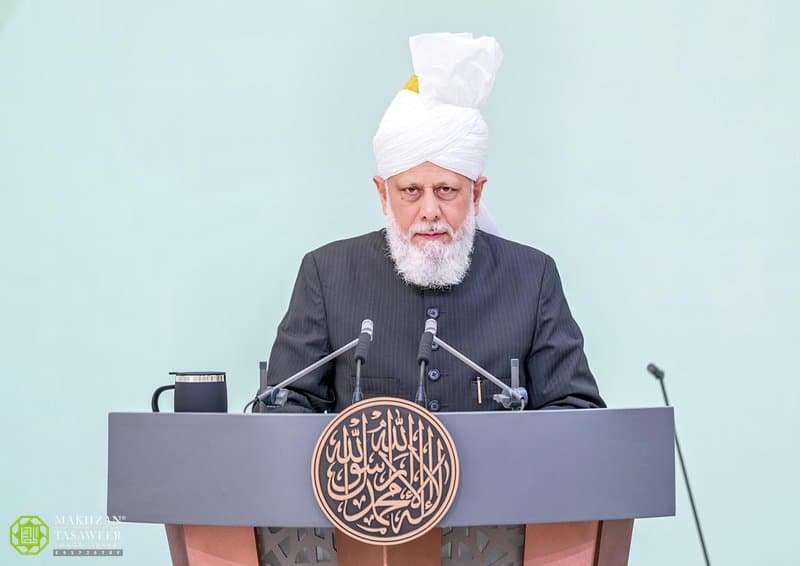
After reciting the tashahhud, ta‘awwuz and Surah al-Fatihah, Hazrat Khalifatul Masih V (aa) recited verses 17 and 18 of Surah Yunus and stated:
The translation of the verses is as follows: “Say, ‘If Allah had [so] willed, I should not have recited it to you nor would He have made it known to you. I have indeed lived among you a [whole] lifetime before this. Will you not then understand?’ Who is then more unjust than he who forges a lie against Allah or [he] who treats His Signs as lies? Surely, the guilty shall never prosper.”
Various aspects of the life and character of the Holy Prophet (sa) were being mentioned. Today, his morals, truthfulness, honesty and integrity will be discussed. Among incidents pertaining to the life and character of the Holy Prophet (sa), we find most excellent examples of his truthfulness, so much so that even his enemies could not refrain from acknowledging his exceptional standard of honesty and truthfulness. Allah the Almighty has described this very standard of his truthfulness in [the verses of] the Holy Quran, which I have just recited. And He instructed the Holy Prophet (sa) to say to them that I have never spoken a lie under any circumstances. I have never abandoned truthfulness, and you are witnesses to this. Would I then fabricate a lie against God Almighty by bringing a religion that is not from God? This is impossible. At the same time, he also instructed his followers that now that you are following me and have made an oath to obey me, you must uphold the highest standards of truthfulness.
As such, today, all of us must examine ourselves in this regard, as it is these very high standards of truthfulness which guarantee success in every moment of our lives, and they will also open for us the doors for tabligh [propagating the true message of Islam].
Discussing the pure life of the Holy Prophet (sa), Hazrat Musleh-e-Maud (ra) wrote at one place, or said in a sermon that “With regards to the Holy Prophet (sa), we observe that even his enemies acknowledged that he was Sadiq [truthful] and Amin [trustworthy] and they never levelled any allegation against him [in this regard]. In fact, even the staunchest of enemies bore witness to his purity and truthfulness. For example, a gathering was held in Mecca to decide what to say to outsiders visiting Mecca and enquiring about the Holy Prophet (sa). They said that they should agree upon a single response so that there would be no disagreement, as they were already being humiliated because one person would say one thing and another person would say something else. Thus, when people come for Hajj [pilgrimage], they should decide upon one response.
“Upon this, one of them suggested saying that he has the habit of lying and that whatever he says is false. Hearing this, a man named Nazr bin Harith stood up and said, ‘This should not be said. If you say this, no one will believe you. People will respond by saying that Muhammad [sa] lived among you during his youth, and at that time, he was regarded as the most righteous among you, the most truthful and the most trustworthy, so much so that when the hair at his temples started turning grey and he brought to you the teaching that he brought, i.e., the teachings of Islam, you started saying that he is a liar. By God! Under such circumstances, he cannot be a liar.’ Upon hearing the response of this individual, they all acknowledged their mistake and started thinking of another objection instead. What a truthful statement that man presented. Had they previously ever attributed falsehood to the Holy Prophet (sa), then someone could possibly have believed this to be true. However, when throughout his entire life they had called him truthful, how could anyone suddenly believe the allegation that he was a liar?
“Similarly, when Heraclius asked Abu Sufyan about the Holy Prophet (sa) – whether he had ever told a lie – Abu Sufyan replied, ‘Until today he has never lied.’ He said that he added the words ‘until today’ only so that some doubt might remain, implying perhaps that he might lie in the future.
“Likewise, on one occasion, the Holy Prophet (sa) climbed a mountain and called the people to gather. (I have mentioned this incident before as well, but now it is in relation to his truthfulness.) When they assembled, he said: ‘If I were to tell you that in such-and-such valley an army has gathered and is about to attack you, would you believe me?’ They replied, ‘Yes, we would believe you,’ even though it was impossible for such a large army to assemble so close to Mecca without the people knowing about it.
“Thus, the fact that they were prepared to believe even such a statement, which outwardly seemed impossible (it was impossible for such an incident to happen), simply upon hearing it from his mouth, shows that they had such firm conviction in his truthfulness that they considered it impossible for him to lie or deceive.” (Hasti-e-Bari Ta‘ala, Anwar-ul-Ulum, Vol. 6, pp. 309-310)
Further explaining this point, Hazrat Musleh-e-Maud (ra) states:
“What was it about the Holy Prophet (sa) that influenced even his opponents? Initially, they were not influenced by the Holy Quran. (The teachings of the Holy Quran did not immediately affect them in a way that would lead them to act upon its teachings or enter into his allegiance.) Rather, what influenced them was the earlier life of Hazrat Muhammad (sa). He had lived among them; they had witnessed his honesty, his truthfulness, his sympathy for mankind, and his spirit of sacrifice – and this is what affected them.
“Before his claim, he did not openly forbid them from associating partners with God, because the command from Allah had not yet come. However, he himself was never a polytheist. The excellence of his conduct and way of life itself had its effect, and this influence was working quietly within them (i.e., this was influencing the people. His righteousness, his example, and his noble character were most certainly influencing people), and they could not raise their eyes in opposition to it.”
As mentioned earlier, when he climbed the mountain in Mecca and called the people and said, “If I were to tell you that a large army is approaching, would you believe me?” – even though such a thing was impossible – the people replied, “Yes, we would believe you.” They said this because they knew that he had never spoken falsely. They said, “We have never heard you utter a lie. You have always been trustworthy and have always spoken the truth. Therefore, we would believe this as well.”
[He continues:] “At that point, he said, ‘If that is the case, then I tell you another true thing – and that truth is that God is One and associating partners with Him is evil. (Worship the One God and abandon shirk.) Otherwise, a punishment will come upon you.’
This statement did not influence them in the same way. His life had influenced them; his actions, his truthfulness, his righteousness, and his goodness had affected them. But when this claim was presented, they did not accept it, and they rejected it.
Therefore, the real thing is that a person’s example and conduct should be such that it influences people. When this happens, then at some point Allah the Almighty creates the means through which the paths of preaching open up, and those same people who were once opponents begin to enter the fold of Islam and come to understand the true teachings of Islam.” (Khutbat-e-Mahmud, Vol. 7, pp. 374-375)
The Promised Messiah (as) states:
“God the Almighty granted our master and chief, the Holy Prophet Muhammad (sa) – who was the leader of the righteous – victory and support through many kinds of divine help. Although in the beginning, like Moses (as) and Jesus (as), he too was destined to experience the trial of migration, yet that very migration contained within it the seeds of triumph and victory.
“Therefore, O friends, understand with certainty that a righteous person is never destroyed. When two parties become enemies of one another and carry their hostility to the extreme, then the party which, in the sight of God Almighty, is righteous and God-fearing receives help from heaven. In this way, through a heavenly decree, religious disputes are ultimately settled. (A decision is made in religious disputes.)
“Just reflect – how our master and chief, our Prophet Muhammad (sa), first appeared in Mecca in a state of weakness. At that time, the disbelievers, such as Abu Jahl, were at the height of their power, and hundreds of thousands of people had become deadly enemies of the Holy Prophet (sa). So what was it that ultimately granted our Holy Prophet (sa) victory and success? Certainly understand that it was his truthfulness, sincerity, purity of heart, and honesty that led to these triumphs.” (Raaz-e-Haqiqat, Ruhani Khazain, Vol. 14, pp. 155-156)
The Promised Messiah (as) further states:
“Allah the Exalted addresses our Holy Prophet (sa) and says:
اِنَّکَ لَعَلٰی خُلُقٍ عَظِیْمٍ
“[‘Thou dost surely possess high moral excellences.’]
“This means that all kinds of noble qualities – generosity, courage, justice, mercy, kindness, truthfulness, and fortitude – are gathered within you. In short, all the faculties that are found within the human heart – such as courtesy, modesty, honesty, nobility, honour, steadfastness, chastity, abstinence, moderation, sympathy (i.e., compassion) for others – as well as courage, generosity, forgiveness, patience, benevolence, truthfulness, loyalty, and so on – when these natural qualities are expressed in their proper place and occasion with the guidance of wisdom and reflection, they are collectively called akhlaq (moral excellences).” (Islami Usool Ki Falasafi, Ruhani Khazain, Vol. 10, p. 333)
Therefore, good morals do not simply mean meeting someone politely or offering a greeting. Rather, according to the example of the Holy Prophet (sa), true moral excellence is the manifestation of all virtues and the proper conduct in all dealings with people. It is towards this that attention must be paid.
The Holy Prophet (sa) came to spread truth in the world. Therefore, on various occasions, he also exhorted those who believed in him to remain steadfast upon truth. In one narration, Hazrat Abdullah bin Mas’ud (ra) relates that the Messenger (sa) of Allah said: “Truthfulness is incumbent upon you, for truth leads to righteousness, and righteousness leads to Paradise. A person continues to speak the truth and strives to adhere to truth until he is declared by Allah to be a Siddiq [truthful person]. And beware of falsehood, for falsehood leads to wickedness, and wickedness leads to the Fire. A person continues to lie and persists in falsehood until he is declared by Allah as a liar. When he is declared as a liar, he is destined for the Fire.” Thus, one ought to pay great heed to this. (Jami’ at-Tirmidhi, Kitab al-birri wa s-silah, Hadith 1971)
There is another narration from Hazrat Abdullah (ra), in which he states that the Holy Prophet (sa), stated, “Lying is never permissible under any circumstance, neither in seriousness nor in jest.” Some people claim that they were joking when they lied. Even jokingly, it is not permissible. “Nor is it permissible for a person to make a promise to his child and then fail to fulfil it. Truthfulness leads to righteousness, and righteousness leads to Paradise. Undoubtedly, falsehood leads to evil, and evil leads to the Fire. Regarding a truthful person, it is said that he spoke the truth and did good, and regarding a liar it is said that he lied and committed evil.” (Al-Jami’ Li Shu’bil Iman Li Al-Behqai, Vol. 6, Hadith 4453, Maktabat-ul-Rushd, p. 441)
Verse 119 of Surah at-Taubah states:
يَا أَيُّهَا الَّذِينَ آمَنُوا اتَّقُوا اللّٰهَ وَكُونُوا مَعَ الصَّادِقِينَ
That is, “O ye who believe! fear Allah and be with the truthful.”
In the commentary of this verse, Allama Razi states that a man came to the Holy Prophet (sa) and said: “O Messenger (sa) of Allah, I wish to avoid wrongdoing, but I am deeply attached to drinking, adultery, theft, and lying. I am heavily embroiled in these habits, while people say that you have deemed such practices as unlawful. I would like to believe in you, but you have declared these practices to be unlawful; however, I possess many such weaknesses. I do not have the strength to abandon them all. If you allow me to leave only one of them, I will accept faith.” The Holy Prophet (sa) replied, “Then abandon lying.” The man agreed and accepted Islam.
After taking leave from the Holy Prophet (sa), he was offered wine. He reflected that if he drank and the Holy Prophet (sa) later asked him about it, he would either have to lie, thus breaking his promise, or tell the truth and face punishment. So, he refrained. Then he was tempted with adultery and reflected similarly and abandoned it. The same occurred with theft. He returned to the Holy Prophet (sa) and said: “What you commanded was excellent. When you forbade me from lying, all other doors of sin were closed for me.” Thus, he repented of every evil. (Al-Tafsir Al-Kabir, Imam Razi, Vol. 16, Dar-ul-Fikr, Beirut, 1981, p. 227)
Regarding the acceptance of Islam by Hazrat Abu Bakr (ra), it is recorded that the Mother of Believers, Hazrat Umm Salamah (ra) narrates that Hazrat Abu Bakr Siddiq (ra) was a close and sincere friend of the Holy Prophet (sa). When the Holy Prophet (sa) was commissioned by God Almighty, the leaders of the Quraish went to Hazrat Abu Bakr (ra) and said, “Your companion has become mad (God-forbid).” He asked what had happened. They said that he was calling people in the Sacred Mosque towards Tawhid (One God) and claiming to be a Prophet. Hazrat Abu Bakr (ra) asked whether he had truly said this. They replied in the affirmative and stated that he was professing this in the Sacred Mosque. Thus, Hazrat Abu Bakr (ra) went to the Holy Prophet (sa) and knocked at his door, beckoning him to come outside. When the Holy Prophet (sa) came out, Hazrat Abu Bakr (ra) asked, “O Abu al-Qasim, what is this I have heard about you?” The Holy Prophet (sa) replied, “O Abu Bakr, what have you heard about me?” Hazrat Abu Bakr (ra) replied, “I heard that you are calling toward the Oneness of God and that you are a Prophet of God.” The Holy Prophet (sa) confirmed and said, “Yes, O Abu Bakr. My Lord, the Mighty and Exalted, has appointed me as a bearer of glad tidings and a warner and has made me the fulfilment of the prayer of Abraham (as) and has raised me for all of humanity.” Hazrat Abu Bakr (ra) replied, “By Allah, I have never known you to lie. You are most deserving of Prophethood due to your trustworthiness, your noble character, your maintenance of ties of kinship, and your good deeds. Extend your hand so that I may pledge allegiance to you.” The Holy Prophet (sa) extended his hand, and Hazrat Abu Bakr (ra) pledged his allegiance, testified to his truth, and proclaimed that the teaching brought by him was the truth. By Allah, Hazrat Abu Bakr (ra) neither delayed nor hesitated when the Holy Prophet (sa) invited him to Islam. (Riyad-ul-Nadra, Vol. 1 [translation], Chishti Kutub Khana, Lahore, 2017, pp. 154-156)
The Promised Messiah (as) states in this regard:
“When the Holy Prophet, peace and blessings of Allah be upon him, made his claim to prophethood, Hazrat Abu Bakr Siddiq, may Allah be pleased with him, had travelled to Syria. On his return, he was still en route when he happened to meet someone. Hazrat Abu Bakr (ra) enquired of him as to the circumstances in Mecca and asked him if there was any current news. It is commonly observed that when a person returns from a journey, they will ask their fellow countrymen about the circumstances of their homeland. The individual responded: ‘What is new is that your friend [Muhammad (sa)] has made a claim to prophethood.’ As soon as Hazrat Abu Bakr (ra) heard this, he responded: ‘If he has made such a claim, then he is truthful indeed.’ This shows the degree to which Hazrat Abu Bakr (ra) thought well of the Holy Prophet (sa). He felt no need to ask for a miracle. In actuality, only such a one who is uninformed of a claimant’s circumstances or who is unrelated to them, will ask to be shown a miracle for their heart’s satisfaction. But as for the one who has no objection, what need does he have for a miracle? In short, Hazrat Abu Bakr Siddiq (ra) affirmed his belief in the Holy Prophet (sa) even before he had returned home. When he arrived in Mecca, he presented himself before the Holy Prophet, peace and blessings of Allah be upon him, and enquired, ‘Have you claimed to be a Prophet?’ The Holy Prophet, peace and blessings of Allah be upon him, said: ‘Yes, this is correct.’ At this, Hazrat Abu Bakr Siddiq (ra) said: ‘Bear witness that I am the first of those who have affirmed your truthfulness.’” (Malfuzat [2022], Vol. 1, p. 337)
Then, at another instance, the Promised Messiah (as) explains this in the following way:
“It is indeed one’s great fortune to accept the message at the outset, because one who does not attain it in the earliest period possesses no real merit or excellence. (One who hears the message and accepts it and pledges allegiance at the outset is worthy and is blessed in nature. A person who engages in evasions and arguments has no merit nor any virtue.) But when God Himself makes the matter manifest, then even stones and trees begin to attest (that is, when everything becomes completely clear, when signs begin to appear, then upon acceptance, virtually everything begins to accept this truth). The person of greater worth, however, is the one who accepts at the very beginning, as Hazrat Abu Bakr (ra) did. He did not demand any miracle; indeed, he had not even yet heard the claim in the blessed words of the Holy Prophet (sa) himself, yet he believed.”
The Promised Messiah (as) then relates the entire account that Hazrat Abu Bakr (ra) had gone out on a trading journey and that along the way, Hazrat Abu Bakr (ra) encountered a man and inquired about the latest news. The man informed him that his friend had claimed prophethood. Upon hearing this, Hazrat Abu Bakr Siddiq (ra) said, “If he has claimed prophethood, then he is truthful.”
The Promised Messiah (as) further states:
“Reflect carefully upon the fact that Hazrat Abu Bakr (ra) did not ask for any sign or miracle; rather, he believed immediately upon hearing it. He had not even heard the claim directly from the Holy Prophet (sa) himself, but only from another person, and yet he accepted it at once. What extraordinary faith this was! Upon merely hearing the report attributed to the Holy Prophet (sa), he entertained not the slightest possibility of falsehood, for he knew that the Holy Prophet (sa) could never utter a lie. Observe that Hazrat Abu Bakr (ra) did not demand any sign; it was for this reason that he was given the title of Siddiq – one brimming with truthfulness. Merely by seeing his countenance, he recognised that he could not be false. Thus, recognising the truthful and accepting them is not a difficult matter, for their signs are manifest.” (Malfuzat [2022], Vol. 4, pp. 122-123)
In this regard, Hazrat Khalifatul Masih I (ra) states at one instance:
“I cannot overlook the testimony of Hazrat Khadija (ra), which she gave at the very outset of the Holy Prophet’s (sa) claim of prophethood. When the Holy Prophet (sa) heard the Divine call and perceived that the whole world would oppose this message, and when he said, ‘Khadija, I fear for my life,’ she replied, ‘Rejoice! By Allah, He will never disgrace you.’ Hazrat Khadija (ra) said, ‘Let people say what they may; you should take comfort. If this is indeed true, then Allah will never disgrace you, for you always uphold the ties of kinship, you speak the truth, you bear the burdens of those in distress, you provide for the destitute, you show hospitality, and you assist in various virtuous causes.’”
Hazrat Khalifatul Masih I (ra) says, “Reflect upon the testimony of a 55-year-old lady, who was a fellow townswoman and countrywoman, who had been married to him for 15 years. The testimony of Khadija (ra) at such a moment, when the Holy Prophet (sa) was sorrowful and anxious, is worthy of deep reflection. Had these qualities not truly been present in him, her statement would never have served as a source of consolation.” (Irshadaat-e-Nur, Vol. 2, pp. 330-331, [footnote])
During the period of complete boycott [imposed by the disbelievers] in Shi‘b Abi Talib, when the third year [of the boycott] was approaching, the Holy Prophet (sa), having been informed by Allah the Almighty, told his uncle Abu Talib that the document of boycott by the Banu Hashim which was hanging at the Ka‘bah had been eaten away by termites, except for the portion which mentioned the name of Allah. Abu Talib had such firm conviction in the words of the Holy Prophet (sa) that he said to his brothers, “By Allah, Muhammad (sa) has never spoken a lie to me.” He then went with them to the leaders of the Quraish and said, “My nephew – who has never told me a lie – has informed me that Allah has set termites upon your document, and they have eaten away at it except the portion mentioning the name of Allah. If my nephew proves truthful, then you must withdraw from your decision of boycott; but if he is proven false, I will hand him over to you and you may either kill him or spare him, as you please.” They said, “This is indeed just.” When the document was examined, it was found exactly as the Holy Prophet (sa) had stated, and thus the Quraish were humiliated before their people. (Al-Wafa bi Ahwal al-Mustafa, Vol. 1, Al-Mathitha Al-Saidiya, pp. 315-316)
On one occasion, the Quraish sent one of their chiefs, Utbah, as a representative to the Holy Prophet (sa). He said, “Why do you speak ill of our deities and declare our forefathers to be misguided? Whatever you desire, we will fulfil it. All you must do is desist from these statements.” The Holy Prophet (sa) listened patiently and in silence. When Utbah had finished speaking, the Holy Prophet (sa) recited a few verses from Surah Ha Mim al-Sajdah. When he reached the verse, “I warn you of a punishment like that of ‘Ad and Thamud,” Utbah stopped him, saying, “That is enough.” He then returned to his comrades and said to the Quraish, “I know that when Muhammad (sa) speaks, he never utters a lie. I fear lest such a punishment should befall you.” (Sirat-ul-Halabiyyah, Vol. 1, Dar-ul-Kotob Al-Ilmiyah, Beirut, 2002, pp. 428-429)
There is also the testimony of Abu Jahl. Hazrat Ali (ra) relates that Abu Jahl said to the Holy Prophet (sa), “We do not call you a liar; rather, we deny that which you have brought; that is, we reject your religion.” (Jami’ at-Tirmidhi, Kitab tafsiri l-quran, Hadith 3064)
In another narration, it is mentioned that on the day of Badr, Akhnas bin Shariq met Abu Jahl and said, “O Abu al-Hakam, there is no one here besides you and me who can hear our conversation. Tell me truthfully whether Muhammad (sa) is truthful or a liar.” Abu Jahl replied, “By Allah, Muhammad [sa] is certainly truthful, and he has never spoken a lie.” (Sharah Al-Shifa, Vol. 1, Dar-ul-Kotob Al-Ilmiyah, Beirut, 2001, pp. 303-304)
At once instance, Hazrat Musleh-e-Maud (ra) states:
“Did the enemies of the Holy Prophet (sa) not recognise their Messenger and instead rejected him? That is to say, how astonishing is the fact that for 40 years they observed Muhammad, the Messenger (sa) of Allah! They witnessed his morals and habits, and through their own direct testimony, they acknowledged that the Holy Prophet (sa) was an exceptionally truthful person. Yet when this truthful man declared, ‘I have been sent by God for your guidance,’ they rose in opposition against him. If a stranger had made such a claim [to oppose him], he could have been excused, and it could have been assumed that since he had not seen the Holy Prophet (sa), he was claiming that he had fabricated a claim against Allah the Almighty. However, the inhabitants of Mecca, before whom the entire life of the Holy Prophet (sa), lay open like a clear book – how did they end up declaring him to be an imposter? How was it possible for them to call him a liar, while in their hearts they knew him to be truthful?
“How great an enemy was Abu Jahl of the Holy Prophet (sa). (This testimony was mentioned earlier as well.) Yet on one occasion, even he admitted (as related by Hazrat Musleh-e-Maud [ra]): ‘We do not call you a liar; rather, we deny the teaching which you have brought.’ Thus, even the heart of such a vehement opponent and evil-natured person as Abu Jahl was not prepared to declare the Holy Prophet (sa) a liar. It was as though his conscience reproached him at the thought of calling him false, and his heart trembled at the gravity of such a vile act. Therefore, he resorted to the excuse that he was rejecting the teaching of the Holy Prophet (sa), and not calling him a liar. This is akin to the proverb: ‘Offering an excuse is worse than the sin itself.’ Nevertheless, it demonstrates the profound impression that the truthfulness and integrity of the Holy Prophet (sa) had established even in the hearts of the fiercest opponents.
“Umayyah bin Khalf was also among his severe adversaries, yet on one occasion these words escaped his lips: ‘By God, when Muhammad (sa) speaks, he speaks only the truth; he does not lie.’ It is said that true enchantment is that which completely captivates the other. How great, then, is this ‘enchantment’ of the Holy Prophet (sa), that even his enemies were compelled to acknowledge his truthfulness and integrity.” (Tafsir-e-Kabir [2023], Vol. 8, pp. 3363-364)
Hazrat Abdullah bin Salam (ra) relates that when the Holy Prophet (sa) arrived in Medina, people rushed to meet him. It was announced: “The Messenger (sa) of Allah has arrived! The Messenger (sa) of Allah has arrived! The Messenger (sa) of Allah has arrived!” – this was announced three times. He then says: “I too went along with the people in order to see him. When I looked carefully towards his face, I recognised that his countenance was not that of a liar. The very first words that I heard him say were: ‘O people, make it a habit to greet each other with the greetings of peace, feed others, maintain ties of kinship, and offer Prayer at night when people are asleep; you shall enter Paradise in peace.’” (Sunan Ibn Majah, Kitab al-ati’mah, Hadith 3251)
There is also testimony from the Jews of Medina. There was a pact of mutual cooperation between the Muslims and the Jewish tribe of Banu Quraizah. During the Battle of Ahzab, the chief of Banu Nadir, Huyayy bin Akhtab, went to Ka‘b bin Asad Qurazi, the leader of Banu Quraizah, and sought to persuade him to break his agreement with the Muslims and assist the Quraish, so that the Muslims might be defeated. On that occasion, Ka‘b bin Asad – who was the leader of Banu Quraizah and an opponent of the Muslims – declared: “I have a covenant with Muhammad (sa) and I shall never break this agreement; I have seen nothing in him but loyalty and truthfulness.” (Al-Bidayah Wa Al-Nihayah, Vol. 6, Dar Hijr Li Taba’at Wa Al-Nashr, 1997, pp. 35-36)
Similarly, it is narrated that ‘Ubayd bin ‘Umayr relates that he heard a person say to Hazrat Ibn ‘Umar: “Did you not hear the Messenger (sa) of Allah say, ‘I do indeed engage in light-hearted speech, but even in that I speak nothing but the truth’?” He replied, “Yes.” (Al-Mu’jim Al-Kabir, Al-Tabarani, Vol. 12, Hadith 13443, Maktaba Ibn Taymiyyah, p. 391)
Bahz bin Hakim narrates from his grandfather that he heard the Messenger (sa) of Allah say: “Woe to the one who speaks and lies so that people may laugh because of it. Woe to him! Woe to him!”
Thus, even the slightest falsehood was strictly forbidden by him and he issued a stern warning against it. (Sunan Abi Dawud, Kitab-ul-Adab, Hadith 4990)
Hazrat ‘Abdullah bin ‘Amr (ra) relates: “Whatever I heard from the Messenger (sa) of Allah, I would write it down, with the desire to commit it to memory. Then the Quraish stopped me and said, ‘Do you write down everything you hear, whereas the Messenger (sa) of Allah is a human being? He speaks in anger and also in happiness.’ So I refrained from writing. Thereafter, I mentioned this to the Messenger (sa) of Allah. He gestured towards his mouth with his finger and said, ‘Continue to write.’ Then, pointing to his mouth, he said, ‘By Him in Whose hand is my life, nothing emerges from it except truth and righteousness.’”(Sunan Abi Dawud, Kitab-ul-Ilm, Hadith 3646). Thus, he instructed that it should indeed be written.
The Holy Prophet (sa) would admonish against falsehood even in its subtlest form; this was mentioned earlier as well.
In one narration, it is related that Hazrat ‘Abdullah bin ‘Amir (ra) states: “One day my mother called me, while the Messenger (sa) of Allah was present in our home. She said, ‘Come here, I will give you something.’ The Messenger (sa) of Allah asked her, ‘What do you intend to give him?’ She replied, ‘I shall give him a date.’ The Messenger (sa) of Allah said to her, ‘If you were not to give him anything, a lie would have been recorded against you.’” He upheld truthfulness to such a degree. (Sunan Abi Dawud, Kitab al-adab, Hadith 4991)
Hazrat Musleh-e-Maud (ra) states:
“The personal rank of the Holy Prophet (sa) in relation to truthfulness was so lofty that his own people had given him the title al-Siddiq (the Truthful). He consistently exhorted his community to remain steadfast upon truth. He personally possessed a lofty rank in this regard, but he also instructed his followers to adhere firmly to truthfulness and endeavoured to raise them to such a lofty standard of honesty that would be entirely free from even the slightest taint of falsehood. He would say that truth leads to righteousness, and righteousness leads a person to Paradise; and that the ultimate station of truth is that a person continues to speak the truth until he is regarded as truthful even in the sight of Allah.
“On one occasion, a man was brought before the Holy Prophet (sa) as a prisoner, who had been responsible for the killing of many Muslims. Hazrat Umar (ra) considered that this man deserved the death penalty and repeatedly looked towards the face of the Holy Prophet (sa), hoping for a signal so that he might execute him. When the man was eventually released and departed, Hazrat Umar (ra) said, ‘O Messenger (sa) of Allah, he was deserving of death.’ The Holy Prophet (sa) replied, ‘If he was deserving of death, why did you not kill him?’ Hazrat Umar (ra) responded, ‘O Messenger (sa) of Allah, had you indicated with your eyes as a sign, I would have done so.’ The Holy Prophet (sa) then said, ‘A Prophet does not act deceitfully. How could it be that I would speak kindly to him with my tongue while signalling with my eyes for his execution? This would be deception, and such conduct is impossible for me.’” (Dibacha Tafsir-ul-Quran, Anwar-ul-Ulum, Vol. 20, p. 418)
Thus, while he established such standards of truthfulness and honesty that even his enemies could not but acknowledge them, he also instructed his followers to attain the highest standards of truthfulness.
Therefore, today it is the duty of every Ahmadi to examine themselves and reflect on their own standards of truthfulness and to strive to remove any weaknesses in them. May Allah the Almighty grant us the ability to do so.
After the Prayer, I shall also lead a funeral prayer in absentia for Shahida Ahmad Sahiba, the wife of the late Mirza Naseem Ahmad Sahib, who passed away recently at the age of 91.
اِنَّا لِلّٰہِ وَاِنَّاۤ اِلَیۡہِ رٰجِعُوۡنَ
[Surely, to Allah we belong and to Him shall we return.]
The deceased was a musia. She was the daughter of Nawab Abdullah Khan Sahib and Sahibzadi Amatul Hafeez Begum, and she was the granddaughter of the Promised Messiah (as).
She is survived by four sons. Her eldest son, Nauman, writes that everyone testifies to her deep affection and exemplary kindness towards others. He relates that she always desired a home filled with people and had a great passion for hospitality; indeed, she would even wish for a larger house with more rooms so that more guests could be accommodated with ease. Similarly, her younger son, Rizwan, writes that she possessed many noble qualities. Messages continue to be received from people of all backgrounds – rich and poor, young and old – bearing witness to how she shared her love with all and formed personal bonds with them. She had a natural desire to help others and a loving nature and would win the hearts of all. In particular, she showed special care for those facing difficulties or hardships and always stood by the weak. She would also advise her children to support the weak. She possessed remarkable determination and courage – something I have personally observed as well, that she had great determination and courage, masha-Allah.
Her sister, Fauzia Shameem Sahiba, who has served as Sadr Lajna Lahore, says that if she were to summarise her in a few words, she would describe her as an embodiment of sacrifice, patience, courage and love.
Her daughter-in-law, Amatul Wakeel, writes that her hospitality was especially outstanding. This has been mentioned by all her children and by many others as well – that her manner of hosting guests was entirely free from undue formalities. In her later years, she suffered a fall, which resulted in a hip injury, after which she became confined to a wheelchair. Yet she endured her illness with great patience and gratitude and never uttered even the slightest complaint. She was a courageous patient and never caused any inconvenience to others.
Her granddaughter, Khadija, has also written about her hospitality and also that she was a loving and compassionate lady and that in recent years she would complete the recitation of the Holy Quran two or three times a month. She had great sympathy for the poor and would also advise others to pray for them.
Her niece’s daughter, Neha, who resides here, writes that she maintained a positive outlook in all circumstances, valued every moment of life and took great care of household staff as though they were her own family. This, too, I have observed – that she would avoid speaking negatively about others or saying anything that might hurt someone’s feelings, always remaining mindful of the sentiments of others.
It is related that when one of her household staff was leaving upon marriage, she felt sorrow as one does at the departure of one’s own daughter, as the house would now feel empty. Often, there are virtues that remain hidden during a person’s life but become known afterwards through those who experienced them. She was among such people. May Allah the Almighty grant her forgiveness and have mercy upon her.
(Official Urdu transcript published in the Daily Al Fazl International, 8 May 2026, pp. 2-8. Translated by The Review of Religions.)