
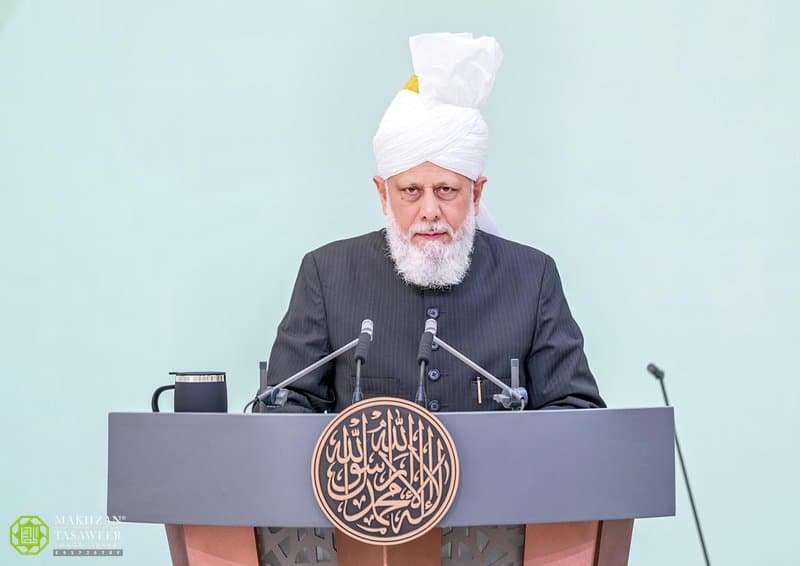
After reciting the tashahhud, ta‘awwuz and Surah al-Fatihah, Hazrat Khalifatul Masih V (aa) stated:
Prior to creating mankind, Allah the Almighty established countless blessings for their benefit. These bounties of Allah the Almighty and His favours upon His creation most certainly require mankind to be grateful to Him. Every Prophet has guided his people towards being grateful servants of Allah the Almighty. And the greatest example of this gratefulness was demonstrated by our Master, the Holy Prophet (sa). Through every action of his, he exhibited gratitude towards Allah the Almighty. Upon seeing him weep and cry and his fervent supplications before Allah the Almighty, when he was asked, ‘Why are you weeping so profusely?’ even though Allah the Almighty has already promised you every kind of success and is, in fact, already granting you this success? In response to this, the Holy Prophet (sa) said that should I not be a grateful servant of Allah the Almighty for these blessings. Should I not bow down before Him in humility and express my gratitude to Him? (Sahih al-Bukhari, Kitab-ul-Tafsir, Hadith 4837, Vol. 12, p. 83, Nazarat Ishaat)
On every occasion, whereas he demonstrated his practical example of being grateful, he also encouraged his followers to be grateful. He taught them the methods of expressing gratitude to Allah the Almighty and also taught them prayers for this. Today, I will discuss this very example of the Holy Prophet (sa), his prayers and his guidance in this regard.
In one narration, Hazrat Anas (ra) relates that the Holy Prophet (sa) said: “Faith consists of two halves; one half is patience, the other is gratitude.” (Al-Jami’ Li Shu’b Al-Iman, Hadith 9264, Maktabat-ul-Rushd, 2003, pp. 192-193)
In reality, patience also manifests an aspect of gratitude. As such, if one reflects upon this, complete faith can only be attained through gratitude.
Hazrat Suhaib (ra) relates that the Holy Prophet (sa) said: “How wonderful is the affair of a believer! Every matter concerning him is good and this is true only for a believer. If he finds delight in something, he is grateful and that is good for him. If hardship befalls him, he remains patient and that too is good for him.” (Sahih Muslim, Kitab az-zuhd Wa Al-Riqaiq, Hadith 5304, Vol. 15, Noor Foundation, p. 194)
This is good, because Allah the Exalted says: “[…] Surely, Allah is with the steadfast” (2:154). He further says: “[…] Give glad tidings to the patient” (2:156).
As such, for someone who has Allah the Almighty by his side and to whom He gives such glad tidings, what greater good could there be for him? Such true patience can only be attained when a person becomes a grateful servant of Allah the Almighty for all His blessings. Thus, even the most concise statements and words of the Holy Prophet (sa) contain treasures of wisdom.
Hazrat Abu Hurairah (ra) relates that the Holy Prophet (sa) said: “He who is not grateful to people, is not grateful to Allah either.” (Jami’ at-Tirmidhi, Abwab al-birri wa s-silah, Hadith 1954)
While being grateful to Allah the Almighty is essential, the Holy Prophet (sa) particularly mentioned being grateful towards people as well. Furthermore, if one develops such sentiments and feelings of gratitude, this will create a beautiful society and this is the true Islamic society that the Holy Prophet (sa) desired to establish.
In another narration, Hazrat Numan bin Bashir (ra) relates that the Holy Prophet (sa) stated from the pulpit: “Whoever is not grateful for little will not be grateful for much either, and whoever is not grateful to people is not grateful to Allah the Almighty either. Speaking of the favours of Allah the Almighty is also a form of gratitude, while not mentioning them is ingratitude.” He further said: “The Jamaat [community] is a mercy and division is a punishment.” (Musnad Al-Imam Ahmad bin Hanbal, Musnad an-Nu‘man bin Bashir, Hadith 18640, Vol. 6, Alam Al Kotob, 1998, p. 297)
That is, remain attached to the Jamaat, become grateful servants of Allah the Almighty and remain as one, as only then will you partake of the favours of Allah the Almighty. However, if you sow division and allow your hearts to become divided, you cannot become recipients of the favours of Allah the Almighty.
The Holy Prophet (sa) taught gratitude with remarkable depth. In this regard, Hazrat Anas (ra) relates that whenever the Holy Prophet (sa) met a particular individual, he would ask, “How are you?” If the person replied, “I am very well, and I praise Allah Almighty,” the Holy Prophet (sa) would pray, “May Allah Almighty continue to keep you well.”
On one occasion, the Holy Prophet (sa) met the same man and asked him the same question. This time he replied, “If I am grateful, then I am well.” The Holy Prophet (sa) remained silent.
The man then asked, “O Prophet (sa) of Allah, whenever you asked me before and I replied that I was well and praised Allah, you would pray for me, saying, ‘May Allah keep you well.’ But today you remained silent.”
The Holy Prophet (sa) replied, “When I asked you before, and you said, ‘I am very well, and I praise Allah Almighty,’ I prayed that Allah Almighty would continue to keep you well and increase His blessings upon you. But today you said, ‘If I am grateful,’ (as though he were in doubt and as though if he expressed gratitude for it, then he was doing just ok; otherwise, his condition wasn’t that great). Therefore, I remained silent.” (Musnad Al-Imam Ahmad bin Hanbal, Musnad Anas bin Malik, Hadith 13571, Vol. 4, Alam Al Kotob, p. 618)
The Holy Prophet (sa) explained that the man had fallen into doubt and had entertained a negative thought about Allah. He could not bear that even the slightest trace of ingratitude or a negative assumption regarding Allah Almighty should enter a person’s mind.
Hazrat Usamah bin Zaid (ra) relates that the Holy Prophet (sa) said:
“If someone does good to you and you say to them, JazakAllah, or JazakAllahu Khairan, i.e., may Allah reward you with the best of rewards, then you have fully expressed your appreciation.” (Jami’ at-Tirmidhi, Abwab al-birri wa s-silah, Hadith 2035)
Similarly, Hazrat Abu Hurairah (ra) relates that the Holy Prophet (sa) said:
“When Allah intends goodness and blessings for a people, He grants them long lives and inspires them to be grateful.” That is, He enables them to offer gratitude. (Kanzul Ummal, Kitab al-akhlaq, Vol. 2, Part 3, Hadith 6409, Dar Al-Kotob Al-Ilmiyah, p. 104)
Thus, gratitude is essential for the progress of a nation, for the progress of the Jamaat, and for the progress of every individual. Gratitude towards Allah Almighty, gratitude towards one another, and gratitude towards everyone from whom one receives any kind of benefit are all essential. It is this spirit of thankfulness that fosters unity and cohesion within a nation.
There is a narration of the Holy Prophet (sa) in which he also gave profound guidance to help people develop a true appreciation of gratitude. Hazrat Aisha (ra) relates:
“The Messenger (sa) of Allah would often say to me, ‘What about your poetry?’” Meaning, recite some verses. Hazrat Aisha (ra) knew many verses of poetry which she would recite. So she would ask, “Which ones? There are many which I know.”
The Holy Prophet (sa) would reply, “Recite the verses about gratitude.”
She would then recite:
“May my parents be sacrificed for you. A poet says:
“‘Support the one who is weak – the one whose weakness prevents him from ever repaying you. One day you will see the fruits of your kindness.’
“(Do not help others only because you expect something in return; rather, help those who cannot repay you, and you will witness the blessings that result from it. This is what a poet has said.)
“‘One day, that weak person will either repay your kindness or praise you, and whoever expresses gratitude for your favour has, in fact, repaid it.’”
He who expresses gratitude by saying alhamdulillah [All praise belongs to Allah] and thanks him has repaid the kindness shown to him.
She would further recite from these couplets:
“When you intend to maintain ties of kinship with a noble person, you will never find that bond to be weak or worn out.”
In other words, showing kindness to relatives is never like holding on to a fragile rope. Rather, it is a strong bond because Allah Almighty Himself rewards such acts.
Hazrat Aisha (ra) says, “When I finished reciting these verses, the Holy Prophet (sa) said:
“‘O Aisha, this is absolutely true. Gabriel has informed me that on the Day of Judgement Allah will raise mankind and ask one of His servants, “One of My servants did you a favour. Did you thank him?” The servant will reply, “My Lord, I knew that the favour ultimately came from You, so I thanked You.” (He did not thank the person; he thanked Allah instead). Allah will then say, “If you did not thank the person through whom I bestowed My favour upon you, then you have not truly thanked Me either.”’” (Kanzul Ummal, Kitab al-akhlaq, Vol. 2, Part 3, Hadith 8621, Dar Al-Kotob Al-Ilmiyah, p. 297)
What a beautiful principle this is for building a harmonious society.
The Holy Prophet (sa) also taught a prayer for cultivating gratitude. Hazrat Abdullah bin Ghannam al-Bayadi (ra) relates that the Messenger (sa) of Allah said:
“Whoever, upon waking in the morning, says: ‘O Allah, whatever blessing I have awakened with is from You alone. You are One and have no partner. To You belongs all praise, and to You belongs all gratitude,’ then such a person has fulfilled the gratitude due for that day. And whoever says the same in the evening has fulfilled the gratitude due for that night.” (Sunan Abu Dawud, Kitab al-adab, Hadith 5073)
Similarly, there is another narration in which Hazrat Mu’adh bin Jabal (ra) relates:
“The Messenger (sa) of Allah took my hand and said, ‘O Mu’adh, by Allah, I truly love you.’ Then he said, ‘O Mu’adh, I urge you never to omit saying after every prayer:
اَللّٰھُمَّ اَعِنِّیْ عَلٰی ذِکْرِکَ وَشُکْرِکَ وَحُسْنِ عِبَادَتِکَ
“‘O Allah, help me to remember You, to thank You, and to worship You in the best manner.’” (Sunan Abu Dawud, Kitab al-witr, Hadith 1522)
Another narration relates that Abu Ala ibn Shakheer reported from a man of the Banu Hanzalah, who said:
“I was travelling with Hazrat Shaddad bin Aus when he said, ‘Shall I not teach you what the Holy Prophet (sa) taught us? He taught us to pray:
“‘O Allah, I ask You for steadfastness in every matter. I ask You for firmness upon guidance. I ask You to enable me to be grateful for Your blessings and to worship You in the best manner. I ask You for a truthful tongue and a sound heart. I seek Your protection from the evil that You know, and I ask You for the good that You know. I seek Your forgiveness and also forgiveness from that which You know.’”
In other words, one seeks forgiveness from Allah and from all those in the world who can forgive and be of benefit to mankind. “Allah alone possesses knowledge of the unseen.” (Jami’ at-Tirmidhi, Abwab ad-da‘wat, Hadith 3407)
He alone knows what will truly benefit a person and what will not. Therefore, the prayer is that: “O Allah, bestow Your grace upon me in every matter, and place goodness for me in everything that You have created and that can be a means of benefit for me.”
Then on one occasion, the Holy Prophet (sa) taught a prayer. Hazrat Abu Sa‘id (ra) relates that a man stated, “O Messenger (sa) of Allah, which prayer is best for me to recite during my prayer?” The Holy Prophet (sa) replied, “Say:
اَللّٰھُمَّ لَکَ الْحَمْدُ کُلُّہٗ وَلَکَ الشُّکْرُ کُلُّہٗ وَلَکَ الْمُلْکُ کُلُّہٗ وَلَکَ الْخَلْقُ کُلُّہٗ وَاِلَیْکَ یَرْجِعُ الْاَمْرُ کُلُّہٗ نَسْئَلُکَ مِنَ الْخَیْرِ وَاَعُوْذُ بِکَ مِنَ الشَّرِّ کُلِّہٖ۔
“‘O Allah, all praise belongs to You, all gratitude belongs to You, all sovereignty belongs to You, all creation belongs to You, and every matter returns to You. We ask You for every kind of goodness and seek Your protection from every kind of evil.’” (Jam-ul-Jawami, Hadith 15222, Vol. 15, Dar Al-Kotob Al-Ilmiyah, 2016, pp. 571-572)
A narration also records one of the Holy Prophet’s (sa) own prayers. Hazrat Ibn Abbas (ra) narrates that the Holy Prophet (sa) would often pray, and this is the translation:
“O my Lord, help me and do not help anyone against me. Grant me aide and do not grant anyone aide against me. Plan for me and do not plan against me. Guide me and make guidance easy for me. Help me against whoever commits injustice against me. O Allah, make me one who is abundantly grateful, one who remembers You frequently, one who fears You, is completely obedient to You, one who bows to you abundantly. O my Lord, accept my repentance, wash away my sins, accept my supplication, strengthen my proof, guide my heart, keep my tongue straight [upon truth], and remove all malice from my heart.” (Sunan Abu Dawud, Kitab al-witr, Hadith 1510)
Now, the heart of the Holy Prophet (sa) was already completely pure and free from every impurity, and he was wholly inclined towards Allah the Almighty. Although he recited this prayer for himself, in reality he was teaching it to us, so that each of his followers should pray for a pure heart and seek the grace of Allah the Almighty.
Hazrat Abu Hurairah (ra) relates: “There is a prayer which I learnt from the Holy Prophet (sa), and I have never abandoned it.” The translation of the prayer is: “O Allah, make me one who thanks You abundantly, remembers You abundantly, follows Your guidance and keeps Your commandments constantly in mind.” (Jami’ at-Tirmidhi, Abwab-ul-Da’wat, Hadith 3604)
If someone recites this prayer every day, then improper thoughts will not arise, nor will they engage in wrongful actions. Instead, they will do only those things which Allah the Almighty has commanded.
Hazrat Abu Hurairah (ra) also narrates that the Messenger (sa) of Allah said that “Whoever sees a person afflicted with some trial and recites this supplication, he has truly expressed gratitude for the blessing bestowed upon him. The supplication is: ‘All praise belongs to Allah, Who has protected me from the trial with which He has tested you, and has granted me excellence over you and over all of His creation.” (Kitab-ul-Shukr, Ibn Abi Dunya, Maktabat al-Turath al-Islami, 1994, p. 55)
When one sees another person suffering from hardship, one should also pray in this manner and thank Allah the Almighty for protecting them from those hardships. Hazrat Aisha (ra) relates that whenever the Holy Prophet (sa) saw something that pleased him, he would say:
اَلْحَمْدلِلّٰہِ الَّذِیْ بِنِعْمَتِہِ تَتِمُّ الصَّالِحَاتُ۔
“All praise belongs to Allah, by Whose favour all righteous deeds are completed.”
Whenever he saw something that displeased him, he would say:
اَلْحَمْدُلِلّٰہِ عَلٰی کُلِّ حَالٍ
“All praise belongs to Allah in every circumstance.” (Sunan Ibn Majah, Kitab al-adab, Hadith 3803)
Hazrat Anas (ra) says, “We were travelling with the Holy Prophet (sa) and rain began to fall.” The narrator (Hazrat Anas [ra]) says that the Holy Prophet (sa) uncovered the cloth from his head until some of the rain fell directly upon him. “We asked, ‘O Messenger (sa) of Allah, why did you do this?’ He replied, ‘Because it has freshly come from our Exalted Lord.’” (Sahih Muslim, [Translation], Kitab Salati l-istisqa’, Hadith 1485, Vol. 4, Noor Foundation, pp. 54-55)
Thus, out of gratitude, he allowed those fresh raindrops to fall upon him.
Hazrat Abu Hurairah (ra) similarly relates that “Whenever the first drops of rain from a cloud began to fall, the Holy Prophet (sa) and his companions would uncover their heads, and the Holy Prophet (sa) would say, “This is a fresh blessing from our Mighty and Exalted Lord, and it is among His most blessed favours.” (Kanzul Ummal, Kitab al-azkar, Hadith 4936, Vol. 1, Part 2, Dar Al-Kotob Al-Ilmiyah, Beirut, p. 267)
There was no occasion on which the Holy Prophet (sa) failed to express gratitude to Allah the Almighty. Even during what appeared to be the smallest matter, he remained thankful. Thus, Hazrat Malik (ra) relates that whenever the Holy Prophet (sa) emerged from the washroom, he would recite:
اَلْحَمْدُلِلّٰہِ الَّذِیْ اَذْھَبَ عَنِّی الْاَذَی وَعَافَانِیْ
“All praise belongs to Allah Who has removed from me what was harmful and has granted me good health.” (Sunan Ibn Majah, Kitab at-taharah, Hadith 301)
Hazrat Zaid bin Khalid al-Juhani (ra) narrates that the Holy Prophet (sa) led them in the Fajr prayer at Hudaybiyyah after rain had fallen during the previous night. When he finished praying, he turned towards the people and asked, “Do you know what your Mighty and Exalted Lord has said?” The people replied, “Allah and His Messenger (sa) know best.” The Holy Prophet (sa) said, “Allah the Almighty has said: ‘Among My servants, some awoke this morning as believers in Me and others as disbelievers in Me. Whoever said, “We have received rain through the grace and mercy of Allah,” is a believer in Me and a disbeliever in the stars. But whoever said, “We have received rain because of the rising of such-and-such star,” is a disbeliever in Me and a believer in the stars.’” (Sahih al-Bukhari, Kitab al-adhan, Hadith 846, [Translation], Vol. 2, Nazarat Ishaat, pp. 247-248)
Meaning he doesn’t believe in Allah; rather, he still worships the stars.
Therefore, the true standard of gratitude is that every blessing should be attributed solely to God Almighty and gratitude be expressed to Him. At that time, some people had not received the proper tarbiyat and traces of their former customs and customary beliefs still remained. They would sometimes attribute rainfall to specific stars. The Holy Prophet (sa) therefore explained the true meaning of gratitude and morally trained them accordingly.
Another narration states that Ja‘far bin Muhammad narrates from his father that whenever the Holy Prophet (sa) looked into a mirror, he would say: “All praise belongs to Allah Who created me, fashioned me and made my character beautiful, and made beautiful in me those things which appear defective in others.” (Kitab-ul-Shukr, Ibn Abi Al-Duniya, Maktabat al-Turath al-Islami, 1994, p. 54)
Hazrat Abu Sa‘id (ra) relates that whenever the Holy Prophet (sa) ate or drank something, he would afterwards express his gratitude by saying:
اَلْحَمْدُلِلّٰہِ الَّذِیْ اَطْعَمَنَا وَسَقَانَا وَجَعَلَنَا مُسْلِمِیْنَ۔
“All praise belongs to Allah, Who has granted us food and water, and made us Muslims.” (Jami’ at-Tirmidhi, Abwab ad-da‘wat, Hadith 3457)
Hazrat Abu Umamah (ra) narrates that it was the practice of the Holy Prophet (sa) that whenever he finished eating – and on one occasion Hazrat Abu Umamah (ra) said that when he would lift up the dining cloth, after finishing a meal – he would say:
اَلْحَمْدُ لِلّٰہِ الَّذِیْ کَفَانَا وَاَرْوَانَا غَیْرَ مَخْفِیٍّ وَلَا مَکْفُوْرٍ۔
“All praise belongs to Allah, Who has sufficed us and satiated our hunger and thirst. This is not a gratitude that ends here, nor one that is abandoned.”
At other times, he would say: “All praise belongs to Allah. O our Lord, this is not a gratitude that ends with this meal, nor one that is abandoned afterwards, nor one of which there will ever be no further need, O our Lord.” (Sahih al-Bukhari, Kitab al-at‘imah, Hadith 5459, [Translation], Vol. 13, Nazarat Ishaat, pp. 401-402)
There is yet another narration in which the Holy Prophet (sa) enjoined gratefulness. Hazrat Sahl bin Mu‘adh bin Anas relates from his father that the Holy Prophet (sa) said that whoever eats food and then prays:
اَلْحَمْدُ لِلّٰہِ الَّذِیْ اَطْعَمَنِیْ ھَذَا الطَّعَامَ وَ رَزَقَنِیْہِ مِنْ غَیْرِ حَوْلٍ مِّنِّیْ وَلَا قُوَّةٍ
“All praise belongs to Allah, Who fed me this food and provided it to me without any power or strength on my part,” then his past and future sins are forgiven.
The Holy Prophet (sa) also said that whoever wears a garment and prays, “All praise belongs to Allah, Who clothed me with this garment and provided it to me without any power or strength on my part,” then his past and future sins are forgiven. (Sunan Abu Dawud, Kitab al-libas, Hadith 4023)
Hazrat Abu Hurairah (ra) relates that when people would see the first fruit of the season, they would bring it to the Holy Prophet (sa). When the Holy Prophet (sa) received it, he would pray:
“O Allah, bless our fruits for us; bless our city for us; bless our sa‘ for us (that is a unit of measure) and bless our mudd for us (another unit of measure). O Allah, surely Abraham was Your servant, Your friend and Your Prophet; and I am Your servant and Your Prophet. He prayed to You for Mecca, and I pray to You for Medina, in the same way that he prayed for Mecca and other prayers the like thereof.”
The narrator says that the Holy Prophet (sa) would then call the youngest child present and give that fruit to him. (Sahih Muslim, [Translation], Kitab al-hajj, Hadith 2423, Vol. 26, p. 338)
In other words, whenever new fruit arrived, he would give it first to children.
Hazrat Hudhaifah (ra) relates that when the Holy Prophet (sa) would lie down upon his bed at night, he would place his hand beneath his cheek and pray:
اَللّٰھُمَّ بِاسْمِکَ اَمُوْتُ وَاَحْیَا
“O Allah, in Your name I die and live.”
When he awoke, he would pray:
اَلْحَمْدُ لِلّٰہِ الَّذِیْ اَحْیَانَا بَعْدَ مَا اَمَاتَنَا وَاِلَیْہِ النُّشُوْرُ۔
“All praise belongs to Allah, Who gave us life after having caused us to die, and to Him shall we return.” (Sahih al-Bukhari, Kitab ad-da‘wat, Hadith 6314, Vol. 15, Naizarat Isha’at, p. 27)
In another narration, the prayer upon waking is recorded as such: when the Holy Prophet (sa) would wake from the night, he would say, “All praise belongs to Allah, Who gave me life after having caused me to die, and to Him shall we return.” (Musnad Al-Imam Ahmad bin Hanbal Musnad Hudhaifah bin Al-Yaman, Hadith 23675, Vol. 7, Alam Al Kotob 1998, Vol. 7, p. 705)
Amr bin Shu‘aib relates from his father, who relates from his grandfather, that the Holy Prophet (sa) said, “Allah loves to see His servants exhibit the signs of His blessings upon them.” (Jami’ at-Tirmidhi, Abwab al-adab, Hadith 2819)
Another form of gratitude to Allah the Almighty is for the blessings which He has bestowed upon a person to be visible and reflected in their appearance.
Similarly, it is narrated that Abu al-Ahwas relates from his father: “I came into the presence of the Holy Prophet (sa) wearing poor and tattered clothes.” (He wasn’t wearing good clothes, but tattered ones). The Holy Prophet (sa) asked him, “Do you possess any wealth?” He submitted, “Yes.” The Holy Prophet (sa) asked, “What kind of wealth do you possess?” In other words, if you are a person of means, what sort of wealth do you have? He replied, “Allah the Almighty has given me camels, sheep and goats, horses, and slaves.” In other words, he possessed considerable wealth. The Holy Prophet (sa) said, “When Allah the Almighty has granted you wealth, then the signs of His blessing and honour should be visible upon you.” (Sunan Abi Dawud, Kitab al-libas, Hadith 4063)
One should show gratitude, and an expression of that gratitude is not to appear in filthy or tattered clothing when one has the means to dress properly. Rather, one should wear decent clothing and express the blessings of Allah the Almighty.
Hazrat Jabir bin Abdullah (ra) relates: “We came into the presence of the Holy Prophet (sa). He saw a man whose hair was dishevelled (that is, his hair was scattered, unkempt and had not been combed). The Holy Prophet (sa) said, ‘Could he not find something with which to tidy his hair?’” In other words, he drew the attention of the companions to the fact that the man should wash, neaten, and comb his hair. The Holy Prophet (sa) then saw another man wearing dirty clothes and said, “Could he not find water with which to wash his clothes?” (Sunan Abi Dawud, Kitab al-libas, Hadith 4062)
Meaning, instead of wearing dirty clothes, one should wash them. Water is available, and one should show gratitude to Allah the Almighty. Cleanliness and neatness reflect purity and refinement, but they also contain within them an aspect of gratitude to Allah the Almighty. A person should not present themselves in such a state that others wonder what kind of condition they have adopted.
In another narration, Hazrat Abdullah bin Mas‘ud (ra) relates that the Holy Prophet (sa) said, “A person who has even an atom’s weight of arrogance in his heart will not enter Paradise.” A man asked, “But a person likes that his clothes should be good and that his shoes should be good.” The Holy Prophet (sa) replied, “Allah is Beautiful and loves beauty.” That is, Allah the Almighty Himself is Beautiful, and He loves beauty; there is no doubt in this. Arrogance is something else altogether: it is to reject the truth out of a sense of self-importance and to look down upon people. (Sahih Muslim, [Translation], Kitab al-iman, Hadith 123, Vol. 1, Noor Foundation, p. 83)
To deny what is true and to treat others with contempt denotes arrogance. If a person wears fine clothes and then becomes arrogant because of them, that is indeed arrogance. But if someone wears good clothing and still meets others with humility and fulfils their rights, then this is not arrogance.
Hazrat Abu Sa‘id Khudri (ra) relates that whenever the Holy Prophet (sa) acquired a new garment, he would mention the garment by name – whether it was a shirt, a turban, or some other article of clothing – and would pray:
“O Allah, all praise belongs to You. It is You Who has clothed me with this. I ask You for its good and the good for which it was made, and I seek refuge with You from its evil and from the evil for which it was made.” (Sunan Abi Dawud, Kitab al-libas, Hadith 4020)
Hazrat Aisha (ra) relates that the Holy Prophet (sa) said: “When Allah grants a servant any blessing, and that servant recognises that it is from Allah, then gratitude for that blessing is recorded in his favour. And when Allah sees that a servant feels remorse over a sin, He forgives him even before he seeks forgiveness. A person buys a garment for a dinar, wears it, and praises Allah; before that garment even reaches his knees, he is forgiven.” (Kitab-ul-Shukr, Ibn Abi Al-Duniya, Maktabat al-Turath al-Islami, 1994, p. 20)
This is how Allah treats those who show gratitude.
Salim relates from Hazrat Abdullah bin Umar (ra) that when the Holy Prophet (sa) returned from a military expedition and reached a valley or elevated ground, he would say “Allah is the Greatest” three times. Thereafter, he would pray:
لَا اِلٰہَ اِلَّا اللّٰہُ وَحْدَہٗ لَا شَرِیْکَ لَہٗ، لَہُ الْمُلْکُ وَلَہُ الْحَمْدُ وَھُوَ عَلٰی کُلِّ شَیْءٍ قَدِیْرٌ۔ اٰئِبُوْنَ تَائِبُوْن عَابِدُوْنَ سَاجِدُوْنَ لِرَبِّنَاحَامِدُوْنَ صَدَقَ اللّٰہُ وَعْدَہٗ وَنَصَرَ عَبْدَہٗ وَھَزَمَ الْاَحْزَابَ وَحْدَہٗ۔
“There is none worthy of worship except Allah; He has no partner. To Him belongs all sovereignty, and to Him belongs all praise, and He has power over all things. We are returning from our journey, confessing our shortcomings and resolving that we will not repeat our mistakes. We worship our Lord alone, bow before our Lord alone, and praise our Lord alone. Allah has surely fulfilled His promise, helped His servant, and Himself destroyed all the confederate forces.” (Sahih al-Bukhari, Kitab al-jihadi wa s-sair, Hadith 2995, Vol. 5, Nazarat Ishaat, pp. 341-342)
On the day of the Battle of Badr, the slain among the disbelievers were cast into the pits and wells of the battlefield. The Holy Prophet (sa) then said:
“All praise belongs to Allah, Who has humiliated and destroyed Abu Jahl, and has delivered us from him.”
When all the slain had been placed in the well, the Holy Prophet (sa) walked around it. As the bodies lay within the pit, Hazrat Abu Bakr (ra) identified each individual to the Holy Prophet (sa) by name. The Holy Prophet (sa), while glorifying and thanking Allah the Almighty, repeatedly declared:
“All praise belongs to Allah, Who has fulfilled the promise He made to me.” (Kitab-ul-Maghazi, Waqidi, Vol. 1, Dar-ul-A’alami, Beirut, 1989, pp. 111-112)
Such was the response of the Holy Prophet (sa) upon witnessing the fate of his fiercest opponent. He displayed no outward jubilation or triumph at their destruction. Rather, he bowed in humility before Allah the Almighty, offering praise and gratitude to Him alone.
There are further narrations concerning this incident. In one narration, Hazrat Abdullah bin Mas‘ud (ra) relates:
“On the day of the Battle of Badr, I presented myself before the Holy Prophet (sa) and submitted, ‘I have killed Abu Jahl.’
“The Holy Prophet (sa) asked, ‘Do you swear by Allah, besides Whom there is no god?’
“I replied, ‘Yes, by Allah, besides Whom there is no god, I have indeed killed him.’
“The Holy Prophet (sa) repeated this question three times, seeking confirmation from me. Thereupon, he proclaimed:
“‘Allah is the Greatest. All praise belongs to Allah, Who has fulfilled His promise, granted help to His servant, and He Himself defeated all the enemies.’
“He then said, ‘Come, show me his body.’ Thus, we set out together. When the Holy Prophet (sa) saw the body, he remarked:
“‘This is the Pharaoh of this Ummah.’”
In another narration, it is related that when the Holy Prophet (sa) was given the glad tidings that Abu Jahl had been slain, he offered two rak‘ahs of prayer in gratitude to Allah.
Further details in relation to this have been mentioned in a narration. Abu Ishaq relates:
“When, on the day of Badr, a man came to the Holy Prophet (sa) bearing the glad tidings of Abu Jahl’s death, the Holy Prophet (sa) asked him three times, asking him to swear by Allah, besides Whom there is no god:
“‘Do you testify that you have indeed seen him slain?’
“The man affirmed this under oath before the Holy Prophet (sa). Thereupon, the Holy Prophet (sa) fell into prostration before Allah.”
Some narrations further state that the Holy Prophet (sa) performed more than one prostration on that occasion. (Dalail al-Nubuwwa, Imam al-Bayhaqi, Vol. 3, Dar Al-Kotob Al-Ilmiyah, Beirut, 2002, p. 89; Tarikh-ul-Khamis, Vol. 2, Dar Al-Kotob Al-Ilmiyah, 2009, p. 119; Musnad, Al-Imam Ahmad bin Hanbal Musnad Abdullah bin Masud, Hadith 4247, Vol. 2, Alam Al Kotob, 1998, p. 166; Sunan Ibn Majah, Kitab Iqamati s-salat, Hadith 1391)
Narrations concerning the Holy Prophet’s (sa) gratitude at the time of the Conquest of Mecca are also found in the narrations. In this regard, Hazrat Abdullah bin Umar (ra) relates that on the day of the Conquest of Mecca, the Holy Prophet(sa) stood upon the steps of the Ka‘bah. He first praised and glorified Allah the Almighty and then proclaimed:
اَلْحَمْدُ لِلّٰہِ الَّذِیْ صَدَقَ وَعْدَہٗ وَنَصَرَ عَبْدَہٗ وَ ھَزَمَ الْاَحْزَابَ وَحْدَہٗ۔
“All praise belongs to Allah, Who has fulfilled His promise, granted victory to His servant, and Himself defeated all the enemy forces.” (Sunan an-Nasa‘i, Kitab al-qisamah, Hadith 4803)
Another narration recorded in Sahih al-Bukhari relates that Hazrat Abdur Rahman bin Abi Layla (ra) said:
“No one informed us that they had seen the Holy Prophet (sa) offer the chasht [forenoon] prayer except Hazrat Umm Hani (ra).”
Indeed, among the narrations regarding the chasht prayer, the only narration is that of Hazrat Umm Hani (ra). She relates:
“On the day of the Conquest of Mecca, the Holy Prophet (sa) came to my house, where he performed ablution and then offered eight rak‘ahs of prayer. I have never seen him offer a prayer lighter than that; (it was relatively brief, but comprised eight rak‘ahs) yet he performed the bowing [ruku‘] and the prostration [sajdah] with complete composure.” (Sahih al-Bukhari, Kitab at-tahajjud, Hadith 1176)
It was not the case that he quickly went through the motions of prayer. Yet, even what was described as a “light” prayer of the Holy Prophet (sa) would compare in length and devotion to what many people would regard as a lengthy prayer.
One biographer of the Holy Prophet (sa) has recorded this incident under the following subheading:
“The Holy Prophet (sa) offered eight rak‘ahs in order to express his gratitude for the blessings bestowed upon him by Allah on that day.” (Dalail al-Nubuwwa, Imam al-Bayhaqi, Vol. 5, Dar Al-Kotob Al-Ilmiyah, p. 80)
Hazrat Abu Hurairah (ra) relates that when the Holy Prophet (sa) entered Makkah, people gathered to see him. Owing to his profound humility and overwhelming gratitude to Allah, his head was bowed so low that it touched the saddle of his mount. Surrounded by the people, he supplicated:
اَللّٰھُمَّ اِنَّ الْعَیْشَ عَیْشُ الْاٰخِرَةِ۔
“O Allah, surely the true life is the life of the Hereafter.” (Subul Al-Huda, Vol. 5, Dar Al-Kotob Al-Ilmiyah, p. 226)
The Promised Messiah (as) states:
“The exaltation that is granted to the special servants of God Almighty is characterised by humility, whereas the exaltation of Satan is accompanied by arrogance; that is, it contains pride within it. Observe how our Noble Prophet, peace and blessings of Allah be upon him, lowered his head and prostrated himself upon the conquest of Makkah in the very same manner as he used to bow and prostrate during the days of hardship and tribulation, when in that same Makkah he was opposed in every possible way and subjected to persecution. When he reflected upon the condition in which he had departed from that city and the condition in which he had now returned, his heart became filled with gratitude to Allah, and he fell into prostration.” (Malfuzat [2022], Vol. 3, footnote, p. 260)
A supplication of the Holy Prophet (sa) expressing this same spirit of gratitude is also recorded in Sahih Muslim. During the Farewell Pilgrimage, when the Holy Prophet (sa) intended to perform the Sa‘i between Safa and Marwah, he began at Safa. He ascended the hill until the Ka‘bah came into view. Facing the Qiblah, he proclaimed the Unity of Allah and expressed His greatness, saying:
“There is none worthy of worship except Allah. He is One and has no partner. To Him belongs all sovereignty, and to Him belongs all praise. He has power over all things. There is none worthy of worship except Allah alone. He has fulfilled His promise, granted help to His servant, and Himself subdued the enemy forces.”
He repeated this three times whilst in the middle [of the two hills] (Sahih Muslim, [Translation], Kitab al-hajj, Hadith 2123, Vol. 6, Noor Foundation, p. 118)
A further narration relates to when Hazrat Ali (ra) sent a message informing about the acceptance of Islam by the tribe of Hamdan in Yemen.
Hazrat Al-Bara‘ bin ’Azib (ra) relates that in the tenth year after Hijrah, the Holy Prophet (sa) sent Hazrat Ali (ra) to Yemen. Thereupon, the entire tribe of Hamdan embraced Islam. Hazrat Ali (ra) conveyed the glad tidings of their acceptance of Islam to the Holy Prophet (sa) by means of a letter.
When the Holy Prophet (sa) read the letter, he immediately fell into prostration before Allah in gratitude and declared:
“Peace be upon Hamdan! Peace be upon Hamdan!”
He repeated these words twice. (Sharah Al-Zurqani, Vol. 4, Dar Al-Kotob Al-Ilmiyah, Beirut, p. 140; Subul Al-Huda Wa Al-Rishad, Vol. 8, Dar Al-Kotob Al-Ilmiyah, Beirut, p. 205)
Further details regarding the Holy Prophet’s (sa) Sajdat-e-Shukr [prostrations out of gratitude] are recorded as follows.
“Hazrat Abu Bakrah (ra) relates that whenever something came before the Holy Prophet (sa) which pleased him or became a cause of joy for him, he would fall into prostration, expressing gratitude to Allah, Blessed is He and the Exalted.” (Sunan Ibn Majah, Kitab Iqamati s-salat, Hadith 1394)
Similarly, it is related by Hazrat Anas bin Malik (ra) that glad tidings concerning a certain matter were conveyed to the Holy Prophet (sa), whereupon he fell into prostration out of gratitude. (Sunan Ibn Majah, Kitab Iqamati s-salat, Hadith 1392)
The glad tidings which Allah the Almighty gave to the believers regarding invoking blessings upon the Holy Prophet (sa), and the manner in which the Holy Prophet (sa) expressed his gratitude for this, are mentioned in one narration as follows. Hazrat Abdur Rahman bin Auf (ra) relates:
“The Messenger (sa) of Allah came out and proceeded towards the place where he would give charity. He then went inside, turned towards the Qiblah, and fell into prostration. He prolonged the prostration so much that I thought Allah the Almighty and most Honourable had caused his soul to depart while he was in that state. I therefore approached him and sat near him. He raised his head and asked, ‘Who is this?’ I replied, ‘Abdur Rahman.’ He asked, ‘What is the matter?’ I submitted, ‘O Messenger (sa) of Allah, you prolonged your prostration to such an extent that I feared Allah the Almighty and most Honourable had caused your soul to depart in that very state,’ meaning that I feared you had passed away. The Holy Prophet (sa) then said, ‘Gabriel came to me and gave me the glad tidings that Allah the Almighty says: “Whoever invokes blessings upon you, I shall bestow My mercy upon him, and whoever sends salutations upon you, I shall send My salutations upon him.” Therefore, I prostrated before Allah the Almighty and most Honourable in gratitude.’” (Musnad Al-Imam Ahmad bin Hanbal Musnad Abdul Rahman bin Auf, Vol. 1, Hadith 1664, Alam Al-Kotob, 1998, pp. 512-513)
Thus, this prostration was one of gratitude, and it was for this reason that it became so prolonged.
Hazrat Abu Bakrah (ra) relates that he saw the Messenger (sa) of Allah when someone came to convey to him the glad tidings that his army had been granted victory over the enemy. At that time, the Holy Prophet’s (sa) head was resting in the lap of Hazrat Aishah (ra). Upon hearing the news, the Holy Prophet (sa) stood up and fell into prostration. (Subul Al-Huda Wa Al-Rishad, Vol. 8, Dar Al-Kotob Al-Ilmiyah, Beirut, p. 205)
In another narration, Amr bin Shu‘aib relates from his father, who relates from his grandfather, that he heard the Messenger (sa) of Allah say:
“There are two qualities which, if found in a person, Allah the Almighty records him among the patient and the grateful. If these two qualities are absent, Allah records him as neither patient nor grateful. The first is that, in matters of faith, a person should look towards one who is superior to him and strive to follow his example. In other words, one should look at those who are better than him in matters of faith and seek to emulate their example. Such a person will be deemed patient and grateful. The second is that, in worldly matters, he should look towards one who is below him and then praise Allah for the favour by which Allah has granted him superiority over that person. Allah the Almighty records such a person among the patient and the grateful. However, whoever looks towards one who is below him in matters of faith and towards one who is above him in worldly affairs and then grieves over what has not been granted to him, Allah the Almighty records him as neither patient nor grateful.” (Kitab-ul-Shukr, Ibn Abi Al-Duniya, Maktabat al-Turath al-Islami, 1994, p. 60)
Likewise, Hazrat Abu Hurairah (ra) relates that the Messenger (sa) of Allah said:
“Look towards those who are below you, and do not look towards those who are above you. This is more likely to prevent you from belittling the favours of Allah.” (Sahih Muslim, [Translation], Kitab az-zuhdi wa r-raqaiq, Hadith 5250, Vol. 15, Noor Foundation, p. 159)
That is, in worldly matters one should look towards those who possess less, and then express gratitude to Allah that He has bestowed His favours upon him.
Hazrat Ibn Abbas (ra) relates that the Messenger (sa) of Allah said:
“There are four things which, if a person is granted them, he has indeed been granted the good of this world and the Hereafter: a grateful heart; a tongue engaged in the remembrance of Allah; a body that remains steadfast in patience at the time of trial; and a wife who is faithful to him, neither betraying her own honour and chastity nor betraying her husband.”
If these four qualities are granted, then true goodness has indeed been bestowed. (Kitab-ul-Shukr, Ibn Abi Al-Duniya, Maktabat al-Turath al-Islami, 1994, p. 17)
Hazrat Abu Hurairah (ra) relates that the Messenger (sa) of Allah said:
“O Abu Hurairah, adopt righteousness, and you will become the most devoted of people in worship. Be content with what Allah has granted you, and you will become the most grateful of people.”
Thus, contentment also leads one towards gratitude.
He further said:
“Love for others what you love for yourself, and you will become a true believer. Treat your neighbour with kindness, and you will become a true Muslim. Laugh little, for excessive laughter makes the heart spiritually dead.” (Sunan Ibn Majah, Kitab az-zuhd, Hadith 4217)
That is, a person ought to remain more inclined towards humbling oneself before Allah the Exalted and should constantly remain attentive towards supplication. One should not remain continually occupied in idle amusement and laughter.
May Allah the Almighty enable us to act upon the sayings of the Holy Prophet (sa).
Depicting the constant gratitude and remembrance of Allah that characterised the life of the Holy Prophet (sa), Hazrat Aisha (ra) relates that the Holy Prophet (sa) would remember Allah at all times. (Sahih Muslim [Translation], Kitab al-haiz, Hadith 550, Vol. 2, Noor Foundation, p. 126)
Thus, the Holy Prophet (sa) established the highest standards of conduct before his Ummah and counselled us accordingly. May Allah the Almighty grant us the ability to act upon this.
The second matter, which I shall mention briefly, is that, insha-Allah, the Jalsa Salana of the Ahmadiyya Muslim Community UK will commence next Friday. Pray that Allah the Almighty makes it blessed in every respect. May He keep everyone under His protection and safeguard them. The intensity of the current weather, owing to the heat, also brings certain risks. May Allah the Almighty protect everyone from every kind of harmful effect. Likewise, may He enable the workers who are serving on duty – some of whom must remain standing in the heat and undertake demanding responsibilities – to discharge their duties in the best possible manner.
(Official Urdu transcript published in the Daily Al Fazl International, 8 August 2026, pp. 1-8. Translated by The Review of Religions.)