
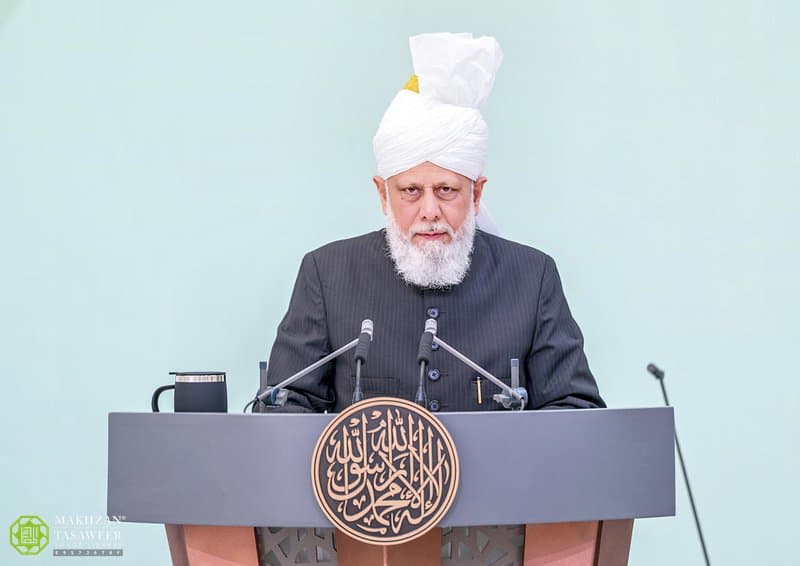
After reciting the tashahhud, ta’awwuz and Surah al-Fatihah, Hazrat Khalifatul Masih V (aa) said:
While mentioning the grace of Allah the Almighty and His benevolence towards the Promised Messiah (as) and also his reliance upon Allah the Almighty from an early age, the Promised Messiah (as) states:
“Some thirty years ago, my respected father – may God bless him with His mercy – fell ill near the end of his life. On the day he was destined to breathe his last, I received the revelation at noon:
“‘By the heavens and the Morning Star’”.
Elaborating further on this, the Promised Messiah (as) states: “[…] Simultaneous with it, I was made to think that it indicated his demise and its meanings are: ‘I swear by the heavens, and I swear by the tragic incident which shall befall after sunset.’
“It was a message of condolence from God Almighty to His humble servant. I understood thereby that my father would die after sunset.
“Many people were informed of this revelation. I swear by Allah the Almighty – in whose hands my life rests and to lie against whom is an act of Satan and of an accursed one – that it happened accordingly.
“On that day, my father’s real illness, which was renal colic, had been cured. Only slight dysentery remained, and he could go to the toilet on his own strength, without any assistance. When the sun set, on return from the lavatory, as soon as he sat down on the bedstead, death’s rattle started (i.e., the sound which emanates when one is about to pass away, and his breathing became irregular). In the same condition of death rattle, he said to me, ‘See what this is.’ Then he lay down. Before this, I had never had the occasion to see anyone speak during the death rattle and talk clearly and firmly in the state of a death rattle. After this, exactly as the sun set, he passed away from this transitory world […] This was the very first of all the revelations and was the first prophecy that God disclosed to me.
“God informed me at noon that this was going to happen and it came to pass after sunset. It is an honour for me, and I will not forget that God Almighty condoled with me at the time of my father’s demise and swore by the death of my father the way He swore by the heavens.
“Those who have a satanic spirit rampant within them would wonder how it could be that God Almighty confers such honour on someone that by declaring his father’s death to be a great shock, He should swear by it. But, once again, I swear by the God of Honour and Glory that this incident is true and that it was God, indeed, who informed me about it by way of condolence and said:
“[‘By the heaven and the Morning Star.’]
“And it came to pass accordingly […]”
The Promised Messiah (as) further states: “[…] when I was apprised of the news that my father would pass away after sunset, I, being human, was distressed upon hearing this news. Moreover, most of the means of our livelihood were contingent upon his life. He received a pension from the British Government as well as a large sum of gratuity, which was contingent upon him being alive. (He received some entitlements from the Government as long as he lived.) Therefore, the thought crossed my mind as to what would happen after his demise. The anxiety surfaced in my heart that perhaps we would face days of deprivation and hardship. All this concern flashed across my mind in a fraction of a second, quite like lightning. At that very moment, I felt drowsy and received the second revelation:
اَلَیْسَ اللّٰہُ بِکَافٍ عَبْدَہٗ
“‘Is God not sufficient for His servant?’
“My heart was strengthened by this revelation from Allah as a gravely painful wound is instantly healed with a balm. The fact is that it has been verified repeatedly that divine revelation has an intrinsic quality to grant comfort. At the root of this quality lies the certainty which one acquires regarding God’s revelation.”
He had full conviction that this was a revelation from Allah, in which He stated that God would be sufficient for him; is God not enough? After this, he became fully convinced and did not require anything else, nor did he need to worry about anyone. All his trust and reliance would be upon God Almighty.
The Promised Messiah (as) then states: “In short, I immediately understood that God would not let me be wasted when I received the revelation:
اَلَیْسَ اللّٰہُ بِکَافٍ عَبْدَہٗ
“‘Is God not sufficient for His servant?’
“After this, I wrote down the revelation and handed it to Malawamal, who is a Hindu, a Khatri by caste, a resident of Qadian, and is still alive. I related the entire incident to him and despatched him to Amritsar so that, through the good offices of Hakim Maulawi Muhammad Sharif of Kalanaur, he may get it engraved in a stone and get a stamp made.
“I selected this Hindu gentleman for this task with the sole intention of making him a witness to this grand prophecy, and so that Maulawi Muhammad Sharif should become a witness too. As a result, through the agency of the respected Maulawi, the signet ring was prepared at the cost of five rupees and delivered to me. It is still with me. (And by Allah’s grace this exists to this very day.)
“I received this revelation at a time when our means of livelihood and comfort were wholly dependent upon my father’s meagre income. Not even a single person from the outside knew me, for I was an unknown individual lying in obscurity in a desolate village like Qadian. After this, God, in keeping with His prophecy, turned a world towards me and helped me financially with such successive victories for which I do not have the words to express my gratitude. Considering my dire condition, I did not expect that even ten rupees a month would come. But God Almighty, who raises the poor from dust and reduces the arrogant to dust, helped me so much so that I can say with confidence that, until now, about 300,000 rupees, or perhaps even more, have already come. This income may be estimated from the fact that the monthly expenditure for the Langar Khanah [public kitchen] alone has been running at 1,500 rupees on average for so many years, and other categories of expenses like the school, etc., and the printing of books are besides it. Hence it is worth noting, indeed, with what clarity, might, and glory this prophecy [اَلَیْسَ اللّٰہُ بِکَافٍ عَبْدَہٗ] has been fulfilled.” (Haqiqatul Wahi, Ruhani Khazain, Vol. 22, pp. 218-221)
Even non-Ahmadis acknowledged his trust in Allah the Almighty and his steadfastness upon the truth. Thus, Malik Salahuddin Sahib relates that in one gathering, a man started opposing the Promised Messiah (as). Maulvi Fazl Din Sahib, who was a non-Ahmadi lawyer and had served as the lawyer of the Promised Messiah (as) in the case of attempted murder, said with great fervour: “I attest to the extraordinary character and moral excellence of Mirza Sahib! I have seen many a righteous men change their statements based on legal advice. However, I have found only Mirza Sahib to remain firmly rooted in the truth. In the Martyn Clark case, I suggested a legal statement and said that the statement of the defendant is not given under oath. After reading the statement, Mirza Sahib said, ‘This contains lies, and Allah the Almighty has not permitted the defendant to lie.’ I said that you are deliberately putting yourself into trouble. Upon this, Mirza Sahib replied, ‘Deliberately putting oneself into trouble would mean that I should give a legal statement in order to gain an unlawful advantage and thus anger my God. I cannot do this, whatever may happen.’”
The lawyer, who was not an Ahmadi, further says: “At that moment, there was a particular majesty and zeal visible upon the countenance of Mirza Sahib. The Promised Messiah (as) said [to the lawyer], ‘Not even for a moment have I ever thought that I would succeed by your legal advice. I rely solely upon God, Who can see into my heart. (i.e. I place my trust in Him alone and He knows all things).’ He further said, ‘My statement will be more effective than your legal statement. Bear this in mind! Since I have placed my trust in Allah, whatever statement I make will be more impactful than any legal statement of yours. Even if, hypothetically, the outcome is not favourable in the eyes of the world (that is, even if I am sentenced), I will be happy because I did not disobey my Lord.’ It is the astonishing power of God that Mirza Sahib was acquitted on the basis of his own statement.” This lawyer says: “I believe him to be a perfectly truthful man, and in my heart, I have the utmost respect for him.” (Ashab-e-Ahmad, Vol. 7, pp. 116-117)
Thus, he made it absolutely clear that legal advocacy is merely a worldly means. It should be utilised, but his reliance was solely upon his God. Therefore, he could not disobey any commandment of Allah the Almighty. He stated with certainty that the decision would be in his favour and even a non-Ahmadi could not help but be deeply impressed by this.
Hazrat Mufti Muhammad Sadiq Sahib (ra) writes that the Promised Messiah (as) once said: “According to people nowadays, to be civilised means that a person should become a worm of the world, forget God and engage themselves in worshipping material means. However, in the sight of Allah the Almighty, to be civil means that one should gain complete trust in Allah the Almighty; His greatness and awe should be firmly established in the heart and that the heart becomes purified.” (Zikr-e-Habib, p. 105)
He then presents an example of this trust in Allah and true purity and how the Promised Messiah (as) acted in accordance with this. When he used to take the pledge of initiation from the general public, he would give the following advice to those taking the pledge; in fact, he would frequently say to Ahmadis – “By entering this Jamaat, one should bring about a change in the way one led their life previously. Bring about a transformation within yourselves so that your faith in God is true and that He may come to your aid in every difficulty. Furthermore, do not look upon His commandments with disdain. Do not regard the commandments of Allah the Almighty as insignificant. Rather, every single commandment should be held in high regard and this respect should be manifested through your conduct. What does it mean to manifest through your conduct? It means to act upon the commandments of Allah Almighty. To bow completely before worldly means, to submit oneself entirely to them, to place one’s trust in them and to not place one’s trust in God is shirk [associating partners with God] and akin to denying the existence of God.” He would give this advice to every person pledging initiation. He said: “One should make use of worldly means only to such an extent that it does not lead to shirk. Our belief is that we do not prohibit making use of worldly means. However, we prohibit placing one’s entire trust in them. One’s hand should be engaged in work, while the heart should be engaged in the remembrance of God. This is how it should be.” (Zikr-e-Habib, p. 354)
Moreover, the Promised Messiah (as) states:
“You are not prohibited from having recourse to the necessary means and appropriate remedies, but you are forbidden to rely upon them. Ultimately, the will of God shall prevail. Complete trust in God, if one can adopt it, is greater than everything else.” (Kashti-e-Nuh, Ruhani Khazain, Vol. 19, p. 13)
He then said, “Allah the Almighty has placed particular healing properties in medicines (He has placed properties in medicines for the treatment of illnesses), and it is mentioned in the Hadith that medicines have effects and that they are used to treat illnesses. However, to rely upon these means and to think that salvation and success will be achieved through them alone is a grave form of shirk and disbelief. One should never place one’s reliance upon the means alone. Rather, one should have recourse to the necessary means and then place one’s trust in God, praying that if He so wills, He may make those means beneficial. One should continue to pray to Him, because bringing about results through the means is His work. This is what true trust in God means.” (Malfuzat, 2022, Vol. 4, p. 340)
In one gathering, there was a discussion regarding illnesses. In this respect, he said, “My belief regarding the healing of illnesses through prayer is such that I am unable to express what is in my heart.” (I cannot explain the thoughts that are in my heart.)
He continued, “A physician reaches a certain point and then stops (a doctor, who is treating a patient, goes only up to a certain stage and then stops) and becomes despondent. (Even today, people often write to me saying that they have lost hope because the doctor has given up.) But beyond that point, God opens a way through prayer. This is what knowing God and placing one’s trust in Him means – that one goes beyond the limits that people have set and develops hope beyond those limits. Otherwise, in such cases, a person dies while still alive, as it were. It is precisely at this point that the recognition of God begins.” (Malfuzat, 2022, Vol. 7, pp. 160-161)
These words of the Promised Messiah (as) regarding this gathering were published in Al Hakam. There is an additional sentence mentioned in Badr: “Our fundamental belief is that even if all the physicians of the world lose hope and declare that death is certain, if spiritual means become available and sufficient attention is devoted to prayer, then, through the acceptance of prayer, healing takes place.” (Malfuzat, 2022, Vol. 7, p. 160, footnote)
With reference to the illness of Hazrat Maulvi Abdul Karim Sahib Sialkoti (ra), Hazrat Sheikh Yaqub Ali Sahib Irfani (ra), describes the Promised Messiah’s (as) complete trust in God Almighty. He writes, “It is in such times when the extent of one’s true love and devotion is tested, as well as the extent of one’s faith in the power of Allah and the nature of his relationship with God. For, in such a critical condition – particularly when the physicians and doctors themselves have become hopeless – no one can remain steadfast except those whom Allah the Almighty has Himself purified.
“During Maulvi Sahib’s illness, the Promised Messiah (as) demonstrated the utmost love and self-sacrifice, as well as complete reliance and trust in Allah the Almighty. For a person of insight, this is sufficient evidence of the fact that the Promised Messiah (as) was sent by God, that he possessed a true relationship with Allah, and that if anyone wishes to see the example of the Holy Prophet (sa) manifested among the Muslim Ummah today, there is no one greater than Hazrat Mirza Ghulam Ahmad (as) of Qadian, no matter where one may search throughout the world.” (Sirat Hazrat Masih-e-Maud [as], Part 2, pp. 185-186)
Although Hazrat Maulvi Abdul Karim Sahib (ra) eventually passed away, the Promised Messiah (as) continued to pray for him until the very end. And when the appointed time came, he also submitted to the will of Allah and was content with His decree.
The Promised Messiah (as) states:
“Trust in God means that you gather, to the best of your ability, the means which Allah the Almighty has appointed for the attainment of a particular objective, and then devote yourself to prayer, saying: ‘O God, You alone bring about a favourable outcome for this matter. There are hundreds of calamities and thousands of hardships that can destroy and overturn even these means. Protect us from their onslaught and enable us to attain true success and reach our ultimate objective.’” (Malfuzat, 2022, Vol. 4, p. 288)
He further states, “In reality, people have fallen into doubts and therefore do not abstain from sin. Some degree of negligence remains in everyone. In the same way, God now desires that these people should understand that, just as in the time of Noah (as), his son said, ‘I shall take refuge in a mountain,’ so these people say (speaking about the time of the plague) ‘We shall take refuge from the plague in the vaccination.’
“The most essential thing is faith in the existence of God. Without this faith, blessings can never enter one’s deeds.”
He stated, “If people establish themselves firmly upon the Unity of God today, this affliction will depart right away. God looks at the deeds of man to see whether one firmly believes in the Unity of God or not.
“There are many actions which are contrary to placing one’s trust in God and are opposed to His Unity. Even if a person recites ‘There is none worthy of worship except Allah’, they can be false in their claim, and this is what is termed disobedience.
“Nowadays, the degree to which people rely on material means is unprecedented when compared to the past. Although there was sin and immorality in those times as well, people also had the fear of God in their hearts.” (Malfuzat, 2022, Vol. 3, p. 387, footnote)
Hazrat Syed Zain-ul-Abidin Shah Sahib (ra) narrates, “I remember well that whenever the plague appeared in an area or city, the Promised Messiah (as) would not only instruct that his own house be cleaned (i.e. he instructed the use of provisions) but would also make arrangements for the cleaning of the boarding house. He would similarly instruct all the people that arrangements should be made in their homes to kill germs by using sulphur, aak [Giant Milkweed], phenyl and guggul. (Guggul is the name of a tree from which a resin is obtained, and it is then burned for fumigation, as it has germicidal properties.) These things should be used so that germs can be killed through them. (As in, use them to kill the germs through fumigation, using phenyl or sprays, etc.)
“The Promised Messiah (as) used to say that making use of the means is also a way of expressing gratitude for the blessings of Allah Almighty and is the same as obeying His command, and abandoning the provisions is contrary to the Divine law. Reliance upon Allah comes after this. That is, one should adopt the means but should not place one’s reliance upon the means themselves. Rather, true recognition of God means that, behind the means, one should see the hand of Allah Almighty.” (Riwayat Ashab-e-Ahmad, Vol. 5, p. 35)
All the methods should be employed, and then one should recognise that Allah the Almighty is behind them. This should be one’s mindset and level of faith.
Hazrat Mirza Bashir Ahmad Sahib (ra) relates that Dr Mir Muhammad Ismail Sahib (ra) told him that the Promised Messiah (as) was very particular about cleanliness. During the days of the plague, he was so particular that he would put phenyl in a vessel and, with his own hands, go to the lavatories and drains of the house and pour it there.
Hazrat Mirza Bashir Ahmad Sahib (ra) says, “I recall that at times the Promised Messiah (as) would have a large pile of fuel gathered inside the house and would also have a fire lit so that harmful germs might be killed. He had also ordered a very large iron furnace, into which coal and sulphur and other substances were placed and burned inside the rooms. At such times, the doors would be closed. Its heat was so intense that even when the stove had cooled down and some time had passed, if the room was opened, it would still be burning hot inside like a furnace. This humble one would like to further add that the Prophets have an extraordinary eminence. On the one hand, they take such great care to employ the means that an onlooker may begin to think that, in their view, the entire matter of divine decree and destiny lies in the hands of these means, and that if these means are not carried out, the task cannot be accomplished. On the other hand, the Prophets possess such a degree of reliance upon God, that they regard the means akin to a dead insect. A person who sees only the outward appearance of this condition is left bewildered. In reality, however, the matter is that the great care which they take with regard to the means, is not because they believe that the keys to divine decree and destiny are in the hands of these means. Rather, it is because these means have been created by God, and respect for God requires – in fact, it is God’s command – that due consideration be given to the means and resources which He has created.
“Thus, since they [the Prophets] occupy the highest position in obedience to the commands of God, this is why they appear superior to others even in their observance of the means. However, their actual reliance is upon no one other than God. And in reality, this is precisely the point of the Unity of God – the very principle upon which the Prophets were sent.”
If one reflects upon it, this is not an easy station to attain. Rather, it requires constant striving and extremely firm faith. Generally, when people rely on practical means, they forget that any power or effectiveness those provisions have is placed in them by God. On their own, they are as insignificant as a dead insect. To some extent, this weakness is also found among those who claim that they do not merely believe in God as a matter of formal observance, but truly and genuinely believe in Him with the insight of their hearts. They verbally utter this claim, but there is weakness in the state of their faith.
“Let every person examine his own heart and reflect upon it; then it will become apparent whether he possesses true faith or whether this weakness exists.”
In times of difficulty, do we rely upon the provisions, or do we have complete reliance upon Allah the Almighty, while our use of the means is merely an outward effort made in accordance with Allah’s command? This, therefore, is something which every believer should examine.
Hazrat Mirza Bashir Ahmad Sahib (ra) writes, “Faith, as a matter of words, is present in the heart of every believer, but there are very few – extremely few – whose hearts are practically illuminated by the living reality of this faith. It generally happens that some people abandon the means, saying, ‘Whatever is going to happen, will happen,’ and in this way, by showing disrespect towards the means created by Allah, they incur the displeasure of Allah and suffer loss. Others fall upon the means in such a manner as though God were nothing and as though everything that is to happen must happen through these means. Both of these groups of people are far removed from the path of righteousness and are concealed beneath the veil of darkness. (They remain obscured). And only those are upon the right path, who follow the practice of the Prophets, observe the means fully, yet whose heart remains filled with the living faith that behind these means there is another Power, at Whose command this entire system is operating, and without Whom all these provisions are completely obsolete and ineffective. However, this station of faith is attained only after great striving, and remaining steadfast upon it also demands constant striving.” (Sirat-ul-Mahdi, Vol. 1, Riwayat 382, pp. 345-347)
The reliance upon God shown by the favoured servants of God also has an extraordinary quality. On the one hand, they employ the means in such a manner that a worldly person begins to think that perhaps their entire reliance is upon the means themselves. Yet, at times, they abandon the means in such a manner as though they have no need for them whatsoever.
We find this complete reliance upon God Almighty throughout the life of the Promised Messiah (as). Hazrat Musleh-e-Maud (ra) relates that approximately two or three years before the demise of the Promised Messiah (as), he suffered from a severe cough.
Hazrat Musleh-e-Maud (ra) states, “I was about 17 years of age at the time and had been entrusted with the duty of administering his medicines and attending to him in this regard. Naturally, when a person is entrusted with a particular responsibility, he begins to regard it as his right to have some say in matters pertaining to it.”
He thought that since he had been entrusted with administering the medicines, therefore, he also had some say in other related matters.
He further relates:
“I too considered it part of my responsibility dispensing medicines to have some say over the Promised Messiah’s (as) diet and would therefore, from time to time, offer suggestions, saying that he should not eat this or that. (Although his duty was to administer the medicines, he would occasionally intervene in other matters as well, commenting on whether something would aggravate or alleviate the illness).
“The prescriptions of Hazrat Khalifatul Masih I (ra) were also prepared and administered, while Western medicines were used as well. Nevertheless, the cough continued to worsen.
“This incident is from 1907. Abdul Hakim, who later left the Jamaat, having read about the Promised Messiah’s (as) cough, wrote that ‘Mirza Sahib (God forbid) would die after becoming afflicted with tuberculosis’, i.e., that lesions would develop in his lungs, he would contract the disease of tuberculosis, and that he would ultimately die from it.”
Hazrat Musleh-e-Maud (ra) states: “Therefore, we were also mindful of the fact that they should not, even inadvertently, provide him with any cause for rejoicing [over the illness of the Promised Messiah (as)]. For this reason, I exercised great caution and would advise the Promised Messiah (as) in relation to this.
“However, the cough from which the Promised Messiah (as) was suffering was extremely severe. At times, he would have such prolonged bouts of coughing that it appeared as though his breathing might stop altogether.”
Such was the condition of the Promised Messiah (as) during his illness.
Hazrat Musleh-e-Maud (ra) relates: “On one such occasion, a friend came from outside and brought some fruit as a gift [for the Promised Messiah (as)]. (It was customary for people to bring fruit as a gift for a person who was ill). I presented the fruit before the Promised Messiah (as) and informed him that the friend had brought it for him.
“The Promised Messiah (as) looked at the fruit and said, ‘Tell him, JazakAllah [May Allah reward him].’ He then picked up one of the fruits, which was probably a banana, and, perhaps in order to teach me a lesson – for I was responsible for administering his medicines – he asked me, ‘What do you think? How is it to eat a banana when one has a cough?’
“The Promised Messiah (as) picked up a banana and asked him about eating it while suffering from a cough.
“I replied that it was not good for the cough. Upon this, he smiled but gave no answer and began to peel the banana and eat it. I again submitted, ‘The cough is very severe, and this is not good for a cough.’ He smiled again and continued eating it. In my ignorance, I persisted once more, saying that he ought not to eat it.
“Upon this, he again smiled and said, ‘I have just received the revelation that the cough has disappeared.’
“Indeed, from that very moment the cough disappeared. This was despite the fact that, at that time, neither was any medicine administered nor was any dietary precaution observed; rather, the opposite of precaution was taken, and yet the cough disappeared. Even though prior to this, treatment had continued for a whole month, the cough had not subsided.
“Thus, this was a manifestation of Divine intervention. Ordinarily, indiscretion in matters of diet can also cause illnesses, while treatment can bring about recovery. However, when Allah Almighty so wills, He also intervenes in human affairs.
“It is for this very reason that Allah the Almighty has taught man the weapon of prayer: that he should turn to God Almighty and say, ‘I do not desire to become independent [from You]; I have become weary of my circumstances. Please, out of Your grace, intervene in my affairs.’
“When Allah the Almighty sees that His servant has placed his complete trust in Him and desires that He intervene in his affairs, then He does indeed intervene (that is, when complete reliance is placed upon Allah the Almighty.)” (Khutbat-e-Mahmud, Vol. 23, pp. 273-275)
Insha-Allah, I shall speak further in relation to this subject on another occasion. At present, however, I wish to mention some of the deceased members whose funeral prayers I shall lead [in absentia] after the Jumuah Prayer.
The first mention is of respected Muhammad Ata-ur-Rahman Sahib of Bharatpur, West Bengal, India, who passed away a few days ago at the age of 76.
اِنَّا لِلّٰہِ وَاِنَّاۤ اِلَیۡہِ رٰجِعُوۡنَ
[Surely, to Allah we belong and to Him shall we return.]
By the grace of Allah Almighty, the deceased was a musi. He is survived by his wife, one daughter and three sons.
One of his sons, Hafeez-ur-Rahman Sahib, is a missionary of the Jamaat serving in Bosnia. Another son, Shah Noor-ur-Rahman Sahib, is serving as a mu‘allim in India. Likewise, one of his sons-in-law, Sabir Ali Sahib, is also a missionary of the Jamaat.
In other words, this may be regarded as a family of life-devotees. His son, Hafeez-ur-Rahman Sahib, who is a missionary and is currently serving in the field, was therefore unable to attend his father’s funeral prayer and burial.
He writes that Ahmadiyyat entered their family during the Khilafat of Hazrat Khalifatul Masih I (ra) when the deceased’s grandfather, Muhammad Qasid Sahib, took the Bai‘at and joined the Ahmadiyya Muslim Jamaat.
He was an influential and wealthy individual in his area. However, after accepting Ahmadiyyat, he sacrificed his social standing and former relationships for the sake of his faith. There was a central mosque in the area which had been under his administration. He handed it over to the non-Ahmadis and had a separate mosque constructed. This mosque is known as Masjid Bait-ul-Awwal and was the first Ahmadiyya mosque in West Bengal.
After the family accepted Ahmadiyyat, they also had to face opposition. The deceased himself relates that the people living in the surrounding area were even prevented from selling daily necessities and provisions to members of their family. The late father of Hafeez-ur-Rahman Sahib wrote that the opposition became so severe that people were stopped from engaging in buying and selling with them. The Ahmadis were subjected to various forms of hardship through different means.
Consequently, in order to obtain essential provisions, they were compelled to travel by boat, covering a distance of approximately 40 to 50 kilometres along the river, and then purchase the necessary goods from there. Despite these severe trials, Allah Almighty kept our family steadfast on our faith.
As for his worldly activities, he had also joined a political party. Eventually, however, he abandoned these worldly pursuits and developed the desire to devote himself to the service of the faith. He therefore came to Qadian, where he spent several years acquiring religious education and training. He was also blessed with the opportunity to serve for several months at Masjid Mubarak.
During his service at Dar-ul-Masih and Masjid Mubarak, he was also blessed with seeing certain blessed dreams. From his days in Qadian onwards, a profound love for the Holy Quran, humility and fervency in worship, regular observance of the Tahajjud Prayer, and a habit of supplication became permanent features of his life. He remained steadfast in these practices until the very end of his life.
He would carry out every Jamaat assignment with complete reliance upon Allah, prayer, and utmost dedication. He did not allow the distance, weather conditions or other difficulties to deter him.
Allah the Almighty bestowed extraordinary blessings upon his efforts in the propagation of the faith. Through his efforts, a number of jamaats were established, and several young men dedicated their lives to the service of the faith. At times, he would even pay for their travel tickets from his own pocket and would also take care of the needs of their families.
Many of those whom he trained are still engaged in the service of the Jamaat today.
During his preaching tours, whatever funds he received from the Jamaat for his expenses or travel, he would reduce his own personal expenditure and save as much as possible. He would then spend the money he saved on poor people to whom he was preaching or on newly converted Ahmadi families.
During distant journeys, he sometimes had to spend several nights away from home. On such occasions, rather than staying at a lodging house or hotel, he would sometimes spend the night at a railway station or bus station, sleeping on a bench in order to save money. He would then spend the money saved on those in need.
Hazrat Khalifatul Masih IV (rh), referring in one of his letters to his services in the field of tabligh, wrote: “Masha-Allah, you are engaged in this noble work with great devotion, concentration, wisdom and grace, and are adding golden chapters to the history of the Ahmadiyya Muslim Jamaat’s efforts in calling people towards Allah.”
He had profound regard for the Jamaat and an exceptional reverence for the Promised Messiah (as). On one occasion, during a tabligh tour, he met a man and, in the course of their conversation, discovered that his late grandfather had once rendered some notable service to that man’s family. The man invited him to his home and arranged an elaborate meal in his honour. As they spoke, their old family ties and those earlier acts of kindness were also mentioned. He relates that he had hardly taken his first bite of food when the host referred to the Promised Messiah (as) in a mocking manner. He immediately put the food down and, without regard for anyone else, rose from the table and left.
When Hazrat Khalifatul Masih IV (rh) visited Qadian in 1991, he attended the Jalsa with his family. On that occasion, he also presented a portion of his ancestral land to Hazrat Khalifatul Masih IV (rh) for the use of the Jamaat. A missionary house now stands on that land. His son says, “Whenever I would take leave of him and return to our place of duty (when the missionary would go abroad for his work), he would say to me, ‘I have sacrificed you in the way of Allah. Do not worry about us. Devote yourself entirely to your work and to the service entrusted to you.’ After I went to Bosnia, he would often call me and say, ‘I am praying for you. Work hard, and strive to fulfil the service which Allah the Almighty has entrusted to you.’”
His son writes: “I found my father to be a man of complete trust in Allah; one who was prepared to make every sacrifice for the mission of the Holy Prophet (sa) and of his true and devoted servant, the Promised Messiah (as); one who strove to obey every instruction of Khilafat as though it were truly a command of God; and one who, in the fullest sense, lived his life giving precedence to faith over the world. He was pure-hearted and compassionate, maintained family ties to the best of his ability, was hospitable, and helped both those close to him and those who were strangers. He loved every member of the Ahmadiyya Muslim Jamaat with sincerity. He was perceptive, wise and devoted to prayer.”
May Allah the Almighty grant him forgiveness and mercy.
The next mention is of the respected Khadija Siddiqa Ponto Sahiba of Indonesia, who passed away recently at the age of 81.
اِنَّا لِلّٰہِ وَاِنَّاۤ اِلَیۡہِ رٰجِعُوۡنَ
[Surely, to Allah we belong and to Him shall we return.]
By the grace of Allah, she was a musia. Allah the Almighty blessed her with five children: three sons and two daughters. She had the opportunity to serve on three occasions as the Sadr Lajna Imaillah Indonesia. From an early age until the final moments of her life, she served the Jamaat wholeheartedly and with complete devotion. She had a deep love for Khilafat and was known for her sincerity, integrity, humility and loyalty. Her zeal for the service of the Jamaat never diminished. She was raised in a family imbued with the spirit of service, and her entire family was devoted to serving the Jamaat. Her father, respected Sadruddin Yahya Ponto Sahib, was a righteous and devoted man. Although he served professionally as an Indonesian diplomat, he always gave precedence to his faith.
Khadija Sahiba was always at the forefront in serving guests of the Jamaat. When Hazrat Khalifatul Masih IV (rh) visited Indonesia, she had the opportunity to serve his entire entourage.
A former Sadr Lajna Imaillah, Hajiah Sharifat-un-Nisa Sahiba, says, “Khadija Sahiba had a profound love for Khilafat. She always obeyed Khilafat and held it in the highest esteem. She was humble, gracious, sociable and treated everyone alike. Whenever she saw members of the Jamaat, particularly members of Lajna, becoming overly absorbed in conversation, she would gently remind them to recite Istighfar. (If women began chatting during a Jalsa or meeting, she would lovingly go over to them and say, ‘Instead of talking, recite Istighfar and engage in the remembrance of Allah.’) Whenever anyone shared a difficulty with her, she would immediately advise them to write to the Khalifa of the time and request prayers. Whether she was serving as President or held any other office within the Lajna organisation, she placed great importance on consultation and would not make decisions on her own. She gave others the opportunity to share their experiences and encouraged those around her to learn from them.”
Zafarulla Ponto Sahib, a missionary of the Jamaat, says: “The deceased was my cousin, but I regarded her as my own sister. She was exceptionally kind to her relatives. She was disciplined, extremely kind and made every effort to attend not only Jamaat programmes, but also public functions and family gatherings.” She maintained strong social ties. He relates that a friend once asked her why she addressed one of her own relatives, a missionary Mansur Minallah Ahmad Baman Sahib, as “Maulana,” when, being related to him, she could easily have addressed him as an uncle or by some other familial title. She said: “If that were the way one thought, then the respect some people show to missionaries would merely be because of the individual himself. (What was her thinking?) I call him Maulana, firstly, because it is our duty to respect the system of the Jamaat. I address him in this way out of respect for the system, not because of his personal qualities. Secondly, I do so to remind him continually of his position and responsibilities. By calling him Maulana, I want him to realise that the respect people show him is not simply a personal regard; rather, Allah has placed him in a position of responsibility. He has been entrusted by the Jamaat with the service of the faith, and he must fulfil that trust and remain conscious of that responsibility. That is why I refer to him like that.” This was her perspective.
I too had observed that she was a deeply sincere woman with a special attachment to both Khilafat and the Jamaat. She attended Jalsa here on several occasions and always displayed great sincerity and devotion. May Allah the Almighty bestow His mercy upon her.
The next mention is of respected Abdul Jalil Sahib of Indonesia, who also passed away recently at the age of 76.
اِنَّا لِلّٰہِ وَاِنَّاۤ اِلَیۡہِ رٰجِعُوۡنَ
[Surely, to Allah we belong and to Him shall we return.]
By the grace of Allah, he was a musi. He is survived by two sons and two daughters. His eldest son, Danan Andiana Sahib, serves as Regional Amir of West Java. His son says that Abdul Jalil Sahib had a deep passion for tabligh. It was through his efforts that the Jamaat of Bernai Mulia in southern Sumatra was first established; he was, in effect, the pioneer of that Jamaat. Before a local Jamaat had been formally established, for 15 years he would offer the Jumuah Prayer at home with his wife and young child. His struggle to establish the Bernai Mulia Jamaat was far from easy.
On one occasion, a Christian headmaster and a priest lodged a complaint against him with the authorities. Christianity had a strong presence in that area. As a result, he was arrested, paraded publicly, and then detained at the police station in Krujon (the name of the area), where he was placed in a cell with two criminals. During his imprisonment, he faced difficulty in offering his prayers because the district military commander, who was a Christian, opposed him. That hostility had begun after a religious discussion between the two concerning the death of Jesus (as). However, one sympathetic military officer quietly gave him some newspapers so that he could spread them on the floor of the cell and offer his prayers upon them.
Despite illness, his enthusiasm for tabligh remained undiminished. He was always devoted to serving guests and had great respect for missionaries. He gave particular importance to the moral and spiritual training of his own family. His concern was not merely the reformation of others; rather, he continually instructed and trained his own children as well. Throughout his life, he was regarded as an exemplary figure in his community, and people frequently sought his advice in resolving various matters. Every day, he also set aside time for the recitation and study of the Holy Quran and the books of the Promised Messiah (as).
Ahmad Nooruddin Isa Sahib, a former missionary, writes: “The deceased was the founder of the Bernai Mulia Jamaat. When I arrived there, he and his wife invited their relatives to hear the teachings of the Jamaat. We held a tabligh session which continued until midnight. Ultimately, as a result of his efforts, 20 people accepted Ahmadiyyat. He had already carried out considerable preliminary work with them beforehand.” As mentioned earlier, he also donated a piece of land to the Jamaat for a mosque. A mosque measuring 10 metres by 10 metres was subsequently built upon that land.
Abdul Wahab Sahib, a lecturer at Jamia Ahmadiyya Indonesia, says, “Abdul Jalil Sahib rendered extensive service in Bernai Mulia and played a major role in organising the Jamaat there. Among his other qualities was his regularity in the five daily prayers, as well as his steadfast observance of Tahajjud [pre-dawn voluntary prayer]. He paid his financial contributions regularly, helped his neighbours and was devoted to serving humanity.”
His son, Shams-ul-Bahrain Sahib, who works in MTA Indonesia, says that his father presented an exceptional example of sacrifice for the Jamaat, both financially and through personal service. He once related that when he first moved to Sumatra, there was no other member of the Jamaat in that area, and means of travel and communication were very limited. He would therefore set aside his financial contributions in a special box throughout the year, and once a year, when he travelled to the centre for Jalsa Salana, he would hand over the entire amount.
Nasrun Ahmad Sahib, the Regional Missionary, says that during the last two years of Abdul Jalil Sahib’s life, when he was seriously ill and confined to bed, he would still call him over and ask about the progress and circumstances of the Jamaat. He remained constantly mindful of death and would also ask for prayers.
May Allah the Almighty grant him forgiveness and mercy.
(Official Urdu transcript published in the Daily Al Fazl International, 23 October 2026, pp. 2-8. Translated by The Review of Religions.)