
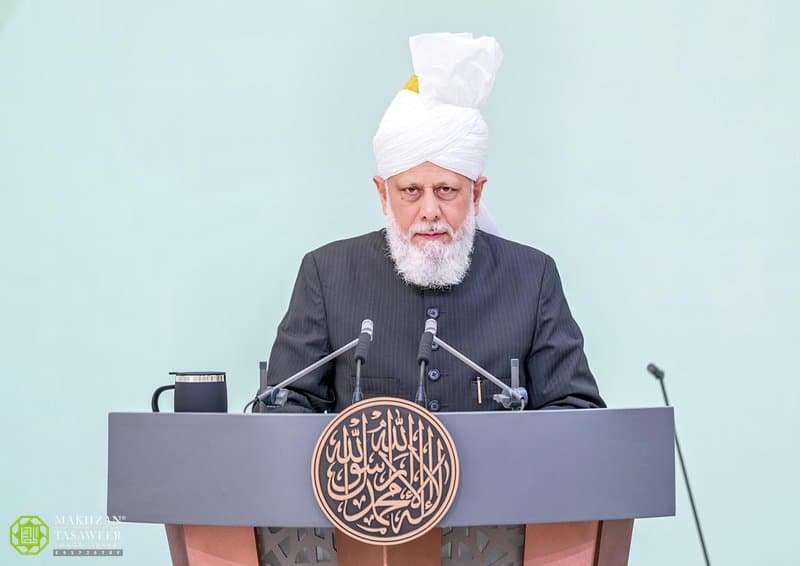
After reciting the tashahhud, ta‘awwuz and Surah al-Fatihah, Hazrat Khalifatul Masih Vaa stated:
By the grace of Allah the Almighty, Ramadan commenced yesterday. Allah the Almighty has ordained this blessed month of Ramadan for us so that we may make a concerted effort to establish a relationship with Him and improve our spiritual condition. May Allah the Almighty enable every Ahmadi to derive the utmost benefit from it. However, one should always remember that true benefit can only be attained if, even after the month of Ramadan, we uphold the standards of love for Allah and His worship and, in fact, strive to elevate them even further. Only then will we be able to fulfil the purpose of our creation.
In the previous several sermons, I mentioned the love of the Holy Prophetsa for Allah, the manner in which he would worship, the standard of his worship, and his guidance for believers to act in accordance with it. Following this, I mentioned incidents from the life of the ardent devotee of the Holy Prophetsa, that is, the Promised Messiahas, who followed his excellent example in the truest sense. This topic remains ongoing, and today it will also be discussed in relation to Ramadan.
I will present some incidents from the life of the Promised Messiahas in this regard, which highlight his relationship with Allah the Almighty and his inclination toward supplication. It is also a special favour of Allah the Almighty that He has presented before us these accounts relating to the worship and love for Allah that occurred between the Master and the servant. This affords us the opportunity to assess ourselves and improve our spiritual condition.
Therefore, whatever incidents I relate, or have related previously, each one of us should remain mindful of them in order to assess our own condition and improve our spiritual state. Furthermore, we should continue to strive to follow this guidance and adopt the manner in which the Holy Prophetsa and his ardent devotee offered their worship and maintained their relationship with Allah the Almighty. It should not be that we merely listen to these incidents and rejoice; rather, they should serve as guidance for us.
In relation to incidents from the life of the Promised Messiahas, I will present a narration recorded by Hazrat Mirza Bashir Ahmad Sahibra. He wrote an account related by Maulvi Muhammad ‘Abdullah Sahib Botalwi, who stated:
“Around 1907, Amatur Rahman Sahiba, daughter of the late Qazi Zia-ud-Din Sahib, who was also related to me maternally, gave me a small piece of paper that would otherwise have been considered scrap. However, since it contained handwritten words of the Promised Messiahas and Hazrat Ummul Momineenra, I gladly took it as a blessed memento.”
He further states:
“At some point, I misplaced the paper among some books. Nevertheless, it was connected to an incident that Amatur Rahman Sahiba herself had narrated to me. The informal text written on this piece of paper, which appeared to be scrap, shed light upon the Promised Messiah’sas relationship with Allah, his righteousness, purity and deep inclination toward worship. As such, I considered it necessary to mention it.
“During the days when Amatur Rahman Sahiba was residing in the home of the Promised Messiahas, she observed and later related to me that on one occasion the Promised Messiahas and Hazrat Ummul Momineen wished to experiment to see whether it was possible to write on paper with one’s eyes closed. This took place in a domestic setting, at home, as a simple experiment between husband and wife.
“The Promised Messiahas held a piece of paper and wrote something on it. He stated that he remembered it word for word. Although the piece of paper has since been lost, he said that he remembers it clearly and can state with full confidence that if it were ever found, the same words would be written upon it.
“The Promised Messiahas wrote with his eyes closed that a person should always remain fearful of God Almighty and supplicate to Him five times a day.”
Thus, this was the standard he consistently urged his followers to adopt. His constant concern was that his followers – indeed every believer – should possess the fear of God and always remain inclined toward worship.
In any case, I will also mention what Hazrat Amma Janra wrote on that note, which related to ordinary household matters. Hazrat Amma Janra wrote simple words: “Mahmud is my dear son; no one should say anything to him.” She then wrote another sentence concerning the children: “Mubarak Ahmad asks for biscuits.” These were the respective writings of the two.
He further narrates that she wrote down ordinary household matters. He then writes that although the Promised Messiah’sas writing appeared somewhat broken, it was nonetheless discernible. Even though it had been written with closed eyes and appeared as though it had been drawn across the page; it was still well-formed and legible. Despite being written with closed eyes, it appeared in straight lines, similar to his other writings. However, the letters written by Hazrat Ummul Momineen [Hazrat Amma Janra] were positioned somewhat above and below the lines, and the alignment was not maintained.
He further states that there is a noteworthy point in this incident which brings him great pleasure and is indeed delightful. Even while sitting informally at home, if the Promised Messiahas was suddenly asked to write something without prior preparation, nothing came to his mind except words of counsel and advice. In contrast, the expression of Hazrat Ummul Momineenra reflected what would naturally come to mind in accordance with her environment.
He further writes that this, in fact, illustrates the difference that exists between divinely commissioned persons and others. His heart was filled with concern for how to bring people closer to God Almighty and how to instil within them a love for worship. (Siratul Mahdi, Vol. 2, Part 4, Narration 1204, pp. 148-149)
Thus, this is a simple incident from a domestic setting, yet it contains a very profound lesson.
Similarly, Hazrat Mirza Bashir Ahmad Sahibra has narrated another incident: Mian Abdullah Sanori Sahibra relates that in 1884, the Promised Messiahas resolved to leave Qadian for a period of seclusion and also to travel within India. Accordingly, he intended to stay in seclusion at Sujanpur in the district of Gurdaspur. Regarding this, he sent me a handwritten postcard.
Mian Abdullah Sahibra, who is narrating this incident, states that he requested permission to accompany him on this journey and travel through India. The Promised Messiahas graciously permitted him. However, he later received a revelation concerning the journey to Sujanpur: “Your purpose will be fulfilled in Hoshiarpur.”
Accordingly, he abandoned the intention of travelling to Sujanpur and decided instead to go to Hoshiarpur.
When he was preparing to depart for Hoshiarpur in January 1886, he wrote to me, calling me to Qadian. He also wrote to Sheikh Mehr Ali, the chief of Hoshiarpur, stating: “I wish to come to Hoshiarpur for two months. Please arrange a house on the outskirts of the city, preferably a two-storey house with an upper room.
Sheikh Mehr Ali vacated his own house for this purpose, which was known as “Tawilah”. The Promised Messiahas set out in a small [ox-drawn] two-wheeled carriage, travelling along the River Beas.
Mian Abdullah Sahib says, “Sheikh Hamid Ali, Fateh Khan Sahib and I accompanied him. Fateh Khan was from Rasulpur near Tanda in the district of Hoshiarpur. He was a great devotee of the Promised Messiahas, but unfortunately, later came under the influence of Maulvi Muhammad Husain Batalvi and became an apostate. When Huzooras reached the river, he crossed over in a boat. As the boat was moving, the Promised Messiahas addressed me and said: ‘Mian Abdullah, the company of a saintly individual is like this river journey: there is hope of crossing it, but also the danger of drowning.’ That is, the one who keeps the company of a learned elder, a saint and friend of God, can end up either crossing safely as the boat was carrying them across, or they could drown.”
He then states, “At the time, I only heard this superficially, but when Fateh Khan later became an apostate, I remembered these words of the Promised Messiahas.” Nonetheless, he continues, “We halted at Fateh Khan’s village on the way and reached Hoshiarpur the next day. Upon arrival, the Promised Messiahas took up residence in the upper storey of the Tawilah residence. To prevent any disputes among us, he assigned separate duties to all three of us. I was given the task of cooking. Fateh Khan was tasked with purchasing provisions from the market. Sheikh Hamid Ali was assigned responsibility for the matters pertaining to the upper storey of the house and for receiving guests.
“After this, the Promised Messiahas issued a written announcement stating that for 40 days no one should come to meet him, nor should anyone invite him for anything. After these 40 days, he would remain there for an additional 20 days. During those 20 days, visitors could come, invitations could be extended, and people could gather to ask questions.
“The Promised Messiahas also instructed us that the inner door chain should remain fastened at all times (meaning the door should be locked). No one in the house should call upon him. If he called someone, they should only respond to the extent that is necessary. No one was to come to the upper storey. (No one should go upstairs where he was staying.)” Nonetheless, he says that “He instructed that his meals should be sent upstairs, but no one should wait for him to finish eating. The empty utensils should be collected later. He also said that since he was observing a period of seclusion, he would offer his prayers upstairs, while we should pray downstairs. Regarding Friday Prayer, he said that since it is obligatory, a deserted mosque on the outskirts of the city should be found where the prayer could be offered in isolation. Accordingly, there was a small, abandoned mosque in a garden outside the city. On Fridays, the Promised Messiahas would go there, lead us in prayer and deliver the sermon himself.”
Mian Abdullah Sahib narrates:
“I used to go and drop the food upstairs [for the Promised Messiahas] and would not utter a single word, but sometimes, Huzooras would say something to me, and I would respond. Once, Huzooras said to me, ‘Mian Abdullah! During these days, the doors to God Almighty’s immense grace and blessings have opened upon me, and at times, God Almighty continues to speak to me until late in the night. If I were to pen all of these accounts, they would fill up quite a lot of pages.’”
Mian Abdullah Sahib further narrates:
“It was during this 40-day period that the Promised Messiahas received the revelation regarding the Promised Son [Musleh-e-Maud] – and after the 40-day period, it was from Hoshiarpur that the Promised Messiahas announced this prophecy.”
This was published in the announcement of 20 February 1886, which is known in the Jamaat as the Prophecy of Musleh-e-Maud.
Coincidentally, today is also 20 February, which marks the grand fulfilment of the prophecy of the Promised Son. The Promised Son, who was born in accordance with the prophecy, and his Khilafat remained established for 52 years, and Allah the Almighty bestowed him with great successes. All of the prophecies, divine revelations and hallmarks which were mentioned in the prophecy relating to the Promised Son were all fulfilled in the person of Hazrat Mirza Bashir-ud-Din Mahmud Ahmadra. The reason why I have said this is a coincidence is that this account came before me just today, and it could have come across at any time before or after as well. However, it was the wisdom of Allah the Almighty that it appeared before me today, and I narrated it. 20 February marks “Musleh-e-Maud Day” and the context of this event has also been mentioned, in terms of how the Promised Messiahas travelled [to Hoshiarpur], how he did the 40-day period of worship in seclusion and the glad tidings he received as a result. Across the various jamaats, jalsas are also being held, and one can learn about their history through them as well. Also, one can learn about it through the programmes being aired on MTA. Members should also watch them.
In any case, it is related that when 40 days had passed, the Promised Messiahas remained there for a further 20 days in accordance with the prior announcement. During those days, many people extended invitations, several came for religious discussions, and old acquaintances of the Promised Messiahas also came to visit him. It was in those days that his debate with Murli Dhar took place, which is recorded in his book, Surma-e-Chashm-e-Arya.
When the two-month period was completed, the Promised Messiahas departed for Qadian by the same route. About five miles from Hoshiarpur, there is the grave of a certain saint. There is another incident mentioned from this journey. When they reached a place where there was a small garden, the Promised Messiahas descended from the carriage for a short while and said, “This is a fine shaded spot. Let us rest here briefly.”
After this, he proceeded toward the grave, which was said to be of a saint. Mian Abdullah Sahib relates that he followed behind him, while Sheikh Hamid Ali and Fateh Khan remained near the carriage. Reaching the tomb, the Promised Messiahas opened the door, entered, stood at the head of the grave, raised his hands in prayer and supplicated for some time.
He then returned and addressed me, saying, “When I raised my hands in prayer, the saint whose grave this is came out of the grave and sat before me on his knees. Had you not been with me, I would have conversed with him. His eyes were large, and he had a dark complexion.”
He then said, “See if there is any caretaker here and enquire about this saint’s description.” The caretaker was questioned and replied, “I have not seen him myself, for nearly 100 years have passed since his death. But from my forefathers, I have heard that he was a great saint of this region and had much influence here.” The Promised Messiahas asked, “What was his appearance?” The man replied, “I have heard that he had a dark complexion and large eyes.”
Thereafter, they departed and reached Qadian. The description given was exactly the same as that mentioned by the Promised Messiahas, that the saint had come and sat before him. Some people say that the righteous, the friends of Allah, and even Prophets may at times converse with the deceased or perceive them. These are the unique ways in which Allah the Almighty treats His chosen servants. In any case, the journey concluded, and they returned to Qadian.
Hazrat Mirza Bashir Ahmad Sahibra states that he asked Mian Abdullah about that period of seclusion and enquired what the Promised Messiahas used to do and how he worshipped. Mian Abdullah replied that he did not know, for the Promised Messiahas remained upstairs in the upper storey and they were not permitted to go there without permission. When food was taken up, they would first seek permission.
Mian Abdullah relates that one day, when he went up to deliver the meal, the Promised Messiahas said, “I have received the revelation:
بُوْرِکَ مَنْ فِیْھَا وَمَنْ حَوْلَھَا
“[‘Blessed are those who are with you and are around you.’]”
And he explained that مَنْ فِیْھَا referred to himself (meaning the Promised Messiahas) and مَنْ حَوْلَھَا referred to those who were with him.”
Mian Abdullah Sahib further relates that he himself remained in the house most of the time and would only go out with the Promised Messiahas for Friday Prayers. Sheikh Hamid Ali also usually stayed inside, but Fateh Khan often spent the day outside and may have been outside at the time of this revelation. This was Hazrat Mirza Bashir Ahmad Sahib’sra opinion.
Mian Abdullah Sahib also mentioned that in those days, Fateh Khan was so devoted to the Promised Messiahas that he would say to us in conversation, “I consider the Promised Messiahas to be a Prophet.” I would become anxious at this statement because, according to the commonly held belief of earlier times, no Prophet could come now. Yet Fateh Khan was so convinced that he referred to him as a Prophet even before he had taken the pledge of allegiance and before any formal claim had been made. This was three or four years prior. However, he later wavered in his belief, and he became an apostate.
Thus, a person must always pray for a good end and strive to be firm in their faith. One must supplicate for it, and especially in the prayers of Ramadan, everyone should pray that Allah the Almighty grant us a blessed end and keep us steadfast in faith.
Mian Abdullah Sahib also relates that once, when he went to deliver food, the Promised Messiahas said, “God addresses me in such a manner and speaks to me in such ways that if I were to disclose even a small portion of them, all these followers you see would turn away.” And in practice, this is indeed what occurred, for when he later made his claim, some people turned against him and intensified their opposition, unable to conceive that Allah the Almighty could speak in such a manner. (Sirat-ul-Mahdi, Vol. 1, Part 1, Narration 88, pp. 62-65)
There is also another incident concerning the Promised Messiah’sas manner of offering prayer. Some people discuss jurisprudential details of prayer, such as how the hands should be folded and how various movements should be performed. Regarding the Promised Messiah’sas manner of worship, Mian Ali Muhammad Sahib relates that he once saw him offering the sunnah prayer before the obligatory prayer. He had folded his hands above the navel, and the middle finger of his right hand reached as far as the elbow or slightly short of it. When he prostrated, he placed his forehead and nose between his hands upon the ground, and his fingers were straight and directed toward the Ka‘bah.
When he rose from prostration, his turban, which was loosely tied, would slip back slightly, and he would straighten it with his finger. It is recorded that he offered these sunnah prayers in Masjid Aqsa, standing to the south of his respected father’s grave, and thereafter the obligatory prayer began, which was led by Hazrat Maulvi Noor-ud-Deen Sahibra. (Ashab-e-Ahmad, Vol. 2, p. 13)
Hazrat Muhammad Jamil Sahib also relates that in the early days of the plague, the Promised Messiahas moved with his entire family to an open garden. They would keep watch at night for the Promised Messiahas. During the spread of the plague, an open area is more suitable to live in, and thus the Promised Messiahas [temporarily] moved there. It is related that during the night watch, whenever they passed by the Promised Messiah’ssa tent, they would see him engaged in prayer. It is a wonder when he would actually sleep. (Ashab-e-Ahmad, Vol. 2, p. 358)
Similarly, Hazrat Chaudhry Bhai Abdur Rahman Sahib relates that the Promised Messiahas would offer Tahajjud (pre-dawn voluntary prayer) with great humility. In the small room opposite the small mosque, his voice could be heard. It was his practice to repeat the words:
اِھْدِنَاالصِّرَاطَ الْمُسْتَقِیْم
“[‘Guide us to the right path.’]” (Ashab-e-Ahmad, Vol. 2, p. 336)
Thus, we too should repeat this prayer so that Allah the Almighty may always keep us firm upon guidance.
Describing the state of the Promised Messiah’sas Tahajjud prayer, Hazrat Master Nazir Hussain Sahib writes, “Once, while travelling to Jhelum, we stayed in Lahore at the house of my grandfather, the late Hazrat Mian Charagh Din Sahib, in Mubarak Manzil. The Promised Messiahas spent the night there, and a room was prepared for him to sleep in.”
He relates, “I too lay down outside that same room on the verandah near the door. I awoke when it was around three o’clock at night and looked inside the room only to find the Promised Messiahas offering prayer. I performed ablution and began to pray behind him at some distance. I tried my very best to stand, bow and prostrate myself in prayer for the same amount of time as the Promised Messiahas, but I could not do so. After just two units of prayer (rak‘at) I became extremely tired, and all the while, the Promised Messiahas was still offering the same set of two rak’at in which I had joined him.” The Promised Messiahas was still in the qiyam position of the same two units he had started offering, while Hazrat Master Nazir Hussain says he became tired and he left the prayer with the Promised Messiahas and began offering his own prayer. This was an example of the Promised Messiahas following his master in worship, and of striving to fulfil the due rights owed to the worship of Allah the Almighty.
Hazrat Master Nazir Hussain further relates, “During the day, when we were sitting in the company of the Promised Messiahas, and he was enjoining and urging the Jamaat to offer Tahajjud, I submitted that if one is unable to offer Tahajjud, then what is the least one should strive to do? (People often ask this: what should they do if they are unable to offer Tahajjud?) Upon this, the Promised Messiahas replied, ‘In that instance, one should abundantly recite istighfar [prayer for seeking forgiveness] and remain engaged in the glorification and praise of Allah. Through this, one is ultimately granted the ability to offer Tahajjud.’”
These supplications enjoined by the Promised Messiahas were not meant to become a substitute for Tahajjud, but were meant to ultimately enable one to offer Tahajjud.
Hazrat Mirza Bashir Ahmad Sahibra has also written, “When I become negligent in observing Tahajjud (this statement is either his or the narrator’s), I act upon this instruction, and I am granted the ability to offer Tahajjud.” (Ashab-e-Ahmad, Vol. 3, p. 178)
Thus, this is a prescription which we too should adopt in our times of indolence.
We are currently passing through Ramadan, and so people are generally able to offer Tahajjud. If not, then one should strive to do so. Of course, Tarawih is offered in the mosque, and it serves as a substitute for the weak, the ill or those who cannot wake up in the morning at the proper time or devote extended time. Yet at the same time, it is not a complete substitute, as it cannot fully make up for Tahajjud. The practice of the Holy Prophetsa and the way of his true servant is that one rises at night and offers Tahajjud. Therefore, even if Tarawih has been offered, one should still strive to offer two or four rak‘at of Tahajjud at night – but Tahajjud should certainly be observed.
Similarly, Hazrat Khairuddin Sahib narrates, “Once, during the spring season, the Promised Messiahas set out from Qadian in the morning around eight o’clock for a walk along the road between Juhaini and Qadirabad, which is also known as Sadak. When he reached the border of Qadian, the Promised Messiahas offered two rak‘at of voluntary prayer and then, passing near our village, returned to Qadian.” (Ashab-e-Ahmad, Vol. 3, p. 90)
Thus, even during a walk, he remained mindful of worship. Now it is also the responsibility of those who live in Qadian that, since he offered voluntary prayers both within it and along its outskirts, they should preserve its sanctity and, in fulfilling the right of that settlement, they should elevate the standard of their worship.
Hazrat Malik Niaz Muhammad Sahib states, “In 1904, when I went to Qadian, the Promised Messiahas used to travel to Gurdaspur in connection with the Karam Din case. When I too went there, he was staying in a house near a pond, and members of the Jamaat were also staying there. The kitchen was operating in the same compound.
“In the court, I observed that a mat would be laid out for the Promised Messiahas, upon which he would sit, and the other members present would also sit upon it. (It was a large mat on which everyone could sit.) One thing I especially noted and still remember was the Promised Messiah’sas constant state of ablution: whenever he went to answer the call of nature, he would invariably perform ablution afterwards. From this, I became convinced that he remained in a constant state of ablution.
“He would softly and continuously recite:
سُبْحَانَ اللّٰہِ وَبِحَمْدِہٖ سُبْحَانَ اللّٰہِ الْعَظِیْمِ
“[Holy is Allah and worthy of all praise; Holy is Allah, the Great].” (Ashab-e-Ahmad, Vol. 2, p. 27)
Hazrat Chaudhry Bhai Abdur Rahim Sahib narrates, “In the early days, it was the Promised Messiah’sas practice generally to arrive at the mosque before everyone else for prayers. Thus, once I tried to reach there first, but he was already at the mosque when I arrived.” (Ashab-e-Ahmad, Vol. 2, p. 336)
The Promised Messiahas spent a portion of his youth, nearly seven years, in Sialkot. There too, the days and nights he spent were marked above all by the love for Allah. Whoever has spoken of that period has particularly mentioned his seclusion, withdrawal from worldly company, and deep absorption in prayer and recitation of the Holy Quran.
In this regard, I will present the testimonies of several reputable and respected elders of Sialkot. Hakim Badr Husain Sahib writes – this is his testimony despite the fact that after the Promised Messiahas made his claim of being commissioned by God, he joined the foremost ranks of the opponents of Ahmadiyyat and even raised hostile objections against certain incidents from his life in the form of a novel. Yet even in the midst of this opposition, he could not forget the pure memory of the Promised Messiah’sas stay in Sialkot.
Thus, he writes, “He possessed a dignified appearance, trustworthy countenance, noble personality, immense patience and lofty thoughts, and I consider no one equal to him in high resolve. As soon as he entered (referring to the room mentioned in this narration), he asked for water to perform ablution; after completing it, he offered the Maghrib prayer. After the prescribed recitations and prayers, he became engaged in the remembrance of Allah.” (Hayat-e-Ahmad, Vol. 1, p. 158)
Then the respected father of the famous Muslim leader Maulvi Zafar Ali Khan Sahib – namely the late Munshi Sirajuddin Sahib, editor of the newspaper Zamindar – stated, “Around 1960 or 1961, Mirza Ghulam Ahmad Sahib served as a clerk in the district of Sialkot. At that time, he would have been about 22 or 23 years old, and we can testify from personal observation that even in youth, he was an exceedingly righteous and pious elder. After completing his official duties, all his time was devoted to the study of religious matters and he interacted little with the public.” (Hayat-e-Ahmad, Vol. 1, p. 74)
Once Hazrat Sheikh Yaqub Ali Irfani Sahib met Syed Mir Hasan Sahib in Sialkot – whom I mentioned in the previous sermon as well. He spoke with tears in his eyes and said with deep emotion: “Alas, we did not value him. I cannot describe his spiritual excellences. His life was not that of an ordinary man; rather, he was among those special servants of God who seldom appear in this world.” (Tarikh-e-Ahmadiyyat, Vol. 1, p. 95)
There is also an incident involving a simple villager, illustrating how he too recognised the light of the Promised Messiahas. The countenances of those beloved and chosen by Allah shine with divine light.
Hazrat Mirza Bashir Ahmad Sahibra writes, “My respected mother narrated that the Promised Messiahas once told her that on one occasion, he was travelling to the hill station of Dalhousie for a legal case when it started raining along the way. He and his Companion got down from the carriage and went toward the house of a man living on the hillside near the road. His Companion went ahead and asked the owner for permission to enter, but he refused. (It would have been a small room, as this is often what the houses of the poor are like.)
“An argument broke out between them, and the owner became angry and began to use profanities. When they insisted on entering and he refused, and the exchange grew heated, the Promised Messiahas said: ‘Hearing this quarrel, I stepped forward, and the moment the owner’s eyes met mine, before I could speak, he lowered his head and said, “The fact is, I have a young daughter, so I do not allow strangers into my house. But you may certainly come in.”’
The Promised Messiahas would say, ‘He was a complete stranger; he did not know me, nor did I know him.’” (Sirat-ul-Mahdi, Vol. Part 1, Narration 8, p. 6)
Yet this was in truth the divine light – a sign of nobility and worship – which he perceived upon the Promised Messiah’sas face. Thus, he said, “Very well, you may enter.”
He was always mindful of God Almighty. No commitment or engagement distanced him from the remembrance of Allah. Thus, the same is the case even during court cases; I have previously related an incident at such delicate times when in the middle of a case hearing, ensuring one observes Prayer is a difficult matter. Yet he had so much conviction in the love of God and was lost in Him that even though his case was being submitted before the court – and they could have been called in at any time – the court official could summon him at any time, as soon as it was time for Prayer, he would leave the call of the court and without the slightest concern for any loss that might result from his absence, respond to the call of the Divine court and presented himself before Allah the Almighty. (Sirat-ul-Mahdi, Vol. 1, Narration 17, p. 14)
This is the fundamental matter that everyone ought to remember: when it is time for Prayer, it must be given precedence in all circumstances. This is the example and model that is the hallmark of a true believer. He learnt this from his master and acted upon it and set this example before us.
Hazrat Sheikh Yaqub Ali Irfani Sahib has described this condition of his in a most beautiful manner. He writes, “The series of court cases was very lengthy and, in some matters, he even had to pursue them further to the Supreme Court.” He further writes: “The matter to which I wish to draw the attention of readers, while acquainting them with this part of the life of Hazrat Mirza Sahib [the Promised Messiahas], is his relationship with Allah. Those who had the opportunity to remain in his company and listen to his words, or who have read his published addresses, know that the Promised Messiahas was the embodiment of the saying:
دست بکار اور دل بہ یار
“Meaning ‘despite being engaged in other works, his heart would remain engaged with the Beloved’, that is, he would remain occupied in the remembrance of God – and this was the guidance he always imparted.
“In court cases, it is generally observed that whether one is a plaintiff or a defendant, both remain in a state of anxiety and restlessness. But when the Promised Messiahas would attend in relation to a case, there was no sign of agitation or worry in his disposition. With complete steadfastness and dignity, his heart remained turned towards the Beloved. While he had to pursue these cases merely to obey his father’s orders and to discharge the duty he owed towards him, during this entire period, he never once missed a prayer, nor did he become heedless of those obligations that relate to the rights of Allah the Almighty. Even within the court, at the time of Prayer, he would become engaged in Prayer as though he had no other task at all.” He has also recorded incidents where, at times, the court would make announcements [for him], yet he remained indifferent.
He further writes: “Even during these journeys related to these cases, his attention would remain fixed upon that Being Who is the Creator and Lord of all the worlds. In the rising sun, in the moon and stars shining in the night sky, in flowing springs and cascading waterfalls, in lofty mountains, in running streams, in the swaying fields, in the chirping of birds and in the sounds of thunder and lightning – everywhere he perceived the reflection of a single Being, and beheld the manifestation of that Source of all Light; that is to say, in everything he perceived the power of Allah the Almighty. Wherever he turned, he saw only the manifestation of the True Beloved. Upon witnessing the moon, if he became restless, it was because even within it he perceived traces of the beauty of the Beloved. In the fountain of the sun, its waves were visible to him; in every star, he beheld the spectacle of His radiance. The grace found in beauty points to the beauty of that True Creator. Every beautiful eye points towards Him, and every curling lock gestures towards that One God. Every flower and every garden is perfumed by the fragrance of the garden of His beauty and beneficence.”
He has described it in a very beautiful manner.
He then says: “The truth is that from the appearance he would travel for these court cases, but in reality, even during these journeys, all ties of loyalty and love for others were severed [except with the beloved].” While describing this state, he writes: “As I have previously mentioned in the account of the journey to Dalhousie, even during that journey, on observing the scenes along the road, he remarked how beautiful were the flowing streams and the green meadows of the mountains. Thus, he remained forever in a state of complete annihilation in that One Being and remained content with him. Whether it was day or night, whether he was in solitude or in company, the remembrance of that True Beloved was never effaced from his heart.” (Hayat-e-Ahmad, Vol. 1, pp. 85-87)
Hazrat Mirza Bashir Ahmad Sahibra relates: “My noble mother narrated to me that once the Promised Messiahas said that it had been revealed to him by Allah the Almighty – or that he had been informed by Allah the Almighty – that one should recite سُبْحَانَ اللّٰہِ وَبِحَمْدِہِ سُبْحَانَ اللّٰہِ الْعَظِیْمِ in great abundance. My mother relates that for this reason, he recited it so frequently that even at night, while turning from one side to the other on his bed, this phrase would be upon his tongue.”
Hazrat Mirza Bashir Ahmadra further says, “[…] When I related this narration to Maulvi Sher ‘Ali Sahib, he said that he too had observed that the Promised Messiahas would frequently recite SubhanAllah.”
Hazrat Mirza Bashir Ahmad Sahibra also relates his own observation that he always heard the Promised Messiahas reciting SubhanAllah. He would repeat these words very slowly, with pauses, with attentiveness and in a gentle manner. In this manner, alongside repeating it, he was reflecting upon the attributes of Allah the Almighty. (Sirat-ul-Mahdi, Vol. 1, Part 1, Narration 1, p. 3)
He further writes that Pir Siraj-ul-Haq Sahib Nu‘mani related to him that the manner of the Promised Messiah’sas sleep was such that after short intervals he would awaken and softly utter SubhanAllah, SubhanAllah, and then fall asleep once more.” (Sirat-ul-Mahdi, Vol. 1, Part 2, Narration 310, p. 287)
Hazrat Sheikh Ya‘qub Ali Sahib Irfani relates that the Promised Messiahas greatly cherished seclusion and solitude, following the noble example and blessed practice of his Master and Benefactor, the Holy Prophetsa. Indeed, had it been within his discretion, he would never have emerged from seclusion. On numerous occasions, he expressed this sentiment in his discourses and writings.
In short, when his natural disposition and inner intricate nature, which preferred solitude and seclusion was deeply inspired and when his intense love for the Divine drew him wholly towards Allah the Exalted, he wrote a letter to his father. By reading that letter, it becomes evident how, from his early youth, the Promised Messiahas was disinclined toward the world and constantly preoccupied with strengthening his bond with Allah the Almighty. This letter, which was written in his youth, reflects his pure nature and noble character.
The letter was written in Persian, and I will read a portion of the letter.
Addressing his father, the Promised Messiahas wrote:
“In these current times, I can clearly see with my own eyes and with a sense of deep concern, that in every land and country, each year some calamity or epidemic arises, separating friends from friends and loved ones from their dear ones. There is not a single year in which I have not witnessed the blazing fires and painful afflictions creating scenes akin to the tumult of the Day of Judgement. Observing such conditions, my heart has grown cold toward the world, and my face has turned pale with apprehension.”
Even in our present times, the state of the world reminds us how fires rage on every side. Therefore, we ought to cultivate an ever-stronger relationship with Allah the Almighty.
The Promised Messiahas further writes:
“I often recall the following couplet of Sheikh Musleh-ud-Din Saadi Shirazi, and tears of anguish flow from my eyes:
مَکُن تکیہ برعمرِ ناپائیدار
مَبَاش ایمن از بازِیِٔ رُوزگار
“‘Place not reliance upon this fleeting life; And deem not yourself secure from these worldly endeavours.’”
That is, one should not imagine that having become preoccupied in worldly affairs, one has thereby attained security.
The Promised Messiahas further writes:
“Furthermore, these two verses from the poetic works of ‘Farrukh Qadiani’ – a penname used by the Promised Messiahas in that time – which instil a sense of heartfelt pain are as follows:
بَدُنیائے دُوں دل مَبَنْد اے جواں
کہ وقتِ اَجَل مِی رَسَدْ ناگہاں
“‘O youth, attach not your heart to this lowly world; For the appointed hour of death arrives suddenly.’
“I desire to spend the remainder of my life in solitude, to withdraw from worldly company and immerse myself in the remembrance of Allah the Glorious, so that I might seek forgiveness and make amends for my shortcomings.”
This is quite a lengthy letter, but from this it becomes evident that the Promised Messiahas did not have any desire for any fame or honour, but possessed a pure and sincere relationship with God Almighty. It is a matter of fact that his love for seclusion was such that he would never have appeared in public had it not been in obedience to the command of Allah the Almighty.
The Promised Messiahas further wrote:
“If Allah the Almighty were to grant me the choice between solitude and public life, I would, by the oath of that Pure Being, choose seclusion. It is God Almighty, Who has drawn me into the field of practical service. The delight I experience in solitude – who besides God is aware of it? For approximately 25 years I remained in seclusion and never once desired to sit upon the seat of worldly renown. By nature, I felt aversion to mingling among people; yet I am compelled by Divine command.” (Hayat-e-Ahmad, Vol. 1, pp. 111-115, [includes footnote])
Thus, having written to his father, he relinquished everything. It was, as it were, a form of princely inheritance that he abandoned. His father possessed seven villages as property, yet he renounced them all purely for the love of Allah the Almighty. (Tarikh-e-Ahmadiyyat, Vol. 1, p. 42)
At times, he would also advise his followers in this regard. It is narrated by Mian Muhammad Musa Sahib that on one occasion, during a visit to Qadian, a newly converted Muslim member submitted before the Promised Messiahas: “Grant me permission your Holiness, for my crop is ready for harvest. (He owned a vast amount of land) and I have to oversee its division (which was done amongst the cultivators).”
The Promised Messiahas inquired, “How big is the crop?” He replied, “It is quite a considerable amount of crop.” Thereupon, the Promised Messiahas said, “I have left many villages and chosen the threshold of God Almighty. You ought to remain here a few more days.” (Ashab-e-Ahmad, Vol. 4, p. 424)
And for him to improve his spiritual condition, and leave worldly matters to Allah. He will bestow His grace.
In that particular case, knowing the circumstances of the individual, he offered this counsel [for his spiritual training]. Elsewhere, however, he also taught that worldly responsibilities are not to be entirely abandoned. The bounties granted by Allah the Almighty are also to be valued. And so, for the purpose of the moral and spiritual training of this new convert, the Promised Messiahas advised him in that manner. Thus, at times, the advice is given in accordance with one’s unique circumstances. Each person should assess his own condition carefully, and therefore one must neither become so immersed in the world as to drown in it, nor so detached as to neglect the rightful worldly obligations. Islam presents a balanced and comprehensive teaching. But the most important point to always remember is that one must never neglect Allah the Almighty. In this respect, one should always pay great heed to this.
These were just some various aspects of the love, devotion and worship of the Promised Messiahas that have been presented today.
May Allah the Almighty enable us to truly do justice to our worship in this month of Ramadan and also enable us to increase in His love, so that we, as much as possible, continue to partake of the blessings of Ramadan and may the impact of these blessings continue even after it as well. May Allah the Almighty enable us to truly embody the hallmarks of a true believer and Muslim. During these days, particularly pray for those Ahmadis who are going through the hardships of having false charges levelled against them. May Allah the Almighty create ease for our Ahmadi brothers. Remember the Muslim Ummah in your prayers as well. Pray for the world to be saved from destruction as well. May Allah the Almighty safeguard the innocent people from such evils, and if a war or destruction is inevitable, then may Allah the Almighty protect the innocent from it and seize the oppressors.
(Official Urdu transcript published in the Daily Al Fazl International, 13 March 2026, pp. 1-8. Translated by The Review of Religions.)