
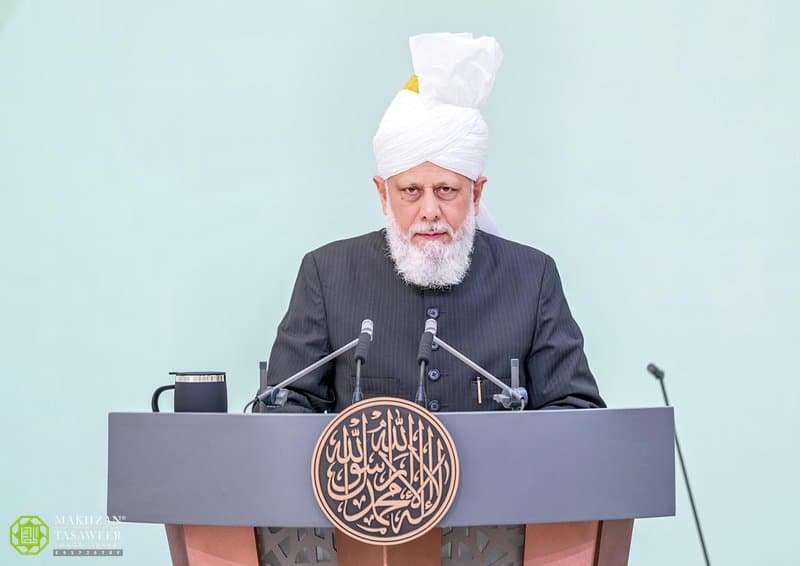
After reciting the tashahhud, ta‘awwuz and Surah al-Fatihah, Hazrat Khalifatul Masih V (aa) stated:
The Promised Messiah (as) greatly encouraged his Companions with regard to gratitude. Regarding this, Hazrat Pir Siraj-ul-Haqq Sahib Nu’mani (ra) relates that, on one occasion, the Promised Messiah (as) said to him: “What were you and Miran Bakhsh Saudai quarrelling about today?” There was a mentally impaired individual, whom Pir Sahib (ra) must have quarrelled with. He says, “I got scared, wondering what the Promised Messiah (as) would say, as he must have heard everything we said. With some trepidation, I told him everything that had transpired.” Upon this, the Promised Messiah (as) said: “A ‘saudai’ is one who is mentally impaired and cannot be held accountable.” That is, someone who lacks sound reasoning and whose deeds, according to the Sharia [Islamic law], are not recorded as good or evil, nor is he held accountable for his sins.
The Promised Messiah (as) said that people who are in such a state are not held accountable for what they say or do. After all, how can they be held accountable if they lack reason? Only one who possesses reason can be held accountable. The Promised Messiah (as) said: “The world refers to such individuals as majzub [someone drawn to God], a waliullah [friend of God], a qutb [saint] and one who is commissioned to serve humanity. However, they are wrong in doing so. In reality, such people are not majzub or waliullah. Rather, they are deprived. That is, they are deprived of all the favours of God. They are deprived of reason, understanding, clothing, the pleasures of eating and drinking, and from the blessings and rewards associated with caring for the wife and children and raising them. They are deprived of the knowledge and recognition of Allah the Almighty, the knowledge of the Being of Allah the Almighty and His attributes and recognising the status of His Prophets and Messengers and following them. They are deprived of reciting the Holy Quran and understanding its meanings, intricacies, insights and subtleties. They are deprived of the Sharia and its observance. They are deprived of prayer, which is the spiritual apex of the believers, of fasting, the special reward of which is Allah Himself, of the observance of Hajj [pilgrimage] and Zakat [giving alms], as well as the rewards and spiritual ranks associated with these deeds. When you see such people, instead of arguing or quarrelling with them, you should thank God for having enabled you to benefit from all these blessings and favours and not having deprived you of them. He has given you reason and understanding. He has granted you the recitation of the Holy Quran and understanding of its knowledge, intricacies, insights and subtleties. He has given you the ability to distinguish between what is lawful and unlawful. He has enabled you to recognise the Messengers. He has granted you knowledge of His Being and His attributes.” (Tadhkira-tul-Mahdi, Part 1, pp. 182-183)
Thus, where the Promised Messiah (as) instructed not to argue with such people, but rather to treat them with kindness, he also taught to be grateful for the blessings bestowed by Allah the Almighty. That is, when we see such people, we should thank Allah the Almighty for having granted us all these blessings.
Similarly, Hazrat Malik Muhammad Hasan Muhammad Sahib (ra) relates that the Promised Messiah (as) came for the Fajr prayer. Following the prayer, he addressed those in attendance and said: “Where were the sarangis [bowed string instrument] and drums being played during the night?” Instruments were being played, and songs were being sung in the neighbourhood. Someone said: “Huzoor, Mirza Nizam-ud-Din Sahib had invited a female dancer (he used to engage in such practices) and had promised her 20 rupees for the night. As such, the dancing in Mirza Nizam-ud-Din’s house continued throughout the night.” The Promised Messiah (as) took a deep sigh and said: “Allah! How remarkably devoted she is!” He was referring to the dancer. He said: “She is extremely devoted for having stayed up dancing and singing the entire night for 20 rupees. On the other hand, we cannot stay up even one or two hours for the sake of our Creator and Master, Who has given us countless blessings.” The Promised Messiah (as) repeated these words two or three times. (Riwayat Ashab-e-Ahmad, Vol. 3, p. 278)
Even upon learning of the actions of such immoral women, his attention was drawn towards fulfilling the rights owed to God Almighty. With great pain, he expressed that such people were willing to sacrifice their sleep for a few rupees, yet we do not even express gratitude for the countless blessings of Allah the Almighty. We do not pay attention to voluntary prayers and [obligatory] prayers and are unable to remain awake. In fact, there are many who are negligent even regarding the obligatory prayers and getting up for the Fajr prayer becomes difficult for them.
Thus, every Ahmadi should assess himself in this regard and consider to what extent we are fulfilling our duty of gratitude to Allah the Almighty.
Hazrat Sheikh Muhammad Ismail Sahib Sarsawi (ra) describes the expression of gratitude of the Promised Messiah (as) in relation the manner of his eating as follows:
“It was the habit of the Promised Messiah (as) to say, ‘Subhanallah, Alhamdulillah’ while eating and he would eat as though he were searching for something.” (Riwayat Ashab-e-Ahmad, Vol. 2, p. 413)
In other words, even while eating, he would remember the blessings of Allah the Almighty with every morsel and express his gratitude.
Hazrat Musleh-e-Maud (ra) said in relation to this, “We also observed the Promised Messiah (as). It was his practice that when he ate bread [roti], he would break off a small piece and put it into his mouth and would continue chewing it thoroughly until his teeth had properly chewed it. It was not his habit to take large morsels; rather, he would always take a small morsel. While he continued chewing the first morsel for a long time, he would take another piece of bread and roll it between his fingers, all the while saying, ‘Subhanallah, Subhanallah [Holy is Allah].’ After some time, he would dip one of the pieces into the curry and put it into his mouth.” (Tafsir-e-Kabir, 2023, Vol. 9, pp. 261-262)
Hazrat Syed Zain-ul-Abidin Waliullah Shah Sahib (ra) relates, “Owing to my young age, and also because the Promised Messiah (as) would accommodate my father, Hazrat Dr Syed Abdul Sattar Shah Sahib (ra), as a guest in his own home, we lived in the house as though we were members of the same family. We would freely come and go inside and outside the house, and would sleep in the home of the Promised Messiah (as).”
He says, “I remember very well that whenever the plague appeared in the surrounding area or in the city, the Promised Messiah (as) would not only instruct that his own home be cleaned, but would also make arrangements for the boarding house to be cleaned. He would similarly instruct all the members to make arrangements in their homes to use sulphur, fire, phenyl and guggal (which is the resin of a tree and is used as incense to kill bacteria) to eliminate germs, among other things.
“The Promised Messiah (as) would say that making use of the available means is also a way of expressing gratitude for the blessings of Allah the Almighty.” This too is a blessing of Allah the Almighty, and we should be grateful that He has created such things which serve as a remedy for these illnesses – particularly during epidemics, when the environment becomes polluted, dirt accumulates, or harmful substances spread. These means help to purify the environment.
“He would say that making use of these means is also a way of expressing gratitude for the blessings of Allah the Almighty and is equivalent to obeying His command. To abandon the available means is contrary to the divine law.” In other words, not making use of the available means is also contrary to the Sharia.
“The station of trust in Allah comes afterwards. That is, one should adopt the available means but should not place one’s reliance upon the means themselves. Rather, true spiritual insight lies in recognising the hand of Allah the Almighty behind the means.” (Riwayat Ashab-e-Ahmad, Vol. 5, p. 35; Urdu Lughat, Vol. 16, p. 304, Urdu Board Karachi)
One should realise that these things that I am using have also been created by Allah the Almighty. May Allah create through them the means of benefit for us. And one should give thanks to Him. If a person thinks in this manner, he will continue expressing gratitude to Allah the Almighty at all times.
Hazrat Muhammad Ibrahim Sahib (ra) relates, “Once, when the Promised Messiah (as) was staying in Gurdaspur in 1904 in connection with the case of Karam Din, this humble one also remained in Gurdaspur for a month in the company of the Promised Messiah (as).
“One day, a friend from Multan brought some freshly ripened dates. Someone remarked that these dates have characteristics which increase heat in the body. The person who had brought them said, ‘Eat as many of these dates as you like, and eat a little onion afterwards – you will not suffer any harm.’ (This was also one of the remedies that elders in former times would suggest – if you had eaten something considered ‘hot’ in nature, eat some onion afterwards and its effect would be neutralised.)
“The Promised Messiah (as) said, ‘Allah the Almighty had made excellent provision, in that He had also created a corrective for everything.’ (That is, He had provided something else to counteract its effects.)
“He said, ‘Eat as many mangoes as you like.’ Diabetics are generally advised not to eat mangoes because they contain a great deal of sugar. ‘Then eat a few jamuns afterwards. (Jamuns are also considered beneficial for those suffering from diabetes.) You will not suffer any harm. As for bananas, they too have their disadvantages as well as their benefits. Eat as many as you like, and then chew a few uncooked grains of rice afterwards. Everything will be digested.’
“On this occasion, the Promised Messiah (as) also delivered an address explaining the excellent physical and spiritual provisions that Allah the Almighty has made for human beings – provisions for which man can never fully express his gratitude.” (Riwayat Ashab-e-Ahmad, Vol. 2, p. 172)
While writing his book Tadhkirat-ush-Shahadatain, the Promised Messiah (as) expressed his gratitude upon being cured of an illness and wrote:
“When I began writing this book, my intention was to complete this treatise before I went to Gurdaspur on 16 October 1903 in connection with a criminal case that had been filed against me by an opponent, and to take it with me. It so happened, however, that I was suddenly afflicted with severe kidney pain. I thought that the work had been left unfinished. There were only a few days remaining. If I continued to suffer from this kidney pain, which is a fatal illness, I would not be able to complete the book.
“At that time, God Almighty drew my attention towards prayer. At night, when approximately three hours had passed after midnight, I said to the members of my household, ‘I am now going to pray. You say amin.’ (He gathered all the members of the household together.) In that painful condition, I prayed while keeping Sahibzada Maulvi Abdul Latif in mind, saying, ‘O Allah, I wish to write this book for this deceased one.’
“When I offered this prayer, I immediately became drowsy and received the revelation:
سَلَامٌ قَوْلًا مِنْ رَبٍّ رَحِیْمٍ
“‘Peace and security – a word from a Merciful Lord.’
“By Him in Whose hand is my life, I swear that it was not yet six o’clock in the morning when I had become completely healthy, and on that very day I wrote approximately half of the book. All praise belongs to Allah for this.” (Tadhkirat-ush-Shahadatain, Ruhani Khazain, Vol. 20, pp. 74-75)
One shining aspect of the life of the Promised Messiah (as) was that he possessed such a great appreciation for even the smallest kindnesses and such deep gratitude that he would express his thanks even for seemingly minor services and gestures.
Hazrat Maulvi Abdul Karim Sahib (ra) relates, “During the week (in which he was giving this account), the most extraordinary and interesting incident that took place, and which greatly strengthened our faith, was the arrival of a letter addressed to the Promised Messiah (as).
“The letter stated, with firm evidence and in detail, that in the Jalalabad area of Kabul there was a platform associated with Yuz Asaf, a Prophet, and that it was commonly known there that approximately two thousand years ago this Prophet had come there from Syria. It also stated that the Kabul government had granted some land in the name of this platform. There is no need to go into further detail here.”
Maulvi Sahib writes that the Promised Messiah (as) was extremely pleased by this letter. He said:
“Allah is Witness and All-Knowing.” The Promised Messiah (as) then said, “If someone were to bring me millions of rupees, I would never be as happy as this letter has made me.”
Hazrat Maulvi Abdul Karim Sahib (ra) says:
“Brothers! Is this happiness over a religious matter not a sign that it is from Allah? Who is there today who would experience such happiness at the prospect of the exaltation of the word of Allah?
“I swear by Allah that when I saw and appreciated the happiness of the Promised Messiah (as) at that time, I felt deeply ashamed within myself. Even though I was also happy, and the friends were rejoicing that another avenue had opened for the defeat of falsehood, and that the complete picture of the journey of Jesus (as) had now been discovered, there was simply no comparison with the happiness of the Promised Messiah (as).” (Al Hakam, Vol. 3, No. 24, 10 July 1899, p. 3, Column 1)
When the Promised Messiah (as) wrote Barahin-e-Ahmadiyya, he recorded in the book the names of those who had provided financial assistance for its publication. While expressing his gratitude to them, he encouraged others to pray for them. This list of those to be remembered in prayer included even those who had contributed five rupees, two rupees and even two annas. The Promised Messiah (as) writes:
“How can I express my gratitude to the Lord of the worlds, who first made it possible for my humble self to write this book by His help, grace and divine support, and then brought it to the attention of Muslim leaders, elders, noblemen and other brothers-in-faith, and invested them with the desire that it should be printed, published and promoted. I must express my gratitude to all those who helped me and whose generosity kept my religious objectives and efforts from going in vain. Indeed, I am so obliged to them for their help that I have no words with which to thank them. When I observe how so many of them have done their utmost to help this noble cause and some of them have promised to make even more contributions, it further deepens my feelings of gratitude towards them.”
He then recorded the names of those who had provided assistance and stated:
“At the end of this statement, I have recorded the worthy names of all the generous and dedicated people who have helped this cause by purchasing copies of the book or contributing towards its publication. I will continue to acknowledge such contributions until the whole book has been printed, (he wrote all their names and stated) so that, as long as it continues to be a source of benefit for the world (as long as people will benefit from this, these names will be written, so that we pray for them), anyone who profits from it and spends a pleasant time reading it may pray for me and all who have helped me.” (Barahin-e-Ahmadiyya, Part 1, Ruhani Khazain, Vol. 1, p. 5)
Those who benefit from it should keep him and his helpers in their prayers.
The Promised Messiah (as) also authored a book entitled Minan-ur-Rahman, in which he proved that the Arabic language is the mother of all languages. In this connection, while expressing his gratitude to those friends who had assisted him in locating various references, he stated:
“Here I cannot keep myself from expressing gratitude to my friends who have helped me in my task of proving the existence of relationships between languages. It gives me great pleasure to acknowledge that, in order to prove the existence of relationships between languages, my sincere friends have exerted themselves with such zeal, which will surely be remembered in this world as long as this world remains inhabited. These men of God bravely dedicated their important time to me and, by undertaking great toil and hard work day and night, they accomplished this momentous task. I believe that they will be tremendously rewarded by God Almighty because they partook in such a war in which, very soon, the trumpets of the victory of Islam will be sounded. Thus, each and every one of them deserves to be decorated with a heavenly medal. I cannot describe how, in every academic session, they would venture hundreds of miles within [their research] in order to discover the common ties of words [between languages], and how they would return with success, and present the gift of a cognate word. This process continued until the languages of the world were collected before us. I will never forget that in this momentous undertaking, my loyal friends provided such help that I do not have the words with which I can express its measure. I pray that may God Almighty accept their efforts, and may He accept them for Himself, and may He always keep them distant and protected from an impure existence, and may He grant them His affinity and an eager longing for Him, and may He be with them. Amin! Amin!”
He then recorded the names of those who had assisted him, among whom he mentioned Hazrat Hakeem Maulvi Noor-ud-Deen Sahib (ra) first, followed by Hazrat Maulvi Abdul Karim Sahib (ra), along with many other Companions. He states:
“Only God Almighty knows whose efforts in this task are greater; He will not let the effort of any true devotee go to waste. But as far as my personal knowledge and observation attests, the greatest effort was made by my dear brother Hakeem Maulvi Noor-ud-Deen, and my dear brother Maulvi Abdul Karim who, leaving behind all relations, have been present with me for this task for many months. Furthermore, Hazrat Maulvi Noor-ud-Deen not only rendered such service as mentioned, rather for this task he also procured by purchasing – from his own pocket – English books of very fine quality, and gathered a collection of valuable books for this objective. May Allah grant them the best reward. And Allah causes not the reward of those who do good, to be lost. Amin!” (Minan-ur-Rahman, Ruhani Khazain, Vol. 9, pp. 143-144)
While mentioning Mian Manzur Muhammad Sahib (ra), the Promised Messiah (as) wrote:
“It is incumbent upon me, as an expression of gratitude for the blessings of Allah the Almighty, to mention that in my important work of writing and publication, God, by His grace, has granted me a sincere helper of great worth; my dear Mian Manzur Muhammad, who serves as a scribe and possesses remarkably beautiful handwriting. He works not for the world, but purely out of love for the faith. He has left his hometown and taken up residence here in Qadian. This is a great blessing of Allah the Almighty, that He has provided me, according to my need and desire, with such a devoted and energetic helper. At any hour of the day or night, I take from him the service of copying manuscripts, and he carries out this work with complete dedication, purely for the pleasure of Allah the Almighty. It is for this reason that, in this age of spiritual battle, tracts that defeat the opponents are being sent forth from my side in rapid succession, like volleys of fire against the adversaries. In truth, the provision of such supporting means is itself a sign from Allah the Almighty. From every direction, all beneficial means have been made available to me. In writing, I have been given such power that it seems as though it is not I who write, but angels, though outwardly it is through my own hand.” (Majmu’ah-e-Ishtiharat, 2019, Vol. 2, p. 546)
The Promised Messiah (as) would never miss an opportunity to thank those who assisted him, even for the smallest service. He would openly acknowledge his companions, praise them, and say that through their help, his work had been made easier.
Hazrat Sheikh Yaqub Ali Irfani Sahib (ra) relates that the Promised Messiah (as) always valued even the smallest services of his devotees and would show great consideration for their feelings. He would give them more than their labour warranted. In the days when a book or pamphlet had to be printed and published urgently, and work continued through the night, he would make special arrangements for milk and other refreshments for those working in the press. He would pay them more than the usual wage, and would express not merely pleasure at their work, but gratitude. (Sirat Hazrat Masih-e-Maud [as], Part 3, p. 348)
Hazrat Musleh-e-Maud (ra) writes that the hearts of Prophets are deeply grateful. They would express their gratitude for even the smallest of acts. He says:
“I have seen that when the books of the Promised Messiah (as) were being printed day and night, then although he himself would sometimes remain awake for several nights at a stretch, whenever someone brought a proof at night and called out, he would personally rise to receive it. As he did so, he would say, ‘May Allah grant you the best reward. How much trouble he has taken. How much hardship these people endure. May God reward them well.’ He would say this despite himself having stayed up the entire night as well.”
Hazrat Musleh-e-Maud (ra) further says: “Many times, I fell asleep while watching the Promised Messiah (as) work; and when I awoke, I found him still working, until the morning. The others were certainly working for the sake of God, but the Promised Messiah (as) still felt their hardship. Why? Because the hearts of Prophets have an extraordinary sense of gratitude.” (Al Fazl, 19 August 1916, Vol. 4, No. 13, p. 7, Column 3)
Hazrat Mirza Bashir Ahmad Sahib (ra) relates another incident. Hafiz Nabi Bakhsh Sahib (ra) of Faizullah Chak said:
“Once, the Promised Messiah (as) went for a walk in his garden. In his blessed hand he was holding a willow cane. He struck at a fruit on a tree with the cane, but the cane became lodged among the branches. It had been thrown from a distance and became so firmly caught that it would not come down. The companions tried repeatedly to dislodge it, but without success. I submitted, ‘Your Holiness, I can climb the tree and bring it down.’ I quickly climbed up and brought down the blessed cane. The Promised Messiah (as) was so pleased and astonished that he repeatedly said, with great affection, ‘Mian Nabi Bakhsh, you have done something remarkable. You climbed the tree and brought the cane down at once. How did you climb the tree? Where did you learn to climb like that? This cane is from our father’s time; today, it is as though you have given it back to us anew.’ Even on the way back, the Promised Messiah (as) kept repeating, ‘Mian Nabi Bakhsh has shown great skill in climbing the tree and retrieving the cane.’
“It was also the habit of the Promised Messiah (as) that, whether a person was young or old, he would never address anyone in the words ‘Tu’ [an informal manner of saying ‘you’].” He says, ‘Although I was only a small child, the Promised Messiah (as) never once addressed me in such a way.” (Sirat-ul-Mahdi, Vol. 1, Part 3, Riwayat No. 543, p. 536)
Hazrat Mirza Bashir Ahmad Sahib (ra) writes that Dr Mir Muhammad Ismail Sahib (ra) told him that whenever someone brought a gift for the Promised Messiah (as), he would show deep gratitude. He would also mention that person’s sincerity at home and say that such and such a person had sent this gift. (Sirat-ul-Mahdi, Vol. 1, Part 3, Riwayat No. 713, p. 647)
How deeply the Promised Messiah (as) appreciated even small gifts is illustrated by another account recorded by Hazrat Mirza Bashir Ahmad Sahib (ra). The wife of the late Dr Khalifa Rashiduddin Sahib (ra) wrote:
“On one occasion, Dr Sahib (ra) took three months’ leave from Agra and came to Qadian. In Agra, there was a sweet called khurma, (something like balushahi), which was made there very well and in large pieces. This was something the Promised Messiah (as) liked. Whenever Dr Sahib (ra) came, he would always bring khurmas for the Promised Messiah (as). One day, when he arrived, the Promised Messiah (as) had not eaten since morning. I came into the house around the time of Asr, and he was very pleased to see me. He asked about the journey. Hazrat Amma Jan (ra) said, ‘The food is ready.’ The Promised Messiah (as) replied, ‘I do not feel like eating.’ Then Hazrat Amma Jan (ra) said, ‘Murad Khatoon has brought khurmas for you from Agra.’ Hearing this, the Promised Messiah (as) was delighted and said, ‘I like those. Bring them; I shall eat some.’ When they were brought before him, he praised them greatly and said, ‘So many!’ He then ate some and said, ‘Keep them for me. I have eaten some now, and I shall eat more later.’”
The manner in which the Promised Messiah (as) ate has already been mentioned; he would eat very little at a time, and would do so while engaged in prayer. In any case, she writes:
“My heart was filled with such joy at the way he appreciated such a small thing that I cannot describe it. When I told Dr Sahib (ra), he too became very happy. For a long while, he kept raising his face towards the sky and saying, ‘Holy is Allah, Holy is Allah.’” Dr Sahib himself was also a person of great sincerity. (Sirat-ul-Mahdi, Vol. 2, Part 5, Riwayat No. 1297, pp. 193-194; Urdu Lughat, Vol. 8, p. 540)
Hazrat Musleh Maud (ra) narrates that when a case was filed against the Promised Messiah (as) in Gurdaspur by Maulvi Karam Din of Bhain, there was at that time a great scarcity of money, and expenses had increased considerably. On that occasion, under divine guidance, certain individuals were approached, and among those approached was Dr Khalifa Rashiduddin Sahib (ra). At that moment, he gathered everything that was in his home and sent it all, writing that he would continue to send whatever income came to him in future. And so whatever he received from his salary and his medical practice, he would send it to the Promised Messiah (as). A friend who was his guest in those days recounted: “I said to him, ‘You send everything there and keep nothing for yourself.’ He replied, ‘Yes, these are such times that demand it.’”
At that time the Promised Messiah (as) also wrote him a letter, which Hazrat Musleh-e-Maud (ra) says he himself read. Dr Sahib had said that these are such times that require us to help the Promised Messiah (as). In any case, the Promised Messiah (as) wrote him a letter at that time, and Hazrat Musleh-e-Maud (ra) says he read that letter himself, and in it the Promised Messiah (as) had written: “You have taken sacrifice to its very highest limit. You need not give any more contributions.” He was giving so much, and yet, Hazrat Musleh-e-Maud (ra) notes, the Promised Messiah (as) would ordinarily counsel people to give their contributions regularly, and had even said that one who does not give for three months cannot remain part of the Jamaat. Hazrat Musleh-e-Maud (ra) says that this letter may perhaps still be in the late Khalifa Sahib’s (ra) home. He continued to give contributions after that too, and he should have; it is not that after receiving that letter he stopped giving altogether. He carried on giving nonetheless, and he should have. Hazrat Musleh-e-Maud (ra) says he should have continued, because what he had been doing before was fulfilling an obligation and what he gave afterwards was out of gratitude.
The Promised Messiah (as), in his treatise, The Will, written as a result of divine revelation, exempted his own children from paying the Wasiyyat contribution. Hazrat Musleh-e-Maud (ra) says: “In it he exempted us – that is, his own children.” Hazrat Musleh-e-Maud (ra) says: “There was always a nagging sense within me that we had been deprived of one opportunity for sacrifice. But then the thought came to me that the Holy Prophet (sa) would worship with such intensity that, as Hazrat Aisha (ra) says, his feet would become swollen. Seeing this, she once said: ‘When Allah has forgiven all your sins, why do you put yourself through such hardship?’ He replied:
اَفَلَا اَکُوْنَ عَبْدًا شَکُوْرًا
“That is, ‘should I not then be a grateful servant?’
“Having reached such a station”, Hazrat Musleh-e-Maud (ra) says, “even if something is not obligatory, it ought to be done out of gratitude. Even if it is not a duty, it should be done as an expression of thanks. This thought came to me: although we have been exempted from the Wasiyyat contribution, gratitude should still be expressed. And so after that I adopted the practice of ensuring that my own contributions exceeded even those of the musian [members of the Wasiyyat system]. Then I also remembered a revelation I had received. A short while after the passing of the Promised Messiah (as), I received the revelation:
اِعْمَلُوْا اٰلَ دَاوٗدَ شُکْرًا
“[‘Work ye, O House of David gratefully;’] Allah the Almighty had referred to the Promised Messiah (as) as David, as in the words:
یَا دَاوٗدُ عَامِلْ بِالنَّاسِ رِفْقًا وَّحُسْنًا
“‘O David, deal with people with gentleness and goodness.’ That is to say, Allah lifts certain burdens from certain people, but it remains their duty to act in gratitude nonetheless. Perhaps that revelation was given to me to dispel precisely this doubt of mine.” (Khutbat-e-Mahmud, Vol. 1, pp. 220-221 & footnote, pp. 224-225; Tadhkirah, 1956, pp. 109 and 120; Tadhkirah, 2023, pp. 91 and 255)
And so, Hazrat Musleh-e-Maud (ra) says that after that he gave very generously in contributions.
I also wish to clarify a question that has, in fact, reached me as well. People raise the question that perhaps all members of the family of the Promised Messiah (as) or the Khulafa are exempt from giving contributions. Let it be clear: this exemption was for his five children only – not for the wives of his sons, not for the husbands of his daughters and not for their descendants. Whoever makes the pledge of Wasiyyat is obligated to pay the Wasiyyat contribution and to give contributions in the same way as any other musi, including giving their share of property just as other musian do. I should also make clear that the Promised Messiah (as) had donated the land of Bahishti Maqbarah in Qadian and perhaps this was one reason among many in the sight of Allah why He exempted his five children from the Wasiyyat contribution and granted them permission to be buried in Bahishti Maqbarah. But the sacrifices these individuals have made have been immense. Hazrat Amma Jan (ra) made great sacrifices, and her children too have made extraordinary sacrifices at every point in history.
In any case, just as Hazrat Musleh-e-Maud (ra) stated that he made financial sacrifices for the objectives of the Jamaat that exceeded even those of a musi, the same has been the case for the rest of the Promised Messiah’s (as) children. And let it also be clear that no Khalifa after Hazrat Musleh-e-Maud (ra) is exempt from this; rather, all have made the pledge of Wasiyyat and pay their Wasiyyat contributions accordingly. Likewise, all have participated in every other appeal and financial initiative launched by the Khulafa, contributing to the best of their ability and beyond. There is no exemption – not for any Khalifa and not for any member of the family of the Promised Messiah (as). The exemption was solely for those five children. I am making this clarification because I had received this question on this matter.
Hazrat Mirza Bashir Sahib (ra) relates that Munshi Abdul Aziz Sahib Aujlawi (ra) stated to him in writing that, “When Maulvi Muhammad Husain Sahib Batalvi had initiated a criminal case against the Promised Messiah (as) in Gurdaspur, the Promised Messiah (as) was residing at the house of Khan Sahib Ali Muhammad Sahib, a pensioner, in a house adjoining the Hajjamah Mosque. This humble one, along with Mian Jamal-ud-Din, Imam-ud-Din and Khair-ud-Din, residents of Sekhwan, were accompanying the Promised Messiah (as). There were other people as well who were staying at a different location.
“One day, the Promised Messiah (as) suffered from an upset stomach. He generally suffered from [gastro] intestinal trouble, and in this instance he had to go repeatedly to relieve himself. The Promised Messiah (as) instructed us to remain asleep, saying, ‘I shall get up; you people should not get up.’ Whenever the Promised Messiah (as) arose to relieve himself, this humble one would immediately get up, take a can of water and accompany the Promised Messiah (as). This continued throughout the entire night. Each time, the Promised Messiah (as) would say, ‘You remain asleep.’
“In the morning, while seated in a gathering, the Promised Messiah (as) mentioned to me that there is a marked difference between the disciples of the Messiah [Jesus] and our companions. When a time of hardship fell upon the Messiah, he had to awaken his disciples, saying, ‘Remain awake and pray,’ but they fell asleep. He awakens them repeatedly, yet they fall asleep again. But such is the condition of the disciples of the Messiah of Prophet Muhammad (sa): we repeatedly urge our friends to remain asleep, yet they continue to remain awake.
“Then, mentioning the humble one by name, the Promised Messiah (as) said, ‘I do not know whether Mian Abdul Aziz slept at all throughout the night. Whenever I got up, he would immediately rise with great attentiveness, and despite my repeatedly telling him to remain asleep, he would get up.’”
Hazrat Mirza Bashir Ahmad Sahib (ra) has commented upon this that the saying of the Messiah of Nazareth is true and indeed accurate: that a tree is known by its fruit. Thus, every unbiased person will have to acknowledge that the sweet fruits which the company of the Promised Messiah (as) produced could never have been produced by remaining in the company of the Messiah of Nazareth. The blessed influence of the Promised Messiah (as) created a Jamaat of thousands and hundreds of thousands who considered it a greater honour than all other honours to sacrifice their lives for him, and indeed continue to consider it so even today. They were, and remain, ready to sacrifice every comfort and ease of their own upon experiencing the slightest hardship suffered by him. Yet the Messiah of Nazareth could not even maintain a small community of twelve people, and one of them accepted thirty pieces of silver, had him arrested and informed the authorities about him. (Sirat-ul-Mahdi, Vol. 1, Riwayat No. 701, pp. 639-640)
Hazrat Inayatullah Sahib (ra) relates that when he came to Qadian for the first time, he brought a bottle of perfume with him. He had travelled on foot. He spent the night in Batala and says that when he looked at the bottle, he found that all but a single drop had been lost. He felt very saddened by this. At the time of the evening prayer, when the Promised Messiah (as) came to the roof of Masjid Mubarak, he shook hands with him and began to massage the Promised Messiah (as). He said, “I had brought a bottle of perfume, but it leaked on the way.” He presented the bottle to the Promised Messiah (as), containing only that single drop. The Promised Messiah (as) said, “You have received the reward of the entire bottle. JazakAllah.” (Riwayat Ashab-e-Ahmad, Vol. 1, p. 131)
Hazrat Muhammad Ismail Sahib (ra) relates that he was approximately 20 years old when, in Gurdaspur, the judgement in the case of Karam Din of Jhelumi Bhain. Bhain, which is in the district of Jhelum – or perhaps in the district of Chakwal as it is known today. In any case, the judgement in his case was to be passed. He arrived there from his village a day earlier.
The Promised Messiah (as) was also staying at a house there. It was the summer season and the Promised Messiah (as) was sitting in a room. His [Muhammad Ismail’s] father, Mian Jamal-ud-Din Sahib, Mian Muhammad Din Sahib Sekhwani and Chaudhry Abdul Aziz Sahib were also present. He went and began fanning the Promised Messiah (as).
The Promised Messiah (as) looked towards him and, pointing towards his father, Mian Jamal-ud-Din Sahib, smiled and said, “Mian Ismail has also come and taken a share of the reward.”
He relates that even now, whenever he recalls how pleased the Promised Messiah (as) would become with the smallest and most humble act of service, a feeling of delight arises within him. (Riwayat Ashab-e-Ahmad, Vol. 2, p. 139)
Hazrat Mian Sadr-ud-Din Sahib (ra) relates that the Promised Messiah (as) would wear a woollen shawl, which he would drape over his shoulder when he came outside.
On one occasion, Chaudhry Bhola told me that he once accompanied the Promised Messiah (as) to Batala. The Promised Messiah (as) had a horse with him. For some time, he himself remained mounted upon it, and then he helped me mount the horse. In other words, he first rode himself and then had him mount it. After riding for some time, he allowed the horse to proceed without a rider so that it, too, might have some rest.
Similarly, the father of Chiragh, who worked as the peon at the Ahmadiyya School, told him that on one occasion the Promised Messiah (as) took him to the well known as the well of Fajja Kashmiri, so that He might bathe there. On the way, he gave him some money and asked him to bring some rewri [a sweet made of sesame seeds and sugar].
He is relating a personal account of his, but the actual incident concerning gratitude begins here. He relates that the Promised Messiah (as) gave him some money and asked him to bring some rewri. When he returned with it, the Promised Messiah (as) divided the rewri into two portions and began giving one portion to him. He refused to accept it. The Promised Messiah (as) then said:
“How can I eat all of this by myself? The money was mine, and I had it brought; but the effort was yours. You went and brought it, and thus you made the effort.”
Subsequently, the Promised Messiah (as) gave half of the rewri to him. (Riwayat Ashab-e-Ahmad, Vol. 4, p. 93)
This, too, was an example of his gratitude for the service rendered by another person. Whether someone was young or old, whoever served him in any capacity, he would express his gratitude for their service. I have already mentioned several such examples.
Hazrat Sher Muhammad Sahib (ra) also relates, “When the Promised Messiah (as) went to Jhelum for a court case in connection with the case of Karam Din, some of my friends in Batala had arranged tea and invited us. We all went together, including the Promised Messiah (as), and Hazrat Maulvi Abdul Latif Sahib Shaheed (ra) was also with us.
“On that occasion, the Promised Messiah (as) asked, ‘Who is serving the tea?’ The friends had invited us for tea, and I humbly submitted, ‘Huzoor, these are servants.’ They were the cooks and household servants of those English ladies – the wives of British officers – who used to proclaim that Christ was God and the son of God. In other words, these were the people who served those who believed and proclaimed that Jesus Christ, the Messiah of Nazareth, was the son of God.
“In any case, the Promised Messiah (as) heard this and expressed his pleasure and conveyed his appreciation and gratitude to those who had made arrangements for the tea. Whether they were Christians, non-Muslims or friends of some other background, he thanked those who had served him.
“And he did not merely express his gratitude to them personally. It is recorded that he subsequently published an announcement of his appreciation in the newspaper as well, stating that these people had served him there. Thus, he accorded such importance to their service that he did not simply thank them verbally; rather, he publicly acknowledged and expressed his gratitude for their service.” (Riwayat Ashab-e-Ahmad, Vol. 2, p. 376)
May Allah Almighty enable us also to adopt the highest standards of gratitude and thankfulness.
(Official Urdu transcript published in the Daily Al Fazl International, 11 September 2026, pp. 2-7. Translated by The Review of Religions.)