
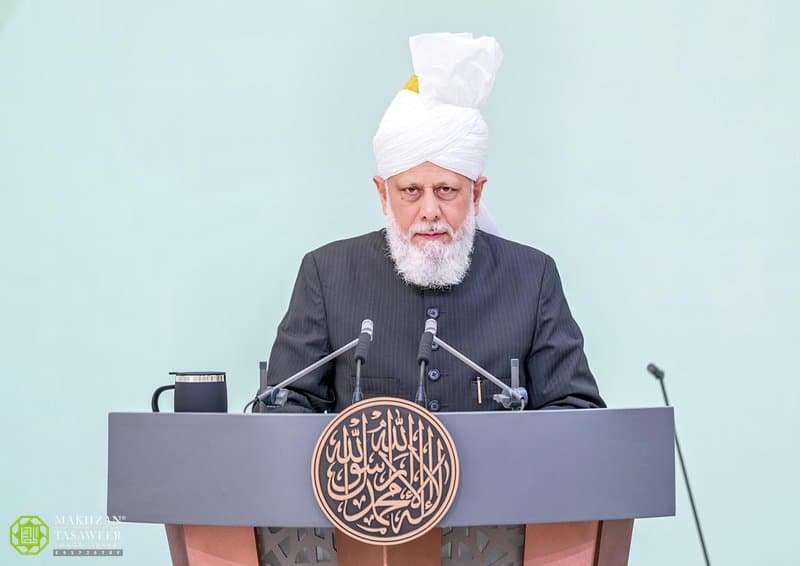
After reciting the tashahhud, ta’awwuz, and Surah al-Fatihah, Hazrat Khalifatul Masih V (aa) stated:
By the grace of Allah the Almighty, the Jalsa Salana UK commences today. Guests from every corner of the country and from various nations across the world are arriving or have arrived or are arriving to participate in this Jalsa. All of them are guests of the Promised Messiah (as), who have come here for a special religious purpose. Therefore, to serve these guests is itself a matter of great honour.
By the grace of Allah the Almighty, wherever Jalsa Salana is held throughout the world, children, youth, men, and women alike are aware of their responsibility to serve the guests of the Jalsa. With this spirit, they willingly offer themselves as volunteers for this service. Despite the fact that the priorities of the world have changed, the sincere members of the Jamaat continue to present themselves for the service of the guests of the Promised Messiah (as). As I have said, from children to the elderly, and from those engaged in various worldly occupations, people take leave from their work during these days in order to dedicate themselves to this service.
These are the people who truly comprehend that Allah the Almighty has commanded believers to honour and respect their guests. The Holy Prophet (sa), both through his practical example and sayings, repeatedly exhorted his followers to fulfil this obligation. Likewise, the Promised Messiah (as) had drawn attention to this matter time and again.
Allah the Almighty commands us to fulfil the due right of the traveller. (The Holy Quran 17:27) Similarly, the Holy Quran records the example of the Prophet Abraham (as); when guests came to him, he did not first ask whether they wished to eat. Rather, he immediately arranged for a calf to be slaughtered, had it roasted, and then placed it before his guests. (The Holy Quran, 11:70)
Similarly, it is narrated in a Hadith that the Holy Prophet (sa) said: “Whoever believes in Allah and the Last Day should honour his guest and fulfil the rights owed to him.” It was asked, “What is the due right of a guest?” The Holy Prophet (sa) said, “It is to extend hospitality for one day and one night.” In another narration, he instructed that a guest should be shown hospitality for three days. (Sahih al-Bukhari, Kitab al-adab, Bab ikrami d-dayfi wa khidmatihi iyyahu bi-nafsih)
This instruction applies to special guests who visit people’s homes and stay for a few days. But generally, whenever someone comes as a guest, Muslims are commanded to extend hospitality to them. However, the guests who are arriving during these days of Jalsa have undertaken long journeys. They have travelled from distant countries, and many of them will remain for more than three days. Under the arrangements of the Jamaat, they are hosted for as long as they stay – whether for two or three weeks or even up to four weeks.
It is indeed a great favour of Allah the Almighty upon the Jamaat that it has such a large number of workers available to serve these guests. These are not paid employees; rather, volunteers willingly dedicate themselves to this service for three or four weeks. In fact, the arrangements for hospitality in the United Kingdom have now become so vast that the Langar [community kitchen] of the Promised Messiah (as) operates throughout the entire year. Many individuals who have their own businesses – some who own restaurants and others who run catering services – regularly devote a portion of their time throughout the year to serving the guests.
The Jamaat in the United Kingdom has also been granted this unique distinction because Khilafat is headquartered here. Owing to the presence of the Khalifa of the time, there is a constant flow of visitors, making the duty of hospitality an ongoing responsibility. Thus, the general hospitality continues throughout the year. By the grace of Allah, members of the Jamaat fulfil this responsibility in an excellent manner. May Allah the Almighty reward them all.
In addition to the workers, many others also render valuable service as volunteers, as I have already mentioned. Nevertheless, these are the days of Jalsa, and during this time we should pay particular attention to caring for the guests. As the Holy Prophet (sa) instructed, every guest must be treated with complete honour and respect. This is essential, for it is a requirement of our faith – a requirement of true belief in Allah and the Last Day.
Indeed, one of the requirements of faith is for a believer to be hospitable, possess noble morals, and treat their guests with kindness and courtesy. Therefore, these days present a great honour for the thousands of volunteers who have been granted the opportunity to serve, including girls and women, boys and men, the elderly and the young alike.
All of them should always remember that this honour can only be truly fulfilled when they discharge the rights of hospitality. They should treat every guest with dignity and respect, conduct themselves with kindness and good manners, and remain mindful of the feelings and sentiments of every guest.
The Promised Messiah (as) has stated that the sentiments of a guest are extremely delicate; therefore, one should always remain mindful of them. (Malfuzat [2022], Vol. 5, p. 111)
Hence, we must never forget that it is our duty to serve the guests in every possible way. If we have presented ourselves for this service, then we should strive, to the best of our abilities, to fulfil this responsibility solely for the sake of attaining the pleasure of Allah the Almighty and so that in return for this service, Allah the Almighty may be pleased with us, and we may fulfil, to the best of our abilities, the rights of serving the guests of the Promised Messiah (as).
The hospitality extended by our workers and indeed the overall arrangements made for the Jalsa leave a profound impression upon non-Ahmadis and non-Muslims. They are amazed to witness food being prepared for thousands of people entirely by volunteers. They also observe how, through a well-organised system, meals are served efficiently, and every effort is made to care for the guests.
Furthermore, they witness the comprehensive system of volunteer service that operates throughout the Jalsa. There are arrangements for traffic management, food serving, cleanliness, cooking, water supply, and numerous other departments. By the grace of Allah, volunteers of the Jamaat are serving in all of these areas. Not only are they rendering service, but by the grace of Allah, they are doing so in an exemplary manner. Those from outside the Jamaat are deeply impressed by what they see. This, too, serves as a means of tabligh [propagation of the message].
Therefore, every worker who has come to serve – whether experienced or serving for the first time – should remember that they have come to serve the guests of the Promised Messiah (as). They should, therefore, make every effort to fulfil this responsibility in the best possible manner and discharge the rights of the guests. This is an essential part of one’s faith.
There is a narration which shows the degree to which the Promised Messiah (as) used to serve guests or had them taken care of. It is mentioned in a narration that the Promised Messiah (as) was exceptionally hospitable towards guests. Hafiz Hamid Ali Sahib had been appointed to care for guests at the Langar. The Promised Messiah (as) would draw his attention towards taking special care of the guests and serving them according to their status as guests on ordinary days. (Zikr-e-Habib, Hazrat Mufti Muhammad Sadiq [ra], p. 153)
By the grace of Allah the Almighty, members of the Jamaat visit throughout the year, and according to its means, the Jamaat serves them. However, they cannot be taken care of to the same degree during the days of Jalsa, during which time there is a general standard of hospitality. Therefore, in this regard, a great deal of care and attention is required.
A Companion says, “It was around 1902 when I undertook the journey from Eminabad to Qadian. I was waiting at the Lahore station to go to Qadian, where I met a friend, and we both started towards Qadian. It rained heavily along our way, and the rain became torrential when we reached Batala. We disembarked at Batala and hired a carriage and headed towards Qadian. When we reached near Qadian, the rain stopped.”
He says, “We reached Qadian, and we were both immediately given a room upon the instruction of the Promised Messiah (as), which these days (at the time when he was narrating this incident) serves as the bookshop.” He says, “The next morning we were given an excellent breakfast, and the menu was quite elaborate. The Promised Messiah (as) repeatedly asked Shah Sahib (the other guest who accompanied him) to let him know if he experienced any discomfort and enquired if he had experienced any inconvenience. He would ask the other guests this same question.” Thus, the Promised Messiah (as) extensively honoured his guests and did so to the highest degree. (Riwayat Ashab-e-Ahmad, Vol. 2, p. 155)
Similarly, Manzoor Ahmad Sahib from Bhera writes: “My respected father had been an Ahmadi for quite some time. He and his mother went to Qadian to meet Hazrat Khalifatul Masih I (ra) for the first time in 1894, and it was then that he, along with his mother, accepted Ahmadiyyat as well.” He says, “My grandfather taught the First Khalifa (ra) when he was young, and my grandfather’s third wife was the adopted sister of Hazrat Khalifatul Masih I (ra).”
He says, “I asked my respected father if he remembered any incident from the times he used to visit Qadian. He related, ‘One day, eight of us went to the Mubarak Mosque to have lunch with the Promised Messiah (as), which was in its original state at the time. We ate in the mosque. It was a small mosque at the time. There was nowhere to seat the guests, and so the Promised Messiah (as) would seat them in the mosque itself. One row would fit eight to 10 people. Hazrat Khalifatul Masih I (ra) was also part of this gathering.” He says: “There were two types of curry that were cooked and brought from home; both contained meat. Every so often, the Promised Messiah (as) would keep taking pieces of meat out from the curry on his plate and place them in the curry that the others were eating.” Any time he came upon a piece of meat on his plate, he would say: “Upon observing this, Hazrat Khalifatul Masih I (ra) would do the same for the sake of the guests.”
Sometimes the guests would express their desire for something. Once, a guest expressed his desire during a meal to eat mangoes. The Promised Messiah (as) remarked that eating mangoes alongside a meal was indeed a good idea that he had thought of. Someone who was seated there, either amongst the guests or from among the locals, asked whether he should go to the market and bring some mangoes. The Promised Messiah (as) said no and told him to remain seated.
A short while later, a parcel arrived in which someone had sent eight mangoes. There were eight men, and the parcel contained eight mangoes. The Promised Messiah (as) gave a mango to each of them. He took his own mango, cut it into pieces, and distributed it among the people, continuing to show them hospitality. (Riwayat Ashab-e-Ahmad, Vol. 2, pp. 204-205)
Similarly, Hazrat Badaruddin Sahib from Malerkotla says: “One day, this humble one was drawing water from the boarding well along with his father. It was nine o’clock in the evening, and the Isha prayer [late evening prayer] had already been offered. The Promised Messiah (as) came to the well holding a bowl containing milk and bread and said to my father, ‘Elder, is there any hungry guest?’ Upon this, my father replied, “Your Holiness, Mian Najmuddin has gone around to ask, and everyone has eaten.’
“Upon this, the Promised Messiah (as) said, ‘Alright, then come with me.’ So, we both went along with the Promised Messiah (as). When we reached the guest house and enquired from them, we did not find anyone [who was hungry], as they had all eaten.” He says: “There was a shop there belonging to Sher Muhammad which was still open, and so we went there and found someone who said, ‘Your Holiness, I wish to have some milk and bread.’ Upon this, the Promised Messiah (as) presented the bowl to him.” (Riwayat Ashab-e-Ahmad, Vol. 3, p. 285)
Allah the Almighty wished to feed him from the hand of the Promised Messiah (as), and he also happened to be in need. Allah the Almighty inspired the Promised Messiah (as) to feed the guests, and so the Promised Messiah (as) went to serve that guest.
There are many incidents like this found in the life of the Promised Messiah (as) exhibiting the Promised Messiah’s (as) hospitality during ordinary times. This was in light of the teachings to treat guests with dignity, respect, and honour; to feed the hungry; and to feed the needy, as commanded by Allah the Almighty.
Similarly, Hazrat Dr Hashmatullah Sahib says while relating his own incident:
“On the occasion of Jalsa, I was to attend a meeting one night of Sadr Anjuman, as I was a Jamaat secretary. The meeting was to take place after the Jalsa proceedings and the Maghrib and Isha prayers.” This meeting was only for office bearers of the Jamaat.
He says, “The meeting was going to take place in the Mubarak Mosque after the Maghrib and Isha prayers, and time was short, so I thought I would eat after the meeting, although I was very hungry and hadn’t eaten anything since eight o’clock in the morning. But since I owed an obligation to the Jamaat, I thought that I would eat later on.
“When the meeting finished, it had gotten late, and I arrived at the Langar when it was 11 o’clock, and I was extremely hungry.” He says: “When I went to the members of my Jamaat and asked them about the food, I learned that the food had finished.” He says, “A friend went and brought a piece of bread back from the kitchen table, saying that since the Langar had closed, I should eat the piece of bread and get by on that.”
He says: “So, I began eating the bread. I had not yet finished eating it when there was a loud knocking on the door to our room. Someone was loudly knocking and said, ‘If there is any guest who is hungry and has not yet eaten, he should go to the Langar to eat.’ This humble one’s fellows urged me to go, and upon reaching the Langar, I thankfully ate whatever was presented.”
He says: “The next day, at 10 o’clock in the morning, I saw the Promised Messiah (as) standing at the door of the small staircase of the Mubarak Mosque, and the workers in the alley were all facing him as the Promised Messiah (as) was speaking to them. Hazrat Maulvi Noor-ud-Deen (ra) was also present there. The Promised Messiah (as) was passionately advising that the food arrangement for the guests should be of a good standard because, during the previous night, Allah the Almighty revealed to him:
یٰاَیُّھَا النَّبِیُّ اَطْعِمُوْا الْجَائِعَ وَالْمُعْتَرَّ
“‘O Prophet, feed the hungry and the distressed.’ Hence, I came to learn that the cause for me being awoken in the middle of the night by the knocking at the door and someone offering food was this very revelation in which Allah the Almighty informed the Promised Messiah (as), as a result of which he sent food.” (Taken from Riwayat Ashab-e-Ahmad, Vol. 4, pp. 155-156; Tadhkirah, p. 631)
These were the pious people whose distress as a result of hunger was perceived by Allah the Almighty, Who then informed His Prophet. At that time, they had the means to make arrangements. Here, the administration of our Jalsa should ensure they remain mindful of the fact that for guests who arrive late – as some arrive late after travelling from far distances, or there are those travelling from Europe and their ferry may have been delayed, their flight may have been delayed, or they may have gotten stuck in traffic along the way – there should be food arrangements made for them. However, care should be taken to ensure that the food remains in good condition. The food should not go bad due to the heat and be served spoiled, causing someone to become ill. The hospitality of guests should be tended to in this way as well; they must be taken care of, and it should be ensured that they are presented with food of excellent quality.
Once, the Promised Messiah (as) said that all the guests should be presented with the same type of food. In other words, the attendees of Jalsa should all be presented with the same food without any distinction. Upon this, Khawaja Sahib, or someone else, said that some of the attendees are poor, who do not even eat lentils in their own homes and merely eat bread with chutney. Therefore, it would not be unbecoming to present them with lentils at the Jalsa, and there was no need to cook meat curry for them. There would be no harm if they were fed lentils, and there was no need to prepare meat curry for them.
The Promised Messiah (as) said: “Even if they do not have lentils in their homes, when they see others eating meat or pulao, they too will desire to eat it, and their feelings will be hurt on account of not being able to have it.” It would be disappointing to see some guests sitting to one side eating meat while others are told to eat lentils. This cannot be. The Promised Messiah (as) said: “Whether poor or rich, I have the same connection with all of my followers.” (Riwayat Ashab-e-Ahmad, Vol. 4, p. 65)
Therefore, prepare the same kind of food. If meat or pulao is prepared, then it should be presented to everyone, and if lentils are prepared, then that should be presented to everyone.” If the means are not available and lentils must be presented, then they should be presented to everyone rather than some people being given meat while others are given lentils.
Such was the Promised Messiah’s (as) conduct, methods, style of imparting advice and manners of hospitality.
Hazrat Chaudhry Abdur Rahim Sahib similarly narrates that on one occasion the Promised Messiah (as) gave me five hundred rupees and said: “The arrangements for the Jalsa are in your hands, but bear in mind that all guests are to be treated in exactly the same way, and one and the same meal is to be prepared for everyone.” Under ordinary circumstances, various dishes would be cooked, as I mentioned, but for those days he said only one dish would be prepared. Some people suggested that Hakim Fazl Din Sahib was more experienced and that the responsibility should be handed to him, as he would manage it better, but the Promised Messiah (as) made no reply to this and told Chaudhry Abdul Rahim Sahib to proceed with the arrangements himself.
He says that during this time, Khawaja Kamaluddin Sahib came to me and said: “Have rice prepared for me, since the Promised Messiah (as) has put you in charge of the food.” I told him: “I have also been commanded by the Promised Messiah (as) that the same meal is to be prepared for everyone. So, if you wish to have rice, you should seek permission.” Khawaja Sahib replied: “What do you mean, seek permission for rice?” I said: “Then I cannot give you so much as a grain of rice without the Promised Messiah’s (as) permission.” At this, he was greatly displeased, and he says that Khawaja Sahib remained upset with him for the entire duration of his stay. (Riwayat Ashab-e-Ahmad, Vol. 2, p. 333)
In any case, guests too should bear this in mind: whatever is served under the arrangements of the Langar should be eaten with patience and gratitude. When you have come here at the call of the Promised Messiah (as), and you have come for the purpose of receiving spiritual nourishment, then your attention should be directed primarily toward that spiritual nourishment. If the food falls a little short in some way, it should be borne with good grace and without any demands.
Some people, even without making excessive demands, make their way to the bazaar and try to eat there, and those stalls end up staying open late into the night, which creates difficulties for the administration. Given the current conditions, and particularly the dry weather, cooking outdoors late at night – at a time when some departments of the administration have already wound down, and full supervision is no longer in place – can become unsafe. Guests should therefore be mindful of this and, for these three days, eat whatever is available with patience and gratitude, without giving voice to any displeasure about the food or refusing to eat it.
Alongside this, I also want to say that food should never be wasted. Take only as much as you can eat. And as I have said, the real purpose for which we have come to the Jalsa is spiritual nourishment, and it is toward the betterment of our spiritual lives that our attention must be primarily directed. By the grace of Allah, food will be provided anyway. For three days, a person can manage perfectly well on patience and gratitude, even with less food, or simpler food, or food that is not entirely to one’s taste.
Similarly, Sheikh Zainul Abidin Sahib says that in the time of the Promised Messiah (as), special care was taken in providing food for guests, and under ordinary circumstances he was always particularly attentive to the comfort and hospitality of visitors.
He says: My brother Hafiz Hamid Ali narrated that on one occasion – most likely at the time of the Jalsa Salana – four large pots of rice had been cooked; in those days, even four pots were considered a great deal. Two were of zardah [sweet rice dish] and two of pulao [rice and meat dish]. Early one morning, the Promised Messiah (as) went to the kitchen and told the cook to lift the lid, as he wished to inspect the rice. When the lid was lifted, the smell did not seem right to him; there was a rancid odour coming from it. He then examined the other pots as well and said: “Both pots of sweet rice are not fit to be eaten. Throw them into the pond. They are not fit for human consumption.”
The Promised Messiah (as) then said: “If the smell is not pleasant to me and the taste seems off – both the flavour and the odour are such that it is hard to bear – then how will the guests find it acceptable? It cannot be that I feed the guests something I myself would not eat. Throw it into the pond and be done with it. The animals will eat it there.” (Riwayat Ashab-e-Ahmad, Vol. 1, p. 103)
This was the care and vigilance of the Promised Messiah (as). Those workers whose duty it is to prepare food should therefore be just as vigilant, particularly in these days given the hot weather. As I have already mentioned, food must be properly stored and not left sitting for long periods, and in particular, lentils and similar dishes which spoil quickly should not be kept for hours and then served to guests. Remain mindful about this, and always check the food thoroughly before it is served.
The same applies to all the other departments. Workers in every department should make every effort to tend to the comfort of guests as best they can, whether in the sanitation and cleaning of bathrooms, traffic management, parking, or security. Security is essential, but it should be carried out with care, courtesy, and respect. It is not the role of a security worker to adopt a manner that causes distress to a guest or leaves them feeling they have been spoken to harshly. We must be especially mindful of these things, and those responsible for maintaining order inside the Jalsa marquee should also exercise care and restraint in their approach, especially on the women’s side.
Likewise, I want to address the guests who have gathered here. We should reflect on the fact that having borne the difficulties of travel to come together here, there is a purpose behind it. Granted, the hardships of travel today are not what they once were in earlier times, but travel is travel nonetheless. Those who have come should bear in mind that they have come out of respect for the wishes of the Promised Messiah (as) and to fulfil the purpose of the Jalsa.
Having joined together in these three days, keep in view that the programmes of the Jalsa are to be listened to properly. These three days are not to be spent sitting around chatting idly or wandering about. Whenever a programme begins, come immediately into the main Jalsa marquee – or to wherever seating has been arranged for men, women, children, and the specific overflow area – and sit there and listen with due attention and respect.
Similarly, for the area set aside for women with young children, the women there should also sit quietly with their children and listen to the Jalsa proceedings. Sitting in the children’s area does not mean the women should begin chatting among themselves. Make every effort to speak only to quieten a child or keep one occupied. If a young child cries, do what is needed to settle them down. However, when mothers begin talking amongst themselves, it creates a general noise, and this should not happen, as it disturbs everyone else around them. Some complaints are also received to the effect that the children themselves make less noise, but the women start talking amongst themselves. Some seem to feel that since they are in the children’s marquee, conversation is permissible, but this is not the case. This arrangement exists precisely so that those without young children can easily listen to the Jalsa and so that the mothers themselves can also sit and listen comfortably. Thus, make every effort to keep conversation to the absolute minimum.
Likewise, although the bazaars are closed during Jalsa programmes, guests should also maintain discipline during the times when they are open, be vigilant, and take care that nothing occurs to disturb the atmosphere there. Purchases should be made with patience and composure. At times, there are long queues at a single stall, and waiting becomes unavoidable, but even then, people should exercise patience, restraint, and forbearance. Only then will you truly be fulfilling the purpose of the Jalsa. The Promised Messiah (as) described the kind of Ahmadis he wished to see, saying, become those who adopt righteousness and practise virtues, for without righteousness Allah is not pleased.” (Malfuzat, Vol. 6, pp. 298-299)
This, then, should be your real purpose in being here – to attain righteousness and to do so by sitting quietly and listening to the Jalsa attentively, both men and women alike. When this purpose is fulfilled, you will be able to draw genuine benefit from what is said at the Jalsa and from the very aim for which it is held.
And to that end, let everyone who has come here meet one another with love and warmth. Make a habit of exchanging greetings of peace – the entire atmosphere of the Jalsa should be one of assalamu alaikum [peace be on you] in every direction. When you meet one another after the programmes are over, do so with affection and kindness. If there are old grievances with anyone, set them aside. Make every effort to avoid any act that might sour the atmosphere.
Some people have little patience, and not everyone who comes is naturally even-tempered and forbearing; some people have very little capacity for restraint. But they should, in these days, work on cultivating that patience through righteousness, seek the pleasure of Allah, resolve personal grievances, or at the very least, not allow personal grievances to become a source of friction in the atmosphere or a burden upon the administration. Always remember: you came here for a noble purpose, and that is what you must fulfil. If that purpose is not served, nothing else will be of any use.
Arrangements for prayers are in place here, but those who are staying for an extended period and residing in the accommodation arranged by the Jamaat should also make a point of attending to their prayers regularly after the Jalsa programmes and should try to offer them in congregation. Those who are staying in tents or marquees during these days should know that Tahajjud [pre-dawn voluntary prayers] are also offered here during this period. When they are awakened for Tahajjud, they should rise. Give this special attention. Regular prayers go without saying, but Tahajjud in particular should be something you strive for, because this is at the very heart of what you came here for. When this is achieved, you will become those who reform their own lives and the lives of the generations that come after them.
I also wish to draw your attention to matters relating to parking. Follow the guidance of the administration when parking your vehicles, and at vehicle checkpoints, if there is a long queue, wait your turn with patience and composure, have your vehicle checked, and then proceed. Do not be in a rush. Guests should not become a source of difficulty for the hosts or for the administration.
Both guests and those on duty should also be particularly mindful, given the current climate of the country and the hostility and resentment that is sometimes found in certain non-Muslims toward Muslims, to keep a watchful eye on the surroundings. If anything or anyone appears suspicious, contact the administration immediately. And while seated at the Jalsa, keep an eye on one another as well.
These days, especially, and as I mentioned before, because the weather is very dry, there is also a risk of fire. Do not light any fire of any kind in your personal or shared accommodation, not even a match. If the need arises, contact the administration and go to the designated area where it is safe to light a fire. But avoid any kind of spark in any other location, and exercise great caution, because a serious accident could result.
As I also mentioned to the workers yesterday, those with older vehicles should take care as well. Many guests have older cars whose engines overheat, and if they are parked on grass, there is a risk of fire. Similarly, some older vehicles have oil leaks. Such guests should take precautions, and when parking, you should inform the administration of the issue so that their vehicle can be directed to a safe spot.
You must also maintain cleanliness. While the administration does its best to keep the toilets and facilities clean, guests too should leave the bathrooms clean after use, not leaving water running across the floor or leaving them in a messy state. Guests should make a particular effort to tend to cleanliness, in keeping with the Hadith, for cleanliness is part of faith, and it is precisely to strengthen our faith that we have come here. Thus, cleanliness must not be overlooked. During these days, everyone who is here should consider themselves a worker and give special attention to cleanliness so that the environment remains hygienic.
Turn your attention to raising the standard of your faith. In these days, place greater emphasis on the remembrance of Allah. In your free moments, wherever you are sitting, direct your attention to Durood Sharif [prayer for sending salutations upon the Holy Prophet (sa)], supplications, and seeking forgiveness. Instead of idle conversation, engage in the remembrance of Allah or in religious discussion. There are also a number of exhibitions on display during these days. You should all go and visit them and look at them with interest and reflection. These exhibitions will benefit you – both in terms of knowledge and in terms of faith. If all of this is tended to, then by the grace of Allah, you will be those who draw the fullest benefit from this Jalsa.
May Allah grant that all of you benefit from this Jalsa in every respect, be it spiritually, in matters of faith, and in terms of knowledge, and may the blessings of the Jalsa remain a permanent part of your lives and the lives of the generations that follow. And may you be among those who fulfil the very purpose for which the Promised Messiah (as) was sent.
This evening, insha-Allah, the Jalsa will formally commence. Listen to the opening address and to the addresses of all the other speakers, with full attention and reflection, and make every effort to act upon what you hear. May Allah grant everyone the ability to do so.
(Official Urdu transcript published in the Daily Al Fazl International, 14 August 2026, pp. 2-7. Translated by The Review of Religions.)