
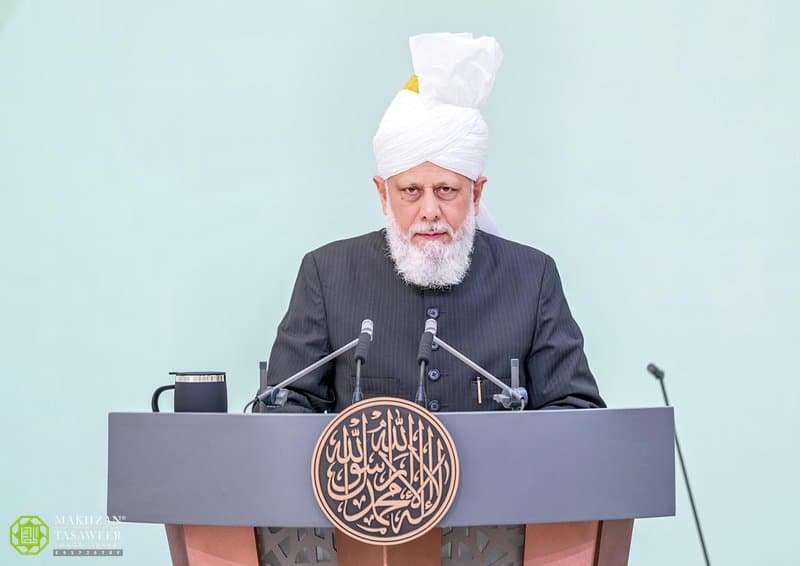
After reciting the tashahhud, ta’awwuz and Surah al-Fatihah, Hazrat Khalifatul Masih V (aa) stated:
Complying with the commands of Allah the Almighty and following the example of the Holy Prophet (sa), we find many accounts in the life of the Promised Messiah (as) of caring for the poor and of his generosity and munificence. These are found not only after his claim. Rather, even during the early years of his life and in his youth, we find incidents of his excellent moral qualities.
Furthermore, even when we look at the life of the mother, under whose care Allah the Almighty nurtured him, we find incidents of caring for the poor and of her generosity and munificence. In other words, he was raised by a mother who also taught him excellent morals. As such, whereas Allah the Almighty Himself instilled virtue in the nature of the Promised Messiah (as), he was also provided with a pious environment by his mother. As such, mentioning the generosity and munificence of the mother of the Promised Messiah (as), Hazrat Sheikh Yaqub Ali Sahib Irfani (ra) writes:
“Hazrat Mai Chiragh Bibi Sahiba (that is the revered mother of the Promised Messiah [as]) belonged to a distinguished and noble Mughal family from the village of Aima in the district of Hoshiarpur. Generosity, munificence and hospitality were deeply ingrained in her nature. She possessed all the lofty moral qualities that a woman of modesty and virtue should possess. She always remained cheerful and steadfast. She was extremely passionate about being hospitable and was extremely kind-hearted. Some of those who have witnessed her excellent moral qualities and hospitality are still alive.”
At the time when Hazrat Maulvi Yaqub Ali Sahib Irfani was writing this, some of them were still alive. He further writes:
“If she were informed that guests were arriving and that four people required food, she would send out food for more than eight individuals so that if more people had come and joined them, they could eat as well. She would be extremely delighted at the arrival of guests.”
He further writes, “She showed particular care for the poor and the weak in her town. One of her regular practices was to provide burial cloth for the impoverished who had passed away. (Whenever a poor person passed away, she would arrange for their burial cloth and burial.) In short, due to her compassion and assistance towards the poor, she became a caring mother for everyone.
“These qualities and virtues of the revered mother had a profound influence on the upbringing of the Promised Messiah (as). Since he was to become the head of a great [spiritual] family, Allah the Almighty made provision from the very outset for the development of these lofty qualities through her. That is, he was nourished under the care of such a loving and caring mother, who was an exemplary embodiment of compassion for mankind, hospitality and generosity.
“Thus, it may be said that he was nourished with these qualities along with the milk of his mother. Qualities of self-sufficiency, courage, bravery, and candidness were inherited from his respected father, while qualities of hospitality, generosity, and compassion for mankind were inherited by him through his revered mother.” (Hayat-e-Ahmad, Vol. 1, Part 2, pp. 217-218)
With regards to incidents relating to the generosity of the Promised Messiah (as) in his youth, Hazrat Mian Allah Yar Sahib relates that, when the Promised Messiah (as) was employed in Sialkot, his mother once sent him two sets of clothes along with some pinniyan [traditional homemade sweets] through an individual named Mangal Hajam.
Hazrat Mian Allah Yar Sahib relates that on his journey back, Mangal passed through their village and said to them: “When I delivered these items to Sialkot and presented them before the Promised Messiah (as), he said to me, ‘Take whatever share belongs to you and give me [only] my share.’ I replied, ‘Huzoor, these are for you. Your mother, Amma Jaan, has sent these for you.’ He said, ‘You have carried all these things such a long distance. As such, you must take half of it as your share!’ Accordingly, he gave me one set of clothes and some of the homemade sweets and said, ‘Convey this message to my mother that she should call me back home soon. My heart does not find peace here. People spend their lives engaged in wrongful practices, and my heart becomes distressed when I see them.’” (Riwayat Ashab-e-Ahmad, Vol. 2, p. 230)
Hazrat Mirza Bashir Ahmad Sahib (ra) narrates, on the authority of Hazrat Syed Zain-ul-Abidin Waliullah Shah Sahib (ra), that when I was in Sialkot, I had the opportunity to meet Mai Hayat Bibi Sahiba, daughter of Fazal Din Sahib, who was the respected mother of Hazrat Hafiz Muhammad Shafi Sahib Qari. Mai Sahiba explained that in earlier days, Mirza Sahib used to live in an upper room in the same neighbourhood adjoining our present house in Mahalla Jhanda Wala. When that house collapsed, Mirza Sahib moved to my father’s house in Mahalla Kashmiri.
She said that when he came to live in our house, I observed that he did not mix much with people in the household. She also mentioned that whatever salary Mirza Sahib received, he would distribute it among the widows and needy people of the neighbourhood. He would have clothes made for them or give them money directly, keeping only enough for his own food expenses. (Sirat-ul-Mahdi, Vol. 1, Part 3, Narration 625, pp. 594-595)
Hazrat Yaqub Ali Sahib Irfani (ra) writes that when we look at the life of the Promised Messiah (as) regarding generosity and charity, and reflect upon the incidents and circumstances we personally witnessed, it becomes clear that he had been granted an abundant share of this noble virtue. This manner of conduct was present in his life from the time he gained awareness (from his very childhood and youth).
It was not that after being appointed by Allah, such noble qualities appeared in him through effort or affectation. Rather, they were an inherent part of his nature.
At times, such qualities remained completely hidden, while at other times they manifested naturally in a way that others became aware of them. His general inclination, however, was that his good deeds should remain concealed. He desired for his good works to remain hidden. In the early period of his life, incidents of his generosity were usually hidden because he lived a secluded life and quietly showed kindness to certain individuals according to their circumstances.
But when Allah brought him before the public, appointed him, and people began coming to him in large numbers, his circumstances became public, and there emerged witnesses and narrators of these incidents.
He writes that he never turned away anyone who asked him for help. His life was a practical embodiment of the Quranic command:
اَمَّا السَّآئِلَ فَلَا تَنْھَرْ
“And as for the one who asks, do not rebuke him.”
Hazrat Maulana Abdul Karim Sahib (ra) relates that one day, after the Asr prayer, the Promised Messiah (as) stood up as usual and placed his foot at the window of the mosque to go inside. Just then, a beggar quietly said, “I am a needy person.” At that moment, Hazrat Sahib (as) had an important matter to attend to, and the man’s voice had blended into the voices of others who had risen after prayer and were talking amongst themselves as people often did after the prayer.
In short, Hazrat Sahib (ra) went inside. That is, he went in unaware of this and without paying attention. Even if the faint sound had reached his ears, his mind was occupied with the other matter, so he did not take notice, went in and didn’t turn around.
However, once he had gone downstairs, that same soft voice he had heard began to leave a deep impression on his heart. After going inside, he suddenly realised that he had heard someone say, “I am a needy person.” It affected him greatly. He quickly returned and called out to Khalifa Nooruddin Sahib, saying, “There was a needy person here – go and look for him.” There was a needy person; where has he gone?
But after Hazrat Sahib (as) had gone inside, the man had already left. Khalifa Nooruddin Sahib searched extensively but could not find him. Khalifa Nooruddin Sahib was a person from Kashmir.
In any case, he says that that evening, after the prayer, as was customary, the same needy man returned and asked again. Hazrat Sahib (as) immediately reached into his pocket, took something out and placed it into his hand. It appeared as though Hazrat Sahib (as) became relieved and happy – as if a burden had been lifted from him.
A few days later, he mentioned that on that day, when the needy man could not be found, his heart had felt such a burden that it caused him great restlessness. He feared that he had committed a failing by not paying attention to the needy person and by going inside too quickly. He said:
“I thank Allah that he returned in the evening. Otherwise, Allah knows in what state of anxiety I would have remained. I had also prayed that Allah the Almighty bring him back.” (Sirat Hazrat Masih-e-Maud [as], Part 2, pp. 285-286)
Similarly, Hazrat Sheikh Yaqub Ali Sahib Irfani (ra) writes in his biography that “near Qadian there was a small village called Sathiali, around six miles away. A Jatt faqir used to come from there, and many people are still alive who had seen him.
“He would sit beneath the roof of Masjid Mubarak near the window in the western wall of Bait-ul-Fikr and call out:
“‘Ghulam Ahmad, I want one rupee!’
“Then he would sit there.
“Sometimes the Promised Messiah (as) would be occupied with some work and deeply focused, so he would not hear him. The man would then keep calling out at intervals. Many people disliked this and thought, ‘Why is he sitting here troubling the Promised Messiah (as)?’
“If someone objected to him, he would reply, ‘Did I come to ask of you? I am asking Ghulam Ahmad (as).’
“If the Promised Messiah (as) came to know that someone had spoken harshly to him, he would dislike that. Smiling, he would give the man a rupee. It was also his practice not to keep a needy person waiting for long.” (Sirat Hazrat Masih-e-Maud [as], Part 2, p. 292)
Hazrat Chaudhry Abdullah Khan Sahib (ra) relates that once, while returning from a walk and entering the house, a dervish clothed only in a loincloth – Some faqirs wore such clothing as part of their spiritual discipline and way of life – called out:
“O Giver, O Giver! Give me something!”
Upon hearing this, the Promised Messiah (as) replied, “Allah is the Giver.” And with that, he went inside. He said “O giver”, but only Allah is the one Who grants.
The man called out again:
“Yes, Allah is indeed the Giver – but please give me something.”
At this, the Promised Messiah (as) sent something for him.
In any case, perhaps that man himself was not going to learn much from that exchange, but through this response, the Promised Messiah (as) taught his followers a lesson: that there should not be even the slightest trace of shirk [associating partners with Allah] in the way we speak. (Riwayat Ashab-e-Ahmad, Vol. 5, p. 298)
Hazrat Yaqub Ali Sahib Irfani (ra) writes that on one occasion, a beggar came to Qadian. He would make a round through the town every morning, reciting a poem by Hazrat Mir Hamid Shah Sahib (ra) whilst walking through the streets. Making a round means that he would walk around the village and its streets, reciting the couplet:
ہوا ناصر خدا تیرا مرے اے قادیاں والے
ہمیں بخشی اماں تو نے ہے اے دار الاماں والے
“God is your Helper, O inhabitant of Qadian.
“You have granted us peace, O inhabitant of the citadel of peace.”
He would recite this, and with it he would also recite the poetic verse:
ہر طرف فکر کو دوڑا کے تھکایا ہم نے
“I exhausted all my efforts in pondering deeply in all directions …”
He would recite this poem of the Promised Messiah (as). He would walk all around Qadian reciting this. Whenever he recited this second poem of the Promised Messiah (as), the respected Hazrat Maulana Abdul Karim Sahib (ra) was extremely displeased. He used to say, “This man is not worthy of this poem, because this poem expresses a reality and a condition (it is profoundly deep) which existed only in the person of the Promised Messiah (as). (The truth explained in this poem cannot be found in an ordinary person.) Whatever has been described in this poem, he would say that he could not bear to hear these verses from the mouth of anyone else, due to his sense of honour for the Promised Messiah (as), let alone an ordinary beggar wandering about reciting them. The fact that such a common beggar would recite these poems would make Maulvi Abdul Karim Sahib (ra) extremely upset.
Nonetheless, Sheikh Yaqub Ali Irfani Sahib (ra) says that this reflected the intensity of this honoured one’s love and devotion for the Promised Messiah (as). In any case, this beggar made a round within Qadian. It was the month of Ramadan, and during this period, the Promised Messiah (as) gave him a lot of charity on numerous occasions. Yet the beggar would continue saying, “Fill my bowl.” Thus, on the day of Eid, he came carrying a very large bowl. He spread a sheet near the entrance of the mosque and sat there. When the Promised Messiah (as) arrived, the beggar asked, “Fill my bowl.” The Promised Messiah (as) placed one rupee into it. As soon as that rupee was placed inside, it was as though a shower of rupees began to fall, and his bowl was filled with various coins. When the Promised Messiah (as) heard his request, he smiled gently and placed the rupee into the bowl. Following his example, those who believed in him also contributed whatever coins they could, and in this manner, the beggar’s bowl was completely filled. (Sirat Hazrat Masih-e-Maud [as], Part 2, pp. 292-293)
Hazrat Sheikh Yaqub Ali Sahib Irfani (ra) writes that when the Promised Messiah (as) travelled to Delhi for the final time in 1905, one day he intended to visit some of the shrines there. Someone remarked that, “Huzoor, along this particular route, there are so many beggars that it is difficult even to pass through”. The Promised Messiah (as) replied, “Today we shall go. We will give to everyone. (We will give charity to all those who are begging).” This was no ordinary promise and determination. He was actually prepared to give to everyone who asked. In reality, the number of beggars proved to be somewhat fewer than had been described, but whoever was encountered received an answer to his request in practical form. (He helped every single person he met). (Sirat Hazrat Masih-e-Maud [as], Part 2, p. 308)
Hazrat Hafiz Ahmadullah Sahib Nagpuri relates that, “One day the Promised Messiah (as) was seated in the round room, where approximately 20 to 25 people were present. He was delivering an address when a beggar arrived and loudly asked for charity.” He says, “I was very displeased, because he was interrupting the voice of the Promised Messiah (as), (Huzoor was speaking, and he interjected), so I got up and closed the door.
“The Promised Messiah (as) saw this. He stopped delivering his address and said to me, ‘Go, knock on the inside door and have something brought for this beggar.’ In other words, he asked, ‘Why did you close the door? Go inside, ask the household, bring something from there, and give it to this beggar.’ He brought something from the house and gave it to him [the beggar]. The Promised Messiah (as) remarked, ‘It was not good to close the door upon someone asking for help’ (this is very wrong, that the beggar asks from you and you close the door).” (Sirat-e-Ahmad, Qudratullah Sanuri Sahib, pp. 87-88)
Hazrat Babu Ghulam Muhammad Sahib (ra) relates that a minstrel who played the sarangi [Indian fiddle] came to the residence of the Promised Messiah (as) as a beggar. The Promised Messiah (as) gave him a four-anna coin. Just then, Mir Nasir Nawab Sahib (ra) arrived from upstairs. The Promised Messiah (as) had already gone inside. Seeing the man with the sarangi, Mir Sahib scolded him severely because he played a musical instrument and said to him, “Do not ever come here again.”
The following day, the same man returned. The Promised Messiah (as) came outside to give him something, but saw that the beggar had disappeared. He had apparently caught sight of Mir Sahib and remembered the scolding from the previous day, so he had run away. The Promised Messiah (as) instructed someone, “Go and look for that sarangi-playing beggar. Where is he?” Someone replied, “Huzoor, he has run away.” The Promised Messiah (as) said, “Then you also run after him and call him back.” Nonetheless, he returned. Seeing Mir Sahib, he became frightened. The Promised Messiah (as) then said to Mir Sahib, “Mir Sahib, what else can this poor man do? He does not know any other skill or occupation. (He doesn’t know anything else. What can he do? He plays the sarangi.) If you can teach him another skill or teach him a profession, then he will no longer play the sarangi.” (Arrange a job for him).
Later, in private, the Promised Messiah (as) said to the minstrel, “As long as you remain here, do not play the sarangi. Mir Sahib may strike you.” (He gets angry; he might hit you or may end up giving you a slap or two.) “Nonetheless, do not play your instrument here. Instead, quietly shake the chain, i.e., the door latch, and I will give you something.” Thus, for as long as he remained in Qadian, he received four annas every day from the Promised Messiah (as). (Riwayat Ashab-e-Ahmad, Vol. 4, p. 247)
Hazrat Syed Fazal Shah Sahib relates:
A faqir [mendicant] had the habit of going to the Promised Messiah (as) and asking for money. At times, he would say, “Give me one anna,” at other times, “Give me two annas,” and sometimes, “Give me eight annas.” In short, he would always ask for a specific amount. If the Promised Messiah (as) happened to be occupied with some work or conversation, the man would continue to repeat his request until he received what he had asked for. He would continue to persist in his request.
Over time, the Promised Messiah (as) became well acquainted with his habit. Whenever the man came and requested a certain amount, the Promised Messiah (as) would immediately give him something and would say:
“He simply will not leave without receiving this amount. Give him exactly what he is asking for.” (Sirat-e-Ahmad, Qudratullah Sanuri Sahib, p. 152)
Hazrat Sheikh Yaqub Ali Sahib Irfani (ra) writes:
“I came into the permanent service of the Promised Messiah (as) in 1898, although I had been visiting Qadian since 1892. During this period, I witnessed many people come to ask for financial assistance. I never once saw the Promised Messiah (as) give a beggar a copper coin (a paisa). He would always give a silver coin to anyone who asked for something.
According to the currency in use at that time, copper coins comprised one paisa, two paisas, and up to half an anna, whereas silver coins included one anna, two annas, and larger denominations, such as the four-anna coin. Although even one or two paisas possessed purchasing value in those days, the Promised Messiah (as) would ordinarily give one or two annas, or even more, in charity – amounts that were considered substantial. Indeed, it was not uncommon for him to give even an ordinary beggar one whole rupee.” (Sirat Hazrat Masih-e-Maud [as], Part 3, p. 308)
On one occasion, a non-Ahmadi faqir came before the Promised Messiah (as) and submitted that he wished to construct a well in a forest so that travellers might benefit from it and have water to drink. It is related that the Promised Messiah (as) gave him 200 rupees for this purpose, saying:
“Since you intend to undertake this work for the service of mankind, go ahead and have the well constructed. I shall provide you with the funds.” (Sirat Hazrat Masih-e-Maud [as], Part 3, p. 308)
Thus, while the Promised Messiah (as) exhorted the members of the Jamaat to serve humanity, he himself set the finest practical example of that teaching.
Hazrat Abdus Sami (ra), a companion of the Promised Messiah (as), relates:
“It was the occasion of Mian Sharif Ahmad Sahib’s Aqiqah, and all the guests were eating in the guest house. He was his third son among those who remained alive. Later, other children were also born who passed away in infancy, but Hazrat Mirza Sharif Ahmad Sahib (ra) lived a long life.
“On this occasion of his Aqiqah, the guests were gathered and eating their meal. The Promised Messiah (as) was also present among them.
“During the meal, a beggar entered the guesthouse seeking food. Some of those present attempted to drive him away. However, the Promised Messiah (as) personally served food to the beggar and instructed the others not to rebuke or turn him away. (Riwayat Ashab-e-Ahmad, Vol. 3, p. 239)
The Promised Messiah (as) said:
“If he has come to eat, do not scold him.”
He himself placed food on a plate and gave it to the beggar.
Hazrat Munshi Zafar Ahmad Sahib Kapurthalvi relates:
Once, a Maulvi came to Qadian and began to engage in a debate with the Promised Messiah (as). The Promised Messiah (as) began replying to him, and the Maulvi fell silent. The discussion was on the topic of whether Jesus (as) was alive or had passed away. This incident is from the early period [of the claim of the Promised Messiah [as]]. Whilst the Promised Messiah (as) was explaining to him the matter, he remained silent. Thereafter, the Promised Messiah (as) enquired, “Have you fully understood the arguments I have presented?” to which he replied, “Yes, I have understood them.” But then spoke in an extremely discourteous manner and said, “I have understood that you are the Dajjal [antichrist], (God forbid), because among the characteristics of the Dajjal is that he will silence others in his arguments.” That is, he will render them speechless. The Promised Messiah (as) again did not say anything and the Maulvi left.
Upon reaching Amritsar, the Maulvi published a public announcement and, citing this incident, stated: “Despite using such words, when he [i.e., the Promised Messiah [as]] went inside, I sent in a small note stating that I was in need. (Here he is admitting his lack of self-honour, and, at the same time, the kind treatment afforded to him by the Promised Messiah [as]). I sent in a small note stating I was in need and desired to be given something. Though I had used foul words against him, nonetheless, I was in need and requested to be treated with kindness.”
He further wrote that the Promised Messiah (as) immediately sent him 15 rupees. He said that the Promised Messiah (as) was extremely generous and even if a harsh word was said to him, he did not harbour any grievances against anyone. The Promised Messiah (as) did not mention to anyone that he had given him 15 rupees and it was only through this public announcement that people learnt that he had given him 15 rupees despite the harsh words he spoke. (Riwayat Ashab-e-Ahmad, Vol. 4, p. 216)
Hazrat Qazi Abdul Ghafur Sahib relates:
“In 1906, I travelled from Rawalpindi to Qadian with my elder brother, Hazrat Hafiz Murad Bakhsh Sahib. As the Promised Messiah (as) was descending the steps of the Mubarak Mosque, a gentleman – most probably Hazrat Hakim Shah Nawaz Sahib of Rawalpindi – presented him with a monetary offering of 17 pounds contained in a small pouch.
“The Promised Messiah (as) accepted the pouch and placed it in his pocket. At the foot of the steps stood a beggar, who asked for charity. The Promised Messiah (as) immediately took the same pouch out of his pocket and placed it into the beggar’s hands.
“When Hazrat Hakim Sahib witnessed this, he respectfully submitted, ‘Huzoor, that pouch contained 17 pounds.’
“The Promised Messiah (as) replied:
“‘They belonged to him, and they have now reached their rightful owner.’
“Having said this, Huzoor remained silent.”
At that time, 17 pounds represented a very substantial sum. One pound was approximately equivalent to 15 Indian rupees, making the total value around 255 rupees, in those days, when a meal could be purchased for only a few paisas. (Riwayat Ashab-e-Ahmad, Vol. 4, p. 290)
Hazrat Sheikh Yaqub Ali Sahib Irfani (ra) writes that giving charity and alms was deeply ingrained in the habits of the Promised Messiah (as), and generally it was his practice to set aside one-10th of his income for charity.
Regarding this, a narration from Hazrat Ummul Momineen (ra) has been recorded by Hazrat Sahibzada Mirza Bashir Ahmad Sahib (ra). He writes:
“My respected mother related to me that the Promised Messiah (as) used to give a great deal in charity, and he would usually do so in such a hidden manner that even we did not know about it.
“I asked her, ‘How much charity did he usually give?’
“My mother replied, ‘He gave a great deal. In his later years, whatever money came in, he would set aside one-10th of it specifically for charity and continue giving from that portion.’
“My mother further explained that this did not mean he never gave more than one-10th. Rather, he used to say:
“‘Sometimes expenses increase – guests come, there are expenses of the langar, and many other costs – so a person may become negligent regarding charity. But if the money for charity is separated beforehand, then negligence does not occur because that money cannot be diverted elsewhere.’
“My mother said that this was why he would separate one-tenth of all income in advance; otherwise, in actual giving, he often gave even more than that.”
Hazrat Mirza Bashir Ahmad Sahib (ra) further writes that he asked:
“Did he consider whether someone was Ahmadi or non-Ahmadi when giving charity?”
His mother replied:
“No. He never considered who was Ahmadi and who was not. If someone was in need, then he would give to them.” (Sirat Hazrat Masih-e-Maud [as], Sheikh Yaqub Ali Irfani Sahib, Part 2, p. 291)
Hazrat Sheikh Yaqub Ali Sahib Irfani (ra) writes that just as it was his habit never to turn away a person who asked, and just as he would often help those in need even without them asking, it was also part of his noble character that he understood even the subtlest forms of asking. In such situations, too, he would respond with generosity.
Sahibzada Siraj-ul-Haq Sahib relates that once someone sent a beautiful cap to the Promised Messiah (as). When the parcel arrived, coincidentally, a Hindu man was also present.
The Promised Messiah (as) opened the parcel, and the cap was there. The Hindu man greatly admired the cap.
As soon as the Promised Messiah (as) heard him praising it, he immediately gave the cap to him. (Sirat Hazrat Masih-e-Maud [as], Part 2, p. 290)
Hazrat Munshi Zafar Ahmad Sahib of Kapurthala relates that there was an Ahmadi named Haji Husain who returned from Hajj and brought with him a tasbih [rotary beads] made of genuine pearls. He presented it as a gift to the Promised Messiah (as). It was a tasbih of real pearls.
The narrator says:
“At that time, I and a friend from Sialkot were present in the company of the Promised Messiah (as). Haji Husain Sahib presented the tasbih before Huzoor. Huzoor said, ‘JazakAllah.’ The tasbih was very beautiful. I thought to myself that after Haji Husain Sahib left, I would ask for the tasbih. My friend from Sialkot had the same intention.
“When Haji Husain Sahib departed, the friend from Sialkot submitted, ‘Huzoor, this tasbih is very beautiful.’
“The Promised Messiah (as) replied, ‘If you like it, then you may have it,’ and handed it to him.
“I then submitted, ‘Huzoor, I had also intended to ask for it.’
“Huzoor smiled and said, ‘Then the two of you should divide it equally between yourselves – take one half each.’
“Later, the friend from Sialkot said to me, ‘Let me keep the tasbih. It has 100 beads anyway.’ I replied, ‘Very well, you may keep it,’” and so he gave it to him. (Ashab-e-Ahmad, Vol. 4, p. 215; Urdu Lughat, Vol. 11, p. 545)
Hazrat Hakim Allah Ditta Sahib relates that Sarfaraz Khan narrated:
“We came to attend the Jalsa and someone presented a horse to Huzoor (as). I thought to myself, ‘How wonderful it would be if that horse were given to me. I would take it home and tell people that I had brought back a horse belonging to the Messiah.’ It was a horse of a fine breed.
“When the Jalsa ended, I submitted, ‘Huzoor, I would like to return home.’
“Huzoor replied, ‘Wait.’
“On the third day, I made the same request again. This time, Huzoor (as) said, ‘Chaudhry Sahib, take this horse with you.’
“I submitted, ‘Huzoor, what is its price?’
“Huzoor replied, ‘Feed it grass and grain and ride it. That is its price.’ In other words, there was no price. ‘Take it and make use of it.’” (Riwayat Ashab-e-Ahmad, Vol. 1, p. 110)
Hazrat Malik Ghulam Husain Sahib (ra) relates that when Maulvi Abdul Rahman Sahib, who was later martyred in Afghanistan, came to visit the Promised Messiah (as), he brought many gifts with him, including a warm sheepskin coat.
After being informed of his arrival, the Promised Messiah (as) called him inside. He presented the gifts and the sheepskin coat. The Promised Messiah (as) expressed great pleasure and said:
“Maulvi Sahib, you have gone to a great deal of trouble.”
Maulvi Abdul Rahman Sahib replied:
“Huzoor, I have brought this sheepskin coat especially for you, and I would dearly like to see you wear it in my presence.”
The Promised Messiah (as) immediately stood up and put it on. It was a long fleece or coat, or whatever it was called, reaching down to the ankles. It was a long coat.
Later that evening, during a meal, Khwaja Kamal-ud-Din Sahib submitted:
“Huzoor, Maulvi Abdul Rahman Sahib has brought a sheepskin coat which is extremely valuable, warm and of excellent quality.”
Khwaja Sahib had already seen it.
The Promised Messiah (as) responded, “Khwaja Sahib, if you like it so much, then you should take it.”
Khwaja Sahib replied, “Huzoor, that is a great kindness.”
The Promised Messiah (as) then gave the sheepskin coat to Khwaja Kamal-ud-Din Sahib. (Riwayat Ashab-e-Ahmad, Vol. 4, pp. 14-15)
Hazrat Sheikh Yaqub Ali Sahib Irfani (ra) states that Hafiz Nur Ahmad Sahib, a pashmina merchant from Ludhiana – a pashmina is a type of woollen cloth – was among the Promised Messiah’s (as) old and devoted servants. He was a trader in woollen cloth and was among the sincere and devoted servants of the Promised Messiah (as). He once suffered severe financial losses in his cloth business, to the point that it was nearly ruined. As a result, he decided to move elsewhere and start a different business in order to rebuild his financial situation.
Throughout the life of the Promised Messiah (as), he remained in regular correspondence with him and served the Jamaat financially beyond his means and capacity.
He would say:
“As far as the generosity, giving, and benevolence of the Promised Messiah (as) are concerned, I can sum it up in one sentence: he simply did not know how to give a small amount.”
Relating a personal incident, he said:
“When my business collapsed, and I decided to travel elsewhere to start again, I requested some money from the Promised Messiah (as) as a loan so that I could establish a new business.
“Huzoor (as) brought out a cash box in which he kept money and placed it before me, saying, ‘Take as much as you need.’
“Huzoor (as) was pleased to give him this amount.
“I took only what was necessary for my needs, though Huzoor continued to say, ‘Take all of it.’
“The truth is that his attitude towards his friends was entirely different. In practice, he regarded his wealth as their wealth. In such matters, it would actually trouble him if a devoted follower showed any sense of hesitation.” (Sirat Hazrat Masih-e-Maud [as], Part 3, pp. 306-307; Feroz-ul-Lughat, p. 298; Lughat-ul-Farsi, p. 363, Dar Umar Farooq)
Hazrat Sheikh Yaqub Ali Sahib (ra) says: “Sheikh Muhammad Ismail Sahib Sarsawi has been my sincere friend and brother for 32 years, and is one of the longstanding servants of the Promised Messiah (as). From the very beginning, his temperament has been of a spiritual and saintly nature, and he has always been drawn to the company of the righteous. He has been a teacher at Madrasa Talim-ul-Islam from its earliest days to the present.
“In the early period, he was also the one who would feed and look after the guests – he might rightly be called the Nazir Ziafat [In-charge of Hospitality]. From the time he arrived in Qadian, the Promised Messiah (as) took particular care of him and personally assumed responsibility for all his needs – standing as guarantor, so to speak, for everything he required.
“On one occasion, Hazrat Nana Jan, the late Hazrat Mir Nasir Nawab Sahib, became very displeased with Sheikh Sahib – deeply displeased. He drew up a list of his debts, which included amounts owed to sweet-sellers, unaware that these had already been settled. The matter was brought to the Promised Messiah (as) – that Sheikh Sahib had run up such debts with the confectioners in order to keep the Langar Khana [community kitchen] running.
“On hearing this, the Promised Messiah (as) smiled and said: ‘I am well aware of this, and that debt has been cleared. Mir Sahib, please do not worry – whatever debt there is, it is settled every week without fail.’ The Promised Messiah (as) would clear Sheikh Sahib’s expenses on a weekly basis, or whenever required, and Sheikh Sahib would bring these matters to him with complete ease and familiarity – the way a son might approach his father, or indeed with even greater ease than that – simply saying: ‘Such-and-such an amount has been spent,’ and the Promised Messiah (as) would settle it at once. This was the kind of majestic and fatherly generosity that was his way. (Sirat Hazrat Masih-e-Maud [as], Part 3, pp. 310-311)
The expenses would certainly have included both personal costs and those of the Langar [community kitchen].
Hazrat Sheikh Yaqub Ali Sahib Irfani (ra) writes: “Hazrat Syed Fazl Shah Sahib was among the most devoted servants of the Promised Messiah (as). Shah Sahib was the elder brother of the respected Syed Nasir Shah Sahib. He had a deep love for the Promised Messiah (as) and eventually migrated to Qadian, where he lived in the Dar-ul-Dhu’afa.
The incident in question dates to July 1900, when he was in Qadian. On 6 July 1900, he sought permission from the Promised Messiah (as) to depart, and also requested that he write a few words of counsel. He further asked for some medicine and a shirt. At the time, the Promised Messiah (as) was suffering from a severe attack of vertigo and had been unable to attend the prayer – yet despite the intense pain in his head, he wrote a letter of counsel in reply to Shah Sahib’s note, and gave him both the medicine and the shirt.
This incident stands as testimony to the fact that even in the most acute states of illness, he remained ready to fulfil the legitimate requests of his servants, and thought nothing of his own discomfort when it came to the benefit and well-being of others.” (Sirat Hazrat Masih-e-Maud [as], Part 3, pp. 307-308)
Hazrat Sheikh Yaqub Ali Sahib Irfani (ra) writes: “From the Promised Messiah’s (as) way of conduct, it is also evident that he would at times participate generously in the joys and celebrations of his friends – and this was a reflection of his love, his open-heartedness, and his kindness. The letters he wrote from time to time to Hazrat Munshi Abdullah Sahib Sanori, as well as Munshi Sahib’s own account, bear witness to this: on one occasion, at Munshi Sahib’s walima [marriage dinner], and on another, at the Aqiqah of his son, the Promised Messiah (as) contributed from his own pocket – and in doing so, he felt genuine joy and delight.
“There were times when people would send a sum of money for such occasions, writing to request that a gathering be hosted at Qadian on their behalf – not realising, in the moment of writing, that a gathering at Qadian was never a small affair. The Promised Messiah (as) was always surrounded by a great many people, and the sum sent was invariably too little to cover the cost. Yet he never wrote back about the shortfall. Instead, he would quietly add from his own means to make up the difference and fulfil his friend’s wish. Such situations arose time and again, yet he never mentioned it – not by hint, not by implication – and on every such occasion he would simply say: ‘This is a feast on behalf of such-and-such a friend,’ without once letting on that he himself had contributed.” (Sirat Hazrat Masih-e-Maud [as], Part 3, p. 310)
There were occasions, however, when he would express it – he would tell those who were close to him that the money sent had fallen short, and that he had made up the rest himself.
In one letter to Hazrat Munshi Abdullah Sahib Sanori, written on the occasion of his wedding, the Promised Messiah (as) wrote: “Congratulations on your marriage. On Friday, in accordance with your letter, a walima feast was hosted in your name for the guests – for there were a great many of them, and Seth Sahib – that is, Abdul Rahman Sahib Madrasi – and Sheikh Rahmatullah Sahib and many other distinguished guests were present, numbering upwards of 80. You had sent 10 rupees, which was not sufficient. Thus, in honour of this happy occasion, I added 10 rupees from my own side, and had a proper meal prepared for 20 rupees – good food, pulao, zarda, korma and naan and so on.”
He went on to write that the guests were thoroughly pleased and, having eaten, offered prayers and good wishes on his behalf. The guests were told only that it was a feast from him – he did not mention that he himself had contributed. (Maktubat-e-Ahmad, Vol. 3, [Letter 60 addressed to Munshi Abdullah Sanori Sahib], p. 230)
In another letter to Hazrat Munshi Abdullah Sahib Sanori, written on the occasion of his son’s Aqiqah, the Promised Messiah (as) wrote: “Two rams were slaughtered – the meat was excellent. One large pot of meat pulao was cooked and one pot of sweet zarda rice with saffron and other ingredients. Bread and meat were also prepared. There were close to seventy guests and all were well looked after. By your good intentions, both the pulao and the zarda turned out beautifully. The total came to 24 rupees. Since I know you will not be in a position to send the full amount, if you wish to send half – 12 rupees – at some point, then you may.” The Promised Messiah (as) expressed great happiness over the celebration and conveyed warm congratulations. (Maktubat-e-Ahmad, Vol. 3, [Letter 65 addressed to Munshi Abdullah Sanori Sahib], p. 234)
Hazrat Ahmad Nur Kabuli Sahib narrates: “When I came to Qadian in 1902, the Promised Messiah (as) accepted my pledge of allegiance at the time of the Maghrib prayer that very evening. Of his own accord, and without any request from me, he gave me land for a home and arranged my marriage – also without any prompting on my part. Without my even being aware of it, he sent me off to my wedding reception along with a few companions. He also arranged for a sack of flour from his own community kitchen to be allocated for me on an ongoing basis, and gave instructions – to Maulvi Muhammad Ali Sahib – saying: “For as long as Ahmad Nur is alive, give him this flour at my expense. The cost of Ahmad Nur’s flour is mine to bear.” (Riwayat Ashab-e-Ahmad, Vol. 2, p. 307)
Mian Abdul Rahim Sahib relates:
“Once, I became gravely ill, to the extent that there was no hope of my survival, and I lay unconscious. At that time, while the Promised Messiah (as) was returning from a walk towards the village of Buttar, my paternal uncle, the late Mian Bakhsh Sahib, submitted in the Chowk of Mori Gate, ‘Your Holiness! Please come and see Abdul Rahim, for he is critically ill.’ Hazrat Khalifatul Masih I (ra), as well as several other companions, were accompanying the Promised Messiah (as).
“Out of sheer grace, His Holiness (as) came to our humble abode. Seeing me lying upon the charpoy, he gently shook my shoulder with his right hand and said, ‘Why are you afraid? You will not die.’ At these words, I opened my eyes. His Holiness then looked towards the roof of the house and said, ‘Abdul Rahim, you will not die from this illness. However, this old and dilapidated house is likely to be the cause of your death. The ceiling is in a very dangerous condition. When you recover, have it repaired.’ He then said to my mother, ‘Come with me and collect some medicine. Give it to him, and we shall also pray. God willing, he will recover.’
“My mother accompanied His Holiness (as) to his house, where he gave her three [small] packets of medicine wrapped in paper. I took the first dose that very morning, at about nine or 10 o’clock, and the second in the evening. After taking these two doses, I was able to sit up on the charpoy. I took the third dose the following morning, and merely by taking these three doses, my illness completely disappeared.
“In any case, after five or six days, I had fully recovered, apart from slight weakness. About a week later, I presented myself before His Holiness. I was still weak, and so I was helped upstairs. When I came before His Holiness, he asked, ‘Have you now recovered?’
“I submitted, ‘By the prayers and medicine of His Holiness, I have not had any fever or illness whatsoever since that day.’
“His Holiness then asked, ‘What has become of the house?’
“I submitted, ‘I remained ill for a month or six weeks, and I do not have a single penny with me. How can I repair the house? How can I replace the roof?’
“His Holiness replied, ‘We shall have it repaired.’
“He immediately summoned Maulvi Muhammad Ali Sahib and instructed him, ‘When you order timber for the rooms of the madrasah, also arrange timber for the roof of Abdul Rahim’s house and have it repaired. Whatever the cost may be, we shall pay it.’
“Accordingly, Maulvi Muhammad Ali Sahib sent the mason, Rukka Ram, to inspect my house and estimate the amount of timber required. He returned and informed Maulvi Sahib that 10 beams would be needed. Maulvi Muhammad Ali Sahib then submitted to His Holiness that the timber would cost 30 rupees. His Holiness immediately gave him 30 rupees, and my house was repaired.”
“He further says, “As for the additional expenses incurred on labour and other work, I do not know how much they amounted to. Those too were borne by the Promised Messiah (as).” (Riwayat Ashab-e-Ahmad, Vol. 4, pp. 174-175)
While presenting a general summary of the blessed character of the Promised Messiah (as) in Sirat Tayyibah, Hazrat Mirza Bashir Ahmad Sahib (ra) writes:
“Our respected elder maternal uncle, Hazrat Dr Mir Muhammad Ismail Sahib (ra), at my request, once wrote an article concerning the moral qualities and virtues of the Promised Messiah (as). In that article, he stated: ‘The Promised Messiah (as) was exceedingly compassionate and merciful. He was generous and hospitable. He was ‘Ashja’ al-Nas’ – the bravest among men. At times of trial, when the hearts of others would sink in fear, he advanced like a fearless lion. Forgiveness, overlooking the faults of others, generosity, humility, loyalty, simplicity, love of God Almighty, love for the Holy Prophet (sa), respect for the elders of the faith, fulfilment of promises, gracious social conduct, dignity, honour, courage, steadfast resolve, cheerfulness and a radiant countenance were among his outstanding moral qualities.’
“He further writes, ‘I first saw the Promised Messiah (as) when I was a child of two years, and he passed from my sight – that is, he passed away – when I was a young man of 27. Yet I swear by God that I have never seen anyone better than him, more noble in character, more righteous, more affectionate with the compassion of an elder, or more deeply immersed in the love of Allah and His Messenger (sa). He was a light that appeared upon the earth for the benefit of mankind and a shower of mercy that descended upon this world after a prolonged drought of faith, bringing it once again to life and verdure.’”
Hazrat Mirza Bashir Ahmad Sahib (ra) then adds his own testimony:
“This is also my own eyewitness testimony, exactly as Mir Sahib has described it.” (Sirat-e-Tayyibah, pp. 66-67)
May Allah the Almighty enable us also to embody those lofty moral qualities for the establishment of which Allah the Almighty sent him in perfect obedience to the Holy Prophet (sa).
(Official Urdu transcript published in the Daily Al Fazl International, 17 July 2026, pp. 2-8. Translated by The Review of Religions.)