
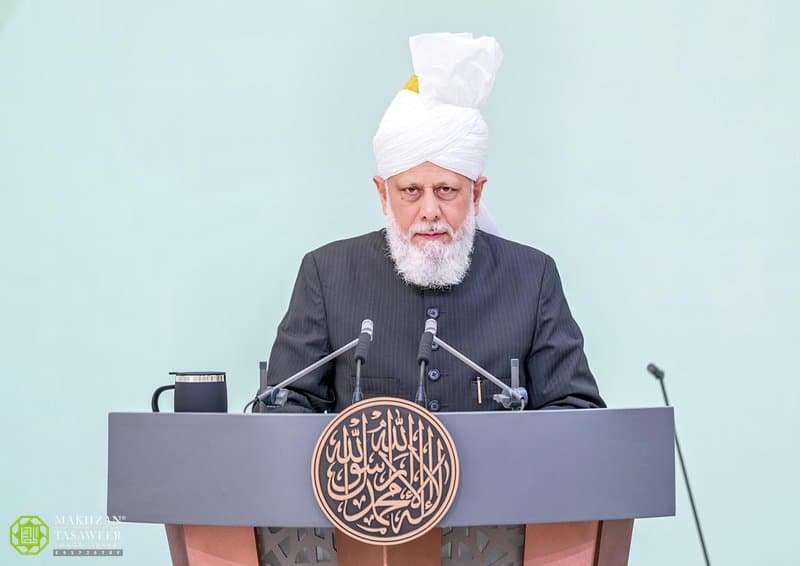
After reciting the tashahhud, ta‘awwuz and Surah al-Fatihah, Hazrat Khalifatul Masih V (aa) stated:
All Prophets came to the world to establish Tawhid [the Unity of God], and they imparted this teaching to their people. Unfortunately, however, most people abandoned this teaching. The Holy Prophet (sa) also brought the same message, and he came to advance the same mission: to instil the spirit of Tawhid within his followers. Furthermore, the status of the Holy Prophet (sa) in this regard is unmatched. Whenever he taught people to accept Tawhid, he presented arguments in support of doing so after having received knowledge from Allah the Almighty. When he strove against shirk [associating partners with God], he did not do so without any arguments. Rather, he explained the evils of shirk, and after doing so, he instilled in those people an aversion towards it. Moreover, his followers showed through their actions that the concept of Tawhid and an aversion to shirk had become deeply rooted in them.
This was because the teaching that Allah the Almighty revealed to the Holy Prophet (sa) was so comprehensive and impactful that once a person truly grasped its depth, it was impossible to turn away from it. This teaching of his, which greatly influenced his followers, was as impactful as it was because every word and deed of the Holy Prophet (sa) was a true reflection of it. He was an embodiment of the magnificent teaching that Allah the Almighty had given him.
His primary concern was that just as other nations had started worshipping their prophets, the Muslim Ummah would also adopt this grievous sin. And so, he sought refuge from ever being held equal to God Almighty. Moreover, he also taught this to his Ummah and instructed them to never make him a means of committing shirk. (Musnad Ahmad bin Hanbal, Vol. 3, Musnad Abi Hurairah, Hadith 7352, Alam al-Kutub, Beirut, 1998, p. 54)
He taught them to never cast their sights on anyone besides God Almighty. In the previous sermons, I discussed the topic of love for Allah and His worship. Every incident I related in this regard from the life of the Holy Prophet (sa) guides us towards Tawhid, and one can see his heartfelt passion and deep yearning for the establishment of Tawhid. On the one hand, this reflects his most elevated status in relation to establishing Tawhid, which Allah the Almighty had endowed him with since childhood, but alongside this, we also gain a deeper understanding of the perfect teaching of Allah the Almighty that was revealed to him.
In the Holy Quran, we have repeatedly been taught about Tawhid in various ways, just as Allah the Almighty states in chapter 21 (Surah al-Anbiya):
وَمَآ اَرْسَلْنَا مِنْ قَبْلِكَ مِنْ رَّسُوْلٍ اِلَّا نُوْحِيْٓ اِلَيْہِ اَنَّہٗ لَآ اِلٰہَ اِلَّآ اَنَا فَاعْبُدُوْنِ
“And We sent no Messenger before thee but We revealed to him, [saying], ‘There is no God but I; so worship Me [alone].’” (Surah al-Anbiya’, 21:26)
The method of worship which the Holy Prophet (sa) was taught and the manner in which he worshipped whilst fulfilling the due rights of Tawhid, was to such a degree that not even a fraction of it can be seen in any other religion. Then, Allah the Almighty says in the Holy Quran:
قُلۡ اِنِّیۡۤ اُمِرۡتُ اَنۡ اَعۡبُدَ اللّٰہَ مُخۡلِصًا لَّہُ الدِّیۡنَ
“Say, ‘Verily I am commanded to worship Allah, being sincere to Him in religion.’” (Surah az-Zumar, 39:12)
Thus, when a true Muslim reads this, he too will announce that he must worship Allah Almighty with complete sincerity, strive to establish the pure Oneness of God, and follow that model which the Holy Prophet (sa) established, in accordance with the command given in the Holy Quran. If, alongside the true establishment of the Oneness of God, we raise the standards of our worship, then we can bring about a true revolution. Otherwise, they are merely claims. Only then will we truly deserve to be deemed true believers in One God.
Then Allah the Almighty says:
وَاعۡبُدُوا اللّٰہَ وَلَا تُشۡرِکُوۡا بِہٖ شَیۡئًا
“And worship Allah and associate nothing with Him.” (Surah an-Nisa’, 4:37)
In another place, Allah the Almighty says:
وَاِلٰـہُكُمْ اِلٰہٌ وَّاحِدٌ لَآ اِلٰہَ اِلَّا ھُوَالرَّحْمٰنُ الرَّحِيْمُ
“And your God is One God; there is no god but He, and he is the Gracious, the Merciful.” (Surah al-Baqarah, 2:164)
Then, towards the end of the Holy Quran, Allah the Almighty proclaims the establishment of His Oneness:
قُلْ ہُوَاللّٰہُ اَحَدٌ اَللّٰہُ الصَّمَدُ۔ لَمْ يَلِدْ وَلَمْ يُوْلَدْ وَلَمْ يَكُنْ لَّہٗ كُفُوًا اَحَدٌ
“Say: He is Allah, the One. Allah, the Independent and Besought of all. He begets not, nor is He begotten. And there is none like unto Him.” (Surah al-Ikhlas, 112:2-5)
Here, Allah Almighty has declared the refutation of every kind of association of partners with Him and commanded the Holy Prophet (sa) to proclaim this to the world. Thus, as his followers who read this, it is also our duty to proclaim this pure Oneness of God, which is declared in this chapter and in many other places of the Holy Quran. And through both our words and our actions, we must show the world that Allah the Almighty alone is One, free from all need; rather, everything is dependent upon Him. He is neither anyone’s father nor son, and none can ever be equal to Him. This proclamation refutes the corrupted teachings found in all other religions. It is this very teaching, the proclamation of which enables a person to attain nearness to Allah the Almighty. The highest and loftiest example of this teaching is our master and leader, the Holy Prophet Muhammad (sa).
Every moment of his life was spent establishing the Oneness of God. In fact, as I mentioned earlier, from his very childhood, Allah the Almighty guided him for the establishment of pure Tawhid. I have only presented a few examples from the Holy Quran, whereas the Holy Quran is, in fact, replete with this message.
I will now present some incidents from the life of the Holy Prophet (sa), which exhibit how, from the time of his childhood to the time of his claim of prophethood, and indeed, throughout his life, he possessed a heartfelt desire and strove for the establishment of the Oneness of God. The nature of the Holy Prophet (sa) was so pure that love for Tawhid was instilled into every fibre of his being. And even before being raised to the station of prophethood, he naturally despised shirk and idol worship.
It is narrated by Hazrat Umm Aiman (ra) that Buwanah was greatly revered by the Quraish. They would visit it and offer sacrifices to it. Once a year, they would spend an entire day devoted to its worship. Abu Talib would go there with his people and would also desire to take the Holy Prophet (sa), but the Holy Prophet (sa) would refuse to the extent that on one occasion, his aunts and Abu Talib became extremely upset with him and said, “O Muhammad, what do you want? Will you not join your people in their festival and increase their gathering?” Eventually, upon the insistence of his aunts, he went to the idol, but soon returned in immense fear and said, “I witnessed a strange sight there”. His aunts said that Satan cannot afflict such a righteous person and asked what he had seen. The Holy Prophet (sa) replied, “Whenever I begin approaching the idol, a white-clad figure would loudly shout, ‘O Muhammad, stay back and do not touch this idol.’” After that, the Holy Prophet (sa) never again participated in any polytheistic festival, and Allah the Almighty always safeguarded him from such idolatrous customs. (Dala’il al-Nabuwwah, Baihiqi, Vol. 1, Dar Al-Kotob Al-Ilmiyah, Beirut, p. 138)
This was before his proclamation of prophethood. During his childhood, on a journey to Syria with his uncle Abu Talib, he met a Christian monk named Bahirah. In response to one of Bahirah’s queries, the Holy Prophet (sa) said, “Do not ask me about the idols Lat and Uzza. I swear by God, I do not hate anything more than I hate these idols.” (Dala’il al-Nabuwwah, Baihiqi, Vol. 2, Dar Al-Kotob Al-Ilmiyah, Beirut, p. 35)
When the Holy Prophet (sa) travelled to Syria with the trade goods of Hazrat Khadija (ra), he sold the merchandise and purchased other goods. During this journey, a disagreement arose between him and another man. That man said, “Swear by Lat and Uzza.” In other words, he told the Holy Prophet (sa) to swear by them and only then would he believe him. The Holy Prophet (sa) replied, “I have never sworn by these idols. Even when I pass by them, I turn my face away.” The Holy Prophet (sa) said that the man was telling him to swear by those idols, but how could he possibly do so? (Al-Tabaqat al-Kubra, Vol. 1, Dar Al-Kotob Al-Ilmiyah, Beirut, p. 124)
In pursuit of this very Tawhid, the Holy Prophet (sa) would go to the Cave of Hira, as I have mentioned before. His heart longed for the worship of the One God and the establishment of His Oneness. Hazrat Mirza Bashir Ahmad Sahib (ra) has described that in the following manner:
Cave Hira is located in a well-known mountain called Hira, which is located among the mountains near Mecca, about three miles from the city. Today it is called Jabal al-Nur. The Holy Prophet (sa) had an aversion to idols from the very beginning, but he was also greatly concerned for those who worshipped idols and distanced themselves from the One and Only God. He not only refrained from this himself, but also worried for those who worshipped idols. Before his advent, he would withdraw from the populated areas and worship in that cave.
When the Holy Prophet (sa) reached the age of forty, Gabriel appeared one day, and the first revelation was sent down upon him, through which God Almighty commissioned him. With that first revelation, the Holy Prophet (sa) began calling people toward the Unity of God and teaching against shirk [associating partners with God]. However, in the beginning, he did not openly proclaim his mission. Rather, he proceeded quietly and confined his teaching to those within his close circle. (Sirat Khatamun Nabiyyin, pp. 117 and 120; Farhang-e-Sirat, p. 101)
The Promised Messiah (as) states:
“Our Holy Prophet (sa) was the Greatest Reformer who brought the lost truth back into the world. No Prophet shares with our Holy Prophet (sa) the distinction that he found the entire world steeped in darkness, and he turned its darkness into light; nor did he die until the entire people among whom he appeared had shed the garb of shirk (polytheism) and put on the gown of Tawhid (belief in One God). Not only that, but they attained the highest levels of faith. They displayed such unprecedented sincerity, faithfulness and certainty as was not to be found anywhere in the world. No Prophet of God ever achieved such a kind and degree of success except the Holy Prophet (sa). The prime argument in favour of the Holy Prophet’ssa Prophethood is that he graced the world with his presence at a time when it was steeped in darkness and was in dire need of a great reformer, and he did not die before hundreds of thousands of people had abandoned shirk and idol-worship and had adopted Tawhid and the right path. None but the Holy Prophet (sa) could have brought about this great reformation. He taught human values to a people who were savages and brutes. In other words, he transformed brutes (or beasts) into men, men into civilised men, and civilised men into godly men. He infused spiritual qualities into them and established their communion with the True God. In His path, they were slaughtered like goats and trampled underfoot like ants, but they held fast to their faith and kept marching forward in the face of every hardship. Our Holy Prophet (sa) was undoubtedly the Second Adam by virtue of establishing spirituality in the world. Rather, he was the true Adam, as it was through him that all human virtues reached their perfection, all the forces for good became active in their respective spheres, and no branch of human nature was left fruitless. The finality of Prophethood in his person consists not only in his being last but also in the fact that all the perfections of Prophethood culminated in him.” (Lecture Sialkot, pp. 5-7)
In another place, the Promised Messiah (as) states:
“Countless thanks be to You, O Allah, for guiding us to the path that leads to You, and for saving us from errors of thought and reason by sending down Your Holy Books.
“We invoke blessings on the Chief of Prophets, Hazrat Muhammad Mustafa (sa) [the Chosen One], on his progeny and on his Companions. Through him, God guided an entire world that had lost its way to the right path. He was the teacher and the benefactor who led misguided people back to the right path; the benevolent and compassionate one who delivered people from shirk [polytheism] and the curse of idols; the light and the disseminator of light who illumined the world with the light of Tauhid [Oneness of God]; the healer and physician who enabled ailing hearts to tread the path of righteousness; the noble miracle-worker who revived the dead with the elixir of life; the merciful and compassionate one who suffered pain and sorrow for his Ummah [the Muslim people]; the valiant and the brave one who rescued us from the jaws of death; the humble and selfless one who bowed his head before his Lord in total submission and completely annihilated his self; the perfect believer in the Oneness of God and the ocean of knowledge who was overawed by nothing except the Majesty of God and saw everything beside Him as worthless; and the miracle of divine power who, despite being unlettered, surpassed all in respect of divine knowledge and brought home to all nations the errors and mistakes from which they suffered.” (Barahin-e-Ahmadiyya – Part I & II, pp. 25-26)
In yet another place, the Promised Messiah (as) writes:
“Tauhid, in its purest form, is not to be found among any people on the face of the earth except the followers of the Holy Prophet, may peace and blessings of Allah be upon him. And there is no book upon the earth, other than the Holy Quran, that has firmly committed millions to this holy doctrine and that leads mankind so reverentially towards the One True God. People of every religion have created artificial gods for themselves, whereas the God of the Muslims is the One, Eternal, and Immutable God, whose attributes are the same today as they were before.” (Barahin-e-Ahmadiyya – Part I & II, p. 138)
Alas, today even the followers of Prophet Muhammad (sa) are forgetting the honour of Tawhid, and true Tawhid no longer remains among them in the manner taught by Allah the Almighty and instilled with such pain and guidance by the Holy Prophet (sa). By neglecting pure Tawhid, even faith in the attributes of Allah the Almighty has weakened from what should characterise a true Muslim.
In such circumstances, it is the duty of those who claim to follow the True Servant of the Holy Prophet (sa) to understand the reality of Tawhid and to bring about special changes within themselves for its sake. This is the month of Ramadan, a month devoted to worship, and in it, special effort should be made and special prayers offered for this purpose.
If we claim love for the Holy Prophet (sa), then we must strive earnestly, as he did throughout his life, for the establishment of Tawhid.
By the command of Allah the Almighty, he endured hardships and pain in striving to establish the Unity of God. Elaborating on this, Hazrat Musleh-e-Maud (ra) states at one instance:
“In the Holy Quran, Allah the Almighty says to the Holy Prophet (sa):
اَنْذِرْ عَشِیْرَتَکَ الْاَقْرَبِیْنَ
“[‘And warn thy nearest kinsmen.’ (Surah ash-Shu‘ara’, 26:215)]
“O Muhammad, Messenger (sa) of Allah, warn the people in every corner of the world, but first warn your own relatives. For the rights you owe them are two-fold: one right is that, like the rest of the world, they too are perishing; and the other is that they are your kin, and their forefathers once treated you with kindness.
“There is also a well-known English proverb: ‘Charity begins at home.’ That is to say, charity and almsgiving begin within one’s own household. Likewise, the process of admonition and counsel should always begin at home.
“Accordingly, the Holy Prophet Muhammad (sa), fulfilled this command in such a manner that, according to the custom of Mecca, he stood upon Mount Safa and began calling out the names of various tribes. First, he summoned the tribe of Aal-e-Ghalib, and they came out of the Sacred Mosque and gathered at the foot of Mount Safa. At that moment Abu Lahab said to the Holy Prophet (sa), ‘The tribe of Aal-e-Ghalib has arrived; say whatever it is you have to say.’ The Holy Prophet (sa) paid no attention to his remark and called out to the tribe of Lu’ayy. When they arrived, Abu Lahab again said, ‘Now that the tribe of Lu’ayy has also arrived, tell us what you wish to say.’ Still, the Holy Prophet (sa) did not deem this statement worthy of attention and called for the Aal-e-Murrah, who also arrived.
“Then he summoned the Aal-e-Kilab and the Aal-e-Qusayy, until all the people had gathered. Those who could not come themselves sent messengers so that they might report back about why they had been assembled that day. When all the tribes of Mecca, including the Quraish, had gathered, the Holy Prophet (sa) began to address them and said:
“‘Tell me, if I were to inform you that behind this mountain a great army has assembled, intending to attack you, would you believe me?’
“They replied, ‘Of course! We would certainly believe you, for we have always known you to be honest and truthful.’
“Those familiar with the conditions of Mecca know that this question presented by the Holy Prophet (sa) was in reality akin to asking them to accept something that was impossible. The Meccans’ animals grazed in the valley, and it was a region in which it would have been utterly impossible for an army to remain hidden. Yet such was the impression of his truthfulness upon them that they declared: ‘Even if our eyes were unable to confirm it, we would still believe you, for your truthfulness is beyond doubt in our estimation.’
“When they unanimously expressed this conviction and trust regarding the Holy Prophet (sa), he said:
“‘Then listen. I bring you an important announcement. I have been sent by Allah the Almighty as His Messenger. Therefore, I tell you that if you wish to be saved from the punishment of Allah the Almighty, then follow me.’
“No sooner had he said this than Abu Lahab exclaimed angrily:
تَبًّا لَکَ سَائِرَ الْاَیَّامِ اَلِھٰذَا جَمَعْتَنَا
“Meaning – God forbid – ‘May you be Perished! Is this why you gathered us?’ And likewise others began to laugh and mock as they dispersed.” (Tafsir-e-Kabir [2023], Vol. 9, pp. 582-583)
Yet this ridicule and opposition did not deter the Holy Prophet (sa) from striving for the establishment of the Unity of God. He continued steadfastly in this effort.
As I have mentioned, ridicule arose, and opposition increased further. This opposition has been described by Hazrat Mirza Bashir Ahmad Sahib (ra), on the basis of historical works, in the following manner:
“His opposition was to be proportionally equivalent to the magnitude of his mission. Since the Holy Prophet (sa) was raised in an era when darkness was especially prevalent, and it was inevitable that upon the advent of light, the armies of darkness would contend their utmost; so it happened as such – in comparison to all the Prophets of the past, the Holy Prophet (sa) was faced with the most opposition. The primary causes as they appear for this opposition are as follows:
“Firstly, the people of the Quraish were idolaters of the highest degree. The honour and love of idols had become so impressed in their hearts that to hear even a word against them was unbearable. These wrongdoers had placed hundreds of idols in the Ka‘bah, which was built for the worship of Allah the Exalted alone. They would turn to these idols for all their needs. When Islam came, its principal foundation was the Unity of God; its clear commandment was not to bow one’s head before any human, tree, rock or star, etc. Rather:
وَاسْجُدُوْا لِلّٰہِ الَّذِیْ خَلَقَھُنَّ
“‘Prostrate yourselves before Allah, Who created them.’ [Surah Fussilat, 41:38]
“Furthermore, the words used to describe the idols of the Quraish in the Holy Quran appeared to the Quraish as very insulting, for they were declared the fuel of hell […] These statements had blazed a fire among the Quraish, and they stood up united to obliterate Islam.” (The Life & Character of the Seal of Prophets(sa), Vol. 1, pp. 186-187)
There were many other causes as well, but this was a major one.
The Promised Messiah (as) states:
“When a Prophet or Messenger comes from God, his followers are perceived to be a promising, truthful, righteous and progressive group that is likely to advance quickly. Pre-existing communities and religious sects inevitably begin to develop a certain kind of anger and jealousy towards them. Religious experts and leaders are particularly vocal about expressing such feelings because the arrival of a man of God leads to a change in their incomes and prestige. Their students and disciples begin to emerge from their trap because they find all excellent qualities of faith, morality and knowledge in the person who is from God. (The righteous and well-natured followers of other religious leaders become drawn to the man of God.) Those possessing sense and discrimination, therefore, begin to understand that these scholars do not deserve the respect that they had been previously accorded on the basis of educational accomplishment, piety and abstinence. Exalted titles such as Najm-ul-Ummah [Star of the Nation], Shams-ul-Ummah [Sun of the Nation], Sheikh-ul-Masha’ikh [Leader of the Honourable] and so forth no longer befit them. Sensible people who do not wish to lose their faith, therefore, turn away from these scholars (These are the actions of those believers who are pure in nature.)
“Religious scholars and patriarchs have always been jealous of God’s Prophets and Messengers because of the foregoing losses. The members of this faction are, in fact, deficient; they possess very little of Divine light, and their flaws are totally exposed during a Prophet or Messenger’s time. Their egos give rise to hostility towards God’s Prophets and the righteous, and they selfishly devise plans to injure them. Such people sometimes even know in their hearts that they have fallen under God’s wrath by unjustly persecuting his pure-hearted man. Their instinctive actions against the righteous indicate the guilty state of their hearts, and the fire of their jealousy – moving like a fast locomotive – pushes them towards the abyss of hatred.
“These reasons incited the hostility of pagan, Jewish and Christian scholars and prevented them from accepting truth in the time of the Holy Prophet (may peace and blessings of Allah be upon him). They therefore sought to eliminate Islam from the face of the earth. Since there were so few Muslims during Islam’s early period, their opponents treated them with bitter hostility out of the natural arrogance that inspires the minds of those who consider themselves to be superior to the followers of a new faith in terms of wealth, property, numbers, esteem and rank. They did not want this heavenly plant [of Islam] to take root upon the earth, but rather were fighting with all their might to destroy these righteous people. They feared that the firm establishment of this religion would, in turn, sow the seeds of destruction for their faith and nation. Because of this fear, which was deeply impressed on their hearts, they committed acts of extreme viciousness and cruelty and brutally murdered many Muslims.
“Their ways remained unchanged for a lengthy thirteen-year period. Many of God’s faithful – the very honour of humanity – were cruelly cut to pieces by the swords of these barbarians. Orphans and weak, helpless women were slaughtered in the streets and alleys. Even so, God commanded that there be no retaliation against evil. These righteous, chosen people adhered to this instruction precisely. While the streets ran red with their blood, they did not utter a sound. They were slaughtered like animals but did not protest.” (The British Government and Jihad, pp. 4-6)
The disbelievers of Mecca sought to deter the Holy Prophet (sa) from spreading the message of Tawhid [the Unity of God]; at times they threatened him, and at times they tried to tempt him. Yet his response was always the same: that the purpose of his life was to establish the Unity of God in the world, and it was for this reason that Allah the Almighty had sent him.
In this regard, Hazrat Musleh-e-Maud (ra) writes at one place:
“When the opposition became intense and, on the other hand, with great persistence, the Holy Prophet (sa) and his Companions began to convey the message of God Almighty to the people of Mecca that: the Creator of this world is One; there is none worthy of worship beside Him. All the Prophets of the past have borne witness to His Unity and called their respective peoples to this very teaching. Believe in the One God and abandon these idols of stone as they are utterly useless and possess no power.
“O people of Mecca! Do you not see that when offerings are placed before them, and swarms of flies settle upon them, they do not even have the power to drive those flies away? If someone attacks them, they cannot defend themselves. If someone questions them, they cannot respond. If someone seeks their help, they cannot help them. But the One God fulfils the needs of those who supplicate to Him. He answers those who ask of Him. He aids those who seek His help. He subdues His enemies and grants lofty progress to His devoted servants. From Him comes a light which illumines the hearts of His devotees.
“Why then do you forsake such a God and bow before lifeless idols, wasting away your lives? Do you not see that by abandoning the Unity of God your thoughts have become impure and your hearts darkened? You have fallen into all manner of superstitious doctrines (They had fallen into superstitions on account of abandoning Tawhid). Delusions arise in your hearts because you have forsaken the Unity of God. You no longer distinguish between lawful and unlawful. You cannot differentiate between good and evil. You dishonour your mothers; you oppress your sisters and daughters and do not grant them their due rights. Your treatment of your wives is appalling. You devour the property of orphans and deal harshly with widows. You oppress the poor and the weak, and by usurping the rights of others, you seek to establish your own greatness. You feel no shame in falsehood and deceit. You harbour no aversion to theft and robbery. Gambling and wine are your pastimes. You pay no heed to the acquisition of knowledge or to the service of the nation. How long will you remain heedless of the One God? Come and reform yourselves and abandon injustice.” They should reform these evils that had taken root within them.
Even today, those who are afflicted with such evils suffer from being distant from the Unity of God. In whatever nations such vices are found – even if some virtue remains – many of the evils that have been mentioned are present within them, and the reason is the same: estrangement from Divine Unity. Unfortunately, the condition of some Muslims is also the same.
Hazrat Musleh-e-Maud (ra) then states that the way to attain nearness to God is that:
“Every rightful claimant be given his due. (This is an essential matter.) If God has granted wealth, then spend it in the service of your country and nation, and for the uplift of the weak and the poor. Honour women and fulfil their rights. Regard orphans as a trust from Allah the Almighty and consider caring for them to be a virtue of the highest order. Become a support for widows. Establish righteousness and piety. Make justice and fairness – not justice alone, but also mercy and benevolence – your distinguishing qualities. (Justice alone is not sufficient; there must also be mercy and kindness. This is what a true believer has been taught.)
“Your existence in this world should not pass in vain. Leave behind noble legacies so that the seed of enduring virtue may be sown. True honour lies not in merely claiming one’s rights, but in sacrifice and selflessness. (Do not strive only to take your rights; sacrifice and selflessness are also necessary.) Thus, make sacrifices and draw near to God. Display the highest example of selflessness before the servants of God, so that your rights may be established in the sight of God. (These are the signs of standing firm upon true Tawhid.)
“Indeed, we are weak, yet do not remain fixated with our weaknesses. (This is also what the Holy Prophet (sa) proclaimed.) The decree has been issued in heaven for the sovereignty of truth. Now, through Muhammad, the Messenger (sa) of Allah, the scale of justice shall be established, and a government of justice and mercy shall be established in which no one shall be wronged. There shall be no interference in matters of religion. The injustices inflicted upon women and slaves shall be eradicated, and in place of the dominion of Satan, the Sovereignty of the One God shall be established.
“When these teachings began to be proclaimed repeatedly to the people of Mecca, and noble-natured individuals started inclining towards Islam, the chiefs of Mecca one day assembled and went to his uncle, Abu Talib. They said to him:
“‘You are our chief, and out of regard for you, we have thus far said nothing to your nephew, Muhammad [sa]. But the time has now come for a final decision to be made. Either you should counsel him and ask what it is that he ultimately desires from us.
“If he desires honour and respect, we are prepared to appoint him as our chief. If he seeks wealth, each one of us is ready to contribute a portion of their wealth to him. If he desires marriage, let him name any woman in Mecca whom he prefers, and we shall arrange his marriage with her. In return, we shall ask nothing of him and shall not restrain him in any other matter. We only request that he desist from speaking ill of our idols. Let him proclaim, if he wishes, that God is One; but let him not say that our idols are false. If he accepts this one condition, reconciliation shall be established between him and us.
“You should advise him and persuade him to accept our proposal. Otherwise, one of two courses will remain: either you will have to renounce your nephew, or your people will withdraw their allegiance to you and deny you your chieftainship.’
“This matter was exceedingly burdensome for Abu Talib. Among the Arabs, material wealth was scarce; their true pride and happiness lay in their tribal leadership and honour. The chiefs lived for their people, and the people lived for their chiefs.
“Upon hearing these words, Abu Talib became extremely anxious and called for the Holy Prophet (sa) and said, ‘O my nephew, my people have come to me and have passed on a message and have stated, ‘If your nephew does not agree to any one of the proposals – and having exerted all our efforts and offered him what we can (having offered him whatever they could) – if he still does not desist, then you must renounce him. And if you are not willing to leave him, then we shall reject your authority and leave you.’’
As Abu Talib mentioned this, his eyes welled with tears. Upon seeing his tears, the Holy Prophet’ssa eyes also filled with tears, and he stated, “O my uncle, I do not say to you to leave your people and support me instead. You can remove your support from me and join with your people. But, I swear by the One God, Who has no partner, that even if the sun were placed in my right hand and the moon in my left, I would still not desist from preaching the Oneness of God Almighty [Tawhid]. I shall continue in this endeavour of mine until death overtakes me. You can decide what is best for you.’ This response, which was filled with utmost faith and sincerity, was enough to open the eyes of Abu Talib. He understood that, though he did not have the opportunity to accept Islam, to even witness such a sight of absolute faith was more valuable than any wealth. Abu Talib then said, ‘O my nephew, continue to render your duty. If my people want to leave me, then they may do so, but I will not abandon you.’” (Dibacha Tafsirul Quran, Anwar-ul-Ulum, Vol. 20, pp. 199-202)
For the establishment of Tawhid [the Unity of God], the Holy Prophet (sa) endured every form of persecution and cruelty at the hands of the disbelievers of Mecca. He instilled the same spirit within his Companions, as has also been written by the Promised Messiah (as). They offered the ultimate sacrifices; as a result, they steadfastly bore persecution whilst proclaiming “Ahad, Ahad” [God is One, God is One] and sacrificed their very lives. (Al-Tabaqat al-Kubra li Ibn Sa‘d, Vol. 3, p. 175, “Bilal bin Rabah” & Vol. 8, p. 207, “Sumayyah bint Khabat”, Dar Al-Kotob Al-Ilmiyah, Beirut)
All the evils of the disbelievers of Mecca that have just been mentioned stemmed from their remoteness from Divine Unity and from their indulgence in shirk [associating partners with God]. Even today, wherever such moral ills are found among nations or individuals – as I mentioned before – they arise from estrangement from Tawhid.
Therefore, our duty is to continue proclaiming the Unity of God. Wherever we convey this message of Tawhid, we must also strive to bring about a manifest transformation in our own spiritual and moral conditions. Only then can we truly be counted among those who believe in Tawhid and who act in accordance with the commandments of Almighty Allah.
May Allah the Almighty grant us the ability to do so.
(Official Urdu transcript published in the Daily Al Fazl International, 20 March 2026, pp. 2-7. Translated by The Review of Religions.)