
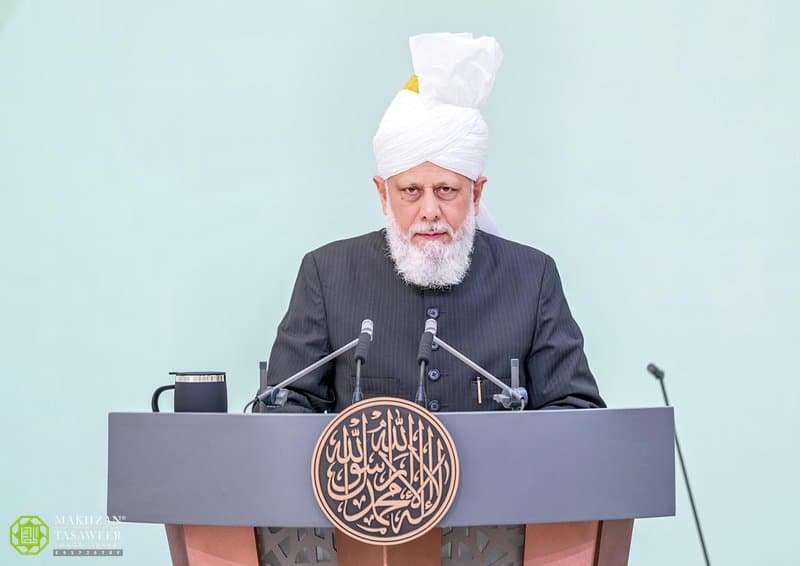
After reciting the tashahhud, ta‘awwuz and Surah al-Fatihah, Hazrat Khalifatul Masih V (aa) stated:
The efforts of the Promised Messiah (as) to raise the flag of the Holy Prophet (sa) across the world are evident. However, he was also extremely grateful to those helpers of his, who assisted in fulfilling his mission in any shape or form. In an announcement on 4 October 1899, the Promised Messiah (as) started an initiative to mention the names of those sincere individuals of the Jamaat, who offered financial assistance. He stated:
“Allah has so ordained that the party of His men always needs financial assistance in the beginning. Even our Holy Prophet (sa) received financial contribution from his Companions on various occasions, of whom Hazrat Abu Bakr (ra) was foremost. So, come forward to assist with manly courage and without hesitation.” At that time, the Promised Messiah (as) had launched an appeal for [financial assistance towards] the Langar Khana [communal kitchen], because this too served an important purpose as guests would come in order to learn about Islam and to hear his claim. The Promised Messiah (as) further stated:
“All should contribute towards the Langar Khana according to their capacity. I wish, if possible, for such arrangements to be made that we can be relieved from the burden of the Langar Khana and devote ourselves to our mission.” That is, he desired to pay even greater attention towards his mission of spreading Islam and propagating the message of the Holy Prophet (sa) across the world. And he desired for separate arrangements to be made for those guests that came for this purpose. In any case, the Promised Messiah (as) stated:
“[…] and devote ourselves to our mission and so that our time will not be adversely affected. Those who help us today will witness Allah’s help.” He further stated: “I cannot refrain from stating that the foremost individual in this support and devotion is our most sincere and beloved for the sake of Allah, Maulvi Hakeem Noor-ud-Deen Sahib. He has not only assisted financially, but has cut all ties with the world, and adopting ways similar to the poor, migrated from his home and remained in Qadian until his demise. He remains ever-ready to serve. If I wish, I can send him east or west (in order to propagate the message of Islam). In my opinion, it is these individuals who are spoken of in the revelation found in Barahin-e-Ahmadiyya:
اَصْحَابُ الصُّفَّةِ وَمَا اَدْرٰکَ مَا اَصْحَابُ الصُّفَّةِ
“‘The People of Suffah. And what will make you know who the People of the Suffah are?’”
He then stated: “Following this distinguished person, on the second rank is my beloved for the sake of Allah, Maulvi Abdul Karim Sahib of Sialkot. God Almighty had already endowed him with an inclination to disassociate from worldly affairs or seeking worldly ranks, but now he has completely given up worldly thoughts as well and sits at this threshold, devoting himself day and night to serving the faith, utilising his mind to its utmost capacity. During the Friday prayers, he presents many verities and insights of the Holy Quran and thereby benefits the Muslims. Then, there is a fellow townsman of Maulvi Hakeem Noor-ud-Deen Sahib, namely Hakeem Fazl Din Sahib. He also lives nearby and is engaged in this service. One of our sincere friends is Dr Buddhay Khan Sahib. Although he has passed away, there is cause for gratitude as there are four other sincere doctors in our Jamaat; Dr Khalifa Rashiduddin Sahib of Lahore, Dr Mirza Yaqub Baig Sahib of Kalanaur, Dr Muhammad Ismail Sahib and Dr Abdul Hakim Khan Sahib.
“Similarly, there were also some extremely sincere people who took up residence here. Among them was Mirza Khuda Bakhsh Sahib, as well as Sahibzada Siraj-ul-Haq Sahib Sarsawi, who migrated from his homeland of Sarsawa and came to Qadian, and there are several others. We pray that the migration of all these gentlemen may be blessed for them. And Maulvi Hakeem Noor-ud-Deen Sahib (ra), meanwhile, is one of the shining lanterns of our Jamaat. Every day, he delivers lectures on the Holy Quran and Hadith and expounds such profound insights and truths of the Quran that, if this is not the help of God, then what else could it be? Hazrat Maulvi Sahib and my beloved brother for the sake of God, Maulvi Abdul Karim, both sincerely desire that they should live in Qadian and die in Qadian. Among those sincere members of our Jamaat who are engaged in trade and business, my beloved brother for the sake of God, Seth Abdul Rahman Sahib, a merchant from Madras, is worthy of praise. He has earned many opportunities to attain spiritual reward. He is such an ardent lover that, despite living so far away, he remains close to us, and he greatly assists the Langar Khana of our Jamaat. His truthfulness and continuous services, filled with love, conviction and faith, are an example for all the wealthy members of the Jamaat, for there are few who are like him. He sends 100 rupees every month without fail, and to this day he has repeatedly sent as much as 500 rupees purely out of the fervour of his love and sincerity. (At that time, this was a considerable sum, which he would send for the propagation of the faith and for the expenditure of guests.) The 100 rupees that he sends every month are in addition to this. Similarly, there is my beloved brother for the sake of God, Sheikh Rahmatullah Sahib, a merchant from Lahore. I know very well that the aforementioned Sheikh Sahib is our devoted lover, with all his heart and soul. And using a considerable amount of his own money in the criminal cases that had been brought against me, he greatly assisted me, and driven by the fervour of his love, he remained tirelessly engaged in showing me his sympathy. Now after having spent hundreds of rupees on our work, he is currently in London. May Allah the Almighty bring him back soon in safety and good health.” This was at the time when he had gone to London. The Promised Messiah (as) further states, “It is also worthy of mention that my beloved brother for the sake of God, Sardar Nawab Muhammad Ali Khan Sahib, has made great progress in love and sincerity. And our sound insight bears witness that he will very soon reach a level of sincerity and love that will be a source of envy. He has always assisted, to the best of his ability, with financial contributions, and it is hoped that he will sacrifice even more of his wealth in the way of God. God Almighty sees everyone’s deeds, and there is no need for me to say or write anything further about them.”
The Promised Messiah (as) said, “Similarly there are many other sincere people […]” but, regrettably, if he were to write all their names, then the announcement which he was making would turn into a very lengthy article. He says, “I prayed for all their sakes, that God may grant them happiness in both worlds. Whatever they do, or will do in the future, for the sake of God is all beneath the watchful eye of God Almighty.” (Majmu‘ah-e-Ishtiharat, 2019, Vol. 2, pp. 542-546)
These were the ways in which the true servant of the Holy Prophet (sa) expressed his gratitude to his helpers. The Promised Messiah (as) would express immense gratitude even for the smallest service by anyone. Thus, Hazrat Munshi Mahboob Alam Sahib relates, “There was a non-Ahmadi in our neighbourhood who used to prepare falooda. When the Promised Messiah (as) came to the house of Khawaja Kamaluddin Sahib, this person who made falooda said to me, ‘If you could obtain permission from the Promised Messiah (as), I would like to serve him falooda.’ Accordingly, I presented his request to the Promised Messiah (as), and he granted permission. The man therefore brought all the necessary ingredients and went there. The Promised Messiah (as) was seated on a bed in the courtyard of Khawaja Kamaluddin Sahib. I presented the man to him, and the Promised Messiah (as) said to make the falooda. Thus, he sat outside and prepared a bowl of falooda and presented it to Huzoor (as). Huzoor (as) drank it and expressed his appreciation, saying that it was very good. The man then sent 10 or 12 more bowls inside and served everyone. Upon this, the Promised Messiah (as) then took out two rupees (at that time, two rupees was a considerable amount) and gave them to me, telling me to give them to the man. I took the two rupees to him, but he refused to accept them and said to me, ‘Take me into the company of the Promised Messiah (as).’ Thus, I took him to the Promised Messiah (as).
“He joined his hands before the Promised Messiah (as) and said, ‘I do not need the two rupees. I presented the falooda as a gift.’ Upon his insistence, the Promised Messiah (as) did not give him the money. Instead, he prayed for him and said, ‘may Allah grant you the best of rewards.’” The narrator says that, through the blessing of this prayer, his children went on to attain very good positions. (Riwayat Ashab-e-Ahmad, Vol. 4, pp. 278-279)
Hazrat Maulvi Ibrahim Sahib Baqapuri relates, “On one occasion, Jamaat-e-Ahmadiyya – including the late Hazrat Mir Hamid Shah Sahib, the late Chaudhry Nasrullah Khan Sahib and this humble servant – presented some money to the Promised Messiah (as) as a gift. The Promised Messiah (as) took the handkerchief in which the money was tied and first said, ‘All praise belongs to Allah’, and then, ‘May Allah reward you’. This increased our faith in a way, for the Promised Messiah (as) first thanked God and then prayed for us.” (Riwayat Ashab-e-Ahmad, Vol. 4, p. 56)
I have mentioned previously that the Promised Messiah (as) said that one should first offer thanks to Allah and then express gratitude to people. (Hayat-e-Qudsi, p. 134)
Hazrat Zulfiqar Ali Khan Gohar Sahib relates an incident: “On one occasion, the Promised Messiah (as) emerged from the Bait-ud-Dua – which was on the lower floor – at around 10 o’clock after having applied henna [to his hair]. (The Promised Messiah [as] had dyed his beard and hair. In those days, henna was used in this manner, and the Promised Messiah [as] would apply it). There was a small room adjoining the Bait-ud-Dua, with one door opening into the courtyard and another towards my room. Since I lived nearby, I would wait in this room for the Promised Messiah (as) to come out.
“The Promised Messiah (as) came out of the Bait al-Dua and sat on a charpoy. He said to me, ‘Tell Maulvi Syed Sarwar Shah Sahib to bring some food here for us.’ (At that time, guests had come and food was cooked collectively, and Sarwar Shah Sahib was responsible for the arrangements.) I went and conveyed the message. We had just finished eating ourselves. Hardly 10 minutes had passed, but there was no food left. (There was no food after just 10 minutes, for the people had eaten it.)
“When I conveyed the message, Maulvi Syed Sarwar Shah Sahib’s face turned pale. Nevertheless, he took some milk in a small bowl and placed three pieces of toast on a plate, along with sugar, and brought them. His face was downcast and he was deeply distressed that the Promised Messiah (as) had asked for food, but there was none available. He said, ‘Your Holiness, there is nothing else left at present.’”
Hazrat Zulfiqar Ali Khan Sahib says that, “I was extremely astonished that there was no food kept for the Promised Messiah (as). What kind of arrangement was this? The Promised Messiah (as), however, expressed his gratitude in a manner that was clearly visible on his countenance. It was not merely an outward or artificial expression; rather, his genuine gratitude was apparent from his face. He took the two pieces of toast, dipped them in sugar and ate them, and then drank some water.”
The narrator says, “At that moment, it occurred to me that Allah the Almighty had caused this oversight so that the Promised Messiah’s (as) patience, gratitude and spiritual rank might be manifested to the world.” (Riwayat Ashab-e-Ahmad, Vol. 3, p. 54)
The Companions would take note even of the smallest incidents.
On 7 August 1900, the Promised Messiah (as) wrote a letter of thanks to Hazrat Nawab Muhammad Ali Khan Sahib (ra), who had sent him a gift of some clothes. He wrote:
“I have received the precious and excellent articles of clothing which you sent with such deep love and sincerity, and I express my gratitude for them. Looking at each piece, it is evident that my dear friend had them prepared with great effort and devotion. May Allah the Almighty, in return, bestow upon you His boundless and incomprehensible grace and favour, and may He clothe you completely in the garment of righteousness, honouring you with the hue of His saints and the righteous.” (Ashab-e-Ahmad, Vol. 2, pp. 686-687)
Thus, in return for a gift of physical clothing, the Promised Messiah (as) expressed not only gratitude, but prayed that Allah the Almighty should grant the sender the true garment of righteousness, and adorn him with the qualities of the pious.
In a letter to Hazrat Munshi Ahmad Jan Sahib (ra), the Promised Messiah (as) wrote:
“My honourable and esteemed brother, Munshi Ahmad Jan Sahib, may Allah the Almighty keep you safe and reward you with the best of rewards. Peace be upon you.
“I have received your letter. The favours of the Generous Lord cannot be adequately appreciated, for He has provided this humblest of servants with such heartfelt friends, whose very existence is a source of honour and pride for this insignificant one. May the Generous Lord keep you happy and joyful, and may He reward you for your heartfelt intentions.
“(The Promised Messiah [as] expressed great humility and said:) This humble one is utterly weak, useless and insignificant. It is purely the grace and favour of He Who is the Most Merciful of all who show mercy that, without even the slightest entitlement on my part, that He is showering countless blessings upon one so unworthy. (Consider the Promised Messiah’s [as] rank, yet such was his humility). I find fault upon fault within myself, yet He bestows favour upon favour. He sees me doing wrong upon wrong, yet He grants bounty upon bounty. In truth, He is Most Merciful and Most Generous. Wherefrom can I find words sufficient enough to express thanks to Him?
“This humble one is nothing, lowly, without means, and utterly poor. He found me in the dust and raised me up. He saw me utterly unworthy and covered my faults. Seeing my weakness, He Himself granted me strength. Seeing my ignorance, He Himself bestowed knowledge upon me. He has shown me favours that I cannot count. One manifestation of His favour is that He has placed love for this most humble one in the hearts of noble brothers such as yourself.”
(This was the gratitude which the Promised Messiah [as] expressed for those who supported him). It is among the favours of God that He causes this love to grow, and would bestow His grace upon all those whom He had joined in this bond.”
After writing this letter, the following couplet of a saint was revealed to him. The Promised Messiah (as) wrote:
ہرگز نَمِیرَدْ آنکہ دِلَشْ زِندہ شُد بِعِشْقِ
ثَبْتْ اَسْت بَرْ جَرِیْدَۂ عَالَم دَوامِ مَا
“One whose heart is brought to life by love can never die. Our eternity has been inscribed upon the register of the world.” (Maktubat-e-Ahmad, Vol. 3, pp. 25-26)
In another letter, addressed to Hazrat Qazi Zahooruddin Akmal Sahib (ra), the Promised Messiah (as) wrote in response to three books he had sent in support of him:
“I have received your gift of three books. May Allah grant you an excellent reward. I have skimmed through all three of them. The discourse is excellent and well-argued. May Allah grant you a good reward. Amin. You should publish and circulate them wherever and whenever appropriate, so that the reward may be doubled.” (Maktubat-e-Ahmad, Vol. 5, p. 245)
Similarly, in a letter to Dr Khalifa Rashiduddin Sahib – who was the father of Hazrat Umm-e-Nasir and the father-in-law of Hazrat Musleh-e-Maud (ra) – the Promised Messiah (as) wrote:
“My beloved brother, Dr Khalifa Rashiuddin Sahib, peace be upon you.
“I have received the sum of fifty rupees which you had sent. At such a delicate and necessary time, when ill-natured and envious people have brought a case against me in court, your repeated financial assistance is truly deserving of gratitude. May Allah reward you with the best of rewards.
“The next court date in the case is 24 February 1899, and it will likely be the day after Eid. Eid will most likely fall on Sunday, and the next day, Monday, I shall have to go to Pathankot for the case. Allah knows best.
“I have now resolved that I shall continue praying for you for some time. (Out of gratitude, the Promised Messiah [as] said that he would continue praying for him). May Allah grant you safe, sound and complete deliverance from distance and separation (he said this as he had been posted far away and he wished to return home). Amin, and again, Amin.” (Maktubat-e-Ahmad, Vol. 4, p. 214)
In another letter, written to Hazrat Sahibzada Sirajul Haq Sahib, the Promised Messiah (as) stated:
“To my honoured brother Sahibzada Sirajul Haq Sahib.
“May the peace and blessings of Allah be upon you.
“Your letter has been received. I am grateful to you for the friendly gift of the turban and perfume which you sent. (This was something small, yet the Promised Messiah [as] still wrote a letter to express thanks). May Allah reward you with the best reward, and may He deal graciously with you in this world and the next. May Allah the Almighty keep you very happy and protect you from the disliked things of both faith and world.” (Maktubat-e-Ahmad, Vol. 3, p. 110)
Along with his gratitude, the Promised Messiah (as) would also pray for the spiritual progress of others.
Syed Mahmud Alam Sahib (ra) relates that Hazrat Maulvi Noor-ud-Deen Sahib (ra) used to say that when the Promised Messiah (as) delivered the Arabic sermon on Eid-ul-Adha, he was later asked about the state in which he had delivered it. The Promised Messiah (as) replied that angels kept bringing tablets before him, written in large letters, and he would read from them as they appeared. When one tablet came, he would recite what was written upon it; then another would appear and the first would disappear. This sequence of tablets continued.
If one of the scribes asked him to repeat something – there were two people who had been seated to write the sermon down – the tablet that had gone would return, and he would look at it and repeat the words. When the sermon concluded, the Promised Messiah (as) fell into prostration out of gratitude. All those present joined him in that prostration of thanks. After raising his head, he said, “I have just seen [in a vision] in red letters the word: مبارک [Felicitations]. This means that the address has found acceptance [with God]. (Tadhkirah [English], p. 488)
Hazrat Mian Ferozuddin Sahib (ra) relates that the Promised Messiah (as) wrote Lecture Sialkot on the roof of Mir Hisamuddin Sahib’s house. Four inkpots had been placed upon the four low parapet walls of the roof. The Promised Messiah (as) would write as he walked. It was around the time of Asr [late afternoon prayer]. He would walk while writing, and at times would suddenly fall into prostration. It seemed that when Allah the Almighty disclosed a certain point to him, he would offer a prostration of gratitude. While writing, he would pause and fall into prostration.
He says, “We watched this entire scene from the roof of our own house. Many others had also gathered there to witness it. Our house was close by and stood higher than any other house, it provided a clear view of the whole scene,” as to how the Promised Messiah (as) was writing the book, and how, alongside his writing, he was continually thanking Allah the Almighty. (Riwayat Ashab-e-Ahmad, Vol. 4, p. 375)
Describing the Promised Messiah’s (as) characteristic of gratitude, one Companion, Hazrat Khairuddin Sahib (ra), relates:
“Once, the Promised Messiah (as) came to our village, Qadirabad. My mother, Taj Bibi Sahiba, filled a tray with sugar and presented it to him. The Promised Messiah (as) placed that sugar into my grandmother’s lap, who was sitting there at the time, and gave it to her. He said, ‘May Allah reward you,’ and prayed for us.” (Riwayat Ashab-e-Ahmad, Vol. 3, p. 89)
Thus, the Promised Messiah (as) expressed gratitude even for the smallest of gifts.
Haji Muhammad Din Sahib (ra) relates:
“Once, I came to know that the Promised Messiah (as) was coming to Sialkot on the occasion of some gathering. On the appointed date, I too went there with an eager desire to see him. The Promised Messiah (as) was staying on the upper floor of a house, while those devoted to him, like moths drawn to a flame, stood below in a large crowd, eagerly awaiting a glimpse of him. After a while, he came downstairs and afforded those present the honour of beholding him.
“When an elderly man met the Promised Messiah (as), he began weeping uncontrollably. The Promised Messiah (as) comforted him and inquired about his circumstances. He submitted, ‘Your Holiness, I used to pray that I might live until the advent of the Imam Mahdi.’ The Promised Messiah (as) replied, ‘Then, O elder, Allah the Almighty has indeed accepted your prayer.’ Upon hearing this, he became very happy. He then presented one of his grandsons before the Promised Messiah (as) and requested that he place his blessed hand upon him and pray for him. The Promised Messiah (as) prayed for him and then went upstairs.”
Moving forward, he mentions the actual incident that highlights the Promised Messiah’s (as) gratefulness. This was just a preamble of the details surrounding the incident. He continues with the incident and says:
“By coincidence, as the Promised Messiah (as) was going upstairs, one of his shoes, which was a very simple one, slipped off his foot and fell down below. This humble servant picked it up and personally put it back on his foot. Upon this, the Promised Messiah (as), with a smiling countenance, lovingly said, ‘May Allah reward you,’ and expressed his thanks most graciously.” (Riwayat Ashab-e-Ahmad, Vo. 5, p. 334)
The Promised Messiah (as) would never miss an opportunity to express his gratitude.
The Promised Messiah (as) wrote the following in a letter to Hazrat Munshi Rustam Ali Sahib (ra):
“Munshi Rustam Ali Sahib, may Allah keep him safe.
“Peace and blessings of Allah be upon you.
“The sum of fifty rupees sent through Mian Imamuddin Sahib has been received. For all the efforts you and Chaudhry Muhammad Bakhsh Sahib have made, may the Gracious Lord, Glorified is His Majesty, bestow upon you a great reward and grant you success in this world and the Hereafter. At the time of writing, all is well here.”
The Promised Messiah (as) informed him of his own circumstances. (Maktubat-e-Ahmad, Vol. 2, pp. 467-468)
The Promised Messiah (as) would express his gratitude to everyone for everything, even when someone had done something very small for him.
There is another incident that Hazrat Mian Miran Bakhsh (ra) Sahib relates:
“I pledged allegiance to the Promised Messiah and Imam Mahdi (as) around 1897 or 1898, but for some time I did not disclose this to my father. However, how long could the matter remain concealed? When the secret came to light, my father plainly refused to accept me and turned me out of the house, saying, ‘You have become an Ahmadi. Now leave my house.’
“Putting my trust in God, the Provider, I rented a separate shop. Although I was experiencing financial hardship, I had a strong desire that, in whatever way I could and according to my means, I should prepare a garment for the Promised Messiah (as), sew it with my own hands (as he was a tailor), and present it to him.
“With this thought in mind, I purchased a muslin kurta, a latha shalwar, a black coat and a muslin turban. I stitched them myself and prepared the outfit. I then somehow managed to collect the fare from here and there and travelled to Qadian.
“The following day was Friday, and I thought that, if possible, this humble person might present this simple gift to the Promised Messiah (as) that very day. Perhaps the Promised Messiah (as) would wear it before the Friday prayer and thereby gladden the heart of this poor man.
“Thus, while contemplating how I might accomplish this, I reached the shop of Qazi Ziauddin Sahib and expressed my heartfelt desire to him. As soon as he heard it, he said, ‘Come, I will take you to the Promised Messiah (as).’
“He immediately got up and took me into the presence of the Promised Messiah (as). At that time, the Promised Messiah (as) was seated upon a bench, writing something, while Khawaja Kamaluddin Sahib was seated on a mat in front of him. We both sat there beside Khawaja Sahib.
“Khawaja Sahib asked the reason for my visit, whereupon Qazi Sahib explained my desire. Khawaja Sahib remained silent for a while. Then, addressing me, he said, ‘Well, shall I represent you?’ Khawaja Sahib was a lawyer, so even on this occasion he used professional terminology.
“I replied, ‘That would be extremely kind of you. Please represent me.’
“Upon this, Khawaja Sahib took the clothes from me and presented them to the Promised Messiah (as). At the same time, he submitted, ‘Your Holiness, this boy wishes that you would wear these clothes and offer the Friday prayer in them.’
“Upon hearing this, the Promised Messiah (as) took up the clothes and began putting them on. However, when he put on the coat, it was very tight. I submitted, ‘Your Holiness, the coat is very tight. If you take it off, I can loosen it a little.’”
The Promised Messiah (as) would not have worn it there, but would have left his work and then put the clothes on, thereafter returning to them.
He says that when the Promised Messiah (as) wore the coat, it was tight. The Promised Messiah (as) took the coat off and gave it to him and he said that he would have it altered as it was a bit tight. He continues:
“I immediately got up, took it to the market, and, sitting at a tailor’s shop, opened up the entire back of the coat. I then returned to the presence of the Promised Messiah (as).
“The Promised Messiah (as) put it on again, but even then the buttons of the coat would not come together and fasten properly as he desired. Nevertheless, in order to spare my feelings, the Promised Messiah (as) pulled and adjusted the coat and fastened the buttons, without giving any thought to whether these clothes were actually suitable for wearing.” (Riwayat Ashab-e-Ahmad, Vol. 1, pp. 368-369)
The Promised Messiah (as) wore the coat in this condition out of consideration for the feelings of that boy, who had only recently become an Ahmadi and had come with a gift. He then expressed his gratitude to him very warmly as well.
Hazrat Mian Saifullah Sahib (ra) relates:
“Once, I went to Qadian. Someone placed a heap of 50 or 60 rupees in front of the Promised Messiah (as), but he did not even turn his attention towards it.”
Normally, he would express his thanks when people gave him something, but perhaps there was some particular reason on this occasion. In any case, he relates that the person gave the money in cash, but the Promised Messiah (as) paid no attention to it.
“Meanwhile, an old woman, who was probably a Hindu woman, arrived with a child. She had a lump of jaggery tied up in a piece of cloth. The woman submitted, ‘Your Holiness, this child has brought this piece of jaggery for you. Please pray for him.’
“The Promised Messiah (as) said, ‘Very good,’ and became very pleased. He took the lump of jaggery, together with the cloth, from the child’s hand and placed it over his shoulder.” (Riwayat Ashab-e-Ahmad, Vol. 4, p. 453)
Thus, even though it was only an ordinary gift from this poor child, he received it with great appreciation, expressed his gratitude for it, and also prayed for the child.
The Promised Messiah (as) wrote the following in a letter addressed to Jamaat-e-Ahmadiyya:
“First and foremost, my heart is filled with gratitude to Allah the Almighty, Who has granted my Jamaat sincere resolve, love and sympathy. Had the grace of God Almighty not been with them, they would never have been granted the opportunity to demonstrate such obedience in the footsteps of the Companions (ra), that despite their own financial difficulties and meagre incomes, they are engaged in financial service beyond their means.
“I pray that Allah the Almighty may bless all their wealth, and that the help and assistance they are rendering for the fulfilment of religious objectives may become a means of their welfare in both this life and the hereafter.” (Maktubat-e-Ahmad, Vol. 5, p. 365)
Then, while imparting guidance, the Promised Messiah (as) states:
“Treating His creation with kindness and compassion is, in fact, the way for those who have been blessed by Almighty Allah to show their gratitude to Him. They should not show arrogance for the grace that God has bestowed upon them and should not be like uncivilised brutes who viciously beat the poor.” (Malfuzat [English], Vol. 7, p. 468)
Thus, he also drew attention towards helping the poor.
Having received knowledge from Allah the Almighty, he would at times also inform people beforehand concerning certain matters relating to them. Likewise, having received knowledge from Allah the Almighty regarding his opponents, he would tell them that such and such would happen to them. However, at times, owing to the wisdom of Allah the Almighty, it would take time for these things to come to pass. On such occasions, the Promised Messiah (as) would become anxious and engage himself in prayers, fearing that the opponents would raise an uproar about the matter. But when it would come to pass, he would prostrate himself before Allah the Almighty with the utmost gratitude. Thus, the Promised Messiah (as) states:
“I had, at one point, prophesied about Bishambar Das, a brother of Sharampat Khatri, that although he would not be acquitted outright in the criminal case in which he was implicated, the term of his imprisonment would be reduced by half.
“Later, when Bishambar Das was released after serving half the term of his imprisonment, as was intimated in the prophecy, his kin falsely announced that Bishambar Das had been acquitted. It was night-time and I had gone to our main mosque for offering Prayer when Ali Muhammad, a mullah, resident of Qadian, narrated it in the mosque that Bishambar Das had been acquitted and that he was being congratulated in the marketplace.
“I was shocked when I heard the news and was rather apprehensive that the bigoted Hindus would now object and say: ‘You had prophesied that Bishambar Das would not be acquitted. Know now that he has, in fact, been acquitted!’ Under the stress of this grief, each rak‘at of the prayer felt as long as a year, and when I prostrated at the end of a rak‘at, my distress reached the extreme. Then, in that very state of prostration, God, addressing me aloud, said:
لَا تَخَفْ إِنَّكَ أَنْتَ الْأَعْلَىٰ
“Meaning that, have no fear at all; you indeed are victorious.
“After this, I waited as to how this prophecy would be fulfilled. But no Sign appeared. I enquired of the very same Sharampat over and over again if it was true that Bishambar Das had been acquitted. He would give the same answer: ‘Yes, he has, in fact, been acquitted and why should I lie?’ In the village, anyone whom I enquired would invariably reply, ‘We too have heard that he has been acquitted.’
“Meanwhile, six months or thereabouts passed. Mischievous people would mock and jeer as is their wont. But Sharampat did not mock or jeer, which convinced me that he had behaved decently towards me on that occasion. Still I felt embarrassed in his presence, [thinking] how emphatically I had communicated to him the news of his brother’s non-acquittal! And now the situation had come to such a pass! Despite all this, I had firm faith in my God and I was certain that He would demonstrate some Sign of His providence and may be he would be apprehended again after acquittal. But I knew not that the very news of his acquittal was a mere fabrication. Then it so happened that one Tehsildar of Batala, Hafiz Hidayat ‘Ali, whom I have mentioned earlier, came to Qadian at eight o’clock in the morning on an official visit to Qadian, for Qadian is part of Tehsil Batala. He came to our residence and had not yet dismounted his horse when a few Hindus, as is their wont, assembled to greet him, and Bishambar Das was among them. On seeing Bishambar Das, the Tehsildar said, ‘Bishambar Das, I was pleased to hear that you had been released from jail, but alas you were not acquitted.’ On hearing this, I fell in grateful prostration to God.
“Immediately I summoned Sharampat and asked him why he had lied to me for so long that Bishambar Das had been acquitted and aggrieved me for nothing. He said he had to lie because of a consideration—namely, that his people are highly critical of even minor flaws when they choose to enter into new marital relationships, and it is very hard to obtain agreement from the girl’s side when someone is proven to be guilty of a wrongdoing. It was because of this consideration that he continued to misrepresent the facts and publicise this falsehood.” (The Philosophy of Divine Revelation, pp. 380-382)
While mentioning one of his signs, the Promised Messiah (as) states:
“A prophecy was fulfilled in the presence of some Aryas who are the followers of Pundit Dayanand, a detailed account of which will not be without benefit for the readers. Even though its description here might be somewhat long, it is being recorded for the benefit of people who are unaware of the grandeur of Islam.
“Before this prophecy was fulfilled, unusual difficulties and undesirable events were experienced. (The Promised Messiah [as] presented this prophecy so as to exhibit the grandeur of Islam and raise the banner of the Holy Prophet [sa] in the world). Finally, the Benevolent God removed all difficulties and fulfilled this prophecy on Monday, 10 September 1883. The detail of this is that, on Thursday, 6 September 1883, the Benevolent God gave glad tidings to this humble one through His blessed word to give solace to me at the exact time of need:
بست وَیَک روپیہ
“‘Twenty and one rupees are coming.’
“This glad tiding had the special aspect that the exact amount to be received was mentioned, and to give intimation of a specific amount is special to the Knower of the unseen; no one else can do so. (It was no ordinary matter that the exact amount was being disclosed). The other, even more wonderful aspect is that this amount was of an unusual nature, because it had no relationship to the price that had been fixed for the book. (The Promised Messiah [as] had never even thought of this amount). Because of these special aspects this revelation was communicated to some Aryas ahead of time. Then a revelation was received emphatically for the third time on 10 September 1883:
بَسْتْ وَ یَکْ روپیہ آئے ہیں
“‘Twenty and one rupees have arrived.’
“It was understood from this revelation that the prophecy would be fulfilled that same day. Perhaps not even three minutes had elapsed from receipt of this revelation when a man by the name of Wazir Singh, tending to a sick man, arrived and presented a gift of one rupee upon his arrival. Even though this humble one does not practise as a physician, if perchance some sick person comes and I am able to think of a medicine, I give it away for the sake of Allah and solely to earn [His] blessings. (The Promised Messiah [as] says he typically didn’t take money for this). However, I accepted this rupee from him for it suddenly passed through my mind that it was a part of that prophecy (regarding 21 rupees). Thereafter, I sent a trusted person to the post office thinking that the other part may be fulfilled through the post office. The postal clerk, a Hindu, replied that he had only one money order valued at five rupees to which a card was attached – which had arrived from Dera Ghazi Khan – but that he did not have any money with him and would remit this money as soon as he would receive it. I was so surprised and perturbed upon receiving this information as cannot be described in words. (This was because the Promised Messiah [as] had mentioned this prophecy before non-Muslims in order to prove the truthfulness of Islam.) During this perturbation, while I had bowed down my head, thinking that five and one would make only six, how will they turn into twenty-one, I begged Allah about the matter. During this very contemplation, I suddenly received this revelation:
بَسْتْ وَ یَکْ آئے ہیں اس میں شک نہیں
“‘Twenty and one have arrived, there is no doubt in this.’
“Not even six hours had elapsed from [the time of ] this revelation on that very day, when an Aryah, who heard the postal clerk’s message, happened to go to the post office and in the course of conversation, the postal clerk informed him that, in fact, twenty rupees had arrived, but by a slip of the tongue he mentioned the amount of five rupees. Thus, the same Aryah brought twenty rupees with a post card from Munshi Ilahi Bakhsh, Accountant, and it was discovered that the post card had not been attached to the money order and it was further discovered that the money had arrived. Moreover, it was known from the writing of Munshi Ilahi Bakhsh, as a receipt in care of the post office, that the money order had arrived in Qadian on 6 September 1883; that is, the same day of the revelation. Thus, the whole statement of the postal clerk was proven wrong and the entire disclosure of the Knower of the unseen was proven correct. Thus, in memory of this blessed day, one rupee’s worth of sweets were distributed to some Aryas as well. (Out of happiness of the fulfilment of this prophecy, the Promised Messiah [as] distributed sweets to the Aryas as well since he had mentioned this prophecy to them).
فَالْحَمْدُلِلّٰہِ عَلٰی آلَائِہٖ وَنُعَمَائِہِ ظَاھِرِھَا وَبَاطِنِھَا
“[So Allah be praised for all His favours and His bounties, manifest and hidden].” (Barahin-e-Ahmadiyya Part IV [English], pp. 402-404)
The Promised Messiah (as) further states:
“There is not a single nation among whom the Signs in my favour have not appeared, and there is not a sect that is not a witness to my Signs. It would be no exaggeration to say that the number of witnesses to these Signs is as much as 100,000,000. But the plight of the opponents is pitiable indeed, that they did not derive any benefit from these Signs. Had these Signs that have been shown to them been shown to the Jews at the time of Jesus, son of Mary (as), they would not have been characterised as ‘those smitten with abasement’ (as has been mentioned in the Holy Quran). Had Lot’s (as) people witnessed these Signs, they would not have been buried under the earth on account of that massive earthquake. But woe be upon these hearts that proved to be harder than stone! The darkness that has overtaken their hearts exceeds every kind of darkness. The fact of the matter is that just as the world has progressed in respect of all kinds of material means, so has it advanced in disbelief and lack of faith. Hence this ‘advanced’ disbelief requires that it should not be visited by any ordinary chastisement; rather it should be overtaken by a chastisement the like of which has never descended since the beginning of the world. At any rate, thousands of thanks be to God that the light that our opponents refused to accept and remained blind, the same light became the cause of advancement of our own sight and spiritual insight.” (The Philosophy of Divine Revelation, p. 378)
The Promised Messiah (as) wrote this in The Philosophy of Divine Revelation.
May Allah the Almighty grant us a true understanding of gratitude and, having enabled us to pledge allegiance to the true servant of the Holy Prophet (sa), may He also bestow upon us true spiritual light, insight and Divine knowledge.
(Official Urdu transcript published in the Daily Al Fazl International, 18 September 2026, pp. 2-7. Translated by The Review of Religions.)