
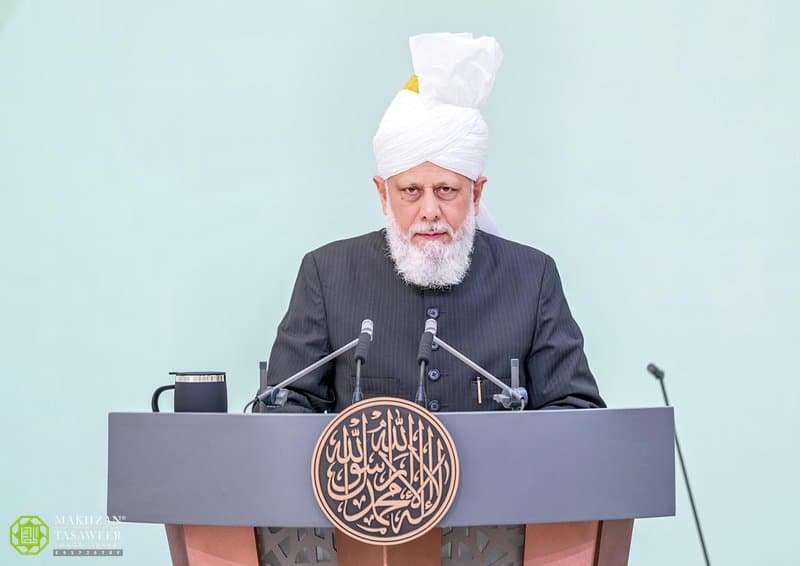
After reciting the tashahhud, ta‘awwuz and Surah al-Fatihah, Hazrat Khalifatul Masih V (aa) stated:
Today, I will share some accounts of the humbleness and humility in the life of the ardent devotee of the Holy Prophet (sa), which were owing to his following the teachings and practice of his master and guide, the Holy Prophet (sa). I will also share his guidance with his Jamaat in this regard.
Observing the lofty standard of his humility, Allah the Almighty Himself certified this by means of a revelation. On 18 March 1907, the Promised Messiah (as) received the revelation:
تیری عاجزانہ راہیں اس کو پسند آئیں۔
“He is pleased with your humble ways.” (Tadhkirah, 2023, p. 675)
At one place, the Promised Messiah (as) states:
“It has been revealed to this humble one that on account of my meekness, humility, trust in God, sincerity and the Signs and [heavenly] light, I resemble the Messiah [Jesus] in his previous life; and that the nature of this humble one and the nature of the Messiah greatly resemble each other, as if they are two pieces of the same jewel or two fruits of the same tree. The harmony between us is of such a great extent that there is very little that the spiritual eye can distinguish between us. There also exists an overt resemblance, which is that the Messiah was the follower and servant of the faith of a perfect and high-standing Prophet, i.e. Moses, and his Gospel is a branch of the Torah, and this humble one too, is one of the lowliest servants of that majestic Prophet who is “Sayyidur-Rusul – the Chief of all Messengers (as) and the Crown of all Messengers.” (Barahin-e-Ahmadiyya, Part 4, Ruhani Khazain, Vol. 1, pp. 593-594 [sub-footnote no. 3])
Once, a person submitted to the Promised Messiah (as) that while writing The Philosophy of Divine Revelation [Haqiqatul-Wahi] – a book written during the latter part of his life – and repeatedly proofreading it, he had exerted himself greatly and this was the cause for his health repeatedly deteriorating. He requested that he should rest completely for a few days and entirely refrain from reading and writing. The Promised Messiah (as) replied: “What effort have we exerted? In fact, we feel ashamed when we look at the effort the Companions (ra) exerted, and how happily they even let their heads be severed for the cause of God.” (Malfuzat, 2022, Vol. 9, p. 182)
At another place, the Promised Messiah (as) states:
“Ignorant people raise the objection that I elevate my own status beyond measure.” In other words, the Promised Messiah (as) elevates his own status excessively. He says: “I swear by God Almighty that it is not in my nature or disposition to desire praise for myself and to take pleasure in displaying my own greatness. I have always preferred a life of humility and anonymity. However, it was beyond my power and control, for God Almighty Himself brought me forth. And whatever praise and greatness He has expressed regarding me in His words that He revealed to me, in fact, belong entirely to the Holy Prophet (sa).” (Malfuzat, 2022, Vol. 4, p. 114)
He would also guide new converts towards the humility and simplicity taught by Islam. Thus, it is recorded that on 22 October 1903, an Australian convert named Muhammad Abdul-Haq came to visit the Promised Messiah (as). During the conversation, the Promised Messiah (as) said to him: “One of our principles is that we lead a simple life. Our gatherings are free from all those formalities that have at present been declared by Europe to be the essentials of life. We are not bound by customs and traditions. We observe every tradition only to a certain extent lest abandoning them might cause harm or lead to sin. (That is, abandoning it should not cause harm or lead to sin.) Otherwise, with regard to eating, drinking and in our social settings, we prefer a simple life.” (Malfuzat, 2022, Vol. 5, pp. 294 and 298-299)
These were the lofty standards of humility which the Promised Messiah (as) desired to instil in his followers. Furthermore, on one occasion, he stated:
“One should adopt humility. Learning humility is not difficult. In fact, what is there to learn? Man is himself inherently humble, and he was created for humility.
مَاخَلَقْتُ الْجِنَّ وَالْاِنْسَ اِلَّا لِیَعْبُدُوْنِ
“‘And I have not created the jinn and the men but that they may worship Me.’
“Pride and arrogance, etc., are traits which are all artificial. If a person removes this pretence, then humility alone will be seen as part of his natural disposition.” (Malfuzat, 2022, Vol. 5, p. 38)
Thus, this is the principle through which the nearness of Allah the Almighty is attained.
While further urging people to adopt humility, he states at another place:
“Blessed are those who consider themselves most humble and lowly, speak modestly, respect the poor and needy, and treat the helpless with honour and never ridicule them out of mischief and arrogance. They remember their Gracious Lord and walk with humility on the earth. So I say repeatedly that it is people such as this for whom salvation has been made ready. One who is not free from the hell of mischief, arrogance, self-conceit, haughtiness, worship of the world, greed, and immorality in this very world will most certainly not be free from them in the hereafter. (That is, the good deeds they carry out in this life will avail them in the next life.) What should I do and from whence should I produce such words that should affect the hearts of this group of people (i.e., his followers)?
“O my Lord! Bestow upon me such words and reveal to me such discourses that should illuminate these hearts with light and remove their poison with their remedial qualities! My entire being throbs with this deep longing that at some point that day should come when I will see in my Community many such people who have in fact forsaken falsehood and have made a sincere pledge with their Lord that they will safeguard themselves against every kind of evil, and will absolutely distance themselves from arrogance, which is the root of all mischief (arrogance is the root of all evil), and will remain fearful of their Lord.” (Shahadatul Quran, Ruhani Khazain, Vol. 6, p. 398)
Some people desire to sit in the front rows at Jalsas, functions or other gatherings. At Jalsas in particular, there are often special areas in the front, such as the Green Area or similar sections, where some people have a strong desire to sit. If the purpose is to hear and see the Khalifa of the time more closely, that is understandable. However, at times it is owing to ego, and this should not be the case. Moreover, such attitudes can create difficulties for those responsible for organising the event. In any case, while advising those who harbour such desires, the Promised Messiah (as) states:
“A person should choose for himself the lowest place whenever he goes somewhere. If he is worthy of a higher place, then the host himself will call him forward, offer him a seat, and honour him.” (Malfuzat, 2022, Vol. 5, p. 93)
If there is a system in place for seating arrangements and someone wishes to sit in a particular area, then that is fine – there is a procedure to follow. One may submit a request, and the administration will consider it. However, if the administration does not approve the request or if circumstances make it impossible to accommodate it, then one should accept that decision without objection and without allowing any complaint or grievance to arise in one’s heart.
Furthermore, humility is also essential for attaining the love of Allah. Regarding this, the Promised Messiah (as) states:
“No one can attain the love and pleasure of Allah until they inculcate two qualities within themselves. Firstly, one must break their own arrogance in the likeness of a tall-standing mountain that crumbles and is razed to the ground. In the very same manner, one ought to dispel all their thoughts of arrogance and superiority. One must adopt humility and lowliness.
“Secondly, one must sever all of their worldly ties, just as a mountain falls to the ground and is
مُتَصَدِّعًا
“[‘rent asunder’]
“(This word has been mentioned in the Holy Quran, i.e., broken into pieces.) In the same manner, a person’s earlier associations, which result in impurity and incur divine displeasure, must all be broken.”
This means that one should sever old associations that were leading to evil and corrupting you. It does not mean that all family ties and relationships should be cut off. Rather, it means removing those harmful connections so that an inclination towards righteousness may develop.
“Then one’s meetings, friendships, loves, and even enmities should be solely for the sake of Allah the Almighty. Whatever action one undertakes should be for the purpose of attaining the pleasure of Allah. (Malfuzat, 2022, Vol. 2, p. 171)
On one occasion, the Promised Messiah (as) said:
“For the protection from sin, Allah the Almighty has taught this prayer:
اِیَّاکَ نَعْبُدُ وَاِیَّاکَ نَسْتَعِیْنُ
“(‘Thee alone do we worship and Thee alone do we implore for help.’)
“Those who continue to supplicate before their Lord in humility, hoping that some act of lowliness and meekness may be accepted, find that Allah Himself becomes their Helper.”
In this connection, the Promised Messiah (as) related an anecdote:
“There was a devout worshipper who would pray profusely, saying: ‘O Allah, grant me freedom from sin.’ After praying for a long time, he began to wonder how and by what means he could attain the highest degree of humility. He reflected on what form of humility would be most complete and concluded that no creature was more humble than a dog. So he began to weep, imitating the cry of a dog.
“Another man heard the sound and thought that a dog had entered the mosque. Fearing that it might make his pot impure, he came to investigate. When he looked, there was no dog there; only the worshipper.
“Eventually, he asked, ‘I heard a dog crying here. Who was it?’
“The worshipper replied, ‘It was I. I am the dog.’
“The man asked, ‘Why were you crying like that?’
“He answered, ‘Allah the Almighty loves humility, so I thought that perhaps in this way my humility would be accepted.’” (Malfuzat, 2022, Vol. 5, p. 210)
This, of course, was his own way of thinking, and he acted according to that understanding. His objective was to become the lowest and most insignificant of beings so that he might somehow attain the nearness of Allah.
In the same context, the Promised Messiah (as) further states:
“Humans, who are a humble creation, begin to consider themselves great because of the result of their own deeds. (It is the result of one’s actions that creates this sense of greatness.) Pride and arrogance overtake that person. In the way of Allah, until a person regards himself as the smallest of all beings, he cannot attain deliverance.” (Malfuzat, 2022, Vol. 5, p. 138)
While instructing those who entered into his pledge of allegiance to attain the highest standards of humility, the Promised Messiah (as) states:
“This pledge of allegiance, in reality, means to sell oneself. Its blessings and effects are linked to this very condition, just like a seed that is sown in the earth. Its initial state is such that it was sown by the farmer’s hand, and there is no idea as to what will become of it. (It is buried deep within the ground, and is hidden from sight; no one knows what it will become.) But if that seed is excellent and possesses the capacity for growth, then by the grace of God and through the efforts of the farmer, it emerges above the soil. (Its sprouts and shoots appear) and one grain produces thousands of grains. In the same way, a person who enters into the pledge of allegiance must first adopt the utmost humility and meekness and must separate himself from his selfishness and desires. Only then does he become capable of growth. But the person who retains selfishness alongside the pledge of allegiance can never receive any benefit from it. (Without humility, there is no benefit to the Pledge of Allegiance.)” (Malfuzat, 2022, Vol. 5, pp. 306-307)
The Promised Messiah (as) further states, “The more gentleness you adopt and the more humbleness and humility you display, Allah the Almighty will be all the more pleased with you.” (Malfuzat, 2022, Vol. 9, p. 66)
The Promised Messiah (as) further says, “The person who seeks the pleasure of God Almighty through humility, Allah the Almighty becomes pleased with them.” (Malfuzat, 2022, Vol. 9, p. 211)
Then, explaining what is gained through humility and where arrogance ultimately leads a person – regarding this point, he states: “At first Adam committed a sin, as did Satan. However, Adam did not possess arrogance. Therefore, he admitted his fault before Allah the Almighty and his sin was forgiven. From this, humans learn that there is hope for the forgiveness of sins through repentance. (Since Allah Almighty forgave Adam, a person who shows humility and repents should also hope that Allah the Almighty will forgive him.) But Satan became arrogant and thus became accursed. (The curse of Allah fell upon him) Due to something that was not present in human beings. (The traits in Satan are not in humans, for humans can become humble.) An arrogant person always prepares to claim a quality for himself (in this case, humility). It is not present within human nature to be arrogant, but nevertheless, a person begins to make claims of greatness just as Satan did, without any reason.”
He further states, “The prophets possess many excellences. One of these excellences is the eradication of self – that is, to subdue one’s ego. Selfishness does not reside within them. They bring a kind of death upon their own selves. Greatness belongs to God alone. Those who do not act arrogantly and instead adopt humility are never ruined.” (Malfuzat, 2022, Vol. 9, p. 173)
Then, while advising his Jamaat to adopt humility, the Promised Messiah (as) once said:
“Even now, there are many people within the Jamaat who become angered if they hear even the slightest thing that goes against their personal desires. Yet it is essential to suppress all such emotions so that patience, forbearance, and self-restraint may develop within one’s nature. It is often observed that a discussion begins over a very minor matter, and each person becomes concerned with defeating the other. One wants to subjugate the other, thinking about how they will become victorious. At such times, one should guard oneself against emotional impulses and, for the sake of removing discord, should knowingly choose humility, even in very small matters. One should never strive to humiliate a fellow brother.” (Malfuzat, 2022, Vol. 6, p. 65, footnote)
If we examine this in our lives, we will find many people who possess a false sense of honour and are selfish. Because of this, disputes increase. However, if one truly seeks nearness to Allah the Almighty, one can obtain salvation. Some people even try to harm others. At times, they maliciously file complaints, saying that someone spoke badly to them during a disagreement, and then they attempt to implicate that person in a false case or some form of punishment, even if it is done incorrectly.
On another occasion, while describing the condition of humble people after death, the Promised Messiah (as) said:
“Death has been decreed for everyone. One day, every person must leave this world. Sooner or later, everyone will meet the same fate. However, those who die in poverty, free from pretentiousness, and in a state of meekness and humility are received in such a way that Paradise itself seems to come forward to welcome them, just as Prophet Jesus (sa) has mentioned regarding Lazarus.” (Malfuzat, 2022, Vol. 8, pp. 289-290)
Who was Lazarus? This incident is recorded in the Gospel of Luke, chapter 16. There was a wealthy man who dressed in purple garments and fine clothing. He wore colourful, soft, and luxurious garments and lived every day in happiness, celebration, and splendour. The Gospel records this account: “There was also a poor man named Lazarus, covered with sores and afflicted with a skin disease. He was laid at the gate of that rich man and would sit there outside his door.”
His longing was to fill his stomach with the scraps that fell from the rich man’s table – meaning, whatever food was left over and thrown out, he would eat of that too – and even the dogs would come and lick his sores. So wretched and feeble was he that he could not even drive the dogs away, and they would come and lick his wounds. And so it came to pass – as the Bible records – that the poor man died and the angels carried him away and brought him to Abraham’s side. And the rich man also died and was buried. In the midst of the realm of the dead, tormented in his agony, he lifted up his eyes – according to the Bible – saw Abraham afar off, and Lazarus by his side and cried out: “Father Abraham, have mercy on me, and send Lazarus that he may dip the tip of his finger in water and cool my tongue – send Lazarus to me, deliver me too from this torment, that he may at least place a drop of water upon my tongue, for I am in anguish in this fire.” Abraham said: “Son, remember that in your lifetime you received your good things, while Lazarus received bad things, but now he is comforted here and you are in agony.” (Luke, 16:19-25)
This, he said, is the ultimate end of the arrogant.
“So long as a person does not treat a poor and helpless old woman with the same conduct that he extends – or ought to extend – to one of noble lineage or high station and does not guard himself from every manner of pride, haughtiness, and arrogance, can never, under any circumstances, enter the kingdom of God Almighty.” (Malfuzat, 2022, Vol. 5, p. 138)
The Promised Messiah (as) then says:
“The arrogant one seeks to sit upon the throne of God. Therefore, you should always seek refuge from this vile trait. Even if all the promises of God Almighty are with you, you should still show humility because only the one who shows humility is dear to God.” (Malfuzat, 2022, Vol. 10, p. 217)
And speaking of an incident in relation to humility and meekness, the Promised Messiah (as) says:
“Humility and lowliness are noble traits. A person who, despite being in need, is arrogant cannot attain their desires. He ought to adopt humility. It is related that the physician Galen was employed by a king. (This is another anecdote.) The king was in the habit of eating such unhealthy food that Galen was certain that the king would contract leprosy. (He had an unhealthy diet. Even today, people try to raise awareness against eating junk food. Even in that era, there must have been similar foods. Nevertheless, Galen was certain that these foods would make him ill, to the extent of causing leprosy.) Therefore, he would always restrain the king, but the king would not desist. Eventually fed up, Galen fled back to his country. (He left the servitude of the king and returned to his homeland). After some time, the signs of leprosy appeared on the body of the king. (What Galen warned of eventually came to pass, and the king was befallen with leprosy). It was then that he realised his mistake and adopted humility. He placed his son upon the throne, clothed himself in simple attire and left. He came to Galen. Galen recognised him and appreciated the humility of the king (that he had realised his mistake and came to him) and began treating him with full attention. Only then did God cure the king.” (Malfuzat, 2022, Vol. 9, pp. 177-178)
In one of his gatherings, while mentioning a divine revelation, the counsel the Promised Messiah (as) gave is recorded in a narration as follows:
After the Fajr prayer, the Promised Messiah (as) came and held a brief gathering – in fact, he arrived even before the Fajr prayer and held a gathering – and spoke concerning the revelation:
اِنِّیْ اُحَافِظُ کُلَّ مَنْ فِی الدَّارِ اِلَّا الَّذِیْنَ عَلَوْا وَاسْتَکْبَرُوْا
Meaning: “I shall protect all those who dwell within this abode, save those who exalted themselves and were arrogant.”
The Promised Messiah (as) said: “By exaltation and arrogance here is not meant the arrogance of wealth and status; rather, every person who does not present himself before Allah with humility and submission and does not obey His commandments falls under this – even if he is a poor man.” (Malfuzat, 2022, Vol. 3, pp. 443-444)
The one who enters this house will be the one who shows humility. The Promised Messiah (as) then said on one occasion: “When a person attains success and is no longer in a state of helplessness and hardship, the one who at such a time adopts meekness and remembers God – that person is truly a sage.” (Malfuzat, 2022, Vol. 1, p. 417)
And these were not merely counsels he gave to the Jamaat – he demonstrated and proved these things through his own conduct as well, as I gave an example at the outset, showing that his conduct found favour with Allah too. In any case, some of the narrations concern his own personal conduct.
Hazrat Mirza Bashir Ahmad Sahib (ra) narrates that Mirza Sultan Ahmad Sahib told him: Our grandfather used to give a chair to our uncle Mirza Ghulam Qadir Sahib (i.e., the grandfather of Mirza Sultan Ahmad Sahib would give the chair to the elder brother of the Promised Messiah [as]) – that is, when he would come to their grandfather’s gathering he would be seated on a chair – but our father would go and sit down himself on the mat among the ordinary people. Whenever the Promised Messiah (as) attended that gathering, he would go and sit at the back where the common people sat, in the rows. Sometimes their grandfather would ask him to come and sit further forward, but he would say: “I am quite comfortable sitting here.” (Sirat-ul-Mahdi, Vol. 1, Riwayat 192, pp. 199-200)
He never had the desire to sit in a place of prominence – he always sat among the ordinary people. Just as he had counselled earlier – that the host himself will seat you where you ought to sit – he himself lived by that principle throughout his life.
Similarly, Hazrat Mirza Bashir Ahmad Sahib (ra) relates another narration, saying: Qazi Amir Husain Sahib told me that on one occasion we asked the Promised Messiah (as): “Your Holiness, it is mentioned in hadith that all the prophets tended goats – Your Holiness, did you ever tend to them?” He replied: “Yes, on one occasion I went out to the fields and there a man was grazing his goats. He said: ‘I have a small errand to attend to – please look after my goats.’ But he went and did not return until the evening and until he came back, I had to tend to his goats.” (Sirat-ul-Mahdi, Vol. 1, Riwayat 108, p. 88)
He spent the entire day grazing that man’s goats – and yet he was the son of the chieftain of that region, a man of standing – but he felt no embarrassment doing it and until evening he continued grazing the goats of that man, who was either a tenant farmer or a labourer in his employment.
In the same vein, speaking of his personal humility, Hazrat Khawaja Abdur Rahman Sahib, a staff member of the Al Fazl office, relates: “I served as gatekeeper at the door of the Promised Messiah (as). I would sit outside, standing guard, to carry and convey messages to those coming and going, or to attend to whatever was needed. I would sit outside at his door, and I have also been inside the Promised Messiah’s (as) home for extended periods – I would go inside as well. In all that time, I never heard Hazrat Sahib (ra) utter any word other than ‘jee’ [a respectful manner of addressing someone]. Whenever he spoke to me, he always addressed me with ‘jee’; he never failed to use it when he spoke. I never witnessed any arrogance or pride in him. He always spoke with gentleness. There was always a cheerfulness upon his face. I never saw him frown or furrow his brow – not once did his forehead crease. And I never heard the Promised Messiah (as) use dismissive or informal names or titles to address anyone. He never used them. He always treated people with respect.” (Riwayat Ashab-e-Ahmad, Vol. 2, pp. 294-295)
Hazrat Mirza Bashir Ahmad Sahib (ra) writes that Dr Mir Muhammad Ismail Sahib (ra) told him: “The Promised Messiah (as) never felt any reluctance about doing domestic work. He would lay out the beds himself, sweep the floor himself – mopping etc. he would do himself – make the beds and sweep with a broom. If it rained unexpectedly in the night, the young children would remain asleep on their beds and the Promised Messiah (as) would take hold of the beds on one side while someone else took the other and move them inside to the veranda.”
In those days there were no air conditioners or fans, and in the summer people would sleep out in the courtyard – and if there was a storm or it rained in the night, the beds had to be lifted and brought indoors to the veranda. So he would help in carrying the children’s beds. If on such an occasion or in the morning, someone wished to wake the children by shaking them abruptly, he would forbid it and say: “Shaking a child suddenly and shouting startles and frightens them – wake them gently by calling softly to them.” (Sirat-ul-Mahdi, Vol. 1, Riwayat 559, p. 543)
Hazrat Mirza Bashir Ahmad Sahib (ra) relates another narration: “Mirza Sultan Ahmad Sahib, having heard the account from Maulvi Rahim Bakhsh Sahib, told me that his father [the Promised Messiah (as)] would remain outside on the topmost storey of the house and that is where his food would be sent (to the outer portion of the home). The Promised Messiah (as) would eat whatever food was sent to him.” (Sirat-ul-Mahdi, Vol. 1, Riwayat 189, p. 199)
Hazrat Mirza Sultan Ahmad Sahib said that his father, referring to the Promised Messiah (as), would remain outside on the upper storey of the house. There was a room made outside on the second floor of the house in which the Promised Messiah (as) would reside, and that was where his food would be brought to him. Food would even be sent to the Promised Messiah (as) at times when he was fasting, which he would then distribute among the poor. He says that the Promised Messiah’s (as) food would be taken there, and no matter what was presented, the Promised Messiah (as) would eat it without comment or complaint.
There is a very famous incident in the history of the Jamaat from the period before the Promised Messiah (as) made his claim. When Maulvi Muhammad Husain Batalvi Sahib had recently returned to Batala from Delhi as a newly qualified Maulvi and scholar, he became widely renowned throughout the region. In those days, scholarly debates on various issues were common between the Muqallidin – those who followed a particular Imam of jurisprudence, such as the Hanafis, Malikis and others – and the non-Muqallidin; those who did not follow any particular Imam of jurisprudence, such as the Ahl-e-Hadith and others.
When the people of Batala witnessed the uproar and commotion caused by these debates, their attention turned to the Promised Messiah (as),, and they thought that he should be brought forward to face him. They were certain that he alone could silence this young Maulvi. The Promised Messiah (as) was persuaded with great difficulty to take part in this debate. Initially, he was not in favour of doing so, but the people insisted greatly, and eventually he agreed. He was thus brought forward for a debate.
A considerable number of supporters had gathered from both sides. The supporters of each of the two parties stood together. It is written that on that day, the Muqallidin were especially confident of their anticipated victory and understandably so, for they had commissioned this esteemed scholar for the debate. They felt that victory was now assured because the Promised Messiah, Hazrat Mirza Ghulam Ahmad (as) of Qadian, had come forth. Such was his mastery [in debates] that his opponent would become as helpless and powerless as a bird caught in a snare.
When the Promised Messiah (as) arrived at the location of the debate, he asked Maulvi Muhammad Husain Batalvi Sahib to explain his views, ideas and beliefs, so that they could be refuted. Maulvi Muhammad Husain Batalvi Sahib replied, “My belief is that the Holy Quran holds precedence, followed by the Hadith and sayings of the Holy Prophet (sa) and it is in accordance with them that judgment will be made.”
When the Promised Messiah (as) heard Maulvi Sahib’s stance, he said, “In my view, there is nothing in your beliefs or views that is objectionable or needs to be refuted.”
Those who had brought the Promised Messiah (as) forward felt that this would be considered their defeat and that the opposing side would beat the drum of victory. The Promised Messiah (as) had plainly told Maulvi Sahib that he found nothing objectionable in what he had said. Their feeling was that no matter what, in one way or another, Maulvi Sahib should be embarrassed in the debate. But the Promised Messiah (as), wholly unconcerned with the pride of victory or the disgrace of defeat, displayed the utmost humility and modesty and returned from the debate.
Referring to this incident, the Promised Messiah (as) writes:
“A wonderful revelation was vouchsafed to me in Urdu in 1868 or 1869, which seems appropriate to be written here. This is how the circumstances developed for this revelation. Maulavi Abu Sa‘id Muhammad Husain of Batala, who had at one time been my fellow student, came back to Batala after completing his religious studies. The people of Batala looked askance at him on account of some of his notions and ideas. One person was very insistent that my humble self should debate a controversial point with Maulavi Muhammad Husain. Yielding to his insistence, I accompanied this man in the evening to the home of Maulavi Muhammad Husain and found him in the company of his father in the mosque. To summarise, upon hearing the explanation of the respected Maulavi [Muhammad Husain], this humblest one concluded that there was nothing unfair and objectionable in his statement; consequently, the debate with him was abandoned for the sake of Allah. At night, the Benevolent God addressed me in His revelation and discourse in reference to the same abandonment of the debate and said:
“‘Your God is well-pleased with what you have done, and He will bless you greatly, so much so that kings will seek blessings from your garments.’
“Thereafter, those kings, riding upon horses, were shown in a state of vision. Since the attitude of humility and lowliness was adopted purely for the sake of God and His Messenger, therefore Allah, the Perfect Benefactor, did not desire to leave it unrewarded.” (Barahin-e-Ahmadiyya, Part 4, Ruhani Khazain, Vol. 1, pp. 621-622, [sub footnote no. 3]
Hazrat Sheikh Yaqub Ali Irfani Sahib (ra) has recorded this incident in his book Hayat-e-Ahmad, and has added a note to it as well. He writes:
“People are well acquainted with the general style of public debates and the condition of those who engage in them. They know how extremely difficult it is for a debater to publicly accept a statement of truth from his opponent or rival. I do not wish to disparage the scholars; however, for many scholars, it is easier to lay down their lives than to admit their own mistake, let alone accept a correct and reasonable statement from the other party. (The same holds true even today). However, the nature of the Promised Messiah (as) was steeped in sincerity and seeking the pleasure of Allah. It also becomes clear that, by nature, he did not like Muslims to be engaged in internal conflict and mutual strife, nor that, over differences of opinion, they should abandon the pursuit of truth and speaking the truth.
“His courage and moral bravery were so great that he went to debate a person, and as he arrived at his home, he felt no hesitation or intimidation due to his knowledge or influence. Yet upon hearing him utter a truthful statement, he did not care in the slightest about what people would say – whether they would consider it a form of retreat or consider it being overawed by his opponent – but only because the statement itself was in line with the truth; he accepted it. He acknowledged what was true without concern for what people might say. By acknowledging the statement’s veracity, the Promised Messiah (as) placed his seal upon it.
“The examples of such actions cannot be found anywhere except in the lives of the Prophets (as) and their true followers. Sincerity in religion and the powerful impulse to crush one’s own ego and desires can only be granted by the grace of Allah the Almighty. The signs of God’s acceptance of this act manifested in that very moment, for Allah the Almighty gave glad tidings through His revelation and, as it were, granted him the certificate of ‘Allah is well pleased with him.’
“In this world, one desires to be increasingly accepted and for people to turn towards him. Allah the Almighty declared, as the fruit of this deed, that kings would seek blessings from his garments. This was a time when the thought of composing and arranging Barahin-e-Ahmadiyya had not yet even arisen, let alone reached the point of making his claim. He was living a life of obscurity from this world. He had already left his employment, and though considerations about the future course of life did not trouble his own heart and mind, members of the household most certainly wondered what he would do. At such a time, the Promised Messiah (as) received the revelation stating that kings would seek blessings from his garments. (This was at a time when he possessed nothing at all, and his respected father was still alive at the time.)
“In short, he was at a stage of life in which a worldly person entertains great hopes and at an age when all manner of ambitions, self-regard and desires for self-display are at their height. One is often insistent and stubborn in defending one’s own position. Yet amidst all these factors, Mirza Sahib went to debate a famous Maulvi, listened to his speech, found it to be correct, and affirmed it.
“He did not concern himself with what people would say, nor did he care that this person was already being widely opposed because of some of his beliefs and that by his own statement, he was, in effect, supporting him. He did not worry that a storm of abuse might arise against him as well. Reflect, then, that in those circumstances when a fierce battle was raging between the Hanafis and the non-Muqallids, and to support any Ahl-e-Hadith scholar was to invite countless troubles upon oneself, Mirza Sahib supported Maulvi Muhammad Husain Sahib, even though he had been commissioned to debate against him.
“To consider that Maulvi Abu Sa‘id Sahib’s knowledge or proficiency silenced the Promised Messiah (as) would be sheer foolishness. Such a notion could potentially have borne some weight if later events had not resulted in direct verbal and written debates with Maulvi Muhammad Husain Sahib and had this valiant servant of Muhammad (sa) not come forward to confront him in a most serious contest.
“It cannot be thought that on that occasion the Promised Messiah (as) was influenced by him, for later events establish that the Promised Messiah (as) challenged Maulvi Muhammad Husain Sahib many times and made clear to him what he was doing wrong and what was right.”
Sheikh Yaqub Ali Irfani Sahib (ra) further writes:
“Never, under any circumstance, could the scholarship or influence of that Maulvi have struck fear in the Promised Messiah (as) even for a mere second. These are historical facts, and no one can deny them. Therefore, to entertain such a thought is sheer ignorance. The only reality that underscores this incident is the Promised Messiah’s (as) sincerity of faith.” (Hayat-e-Ahmad, Vol. 1, pp. 291-291)
It was the Promised Messiah’s (as) sincere devotion in faith. Thus, when he accepted Maulvi Muhammad Husain Batalvi’s statement on that occasion, he did not do so out of fear of him. Later, he challenged him many times, invited him repeatedly for discourse, and urged him to come to the right path.
On one occasion, the Promised Messiah (as) wrote a letter to Maulvi Muhammad Husain Batalvi, conveying to him the message of truth. Yet, despite occupying the lofty station of one appointed by God, he expressed the utmost humility and meekness regarding himself. He wrote:
“My respected and honoured brother, Maulvi Sahib, may Allah protect you!
“Your letter has been received. (He also wrote the greeting of peace at the beginning as well.) A matter of great difficulty for this humble one is that my health frequently deteriorates suddenly to such an extent that death appears to be before my eyes. Moreover, a degree of illness remains with me day and night. If I engage in extensive conversation, a bout of illness begins; if I exert myself in deep thought, the same condition overtakes me.
“When your last letter arrived, it appeared that it had been written jointly with Maulvi Abdul Jabbar Sahib; that is, both of you had collaborated in writing it. Therefore, a reply was prepared in this manner.
“This humble servant is being rendered almost entirely ineffective due to the severity of illness. (At the time, he was extremely ill). Where is the strength for me to engage in verbal or written debates? (At this time, I do not possess the strength to engage in debates.)
“It is solely through the grace of Allah the Almighty that these three treatises were written (i.e., Fath-e-Islam, Taudih-e-Maram and Izala-e-Auham). Even these were composed in such a manner that, in most cases, another person would write down what this humble one dictated, and it happened only rarely that I wrote anything with my own hand. I do not even have the ability to revise and refine the wording properly.
“Your knowledge of Hadith is extensive (he is addressing Maulvi Sahib, that though he has written these books, however, Maulvi Sahib was a great scholar of Hadith), whereas this humble one is an unlettered and ignorant man. Neither do I possess worship nor spiritual exercises (the Promised Messiah [as] is expressing his utmost humility); neither knowledge nor any competence. In short, I possess nothing whatsoever.
“However, there was a command from Allah the Almighty, and it was clear and definitive. Thus, this humble servant conveyed it. Whether one accepts it or not depends upon one’s own judgement and understanding.” (Maktubat-e-Ahmad, Vol. 1, Letter no. 10, pp. 319-320)
The Promised Messiah (as) conveyed this message to him with utmost humility.
Another published letter of the Promised Messiah (as), addressed to Hazrat Munshi Ahmad Jan Sahib (ra), likewise illustrates his humility and meekness. He writes:
“My respected and honoured friend, I have received your letter. I cannot adequately express gratitude for the favours of Allah the Almighty, Who has provided this lowly servant with such sincere and devoted friends, whose very existence is a source of honour and pride for this insignificant one. May Allah the Gracious keep you happy and prosperous and reward you for your heartfelt attention to this matter.
“This humble servant is utterly incapable and insignificant. It is entirely through the grace and beneficence of the Most Merciful One that He continues to shower abundant favours upon this unworthy one without the slightest merit or entitlement on my part. (He is bestowing great favours.) He finds fault upon fault in me, yet grants kindness upon kindness. He sees wrongdoing upon wrongdoing, yet continues to confer blessing upon blessing. Truly, He is Most Merciful and Most Generous.
“From where could I find the words with which to render thanks for His favours? This humble one is nothing, lowly, without means, and utterly destitute. He found me in the dust and raised me up (i.e., Allah the Almighty found him in dust, as it were, and raised him in rank). He saw me as completely unworthy, yet concealed my shortcomings. Seeing my weakness, He granted me strength; seeing my ignorance, He bestowed knowledge upon me. (All of the knowledge he possessed was granted to him by Allah the Almighty.)
“The countless favours He has shown me are beyond enumeration. One manifestation of His grace is that He has instilled affection for this humble servant in the hearts of noble brethren such as yourselves. It is my hope that, through His continued beneficence, He will increase this bond of love and bestow His grace upon all those whom He has joined to this Jamaat.” (Maktubat-e-Ahmad, Vol. 3, pp. 25-26)
That is, he will grant success upon those who have entered his Jamaat.
While publishing this letter, Hazrat Sheikh Yaqub Ali Irfani Sahib (ra) wrote in a note:
“This letter clearly demonstrates the extraordinary degree to which the love and majesty of God dominated the heart of the Promised Messiah (as). It also manifests the highest standards of humility, meekness and humbleness. The spirit of gratitude for the divine favours and blessings bestowed upon him speaks through every line.” (Maktubat-e-Ahmad, Vol. 3, p. 26)
When the Promised Messiah (as) announced his claim of being the Messiah in the likeness of Jesus, Maulvi Muhammad Husain Batalvi Sahib began a vigorous opposition. And he began to write letters to the Promised Messiah (as) employing harsh and discourteous language and used similar language in his journal Ishaat-us-Sunnah. He declared that this movement was a source of disorder and asserted that he would disperse its followers. He even claimed that just as he had previously elevated the Promised Messiah (as), he would now bring him down. He felt that since he had raised the Promised Messiah (as) in status due to praising him, now, God forbid, he would bring him down. (Risalah Ishaat-us-Sunnah, 1890, no. 1, Vol. 13, p. 324)
Maulvi Sahib was of the view that his favourable review of Barahin-e-Ahmadiyya had played a significant role in enhancing the reputation of the Promised Messiah (as). However, in response to this hostile language, and expression of pride in his letters, the Promised Messiah (as) consistently displayed remarkable forbearance, patience, humility and meekness that it even surpassed the patience and forbearance exhibited by Jesus (as).
The following letter of the Promised Messiah (as) addressed to Maulvi Sahib is presented, which illustrates that, despite the Maulvi Sahib’s harsh language and arrogance, the heart of the Promised Messiah (as) remained filled with sympathy, goodwill, humility and compassion.
Thus, addressing Maulvi Sahib, the Promised Messiah (as) writes:
“I received your letter. Although the Gracious God knows full well that this humble one has been commissioned by Him, when it comes to those matters where there is fear that disorder will spread among the general public, unless something is made manifest to this humble one in a complete, decisive, and certain manner, I never bring it upon my tongue. However, within this, there must be some wisdom of the Gracious God. Concerning the issue of the descent of the Messiah – a matter which bears no relation to the essence and core of Islam, that is, to the reality and very substance of the faith – when its true nature has been made manifest to a fellow Muslim, regarding whom, by virtue of brotherhood, one ought to maintain a favourable opinion, the honourable gentleman has instead been moved to write in opposition to it.
“Firstly, if I stated that Jesus has passed away, then as Muslims, you ought to have supported me, but instead you began speaking against me.” He further states, “The honourable gentleman has been stirred to write against me, and I know that your intention in this is for good. (Perhaps he did this out of sincerity.) Although I have a complaint regarding your haste, and as a result of your swiftness, you are using certain words – and whether I mention this to you or in your absence, I still hold a positive view of your intentions. Despite this, I continue to think well of you, and I regard you as superior to most scholars of the present age, and if you would not be displeased, in terms of striving sincerely in the cause of Allah, I consider you even better than Maulvi Nazeer Hussain Sahib. Although I may complain to you about these matters, nevertheless, on account of your purity of heart, I have the utmost regard for you.
“If I am not recognised, then I shall consider that this was decreed for me. I have no concern with victory or defeat; rather, my concern is with the command of servitude and obedience. (My concern is obedience to the command, not whether I attain victory or not.) Allah the Almighty has commanded me to do this, and in obedience to Him I am doing so. I have made my claim; I know that this disagreement will be with good intentions, but in my view, it would be better if you first converse with me and examine my books – Risalah Thalasah; Fath-e-Islam, Taudih-e-Maram, and Izala-e-Auham – and then write something.
“I have no grief or sorrow that friends such as yourself may become inclined towards opposition, because even this difference of opinion is for the sake of truth. Perhaps you are striving for the truth, but first read my books. Now I have sufficient health to meet you. (His health was better and he could now meet him). If you come to Batala, then although I am unwell and suffer from such severe dizziness that I cannot even offer prayers standing, still, despite any difficulty, I shall come to you.” (Maktubat-e-Ahmad, Vol. 1, Letter no. 6, pp. 311-312)
In other words, I have enough strength that I can travel, even though I suffer from headaches and dizziness; I shall come.
Then, in another letter addressed to Maulvi Muhammad Husain Batalvi Sahib, the Promised Messiah (as) writes:
“If you would not be displeased, then in the opinion of this humble one, your writing in response to my brother, Maulvi Hakeem Noor-ud-Deen Sahib, contained some harshness. In the letter which Hakeem Maulvi Noor-ud-Deen Sahib wrote to you, you used very harsh words in response. God Almighty always loves humility and meekness, and the morals of scholars towards their brothers ought to be of the highest order. (One’s morals ought to be good.) What does our faith require for which one expends all their efforts day and night in support of it? It is only this: that all our conditions, actions, movements, and states of rest should become in accordance with the will of Allah and His Messenger.
“In my view, among all the qualities that may be acquired, there is no branch of moral excellence more beloved to Allah the Almighty than humility, meekness, lowliness and every form of self-effacement that stands opposed to pride. I recall that my humble self was once having a conversation with a very irreligious Hindu. He exceeded the limits in using contemptuous terms for the mighty faith of Islam. Out of religious zeal, I acted upon the injunction:
وَاغْلُظْ عَلَیْھِمْ
“(‘be strict against them’) – to a certain extent. But since that harshness had been directed at a particular individual, I received the revelation: ‘Your statement was very severe. Gentleness is needed, gentleness.’
“Although I had answered him, even then Allah the Almighty instructed me to adopt gentleness. If we look with fairness, what are we, and what is our knowledge? If a sparrow were to dip its beak into the ocean, what decrease would it cause? (If a bird drinks from the sea and strikes the water with its beak, what difference does it make?) Likewise, it is better for us that, since in reality we are humble, we remain as dust. When our Master does not approve of arrogance and pride from us, why should we adopt it? For us, dishonour is better than such honour that incurs divine displeasure.” It is better that we continue to suffer dishonour than displease Allah the Almighty. (Maktubat-e-Ahmad, Vol. 1, Letter no. 8, pp. 315-316)
Thus, every word and action of his was filled with the expression of humility. There was only one pursuit: to attain the pleasure of Allah the Almighty, to convey His message to the world, and to establish His Oneness. Time and again, he gave us the same counsel: adopt humility – therein lies your welfare. And it is this very quality that will also draw you closer to Allah the Almighty.
May Allah the Almighty enable us to adopt the paths of humility.
(Official Urdu transcript published in the Daily Al Fazl International, 19 June 2026, pp. 1-8. Translated by The Review of Religions.)