
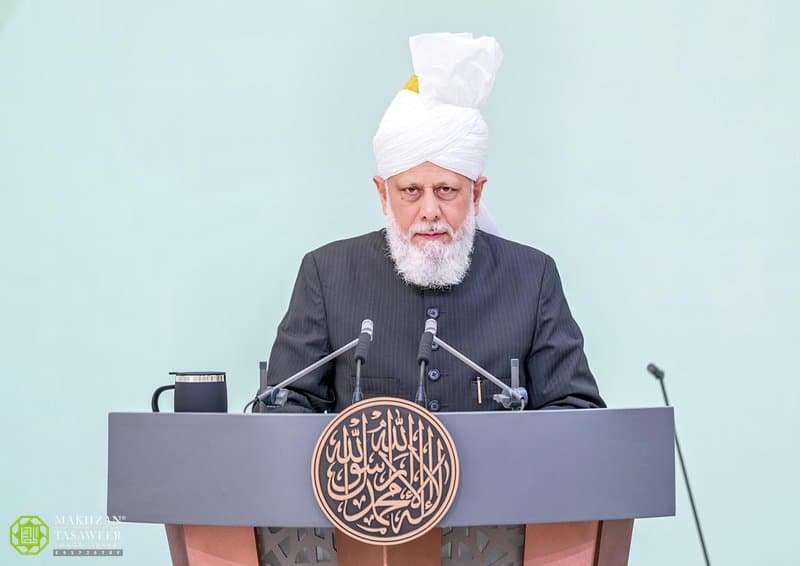
After reciting the tashahhud, ta’awwuz and Surah al-Fatihah, Hazrat Khalifatul Masih V (aa) stated:
I will present some incidents in relation to the kindness, generosity and munificence of the Promised Messiah (as).
Hazrat Sheikh Yaqub Ali Sahib Irfani (ra) writes that his generosity was like an endless river and his hands were like clouds that showered pearls. It would start pouring and continue to satiate [those it fell upon]. This would increase exponentially during the month of Ramadan as he would continue to give to those in need in complete secrecy. In fact, he would not hesitate to give others even the most precious of things. This characteristic of his can be found throughout every stage of his life. This was prominent even prior to his appointment [as the Messiah and Mahdi].
As such, recounting the kindness and benevolence of the Promised Messiah (as), Mian Ghaffara Sahib (Abdul Ghaffar) Kashmiri, relates that when he got married, the Promised Messiah (as) gave him two pieces of valuable jewellery to assist him financially. This was prior to him being commissioned [as the Promised Messiah], when he was still living a life of seclusion.
Hazrat Sheikh Sahib (ra) writes that this is not an isolated incident. Rather, there are many such incidents. It has never so happened that someone asked him for something and he did not give him anything, or that he perceived the need of someone and did not help or assist him, even without the individual asking the Promised Messiah (as). He was extremely generous and kind. (Sirat Hazrat Masih-e-Maud [as], Vol. 3, p. 312; Sirat Hazrat Masih-e-Maud [as], Vol. 2, p. 290; Feroz-ul-Lughat, p. 52)
The mother of Bashir Ahmad Sahib Bhatti says that once, on the occasion of the wedding of Hazrat Amirul Momineen, Khalifatul Masih II, Hazrat Mirza Mahmud Ahmad (ra), a woman who was involved in the playing of traditional music came to the house of the Promised Messiah (as) with a drum and started beating it, hoping to receive something, as it was a wedding. This was the custom there. When the Promised Messiah (as) heard the sound of the drum, he immediately turned his attention to it and said, “Tell her not to beat the drum and to stop it, and give her whatever she is asking for.” Accordingly, she was given four or five rupees. She then said, “Winter has arrived, and I get cold.” Upon this, the Promised Messiah (as) gave her a quilt as well. However, he stopped her from beating the drum. (Riwayat Ashab-e-Ahmad, Vol. 3, p. 441)
Hazrat Mirza Bashir Ahmad Sahib (ra) relates that, first of all, it should be clearly understood that the Promised Messiah (as) was not fond of any particular type of clothing. During the last few years of his life, he received many simple and tailored clothes as gifts, especially coats, waistcoats, traditional trousers and upper garments, etc., which Sheikh Rahmatullah Sahib of Lahore would frequently bring with him as gifts on the occasion of Eid-ul-Adha. These were generally the clothes he wore. However, aside from this, he would occasionally have clothes made for himself as well. He usually purchased his own turbans and wrapped them as well.
In the same manner that these clothes were made and worn, they were also continually given away, for people would constantly request them as blessed keepsakes. At times, it would even reach the point that he would give away a piece of garment as a blessed keepsake and immediately have another one made to wear in its place. Some discerning individuals would even send him an item of their clothes and, at the same time, request the Promised Messiah (as) to give them one of his worn garments as a blessed keepsake. (Sirat-ul-Mahdi, Vol. 1, Part 2, Riwayat 447, p. 416)
Hazrat Mufti Muhammad Sadiq Sahib (ra) writes that the Promised Messiah (as) once said to him:
“I used to have a small pocket-sized copy of the Quran that I used to carry with me. It was beautifully printed with a very clear script, and I was very fond of it. But someone asked me for it, so I gave it to him so that I would not have to refuse a person who asked.” (Zikr-e-Habib, p. 138)
Hazrat Qureshi Sheikh Muhammad Sahib (ra), who worked as a postman in the post office and was a resident of Qadian, relates:
“On one occasion, I took a large number of money orders to the Promised Messiah (as) for distribution. After handing over the amounts to him, I continued delivering the remaining money orders throughout the town. When I returned to the post office at about four o’clock and began handing in the processed money orders to the postmaster, the accounts revealed that I had mistakenly overpaid someone by six rupees.
“I became extremely worried because the amount delivered to the Promised Messiah (as) had been a substantial sum. The postmaster, whose name was Allah Ditta and who was a prejudiced non-Ahmadi, said to me, ‘It would be best if you went and asked Mirza Sahib.’
“I really did not want to trouble the Promised Messiah (as) again, but because the postmaster insisted repeatedly, I went to him and said, ‘Today I accidentally overpaid someone by six rupees.’
“The Promised Messiah (as) replied, ‘My dear brother, I do not even know exactly how much money was received, and I have already spent part of it (i.e., he had already distributed it to others). Nevertheless, you are a poor man, so I will give you these six rupees. But in future, be more careful, because you are poor.’”
This incident illustrates the Promised Messiah’s (as) noble character, generosity and compassion for those in need. (Riwayat Ashab-e-Ahmad, Vol. 5, pp. 337-338)
Hazrat Mir Mehdi Husain Sahib (ra) relates:
“On one occasion, Maulvi Muhammad Ahsan Sahib asked me for a copy of Chashma-e-Masihi [Fountain of Christianity]. I told him, ‘The Promised Messiah (as) has instructed that a certain number of copies should always remain in the office because the government sometimes requests copies of published books. Therefore, there are no spare copies available to give you. However, if you obtain permission from the Promised Messiah (as), you may have one.’
“So Maulvi Sahib wrote to the Promised Messiah (as). In summary, he wrote: ‘Only 20 copies of Chashma-e-Masihi remain in the office, and I need one copy. If there is no objection, kindly allow one to be given to me.’
“The Promised Messiah (as) wrote on the letter, ‘You may take one copy,’ and signed it.” (Riwayat Ashab-e-Ahmad, Vol. 3, p. 479)
This incident demonstrates not only the honesty and transparency of the companion, who openly explained the office’s policy and the limited number of remaining copies while respectfully making his request, but also the graciousness of the Promised Messiah (as). Although those copies had been reserved in case they were needed later, he still did not refuse the request of someone who asked.
From time to time, Pandit Mohan Lal, who was then a bright young man, would come to the Promised Messiah (as) carrying a note or letter from Pandit Lekh Ram. Since Mohan Lal’s family had long-standing ties with the family of the Promised Messiah (as), whenever he visited, the Promised Messiah (as) would never let him leave empty-handed. He would always give him something as a gift – such as fruit or fine sugar, which in those days was considered a particularly valuable gift.
Sheikh Yaqub Ali Sahib (ra) says, “Pandit Mohan Lal, whose family had also enjoyed friendly relations with mine since the time of my father, would often recount these incidents to me. He would always say, ‘The Promised Messiah (as) treated me with great kindness, always welcomed me with a smile, and never allowed me to leave empty-handed. On one occasion, the Promised Messiah (as) gave me some exceptionally fine apples. I took them with me. It had become Pandit Lekh Ram’s habit that whenever I returned, he would ask, “What have you brought?” When I told him that I had brought apples, he looked at them longingly and said, “Come on then, let me have some too.”
Pandit Mohan Lal said that I jokingly replied, “You shouldn’t eat anything that comes from the house of your enemy. (You claim to be such a great opponent of the Promised Messiah [as], so why are you asking for something from his home?)”
Without another word, he immediately snatched an apple from my hand and began eating it.’”
Hazrat Sheikh Yaqub Ali Sahib (ra) concludes by saying that Mohan Lal always testified that he had experienced nothing but kindness, generosity and graciousness from the Promised Messiah (as). (Hayat-e-Ahmad, Vol. 2, Part 2, pp. 186-187)
Hazrat Munshi Zafar Ahmad Sahib (ra) relates:
“The Promised Messiah (as) kept musk. On one occasion, I mentioned that I wanted some. He placed the container in front of me and said, ‘Take as much as you like.’
“I took only a small amount. Smiling, he said, ‘That is hardly anything,’ and then he himself measured out about one to one and a half tolas [approximately 11-17 grams] of musk and gave it to me.” (Ashab-e-Ahmad, Vol. 4, p. 213)
Musk was an extremely valuable commodity – as it still is today – and was used in perfumes and medicines. Yet the Promised Messiah (as) was never concerned with the monetary value of his possessions. His only concern was to demonstrate the highest standards of generosity and noble character.
Hakim Mufti Fazlur Rahman Sahib (ra) relates the following incident, illustrating the Promised Messiah’s (as) deep compassion and generosity towards his friends:
“My wife gave birth to a child, and on the seventh day, around Maghrib time, she began showing signs of meningitis. Since an epidemic of this illness was spreading at the time, I became extremely concerned.
“After the Maghrib prayer, I hurried to the Promised Messiah (as) and explained my wife’s condition. He said, ‘This appears to be the beginning of a very dangerous illness. Immediately give her ten rattis [a very small quantity] of asafoetida (he prescribed asafoetida to him), then come back and inform me after an hour or an hour and a half.’
“After the Isha prayer, I returned and reported, ‘The illness has increased (it has worsened instead of improving).’
“He then instructed, ‘Give her 10 rattis of quinine, and let me know again after an hour. And do not think that I will be asleep. Simply call out from the men’s staircase without hesitation.’
“An hour later, I returned and said, ‘There has been no improvement.’ He replied, ‘Then give her 10 rattis of musk.’ I said, ‘At this hour, where can I possibly obtain musk?’
“The Promised Messiah (as) went inside, returned with a handful of musk, and said, ‘This should be enough for 10 rattis.’ I submitted, ‘Huzoor, this is far more than that.’ He replied, ‘Take it with you. It will be useful again in the future.’ I took it, measured out 10 rattis, and gave it to my wife.
“An hour later, I returned once more and informed him that her condition had become even more serious.
“He then instructed, ‘Give her 10 tolas [116 grams] of castor oil.’ He continued changing the medicines in an effort to help her. I returned home and gave her the castor oil. Soon afterwards, she vomited severely. In this illness, vomiting was usually considered the final stage. After vomiting, her breathing became laboured, her neck arched backwards, her eyesight faded, and she lost the ability to speak.
“I immediately ran back and called from the staircase. Hearing my voice, the Promised Messiah (as) opened the door and asked, ‘What has happened?’
“I replied, ‘Her condition has become critical. She is struggling to breathe, her neck has become rigid (this is a symptom of this illness known as meningitis), she has lost sight in her eyes, and she has lost her speech.’
“The Promised Messiah (as) said, ‘We have now used every remedy that this world has to offer. Only one remedy remains, and that is prayer. Go home. I will now bow my head in prayer (what extraordinary compassion he displayed) until Allah grants her recovery.’
“Hearing these words, I returned home and said to my wife, ‘Now you have nothing to worry about. The One Who has taken responsibility for your case has Himself taken charge.’
“By then it was two o’clock in the morning. I left my wife in that condition, spread a bed for myself in the next room, and went to sleep, saying to myself, ‘The Promised Messiah (as) has said that he will now pray. There is nothing more for me to do.’
“The next morning, I awoke to the sound of utensils. When I looked up, I saw my wife at the foot of my bed arranging the kitchenware. I asked, ‘How are you?’ She replied, ‘You were asleep. About two hours later, Allah the Almighty bestowed His grace upon me. All praise belongs to Allah, Lord of all the worlds.’” (Sirat-e-Ahmad, Qudratullah Sanauri Sahib, pp. 17-172)
This incident demonstrates the Promised Messiah’s (as) exemplary standards of both compassion for his friends and generosity towards them.
Hazrat Sheikh Yaqub Ali Sahib (ra) writes that there was a man of Jatt [caste] in Qadian named Nihal Singh, who was an uncouth and foolish man in his youth. He had served in the army and received a pension. His house stood wall-to-wall with the drawing room of Khan Bahadur Mirza Sultan Ahmad Sahib. He was a bitter enemy of the Jamaat. At his instigation, a serious but false criminal case was filed against the first Khalifa, Hazrat Hakim-ul-Ummat (Hazrat Khalifa Noor-ud-Deen, Khalifatul Masih I [ra]), and some other Ahmadis. He would always join others in harassing Ahmadis, and hurling abuse at them had become his regular habit.
During the very period when these court cases were ongoing, musk became necessary for the wife of his nephew, named Santa Singh. Not only was musk unavailable elsewhere, but it was also an extremely expensive item. In this situation, Nihal Singh himself, the same man who was an opponent, came to the door of the Promised Messiah (as) and requested some musk. As soon as he called out, the Promised Messiah (as) immediately came out and didn’t make him wait even for a moment. As soon as he heard the request, he went inside immediately, saying, “Wait here; I will bring it right now.” He then returned with approximately half a tola of musk and handed it over to him. (Sirat Hazrat Masih-e-Maud [as], Sheikh Yaqub Ali Irfani, Vol. 2, pp. 295-296; Feroz-ul-Lughat, p. 175)
Hazrat Sheikh Yaqub Ali Sahib (ra) further writes that when the plague spread through the country, the Promised Messiah (as), under divine revelation and guidance from Allah the Almighty, began preparing a medicine, which he named “Tiryaq-e-Ilahi” [The Divine Antidote]. And there was no fixed formula for this medicine. Rather, whatever ingredients Allah the Almighty guided him to include through subtle divine revelation, he would gather and add accordingly, paying no attention to conventional principles of medicine; even the weights and measures of the ingredients were determined solely under divine guidance. (He would add the quantities as he was guided.) Several thousand rupees’ worth of precious ingredients were incorporated into this medicine, along with other costly medicinal ingredients.
When the medicine was prepared, the Promised Messiah (as) distributed it with great generosity. He did not charge anyone even for a single pill or grain of it. In fact, when people requested it from distant places, he would send it to them by registered parcel entirely at his own expense.
Dr Sadiq Sahib once related that, “Someone requested only two or three masha [unit of measurement] of the tiryaq; however, the Promised Messiah (as) packed a larger quantity into containers and had it sent by registered post.” [Hazrat Sheikh Yaqub Ali] Irfani Sahib (ra) writes, “When I also requested some, the Promised Messiah (as) granted me a very large quantity.” This wasn’t his practice only with regard to the “Ttryaq”; rather, when it came to medicines, his character was such that he would often hand over entire bottles to those who requested them.
On some occasions, he even gave highly valuable, top-quality musk to his fiercest enemies, one such incident having already been mentioned earlier. (Sirat Masih-e-Maud [as], Hazrat Sheikh Yaqub Ali Sahib Irfani [ra], Vol. 2, pp. 309-320)
Hazrat Sheikh Muhammad Naseem Sahib (ra) states that, “On one occasion I needed musk, which was almost impossible to obtain in Qadian during those days. I asked the Promised Messiah (as) regarding it, and he gave me far more than what I actually required.” (Riwayat Ashab-e-Ahmad, Vol. 5, p. 446)
Munshi Zafar Ahmad Sahib (ra) of Kapurthala relates that, “A friend had made great efforts and spent a considerable amount of money to obtain the formula for preparing a particular medicinal mixture from someone.
“After preparing it, he presented the medicine and its formula to the Promised Messiah (as). Another friend asked me to obtain that formula, but the friend would not share it with anyone. I went to the Promised Messiah (as) and said, ‘A certain friend has presented a medicinal mixture to Huzoor.’ He replied, ‘The bottle is lying there. You may take it.’ I then asked, ‘What about the formula?’ Huzoor replied, ‘That too is lying right beside it.’
“So I took both the medicinal mixture and its written formula and showed them to that friend, saying, ‘You would not tell anyone, but I have brought it. Here it is.’ That friend then went to the Promised Messiah (as) and remarked, ‘Huzoor has given it away.’ The Promised Messiah (as) replied, ‘He came to me asking for it, so I gave it to him.’ The Promised Messiah (as) further told me, ‘We also have the notebook of prescriptions belonging to Mirza Sahib (i.e., his late father). If you want medicinal formulas, I will give you that notebook as well. It contains many excellent prescriptions; you may take it.’ However, afterwards I no longer remembered to take that notebook, although Huzoor had graciously wished to give it to me.” (Ashab-e-Ahmad, Vol. 4, pp. 214-215)
Hazrat Mufti Muhammad Sadiq Sahib (ra) wrote in a letter to the Promised Messiah (as): “Due to a pregnancy, there has for some time been such difficulty in my household that food cannot be prepared at home. Bread can be baked by others, but preparing cooked dishes is difficult. Therefore, I respectfully request that for some time arrangements may be made for curry from the Langar [communal kitchen] to be sent to my home.”
In reply, the Promised Messiah (as) wrote to Mian Najmuddin Sahib, who was in charge of the Langar, instructing him: “Mufti Sahib should be provided with good-quality curry from the Langar twice daily. This is an instruction.” (Zikr-e-Habib, p. 281)
Hazrat Muhammad Ismail Sahib (ra) relates, “The Promised Messiah (as) once intended to send a delegation to Nasibain to investigate matters relating to Jesus (as). The delegation consisted of Mirza Khuda Bakhsh Sahib, Maulvi Qutbuddin Sahib, and the third member (the narrator says) was my father, Mian Jamaluddin Sahib. These individuals had been selected by drawing lots. The Promised Messiah (as) gave each of the three men 50 rupees to prepare clothing and other necessities for the journey. He also held a farewell gathering for them.
“However, due to certain circumstances, the expedition was later cancelled. When the journey was called off, (the narrator says that) my father went to return the 50 rupees to the Promised Messiah (as). Huzoor replied, ‘Whatever we have once given to someone, we do not take back.’ When my father returned home, he later narrated this incident to me.” (Riwayat Ashab-e-Ahmad, Vol. 2, p. 140)
Hazrat Malik Ghulam Husain Sahib (ra) relates, “The Jalsa Salana of either 1894 or 1895 was also attended by Husamuddin Sahib Sialkoti, who had a great fondness for cooking and food. He spoke very highly in the presence of the Promised Messiah (as) about a dish called ‘shab deg’, saying, ‘Your Holiness, shab deg is an exceptionally delicious dish.’ (Shab deg is a dish prepared with different kinds of meat, and various vegetables and other ingredients are also added to it; it is then cooked throughout the night.)
“The Promised Messiah (as) called me and said, ‘Provide Shah Sahib with whatever he likes and as many ingredients as he requires.’ Accordingly, meat was obtained locally, while turnips were brought from Batala. Towards the evening, approximately four large cooking pots were placed on the fire. Rice was also purchased from a well-known shop in the amount of about two to two and a half maunds. In the morning the guests were served food as desired by Syed Husamuddin Sahib.” (Riwayat Ashab-e-Ahmad, Vol. 4, p. 30)
Hazrat Mirza Bashir Ahmad Sahib (ra) relates, “Munshi Zafar Ahmad Sahib wrote to me saying: ‘Once, on the occasion of Jalsa Salana, the funds ran out. In those days, there was no regular system of collecting donations specifically for Jalsa Salana; rather, the Promised Messiah (as) would personally bear the expenses from his own resources.
“The late Mir Nasir Nawab Sahib, who was in charge of the Langar, came and submitted that there was no provision left for the guests that night. In other words, the expenses had been exhausted, the money had run out, and the stores of food had also been depleted. There was now nothing available with which to feed the guests.
“The Promised Messiah (as) said, ‘Take some jewellery from Bibi Sahiba; that may be sufficient to fulfil the need at hand.’ In other words, the Promised Messiah (as) instructed that jewellery be taken from Hazrat Amma Jaan (ra), and that it should either be sold or used to raise funds so that provisions could be arranged. Accordingly, the jewellery was either sold or pledged, and Mir Sahib brought the money and arranged the necessary provisions for the guests.
“Two days later, Mir Sahib again said at night, in my presence, that there was nothing left for the following day. The funds raised from the jewellery had lasted for two days, but now what was to be done? The Promised Messiah (as) said, ‘We made whatever arrangements we could with apparent means. We have given whatever we had. There is nothing left for us to do. These are the guests of God and have come for the sake of Allah the Almighty; they are the guests of Allah. He Himself will now make the arrangements.’
“Munshi Zafar Ahmad Sahib says, ‘The next morning, around eight or nine o’clock, when the postman arrived, the Promised Messiah (as) called Mir Sahib and me. The postman had in his hand around 10 or 15 money orders that had arrived from different places, each for 50 or 100 rupees. The senders had written on them that they were unable to attend the Jalsa, and were therefore sending money for the expenses of the guests.
“The Promised Messiah (as) received the money orders and then delivered a discourse on trust in Allah. Munshi Zafar Ahmad Sahib says, ‘A few others were also present at the time. The Promised Messiah (as) said, “Just as a worldly person has confidence in the money placed in his safe, believing that he can take it out whenever he wishes, those who place their trust in Allah have an even greater certainty in Allah the Almighty. It is certainly the case that whenever there is a need, Allah the Almighty sends the means immediately.”’” (Sirat-ul-Mahdi, Vol. 2, Part 4, Riwayat 1124, pp. 97-98)
Thus, when the Promised Messiah (as) said that they were the guests of Allah and had come for His sake, he would certainly have prayed as well; and his trust in Allah was resolute. Allah the Almighty then made the arrangements Himself.
Hazrat Mian Rahmatullah Sahib (ra) relates, “The Promised Messiah (as) would say, ‘Famine and the plague are happening all at once, yet still people do not repent. They die of hunger.’ Three years after this, a severe plague spread across the country. During the days of famine, the Promised Messiah (as) would say that it is mentioned in the Ahadith that a famine would occur in the time of the Promised Messiah. The saying of the Holy Prophet (sa) and the promise of Allah the Almighty were fulfilled.
“On the other hand, the Promised Messiah (as) instructed Maulvi Sahib, Hazrat Khalifatul Masih I (ra), that as much grain as possible should be procured. At that time, the Promised Messiah (as) himself oversaw the arrangements of the Langar. Since there was a fear and danger of famine, he instructed that grain and other provisions should first be arranged, and he entrusted Hazrat Khalifatul Masih I (ra) with this task so that purchases could be made immediately.
“In accordance with the Promised Messiah’s (as) instruction, Maulvi Sahib purchased 30 sacks for the Langar from me. There was a shortage of donations, and the Promised Messiah (as) sold all the jewellery that was present in his home. He gave Maulvi Sahib 700 rupees to purchase wheat. (Seven hundred rupees was a very large sum in those days.) Hazrat Maulvi Sahib then sent the late Mian Najmuddin Sahib to the village to purchase wheat. It is said that Mirza Ismail Sahib also accompanied him and they purchased grain.
“People who had been displaced from Bikaner, a region of Rajasthan in India, came into our area. A severe famine had struck there, and people had begun coming from that region. Cries for bread could be heard from every direction. The Promised Messiah (as) instructed that flour should be prepared in the Langar at all times and that bread should remain ready. He told Mian Najmuddin Sahib that anyone who asked for bread should be given bread and that no one should leave empty-handed.
“Within a few days, the grain that had been purchased was all used. The Promised Messiah (as) then delivered a speech, the words of which were as follows: ‘This is a temporary matter. Such sacrifices are not always required, nor is such reward always available. These are special days for the believers. May Allah the Almighty enable the members to strive for His pleasure.’
“As a result of this speech, some money was collected, and some also arrived from outside. More grain was then purchased. In this way, during the days of famine, this system continued. Whoever came was immediately provided with food.
“The Promised Messiah (as) would say, ‘I read in some newspapers that in certain countries, so many children have died of hunger and so many people have died. Grain is not available. The fact that grain is not available is a severe punishment and wrath from Allah the Almighty.’ He would repeatedly say, ‘May Allah the Almighty have mercy.’ With great concern and anguish, the Promised Messiah (as) would ask Mian Najmuddin Sahib and Maulvi Sahib about the grain.” (Riwayat Ashab-e-Ahmad, Vol. 4, pp. 72-73; “Bikaner”, Wikipedia)
Even today, there are some countries in the world where similar conditions exist. There is great hardship; famine prevails, grain is unavailable, or inflation is such that people cannot afford to buy food. People are dying from poverty and hunger. By the grace of Allah, wherever the Jamaat becomes aware of such conditions, it sends funds to assist people and fulfils their essential needs. Members also contribute their share in this effort. May Allah the Almighty grant them even greater ability to continue striving to help the poor and those afflicted by famine.
Hazrat Qazi Noor Muhammad Sahib (ra) relates (writing at the time of Hazrat Khalifatul Masih II [ra]), “I had the opportunity to study at night in Dar-ul-Masih with Hazrat Khalifatul Masih II (ra), who was my classmate. Hazrat Maulvi Sher Ali Sahib (ra) would teach us. The Promised Messiah (as) would deliver addresses to the ladies, and at that time the sound of his address would reach them clearly; however, regrettably, I do not remember what the Promised Messiah (as) said.
“Generally, Mullah Ahmad Noor would go to obtain flour for the Langar. When the flour was brought on a donkey, Allah the Almighty would grant this humble one the opportunity to lift the sack of flour and carry it into Dar-ul-Masih. On one occasion, I saw the Promised Messiah (as) bring many rupees in the fold of his shirt and place them into the pocket of Mullah Ahmad Noor’s garment without counting them. He gave the money without counting it and instructed him, in effect, to go and purchase whatever was needed for the Langar so that its arrangements could continue.” (Riwayat Ashab-e-Ahmad, Vol. 4, p. 75)
Hazrat Mian Chiragh Din Sahib (ra) narrates: “On one occasion, my throat became so badly constricted that I lost my voice. The Promised Messiah (as) said to Hazrat Maulvi Noor-ud-Deen Sahib (ra): ‘See to Chiragh Sahib’s throat – what is the matter that he has lost his voice?’ Hazrat Maulvi Sahib (ra) treated him for some time, but to no avail. Then on one occasion, when Dr Muhammad Husain Shah Sahib, Dr Yaqub Baig Sahib, and Dr Bura Khan Sahib of Lahore all happened to be present together, the Promised Messiah (as) raised the matter before them as well, asking what the reason might be that the boy had lost his voice. Dr Yaqub Baig Sahib examined my throat and said: ‘If you give the order, the insides of his throat can be cut’ – meaning, it appeared to be a matter of the tonsils, and that removing them would restore his voice. The Promised Messiah (as) said nothing in response and fell silent.
“A few days later, the Promised Messiah (as) said: ‘Chiragh, we shall now treat you ourselves’ – and looking at him there and then, he said: ‘We shall prepare a remedy for you.’ By God’s own wisdom, that very day a herbalist from Amritsar arrived carrying a jar of pickles made from madar leaves. The Promised Messiah (as) opened it, looked at it, and said: ‘This is your cure.’ The Promised Messiah (as) had already said he would prepare a remedy, and then, as if on cue, a man who prepared such things – remedies and preserves – arrived with this madar-leaf pickle, whereupon he declared it to be the treatment. At mealtimes, two or three leaves would be placed on a flatbread and given to him – it was very pleasant to eat – and the Promised Messiah (as) partook of it himself as well. He says: it brought him relief. At that point, the Promised Messiah (as) gave him the entire jar, saying: ‘Finish it yourself.’ And when he did, he recovered completely.” (Riwayat Ashab-e-Ahmad, Vol. 2, p. 72)
Hazrat Mirza Afzal Baig Sahib (ra) narrates: “I first came to Qadian in 1898. My father, Mirza Fazal Baig Sahib, a court pleader, enrolled me in Talimul Islam High School to pursue my studies. At the time, there were a few boarding students, and their meals were provided through the Langar. Some complaints were raised about the food and my father mentioned to the Promised Messiah (as) that the children were having difficulty with the meals. Out of his kindness, he immediately said that food would be sent to the children from his own home – and so for several months, our meals came from his personal household. From time to time, he would also send mangoes and sweets for the children to enjoy. (Riwayat Ashab-e-Ahmad, Vol. 4, p. 167)
Khwajah Abdul Rahman Sahib Kashmiri told Hazrat Mirza Bashir Ahmad Sahib (ra) that the late Hafiz Hamid Ali Sahib used to recount: whenever money came to the Promised Messiah (as) from anywhere, he would call me, hand over the money without counting it, and say: “Take it now – who knows when there will be more.” Hazrat Mirza Bashir Ahmad Sahib (ra) notes that the late Hafiz Hamid Ali Sahib was among his personal attendants, to whom he would give money for household needs and to look after guests. (Sirat-ul-Mahdi, Vol. 1, Part 3, Narration 530, pp. 529-530)
Hazrat Khan Sahib Syed Ghulam Husain Sahib (ra) narrates: On one occasion, the Promised Messiah (as) sent me from Qadian to Batala to collect a parcel that had arrived by rail and gave me five rupees for the purpose. The parcel had arrived by train, and I was to retrieve it. The parcel turned out to be a basket of grapes, on which only four annas had been charged. When I brought the basket and presented it to him, he tore open the burlap covering with both hands, scooped out some grapes, and gave them to me first, saying: “This is your share.” When I tried to return the remaining money – nearly five rupees – he picked up the basket, carried it inside, and said: “We do not keep accounts with our friends.” I was 15 years old at the time, he says. (Riwayat Ashab-e-Ahmad, Vol. 5, p. 120)
Hazrat Munshi Qazi Mahbub Alam Sahib (ra) says: Maulvi Muhammad Ali Sahib and Khwaja Kamaluddin Sahib used to practise law together in Peshawar as partners – it was a shared practice. Maulvi Muhammad Ali Sahib later came to Qadian, while Khwaja Sahib remained there. When cases were brought against the Promised Messiah (as) – this appears to refer to the cases brought by Karam Din – Khwaja Sahib came from Peshawar to represent him.
The Promised Messiah (as) was present in the Mubarak Mosque when Khwaja Sahib arrived, wearing a look of great distress, and said: “Only God and His Prophet know what it took to get here. I pledged my wife’s jewellery to raise the fare for the journey. The financial situation is very bad.” The Promised Messiah (as) said: “Khwaja Sahib, you need money? Come.” He went inside with Khwaja Sahib following him, opened a trunk, and scooped out two or three large handfuls – whatever coins had come in – and poured them into Khwaja Sahib’s lap, saying: “Is that enough, Khwaja Sahib – or do you need more?” Khwaja Sahib said: “That is more than enough.” When Khwaja Sahib counted the money afterwards in the Mubarak Mosque, it came close to 300 rupees. He left for Gurdaspur the following day.
The Promised Messiah (as) had poured that money into his lap without counting it at all – and this was his general habit: he never counted out money for his attendants either, placing complete trust and confidence in them. In all the time I was fortunate enough to spend in his company, I never once saw him ask any attendant for an account. Whenever anyone asked, he simply gave. (Riwayat Ashab-e-Ahmad, Vol. 4, p 277)
Hazrat Sheikh Yaqub Ali Sahib Irfani (ra) writes, whilst mentioning the kindness shown to Khwaja Sahib:
“Khwaja Kamaluddin Sahib, who has now severed his ties with the Jamaat – that is, he has separated himself from the Jamaat – and harbours enmity and hostility towards the progeny of his benefactor, (i.e., the Promised Messiah [as] had bestowed countless favours upon him, yet he bears animosity towards Hazrat Khalifatul Masih II [ra] who is from his progeny) had extensive personal experience of the graciousness, benevolence, generosity and munificence of the Promised Messiah (as). Indeed, he had witnessed these favours on numerous occasions. He received substantial sums of money repeatedly, yet despite receiving them, he never once acknowledged it, nor did he ever express gratitude to the benefactor. Rather, he continued to boast of his own services, constantly claiming that he was rendering great service to the Jamaat.”
Hazrat Sheikh Yaqub Ali Sahib Irfani (ra) further writes:
“I regard this as ingratitude towards one’s benefactor and a complete disregard of his favours. During the days when the court cases against Maulvi Karam Din were being heard in Gurdaspur, on one occasion, during the proceedings, he showed the Promised Messiah (as) a letter that had arrived from his home in Peshawar, mentioning the financial hardship they were facing. The Promised Messiah (as) immediately gave him 500 rupees in cash and then instructed that he be given 100 rupees every month. Thereafter, he continued to receive 100 rupees monthly. In particular, at the instruction of the Promised Messiah (as), members of the Community had contributed a considerable sum towards the expenses of the court cases, and this money remained in Khwaja Sahib’s custody. Yet the Promised Messiah (as) never once asked him to account for it.
“In addition to such financial generosity and beneficence, Hazrat Sahibzada Abdul Latif Sahib Shaheed (ra) had presented the Promised Messiah (as) with a valuable Afghan-style coat. Khwajah Sahib requested it, saying, ‘Your Holiness! Kindly grant me this coat so that I may wear it when appearing in court. By virtue of its blessing, I shall command awe in the opposing counsel and in the court.’ With a smile, the Promised Messiah (as) presented this beautifully embroidered and valuable cloak to Khwaja Sahib.” (Sirat Masih-e-Maud [as], Part 3, pp. 311-312)
This was also mentioned in the previous sermon: someone had brought a fine sheepskin leather coat. Even today, leather garments are regarded as valuable, and they were considered so in those days as well. When Khwaja Sahib requested that coat, the Promised Messiah (as) gave it to him.
Sheikh Hamid Ali Sahib (ra) relates:
“Until the very end of his life, he never once asked me to render an account, nor did he ever become displeased with me. On one occasion, I went to Lahore. Maulvi Noor-ud-Deen Sahib had sent a remittance of 700 rupees, which he brought back. It was either in the form of cash, a money order, or a voucher. He also purchased some supplies, and after doing so, he returned with approximately 50 rupees remaining. I presented the breakdown to the Promised Messiah (as). He replied, ‘When did I ever ask you for a breakdown?’” (Sirat-e-Ahmad, Qudratullah Sanauri Sahib, p. 59)
Hazrat Sheikh Ahmad Din Sahib (ra) relates:
“On one occasion, the Promised Messiah (as) instructed this humble one, ‘Go to Mian Nabi Bakhsh Sahib, the darner, in Amritsar.’ The Promised Messiah (as) wrote a letter and said, ‘Deliver this to him. Whatever items he purchases for you, bring them back promptly, and return by tomorrow.’
“The following day, I was delayed somewhat in returning. The Promised Messiah’s (as) attendant, Mian Karamdad Sahib, was instructed, ‘Go quickly. I had sent Ahmad Din to Amritsar, and he has still not returned. I hope all is well. Go and find out.’
“On the way, Mian Karamdad Sahib met me and said, ‘Hazrat Sahib is greatly concerned about you.’ When I presented myself before the Promised Messiah (as), he immediately asked, ‘Did you suffer any inconvenience?’
“I submitted, ‘Huzoor, I suffered no inconvenience whatsoever.’ Merely hearing Huzoor enquire after my well-being filled my heart with immense joy, for he had kindly asked after my condition.
“I then wished to present a breakdown of the expenses along with the remaining money. Huzoor (as) asked, ‘What is this paper?’ I respectfully replied, ‘It is the list of the items purchased, and this is the money that is left over.’
“With great affection, Huzoor said, ‘What accounting is there between you and me? You may spend this remaining money on your own needs.’ At this, I was overjoyed.” (Riwayat Ashab-e-Ahmad, Vol. 4, pp. 95-96)
Hazrat Sheikh Yaqub Ali Sahib Irfani (ra) relates that on one occasion, Hazrat Hakim-ul-Ummat Maulana Noor-ud-Deen Sahib (ra) borrowed a sum of money from the Promised Messiah (as). When he later sent the money back in repayment, the Promised Messiah (as) expressed his disapproval, returned it, and remarked, “Do you regard our money as being separate from your own?” (Sirat Masih-e-Maud [as], Part 3, p. 307)
Hazrat Sheikh Yaqub Ali Sahib Irfani (ra) further writes that after the Promised Messiah (as) announced that he had been commissioned by God Almighty, and people also came to know that Allah the Almighty had given him the glad tidings, “Kings shall seek blessings from your garments,” people would commonly request articles of his clothing. He would never refuse anyone. At times, the situation became such that only the clothes he was wearing remained on his person, as all his other garments had been given away. (Sirat Masih-e-Maud [as], Part 2, p. 290)
Hazrat Sheikh Yaqub Ali Sahib Irfani (ra) relates that the Promised Messiah (as) permitted Mir Abbas Ali Sahib to retain and spend the proceeds received from the sale of Barahin-e-Ahmadiyya. This is but a modest illustration of his magnanimity and generosity.
Hazrat Munshi Zafar Ahmad Sahib (ra) narrates that Mirza Nizamuddin Sahib and Mirza Imamuddin Sahib, though relatives of the Promised Messiah (as), were among his staunch opponents. Nevertheless, whenever they found themselves in need and sought financial assistance from the Promised Messiah (as), he would fulfil their request. On one occasion, he relates, Mirza Nizamuddin Sahib asked the Promised Messiah (as), in his presence, for 50 rupees, or thereabouts. The Promised Messiah (as) immediately instructed Hafiz Hamid Ali Sahib to deliver the amount to him. (Ashab-e-Ahmad, Vol. 4, pp. 215-216)
Hazrat Mirza Bashir Ahmad Sahib (ra) writes that Dr Mir Muhammad Isma’il Sahib (ra) related to him that, during the era of Hazrat Khalifatul Masih I (ra), Abdul Muhyi Sahib, an Arab, once remarked to him:
“What can one say of the generosity of the Promised Messiah (as)? During his lifetime, I never experienced any hardship. Whenever I needed something, I would ask him without the slightest hesitation, and he would give me more than I needed. Indeed, he would also provide for me of his own accord.
“After the Promised Messiah (as) passed away, although Hazrat Khalifatul Masih I (ra) was himself renowned for his generosity, he was unable to fulfil my needs in the same manner. After all, finding myself in difficulty, I wrote to him saying, ‘You have indeed become the Khalifa of the Promised Messiah (as), but in fulfilling my needs you have not succeeded to his example. The Promised Messiah (as) used to treat me in such and such a manner.’
“Upon receiving my letter, Hazrat Khalifatul Masih I (ra) provided me with financial assistance. Even so,” he said, “I swear by Allah that there is no comparison between the Promised Messiah (as) and anyone else in this respect. No one comes near him in comparison.” (Sirat-ul-Mahdi, Vol. 1, Part 3, Narration 562, p. 545)
On one occasion, a poor woman stole some rice from the house of the Promised Messiah (as). When people caught her, a commotion arose. At the time, the Promised Messiah (as) was in his room working and upon hearing the noise, he came out. He saw a poor, destitute woman, extremely dishevelled, standing with a small bag of rice in her hand. When the Promised Messiah (as) learnt of the entire incident and observed the state of this poor woman, he felt great sympathy for her, and he said, “This woman appears to be hungry and destitute. So give her some more rice and let her go. And adopt the divine attribute of Sattar [i.e., covering one’s shortcomings].”
After narrating this incident, Hazrat Mirza Bashir Ahmad Sahib (ra) states, “Following this account, someone could hastily draw the conclusion that this act emboldens the habit of stealing; in other words, one is giving further courage to the one who has committed theft. However, a wise person would understand that since the property belonged to the Promised Messiah (as) and the one who took from it was a hungry and destitute woman, then this would not be considered as lending support to the act of stealing; rather, it would be considered as helping the needy. It is proven from the Ahadith that in such compelling circumstances, the Holy Prophet (sa) also did not consider such a person a thief, who was extremely hungry and took something to eat. Rather, he concealed his flaw in such a case.” (Sirat-e-Tayyibah, pp. 64-65)
These are the perfect examples of subservience to his master, the Holy Prophet (sa).
اَللّٰھُمَّ صَلِّ عَلٰی مُحَمَّدٍ وَّعَلٰی عَبْدِکَ الْمَسِیْحِ الْمَوْعُوْدِ وَبَارِکْ وَسَلِّمْ
[O Allah! Send down Your blessings upon Muhammad and upon Your servant the Promised Messiah. And grant blessings and peace.]
(Official Urdu transcript published in the Daily Al Fazl International, 22 July 2026, pp. 7-13. Translated by The Review of Religions.)