
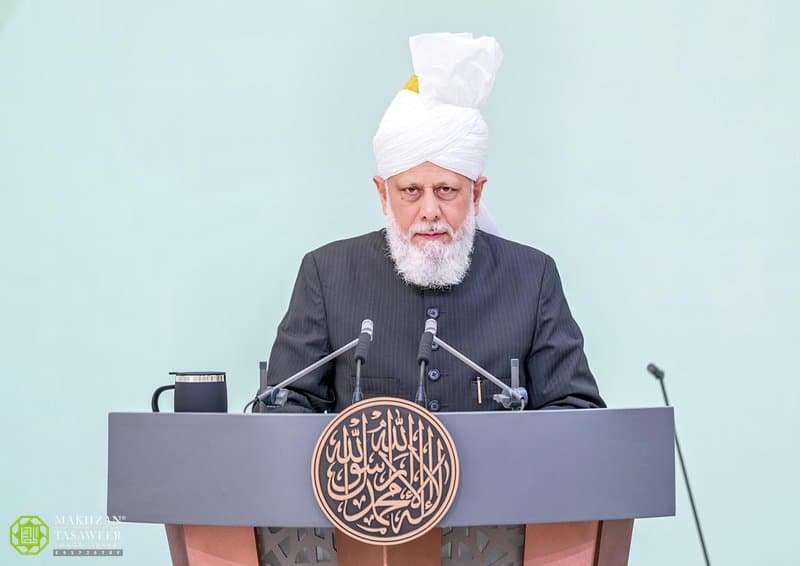
Friday Sermon
30 January 2026
Allah is supreme: The Prophet’ssa love at Uhud
After reciting the tashahhud, ta‘awwuz and Surah al-Fatihah, Hazrat Khalifatul Masih Vaa stated:
There are countless accounts about the Holy Prophet’ssa love for Allah the Almighty. In fact, every deed of his and every incident points to the fact that an ocean of divine love was always surging in his heart. We see one such instance during the Battle of Uhud, where his zeal for the love of Allah was expressed in an extraordinary and unique manner.
It is related that Hazrat Bara’ara narrated, “On the day of Uhud, we came up against the idolaters [in battle]. The Holy Prophetsa prepared a battalion of archers and appointed Hazrat Abdullah as their leader. He instructed them emphatically that they must not leave their post. They must not leave even if they see that we have overcome the enemy. And even if they saw that the enemy overcame us, they should not come to our aid.” That is, in both victory and defeat, they must not abandon their position. Towards the end of this incident, we are able to observe the intensity of his love for Allah. The narrator relates, “When the battle commenced, the enemy fled, so much so that I saw the idolatrous women running toward the hills. They had lifted their garments from their feet, and their anklets were visible. The Muslims then began to call out: ‘The spoils of war, the spoils of war!’ Hazrat Abdullah held his battalion back and said: ‘The Holy Prophetsa instructed me that you must not move.’ However, they did not obey. When they abandoned the mountain pass and approached the spoils of war, Allah the Almighty turned away from those Muslims. (That is, when they left the pass to collect the spoils of war, Allah the Almighty also turned away from them.) The tide of battle turned, and the enemy launched another attack, resulting in 70 Muslims being martyred.” He says, “During this time, the Holy Prophetsa, along with his Companions, had taken shelter at the foot of a mountain when Abu Sufyan climbed to an elevated place and called out: ‘Is Muhammad among the people?’ The Holy Prophetsa said: ‘Do not answer him.’ Abu Sufyan then called out: ‘Is Ibn Abi Quhafah among the people?’ The Holy Prophetsa again instructed: ‘Do not reply.’ Then Abu Sufyan called out: ‘Is Umar Ibn al-Khattab among the people?’ When there was no reply, Abu Sufyan said: ‘All of these men have been killed. Had they been alive, they would surely have responded.’ Hazrat Umarra could not restrain himself and called out: ‘O enemy of Allah! You have lied! Allah has kept alive the one who will humiliate you.’ Abu Sufyan then raised the slogan: ‘Glory to Hubal!’ Upon hearing this, the Holy Prophetsa became restless and said: ‘Respond to him!’ The Companions asked: ‘What should we say?’ He replied: ‘Say that Allah is the Most High and the Most Glorious.’ Abu Sufyan then said: ‘We have ‘Uzza, and you have no ‘Uzza.’ The Holy Prophetsa said: ‘Respond to him!’ The Companions asked: ‘What should we say?’ He replied: ‘Say that Allah is our Helper, and you have no Helper.’” (Sahih al-Bukhari, Kitab al-maghazi, Bab ghazwati uhud, Hadith 4043)
When the honour and majesty of Allah the Almighty and his love for Him came into question, the Holy Prophetsa was not concerned for his own life. He immediately instructed the Companions to respond. Previously, he had chosen not to reply out of wisdom.
Hazrat Musleh-e-Maudra has also written about this incident with reference to history. He writes that those Companions who were around the Messengersa of Allah, and who had been pushed back due to the onslaught of the disbelievers, regrouped around the Messengersa of Allah as soon as the disbelievers retreated. That is, the Companions gathered around his blessed body and lifted him up, for he had fallen unconscious. One Companion, Ubaidah bin al-Jarrah, pulled out with his teeth a nail that had become embedded in the Holy Prophet’ssa head, as a result of which two of his own teeth broke.
After a short while, the Holy Prophetsa regained consciousness. He had fainted due to his wounds, as I have mentioned. When he regained consciousness, the Companions sent men running in all directions across the battlefield, announcing that the Holy Prophetsa was alive and that everyone should come back. The enemy had spread the rumour – God forbid – that he had been martyred. The Muslim army, which had become scattered, began to regroup.
The Holy Prophetsa took them towards the foot of the mountain. When the remaining force had gathered there, Abu Sufyan shouted loudly and said, “We have killed Muhammad[sa].” The Holy Prophetsa did not respond to Abu Sufyan, lest the enemy come to know the true situation and launch another attack. Otherwise, the enemy would think that since the Muslims were not dead but wounded, and since they were wounded, they would not be able to withstand another attack, and thus the injured Muslims might again fall prey to the enemy.
When no response came from the Muslim army, Abu Sufyan became convinced that his assumption was correct. He then shouted loudly, “We have also killed Abu Bakr.” The Holy Prophetsa instructed Hazrat Abu Bakrra as well not to respond. Then Abu Sufyan shouted, “We have also killed ‘Umar.” At this, Hazrat Umarra, who was very passionate, wanted to reply by saying that, by the grace of Allah, we are alive and ready to face you, but the Holy Prophetsa restrained him and said not to put the Muslims at risk and to remain silent. This was a time of weakness, and if the enemy attacked suddenly, greater harm could occur.
Now the disbelievers became convinced that they had killed the Foundersa of Islam as well as his right and left supporters. At this, Abu Sufyan and his Companions raised joyful slogans, crying out:
اُعْلُ ھُبَل اُعْلُ ھُبَل
“Exalted is Hubal! Exalted is Hubal!” Meaning that their idol Hubal had prevailed and had ended Islam that day.
The same Holy Prophetsa, who had instructed silence when his own death was announced and when the deaths of Hazrat Abu Bakrra and Hazrat Umarra were proclaimed – so that the wounded Muslims might not be attacked again and the small remaining group might not be martyred at the hands of the disbelievers – now, when the honour of the One God was challenged and a slogan of shirk [associating partners with God] was raised on the battlefield, his soul became restless.
Turning to the Companions with great fervour, he said, “Why do you not respond?” The Companions replied, “O Messengersa of Allah, what should we say?” He said, “Say:
اللہُ اَعْلٰی وَ اَجَلّ اللہُ اَعْلٰی وَ اَجَلّ
“That is, ‘You are lying when you claim that Hubal has been exalted. Allah alone, without any partner, is Exalted and Majestic. His alone is the highest rank, and not Hubal.’”
And in this manner, he conveyed to the enemies the news that he was alive.
The impact of this bold and courageous reply upon the army of the disbelievers was so profound that, despite the fact that their hopes were crushed by this response, and despite the fact that before them stood only a handful of wounded Muslims whom, according to material calculations, it was entirely possible to attack and kill, they did not dare to launch another assault. Content with the victory they had already gained, they celebrated and returned to Mecca. (Dibachah Tafsir-ul-Quran, Anwar-ul-Ulum, Vol. 20, pp. 252-253)
The Holy Prophetsa would not allow even the slightest trace of shirk to enter due to his love for God Almighty. It is related in a narration from Hazrat Ibn ‘Abbasra that a man once said to the Holy Prophetsa, “Whatever Allah wills and whatever you will.” Thereupon, the Holy Prophetsa said, “Have you made me equal to Allah?” Rather, say, “Whatever Allah alone wills.” (Sunan Ibn Majah, Kitab al-Kaffarat, Bab al-Nahy an Yuqal Ma Sha’ Allah wa Shi’ta, Hadith 2117)
Not even the faintest aspect of shirk should be allowed to enter. Some people casually utter such phrases as “Whatever Allah wills and whatever you will.” Yes, one may say, “Whatever Allah wills, and by His grace”, and if he also prays, then blessings will be bestowed. Up to the extent of supplication, it is acceptable, but the phrase “and whatever you will” is incorrect, because the Holy Prophetsa strongly disapproved of it.
He was also concerned that people might turn graves into places of worship. Unfortunately, today the opposite is practised. I have mentioned this before as well that Muslims go to the graves of saints and worship there, even prostrating, whereas the Holy Prophetsa forbade turning graves into mosques.
Hazrat Aishara relates that during the illness in which the Holy Prophetsa passed away – that is, at his final moments – he said, “May Allah curse the Jews and the Christians; they turned the graves of their prophets into mosques.” Hazrat Aishara said that had he not said this, his grave would have been left open, but she feared that it might be turned into a mosque; therefore, it was not left open so that it would not become a place of worship. (Sahih al-Bukhari, Kitab al-jana’iz, Bab ma yukrahu min ittikhazi l-masjidi ‘ala l-qubur, Hadith 1330)
Nowadays, the authorities have made proper arrangements around it, erecting railings and walls, so that no form of shirk may take place. At least in this regard, they have done well, because he had intense hatred for shirk.
Regarding the proclamation of the Oneness of God Almighty, a narration is reported as follows: Hazrat Ibn Abi Ka‘bra relates that the polytheists said to the Messengersa of Allah, “Tell us the lineage of your Lord.” Thereupon, Allah Almighty revealed:
قُلۡ ہُوَ اللّٰہُ اَحَدٌ اَللّٰہُ الصَّمَدُ
“Say: ‘He is Allah, the One. Allah, the Self-Sufficient. He is One and Unique. He neither begets nor is begotten, because nothing that is born is free from death, and nothing that dies is without an heir. Allah, the Mighty and Exalted, neither dies nor has any heir, nor does He have any equal.’”
The narrator says: “He has no likeness, no equal, and none comparable to Him.” (Sunan at-Tirmidhi, Abwab tafsiri l-qur’ani ‘an rasulillahsa, Bab wa min surati l-ikhlas, Hadith 3364)
The Holy Prophetsa never let any opportunity pass without mentioning the Oneness of God Almighty, and every word he uttered overflowed with love for Allah. On every occasion, whenever he spoke, each word clearly reflected that the love of Allah was deeply and abundantly embedded in his heart. Rather, his heart was completely filled with love for God, and there was nothing else in it besides that.
Hazrat Zaid bin Khalid Juhanira relates that the Holy Prophetsa led them in the morning prayer at Hudaibiyah following rainfall during the night. When he had finished the prayer, he turned towards the people and said, “Do you know what your Lord, the Mighty and Exalted, has said?” Allah Almighty knows the state of hearts. Whatever thoughts people had upon seeing the rain were known to Allah, and Allah the Almighty informed the Holy Prophetsa of them.
The people said, “Allah and His Messengersa know best.” The Holy Prophetsa said: “Allah states, ‘Among My servants, some would begin the morning in such a state that they would believe in Me, and some would deny Me. (That is, among the people there were some who, after witnessing the night’s rain, began the morning as believers, but some were disbelievers.) Whoever said: “Rain fell upon us due to the grace and mercy of Allah the Almighty,” that person believes in Me. And those who said that rain fell due to the grace of Allah the Almighty (they are believers, as I have said), and they are deniers of the stars – (in that era, stars would also be worshipped, and many idol-worshippers of this kind also entered Islam and had not been fully educated. So some people would say that rain fell today because of such-and-such a star.) Thus, whoever said that rain fell today because of the stars are those who denies Me, and instead believes in the stars.’” (Sahih al-Bukhari, Kitab al-adhan, Bab yastaqbila l-imamy n-nasa idha sallam, Hadith 846)
Thus Allah the Almighty said to the Holy Prophetsa: “O Muhammadsa, just as you possess complete understanding of the Oneness of God Almighty, inform the believers as well regarding the vigour with which one must affirm the Oneness of Allah the Almighty and His love in every matter, and one must believe in it from the depths of the heart.
Hazrat Jabirra relates that a man came to the Holy Prophetsa and said: “O Messengersa of Allah, what are two things that make Paradise and Hell certain?” The Holy Prophetsa replied: “Whoever dies in such a state that he does not associate anyone with Allah will enter Paradise, and whoever dies in such a state that he associates partners with Allah will enter the Fire.” (Sahih Muslim, Kitab al-iman, Bab ad-dalil ‘ala mun mata laa yushrik billahi shay’an dakhala l-jannah…, Hadith 93)
Thus, even today, this answer suffices for anyone who asks about the meaning of shirk. Just as the Promised Messiahas has also stated that to place trust in provisions, trust in one’s own self, trust in one’s own ability, trust in one’s wealth, trust in one’s family and tribe, to place trust in one’s children – indeed, anything in which a person places trust without giving precedence to God Almighty, and places trust without proclaiming the name of Allah the Almighty, he becomes guilty of shirk [associating partners with God]. (Malfuzat, 2022, Vol. 2, p. 420)
Thus, we must continue to examine ourselves very carefully so that we remain protected from associating partners with God, act upon this guidance, and continue to establish the love of Allah the Almighty within our hearts. Then at another instance, it is mentioned in further detail, as narrated by Mahmud bin Labid, that the Holy Prophetsa said: “The thing that I fear most for you is minor associations of partners with God.’ The Companions said: ‘O Messengersa of Allah, what are minor associations of partners with God?’ The Holy Prophetsa replied: ‘Ostentation; on the Day of Judgement, Allah the Almighty will say: “Go to those for whom you used to show off in the world and see whether you find any reward with them.”’” (Musnad Imam Ahmad bin Hanbal, Vol. 7, Hadith Mahmud bin Labid, Hadith 24030, Alam al-Kutub, Beirut, p. 799)
Meaning you used to perform certain deeds to show them, so now seek your reward from them. Thus, showing off – that is, artificial principles and pretence adopted in order to show off in front of people – are things that Allah the Almighty greatly dislikes, because one is not doing those things to please Allah the Almighty, but rather to please people through display. We must examine our deeds from this perspective as well, because in the next world, no intermediary will be of use in this manner. It is only the grace of Allah the Almighty that can render any benefit, and acting in accordance with the practice of the Holy Prophetsa, while remaining obedient and subservient to him. These are the real things that will be of benefit, which Allah the Almighty Himself has expressed His pleasure for, because Allah the Almighty Himself has stated:
فَاتَّبِعُوۡنِیۡ یُحۡبِبۡکُمُ اللّٰہ
That is, He instructed the Holy Prophetsa to proclaim: “Tell the people, follow me; Allah will love you.” (The Holy Qur’an 3:32)
In another narration, Hazrat Abu Hurairahra relates that the Holy Prophetsa said:
“Allah, the Mighty and Glorious, has taken it upon Himself that for the one who goes forth in His cause, He shall either return him home with reward or spoils of war, or else admit him into Paradise. (Meaning that either he will gain victory or, if he attains martyrdom, he will enter Paradise), provided that it was firm faith and the acceptance of the Messengersa of Allah that motivated him to go forth in jihad. (This is the condition: one’s faith must be strong, and one must set out for jihad whilst fulfilling the due right of obedience and pledging allegiance to the Messengersa of Allah.)
“If it were not that I would cause hardship for my people, I would join every contingent of the army myself. My wish is that I be slain in the way of Allah, then brought back to life, then slain again, then brought back to life, and then slain once more.”
Here, the Holy Prophetsa expressed his deep yearning. (Sahih al-Bukhari, Kitab al-iman, Bab al-jihadi min ai-iman, Hadith 36)
Commenting on this Hadith, Hazrat Syed Waliullah Shah Sahib writes about this narration from Sahih al-Bukhari:
“The Holy Prophet’ssa statement:
لَوْلَا أَنْ اَشُقَّ عَلَى أُمَّتِی
“‘If it were not that I would cause hardship for my people’ means that the Holy Prophetsa had already experienced how eagerly the Companions fervently desired to follow him in every act. (The majority were deeply devoted to emulating him.) His noble example possessed such attraction and influence that the Holy Prophetsa would always consider the welfare of his people, lest his own actions should become a cause of hardship for them.”
Meaning, if he were to make every matter obligatory, it would eventually impose difficulty upon his people. Hence he said that he sometimes refrained from doing certain things so that his followers might not be overburdened.
Syed Waliullah Shah Sahib further writes, “The Holy Prophetsa had great love for Allah the Almighty, as even his opponents acknowledged this when they would say:
عَشِقَ مُحَمَّدٌ رَبَّةَ
“[‘Muhammad is absorbed in the love of his Lord.’]
“Yet along with that love, he maintained perfect self-control and never once abandoned reason. Those who act with excess in their deeds should learn from this. To follow one’s passions blindly is neither a sign of perfect faith nor of high virtue (some people claim they act out of zeal, saying, ‘We must do this’ or ‘We must do that.’ But Allah the Almighty is pleased with moderation.) The pinnacle of righteousness lies in the middle path, for it requires struggle against oneself.” (Sahih al-Bukhari, Urdu Translation, Vol. 1, Kitab al-iman, Bab al-jihadi min al-iman, Hadith 36, Nazarat Ishaat, Rabwah, p. 84)
Struggle against oneself and love for Allah the Almighty: one must proceed bearing both in mind, never proceeding blindly.
Through his own example, the Holy Prophetsa showed us a path where the love of God reaches its utmost height, the expression of longing reaches its peak, and the spirit of sacrifice attains perfection – yet reason and balance are maintained, for even moderation itself is by Allah the Almighty’s command.
In another narration, it is related that the Holy Prophetsa strongly disliked taking help from idolaters. His noble wife, Hazrat Aishara, narrates that when the Messengersa of Allah set out for Badr and reached Harrat al-Wabarah, a place three miles west of Medina, he was met by a man famed for his courage and valour. The Companions of the Holy Prophetsa were very happy to see him, thinking he would join them in battle. When he came before the Holy Prophetsa, he said that he had come to join them and share in their expedition by rendering his help. The Holy Prophetsa asked, “Do you believe in Allah and His Messenger?” He replied, “No.” The Holy Prophetsa said, “Then go back, for I do not seek the help of any polytheist.”
Hazrat Aishara relates that the man turned back, but when they reached Shajrah – a tree near Dhul-Hulaifah, seven miles from Medina, where the Holy Prophetsa used to wear the ihram – the man came again and repeated the same words. The Holy Prophetsa gave him the same reply, “Go back, for I do not seek the help of a polytheist.” The man left once more, but when they reached Baida, which lies ahead of Dhul-Hulaifah between Mecca and Medina, he came again. This time, when the Holy Prophetsa asked, “Do you believe in Allah and His Messenger?” This time, he replied, “Yes.” The Holy Prophetsa then said, “Now come along; you may go with us.”
Thus, no matter the circumstance, the Holy Prophet’ssa love for Allah and his honour for Him could not permit him to take assistance from an idolater, especially in a mission undertaken solely for the pleasure of God Almighty and the service of His faith. (Sahih Muslim, Kitab al-jihadi wa s-siyar, Bab karahah l-isti‘anah fi al-ghazwi bi kafirin…, Hadith 1817; Farhang-e-Sirat, pp. 71, 102, 105 and 162)
Hazrat Musleh-e-Maudra states:
“Observe how deep was the Holy Prophet’ssa knowledge of God, how cautious he was, and how intensely he feared Him. Though he was the most perfect of all men, free from every sin, and though God Almighty Himself was his Protector and Guardian, yet even with all his purity and holiness, he lived in awe of Allah the Almighty at every moment. He excelled continuously in goodness, performing deed upon deed of the highest virtue. (He performed one virtuous deed after the other, and sin was entirely absent from him – not even its faintest trace existed. He performed the most exalted of deeds.) He was constantly engaged in the worship of Allah, and yet he feared Him greatly.
“Even while exercising utmost care in all things, when he would look upon the majesty of God and reflect upon His boundless self-sufficiency, he would renounce all his own deeds before the Divine and seek forgiveness, repenting whenever the occasion arose.
“Hazrat Abu Hurairahra relates:
سَمِعْتُ النَّبِيَّ صَلَّى اللّٰهُ عَلَيْهِ وَسَلَّمَ يَقُولُ: وَاللّٰهِ إِنِّي لَأَسْتَغْفِرُ اللّٰهَ وَأَتُوبُ إِلَيْهِ فِي الْيَوْمِ أَكْثَرَ مِنْ سَبْعِينَ مَرَّةً
“(This is a narration from Bukhari.)
“‘I heard the Holy Prophetsa say, “By Allah, I seek forgiveness from Allah and turn to Him in repentance more than 70 times a day, bowing before him.”’” (Siratun Nabisa, Vol. 1, p. 82)
The number 70 in Arabic is used to mean ‘countless’. Thus, the Holy Prophetsa would repent countless times.
Such was the Holy Prophet’ssa love for Allah the Almighty that he was always engaged in His remembrance. Hazrat Aishara relates that the Holy Prophetsa remembered God under all circumstances. (Sunan at-Tirmidhi, Abwab ad-da‘wah, Bab ma ja’a ‘an da‘wati al-muslimi mustajabah, Hadith 3384)
As has been mentioned by Hazrat Musleh-e-Maudra, and it is established through many traditions of the Holy Prophetsa, he was always engaged in the remembrance of Allah.
Hazrat Samarah bin Jundubra narrates that the Holy Prophetsa said that there are four phrases that are superior to all other words. It matters not with which of them you begin. It is best for you to begin all things with these phrases. They are the best and most blessed of all utterances:
سبحان اللہ
الحمد للہ
لا الٰہ الا اللہ
اللہ اکبر
That is, Holy is Allah, All praise belongs to Allah, There is none worthy of worship except Allah, and Allah is the Greatest. (Sunan Ibn Majah, Kitab al-Adab, Kitab Fadl al-Tasbih, Hadith 3811)
Thus, if a person always remains mindful of these things and keeps them in view at all times, whether while speaking or while working, they will bring nothing but blessings.
Similarly, Hazrat Abdullah bin Bisrra relates that a Bedouin submitted to the Holy Prophetsa, “There are too many rules and virtuous deeds in Islam for me,” meaning that there are so many rules, commandments, and virtuous actions that, for a person like him, they felt overwhelming. Bedouins would ask such questions. He then said, “O Messengersa (of Allah, tell me something among them that I may firmly hold on to, and make that my primary practice.”
The Holy Prophetsa replied: “Remain continuously engaged in the remembrance of Allah.” The Holy Prophetsa said that he should constantly be occupied in the remembrance of Allah. He said:
لَا يَزَالُ لِسَانُكَ رَطْبًا مِنْ ذِكْرِ اللَّهِ عَزَّ وَجَلَّ
“You should remain constantly occupied in the remembrance of Allah.” (Sunan Ibn Majah, Kitab al-Adab, Bab Fadl al-Dhikr, Hadith 3973)
Then, in another narration, it is reported from Hazrat Jabirra that the Holy Prophetsa said: “The most excellent remembrance is لا الٰہ الا اللہ [There is no god but Allah] and the most excellent supplication is الحمد للہ [All praise belongs to Allah.]” (Sunan at-Tirmidhi, Abwab al-Da`wat, Bab Ma Ja’a an Da`wah al-Muslim Mustajabah, Hadith 3383)
In another narration, Hazrat Abu Umamahra relates that the Holy Prophetsa said, “Allah the Almighty offered to turn the entire valley of Batha (Mecca) into gold for me. I submitted: ‘O my Lord, let it instead be that one day I eat to my fill, and one day I remain hungry. When I am hungry, I shall fervently implore You and remember You; and when I eat to my fill, I shall praise You and thank You.’” (Musnad Imam Ahmad bin Hanbal, Vol. 7, p. 402)
The Holy Prophetsa did not desire gold. What he desired was for God to always be remembered, lest an excess of gold and wealth would lessen the remembrance of God.
The Promised Messiahas states that the Holy Prophetsa bore such hardships and constraints upon himself, or it can be said that his circumstances were financially strained, not because Allah the Almighty had not provided for him. Indeed, Allah the Almighty had provided for him in abundance. However, out of love for Allah and His remembrance, the Holy Prophetsa chose a life of simplicity and poverty. At the same time, the Holy Prophetsa would not reject blessings. He would partake of good, well-prepared food and other blessings and would give thanks to Allah the Almighty for them. (Tafsir Hazrat Masih-e-Maudas, Vol. 8, pp. 42-43)
Similarly, in another narration, Hazrat Abu Bakrahra relates that whenever the Holy Prophetsa was presented with something pleasing or was given glad tidings of any kind, he would immediately fall into prostration to offer thanks to Allah. All gratitude belongs before Allah the Almighty alone, and it is the demand of His love, His praise, and His worship that one should immediately bow before Him and offer thanks to Him.
Hazrat Bara bin Azibra narrates that the Holy Prophetsa said: “When you come to your bed, perform ablution, as you do for prayer. (Performing ablution before sleeping is a good practice.) Then lie down on your right side and recite the supplications (I shall recite the translation of these supplications; they are as follows):
“‘O Allah, I submit myself to You. I entrust my affairs to You, and I take You as my support, fearing You and loving You. There is no refuge and no place of salvation except with You. Salvation rests only with You. I believe in the Book that You have sent down, and in the Prophet whom You have sent.’”
The Holy Prophetsa said: “Recite this supplication, for if you were to pass away that night, you would pass away upon the fitrah [Islam].”
The Holy Prophetsa said that these should be a person’s final words. The narrator says: “I submitted that I will memorise these words, and while repeating them, I said:
وَبِرَسُولِكَ الَّذِي أَرْسَلْتَ
“‘And in Your Messenger whom You have sent.’ I said that I would include these words as well. Upon this, the Holy Prophetsa said: “No, say:
وَبِنَبِيِّكَ الَّذِى اَرْسَلْتَ
“‘And I believe in Your Prophet whom You have sent.’” (Sahih Muslim, Urdu Translation, Vol. 14, Kitab dh-dhikri wa d-du‘a, Bab ma yaqulu ‘inda n-nawm wa ahkdhi al-madja‘, Hadith 4870, Noor Foundation, pp. 82-83)
Hazrat Musleh-e-Maudra states, “The Holy Prophetsa was never heedless of death at any moment, and the fear of Allah was ever present in him that every day he would sleep with the conviction that perhaps death might come that very night and he would have to present himself before Allah the Almighty. Thus, he lived like a traveller who feels that the train may depart at any moment. Such a person never immerses himself in a task that would be difficult to abandon. (If one has to board a train, one remains alert, lest the train depart, or one becomes delayed. And so a person waits attentively for the train.) In the same way, the Holy Prophetsa was always prepared to go to his Beloved and regarded every passing moment as a result of His grace, while keeping death constantly in mind.”
Hazrat Hudhaifahra relates that it was the habit of the Holy Prophetsa that when he lay down on his bed, he would place his hand beneath his cheek and say: “O my Lord, may my life and death be for Your sake alone.” And when he awoke from sleep, he would say: “All praise belongs to my Lord, Who has given us life after causing us to die, and to Him is the return.”
From this, it becomes evident that every night, when the Holy Prophetsa went to his bed, he would settle his affairs and supplicate before God Almighty that even if he were to pass away, his life should still be in His name. And when he awoke, he would praise God Almighty for His favour, acknowledging that, from his side, he had already detached himself from the world; it was only by Allah’s grace that He had given him life again and granted blessing in his lifespan. Just as the first supplication shows that the Holy Prophetsa constantly remained mindful of death, so too does this supplication bear witness to the same reality.
There is yet another supplication that shows that the Holy Prophetsa regarded every moment of his life as the final moment. When he would lie down to sleep, he would settle his affairs with his Lord, as though preparing himself for every change. Accordingly, Hazrat Bara bin Azibra narrates that when the Holy Prophetsa went to his bed and lay down, he would lie on his right side and say:
“O my Lord, I entrust my life to You. I turn all my attention towards You. I place my affairs in Your hands and resign myself to Your protection. I hope for benefit from You, and I fear You, Your greatness, and Your self-sufficiency. There is no refuge from Your wrath, nor any place of salvation, except that salvation and refuge be sought from You alone. I believe in the Book that You have revealed and in the Messenger whom You have sent.”
He taught us this prayer and would regularly recite it himself as well. Hazrat Musleh-e-Maudra writes: “People settle their accounts when closing their shops (in the evening, shop owners settle their accounts before they go to sleep) but they do not settle their accounts with God Almighty. (They pay no heed to it.) How eminent was that individual who spent morning till evening occupied in fulfilling the obligations owed to God Almighty, and who did not merely fulfil them himself, but simultaneously kept watch over thousands to ensure whether they too were discharging their duties. Yet, at night, before going to sleep, he would close his eyes to all his efforts and acts of worship and stand humbly in the presence of his Master in order to settle his account, as though he had rendered no service at all. He would not sleep until he had fully entrusted his soul to God, declared his dissociation from the world and all that it contains, and placed his hand wholly in the hand of God.” (Siratun Nabisa, Vol. 1, pp. 83-85)
In one narration, Hazrat Anas bin Malikra narrates that the Messengersa of Allah said: “To sit with those who engage in the remembrance of Allah from the morning prayer until the sun rises is more beloved to me than freeing four slaves from among the progeny of Hazrat Ishmaelas; and to sit with those who engage in the remembrance of Allah from the Asr prayer until the sun sets is more beloved to me than freeing four slaves.” (Sunan Abi Dawud, Kitab al-Ilm, Bab fi al-Qasas, Hadith 3667)
Owing to his love for Allah the Almighty, he gave preference to those who love Allah and those who engage in His remembrance over the progeny of Ishmaelas, i.e., over his relatives and close kin. He was willing to endure them remaining in bondage but could not bear separation from such individuals [who remember Allah]. How is it possible that there should be a gathering in which Allah the Almighty is remembered, in which His love is mentioned, and that he should remain distant from such a gathering? How exalted indeed is the station of divine love, a love which he was instilling among the people and which had itself reached its utmost perfection within him.
Then, while counselling his followers that they should remain constantly immersed in the love and remembrance of Allah the Almighty, the Holy Prophetsa said: “The most beloved deed in the sight of Allah is that death should come to you while your tongue is engaged in His remembrance.” (Al-Jami‘ al-Saghir li al-Suyuti, Vol. 1, Harf al-Hamzah, Hadith 198, Dar Al-Kotob Al-Ilmiyah, Beirut, 2004, p. 19)
Hazrat Abu Dardara relates that the Holy Prophetsa said: “Shall I not inform you of a deed that is the best of all deeds, the purest in the sight of your Lord, that which raises your ranks to the highest levels and which is better for you than spending gold and silver, and even better than if you should encounter the enemy; wherein you would strike their necks and they would strike yours (i.e., facing the enemy in battle in which there would be death on both sides.) Indeed, you may call this jihad, but the deed that I am about to tell you surpasses all this.”
The Companions submitted: “Certainly, O Messengersa of Allah.” These days, Muslims often claim that jihad is the most excellent of deeds. They do not smite the enemy; they kill their own people, which is the gravest of sins. In any case, here the Holy Prophetsa is stating that there is something even better than this. He said: “It is the remembrance of Allah. Engage in the remembrance of Allah; this is a jihad greater than all jihads.” Accusations are levelled against Muslims, whereas this is the real teaching.
Hazrat Mu‘adh bin Jabalra relates that the Holy Prophetsa said: “There is nothing that delivers a person more effectively from the punishment of Allah than the remembrance of Allah. If one occupies oneself in the remembrance of Allah, then in turn Allah the Almighty delivers one from all matters and punishments. (Sunan Ibn Majah, Kitab al-adab, Bab fadli al-Dhikr, Hadith 3790)
Owing to his love for Allah the Almighty, the remembrance of Allah at all times was most beloved to the Holy Prophetsa.
It is stated in a narration related by Hazrat Abu Hurairahra that the Holy Prophetsa said:
“If I say سبحان اللہ (Holy is Allah), الحمد للہ (All praise belongs to Allah), لا الٰہ الا اللہ (There is none worthy of worship except Allah), and اللہ اکبر (Allah is the Greatest), this is more beloved to me than all that upon which the sun rises.” (Sahih Muslim, Translated, Vol. 14, Kitab adh-dhikri wa d-du‘a, Bab fadli t-tahlili wa t-tasbihi wa d-du‘a, Hadith 4847, Noor Foundation, p. 66)
This was the intense passion of his love for God, that even in the final moments of his life, the blessed tongue of the Holy Prophetsa was occupied with the name of that True Beloved.
Hazrat Aishara relates that the Holy Prophetsa used to say – while he was in good health – that no prophet passes away until he is shown his abode in Paradise, and thereafter he is granted a choice. Hazrat Aishara further states that when the time of the Holy Prophet’ssa demise drew near, and his blessed head was resting upon her thigh, he fell unconscious. Then he regained consciousness, raised his gaze towards the roof of the house, and supplicated:
اللّٰھُمَّ الرَّفِيقَ الْأَعْلى
[O Allah, the most Exalted Companion]. (Sahih al-Bukhari, Vol. 9, Kitab al-maghazi, Bab akhiru ma takallama bihi n-nabiyysa, Hadith 4463, Nazarat Ishaat, p. 351)
She narrates, “At that moment, I said to myself that now he would not choose to remain with us; rather, he was departing to Allah. From this, I understood that this was the very matter he used to explain to us during his days of good health; that the choice would be granted, and that now he was choosing to go to Allah.” Hazrat Aishara relates that the final words uttered by the Holy Prophetsa were:
اللّٰھُمَّ الرَّفِيقَ الْأَعْلى
[O Allah, the most Exalted Companion].
Hazrat Aishara relates at another place: “Among the blessings of Allah upon me is that the Messengersa of Allah passed away in my house, on the day when it was my turn, while his head was resting between my chest and my collarbone. And among these blessings is that Allah combined my saliva with his saliva at the time of his passing.”
She explains how this happened: “Abdur Rahman came to me while he had a miswak in his hand, and I was supporting the Messengersa of Allah. I noticed that he was looking towards it, and I knew that he liked the miswak. I asked, ‘Shall I take it for you?’ He indicated yes by nodding his head. I took it and gave it to him, but it was hard for him. I then asked, ‘Shall I soften it for you?’ He again nodded his head in agreement. So, I softened it for him. (That is, she placed it in her mouth and softened the miswak.)
“There was a vessel of water in front of the Holy Prophetsa. (The narrator does not recall whether this vessel was small or big.) The Holy Prophetsa would dip his hand into the water and wipe it over his blessed face, saying:
إِلهَ إِلَّا اللهُ إِنَّ لِلْمَوْتِ سَكَرَاتٌ
“‘There is no god worthy of worship except Allah. Indeed, death has its hardships.’
“Then he raised his hand and began to say:
فِي الرَّفِيقِ الاعلیٰ
“‘Towards the Most Exalted Companion.’
“He continued until his soul departed, and his hand fell gently to his side. (Sahih al-Bukhari, Kitab al-maghazi, Bab mardi n-nabiyyisa wa wafatih, Hadith 4449)
The Promised Messiahas states:
“The Holy Prophetsa was given the choice at the end that if he wished, he could live in this world, and if he wished, he could come to Him. The Holy Prophetsa submitted: ‘O my God! I now desire that I should come to You.’ And the last words that he uttered while his blessed soul departed were بِالرَّفِیْقِ الْاَعْلٰی. Meaning that, ‘I do not wish to live here now; I wish to go to my God.’” (The Light of the Holy Quran, p. 110)
That is, he did not wish to remain in this world any longer; rather, he desired to go to his Lord. Allah the Exalted granted him the choice – had he wished to remain alive, it would have been so – but he declared that he no longer wished to remain in this world. Thus, he presented himself before Allah the Exalted.
اللَّهُمَّ صَلِّ عَلَى مُحَمَّدٍ وَعَلَى آلِ مُحَمَّدٍ وَبَارِكْ وَسَلَّمْ إِنَّكَ حَمِيدٌ مَجِيدٌ
[“O Allah, send down blessings on Muhammadsa and on the people of Muhammadsa, and send blessings and peace. Surely, Thou art the Praiseworthy, the Most Glorious.”]
(Official Urdu transcript published in the Daily Al Fazl International, 20 February 2026, pp. 2-8. Translated by The Review of Religions.)