
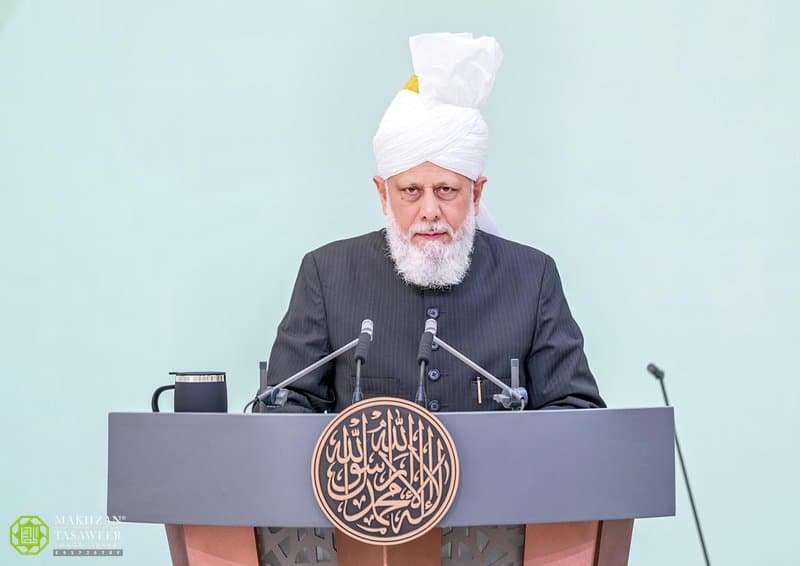
After reciting the tashahhud, ta‘awwuz and Surah al-Fatihah, Hazrat Khalifatul Masih V (aa) stated:
By the grace of Allah the Almighty, the three-day Jalsa Salana UK concluded successfully last Sunday, garnering the blessings of Allah. Preparations for the Jalsa take months; in fact, they begin immediately after the Jalsa concludes. The intensity of the preparations increases several weeks prior to the Jalsa, and it reaches its peak one or two weeks before the Jalsa. During the days of the Jalsa, thousands of volunteers – girls, women, children, men, elders and youths – serve tirelessly to the best of their abilities and with the utmost sincerity. They not only provide comfort to Ahmadi guests, but along with catering for the needs of non-Ahmadi and non-Muslim guests who attend from countries around the world; they also portray the true image of Islam. And in doing so, they engage in a silent form of preaching. As such, every volunteer who serves in any department of the Jalsa deserves our gratitude. May Allah the Almighty grant them the best reward for their service.
Similarly, besides those volunteers who served directly at the Jalsa, there are the workers of MTA, many of whom are volunteers. They too deserve our gratitude as they made every possible effort to broadcast the proceedings of the Jalsa to every corner of the world in an excellent manner. This too is a powerful means of tabligh [propagating the message of Islam].
Likewise, the Press and Media departments played their role in disseminating news [about the Jalsa]. This includes both the Central Press Department and the UK Press Department. This managed to reach millions of people. Men and women alike contributed towards this.
As in previous years, many volunteers from Majlis Khuddam-ul-Ahmadiyya Canada came to assist the workers, who helped with dismantling and winding up the Jalsa after its conclusion. And now, volunteers from Australia have also started coming. They are working with great diligence, and they too deserve our gratitude. May Allah the Almighty reward them as well.
The impression that is left upon non-Ahmadi guests by the workers presents before them the true image of both the Jamaat and Islam, and they are deeply moved. They send countless sentiments and also express their gratitude. At present, I mention some of those sentiments from what I have selected. It may not be possible to present all of them; however, I will at least present some of them.
Similarly, I would personally like to express my heartfelt gratitude to all the male and female volunteers as well, who rendered such selfless service. At the same time, they should remember that they themselves ought to be grateful to Allah the Almighty for granting all of them the opportunity and ability to serve the guests of the Promised Messiah (as). The expressions of gratitude you receive from others should make you even more humble, submit even more before Allah the Almighty and be grateful to Him. May Allah the Almighty enable you to do so.
As I mentioned, I will present some of the guests’ impressions [that have been shared]. The first one, which is before me at present, is that of Mr Lamin Jabbi Sahib, Gambia’s Minister for Communications and Digital Economy. He says:
“Having witnessed the Jalsa Salana, I was deeply astonished by the profound reality before me. This is a great global event which is founded upon a spirit of selfless service and a silent, unwavering sacrifice. It is deeply moving to learn that such a vast gathering began in Qadian with only 75 people, and in terms of its organisation, it has taken the form of a remarkable feat. It is broadcast via satellite to 200 countries around the world. I was also amazed that no police are required for the arrangements. There is no material incentive involved.
“Corporate executives, doctors and young people set aside their worldly positions and voluntarily cleaned the floors, cooked food over fires and directed traffic. Then, when the call to prayer was given, this enthusiastic gathering, comprising people of different nationalities, immediately fell into complete silence – so much so that one could not even hear the sound of a pin drop.
“To witness this living reality of such immense discipline and spirituality is seldom seen in today’s materialistic world.”
He further says, “Taking part in the international Bai‘at whereby thousands of people who were filled with fervent emotions formed a chain and connected with their Imam, made this an unbelievable reality of such a unique bond.
“My lasting impression is that the great global influence of the Jamaat is not the result of material wealth or any political reasons. Rather, it is the fruit of a commitment to perfect righteousness and a sincere, practical message of peace.”
From Nigeria, a king named Oba Kehinde Gbadewole, who administers approximately half of a state, says:
“When I departed to attend the Jalsa Salana UK, I had absolutely no idea that I was about to become part of such a magnificent, organised and spiritual gathering that would leave such a profound impression upon my life.
“Upon arriving here, I witnessed not only an extraordinary example of discipline, brotherhood and service to humanity, but also people from different countries and nationalities bound together by love, respect and brotherhood. We were received with exceptionally sincere hospitality, which will always remain a cherished part of our memories.
“I had the opportunity to learn a great deal here, but the most memorable moment was meeting the Imam of the Jamaat and listening to his addresses, from which I learnt many lessons. I also heard a report about the worldwide progress of the Ahmadiyya Muslim Jamaat, which was truly astonishing.”
He then says, “Your motto, ‘Love for All, Hatred for None’, is not merely a slogan; it is the practical identity of the Ahmadiyya Muslim Jamaat. If the world were to adopt this spirit of love, tolerance and respect for humanity, then without doubt the world could become a cradle of peace.”
He continues, “The live programmes being broadcast in different languages around the world also greatly amazed me.”
His wife, who is a princess, expressed similar sentiments. She said:
“What surprised and pleased me most were the exemplary arrangements made for women and the respect, freedom and dignified environment provided for them. Seeing thousands of women arriving and departing in such an organised manner and participating in the Jalsa with complete dignity changed many of my perceptions about Islam.
“I felt that the Ahmadiyya Muslim Jamaat had presented, in practical form and in accordance with Islamic teachings, the respect owed to women and their rights.”
There was a guest from Senegal, Mr Alioune Badara Samb, a former governor of Saint-Louis. He says:
“What impressed me most was the excellent organisation. Despite the very large number of participants, it was clear that the Jalsa had been organised with the utmost efficiency. The system of transport was also excellent. The volunteers were courteous and always available. I listened attentively to all the speeches.”
Now even non-Ahmadi guests do not merely sit through the speeches – they say that they listened to them attentively.
“The arrangements for different languages were also excellent, enabling us to understand all the speeches and messages clearly. Throughout the Jalsa, the message that repeatedly stood out was the message of love, peace and brotherhood.”
Similarly, Mr Radu Duta, a lawyer and barrister from Luxembourg, attended the Jalsa for the first time with his son. He says:
“The three days of the Jalsa became some of the most important days of my life. For the first time, I witnessed such a large, organised and dignified Islamic gathering. Despite the enormous number of people, the entire event was being managed by volunteers in an exceptionally efficient manner.
“I felt as though the people who had come from different countries were members of one family. Every volunteer was engaged in serving the guests with a smile. Every worker on duty treated each guest with such love, respect and attention, as though that individual were the most important and honoured person there.”
Witnessing the global Bai‘at ceremony usually has a profound impact on the guests. He says, “The sight of the international Bai‘at was also deeply moving and unforgettable for me. Seeing thousands of people from different countries pledge allegiance at the hand of a single Imam and pray before Allah the Almighty with the utmost humility was a faith-inspiring and spiritual experience that left a profound impression upon my heart.”
He then says, “I also had the opportunity to meet the Imam of the Jamaat. At first, I was nervous, but after meeting him, my nervousness disappeared. There were certain thoughts and feelings in my heart that I wanted to ask him about, yet without my even asking, he himself raised those very matters with me and explained them.”
There is also a new convert, Elijah Gabourel, who says: “Before accepting Islam, I was a Christian. We were always taught that faith is tied to music (and this has indeed become widely prevalent in the world today: the idea that music is essential), but I was never able to find genuine spiritual peace or closeness to God through that approach. Even after becoming Muslim, I would pray, but I never found the ability to weep and supplicate from the heart. But when the opportunity came to take the pledge of allegiance at the Jalsa Salana, a spiritual state came over me that I cannot express in words. I continued in a state of remorse over my sins, seeking forgiveness without pause. I kept making supplications, and tears flowed from my eyes beyond my control. A spiritual connection was established with Khilafat, and a spiritual connection was established with Allah the Almighty. After that, it was time for prayers, and this spiritual state continued to stay with me throughout the prayer. I walked out of the Jalsa Gah in that very state, and I did not even notice that I had forgotten to put my shoes on. I walked to the washrooms in that same condition, and a volunteer standing there noticed that I was barefoot; he took off his own shoes and handed them to me, saying: “Please wear these, as you will hurt yourself going in without shoes.” That small incident strengthened my faith even further – that this is truly a divinely established community, where one person is always ready to help their brother.
Thus, Ahmadi volunteers and workers who look after the guests in this way also become a means to strengthen people’s faith.
A professor from the Czech Republic, Professor Jaroslav Franc, attended the Jalsa along with another professor, Marek Cejka Sahib. They said: “We were so moved by the Jalsa Salana that we cannot adequately express our feelings. On returning to the Czech Republic, the only thing we will be able to tell our students and fellow professors is that they must come here themselves and experience this magnificent gathering – one that was filled with spirituality and completed with the finest arrangements.”
They further said: “People from different corners of the world had gathered in one place in a spirit of love, peace, and brotherhood. The experience of meeting people after the prayers was extremely pleasant and deeply moving. It was a joy to see how a single faith is binding people from across the world in a bond of love, peace, and unity. Through the address of the Khalifa of the time, we gained a true understanding of Islam and taqwa [righteousness]. We acquired a deep comprehension and knowledge of the subject.” They also said that the coverage through MTA reaching across the world was equally remarkable.
Saule Sahiba attended the Jalsa from Kazakhstan. She says: “It was a spiritually uplifting and memorable Jalsa that left a deeply pleasant and lasting impression upon my heart. The addresses of the Leader of the Jamaat and the other speakers shed light on important themes such as faith, high moral standards, peace, mutual harmony, family values, the upbringing of youth, and service to society. What moved me most was the atmosphere of brotherhood among people from different nations and the conversations centred on peace and goodwill.”
Professor Dr Brett Scharffs, a professor of law from the United States, also attended. He says: “I have had the opportunity to attend various international conferences and conventions around the world, but the experience of the Jalsa Salana UK has been unique among them all. I had the chance to meet guests from over a hundred countries, from different faiths, nationalities, and walks of life – and every single one of them shared the same view: that the atmosphere of love, respect, peace, and mutual brotherhood found here is truly extraordinary. Humanity First and the various academic and historical exhibitions left a deep impression on me. It was heartening to see that the Jamaat, with its own resources, is serving those in need across the world – regardless of their religion or nationality. Highly qualified people – doctors, engineers, lawyers and other professionals – were carrying out voluntary service with remarkable humility, and that had a lasting impression on me.”
Television reporter Eric Portella from Brazil says: “I cannot help but say that I was left astonished at the sheer scale and breadth of this event – particularly the size of the Langar Khana [community kitchen] and all the areas where food is prepared; they were modern, spacious, organised, and immaculately clean. To witness the dedication, refinement, and commitment of every volunteer is a truly beautiful experience that fills my heart with peace and joy.”
Professor Yousuf Morales came from the Philippines with his wife, Professor Sherima Morales. He has accepted Islam after previously being a Christian and has also served as Chairman of the National Commission of Muslim Filipinos. He is not yet an Ahmadi. He said:
“Although the official attendance was stated to be around 50,000, when I saw the vastness of the Jalsa site and the scale of the arrangements, I felt that this gathering was far larger than that. I was especially astonished by the efforts of the thousands of volunteers who give their time and service to establish an entire temporary city, where accommodation, food, transport, cleanliness and other facilities are provided for tens of thousands of people.
“Despite being financially well-off, the volunteers render service in simple and physically demanding roles with great humility. These are the very qualities that can build a peaceful and harmonious society. I saw young children serving water. Similarly, there were two boys, perhaps 14 or 15 years old, on food duty; the responsibility with which they were running about and serving food to 300 people was astonishing.
“After coming here, I also learned that Sir Muhammad Zafrulla Khan Sahib was an Ahmadi. I also came to know more about the achievements of Dr Abdus Salam Sahib. Likewise, the addresses of the Imam of the Jamaat greatly impressed me. In a short span of time, he covered many subjects and presented each topic in a detailed yet simple and easily understandable manner.”
A guest from El Salvador, Saul Edgardo, who is a representative of El Salvador in the Central American Parliament, also attended. He said:
“This was my first Jalsa Salana UK, and it gave me the opportunity to see the Ahmadiyya Muslim Jamaat up close. The most important thing I learned was how we ought to live our daily lives. The central message was that just as a branch, once separated from the tree, dries up because the tree was the source of its life, in the same way, if we become distant from Allah the Almighty, it results in our spiritual death.
“What the Khalifa, the Imam of the Jamaat, said about tending to seek God only when we are in difficulty was absolutely true. Similarly, the guidance he gave regarding the relationship between husband and wife was such that, if we act upon it and practise lowering our gaze, many marital issues can be avoided.”
Thus, if non-Ahmadis can understand this message, Ahmadis must strive to understand it even more.
He further said:
“I was deeply impressed by the extraordinary arrangements. My meeting with the Imam of the Community was very brief, and I wished I could have had more time. Yet even in that short time, he noticed everything and spoke with me. After the meeting, I became convinced that the Khalifa of the time possesses deep knowledge about his Jamaat; its standing in various places. He had a profound interest in all these matters.”
A new convert from Belize, Mosique Mariano Sahiba, said:
“We belong to a very small country. The population of our town is only 50,000. Quarrels break out even if just a hundred people gather, but there was an extraordinary sense of peace throughout the Jalsa, and people were meeting one another in a beautiful manner.
“It is not possible for me to express my emotions in words. I now feel joy in calling myself an Ahmadi Muslim. My husband was granted the opportunity to attend Jalsa Salana last year, and at that time the Khalifa of the time told him to convey the message of Ahmadiyyat to his wife as well. By the grace of Allah, today I say with complete certainty and pride that I am an Ahmadi Muslim.”
Svilen Penkov from Bulgaria, Secretary General of the Ministry of Labour and Social Policy, said:
“I have attended Jalsa Salanas held in various cities of Germany several times, but the experience of the Jalsa Salana UK was unique and unparalleled in its scope, organisation and high standards. What impressed me was the extraordinary expanse of the Jalsa site and the temporary city established there. All the basic facilities had been provided in an excellent manner, and more than 50,000 people were gathered there.
“The speeches delivered at the Jalsa were very informative, scholarly and of a high standard. The speakers presented religious and scientific subjects in an excellent manner, increasing the knowledge and understanding of the audience. The various exhibitions impressed me immensely. They had been arranged in a highly professional manner in keeping with modern standards. There were also educational programmes and exhibitions for children. These are the kinds of things that are beneficial for the training of the next generation.”
Ahmadou Ba Sahib from Senegal, who belongs to the Tijaniyya faith and is a religious leader in his area, said:
“The excellent organisation and arrangements of this Jalsa have deeply impressed me. The manner in which this Jalsa was held; the excellent security arrangements; the high morals of the attendees, their wisdom, good conduct, and especially the noble character of the members of the Ahmadiyya Jamaat, have left a profound impression upon my heart.
“Previously, I had only heard about the Ahmadiyya Jamaat. But today, seeing with my own eyes a Jamaat that is so organised, so sincere, and so fully obedient to the guidance of its Khalifa has brought me immense happiness.
“I already knew that you do a great deal for the service of humanity through donations, water wells, mosques, hospitals, relief work and other welfare projects. But today, after seeing your efforts for human values and human progress, your wisdom, your promotion of basic education and your educational institutions, especially through the exhibitions, I have been even more deeply impressed. I sincerely pay tribute to you from the depths of my heart.”
He also said that his meeting with the Imam of the Jamaat gave him a great opportunity to understand the Jamaat.
Similarly, from Senegal, Mourmane Kaba Diakhaté Sahib, a Member of Parliament, said:
“I saw with my own eyes that service to the public, dignity, courage and resolve are among your prominent qualities. Beyond words, I saw Islam expressed through service. I saw hands that give, hearts that forgive, and doors that are always open for others.”
Professor Dr Halil Ibrahimi Sahib from Kosovo is a distinguished academic, researcher and university professor, and is held in great respect in Kosovo for his scholarly work and research. He said:
“The practical image of discipline, cooperation and sacrifice that I witnessed in every department was truly enviable. Alongside this, the love, sincerity, respect and generous hospitality I received from every person made this experience unforgettable for me.
“During these days, I had the opportunity to listen to various speeches, especially the address of the Imam of the Jamaat. I also had a meeting with him. What impressed me most was the continuous and extraordinary emphasis upon peace, interfaith harmony, human equality, mutual respect, and the concept of taking every member of society along together. In our time, when religious misunderstandings, extremism and intolerance have become serious challenges in many parts of the world, these messages felt extremely timely, hope-inspiring, and capable of providing guidance for humanity.”
Juan Antonio Reyes, the Mayor of Pedroabad, from Spain, says:
“The Jalsa Salana gave us the opportunity to witness that this gathering is not merely a celebration of ideology, but an extraordinary demonstration of coexistence among people from different countries, cultures, and walks of life, united by the shared values of peace, respect, and brotherhood. Through the various exhibitions and informational programmes, I also came to learn about the services rendered by the Ahmadiyya Muslim Jamaat across different fields.”
Two guest lawyers from Australia, Kerolin Sahiba and Hanna Sahiba, attended the Jalsa. They said: “We consider it our good fortune to have attended the Jalsa Salana. The arrangements left us astonished. There was an atmosphere of peace everywhere. I looked around both inside and outside the Jalsa venue, and there was no quarrelling or noise. People this peaceful and calm simply do not exist elsewhere in the world. Everyone was ready to help one another. It was a joy to see children giving water to people, and I attended the human rights meeting. The Jamaat’s commitment to spreading peace throughout the world and upholding the rights – not only of Ahmadis but of every oppressed person – and raising its voice for all who are wronged, is something remarkable, and I was deeply moved by it.”
Indeed, she was so moved that she took a promise from her missionary that he would bring her back again next year.
Guider Guillen, a journalist from Bolivia, attended the Jalsa. He says:
“Attending the Jalsa Salana of the Ahmadiyya Muslim Jamaat was a magnificent experience for me. I was greatly moved by the speeches – and particularly by the address of the Head of the Jamaat. It was a gathering that will remain imprinted on our lives forever, and will show us the path to drawing closer to our Lord and attaining His mercy.”
May Allah grant that they too come to accept the message of Islam.
He says: “I personally had the opportunity to see for myself that the propaganda that has been spread for years – that Muslim women are oppressed and live under duress – is an outright lie. On the contrary, I was deeply impressed by the honour, protection, and importance accorded to women in Islam.”
Avni Jashari from Kosovo, who is the Chief of the Cabinet of Baldianijan, says:
“I had the opportunity to hear the address of the Leader of the Community, and before the Jalsa began, he had counselled the volunteers to regard the service of guests as a great responsibility and to carry it out with love, humility, sincerity, and the finest conduct. (This was on Thursday evening.) At the time, I found this counsel admirable, but I had no idea that the very next day, I would witness its practical embodiment before my own eyes. I suddenly fell ill. I began feeling dizzy, I felt unwell, and I began vomiting. The first aid team immediately attended to me, and six doctors gathered around me. It felt as though I were in my own home. In that moment, I realised that the directives of the Khalifa were not merely words – they were a living part of every volunteer’s daily life.”
Hiroyuki Iwamoto Sahib from Japan says: It was a truly memorable journey for us. We found the atmosphere of the Jalsa to be filled with love and spirituality. The spirit of the serving workers, the manner in which the children went about giving water, the bond of the Jamaat with Khilafat, and the longing to see you [the Khalifa] – it was a truly powerful experience.”
Another guest, originally from Lebanon and a resident of Belgium, says:
“Since I work in the diplomatic corps, I travel to various places around the world where major meetings are held – whether in Qatar, Brussels, or other larger places – but nowhere have I seen a programme as elevated and as well-organised as this Jalsa, where more than 50,000 people are present and not a single person is jostling another, not a harsh word is spoken. Everyone is meeting each other with dignity, respect, and love. I have seen here, in practice, the Islamic teaching of brotherhood. Likewise, at this Jalsa, I have witnessed the practical manifestation of the Quranic teaching of لَاۤ اِکۡرَاہَ فِی الدِّیۡنِ [“There shall be no compulsion in religion.” (Surah al-Baqarah, Ch.2: V.257)]: people of other faiths are here, living among us, being treated with full courtesy and respect, and moving about freely and happily.
Sergio Rubin from Argentina also attended. He is the Chief Editor for Religious Affairs at Clarín, one of the country’s most important national newspapers. He says: “Before coming, when I informed my newspaper of my intention to attend this Jalsa, many of my colleagues advised me to reconsider my decision owing to the general prejudices against Islam that are prevalent. In any case, when I observed the atmosphere of the Jalsa firsthand, it became clear that the finest proof that Islam is a religion of peace is your Jamaat itself and the peaceful atmosphere of your Jalsa. Despite such a vast and large gathering, there was an atmosphere of peace and tranquillity everywhere.”
On the final day of the Jalsa, he broadcast a live transmission of the proceedings on television channel TN, so that the viewers might also see this atmosphere. He emphasised that Islam is a religion of peace, and he presented the Jamaat as a living testimony of this. He is himself a Catholic.
He further says: “I very much appreciated the Khalifa’s inaugural address at the Jalsa, in which he spoke of righteousness – the essence of every religion. As a Christian, this gave me a tremendous opportunity to expand my own knowledge and understanding in this regard.
Mrs Svetlana Markeviciene from Lithuania says:
“At the Jalsa Salana, I had the opportunity to live among Muslims and observe their ways and customs in close proximity, and I learned a great deal that was new to me.
“Hearing the Leader of the Jamaat’s address to the women cleared up many of my misconceptions about the place of women in Islam. It was a joy to learn that Islam teaches women’s dignity, protection, and their fundamental rights. The address was thoroughly balanced, well-reasoned, and deeply moving and gave me the opportunity to think about Islam in a more positive light.”
Giulia Pratesi, a United Nations Human Rights Consultant from Switzerland, says: “It was a unique experience for me and by attending the gathering, I had the opportunity to closely observe and understand a religious community about which my knowledge had previously been limited. The hospitality, warmth, and helpfulness of the volunteers and participants made a very strong impression on me. Everyone met me with a cheerful and open manner, answered my questions, and was always ready to respond to whatever I asked – and this gave me a much better opportunity to understand the history, traditions, and core values of the Ahmadiyya Muslim Jamaat. She also praised the various exhibitions, saying they were very engaging and that they presented the history, the humanitarian service projects, and the Jamaat’s contributions across different fields in a compelling and effective manner. The exhibition on the role of women was particularly informative for me, as it gave me the opportunity to understand this subject from the Jamaat’s own perspective.”
Professor Federica Sona Sahiba from Turin, Italy, says
“At the Jalsa Salana I witnessed a beautiful harmony of wisdom and spirituality. From a rational perspective, what struck me most was the remarkable efficiency and grace with which the entire event was organised and conducted. Everything appeared to function so naturally and seamlessly like a natural flow of the wind.
“From the youngest volunteer assigned to serve water to the senior-most workers, everyone shared the same qualities of sincerity, hospitality, courtesy and a warm smile.
“Speaking from an emotional perspective, I felt as though I was being welcomed into one large international family. Every guest was received with genuine joy and treated with care and affection.”
She further relates, “I met many men, women, and children who greeted me with smiles; helped me find my way; and shared accounts of their lives – some painful, some joyful and others inspiring and enlightening.”
Referring in particular to the spiritual and subtle aspects of her experience, she says, “I was deeply impressed by accounts shared by some members of the Jamaat regarding experiences such as future events through clear dreams.”
She concludes by saying, “This Jamaat is one large and united family that transcends geographical boundaries.”
Cenap Aydin Sahib, a scholar of the sociology of religion based in Rome, says:
“The first thing that captures one’s attention is the gathering of so many different nationalities, languages and cultures in one place. The ceremony in which the flags of various countries are flown alongside the flag of the Jamaat beautifully illustrates this international unity – a small world, as it were, where diverse peoples live together without losing their individual identities.”
He further says, “As a student of the sociology of religion, the Jalsa gave me the opportunity to observe how a religious community can successfully uphold both local identities and a shared global unity.”
He also expressed high appreciation for the hospitality extended to the guests and warmly commended the dedication of the volunteers.
Reverend Tony Snow Sahib of the Stoney Nakoda First Nation, Canada, says:
“Witnessing such a large gathering was a fascinating experience for him. Excellent arrangements had been made, and every individual was striving to contribute to the best of his or her ability to ensure the smooth running of the event.”
He further adds, “Organising an event of this scale is by no means an easy task, and I was deeply impressed by the spirit of dedication with which all the work was being carried out.”
Professor Metin Bozan from Türkiye, a non-Ahmadi guest, is Professor and Head of the Department of the History of Islamic Religions at Dicle University. Under his supervision, students have also completed academic theses on the Ahmadiyya Muslim Jamaat.
He says, “Every aspect of the Jalsa’s organisation and every activity was carried out with exemplary discipline.”
He further states, “Our principled position is that anyone who professes belief in Allah, His Messenger (sa), and the Hereafter and fulfils the essential requirements of faith and Islam is a Muslim. We therefore do not consider it permissible to declare such a person to be a disbeliever. Accordingly, in our view, Ahmadis are also Muslims.”
Only if the Ulema [religious scholars] of Pakistan would come to understand this as well.
He further remarked, “I greatly appreciate the Jamaat’s efforts to promote international peace and security.”
He also observed that, on every occasion, separate arrangements had been made for men and women, leading him to conclude that the Jamaat places particular emphasis on observing the Islamic injunctions regarding purdah [veil].
Thierry Valle Sahib from France, President of the Coordination of Associations and Individuals for Freedom of Conscience, says, “The arrangements were flawless, the atmosphere was peaceful, and a profound sense of tranquillity prevailed. The concluding address of the Head of the Ahmadiyya Muslim Jamaat was truly inspiring and a great beacon of guidance. It reminded us of the high moral standards that every individual should strive to uphold and of the peaceful world that all people should work together to build.”
He further expressed, “I express my heartfelt gratitude as this visit enabled me to witness first-hand the practical manifestation of the Ahmadiyya Muslim Jamaat’s message of peace, love and brotherhood. Seeing people from more than 100 countries gathered together like a beautiful bouquet allowed me to experience its fragrance for myself.”
A journalist from Belgium says, “I have attended the Jalsa before; however, this year I was particularly impressed by the address delivered by the Head of the Ahmadiyya Muslim Jamaat to the Lajna (women’s) gathering. In his address, he encouraged women not only to acquire religious knowledge, but also to pursue secular education and to strive for excellence in every field of life.”
Professor Minesaki Hiroko Sahiba from Japan, who has researched the Ahmadiyya Muslim Jamaat and authored a book on this, also shared her impressions. As part of her research, she visited Rabwah, Qadian and several other places and has developed a profound understanding of the Jamaat. She relates:
“I met a young German man at the Jalsa who had taken Bai‘at earlier that very day. When I asked what had inspired him to join the Ahmadiyya Muslim Jamaat, he replied that it was the atmosphere of the Jalsa and the spirit of brotherhood and mutual love among Ahmadis that had drawn him to accept Ahmadiyyat.”
She also highly praised the work of the volunteers.
Archie Sahib, an Indonesian who lives in Greece with his Greek wife, a non-Ahmadi convert to Islam, says,
“When I received the invitation to attend the Jalsa, I regarded it as a spiritual journey that would bring me closer to Allah the Almighty. With this hope, I travelled from Greece to attend the convention. The addresses of the Khalifa of the Time left a profound impression upon me, and I was equally moved by the selfless spirit of service displayed by the volunteers.”
Normunds Boluzs Sahib from Latvia, who holds a Master’s degree in Political Science. His academic dissertation focused on the persecution and injustices faced by Ahmadis in Pakistan. He attended the Jalsa and says, “During the course of the convention I found answers to all of the questions I had regarding Islam and Ahmadiyyat.”
Then there was a lady among the delegation from Greece. She says, “It was a wonderful experience. Every one of the volunteers was extremely friendly and helpful towards the guests. The exhibitions were excellent, particularly The Review of Religions exhibition on the history of Islam. I wished I could have spent many hours there. I was also told about the archaeological exhibits.”
After mentioning this praise, she mentioned one point which she did not like. She said, “There is one thing that I did not like; that some women were not properly observing the Islamic dress code, i.e., purdah, and some men were also showing weakness in lowering their gaze.” This was despite the fact that I had particularly drawn attention to this matter. Therefore, we should reflect upon this and use such negative comments for our own reformation.
Thus, those who have been careless should remember that non-Ahmadis observe us very closely, and we should never give them any opportunity that might tarnish the true image of Islam. In fact, during the Jalsa addresses, I also read a quotation of the Promised Messiah (as), in which he said that we should not give others any opportunity to point a finger at us. (Malfuzat, 2022, Vol. 3, p. 143)
From Poland, there was Professor Wojciech Lamentowicz – the name is somewhat difficult. In any case, he is a professor of human rights and has also served as a university chancellor. He teaches law. He says, “I was deeply impressed by the arrangements, and as for my meeting with the Imam of the Community, I do not have the words to express my sentiments and emotions.” He further says that after speaking with him, he was greatly impressed. He then says, “What I have learnt here, I will now convey to my students so that they may come to understand the true meaning of the teachings of Islam.”
I selected a few incidents, and from among them I have narrated only a few.
As I mentioned, during these days the Press and Media, as well as the UK press, provided extensive coverage. The Times, which is one of Britain’s leading newspapers, gave prominent news coverage. There was also coverage by other sections of the press.
The media coverage included 16 print articles, with a readership of 10 million. There were 35 radio programmes, which is an increase of 10 compared to last year. There were six television programmes, with an estimated audience of 7.2 million. On social media, there were 530,000 views, and the UK section also has a report in which the figures reach into the tens of millions. Altogether, through the press and media, the coverage reached 52.8 million people. Around 12 different newspapers and television channels covered the Jalsa, including well-known national television channels and newspapers.
Among the journalists’ impressions, one lady journalist said after witnessing the Bai‘at ceremony on the final day, “I am deeply moved. My eyes filled with tears. This is a scene that I have never witnessed anywhere in the world, and I do not think that anyone else in the world could ever organise such an event or provide such an experience. It was a breathtaking sight, and I was completely captivated by it.” There were many similar impressions from others as well.
MTA Africa is also carrying out tremendous work. 20 journalists participated here, and they sent 157 reports. Their reports reached more than 63 million households with news of the Jalsa. Throughout Africa, news and addresses from Jalsa Salana were broadcast live on more than 18 channels, and the estimated reach of these broadcasts exceeded 35 million people.
Sentiments of non-Ahmadi viewers in Africa were as follows:
Pastor George from the village of Tentafour in Sierra Leone says, “By profession I am a teacher, and I live in the village of Tentafour in Sierra Leone. I am not an Ahmadi Muslim. During all three days of Jalsa Salana UK, the thing that impressed me the most was the profound love that Ahmadi Muslims have for Khilafat and the way they expressed peace, love, loyalty and respect for the whole of mankind, regardless of whichever country they belonged to.” He says, “I was supposed to go to church on Sunday, but instead I decided to go to the mosque to watch the International Bai‘at ceremony. What I witnessed there was completely different from what I had imagined. I now understand why the Ahmadiyya Muslim Jamaat is spreading so rapidly throughout the world.”
Likewise, there are many other pastors and educated people who have sent their impressions.
May Allah the Almighty guide these people and incline them towards Ahmadiyyat, the true Islam, just as He ensures the blessed effects of this Jalsa to remain established upon all members of the Jamaat.
(Official Urdu transcript published in the Daily Al Fazl International, 21 August 2026, pp. 2-7. Translated by The Review of Religions.)