
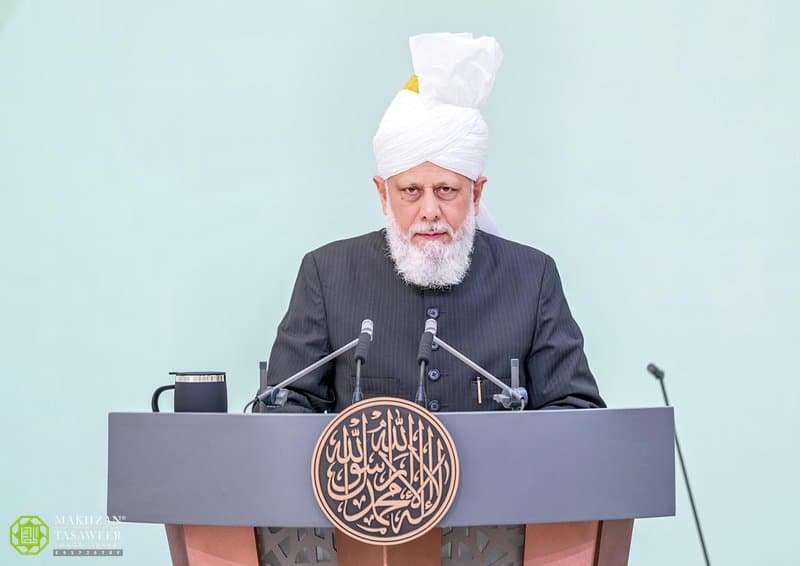
After reciting the tashahhud ta‘awwuz and Surah al-Fatihah, Hazrat Khalifatul Masih V (aa) stated:
When Allah the Almighty made the Holy Prophet (sa) a perfect man and established him as an excellent model for all mankind, He instilled every moral quality within his person, elevating each to the highest degree.
Furthermore, He instructed the believers that if you wish to develop virtuous qualities within yourselves and attain the highest standards of moral excellence, then you should follow this great Messenger (sa), as this would become the means by which they could attain the pleasure of God Almighty. Where the Holy Prophet (sa), in accordance with the commands of Allah the Almighty, elevated every moral quality to the highest standard, he also instructed the believers to strive to attain these lofty standards.
As various aspects of his life are being discussed these days, today I will speak about an aspect of the life of the Holy Prophet (sa) in relation to his trust [i.e., tawakkul] in Allah: his status, his guidance to the believers and his own practical example.
Allah the Almighty has mentioned placing one’s trust in Him on various occasions in the Holy Quran. In one place, addressing the Holy Prophet (sa), Allah the Almighty states:
“O Prophet, truly We have sent thee as a Witness over the world, and Bearer of glad tidings for the believers, and a Warner to the disbelievers. And as a Summoner unto Allah by His command, and as a radiant Lamp. And announce to the believers the glad tidings that they will have great bounty from Allah. And follow not the disbelievers and the hypocrites, and ignore their nuisances, and put your trust in Allah; for Allah is sufficient as a Guardian.” [33:46-49]
Thus, while this is a glad tidings for the Holy Prophet (sa), it is also a glad tidings for the believers that if they remain established upon faith, act in accordance with the commandments of Allah the Almighty and place their complete trust in the Being of Allah the Almighty, then He too will be sufficient for them in every difficulty.
Then, drawing the attention of the believers, Allah the Almighty says:
اَللّٰہُ لَآ اِلٰہَ اِلَّا ہُوَ وَعَلَي اللّٰہِ فَلْيَتَوَكَّلِ الْمُؤْمِنُوْنَ
“Allah! There is no God but He; so in Allah let the believers put their trust.” [64:14]
Thus, if you fulfil the right of worshipping Allah the Almighty and place your trust in Him, then you will also witness His signs. We find the most excellent example of this in the person of the Holy Prophet (sa). Through him, his companions also derived benefit from this and set an example for us.
The Promised Messiah (as) states:
“It is very clear when we study the life of Hadrat Khatamul-Anbiya’ [the Seal of the Prophets], may peace and blessings of Allah be upon him, that he possessed the highest level of uprightness and integrity. He was ever willing to sacrifice his life for God. He was entirely free from fear or hope [from the people] (that is, he turned away completely from fear or hope from people). He placed his trust only in his Lord; that among the accounts of the Prophets, there is not a single example of such circumstances of danger (such occasions or situations of peril) in which someone relied upon God and openly stood against idolatry and the worship of creation, while being so firmly opposed to it, and then remained so steadfast and resolute.” (Barahin-e-Ahmadiyya, Part 4, Ruhani Khazain, Vol. 1, pp. 111-112)
The Promised Messiah (as) said that although the status of the other Prophets is lofty, we do not find in their lives these same examples of placing their trust in Allah as demonstrated by the Holy Prophet (sa).
The Promised Messiah (as) further states:
“It is the Messenger (sa) of Allah, our Prophet, who is the true example of complete devotion towards God, excluding all others. The Holy Prophet (sa) neither cared for anyone’s praise nor for their reproach. (He neither cared for praise nor for criticism of people.) He was faced with countless hardships, but he did not care in the least. No greed or desire could obstruct the Holy Prophet (sa) from the work of God that he had come to accomplish. Until a person is able to see this state within themselves and passes their test, they should never become unconcerned.”
The Promised Messiah (as) instructed us to try to acquire this rank. We should not become carefree, and instead reach such a high rank in terms of placing our trust in Allah that only the Being of Allah the Almighty becomes our sole objective.
The Promised Messiah (as) further states: “Moreover, it should also be borne in mind that only when a person becomes completely devoted to God can they nurture trust in Him. That is to say, in order to become a person who trusts God, it is a precondition that one must first become wholly devoted to Him.” In other words, if you wish to place your trust in Allah, you must also submit yourselves before Him.
[The Promised Messiah [as] then states:] “For, while one maintains a relationship of trust and dependency on others, how can one purely trust Allah alone?
“When he turns completely towards God, He turns him away from the world and attaches him to God. This happens when there is perfect trust in God. Just as our Noble Prophet (sa) was perfectly detached from the world, so too was he perfectly trusting in God. This is why he did not care even slightly for people of great status or the chiefs of nations and tribes, nor was he in the least affected by their opposition.
“He possessed an extraordinary certainty in the Being of Allah. This is why he took upon himself such a tremendous burden, opposed the whole world, and considered them of no consequence. This is a great example of trust in God, the like of which cannot be found anywhere in the world.
“This is because, in such a state, a person chooses God and makes the world his opponent. But this state cannot develop until, as it were, he sees God, and until he has the hope that another door is about to open for him. When this hope and certainty develops, he is prepared to turn even his loved ones into opponents for the sake of God, because he knows that God will make them his friends. He is prepared to lose his property because he has the certainty that he will be given something better in return.
In short, giving precedence to the pleasure of God alone is tabattul [attaching oneself to God], and tabattul and tawakkul [trust in God] are inseparable. (They are joined together, like twins.) The secret of tawakkul is tabbatul, and the condition for tawakkul is tabattul. This is our teaching regarding this matter.” (Malfuzat, 2022, Vol. 2, p. 302)
Only when we turn completely towards Allah and cease relying upon the world will the true state of tawakkul develop within us. And, as I said, and as we all know, the highest example of this is our Master and Leader, Muhammad Mustafa (sa).
The Promised Messiah (as) says:
“Do not think that Allah the Almighty is weak. He is a Being of immense power. When you place your trust in Him regarding any matter, He will certainly help you.
وَمَنۡ یَّتَوَکَّلۡ عَلَی اللّٰہِ فَہُوَ حَسۡبُہٗ
“‘And whoever puts his trust in Allah, He is sufficient for him.’ [65:4]
“However, those who were primarily addressed by these verses were people devoted to faith. All their concerns were solely related to religious matters, while they entrusted their worldly affairs to God. Thus, Allah the Almighty reassured them: ‘I am with you.’
“In short, one of the blessings of righteousness is that Allah the Almighty delivers the righteous from the difficulties that are unrelated to religious matters. In the same way, Allah especially provides sustenance for the righteous. Here, I will mention the sustenance of spiritual knowledge.”
He is not referring to material sustenance; he is speaking of the sustenance of spiritual knowledge. He says, “The Holy Prophet (sa), despite being unlettered, had to confront the entire world, including the People of the Book, philosophers, and people possessing the highest level of intellectual learning. Yet he was granted such abundant spiritual sustenance that he prevailed over them all and exposed the errors in their teachings.
“This was spiritual sustenance the like of which has no parallel.” (Malfuzat, 2022, Vol. 1, p. 11)
Hazrat Umar bin al-Khattab (ra) relates that the Holy Prophet (sa) said, “If you place your trust in Allah as you ought to place your trust in Him, you will surely be provided for, just as the birds are provided for. (Here, he also mentioned material sustenance – if you place your trust in Allah, you will receive it.) They leave in the morning with empty stomachs and return in the evening with their stomachs full.” (Sunan at-Tirmidhi, Abwab az-zuhd, Hadith 2344)
It is narrated from Hazrat Abu Dharr (ra) that the Holy Prophet (sa) said, “Renunciation of the world does not mean declaring the lawful to be unlawful, nor does it mean wasting wealth. (It does not mean that we have no interest in wealth and therefore declare even those things which are lawful to be unacceptable, as some so-called spiritual guides and ascetics do nowadays.) Rather, renunciation of the world means that what is in your own hands should not be more reliable to you than what is in the hands of Allah. This is the meaning of renunciation – that you should have greater certainty that what is with Allah will benefit you than what wealth you possess yourself. And with regard to the reward for enduring hardship, you should be such that when a hardship befalls you, you would prefer that it remained with you, because of the reward it brings.” (Sunan at-Tirmidhi, Abwab az-zuhd, Hadith 2344)
This, then, is trust in Allah – to have greater certainty that Allah the Almighty will fulfil your needs than in the things you currently possess. Some of the things you have may be lost, but what is with Allah can never be lost. And according to his needs, the one who places his trust in Allah and performs righteous deeds continues to receive what he requires.
Hazrat Amr bin al-Aas (ra) relates that the Holy Prophet (sa) said, “From the heart of the son of Adam there is a path leading into every valley. Whoever follows all the paths of his heart, Allah has no concern for him, whether He allows him to perish in one valley or another. But whoever places his trust in Allah, Allah will suffice for him while he traverses these various paths.” (Sunan Ibn Majah, Kitab az-zuhd, Hadith 4166)
The explanation of this hadith states that its meaning is that whoever makes his heart subject to various desires, anxieties and worldly worries, so that his attention remains scattered in every direction, becomes a person concerning whom Allah the Almighty has no regard. He may go into any valley and perish. In whichever valley he perishes, wherever he lives and wherever he dies, Allah has no concern for him.
As for the words, وَمَنْ يَّتَوَكَّلْ عَلَی اللّٰہِ “And whoever places his trust in Allah”, they mean that Allah the Almighty takes responsibility for the various needs, anxieties and requirements of one who turns towards Allah, and Allah fulfils them for him.
The same meaning is supported by another narration in which the Holy Prophet (sa) said that whoever makes all his concerns into one concern – the concern for faith and religion – who examines his faith, his relationship with Allah and his spiritual condition, Allah the Almighty becomes sufficient for him with regard to all his other concerns of this world and the Hereafter. (Mirqat-ul-Mafatih, Vol. 9, Dar Al-Kotob Al-Ilmiyah, Beirut, 2001, p. 498)
This is the meaning of this hadith.
How carefully the Holy Prophet (sa) used to pray for his everyday affairs while keeping his reliance upon Allah Almighty foremost in his mind. Hazrat Umm Salamah (ra) narrates that when the Holy Prophet (sa) would leave his home, he would say:
[بِسْمِ اللّٰهِ تَوَكَّلْتُ عَلَى اللّٰهِ اللّٰهُمَّ إِنَّا نَعُوذُ بِكَ مِنْ أَنْ نَزِلَّ أَوْ نَضِلَّ أَوْ نَظْلِمَ أَوْ نُظْلَمَ أَوْ نَجْهَلَ أَوْ يُجْهَلَ عَلَيْنَا۔]
The translation is as follows: “In the name of Allah, I placed my trust in Allah. O Allah, we seek Your protection from stumbling or going astray, from committing an injustice or being subjected to injustice, from acting ignorantly or being treated with ignorance.” (Sunan At-Tirmidhi, Abwab ad-da‘wat, Hadith 3427)
Similarly, another narration is mentioned. Hazrat Buraidah (ra) narrates that when the Holy Prophet (sa) would leave his home, he would say:
[بِسْمِ اللّٰهِ، تَوَكَّلْتُ عَلَى اللّٰهِ لَا حَوْلَ وَلَا قُوَّةَ إِلَّا بِاللّٰهِ۔اَللّٰھُمَّ اِنِّیْ اَعُوْذُبِکَ اَنْ اَضِلَّ اَوْ اُضَلَّ اَوْ اَزِلَّ اَوْاُزَلَّ اَوْ اَظْلِمَ اَوْ اُظْلَمَ اَوْ اَجْھَلَ اَوْ یُجْھَلَ عَلَیَّ اَوْ اَبْغیْ اَوْ یُبْغٰی عَلَیَّ۔]
“In the name of Allah, I place my trust in Allah. Only with Allah’s power do I possess the strength to do good and abstain from evil. O Allah, I seek Your protection from going astray or being led astray; from slipping or being caused to slip; from wronging anyone or being wronged; from acting ignorantly or being treated with ignorance; and from transgressing against anyone or having transgression committed against me.” (Kanz-ul-Ummal, Vol. 7, Riwayat 18416, Dar Al-Kotob Al-Ilmiyah, Beirut, p. 54)
Thus, all these matters have been covered and encompassed in this prayer.
Similarly, there is also a prayer mentioned for entering the home. Hazrat Abu Malik Ash’ari (ra) relates that the Holy Prophet (sa) said, “When a person enters his home, he should say:
[اللّٰهُمَّ إِنِّي أَسْأَلُكَ خَيْرَ الْمَوْلِجِ وَخَيْرَ الْمَخْرَجِ بِسْمِ اللّٰهِ وَلَجْنَا وَبِسْمِ اللّٰهِ خَرَجْنَا وَعَلَى اللّٰهِ رَبِّنَا تَوَكَّلْنَا]
“‘O Allah, I ask Thee for good, both when entering the home and when leaving. In the name of Allah we enter, and in the name of Allah we leave, and upon Allah, our Lord, do we place our trust.’” (Sunan Abu Dawud, Kitab al-adab, Hadith 5096)
Then one should recite this prayer and then enter the home and greet the members of one’s household.
There is another narration regarding the Holy Prophet’s (sa) reliance upon Allah Almighty and his fear of Him. Hazrat Abu Hurairah (ra) relates that the Holy Prophet (sa) went to Hazrat Bilal (ra) and saw a pile of dates with him. He asked, “O Bilal, what is this?” Hazrat Bilal (ra) replied, “These are some dates which I have stored for you.” The Holy Prophet (sa) said, “Woe unto you, O Bilal! Do you not fear that its smoke will rise in hell on the Day of Judgement?” In other words, that it could become a means of punishment. “O Bilal, spend, and do not fear poverty from the Lord of the Throne.” (Al-Mu’jam Al-Ausat, pt. 3, Hadith 2572, Dar-ul-Haramain, Cairo, p. 86)
In other words, place your trust in God.
The Promised Messiah (as) states in this regard: “There can be progress in man’s faith only when he follows the directives of God Almighty and establishes his trust in God. Once the Noble Messenger, may peace and blessings of Allah be upon him, saw Bilal (ra) gathering dates. He asked Bilal (ra) why he was doing so. Bilal (ra) said that he was collecting them for the next day. The Messenger (sa) of Allah asked him, ‘Do you not believe in the God of tawakkul [trusting in Him]?’ (The God Who is giving it to you today, will He not grant it tomorrow? Do you not trust Him? The Promised Messiah [as] also clarified that a person shouldn’t spend wastefully. Some people spend freely.) But he said this only to Bilal (ra); he didn’t say it to everyone. Everyone is advised and instructed according to what they can bear.” (Malfuzat, 2022, Vol. 9, p. 210)
This was certainly an admonition from the Holy Prophet (sa), because the hadith clearly mentions that when Hazrat Bilal (ra) said that he was storing the dates for the Holy Prophet (sa), he advised Hazrat Bilal (ra) that his trust was in God and that if these were being stored for him then the smoke of the fire would reach him.
However, according to the teachings of the Holy Quran, there is also an instruction that one should not be so extravagant that nothing is retained for one’s provisions. One should make the necessary arrangements and then place one’s trust in Allah Almighty, that He may safeguard those means and enable one to derive benefit from them.
Trust in God does not mean that one should abandon precaution and make no use of the means available. This too becomes contrary to Islamic teachings. Thus, Hazrat Anas bin Malik (ra) relates that a man asked, “O Messenger (sa) of Allah, should I tie the knee of my camel and place my trust in Allah, or should I leave it untied and place my trust in Allah?” The Holy Prophet (sa) replied, “Tie its knee and place your trust in Allah.” (Sunan at-Tirmidhi, Abwab sifati l-qiyamah, Hadith 2517)
This is an example which can be applied to other matters as well. It is related that the Holy Prophet (sa) gave this instruction when a Bedouin – or according to another narration, Hazrat Amr bin Umayyah (ra) – left his camel untied at the door of the mosque of the Holy Prophet (sa) and went inside to offer the prayer. (Takhrij Ahadith Wa Athar Kitab Fi Zalal Al-Quran, Hadith 660, Dar-ul-Hijrah, 1995, p. 342)
The Promised Messiah (as) has explained this incident in the following manner:
“A person should not abandon righteousness and should place his trust in God; then he cannot suffer any kind of loss. Reliance upon God does not mean that a person should abandon planning and precaution. Rather, it means that after making all the necessary arrangements, one should leave the outcome to God – and this is what is called Tawakkul [trust in Allah]. If he makes no arrangements and merely claims to place his trust in Allah, then his trust is hollow and empty. And if a person relies solely upon his own planning (and thinks, ‘I have made all the necessary arrangements; now that is sufficient’) and there is no need to rely upon Allah, then that planning too is hollow and will come to nothing.
“A man was riding upon a camel. When he saw the Holy Prophet (sa), he dismounted out of respect and intended to place his trust in Allah without taking any precaution. Thus, he did not tie the knee of his camel. When he returned after meeting the Holy Prophet (sa), he found that his camel was gone. He came back and complained to the Holy Prophet (sa), saying, ‘I placed my trust in Allah, yet my camel has gone.’ The Holy Prophet (sa) told him, ‘You made a mistake. You should have first tied the knee of your camel and then placed your trust [in Allah]. That would have been correct.’ (Malfuzat, 2022, Vol. 6, pp. 58-59)
Hazrat Aisha (ra) relates that the Holy Prophet (sa) received some dinars. He distributed all of them, except for six dinars, which he had kept with one of his blessed wives.
According to another narration, during the final illness of the Holy Prophet (sa), while he was reclining against the chest of Hazrat Aisha (ra), he said, “O Aisha, where are those gold dinars?” Hazrat Aisha (ra) replied, “They are safely in my possession.” The Holy Prophet (sa) said, “Spend them in the cause of Allah.” Thereafter, owing to the severity of his illness, the Holy Prophet (sa) became unconscious. He had kept those dinars with the intention that he would distribute them at some point.
When he regained consciousness, he asked again, “O Aisha, have you spent those gold dinars?” She replied, “No, by Allah, O Messenger (sa) of Allah, I have not spent them yet.”
Hazrat Aisha (ra) relates that the Holy Prophet (sa) asked for the dinars to be brought to him. When they were brought, he placed them upon his palm and counted them, and they were six dinars. He then said, “What reliance would Muhammad have upon his Lord if, at the time of meeting his Lord and departing from this world, these dinars were still in his possession?” Thereafter, the Holy Prophet (sa) gave all those dinars in charity in the cause of Allah, and on that very day, he passed away. (Al-Tabqat Al-Kubra, Vol. 2, Dar Al-Kotob Al-Ilmiyah, pp. 182-183)
Allah Almighty states in the Holy Quran:
“Say, ‘Nothing shall befall us except that which Allah has ordained for us. He is our Protector, and in Allah should the believers put their trust.’” [9:51]
In the life of the Holy Prophet (sa), we find a magnificent example of trust in Allah and how he demonstrated the highest standard of reliance upon Him. Allah Almighty has commanded us to place our trust in Him, and we see how the Holy Prophet (sa) himself acted upon this command. When Musailimah, the Liar, said that he would submit to the Holy Prophet (sa), but imposed a condition, the Holy Prophet (sa) categorically rejected the condition and firmly refused to accept it.
It is narrated by Hazrat Ibn Abbas (ra) that he said: “Musailimah, the Liar, came during the time of the Messenger (sa) of Allah and said, ‘If Muhammad [sa] appoints me as his successor after him, I shall follow him.’” He had come to Medina with his army and a large number of people. According to some narrations, there were 100,000 people with him, i.e. his total followers. Although, in reality, the number who came with him would have been much smaller.
The Messenger (sa) of Allah went to him, and Hazrat Thabit bin Qais bin Shammas (ra) was with him. The Messenger (sa) of Allah had a date-palm stick in his hand. He came and stood before Musailimah while he was seated with his companions and said, “Even if you were to ask me for this piece of wood, I would not give it to you. You shall never go beyond what Allah has decreed for you. If you turn your back and depart, Allah Almighty will cut off your root. And I see you as the very person concerning whom I have been shown much in a dream.”
Prior to this, he had already said to the Holy Prophet (sa), “Appoint me as your successor.” In any case, the Holy Prophet (sa) said that he would not even be given the equivalent of that stick. He then said that he could now see that the person whom he had seen in his dream was before him. And this was Hazrat Thabit, who was with the Holy Prophet (sa). When he said, “And this is Thabit,” he meant that Hazrat Thabit was his representative and would give him a response on his behalf. Having said this, he left him and returned.
Hazrat Ibn Abbas (ra) says that he enquired about the saying of the Messenger (sa) of Allah [i.e. the following statement], “You are the very person concerning whom I have been shown in a dream.” Hazrat Abu Hurairah (ra) told him that the Messenger (sa) of Allah said: “Once, while I was asleep, I saw two golden bangles on my hands. Their appearance caused me concern. Then, in my dream, I was commanded to blow upon them. Thus, I blew upon them and they flew away. I interpreted them as two liars who would appear after me. One of them was Al-Aswad Al-Ansi and the other was Musailimah.” (Sahih al-Bukhari, Kitab al-maghazi, Hadith 4373-4374, [Translation], Vol. 9, Nazarat Ishaat, pp. 257-258; Al-Bidayah Wa Al-Nihaya, Part 9, p. 333, 1998)
Al-Aswad Al-Ansi and Musailimah were the two who adopted a rebellious attitude. They departed from there at that time, and during the era of Hazrat Abu Bakr (ra), they again fought.
Hazrat Musleh-e-Maud (ra) writes in this regard, explaining it in great detail:
“The Holy Prophet (sa) had no inclination towards the world and the people of the world in any matter whatsoever, nor would he even raise his eyes towards worldly means. Rather, in every matter, his gaze remained fixed upon God Almighty, that He alone would bring about the desired result. In other words, he was a perfect embodiment of trust in Allah, the like of which is found neither among the earlier Prophets nor was a person possessing such trust in Allah ever born after him.
“Thus, history tells us that during the lifetime of the Holy Prophet (sa), Musailimah came to him in Medina with a formidable army and requested that, if he appointed him as his successor after him, he would, along with his entire community, follow him. At that time, Islam was in a weak state, and it would have been desirable, from a worldly point of view, to avail oneself of this means and benefit from his support. But the pure being who had complete trust and reliance upon the power of God Almighty, and who could not pay the slightest heed to human schemes, immediately rejected his request. He said: ‘This cannot be.’
“Hazrat Ibn Abbas (ra) relates that during the time of the Holy Prophet (sa) (this is the same hadith which I have related earlier), Musailimah the Liar came and said that if Muhammad (sa) appointed him as ruler after him, he would become his follower. At that time, he had brought with him a large number of people from among his people. Upon hearing this, the Holy Prophet (sa) went towards him, and Hazrat Thabit bin Qais bin Shammas (ra) was with him. The Holy Prophet (sa) had a piece of a date-palm branch in his hand. He came until he stood before Musailimah, who was seated among his companions.
“The Holy Prophet (sa) said: ‘Even if you were to ask me for this branch, I would not give it to you. You shall not go beyond that which God has decreed for you. And if you turn your back and depart, Allah Almighty shall cut off your roots. And I find you to be the very person concerning whom I was shown the vision that I was shown. And this is Thabit, who shall give you the answer on my behalf.’
“Then he departed from there.
“Hazrat Ibn Abbas (ra) says (as I have mentioned previously) that he asked about what the Holy Prophet (sa) meant when he said, ‘I find you to be the very person concerning whom I was shown the vision.’ Hazrat Abu Hurairah (ra) informed me that the Holy Prophet (sa) had said:
“‘Once, while I was asleep, I saw two golden bangles in my hands. I found their presence somewhat displeasing. Thereupon, I received revelation in my dream that I should blow upon them. When I blew upon them, both of them flew away. I therefore interpreted this to mean that there would be two liars who would arise after me. One would be Al-Aswad Al-Ansi and the other would be Musailimah.’
“This incident demonstrates the extent of the Holy Prophet’s (sa) certainty in God Almighty and how completely assured he was of the help of God Almighty. All around him were disbelievers who were constantly engaged in causing him pain and distress and would employ every means possible to inflict suffering upon him. Caesar and Chosroes were also sending command after command to their respective governors to oppose him. The Banu Ghassan were making preparations to fight, while the Persians were observing this rising power with jealousy and astonishment, and every government was viewing this new movement with suspicion and doubt.
“At such a time, until a formidable army had gathered around the Holy Prophet (sa), it apparently seemed difficult, indeed almost impossible, for him to remain safe from the attacks of his enemies. The victories extending from Medina to Mecca had brought him face to face with every government in the surrounding regions, and farsighted eyes, from the very outset, were already concerned with devising ways to destroy this growing power, for they were convinced that if this power grew any further, it would reduce their great and magnificent palaces to rubble.
“Then, whatever preparations the Holy Prophet (sa) could make to face those extraordinary challenges would never be enough. The way human reason, in such circumstances, seeks to bring friends and enemies together and, through various measures, wishes to draw even strangers into its ranks, can easily be understood by those who study history. But my beloved was not of the earth; he was of heaven. The advancing armies, the galloping horses, the rising spears and the flashing swords held no real significance in his eyes. He was witnessing the descent of the angels from heaven, while the Creator of the heavens and the earth was continually speaking words of reassurance in his ear. His heart was filled with certainty, and his breast was full of faith. In short, rather than relying upon worldly means, his reliance was upon God. How, then, could he ever have been overcome by these difficulties?
“He did not deem it appropriate, even for a moment, to place his reliance upon Musailimah and his army. He plainly stated that seeking to win you over by offering you the Caliphate in deceit and thereby obtaining the support of your people was one matter altogether, but even if I had to obtain your support in exchange for a single date-palm branch, I would not so much as cast my eyes towards it.
“Consider the state of this honourable heart. Look at the grandeur of this man who placed his complete trust in God. Try to create within your own hearts a sense of the state of certainty within his heart with which he answered Musailimah, and the trust in God upon which his response was founded. Could any king display such courage and bravery at such a time? Can history show us an ordinary man of flesh and blood emerging from such circumstances with such safety? If not, then why?
“The reason is simply that it is wrong even to compare the life of the Holy Prophet (sa) with that of ordinary men, for he was a Prophet. If he can be compared with anyone, it can only be with the Prophets. Yet even among the Prophets, no example can be found of the extraordinary rank that he possessed, because he was granted superiority over all the Prophets.
“It should also be remembered here that, when the Holy Prophet (sa) responded to Musailimah, he was not motivated by a desire to preserve the right of government for his own progeny. Had this been the case, his refusal would not have been attributed to his trust in Allah, but rather to his love for his children. Yet the Holy Prophet (sa) did not appoint his own children as his successors after him. Rather, he indicated that Abu Bakr would be the Caliph, which shows that his refusal was not motivated by any worldly objective, but was the result of his boundless certainty.
“Likewise, it should be remembered that, apparently, there was nothing religiously harmful in obtaining the support of Musailimah the Liar either. If he had stipulated, for example, that he would follow the Holy Prophet (sa) on the condition that he accept his position in certain religious matters, it could perhaps have been said that the Holy Prophet (sa) rejected his demand merely because he did not wish to compromise or make concessions in a matter of principle. In other words, he denied his request to adhere to his principles. But Musailimah made no such demand from which it could be inferred that he wished to bring about any change in religion. Therefore, the refusal was solely the result of the trust and certainty that he had in God Almighty.
“There is another point worthy of bearing in mind. Had the Holy Prophet (sa) wished, he could have had Musailimah arrested and killed at that very time. Although he had come with a large following, he was still in Medina and was under the Holy Prophet’s (sa) authority. Yet even in this matter, he placed his trust in Allah the Almighty, believing that He Himself would destroy this mischief-maker.
اَللّٰہُمَّ صَلِّ عَلٰی مُحَمَّدٍ وَّعَلٰی اٰلِ مُحَمَّدٍ وَّبَارِکْ وَ سَلِّمْ اِنَّکَ حَمِیْدٌ مَّجِیْدٌ۔
“[O Allah, send blessings upon Muhammad and upon the people of Muhammad, and bless and grant peace to them. Indeed, You are Praiseworthy, Exalted.]” (Sirat-un-Nabi, Anwar-ul-Ulum, Vol. 1, pp. 500-504)
After the prayer, I shall offer the funeral prayer in absentia for some deceased members.
The first mention is of the respected Mirza Safdar Mahmood Sahib, son of the respected Ghulam Rasul Sahib, a resident of Mandi Bahauddin [Pakistan]. He was martyred in Mandi Bahauddin on 2 September, just a few days ago.
اِنَّا لِلّٰہِ وَاِنَّا اِلَیْہِ رَاجِعُوْنَ
[“Surely, to Allah we belong, and to Him shall we return.”]
An unknown assailant pursued him and fired at him from behind, thereby causing his martyrdom. At the time of his martyrdom, the deceased was 65 years of age.
According to the details, on the day of the incident, Mirza Safdar Mahmood Sahib left his workshop on his motorcycle to offer the Maghrib prayer. While passing through a deserted area along the way, an unknown person pursued him on a motorcycle and fired at him from behind. The deceased was struck by three bullets and passed away at the scene. After the incident, the assailant fled.
Ahmadiyyat entered the family of the deceased martyr through his maternal grandmother, respected Hussain Bibi Sahiba of Kharian, District Gujrat. Usually, the faith enters families through men, but in this case Ahmadiyyat entered their family through a woman, who had the honour of taking the pledge of allegiance during the early period of the Second Khalifa. Later, through the efforts and propagation of his maternal grandmother, respected Hussain Bibi Sahiba, the martyr’s grandfather, Nawab Din Sahib, who was a relative of hers, also took the bai‘at [pledge of allegiance].
The martyr was a prominent Ahmadi in his area and was particularly well known for his profession and expertise. He was a mechanic and owned his own workshop. He had a good business. Truthfulness, adherence to principles and a hatred of falsehood were among his prominent qualities. He met everyone who came to him with great cheerfulness and affection, greeting them with great warmth. No one in need ever left his shop empty-handed.
The martyr’s wife, Naveeda Sahiba, relates that he had an immense love for Khilafat. In addition to the five daily prayers, he was regular in offering the Tahajjud prayer and regularly benefited from the programmes of MTA. On the first day of every month, he would complete his income statement, contact the Finance Secretary and regularly pay his contributions. He would personally go to the home of the Finance Secretary to make the payment. He gave charity every day and would also sacrifice a goat for charity each month. He would be the first to contribute towards the mosque and other financial appeals.
He himself was part of the Wasiyyat scheme and also enrolled all the members of his family in the Wasiyyat scheme. He took great care of his employees as well. Whenever they had a need or faced financial difficulties, or whenever someone fell ill, he would take care of the matter. He also looked after their children and tried to meet their expenses.
He owned a workshop. While people generally focus on earning as much as possible, if a traveller’s vehicle broke down, he would repair it for a very small fee, and on some occasions he would even repair people’s vehicles free of charge. No matter how busy he was, he gave priority to Jamaat programmes.
The Amir of Mandi Bahauddin District says that, at the time of his martyrdom, the deceased was serving as Naib Sadr Jamaat, Secretary Jaidad, Naib Zaeem Ansarullah and Muntazim Maal Ansarullah in Mandi Bahauddin. He had been entrusted with many responsibilities. The administration and management of the mosque were also entrusted to him, and he had the key to it. He would go to the mosque and open it for every prayer. Businessmen generally do not pay attention to such matters, but he would go to the mosque at the time of every prayer and open it.
Muzaffar Mahmood Sahib, a missionary of the Jamaat, says that the deceased told him, “For the past 25 years, every day before coming to the workshop, I have offered two rak‘at of prayer.”
The martyr is survived by his wife, Naveeda Safdar Sahiba, and two sons, Kamran Safdar and Luqman Safdar, both of whom are married.
May Allah the Almighty elevate the rank of the deceased martyr and grant him an exalted place in the highest paradise. May He grant all the bereaved family members patience and remain their Supporter and Helper.
The second mention is of Amatul Aziz, who also passed away recently at the age of 62. She had been quite ill for some time.
اِنَّا لِلّٰہِ وَاِنَّا اِلَیْہِ رَاجِعُوْنَ
[“Surely, to Allah we belong, and to Him shall we return.”]
By the grace of Allah the Almighty, she was a musiah.
She was the granddaughter of Hazrat Musleh Maud (ra) and Hazrat Sayyidah Umm Tahir Sahiba. She was the daughter of Sahibzadi Amatul Hakim Sahiba and Syed Daud Muzaffar Shah Sahib. Syed Daud Muzaffar Sahib was the nephew of Umm Tahir and the son of Syed Mahmoodullah Shah Sahib. She was also my maternal cousin and the youngest sister of my wife.
Her Nikah was announced by Hazrat Khalifatul Masih IV (rh) with Khalid Zufar Sahib. His first wife had passed away, and his marriage to Amatul Aziz was his second marriage.
Allah Almighty blessed her with two sons, and both sons are well-educated. One of them, after qualifying as a lawyer, is now a life devotee and is serving in the Nazarat Umur-e-Aama in Rabwah. He is a capable and accomplished lawyer. The other is Hashir Zufar. The first son is Mahmood Iftikhar, and the second is Hashir Ahmad. He also studied in Germany and attained higher education.
Both sons served their mother to the best of their ability. May Allah the Almighty reward them and, in the future as well, make them heirs to their mother’s prayers and keep them steadfast upon righteousness.
Although her life was marked by great hardship, she bore it with remarkable patience. I have seldom seen anyone who showed the degree of patience that she did.
Her brother, Syed Khalid Ahmad Shah Sahib, says: “Our sister served her parents with great devotion, and after our mother’s demise, she cared for our father with exceptional dedication. In sympathy for others and care for the poor, she followed in the footsteps of our mother. Her love and reverence for Khilafat were exemplary, and she also raised her children in an excellent manner. One of her qualities was that she neither spoke ill of anyone nor listened to anything said against others. She kept her heart pure. She could not bear to see anyone in pain. She had great courage and patience in enduring her own suffering.”
As I have said, she showed extraordinary patience. In order to avoid disputes, she kept herself away from the entanglements of the world. People said wrong things about her and made comments, but she did not quarrel with anyone. There are typically people who raise opposition everywhere; nevertheless, she neither argued with anyone, nor answered back, nor caused emotional hurt to anyone. She could not bear the suffering of others and would remain restless until she could help them. She was very loving towards young children. She had great self-respect; she would keep her own needs hidden in her heart and would never express them to others. She possessed extraordinary trust in Allah the Almighty, and Allah the Almighty, too, preserved the dignity of her self-respect, providing for her needs from the unseen.
Her sister, Amatul Rauf Sahiba, the wife of the late Dr Tathir Mujtaba, says: “Our sister was very quiet by nature, simple, patient, and exceptionally self-respecting. She cared for the poor and gave a great deal in charity. She had extraordinary respect and reverence for Khilafat.” She says that if ever I said something, she would accept it immediately. When she fell ill and was taken to hospital, she had an idea that her illness was such that survival would be difficult, and she felt there was no benefit in going to the hospital. But when I told her that she should go to the hospital and seek treatment, although she had initially refused, she immediately accepted this and went for treatment.
Her son, Mahmud Iftikhar, says: “My mother would advise me, saying, ‘You belong to the family of the Promised Messiah (as); therefore, your responsibility to serve the Jama‘at is doubled.’ In the early period of the Fifth Khilafat, when we were still young children, she immediately had both of us write letters to the Khalifa of the time, and she would continue to advise us to write regularly. She always instructed us to offer prayers and listen to the Friday Sermon. She had great honour and concern for the system of the Jamaat and could not tolerate anyone speaking against it or criticising it.”
Her son says that whenever anyone among her siblings dedicated their life for the service of the faith, she would be very happy and would say that such people are never left in financial difficulty. This was also her desire for both her sons – that they should dedicate their lives. One of them did so. He says: “When I dedicated my life, she advised me, ‘You have now devoted yourself, but you must fulfil this devotion properly.’ And when I was later entrusted with a higher office and appointed Naib Nazir, she said, ‘Now do not take pride in this at all; rather, conduct yourself with humility.’”
Regarding office work, he says: “She would pray for me a great deal. She would also keep asking about the circumstances of the Jamaat. On Fridays, she would ask after my well-being, and if she needed something, she would first ask what I was doing. If I told her that I was occupied with Jama‘at work, she would say, ‘That is fine. Finish your Jama‘at work first; afterwards, you can do this work of mine.’”
She cared more for others than for herself and was mindful of their needs. Her son writes: “If anyone asked for help, my mother would certainly help them. She had tremendous patience and forbearance. She would endure her own suffering, but could not bear the suffering of another person. She wanted no one else to suffer, and she would always try to remove their pain.
“She had a relationship of deep love and affection with all her siblings, their children, and also with the children of my father’s first wife. She always cared for them and would tell us brothers that we must always remain united. She would say that the children from both mothers should live together united as one, and that there should be no quarrelling at all. She never said anything that created any distinction between the children of my father’s first wife and us; rather, she always taught us to live with love and affection.”
I myself observed this in her as well. She was very mindful of the children of her husband’s first wife, who had passed away leaving behind young children. She cared for them exactly as her own children, doing whatever she could for them according to the circumstances and opportunities available to her.
Her son further writes:
“In our childhood, her greatest concern for us was that we should complete the reading of the Holy Quran. For this purpose, she would regularly take us to the Quran teacher herself, leave us there, and then bring us back. She would draw our attention towards offering prayers on time. When she mentioned her parents, she would speak often of their services. She would say, ‘If only they were alive to see this; they endured very difficult circumstances, whereas our circumstances today are far better and more comfortable by comparison.’ She would also serve those who had served her parents and would express gratitude to them.” Her son says further: “Whatever she told us to do, she practised herself. She would relate incidents full of guidance from the lives of our elders. The first book she gave us to read in childhood, once we had learned to read, was about Sayyidna Bilal (ra) and Sahibzada Abdul Latif Sahib (ra).
“She was also deeply concerned that her financial contributions should be paid at the very first opportunity and not delayed. She once said that she had written a pledge for financial contributions, but did not have the money and was very worried. She prayed to Allah the Almighty, and soon He arranged the means.
“She would also advise us to pay financial contributions regularly. She would see true dreams. She always maintained the confidence of others. There was a strong quality of covering the faults of others in her nature. Among her true dreams was one in which she saw my name, ‘Mahmud Iftikhar’; Hazrat Khalifatul Masih IV (rh) gave her this name in the dream, and it was after this that I was named Mahmud Iftikhar.”
Her son writes: “She faced many severe hardships in her life, yet she never complained of any suffering and always remained grateful to Allah. Even during her final illness, she continued to care for us. If I stayed awake for her in the hospital or at home, she would tell me to go to sleep. If I was asleep, she would not wake me; instead, she would wait until I awoke before asking me to do anything.” He further writes: “She sacrificed her own happiness and gave importance to the happiness of others. She had great respect for life devotees.”
Her younger son, Hashir, also writes in a similar manner. He says, “Just like our grandmother, she possessed an open and generous heart and never held back when spending on the poor. She would also tell me, ‘Although you are not formally a life devotee, you should still serve the faith.’”
When he told her that he was serving in Germany, she was very pleased. May Allah the Almighty grant her His forgiveness and mercy, and elevate her station.
The third mention is of respected Rashid Ahmad Ayaz Sahib, a pensioner of Sadr Anjuman Ahmadiyya, who passed away recently at the age of 86.
اِنَّا لِلّٰہِ وَاِنَّا اِلَیْہِ رَاجِعُوْنَ
[“Surely, to Allah we belong, and to Him shall we return.”]
By the grace of Allah, he was a musi. He is survived by his wife, two daughters and four sons. One of his sons, Tahir Ahmad Zafar Sahib, is a missionary of the Jamaat and serves as Vice Principal of Jamiatul Mubashireen Ghana. Owing to his responsibilities and being in the field of duty, he was unable to attend his father’s funeral. May Allah the Almighty grant him patience and steadfastness as well.
The missionary [Tahir Ahmad Zafar] writes that Ahmadiyyat entered their family through their great-grandfather, respected Mian Allah Ditta Sahib of Absar Chur, and thereafter spread within the family.
Rashid Ayaz Sahib served in various departments of Sadr Anjuman Ahmadiyya, and after retirement, he continued to carry out other services as well. His son writes that he was regular in offering voluntary prayers and punctual in observing the obligatory prayers. He engaged abundantly in the remembrance of Allah and was always occupied in prayer. He had deep devotion to Khilafat. He recited the Holy Quran regularly. He was very regular in paying his financial contributions and kept a complete record of them. As a musi, he also paid his Hissa Jaidad during his lifetime. May Allah the Almighty grant him forgiveness and mercy.
(Official Urdu transcript published in the Daily Al Fazl International, 25 September 2026, pp 2-8. Translated by The Review of Religions.)