
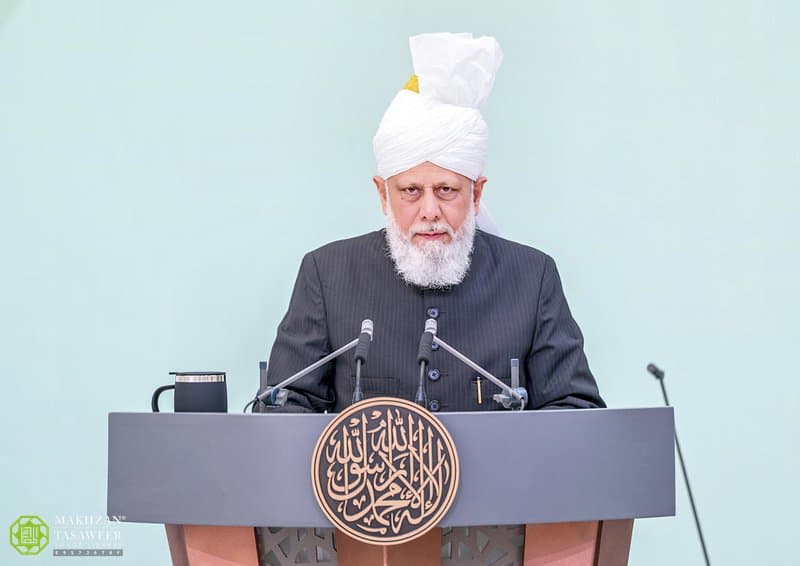
After reciting the tashahhud, ta‘awwuz and Surah al-Fatihah, Hazrat Khalifatul Masih V (aa) recited verse 87 of Surah Sad and stated:
قُلْ مَآ اَسْـَٔــلُكُمْ عَلَيْہِ مِنْ اَجْرٍ وَّمَآ اَنَا مِنَ الْمُتَكَلِّفِيْنَ
“Say, ‘I ask not of you any reward for it, nor am I of those who are given to affectation.’”
This is the verse in which Allah the Almighty instructs the Holy Prophet (sa) to announce to the people that “I am conveying the message of God Almighty to you and showing you ways to improve yourselves merely in order to adorn your present life as well as the life in the hereafter, and it is solely for your benefit. I do not require anything from you in return for this work, nor do I have the need to require anything from you, as I am receiving the reward for this from He Who possesses all the treasures.
“My life is free from these affectations,” and when one’s life is free from such pretentions, then there is no need for these worldly rewards. A person who lives a simple life, free from affectations, does not have any worldly desires. Furthermore, whatever is necessary for his worldly needs is provided by Allah the Almighty Himself. Hence, this is the expression of simplicity, which is ever manifest in the magnificent example of the Holy Prophet (sa). We see it demonstrated on various occasions throughout his life. He also guided the believers to maintain simplicity and to stay free from affectation.
In one narration, it is related by Hazrat ‘Uthman bin Affan (ra) that the Holy Prophet (sa) said: “The son of Adam has no right to anything but a home, in which he can stay, enough clothing to cover his nakedness and plain and simple bread and water.” (Sunan at-Tirmidhi, Abwab az-zuhd, Hadith 2341)
In reality, the Holy Prophet (sa) was describing his own condition and depicting his own life by saying that “this is the degree of my simplicity and I do not have any need for anything extra.”
This is also why he would offer the following prayer, as recorded in one narration. Hazrat Abu Sa‘id Khudri (ra) relates that the Holy Prophet (sa) said that you should love the poor. He further states: “I heard the Holy Prophet (sa) say the following in his supplications:
اَللّٰھُمَّ اَحْیِنِیْ مِسْکِیْنًا وَّاَمِتْنِیْ مِسْکِیْنًا وَّاحْشُرْنِیْ فِیْ زُمْرَةِ الْمَسَاکِیْنِ
“‘O Allah, let me live as a poor person, cause me to die as a poor person and raise me among the company of the poor.’” (Sunan Ibn Majah, Kitab az-zuhd, Hadith 4126)
Similarly, drawing the attention of the believers towards simplicity, the Holy Prophet (sa) said that simplicity is part of faith. In one narration, Hazrat Abu Umamah relates: “One day, the Companions of the Holy Prophet (sa) mentioned worldly affairs in his presence.
“Upon this, the Holy Prophet (sa) said, ‘Do you not listen? Do you not listen? Surely, simplicity is a part of faith. Surely, simplicity is a part of faith.’” (Sunan Abu Dawud, Awwalu kitabi ar-rijal, Hadith 4161)
He addressed them and drew their attention towards this twice.
Hazrat Imran bin Husain (ra) relates that the Holy Prophet (sa) said, “Indeed, Allah loves that servant of His who is a believer, poor, who does not beg and is responsible for a family.” (Sunan Ibn Majah, Kitab az-zuhd, Hadith 4121)
A person can avoid begging only when they live simply and are content. It should not be that, as soon as even a few needs arise, a person resorts to wrongful means to fulfil their desires or begins to complain.
On one occasion, the Holy Prophet (sa) gave glad tidings of paradise to those who live a life of poverty and simplicity. Hazrat Abdullah bin Umar (ra) relates that the poor Muhajirun complained to the Holy Prophet (sa) about the superiority that Allah the Exalted had granted to the wealthy among them. The Holy Prophet (sa) said, “O company of the poor, shall I not give you glad tidings that poor believers will enter paradise half a day – that is, 500 years – before their wealthy counterparts?”
Half a day means half of a day according to Allah the Exalted. The narrator, Musa, recited the following verse:
وَاِنَّ یَوْمًا عِنْدَ رَبِّکَ کَاَلْفِ سَنَةٍ مِّمَّا تَعُدُّوْنَ
“And verily, a day with thy Lord is as 1,000 years of your reckoning.” (Surah al-Hajj, V. 48)
(Sunan Ibn Majah, Kitab az-zuhd, Hadith 4124)
Thus, half a day according to Allah the Exalted means 500 years. How fortunate, then, are those who live with simplicity and contentment.
Today, there is such greed for worldly things, and people are tempted by various means, that worldly pursuits alone come to dominate their thoughts. In such circumstances, those who follow the guidance of the Holy Prophet (sa) will surely attain the blessings of Allah the Exalted.
However, this does not mean that a person should sit idle and do no work. To work with full attention and effort, then to live simply, be content and give thanks to Allah the Exalted is the hallmark of a believer. It also increases one’s faith. Hard work and making full use of one’s abilities are likewise characteristics of a believer and constitute a branch of faith.
Hazrat Abdullah bin Umar (ra) relates that the Holy Prophet (sa) held him by the shoulder and said, “Live in this world as though you were a stranger or a traveller passing along a road.”
Hazrat Ibn Umar (ra) would say, “When evening comes, do not expect to see the morning; and when morning comes, do not expect to see the evening. Take from your health for your illness, and from your life for your death.” (Sahih al-Bukhari, Kitab ar-riqaq, Hadith 6416, [Translation], Vol. 15, Nizarat Ishaat, pp. 181-182)
That is, in every circumstance, one should remember the pleasure of Allah the Exalted and the meeting with Him. The true reward for every deed comes only from Allah the Exalted, and one does not know when life may come to an end.
Concerning how the Holy Prophet (sa) demonstrated his simplicity and humility on every occasion, Hazrat Ibn Abbas (ra) relates that he heard Hazrat Umar (ra) say, while standing on the pulpit, “I heard the Holy Prophet (sa) say, ‘Do not exaggerate in praising me as the Christians exaggerated in praising the son of Mary. I am only a servant of Allah, so say, “His servant and His Messenger.”’” (Sahih al-Bukhari, Kitab ahadithi l-anbiya, Hadith 3445, [Translation], Vol. 6, Nizarat Ishaat, p. 426)
Mutarrif relates that his father told him, “I went with a delegation of Banu Amir to the Holy Prophet (sa), and we submitted, ‘You are our chief.’ He replied, ‘The Chief is Allah.’ We said, ‘You are the most excellent among us in virtue and the greatest among us in benevolence.’ He said, ‘Say what you have come to say, and do not indulge in these excessive forms of praise.’ Or he said, ‘State your purpose, lest Satan embolden you.’” (Sunan Abu Dawud, Kitab al-adab, Hadith 4806)
Thus, while expressing his humility and simplicity, he also drew attention, in a most subtle manner, to the need to avoid shirk.
Hazrat Rubayyi (ra) (a female Companion) relates, “When I was married, the Holy Prophet (sa) came and sat on my bed, just as you are sitting beside me.” She related this to the narrator: just as they were sitting on her bed, so too was the Holy Prophet (sa). “At that time, some girls began to beat the duff [drum] and praise her elders who had been martyred in the Battle of Badr. In one of their verses, one of the girls said, ‘Among us is a Prophet who knows what will happen tomorrow.’
“The Holy Prophet (sa) said, ‘Leave this and continue singing what you were singing before.’” That is, about Badr. (Sahih al-Bukhari, Kitab an-nikah, Hadith 5147, [Translation], Vol. 13, Nizarat Ishaat, pp. 84-85)
In other words, do not praise me falsely. Whenever there was unnecessary praise of him or anything suggestive of shirk, he immediately stopped them and told them not to do so. He was a simple and humble servant of God.
Regarding the simplicity of his home and living arrangements, it is recorded that after his migration from Mecca to Medina, a residence was prepared for the Holy Prophet (sa) adjoining Masjid Nabawi. It was not truly a house, but a small chamber or room measuring approximately 10 to 15 feet. A door was made between this chamber and the mosque, through which the Holy Prophet (sa) would enter the mosque for prayers and other purposes.
As the Holy Prophet (sa) married again, further chambers were prepared alongside this first chamber. (Sirat Khatamun Nabiyyin, p. 270)
Hazrat Mirza Bashir Ahmad Sahib (ra) has written this in Sirat Khatamun Nabiyyin. Historical accounts further explain how these chambers came to be added.
One of the Holy Prophet’s (sa) sincere Companions, Harithah bin Nu’man (ra), had several houses near and around the mosque. Whenever the Holy Prophet (sa) married a new wife, Harithah would give one of his houses to him, until all of Harithah’s houses had become the property of the Holy Prophet (sa). (Sharh al-Mawahib al-Ladunniyyah, Allama Al-Zurqani, Vol. 2, Dar Al-Kotob Al-Ilmiyah, 1996, p. 185)
Thus, it was not merely a matter of constructing additional rooms. Further houses were gradually added, and these too were small and extremely simple. In this manner, there were nine residences in all, in which the Holy Prophet (sa) spent the last 10 years of his blessed life. He was also buried in one of them – the home of Hazrat Aisha (ra).
Each residence consisted of a small room and an even smaller courtyard. Their construction was so simple that neither baked bricks nor stone were used, even though the entire area was filled with stones. The houses were constructed from palm branches, mud and at most, sun-dried bricks. Their courtyards were enclosed with palm branches, over which hair blankets were placed so that there would be no breach of privacy through the gaps between the branches. This is how the courtyard walls were made.
Each room was approximately five metres long and four metres wide. The courtyard was even narrower – approximately three and a half metres wide – while its length was equal to that of the room. The roofs were so low that they could be touched simply by raising one’s hand. (Ziyarat Makkah Al-Mukarramah Aur Ziyarat Madinah Al-Munawwarah, Dar-ul-Ishaat Karachi, pp. 404 and 408-409)
Ata relates, “On the day when these chambers were demolished, I heard Sa’id bin Musayyib say, ‘By Allah, I wished that these chambers had been left as they were, so that the people of Medina and visitors coming from outside could see how the Messenger (sa) of Allah was content with such little provisions during his blessed life. This would have prevented people from taking pride in the abundance of worldly wealth and possessions.’” (Al-Tabaqat Al-Kubra, Ibn Sa’d, Vol. 8, Dar Al-Kotob Al-Ilmiyah, Beirut, 1990, p. 133)
Hazrat Abu Umamah (ra) narrates, “I wish that the chambers of the wives of the Messenger (sa) of Allah had been left standing and not demolished, so that people might have exercised restraint in constructing buildings, and seen what Allah had chosen for His Prophet (sa), despite the fact that the keys to the treasures of the world were in his hands.” (Al-Tabaqat Al-Kubra, Ibn Sa’d, Vol. 8, Dar Al-Kotob Al-Ilmiyah, Beirut, 1990, p. 134)
Hazrat Musleh-e-Maud (ra) explains that regarding his living quarters, the Holy Prophet (sa) preferred simplicity. Generally, his houses consisted of a single room and a small courtyard. A rope was tied in the room, upon which a cloth could be hung when visitors came to meet him, and he would sit separately and speak with them. In other words, the partition in the room was made by hanging a sheet in the middle, so that a screen would be formed between the women’s side and the men’s side. He did not use a charpoy [traditional woven bedstead]; rather, he would lay his bedding on the ground and sleep there.
The simplicity of his living arrangements was so pronounced that after his demise, Hazrat Aisha (ra) stated, “During the lifetime of the Holy Prophet (sa), they would often have to survive off of water and dates. Even on the day he passed away, there was nothing in our home to eat except dates and water.” (Dibacha Tafsir-ul-Quran, Anwar-ul-Ulum, Vol. 20, p. 382)
The Promised Messiah (as) states:
“Just think how, to his last breath, the Holy Prophet (sa) steadfastly and unwaveringly held on to his claim of prophethood in the face of countless perils and so many enemies, detractors and intimidators. The persecution and hardship he endured for years seemed to preclude all possibility of success, and were increasing day by day. His patient response to them clearly rules out any plans for material gain. On the contrary, the very moment he made his claim to prophethood, he lost even the little support he already had. (Those who supported him prior also stepped back.)
“With a single announcement, he made innumerable enemies and brought upon himself countless tribulations. (Due to calling people towards Allah, he faced harsh persecution.) He was forced into exile, pursued by bloodthirsty enemies; his home and property were destroyed, and repeated attempts were made to poison him. Those who were once his well-wishers turned against him, and friends became foes. The severe hardship he endured for so long and with such fortitude could not have been tolerated by a deceiving imposter. And when, at long last, Islam became victorious and a time of ease and prosperity ushered in, he accumulated no wealth, built himself no citadels or mansions, piled up no provisions for luxurious and royal living, and made no personal acquisitions. Rather, he gave away everything to orphans, the needy, widows, and those burdened by debt, while he himself never even enjoyed a full meal.” (Barahin-e-Ahmadiyya, Part 2, Ruhani Khazain, Vol. 1, pp. 108-109)
It is narrated from Hazrat Aisha (ra) that she would say that the bedding of the Messenger (sa) of Allah was made of leather and was stuffed with date-palm fibres. (Sahih al-Bukhari, Kitab ar-riqaq, Hadith 6456, [Translation], Vol. 15, Nizarat Ishaat, p. 225)
The details of his bedding are further described in another narration. Hazrat Aisha (ra) was asked, “In your home, what kind of bedding did the Messenger (sa) of Allah have?” She replied, “It was made of leather and stuffed with date-palm fibres.” Hazrat Hafsah (ra) was also asked, “What kind of bedding did the Messenger (sa) of Allah have in your home?” She replied, “It was filled with hair and wool. I used to fold it into two layers.” It was like a woollen sheet or blanket. “I would fold it into two layers, and the Holy Prophet (sa) would sleep on it.”
She relates, “One night, I thought, ‘Why should I not fold it into four layers? (I could make it a little thicker) so that it would be more comfortable for him.’ Accordingly, we folded it into four layers (after consulting within the house).” When morning came, the Holy Prophet (sa) asked, “What was it that you spread for me last night?” Hazrat Hafsah (ra) says, “I submitted; it was your usual bedding. We had only folded it into four layers so that it might be more comfortable for you.” He said, “Leave it as it was before, for its softness was preventing me from offering the prayer at night.” (Shamail-ul-Nabi, Imam Tirmidhi, Hadith 314, Noor Foundation, p. 134; Fayd al-Qadir Sharh al-Jami al-Saghir, Vol. 5, Al-Maktabatah Al-Tajariyah Al-Kubra, Egypt, p. 220)
This does not mean that he felt sleepier or that his sleep had otherwise interfered with his prayer. Rather, he would stand and offer prayer on his bedding itself. He felt that it impacted his balance, or that he was not experiencing the same delight in his worship.
Hazrat Aisha (ra), the noble wife of the Holy Prophet (sa) relates, “I would sleep in front of the Messenger (sa) of Allah, with my feet stretched out before him. When he prostrated, he would nudge me with his hand and I would draw my feet in. When he stood up, he would stretch them out again.”
She would say that in those days, there were no lamps in the houses. (Sahih al-Bukhari, Kitab as-salat, Hadith 382, [Translation], Vol. 1, Nizarat Ishaat, pp. 487-488)
There was no light; it was dark. The Holy Prophet (sa) would offer prayer on the bedding, while Hazrat Aisha (ra) lay sleeping beside him. When he needed to prostrate, he would gesture with his hand for her to draw her feet back, and then he would prostrate.
Hazrat Abdullah (ra) relates that the Messenger (sa) of Allah once slept on a straw mat. When he got up, the mat had left marks on his side. We submitted, “O Messenger (sa) of Allah, if only we could prepare a bed for you!” He replied, “What have I to do with the world? In this world, I am merely like a traveller who stops beneath a tree to rest in its shade for a while, then sets off again and leaves it behind.” (Sunan at-Tirmidhi, Abwab az-zuhd, Hadith 2377)
Hazrat Abdullah bin Mas’ud (ra) relates: I came into the presence of the Holy Prophet (sa) while he was in a room that was something like a bathhouse; that is, it was extremely hot and stifling. He was sleeping on a mat which had left its mark upon his side. Seeing this, I began to weep. The Holy Prophet (sa) said, “O Abdullah! What made you weep?” I submitted, “O Messenger (sa) of Allah! Chosroes and Caesar walk upon silk, harir and dibaj (various kinds of silk), while you are sleeping on a mat that has left marks upon your side.” The Holy Prophet (sa) said, “O Abdullah, do not weep, for the world is for them and the Hereafter is for us. What have I to do with the world? My likeness and the world’s is that of a rider who alighted beneath a tree, rested a while, and then went on his way, leaving it behind.” (Al-Mu’jam Al-Kabir, Al-Tabrani, Vol. 10, Hadith 10327, Maktabah Ibn Taiymiyah, pp. 200-201; Al-Mawahib al-Ladunniyyah, Allama Al-Zurqani, Vol. 2, Al-Maktab Al-Islamiyyah, Beirut, 2004, p. 471)
Similarly, there is a narration on the authority of Hazrat Umar (ra) as well. Once, he went to meet the Holy Prophet (sa). Hazrat Umar (ra) relates:
“When I came, I saw that the Holy Prophet (sa) was in his upper chamber, which he reached by climbing a ladder made of palm trunks. A room had been built in the house, above the rest of it, with a palm-trunk ladder leading up to it, and an attendant of his who had a darkish complexion was at the top of the ladder. I said to him, ‘Tell the Holy Prophet (ra) that Umar bin Khattab has come.’ He permitted me to enter, and at that time he was lying on a mat of woven reeds. There was nothing between him and the mat, that is, no sheet or the like upon it. It was a rough mat of the kind one might call matting, made of grass, or perhaps a sack of sorts. Beneath his head was a leather pillow stuffed with palm fibre; at his feet lay a heap of acacia leaves, and near his head hung some raw hides. I also saw the mark of the mat upon his side, and seeing this I began to weep. He asked, ‘What makes you weep?’ I said, ‘O Messenger (sa) of Allah, Chosroes and Caesar live in the luxury in which they live, while you are the Messenger of Allah.’ He said, ‘Are you not content that the world should be theirs and the hereafter ours?’” (Sahih al-Bukhari, Kitab at-tafsir, Hadith 4913, [Translation], Vol. 12, Nizarat Ishaat, p. 267)
The Promised Messiah (as) has narrated this incident of Hazrat Umar (ra) in the following way:
“Such was the Holy Prophet’s (sa) dependence on worldly things that once Hazrat Umar (ra) went to visit him and, sending a boy ahead, sought permission to enter. The Holy Prophet (sa) was lying on a mat of palm leaves.
“When Hazrat Umar (ra) came in, he sat up. Hazrat Umar (ra) saw that the house was entirely bare and there was no article of adornment in it. A sword hung from a peg, and there was the mat on which he had been lying, whose marks were imprinted upon his blessed back in just this way.
“Seeing them, Hazrat Umar (ra) wept. He asked, ‘O Umar, what has made you weep?’ Hazrat Umar (ra) submitted, ‘Chosroes and Caesar keep every means of luxury, while you, who are the Messenger of God and the king of both worlds, live in this condition.’ The Holy Prophet (sa) said, ‘O Umar, what have I to do with the world? I pass my days like a traveller riding upon a camel toward his destination, on a desert road, who, because of the fierce intensity of the heat, sees a tree and rests in its shade, and as soon as his sweat has dried a little, sets out again.’” (Malfuzat, 2022, Vol. 6, pp. 228-229)
The Holy Prophet (sa) would also urge his children to adopt simplicity. In relation to this, Hazrat Musleh-e-Maud (ra) has highlighted this aspect from the life of the Holy Prophet (sa) with reference to Sahih al-Bukhari, as follows:
“Hazrat Fatima (ra) complained that grinding at the hand mill pained her. She had to turn the hand mill to grind the grain into flour, which caused her hardship.
“At about that time, some slaves [i.e., prisoners] came to the Holy Prophet (sa). Hazrat Fatima (ra) went to the Holy Prophet (sa) but did not find him at home, so she informed Hazrat Aisha (ra) of her visit and returned home. When the Holy Prophet (sa) came home, Hazrat Aisha (ra) informed him that Hazrat Fatima (ra) had come. That is, when the Holy Prophet (sa) returned home, Hazrat Aisha (ra) informed him that Hazrat Fatima (ra) had come.
“Hazrat Fatima (ra) says that he then came to their house, and they had already retired for bed. She says: Upon seeing him enter, I tried to stand up, but the Holy Prophet (sa) said, ‘Stay where you are.’
“Then he sat between us, and I felt the coolness of his feet on my chest. When he had sat down, he said, ‘Shall I not tell you of something better than what you asked of me?’ She told Hazrat Aisha (ra) that she had come for this purpose and asked her to let him know.
“So the Holy Prophet (sa) said to them, ‘I shall tell you of something better than that, and it is this: when you lie down in your beds, say Allahu Akbar [Allah is the Greatest] 34 times, Subhanallah [Glory to Allah] 33 times and Alhamdulillah [All praise is for Allah] 33 times. This is better for you than a servant.’
“(Hazrat Musleh-e-Maud [ra] writes that) from this account it is evident that the Holy Prophet (sa) was so scrupulous in the distribution of wealth that, although Hazrat Fatima (ra) needed a servant and her hands were pained by grinding at the mill, he did not give her one, but instead encouraged her to pray and directed her toward Allah the Almighty.
“Had he wished, he could have given Hazrat Fatima (ra) a servant, for the goods that came to him for distribution were also to be distributed among the Companions, and Hazrat Ali (ra) too had a right in its share, and Hazrat Fatima (ra) was likewise entitled to them. But the Holy Prophet (sa) exercised caution and did not wish to give these goods to his own kin and relatives, for it was possible that in future people would draw all manner of wrong conclusions from it, and kings would come to regard the property of the people as lawful for themselves – those kings who were to arise in the Ummah would deem it lawful.
“(Indeed, even now those kings regard such things permissible; rather, they regard even what is impermissible as permissible. Nevertheless, out of caution, the Holy Prophet [sa] gave Hazrat Fatima (ra) none of the slaves and bondwomen who had come to him at that time for the purpose of distribution.)
“Here it should also be borne in mind that Allah the Almighty has Himself appointed a share in these goods for him and for his relatives, and there is no prohibition in this. He would spend from that share and would give to those dependent upon him as well. Yet until something fell within his own share, he would never spend it at all, and he would not give it even to his dearest relatives. Can the world present the example of any king who has been such a guardian of the public treasury? If any parallel can be found, it can be found only among the servants of that pure being; otherwise, other religions cannot present a parallel to it.” (Sirat-ul-Nabi, Anwar-ul-Ulum, Vol. 1, pp. 544-545)
The simplicity displayed by the Holy Prophet (sa) in the dowry given to his daughter is evident from the account of Hazrat Ali (ra). He relates that when the Messenger (sa) of Allah arranged his marriage to Hazrat Fatima (ra), he sent the following items with her: a silk sheet, a leather cushion filled with palm fibre, two hand mills for grinding flour, a water skin, and two earthenware pots. (Musnad Imam Ahmad bin Hanbal, Vol. 1, Hadith 838, Aalam-ul-Kotob, 1998, p. 314)
This was the standard of the Holy Prophet’s (sa) simplicity. Had he wished, he could have given her far more. People today incur debts in order to prepare elaborate dowries, whereas the Companions of the Holy Prophet (sa) would gladly have placed all manner of things at his disposal. There were many among them with ample means, and who could easily have provided whatever was required, without any need for debt. Yet the Holy Prophet (sa) chose to send his daughter to her new home with the utmost simplicity.
In another narration, the Mother of the Believers Hazrat Aisha (ra) and the Mother of the Believers Hazrat Umm Salama (ra) relate:
“The Holy Prophet (sa) instructed us to prepare Hazrat Fatima (ra) for her marriage and to take her to Ali (ra). Beforehand, we prepared the room in which they were to live. We plastered it with mud and made two cushions which we filled with date-palm fibre. We served the people dates and grapes and gave them sweet water to drink. We also fixed a piece of wood along one side of the room from which clothes and a waterskin could be hung. We never witnessed a wedding better than that of Hazrat Fatima (ra).” (Sunan Ibn Majah, Kitab an-nikah, Hadith 1911)
It was a wedding of extraordinary simplicity.
This account provides a brief glimpse of the wedding, but judged by the standards of that time, the Holy Prophet (sa) established the highest example of simplicity. Through his own daughter, he demonstrated that what truly matters is not outward display, but simplicity and the attainment of the pleasure of God. This is what a believer should strive for.
Whilst describing the simplicity of this king, Hazrat Musleh-e-Maud (ra) said:
“Towards the latter part of his life, the Holy Prophet (sa) was undoubtedly a king. The question, however, is what worldly advantages he derived from that position. To what extent did he use his authority to provide comfort for his wives and children, his friends or his relatives?
“When one reflects upon his life, it becomes clear that the Holy Prophet (sa) derived no worldly benefit whatsoever from his rule. On the contrary, throughout his entire life, he continually made sacrifices for others. He never regarded the conquered territories or properties as his personal possessions. Indeed, the great disagreement that later arose between Sunnis and Shias after the demise of the Holy Prophet (sa) centres precisely upon the fact that he did not treat such properties and conquered lands as his personal estate, nor did he establish that they could pass to his family as inheritance. (Yet the disputes that later arose became entangled in this very question of inheritance.)
“Thus, the Holy Prophet (sa) derived no personal benefit from his authority. As for his children, we find that he left no worldly provision for them. Indeed, at the time of his demise, some of his belongings had been pledged as collateral in order to obtain necessities for the household. History bears witness to this. There are times in a person’s life when necessity compels him to pledge something he owns. In the same way, periods of both hardship and relative ease came upon the Holy Prophet (sa).
“There is also the well-known incident concerning Hazrat Fatima (ra). On one occasion, after a battle, a considerable amount of wealth had been received, and she requested the Holy Prophet (sa) to grant her a maid who could assist her with the burdens of her household work. The Holy Prophet (sa) said to her, ‘This wealth does not belong to me; it belongs to God Almighty. I cannot give you anything from it.’ Instead, he advised her to engage in the remembrance of Allah and to set aside the thought of having a servant.” (Khutbat-e-Mahmud, Vol. 17, pp. 491-492)
Regarding the simplicity of the Holy Prophet’s (sa) domestic life and the way he would assist his family with household work, there is a narration from Aswad, who says:
“I asked Hazrat Aisha (ra), ‘What did the Holy Prophet (sa) do when he was at home?’ She replied, ‘He would remain occupied in serving his family (in other words, he would assist them with their household tasks) and he would depart when it was time for prayer.” (Sahih al-Bukhari, Kitab al-adhan, Hadith 676, Vol. 2, Nizarat Ishaat, p. 73)
Even today, many women write to me complaining that their husbands behave harshly and imperiously in the home, as though they are rulers over everyone else. Such husbands should carefully consider this example of the Holy Prophet (sa) and reform themselves accordingly.
Another incident illustrates how simply the Holy Prophet (sa) lived, like any ordinary person. Hazrat Hasanah bin Khalid and Hazrat Sawa bin Khalid once went to the Holy Prophet (sa) and found him engaged in repairing a wall or part of his house. The two Companions joined him and helped with the work. (Subul Al-Huda Wa Al-Rishad, Vol. 7, Dar Al-Kotob Al-Ilmiyah, p. 36)
Hazrat Aisha (ra) also relates an incident concerning the simple daily routine of the Holy Prophet (sa). She says that she was once asked, “What work did the Holy Prophet (sa) do in his home?” She replied: “He was a human being like other human beings. He would clean his own clothes, milk his own goat and attend to his own needs.” (Musnad Ahmad bin Hanbal, Vol. 8, Hadith 26724, Aalam-ul-Kotob, Beirut)
It is written in the commentary of this hadith that Hazrat Aisha (ra) emphasised his humanity because the disbelievers imagined that it was beneath the dignity of a prophet to perform the ordinary tasks undertaken by other people. They conceived of prophets as though they should live like worldly kings, for kings, out of pride, often consider themselves above commonplace and ordinary work. Allah the Almighty has recorded this objection of the disbelievers in the words:
مَالِ ھٰذَا الرَّسُوْلِ یَأْکُلُ الطَّعَامَ وَیَمْشِیْ فِی الْاَسْوَاقِ
“What is the matter with this Messenger that he eats food, and walks in the streets (like ordinary people)?”
Hazrat Aisha (ra) therefore explained that the Holy Prophet (sa) was a human being from among the creation of Allah; one of the children of Adam. Allah the Almighty had honoured him with prophethood and raised him to the exalted station of being a messenger. In his dealings with the creation of God, he displayed the best morals, while in his relationship with Allah the Almighty he was the embodiment of truthfulness and sincerity.
Thus, he performed the same ordinary tasks that other people performed. He adopted humility and assisted others in their work, thereby giving mankind a living example of humility and teaching them, through his own conduct, to shun arrogance and pride. His was a life of complete simplicity. (Sharh al-Tibi ʿala Mishkat al-Masabih, Vol. 12, Maktabah Nizar Mustafa al-Baz, 1997, p. 3708)
Hazrat Abu Hurairah (ra) relates that the Holy Prophet (sa) said:
“Allah has not sent any Prophet who did not tend to sheep.” The Companions submitted, “O Messenger (sa) of Allah, did you tend to sheep as well?” He replied, “Yes, I used to tend the sheep of the people of Mecca in exchange for a few qirats.” (Sahih al-Bukhari, Kitab al-ijarah, Hadith 2262, [Translation], Vol. 4, Nizarat Ishaat, p. 230)
Some scholars have adopted the position that the Holy Prophet (sa) did not tend sheep in exchange for qirats or any other form of payment. Rather, they maintain that Qararit was the name of a place, meaning that the Holy Prophet (sa) tended sheep at a place called Qararit, as the word Qararit is used in this hadith.
However, many scholars and commentators do not consider this view correct. They hold that working in this manner in exchange for wages is not contrary to the dignity of a prophet. Indeed, the Holy Quran explicitly mentions that Moses (as) worked in exchange for wages. Surah al-Qasas, verses 28 and 29, details how he worked for the father of the two women for remuneration and later married one of his daughters.
Therefore, those scholars who seek to deny that the Holy Prophet (sa) tended sheep for wages are going through unnecessary effort to establish a position that is not warranted by the text.
For this reason, some biographers of the Holy Prophet (sa) and commentators of Hadith have also clarified that Qararit refers to qirats, rather than a place or location. Our commentator of Sahih al-Bukhari, Syed Zain-ul-Abidin Waliullah Shah Sahib (ra), also explains that Qararit is the plural of qirat, and one qirat was equivalent to the weight of four rattis of silver. (Sahih al-Bukhari, [Translation], Vol. 4, Nizarat Ishaat, p. 231)
Allama Burhanuddin al-Halabi states that Qararit refers to small denominations of dirhams and dinars with which inexpensive items were purchased. Imam Bukhari has recorded a narration in Kitab al-Ijarah [The Book of Hiring], in which the Holy Prophet (sa) states, “I used to tend the sheep of the people of Mecca for Qararit.” This serves as evidence that Qararit here refers to wages, rather than a place. In some narrations, the word Ajyad – referring to a location called Ajyad – appears in place of Bil Qararit. Thus, Qararit refers to remuneration, whereas Ajyad refers to a place. (Al-Sirah Al-Halabiyyah, Vol. 1, Dar Al-Kotob Al-Ilmiyah, 2002, pp. 183-184)
The Promised Messiah (as) states:
“Our master and guide, the Holy Prophet (sa), spent a considerable portion of his life, up to the age of 40, in helplessness, distress and as an orphan. During that period of isolation, not a single relative or kinsman fulfilled the obligations of kinship towards him. To the extent that, in his early childhood, this spiritual king was entrusted to certain women who lived in the wilderness and wandered from place to place, as would be the case of orphaned children who had no one to look after them. It was in this very state of helplessness and destitution that the Chief of Mankind completed the days of his infancy. When he reached the age of discernment, these people who dwelt in the wilderness entrusted the task of tending sheep to this Benefactor of the Worlds, just as they would to an orphaned and helpless child who had no one in the world. During those days of hardship, his only sustenance consisted of the basic grain or the milk of sheep.” (Izala-e-Auham, Part 1, Ruhani Khazain, Vol. 3, pp. 112-113, footnote)
On another occasion, the Promised Messiah (as) states:
“In reality, God has bestowed a great favour by making poverty a part of the lives of prophets as well. The Holy Prophet (sa) used to tend sheep, and Moses (as) also tended sheep. Could the wealthy undertake such work? Never.
“On one occasion, the Holy Prophet (sa) passed through a wilderness where there were some fruit-bearing trees. A few Companions who were accompanying him began plucking and eating the fruit. The Holy Prophet (sa) said, ‘Eat the fruit of such-and-such tree; it is very sweet, and its fruit is better.’ The companions asked, ‘O Prophet (sa) of Allah, how do you know this?’ He replied, ‘When I used to tend sheep, I would also come to this wilderness and eat these fruits.’ Similarly, Allah the Almighty did not ordain that prophets should belong to royal families; otherwise, some degree of arrogance and pride would inevitably have remained in them.” (Malfuzat, 2022, Vol. 6, p. 272)
Hazrat Musleh-e-Maud (ra) states:
“The example of the lives of the kings who lived around the time of the Holy Prophet (sa) was not such that he could have acquired from it the qualities he manifested in his actions. It is also worth reflecting upon the fact that Allah the Almighty had granted the Holy Prophet (sa) such a lofty station that he had become the focal point of the attention of all peoples. On one side, Rome viewed his growing power with suspicion, while on the other, Persia regarded his rising fortunes with apprehension. Both were concerned about what measures they should adopt to stem this tide. Consequently, representatives of both empires would come and go in his presence, and correspondence had also begun between the Holy Prophet (sa) and them.
“In such circumstances, it would seemingly have been necessary, in order to establish an imposing presence before these people, for him to keep a retinue of slaves and conduct himself in a manner that would impress and render them overawed. Yet he never did anything of the sort. Far from keeping a retinue of slaves, he did not even employ a servant to attend to the household chores; instead, he would carry out all the tasks himself.
“It is recorded regarding Hazrat Aisha (ra) that she was asked what the Holy Prophet (sa) used to do. She replied that he would work for his family – the Arabic word used here is ‘mehnat’ which means that he would serve them. When the time for prayer arrived, he would go out to offer the prayer.
“This hadith demonstrates the simplicity of the life he led. Despite his sovereignty, there was no servant to attend to the household chores. Rather, in his spare time, he would personally assist his blessed wives with the household work.
“By Allah! What a simple life! What an unparalleled example! Can any other person be presented who, despite being a king, set such an example that he did not even have a single servant to attend to the household chores? If anyone has ever set such an example, he too must have been among his devoted servants. No other king, who did not take pride in being devoted to him, has ever demonstrated such an example.
“There are those who, out of fear of the world, renounced it altogether. There are also those who became engrossed in the world and wholly devoted themselves to it. But to bear the burden of reforming the world upon one’s own shoulders, to retain the reins of governance over nations in one’s own hands, and yet remain detached from the world, harbour no love for it, and embrace a life of humility and simplicity despite being a king – such an example is found in none other than the Holy Prophet (sa) and his devoted servants.
“Those who possessed nothing at all could not even find a dwelling in which to live. Their enemies would not allow them to remain in peace anywhere, compelling them to move from one place to another. The simplicity of such people does not constitute an exalted example, for how could those who possessed nothing possibly live in grandeur and splendour?
“However, for a king of Arabia to distribute hundreds of thousands of rupees among the people with his own hands, and to perform the household chores himself as well, is something that cannot fail to attract the attention of those endowed with insight.” (Sirat-ul-Nabi [sa], Anwar-ul-Ulum, Vol. 1, pp. 563-564)
The Promised Messiah (as) states:
“The excellence of the Holy Prophet’s (sa) moral character was such that even if an elderly woman took hold of his hand, he would stop and listen attentively to what she had to say. He would not leave her until she herself let go of his hand.” (Malfuzat, 2022, Vol. 1, p. 189)
With utmost simplicity and humility, he would listen to her words.
‘Adiyy ibn Hatim, the son of Hatim Ta’i, a renowned figure of Arabia, relates:
“I set out towards the Messenger (sa) of Allah and eventually arrived in Madinah. I entered the mosque, approached the Messenger (sa) of Allah and greeted him with the salutation of peace.
“The Messenger (sa) of Allah asked, ‘Who are you?’
“I replied, ‘I am ‘Adiyy ibn Hatim.’
“The Messenger (sa) of Allah stood up and took me towards his home. Along the way, we encountered an elderly woman who began explaining a personal need to him. She continued speaking for quite some time, and the Holy Prophet (sa) remained standing there patiently, attending to her needs.
“I said to myself (i.e., the son of Hatim relates), ‘This man cannot be a king, for kings do not possess such noble qualities’ (in that they would stand humbly before a poor woman in this manner).
“The Holy Prophet (sa) then took me to his home. Upon entering, he picked up a leather cushion filled with palm fibres, placed it before me, and said, ‘Take a seat on this.’
“I replied, ‘Please, you sit on this.’
“But the Holy Prophet (sa) stated, ‘No, you sit.’
“Eventually, I sat upon it, while he sat on the ground. Upon witnessing his simplicity, humility, and meekness, I thought to myself, ‘This is certainly not the conduct of kings.’”
Adiyy relates, “Having witnessed the excellent moral character and simplicity of the Holy Prophet (sa), I accepted Islam.” (Al-Sirah Al-Nabawiyyah, Ibn Hisham, Dar Al-Kotob Al-Ilmiyah, 2001, p. 854; Dairah Ma’arif Sirat Muhammad Rasoolullah [sa], Vol. 9, pp. 440-441)
اَللّٰہُمَّ صَلِّ عَلٰی مُحَمَّدٍ وَّعَلٰی آلِ مُحَمَّدٍ وَّبَارِکْ وَسَلِّمْ اِنَّکَ حَمِیْدٌ مَّجِیْدٌ۔
[“O Allah, send blessings upon Muhammad and the people of Muhammad, and grant them peace and prosperity. Verily, Thou art the Praiseworthy, the Most Glorious.”]
I would like to draw attention once again to prayers for the Ahmadis living in Pakistan. In the name of Allah and His Messenger (sa), unjust people, who in fact are extremists or have vested interests, are subjecting Ahmadis to severe persecution. At times, government officials are also supporting them and owing to their fear of the clerics, Ahmadis who are imprisoned on account of their faith are not even granted bail, and judges are often too fearful to issue verdicts in their favour.
Although there are some officials who demonstrate courage and judges who show strength, the general situation is such that those who seek to create disorder in the name of Islam have instilled fear throughout the country, and the entire machinery of the government is in fear of them. May Allah the Almighty swiftly bring about the means to hold these wicked individuals and mischief-makers to account.
Ahmadis in Pakistan should pay particular attention to reciting durood and istighfar, offering the prayers I have mentioned, and performing voluntary prayers. They should pray extensively, seeking Allah’s protection from these unjust individuals. May Allah the Almighty grant them the ability to do so.
Similarly, the situation of the Jamaat in Malaysia is also quite dire. Various government departments are imposing restrictions on Ahmadis. Our mosques are routinely raided, and searches and inspections are carried out unnecessarily. May Allah the Almighty keep the Ahmadis in Malaysia under His protection.
(Official Urdu transcript published in the Daily Al Fazl International, 6 November 2026, pp. 1-8. Translated by The Review of Religions.)