
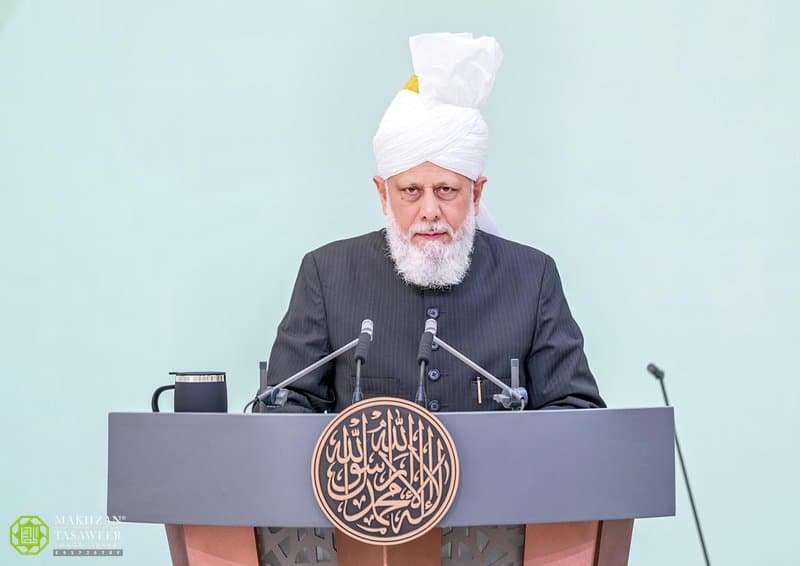
After reciting the tashahhud, ta‘awwuz and Surah al-Fatihah, Hazrat Khalifatul Masih V (aa) stated:
The lofty standards of the Holy Prophet (sa) in expressing his gratitude, his own practical examples and guidance in this regard were being discussed in the sermons prior to the Jalsa, and I will continue doing so today as well. Drawing our attention towards being grateful to Allah the Almighty, he guided us to be thankful even for the smallest of things. In relation to this, Hazrat Anas bin Malik (ra) relates that the Holy Prophet (sa) said: “Allah is pleased by this deed of His servant that when he eats a morsel or drinks a sip, he praises Him.” (Sahih Muslim [Translation], Kitab az-zikri wa d-du‘ai wa t-tawbati wa l-istighfar, Hadith 4901 (89), Vol. 14, Noor Foundation, p. 107)
Similarly, Hazrat Aisha (ra) relates that once, the Holy Prophet (sa) entered his home and saw a piece of bread lying on the floor. He picked it up, cleaned it, ate it and said: “O Aisha! Honour that which is worthy of honour. When this blessing of sustenance is removed from a people, it does not return to them.” (Sunan Ibn Majah, Kitab al-at’imah, Hadith 3353)
This was the practical example of the Holy Prophet (sa). He would express his gratitude to Allah the Almighty for seemingly even the smallest of things. He would thank Him for His blessings and instruct the members of his household to do the same. Hence, if we desire blessings in our provisions, we must express gratitude for every blessing of Allah the Almighty.
Hazrat Ibn ‘Abbas (ra) relates that on the day of the Victory of Mecca, the Holy Prophet (sa) went to the home of his paternal cousin, Umm-e-Hani bint Abi Talib (ra). At the time, he was hungry and said: “Do you have anything that we can eat?” She replied: “I have nothing except some pieces of dry bread, but I feel embarrassed to present them before you.” The Holy Prophet (sa) said: “You may bring them.” He then placed them in water and broke them into small pieces. She then brought some salt. The Holy Prophet (sa) asked: “Is there any broth?” She replied: “O Messenger (sa) of Allah! There is nothing except some vinegar.” The Holy Prophet (sa) said: “You may bring that.” He poured it over his food, ate from it and praised Allah the Glorious. He then said: “What an excellent broth vinegar is! O Umm-e-Hani! A home that has vinegar is not a poor home.” (Al-Mu’jim Al-Saghir, Al-Tabrani [Translation], Hadith 951, Shabbir Brothers Lahore, 2014, pp. 615-616)
These were the standards of the gratitude expressed by the Holy Prophet (sa). We live in these countries [in the West] and benefit from countless blessings. Despite this, we do not fulfil the due right of being grateful towards Allah the Almighty. In fact, at times, we even begin to complain over the smallest matters. We complain to our family members that you did not bring this or that. Hazrat Musleh-e-Maud (ra) has described such ungrateful people, while on the other hand the gratitude of the Companions in a very powerful manner. He states:
“If you ever have to wear a torn garment, you begin to lament and say, ‘How unfortunate we are that we have been left with torn clothes to wear.’ But when the Companions received a torn garment, their heads would bow before Allah the Almighty. Their tongues would become occupied in His praise, and they would say, ‘What a wonderful garment our God has bestowed upon us.’
“If, after four days, they received nothing more than a piece of dry bread, their eyes would sparkle with joy, and they would say, ‘alhamdulillah [all praise belongs to Allah], God has favoured us with His bounty.’
“That is why those pieces of dry bread benefited them (addressing members of the Jamaat, he said) more than even pilau and korma benefit you today.
“Today, a person who is served pilau eats it, yet at the same time regrets that there was no zarda with it. If someone is given both pilau and zardah, he still weeps tears of disappointment and says, ‘If only there had been firni as well.’ The one who is given lentils longs for meat. The one who is given meat craves rice. The one who has four loaves to eat. […]”
Hazrat Musleh-e-Maud (ra) then gave many such examples. He then says, “In contrast, what was the condition of the Companions? If they received even a simple piece of dry bread, they would say, ‘We were not even worthy of this morsel. It is purely the grace of Allah that He has granted it to us.’
“The result was that even a piece of dry bread became a source of strength for them. It instilled in them lofty aspirations and further increased their spirit of gratitude.
“On the day of the Conquest of Mecca, when the power of the Arab chiefs came to an end, and the Holy Prophet (sa) entered Mecca with 10,000 devoted followers, the great leaders whose entire lives had been spent opposing Islam came before him with their heads bowed. He announced to them:
“‘Go, I shall not say a thing to you, for you are all free.’
“After making this proclamation, the Holy Prophet (sa) went to the house of Hazrat Umm Hani (ra), (who was his paternal cousin, as has been mentioned earlier). He asked, ‘Do you have anything to eat?’
“She replied, ‘There is nothing to eat (as was just mentioned). Had I possessed anything, I would gladly have served it to you. All I have is a piece of dry bread that has been lying here for several days.’
“The Holy Prophet (sa) said, ‘Very well, bring that.’
“When she brought the bread, he said, ‘This is an excellent loaf, yet you were distressed, saying that you had nothing in the house.’
“She then brought some water, and he soaked the bread in it. After that he asked, ‘Do you have any broth?’
“She replied, ‘Where could I have got any broth? I scarcely even had bread to offer you. If I had it I would have brought it before. I only have a little vinegar.’
“The Holy Prophet (sa) said, ‘What an excellent condiment vinegar is.’
“She brought the vinegar (as mentioned), and he dipped it in the vinegar and ate the bread with it.”
Hazrat Musleh-e-Maud (ra) says:
“The Holy Prophet (sa) regarded even vinegar as a blessing from God and ate the dry bread with it, thanking Allah for His favour.
“In reality, a person’s digestion is strengthened by the cheerfulness that arises within the heart. If even something simple is eaten with joy and gratitude, it produces great strength. But if the finest foods are eaten with sorrow and discontent, they bring no real benefit.”
He continues, “People today think they deserve more than they have received. The companions, however, always felt they deserved less than what they had been given. Such was their gratitude that even if they received only a little, they would say, ‘This is more than enough.’
“It was for this reason that a single roti [flatbread] benefited them more than ten rotis benefit you today.”
He then said, “This is because many of you have not yet tasted the sweetness of faith. Your hearts remain completely unaware of the reality that Allah has created you for a magnificent spiritual mission. Compared to the one whom Allah has chosen to bring about a spiritual revolution and transformation, even the greatest king in the world is insignificant.
“Yet instead of understanding your true station and recognising your responsibilities, you become preoccupied with the most trivial and insignificant matters. You complain, ‘I did not get this,’ or ‘I was not given that.’
“Until you develop a true awareness of the purpose for which Allah has created you, and until you recognise your rank, you will never accomplish the work expected of you.
“Allah has placed you in a position where your heart should constantly overflow with joy, and where alertness and vitality should always be evident within you. If this quality is developed, you will immediately acquire such strength that even the smallest amount of food will be enough to enable you to carry out your work.” (Amal Ke Baghair Kamyabi Hasil Nahi Ho Sakti, Anwar-ul-Ulum, Vol. 18, pp. 475-479; Usdul Ghaba, Vol. 7, Dar Al-Kotob Al-Ilmiyah, p. 393)
Thus, this is a course of action that every Ahmadi should adopt – especially those with limited means, but even more so those who have dedicated their lives as waqifeen-e-zindagi – in order to elevate their standards of gratitude. There is a great need for this. Likewise, they should strive to instil this spirit as much as possible in their wives and children, because the objective for which the waqifeen have dedicated their lives is a truly noble one. To attain such a lofty goal, they must keep before them the examples of those who themselves achieved such lofty objectives and endeavour to follow them. Only then can that goal truly be realised.
The Holy Prophet (sa) not only appreciated the service of his Companions but also rewarded them with heartfelt prayers. In this regard, there is a narration from Hazrat Abu Qatadah (ra). He relates that the Holy Prophet (sa) addressed the Companions during a journey and said:
“You will continue travelling throughout this evening and the entire night, and tomorrow, insha-Allah, you will reach water (they were on a journey somewhere).”
The people continued travelling, not even turning to one another. Hazrat Abu Qatadah (ra) relates:
“The Messenger (sa) of Allah continued riding until the middle of the night. I was riding beside him. The Holy Prophet’s (sa) eyes felt heavy with sleep, and he began to lean to one side on his mount. I quietly went close to him and supported him without waking him until he regained his balance and sat upright again.
“He continued travelling until most of the night had passed, when sleep overtook him again, and he leaned to one side. Once more I supported him without waking him until he sat upright again.
“We continued in this manner until the final part of the night. This time he leaned even more than before, to the point that he was about to fall from his mount. I hurried forward and supported him.
“He then raised his head and asked, ‘Who is this?’ I replied, ‘Abu Qatadah.’ He asked, ‘Since when have you been accompanying me like this?’ I replied, ‘Since the beginning of the night.’ The Holy Prophet (sa) then prayed, ‘May Allah protect you, just as you have protected His Prophet.’” (Sahih Muslim [Translation], Kitab al-masajidi wa mawadi‘i s-salat, Hadith 1091 (311), Vol. 3, Noor Foundation, pp. 165-166)
In this way, the Holy Prophet (sa) expressed the highest standard of gratitude.
The Holy Prophet (sa) also set before us the perfect example of gratitude in his own life. One narration relates from Hazrat Abu Umamah (ra) that the Messenger (sa) of Allah said:
“My Lord, the Mighty and Majestic, offered to turn the valley of Mecca into gold for me. I replied, ‘No, my Lord. Rather, I would prefer to be hungry one day and well-fed the next, so that when I am well-fed I may praise You and give thanks to You, and when I am hungry I fervently pray before You, and supplicate to You.’” (Kitab Akhlaq- an-Nabiyyi Wa Adabuhu, Ibn Hayyan al-Asbahani, Dar al-Kitab al-Arabi, 1986, p. 224)
Another narration is related by Hazrat Abdullah bin Mas‘ud (ra). He states that whenever the Holy Prophet (sa) drank water, he would drink it in three sips, removing the vessel from his mouth between each sip. (He wouldn’t drink it all in one go; rather, he would do so in three sips). With each sip, he would praise Allah, and after the final sip he would thank Him. (Kitab Akhlaq-ul-Nabi Wa Adabuhu, ibn Hayyan al-Asbahani, Dar al-Kitab al-Arabi, 1986, p. 191)
As the Holy Prophet (sa) taught, even when you take a sip of water, praise Allah and thank Him. This is the proper manner of drinking water – with gratitude. It is also beneficial for one’s health, for instead of drinking it all at once, one should drink slowly, pausing between sips.
In Bukhari, there is a lengthy narration of Hazrat Abu Hurairah (ra). He says, “By Allah, besides Whom there is no god, that one day because of hunger, I would lie with my liver pressed against the ground in order to support myself, and at times, because of hunger, I would tie a stone around my stomach.” He says that this was not a matter of one day; rather, it continued for several days.
He says, “One day, I sat along the pathway (he was in a very difficult condition) through which people would pass. Hazrat Abu Bakr (ra) passed by. I asked him about a verse of the Book of Allah, the Holy Quran, regarding care for the poor, who do not ask for help and who are hungry. So he explained its meaning to me and then went away. And after this, Hazrat Umar (ra) passed by. I similarly asked him, and he also explained its meaning to me and went away. After this, the Holy Prophet (sa) passed by me. When he saw me, he smiled and understood the condition of my heart, which was visible upon my face. He said, ‘Aba Hirr!’ I said, ‘I am present, O Messenger (sa) of Allah.’ He said, ‘Follow me.’ The Holy Prophet (sa) went towards his home, and I followed behind him. He entered and gave me permission to enter as well. Inside his room there was a bowl of milk. He asked his household where it had come from. They told him that it had been sent as a gift from somewhere. Nonetheless, he then said, ‘Aba Hirr!’ I said, ‘I am present, O Messenger (sa) of Allah.’ He said, ‘Go to the People of the Suffah and bring them to me.’” These were people who were often hungry and would remain seated there outside. People would sometimes take food to them and feed them at their homes. Nevertheless, he called them. He narrates further, “I disliked being asked to call them. I thought to myself, what can this small quantity of milk possibly do for the People of the Suffah? I had a greater right to drink some of this milk so that I might gain some strength. If they come and he orders me to give it to them, then I will have no choice but to give it to them, and then I have no hope that I will receive any of this milk. There was no alternative for me except to obey Allah and His Messenger (sa). (I had no other choice). Thus, I went to them and called them. The People of the Suffah came and sat in their places. The Holy Prophet (sa) said, ‘O Abu Hurairah!’ I said, ‘I am present, O Messenger (sa) of Allah.’ He said, ‘Take this and give it to them.’ I took the bowl and gave it to one man. He drank until he was satisfied, then another drank, then a third, and they continued drinking in this manner, until I reached the Holy Prophet (sa), while all those who had been sitting there had become completely satisfied and had drunk their fill of the milk. The Holy Prophet (sa) took the bowl and placed it upon his hand. He looked towards me, smiled, and said, ‘Abu Hurairah!’ I said, ‘I am present, O Messenger (sa) of Allah.’ He said, ‘You and I are the only ones remaining now.’ I said, ‘O Messenger (sa) of Allah, you have indeed spoken the truth.’ He said, ‘Sit down and drink.’ I sat down and began drinking. He said, ‘Drink more.’ So I drank more. He continued saying, ‘Drink more,’ and I continued drinking. Eventually I said, ‘No more, by Him Who sent you with the truth! I can no longer find any room for it. (My stomach is completely full.)’ He said, ‘Show me.’ I handed the bowl to him. He first praised and thanked Allah the Almighty (despite the fact that he too had been hungry). He first thanked Allah the Almighty and invoked His name, and then he drank the remaining milk.” (Sahih al-Bukhari, Kitab ar-riqaq, Hadith 6452 [Translation], Vol. 15, Nazarat Ishaat, pp. 220-223)
Such was his gratitude, and owing to this gratitude, Allah the Almighty placed such a blessing in it that all the Companions were able to drink from it, and the Holy Prophet (sa) was also able to satisfy his hunger with it.
Hazrat Aisha (ra) relates that the Holy Prophet (sa) said, “When someone does a favour to a person, he should repay that favour. If he does not have the ability to repay it, he should mention the favour before others, because the person who mentions it has expressed his thankfulness for it. But the person who pretends to possess a quality of greatness which he does not actually possess is like the one who wears two garments of falsehood” that is, he is false from head to toe. (Musnad Imam Ahmad bin Hanbal, Musnad Aisha, Vol. 8, Hadith 25100, Alam Al Kotob, pp. 142-143)
It is narrated that the maternal uncle of the Holy Prophet (sa), Aswad bin Wahb bin Abd Manaf bin Zuhrah, sought permission to meet him. The Holy Prophet (sa) said, “O my maternal uncle, come inside.” He entered, and the Holy Prophet (sa) spread his cloak for him and said, “Sit upon it, because the status of a maternal uncle is like that of a father.” He then said, “O my maternal uncle, when someone is shown a favour and does not express gratitude for it, then at the very least he should mention that favour. For when he mentions it, it is as though he has expressed gratitude for it.” (Al-Sirah Al-Halabiyah, Vol. 2, Dar Al-Kotob Al-Ilmiyah, 2008, p. 313)
How do we see this aspect of gratitude in the personal life of the Holy Prophet (sa)? There are numerous incidents. He always remembered those who had done him favours and continued to mention them on every occasion. For example, Hazrat Khadija (ra), his noble wife, continually aided the Holy Prophet (sa) and treated him with kindness at every step. She was a wealthy woman of Mecca. When she married the Holy Prophet (sa), she placed all of her wealth before the Holy Prophet (sa), telling him to use it in whatever manner he wished.
Then, after his claim to prophethood, she stood beside him with complete sincerity and devotion through every hardship and every difficulty, until her demise in the 10th year of his prophethood. The Holy Prophet (sa) remembered the favours of this devoted wife until the end of his life and always mentioned her good deeds. He mentioned her so frequently that his other noble wives sometimes felt jealous. Thus, Hazrat Aisha (ra) relates that whenever the Holy Prophet (sa) mentioned Hazrat Khadija (ra), he praised her – and praised her very highly. One day, I became jealous and said to the Holy Prophet (sa), “Why do you continue to mention that old woman, when Allah the Almighty has given you wives better than her?” Upon this, the Holy Prophet (sa) said, “Allah the Almighty has not given me a wife better than her because Khadija accepted me when others rejected me; and when people declared me a liar, she affirmed my truthfulness; when people deprived me of their wealth, she supported me with her wealth; and Allah the Almighty granted me children through her, whereas He did not grant me children through the other wives.” (Musnad Imam Ahmad bin Hanbal, Musnad Aisha, Vol. 8, Hadith 25376, Alam Al Kotob, 1998, p. 204)
Throughout his entire life, he remembered her services and always expressed his gratitude for them.
Similarly, regarding his friends who had assisted him in various ways, he expressed great gratitude. Once, a disagreement occurred between Hazrat Umar (ra) and Hazrat Abu Bakr (ra). When the Holy Prophet (sa) was told of this, he reminded the others of the great favours of Hazrat Abu Bakr (ra) and instructed the Companions not to cause him any pain.
When both of them came before the Holy Prophet (sa) regarding the matter, both realised their own fault. Hazrat Abu Bakr (ra) said that he had acted excessively towards Hazrat Umar (ra) and sought his forgiveness. Hazrat Umar (ra) also said that he had acted excessively and asked for forgiveness. In any case, the Holy Prophet (sa) expressed his displeasure at Hazrat Umar (ra) because he argued with Hazrat Abu Bakr (ra). He then said, “O Abu Bakr, may Allah conceal your faults and forgive you.”
Then Hazrat Umar (ra) became remorseful and went to the house of Hazrat Abu Bakr (ra). The two were sitting together, and the Holy Prophet (sa) said, “O people, Allah sent me towards you, and you said, ‘You are a liar,’ whereas Abu Bakr said, ‘You are truthful.’ He supported me with his life and his wealth. Will you leave my companion alone for me or not?” He repeated this twice and after this, Hazrat Abu Bakr (ra) never caused distress. He was always treated with due consideration. (Sahih al-Bukhari, Kitab fada’ili ashabi n-nabiyy, Hadith 3661 [Translation], Vol. 7, Nazarat Ishaat, pp. 153-154)
Hazrat Abu Sa‘id Khudri (ra) relates that the Holy Prophet (sa) addressed the people and said, “Allah gave a servant the choice between preferring the world or preferring the blessing which is with Allah, and that servant chose the blessing which is with Allah.”
Hazrat Abu Sa‘id (ra) says that upon hearing this, Hazrat Abu Bakr (ra) began to weep. We were surprised at his weeping because the Holy Prophet (sa) was speaking about a servant who had been given a choice, but Hazrat Abu Bakr (ra) had begun to weep. In reality, this referred to the Holy Prophet (sa) himself, who had been given the choice. The narrator says that Hazrat Abu Bakr (ra) was the most knowledgeable of us regarding this matter, and therefore he began to weep. The Holy Prophet (sa) said, “Among the people, the person who has shown me the greatest favour through his companionship and through spending his wealth is Abu Bakr. If I were to take anyone as a deeply close friend besides my Lord, I would take Abu Bakr.” (Sahih al-Bukhari, Kitab fada’ili ashabi n-nabiyy, Hadith 3654 [Translation], Vol. 7, pp. 149-150, Nazarat Ishaat)
The reason Hazrat Abu Bakr (ra) began to weep was that, upon hearing these words, he realised that Allah the Almighty intended to call the Holy Prophet (sa) to Himself.
When the Muslims were subjected to various forms of persecution in Mecca, they migrated towards Abyssinia with the permission of Allah the Almighty. At that time, the King of Abyssinia granted them refuge in his country.
The Holy Prophet (sa) always remembered this favour of King Negus, and on every occasion expressed his gratitude for this kindness through his words and actions. On one occasion, a delegation from Negus came to the Holy Prophet (sa). The Holy Prophet (sa) stood up to welcome them. His Companions said, “O Messenger (sa) of Allah, we are sufficient [to receive them].” He replied, “They treated my Companions with great honour and respect, and I wish to personally repay their favour.” (Al-Sirah Al-Nabwaiyyah, Ibn Kathir, Vol. 2, Maktab Dar-ul-Ma‘rifah, p. 31)
Then, moved by this same spirit of gratitude, the Holy Prophet (sa) also offered the funeral prayer in absentia for the king. Thus, Hazrat Abu Hurairah (ra) narrates that when the Holy Prophet (sa) received news of the death of Negus, he offered his funeral prayer in absentia. The Companions formed rows behind him, and the Holy Prophet (sa) pronounced the takbir [saying Allah is the Greatest] four times during the prayer. (Musnad Imam Ahmad bin Hanbal, Musnad Abi Hurairah, Vol. 3, Hadith 9644, Alam al-Kotob, p. 551)
An expression of the Holy Prophet’s (sa) gratitude for the conduct of the Ansar is found in the following narration. In the 13th year of his prophethood, before the migration, seventy people from Medina pledged allegiance at the hand of the Holy Prophet (sa). They vowed that when the Holy Prophet (sa) came to Medina, they would protect him as they protected their own lives. On that occasion, one Companion from among the Ansar submitted, “O Messenger (sa) of Allah, we have long-standing ties with the Jews of Medina. By supporting you, those ties will be severed. Let it not be that when Allah grants you victory, you leave us and return to Mecca.” The Holy Prophet (sa) replied, “No, not at all. This will never happen. Your blood is my blood. Your friends will be my friends, and your enemies will be my enemies.” (Al-Sirah Al-Nabwaiyyah, Ibn Hisham, Dar Al-Kotob Al-Ilmiyah, 2001, p. 315; Subul Al-Huda Wa Al-Rishad, Vol. 3, Maktabah Dar Al-Kotob Al-Ilmiyah, Beirut, p. 201)
Hazrat Ibn Abbas (ra) relates: “The Holy Prophet (sa) once went to answer the call of nature, and I placed water for his ablution. The Holy Prophet (sa) asked, ‘Who placed this here’. “When he was informed, the Holy Prophet (sa) prayed, saying:
اَللّٰھُمَّ فَقِّھْہُ فِی الدِّیْنِ
“‘O Allah, grant him understanding of the faith.’” (Sahih al-Bukhari [Translation], Kitab al-wudhu, Hadith 143, Vol. 1, p. 233)
The Holy Prophet (sa) would express gratitude even for a small act of service.
There is another narration that during the journey after the Battle of Khaibar, the Holy Prophet (sa) married Hazrat Safiyyah (ra). On the night of the wedding, Hazrat Abu Ayyub Khalid bin Zaid (ra) stood guard outside the Holy Prophet’s (sa) tent throughout the night. When the Holy Prophet (sa) awoke in the morning and saw Abu Ayyub (ra) standing guard outside, he asked, “O Abu Ayyub, is everything alright? What is the matter?” He submitted, “O Messenger (sa) of Allah, I felt apprehensive for you because of this woman, lest she cause you harm. In the Battle of Khaibar, you killed her father, her husband and her people, and she has only recently accepted Islam. For this reason, I feared for you on her account.” The narrator relates that, seeing his sincerity, the Holy Prophet (sa) prayed for him, saying, “O Allah, protect Abu Ayyub just as he spent the night protecting me.” (Al-Rawd al-Unuf, Vol. 4, Abu Ayub yahrisu r-raula laylah…, Dar Al-Kotob Al-Ilmiyah, p. 85)
Mut‘im bin Adiyy was the person who tore up the cruel pact of the Quraish, and who, upon the Holy Prophet’s (sa) return from Ta’if, granted him protection and brought him into Mecca under his safeguard. Thus, when the prisoners of Badr were brought before the Holy Prophet (sa), he recounted the favours of Mut‘im. It is narrated that Muhammad bin Jubair related from his father, Hazrat Jubair bin Mut‘im (ra), that the Holy Prophet (sa) said regarding the prisoners of Badr, “Had Mut‘im bin Adiyy been alive and mediated with me concerning these wretched people, I would have released them for his sake.” (Sahih al-Bukhari [Translation], Kitab fardi l-khums, Hadith 3139, Vol. 5, pp. 487-488; Al-Sirah Al-Halabiyah, Vol. 1, Maktabah Dar Al-Kotob Al-Ilmiyah, pp. 487 and 507)
Hazrat Mirza Bashir Ahmad Sahib (ra) has also recorded this incident. After narrating it, he writes:
“Mut‘im was a staunch idolater and he died in this very state, but possessed a noble disposition. As such, Mut‘im was the one who tore apart the cruel document of the Quraish, due to which the Muslims had been besieged in the valley of Abu Talib. When the Holy Prophet (sa) returned from Ta’if as well, it was Mut‘im who escorted the Holy Prophet (sa) into Mecca under his own protection. It was in remembrance of this benevolence that the Holy Prophet (sa) uttered these words. In actuality, it was a distinct quality of the Holy Prophet (sa) that if a person did even the smallest good deed to him, he would never forget his benevolence. The Holy Prophet (sa) would always desire that he continue receiving an opportunity to practically express gratitude for that person’s goodwill. Furthermore, the Holy Prophet (sa) was not like such worldly people who after returning an individual for his generosity with a good deed once, would begin saying that now his debt had been repaid. Rather, the Holy Prophet (sa) would continue striving throughout his life to repay the favour, or would continue to mention it.” (Sirat Khatam-un-Nabiyyeen, pp. 365-366)
Abdullah bin Abi Rabi‘ah Makhzumi (ra) narrates from his father, and he from his grandfather, that when the Holy Prophet (sa) set out for the Battle of Hunain, he took a loan of 30 or 40 thousand dirhams from him. When he returned from Hunain, he repaid it. Then the Holy Prophet (sa) said to him, “May Allah bestow blessings in your family and in your wealth.” The proper recompense for wealth and a loan is full repayment and words of praise.”
That is, it is necessary to thank the person who gives a loan. (Sunan Ibn Majah, Kitab as-sadaqat, Hadith 2424)
Hazrat Amr bin Akhtab (ra) relates: “Once, the Holy Prophet (sa) asked for water. I brought water for him in a vessel, but there was a hair in it. I removed the hair (this was something very small) and then presented the vessel to the Messenger (sa) of Allah. The Messenger (sa) of Allah said:
اَللّٰھُمَّ جَمِّلْہُ
“‘O Allah, grant him beauty.’”
There was no occasion, however small, upon which the Holy Prophet (sa) would fail to express gratitude. The narrator says that later he saw the effect of the Holy Prophet’s (sa) prayer upon him, as he lived to the age of ninety-three, and there was not a single white hair on his head or in his beard. (Musnad Imam Ahmad bin Hanbal, Musnad Amr bin Akhtab Abu Zaid, Vol. 7, Hadith 23271, Alam al-Kotob, 1998, p. 600)
Similarly, there is a narration from Qatadah, who said: “I heard Hazrat Anas (ra) say that Hazrat Umm Sulaim (ra) said to the Holy Prophet (sa), ‘Anas is your servant.’ The Holy Prophet (sa) prayed for Anas, saying, ‘O Allah, increase his wealth and his progeny and bless him in whatever You have granted him.’” (Sahih al-Bukhari [Translation], Kitab-ul-Da’wat, Hadith 6334, Vol. 15, Nazarat Ishaat, p. 59)
The fulfilment of this prayer is mentioned in the following words. Hazrat Anas (ra) says, “By Allah, my wealth is indeed abundant, and the number of my children and grandchildren has now reached nearly one hundred.” (Sahih Muslim [Translation], Kitab fada’ili s-sahabah, Hadith 4517 (143), Vol. 13, Noor Foundation, p. 124)
Then, Hazrat Jabir (ra) narrates that the Holy Prophet (sa) offered guidance and said: “Whoever is shown a favour and then mentions it has expressed gratitude for it; and whoever conceals it has shown ingratitude.” (Sunan Abi Dawud, Kitab-ul-Adab, Hadith 4814)
It is narrated by Hazrat Aisha (ra) that the Holy Prophet (sa) would accept gifts and would also give something in return. (Sunan Abi Dawud, Kitab al-adab, Hadith 3536)
Hazrat Jabir bin Abdullah (ra) relates that the Holy Prophet (sa) said, “If someone is given a gift, then if he has the means, he should give something in return. And if he does not have the means, then he should praise the one who gave the gift, for whoever praises him has expressed gratitude; and whoever conceals it has shown ingratitude.” (Sunan Abi Dawud, Kitab al-adab, Hadith 4813)
These are the fundamental moral qualities that are essential for fostering love and tolerance in society.
It is narrated by Hazrat Abu Hurairah (ra) that a Bedouin presented a she-camel to the Holy Prophet (sa) as a gift. In return, the Holy Prophet (sa) gave him six she-camels. (Jami’ at-Tirmidhi, Abwab al-manaqib, Hadith 3945)
It is narrated by Hazrat Abu Hurairah (ra) that a person came into the presence of the Holy Prophet (sa) and asked him for assistance. The Holy Prophet (sa) borrowed half a wasq of grain and gave it to him, which was approximately eighty kilograms. When the person who had lent the grain came to the Holy Prophet (sa) to demand repayment, the Holy Prophet (sa) gave him one wasq and said, “Half of it is in repayment of his debt, and the other half is a gift for him as an expression of gratitude.” (Al-Shifa Bi Ta’reef Huqooq Al-Mustafa, Qazi Ayyaz, Dar Al-Kotob Al-Ilmiyah, Beirut, 2002, pp. 77-78)
It is narrated by Hazrat Abu Hind (ra) that Tamim bin Aus al-Dari (ra) brought lanterns, olive oil and stitched ropes from Syria to Medina. When he arrived in Medina, it happened to be the night of Friday. He instructed his servant to prepare the ropes and hang the lanterns in the Holy Prophet’s (sa) Mosque. He then filled the lamps with oil and placed wicks in them. When the sun had set, Tamim (ra) instructed his servant to light them.
When the Holy Prophet (sa) came to the mosque, he saw that it was illuminated by these lamps. The Holy Prophet (sa) was greatly pleased upon seeing this and asked, “Who has done this?”
The Companions submitted, “O Messenger (sa) of Allah, it was Tamim al-Dari.”
The Holy Prophet (sa) prayed for him and said, “You have indeed illuminated Islam. May Allah illuminate you in this world and in the Hereafter.”
The Holy Prophet (sa) further said, “If I had a daughter, I would have married her to you.” In this manner, he expressed his great appreciation for the service Tamim had rendered by illuminating the mosque. (Al Jami al-Ahkam al-Quran [Tafsir al Qurtubi], Vol. 2, Dar Ibn Hazm, pp. 2205-2206; Al-Tabqat Al-Kubra, Vol. 7, Maktabah Dar Al-Kotob Al-Ilmiyah, p. 286)
It is narrated by Hazrat Aisha (ra) that the Holy Prophet (sa) would stand for such a long time in prayer during the night that his feet would become swollen and the skin would crack. Seeing this, Hazrat Aisha (ra) said, “O Messenger (sa) of Allah, why do you exert yourself to such an extent, when Allah has safeguarded you from all sin, both past and future?”
The Holy Prophet (sa) replied, “Should I not then strive to become a grateful servant of Allah?”
When, owing to his physical condition, the Holy Prophet (sa) experienced discomfort in his legs while standing, he would sometimes offer the prayer while seated. In such circumstances, he would recite Surah al-Fatihah and another chapter while seated. However, when he intended to perform the ruku’, he would stand up and then perform the ruku‘ from the standing position. (Sahih al-Bukhari [Translation], Kitab at-tafsir, Hadith 4837, Vol. 12, Nazarat Ishaat, p. 83)
Ata narrates that on one occasion, I went to visit Hazrat Aisha (ra) in the company of Ibn Umar and Ubaidullah bin Umar. I said to the Mother of the Believers, Hazrat Aisha (ra), “Tell me of the most extraordinary thing that you witnessed in the Holy Prophet (sa).”
Upon hearing this, Hazrat Aisha (ra) became overcome with emotion at the remembrance of the Holy Prophet (sa) and began to weep. She said, “Every aspect of the Holy Prophet’s (sa) conduct was extraordinary.”
She related, “On one occasion, the Holy Prophet (sa) came to me at night and lay down beside me. He said, ‘O Aisha, will you permit me tonight to worship my Lord?’ I replied, ‘By Allah, I completely respect your desire and cherish your nearness to me. You have my permission.’
“He then arose, performed ablution from a water-skin and stood for prayer. During the prayer, he wept so profusely that his tears began to fall upon his chest. After completing the prayer, he sat reclining on his right side, with his right hand beneath his right cheek, and began to weep again. He continued weeping until his tears fell upon the ground.
“This continued until Bilal (ra) came to call for the Fajr prayer. Seeing him in this state of intense weeping, Bilal (ra) said, ‘O Messenger (sa) of Allah, why do you weep so much, when Allah the Almighty has forgiven all your past and future shortcomings?’
“The Holy Prophet (sa) replied, ‘Should I not then be a grateful servant of Allah? And why should I not weep when, tonight, my Lord has revealed these verses?’”
(The verses are the following verses of Surah Aal-e-Imran:)
اِنَّ فِیۡ خَلۡقِ السَّمٰوٰتِ وَالۡاَرۡضِ وَاخۡتِلَافِ الَّیۡلِ وَالنَّہَارِ لَاٰیٰتٍ لِّاُولِی الۡاَلۡبَابِ۔ الَّذِیۡنَ یَذۡکُرُوۡنَ اللّٰہَ قِیٰمًا وَّقُعُوۡدًا وَّعَلٰی جُنُوۡبِہِمۡ وَیَتَفَکَّرُوۡنَ فِیۡ خَلۡقِ السَّمٰوٰتِ وَالۡاَرۡضِۚ رَبَّنَا مَا خَلَقۡتَ ہٰذَا بَاطِلًاۚ سُبۡحٰنَکَ فَقِنَا عَذَابَ النَّارِ
“In the creation of the heavens and the earth and in the alternation of the night and the day there are indeed Signs for men of understanding; Those who remember Allah while standing, sitting, and lying on their sides, and ponder over the creation of the heavens and the earth: ‘Our Lord, Thou hast not created this in vain; nay, Holy art Thou; save us, then, from the punishment of the Fire.’” [3:191-192] (Tafsir Ruh al-Bayan, Commentary under the verse: Surah Aal-e-Imran, V.191-192, Vol. 2, Dar Al-Kotob Al-Ilmiyah, 2003, p. 150; Kitab Akhlaq-ul-Nabi Wa Adabuhu, Hadith 553, Dar Al-Lu Lu, Cairo, 2016, pp. 408-409)
The Holy Prophet (sa) then stated after reciting these verses, “Woe to the person who recites these verses but does not reflect upon them.” (Ruh al-Ma‘ani, under the commentary of Surah Al-e-‘Imran, Verses 191-192, Vol. 4, Dar Ihya al-Turath, 1999, pp. 499-500)
Explaining this Hadith, Hazrat Musleh-e-Maud (ra) states at one place that:
“The Arabic words:
اَلَا اَکُوْن عَبْدًا شَکُوْرًا
“[Should I not be a grateful servant?]”
This refers to the hadith about the gratitude expressed by the Holy Prophet (sa). He says, “The Holy Prophet (sa) said, ‘O Aisha, is it only the duty of God to show benevolence? Is it not also the duty of a man upon whom God has bestowed His blessings to then fulfil his obligations towards God?’
“If even a person such as the Holy Prophet (sa), despite all the sacrifices he made and despite the abundance of love and devotion he possessed for Allah the Almighty, still felt the need to rise during the nights and stand before Allah for such prolonged periods that his feet would become swollen; if he worshipped during the day and sought to make his life increasingly worthy of attaining nearness to Allah the Almighty – then what other human being can consider himself exempt from these responsibilities?” (Qiyam-e-Pakistan Aur Humari Zimmadarian, Anwar-ul-Ulum, Vol. 19, pp. 439-440)
The Promised Messiah (as) also states with regard to this that the Holy Prophet (sa) would weep so profusely and stand for such prolonged periods during his prayers that his feet would become swollen. The Companions submitted, “Allah the Almighty has forgiven all your shortcomings; then what is the reason for such exertion and weeping?” He replied, “Should I not then be a grateful servant of Allah?” (Malfuzat, Vol. 6, p. 231)
This condition of the Holy Prophet (sa) teaches us all that, while being grateful for the countless blessings of Allah the Almighty, we should strive to carry our gratitude to the highest possible degree. Gratitude does not mean to sit contently; rather, true gratitude requires further progress in action.
The Holy Prophet (sa) had attained the highest possible standard of righteousness. Therefore, he also attained the highest standard of being an “abd shakur” – a truly grateful servant – and at the same time, he instructed us to become grateful servants as well.
If we are to fulfil the rights of being true servants of Allah the Almighty, then, as Allah’s blessings continue to descend upon us, we must raise the standards of our worship accordingly and express ever greater gratitude. The result of Allah the Almighty’s blessings should never be indolence. Rather, we should continually advance in our worship and in our gratitude to Him.
Thus, so long as we act upon this principle, we shall continue to progress from one stage of advancement to another, both individually and collectively, insha-Allah.
Hazrat Musleh-e-Maud (ra), further explaining this subject, states at one place:
“Foolish is the person who says:
’’کرم ہائے تو مارا کرد گستاخ‘‘
“Meaning, ‘It is Your grace that has made me insolent.’
“These are the words of a Persian verse in which the poet says to Allah that it was His grace that made him insolent. In other words, instead of becoming grateful for the favours of God, he became insolent. The blessings of Allah do not make a person insolent and rebellious; this is an erroneous notion of his, rather, they cause him to become increasingly grateful and obedient.
“Therefore, you should become even more grateful than before, for Allah the Exalted states:
لَئِنْ شَکَرْتُمْ لَاَزِیْدَنَّکُمْ
“‘If you are grateful, I will surely increase My blessings upon you.’” (Khutbat-e-Mahmud, Vol. 5, pp. 361-362)
May Allah the Almighty enable us to become truly grateful servants and true worshippers of His, and may He always enable us to partake of His grace and blessings.
(Official Urdu transcript published in the Daily Al Fazl International, 28 August 2026, pp. 2-7. Translated by The Review of Religions.)