
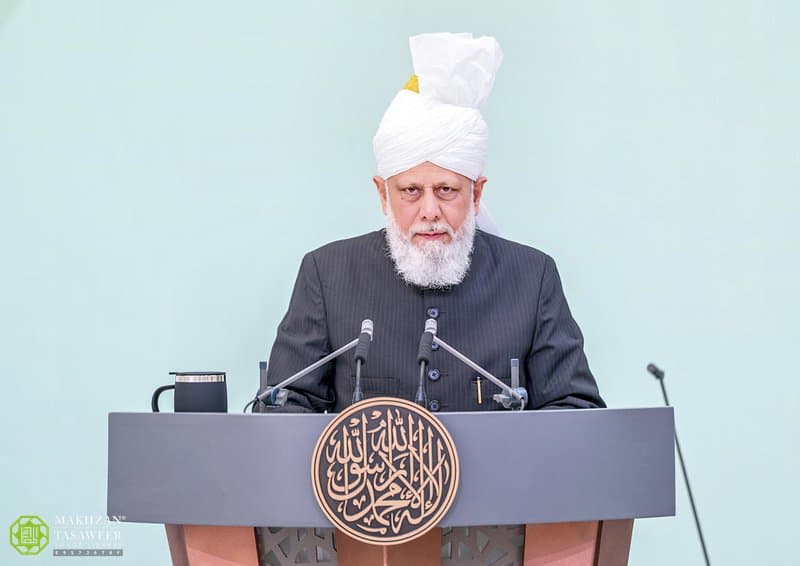
After reciting the tashahhud, ta‘awwuz and Surah al-Fatihah, Hazrat Khalifatul Masih V (aa) stated:
While recounting accounts in relation to the Promised Messiah’s (as) trust in Allah, Hazrat Mirza Bashir Ahmad Sahib (ra) writes: “Dr Mir Isma’il Sahib told me that in matters of medical treatment, the Promised Messiah (as) would never rely upon just one form of treatment. In fact, for the same illness, he would use allopathic medicine as well as administer Greco-Arabic medicine alongside it. If anyone would make a beneficial suggestion, he would act in accordance with that too. And if someone had learned of something through a dream, he would act upon that as well. (At times, certain holy people see remedies in dreams.) Alongside, he would supplicate and pray and at the same time, consult doctors and physicians and also seek assistance in treatment by referring to medical books. In short, he would turn treatment for an ailment into an extraordinary combination of different methods being utilised. However, his ultimate trust was in God.” (Siratul Mahdi, narration 906, Vol. 1, p. 786)
Explaining the difference between the anxiousness experienced by Prophets and that experienced by ordinary people; since people ask about those experiencing anxiousness, and why it occurs and whether it is a punishment or due to another reason; explaining this, he states:
“Although a person experiences feelings of anxiousness due to his human nature (it is natural for a person to feel anxious and distressed), he does so as this is a characteristic of human nature, which is shared by all Prophets as well. For example, the Holy Prophet (sa) felt anxious during the Battle of Badr. The difference between ordinary people and Prophets is that the anxiousness of Prophets is never accompanied by despair (i.e., despondency), as is the case with ordinary people. They have the firm conviction that God will never let them go to waste.”
The Promised Messiah (as) said, “My condition is such that even if I were cast into a blazing fire, I would still believe that I would not be destroyed. I would certainly feel anxious, because it is fire and it burns people. Nonetheless, I would believe that I would soon hear a voice:
یٰنَارُکُوْنِیْ بَرْدًا وَّسَلَامًا عَلٰی اِبْرَاھِیْمَ
“‘O fire, be thou cold and a means of safety for Abraham!’
“However, the distress of other people is accompanied by despair. (Those who do not have faith feel despair.) They do not have any faith in God, and this is disbelief.” (Malfuzat, 2022, Vol. 4, p. 271)
This is a state of disbelief. Thus, just as placing one’s trust in Allah, even in times of distress, is a distinguishing characteristic of the Prophets, a believer should also follow the example of the Prophets, particularly that of the Holy Prophet (sa) and not allow despair and despondency to come near him.
Even in times of distress, one should place his trust in Allah the Almighty. One should make use of means, supplicate fervently and then place his trust in Allah the Almighty. He also advised believers that it is their duty to maintain their trust in Allah the Almighty and not to fall into despair.
Hazrat Musleh-e-Maud (ra) relates: “Dozens of people among us are living witnesses to the fact that when Hazrat Khalifatul Masih I was writing his book Noor-ud-Deen, he wrote therein that the incident of Abraham (as) being cast into the fire refers to the fire of battle. He thought that surviving after being cast into an actual fire would be extremely difficult. Therefore, he interpreted the fire as the fire of battle. In those days, the Promised Messiah (as), used to go for walks in a village near Qadian called Basrama.”
Hazrat Musleh-e-Maud (ra) further relates:
“I remember that I was also present. While walking, someone remarked, ‘Huzoor, the senior Maulvi Sahib – meaning Hazrat Khalifatul Masih I (ra), Maulana Noor-ud-Deen Sahib – had expressed a very subtle point. People who are generally more inclined towards rational arguments greatly appreciate such matters.’
“However, throughout almost the entire journey, the Promised Messiah (as) continued to refute this point and said, ‘Convey to Maulvi Sahib on my behalf that he should remove this passage. We have received the revelation that “Fire is our servant and indeed, the servant of our servants.” Thus, if Allah the Exalted dealt with Abraham (as) in this manner, what is impossible about it?’
“He then said, ‘Is the plague any less than fire? Is this any less of a miracle in that the plague spread all around us, yet Allah the Almighty kept our home safe from it. Therefore, if Allah the Almighty saved Abraham (as) from the fire, then this indeed was the case. Convey to Maulvi Sahib on my behalf that he should remove this passage.’ Subsequently, Maulana Noor-ud-Deen Sahib (ra) removed that sentence.” (Khutbat-e-Mahmud, Vol. 19, p. 617; Daily Al Fazl Qadian, No. 209, Vol. 26, 10 September 1938, pp. 5-6)
This demonstrates the remarkable standard of his trust in Allah the Almighty. Once Allah had declared that He would save him from the fire, there was no question of not relying upon that promise or of lacking complete certainty. With absolute conviction, he said, “I say that fire will not burn me, because Allah the Exalted has declared it.”
Hazrat Mirza Bashir Ahmad Sahib (ra) writes that Munshi Zafar Ahmad Sahib of Kapurthala (ra) related:
“On one occasion, during the Jalsa Salana, funds had run out. In those days, no special contributions were collected for the Jalsa Salana; the Promised Messiah (as) bore the expenses himself. The late Mir Nasir Nawab Sahib came and submitted, ‘There is nothing available for the guests tonight.’
“The Promised Messiah (as) said, ‘Take some jewellery from my wife and sell or pawn whatever is sufficient.’ Accordingly, the jewellery was sold or pawned, and Mir Sahib brought the money and food was provided for the guests.
“After two days, Mir Sahib returned in the night, whilst I was also present there, and he informed that there was again nothing available for the following day. The Promised Messiah (as) replied, ‘We made arrangements in consideration of the apparent means available to us, but now we have no need to do so. The One Whose guests they are will Himself provide for them.’
“The next morning, at around eight or nine o’clock, when the postman arrived from the post office, the Promised Messiah (as) called Mir Sahib and me. The postman had brought approximately 10 to 15 money orders from various places – some for 100 rupees and others for 50 rupees. They stated, ‘We are unable to attend, so we are sending this money for the expenses of the guests.’
“After receiving these amounts, he spoke about trust in Allah. A few other people were also present where he was sitting. He said, ‘Just as a worldly person relies on the money kept in his chest, knowing that he can take it out whenever he wishes, those who place their trust in Allah the Almighty have an even greater certainty in Him. And this is indeed how it happens: whenever there is a need, God Almighty promptly sends what is required.’” (Siratul Mahdi, Vol. 2, narration 1124, pp. 97-98)
Whilst describing the Promised Messiah’s (as) trust in Allah the Almighty, and the way Allah the Exalted treated him, an assistant of his named Hazrat Hafiz Hamid Ali Sahib states:
“Mian Najmuddin Sahib Bherwi was among the administrators of the Langar Khana [communal kitchen]. On one occasion, Mian Najmuddin Sahib came to the Promised Messiah (as) and submitted that some money be granted for the needs of the Langar Khana, including the purchase of flour and other provisions.
“The Promised Messiah (as) replied, ‘At present, I have no money. The One Whose guests they are and for whom the Langar has been established, will Himself make the arrangements.’
“Mian Najmuddin Sahib then returned. Shortly afterwards, a man dressed in torn, worn-out clothes came to the Promised Messiah (as) and sent word inside. The Promised Messiah (as) came out and the man placed in his hand a bundle wrapped in cloth containing money, then departed.
“When the Promised Messiah (as) opened the cloth, he found that it contained a considerable sum of money. He tried to have the man called back and to find out who he was, but he could not be found. The Promised Messiah (as) then called Mian Najmuddin Sahib and gave him all the money.” (Daily Al Fazl Rabwah, Vol. 46-81, No. 214, 21 September 1996, p. 3)
Hazrat Khalifatul Masih I (ra) relates:
“Our Hazrat Sahib (as) used to say: ‘Some people are pleased with possessing wealth, others are happy that they have many children, and others are happy that they have a large following. But I am pleased by the fact that my God is the All-Powerful.’” (Haqaiqul Furqan, Vol. 2, p. 171)
The Promised Messiah (as) states:
“The true Provider is God Almighty. A person who puts his trust in Him, can never be deprived of provisions. A person who places trust in Him, God provides for him from every way and every place. God Almighty states that the one who relies on and trusts Him, He showers provisions upon him from the heavens and grows them from under his feet. Therefore, everyone must put their trust in God Almighty.” (Malfuzat, 2022, Vol. 9, pp. 240-241)
Hazrat Sheikh Yaqub Ali Irfani Sahib states that Hazrat Mirza Bashir-ud-Din Mahmud Ahmad (ra) stated, “The Promised Messiah (as), on 5 September 1898, after the Asr Prayer, narrated a story at my request. (At Hazrat Mirza Bashir-ud-Din Mahmud Ahmad’s [ra] request, who was still a child at the time.) The story was as follows.
“The story encapsulates that placing one’s trust and reliance upon Allah the Almighty, together with true righteousness, makes a person worthy of Allah Himself becoming his Guardian. He fulfils the person’s needs in such a manner that no one comes to know of it. (He narrated the story based on this topic). The Promised Messiah (as) narrated:
“‘A saintly man was once travelling somewhere and passed through a forest in which a thief lived. The thief would rob every traveller who passed through. In accordance with his habit, he also began to rob this saintly man. The saintly man stated:
وَ فِی السَّمَآءِ رِزْقُکُمْ وَمَا تُوْعَدُوْنَ
““Your sustenance is in heaven, and that which you are promised aside from this.” (The Holy Quran, 51:23)
“‘He then said to him, “Your sustenance is present in heaven. Place your trust in God, adopt righteousness and abandon stealing. Allah the Almighty Himself will fulfil your needs.” These words affected the thief’s heart, and he let the saintly man go. He acted upon his advice, so much so that he began receiving excellent meals served in dishes of gold and silver. After eating the food, he would throw the vessels outside his dwelling. By chance, the same saintly man passed that way again. The thief, who had now become a very virtuous and righteous person, related the entire account to him and asked him to recite another verse. The saintly man replied:
السَّمَآءِ وَالۡاَرۡضِ اِنَّہٗ لَحَقٌّ
“‘“This is the promise of the Lord of the Heavens and the Earth.” In other words, when these things are fulfilled, it becomes evident that the Quran is indeed the truth.
“‘Upon hearing these sacred words, the man, who had abandoned stealing and had turned towards piety, and was actually practising it, was so deeply affected that the greatness of Allah the Almighty was firmly established in his heart. He advanced further in righteousness and became anxious. (He became overwhelmed with anxiety and restlessness due to this realisation) and passed away in that very state. (He had attained such a deep understanding). Therefore, O dear one! You see the blessings bestowed by placing your trust in Allah the Almighty, and the wealth that comes from adopting righteousness. Reflect: God, Who is the Provider of the Heavens and the earth, can any doubt be maintained regarding Him? It is the Holy and True God alone Who nurtures and sustains all of you. Therefore, fear God alone, place your trust in Him and adopt righteousness.’” (Hayat-e-Ahmad, Vol. 1, pp. 242-243; Al Hakam, No. 26-27, Vol. 2, 6-13 September 1898, p. 11)
People generally say that young children do not understand profound matters. However, the Promised Messiah (as) narrated this story to Hazrat Mirza Bashir-ud-Din Mahmud Ahmad (ra) when the latter was only nine. Certainly, the Promised Messiah (as) would have related the story in a manner suited to Hazrat Mirza Bashir-ud-Din Mahmud Ahmad’s (ra) intelligence, knowing that the child would understand it. However, he would also have been cognizant of the importance of instilling in children, from an early age, the significance of placing their trust in God. Thus, these principles of moral training serve as guidance for all of us.
Hazrat Musleh-e-Maud (ra) says that the Promised Messiah (as) used to relate the story of a saintly man who sat in a corner offering sermons and counsel, and Allah the Almighty would deliver his sustenance to him right there. It was a place far outside the city where he lived. Once, several days passed and no food came. Perhaps this was a test from Allah the Almighty. He said, “Now I should go into the city and ask some friend for something, for many days have passed while I have remained hungry.” So he went and asked a friend to give him something to eat. The friend gave him two or three flatbreads with some curry poured over them. As he set off, the friend’s dog followed behind him, wagging its tail as it went. The saintly man reasoned that the dog too had a share in this bread, since it guards that house. He thought, “The owner of the house from whom I have brought this bread, this is his dog, and it has a right, because it keeps watch there; the house dog stands guard.” So he put a third of the curry on one flatbread which he had got from its owner and threw it to the dog, thinking it is the dog’s due right. The dog ate it and again followed behind. The saint thought, “Indeed, its right is greater, for it is the guardian of that house,” and putting another portion of curry on a flatbread, he threw it to the dog, but the dog, having eaten that too, followed him still. By now, the saint himself was gripped by severe hunger, and he said, “You are very shameless.” Now the saint is speaking to the dog: “I have given you two of my three flatbreads, and still you will not leave me alone.” No sooner had he said this than a vision came over him, and he forgot the condition of the world entirely. The dog’s spirit, taking on a personified form, appeared before him and said, “You call me shameless, when I am only a dog, and you are a human being. I have endured starvation for seven days at a stretch in that house, again and again, and never left that threshold, yet when you faced a mere three days of hunger, you left and came to the city. Tell me, who is the shameless one, I or you?” Hearing this, his eyes were opened, and he threw the third flatbread, along with its curry, before the dog as well. When he returned to his place, he found a man sitting with an elaborate meal, who said, “Where did you go? I have been waiting for you.”
Thus, the station of tawakkul [trust in God] is precisely this: that a person fix his gaze on none but Allah the Almighty. Yet, tawakkul does not mean, either, that those who seek Allah the Almighty are forbidden to make provision for themselves. Allah the Almighty has not forbidden this; means are to be utilised too. (Khutbat-e-Mahmud, Vol. 20, pp. 511-512)
Allah the Almighty’s dealing with each person is particular to him. With that saintly man, Allah the Almighty treated him in a particular manner and tested him in that way; but it is also true that means must be employed. In this matter too it is Allah the Almighty’s own command, and the Promised Messiah (as) has stated it in many places.
Hazrat Mufti Muhammad Sadiq Sahib relates that the Promised Messiah (as) used to say:
“In my opinion, the greatest idolaters are the alchemists. They roam around in vain searching for sustenance and do not take advantage of the means that Allah the Exalted has provided for its lawful attainment, nor do they put their trust in God Almighty, whereas He says:
وَ فِی السَّمَآءِ رِزْقُکُمْ وَمَا تُوْعَدُوْنَ
“‘And in the heavens is your sustenance and that which you are promised.’ (The Holy Quran, 51:23)
“I want to inform such avaricious people of an alchemy recipe, (that is, the so-called alchemists who claim to produce silver and gold from various different roots and shrubs). I want to inform them of an alchemy recipe on the condition that they act upon it.
“They go on practising alchemy in vain and have gained nothing. And so, the Promised Messiah (as) stated that he shall tell them a formula, and it will be effective too, provided they act upon it. The Promised Messiah (as) says:
God Almighty states:
وَ مَنْ یَّتَّقِ اللّٰہَ یَجْعَلْ لَّہٗ مَخْرَجًا وَّ یَرْزُقْہٗ مِنْ حَیْثُ لَا یَحْتَسِبُ
“‘And he who fears Allah – He will make for him a way out, and will provide for him from where he expects not.’ (The Holy Quran, 65:3-4)
“Thus, taqwa [righteousness] is such a quality that whoever attains this, it is as if they have attained all the bounties of the world. Remember that a righteous one is never dependent on anyone; rather, he is at such a station that whatever he desires, God provides it for him even before he even asks for it.”
The Promised Messiah (as) states:
“Once I saw Allah the Exalted in the form of a [human] manifestation in a vision. Putting His hand around my neck, He said: ‘If you will be devoted to Me, the whole world will be yours.’
“This is the formula that has been tried by all Prophets, Auliya’ [Saints] and the Righteous. The ignorant abandon this formula and wander aimlessly in search for roots and shrubs. If they had exerted the same effort in the search of the Creator of these roots and shrubs (i.e., the roots and shrubs are created by Allah the Almighty, and so if they strived to attain Him and taqwa), they would have achieved all their desired goals.” (Zikr-e-Habib, pp. 207-208)
Relating an incident of the Promised Messiah’s (as) trust in God, Hazrat Munshi Arora Khan Sahib writes:
“The Promised Messiah (as) went to Delhi. When departing, he wrote letters to certain special friends, saying that whichever friend received the letter should come to Delhi if they can, as a debate will be held with Maulvi Nazir Husain of Delhi. (A debate was to be held with Maulvi Nazir Husain). I too reached Delhi. There it became known that Maulvi Nazir Husain intended to create disorder. We mentioned this to Amir Ali Shah, who was, I believe, a police inspector, or some other official. He said, ‘We shall make excellent arrangements for peace. I shall send a sufficient number of police; do not worry, there is no such problem.’ In short, on the day the debate was to be held, Chaudhry Nawab Khan and I went to Amir Ali Shah, but he said, ‘I am sorry, we cannot make any arrangement. Maulvi Muhammad Husain Batalvi has submitted to the Deputy Commissioner Sahib Bahadur that clerics debate every day, and asked whether he would make such arrangements for such ordinary matters every day, sending large contingents of police.’ So the Deputy Commissioner said that no arrangement was necessary. The police inspector said, ‘We are helpless; we can do nothing.’ In this way, the conversation caused some delay. I said to Nawab Khan, ‘Come, it is time; the Promised Messiah (as) will not wait for us. Let us reach the venue of the debate on time.’ We hurried there and saw that the Promised Messiah (as) was boarding the carriage. It was submitted to him that there was no police arrangement, that is, not the arrangement they had wanted, though there was in fact a small number of police present. He said, ‘Why should I be concerned?’ The Promised Messiah (as) said, ‘What do I care? Our arrangements will be made by God. We shall certainly go; we cannot be stopped.’ He arrived there. With the Promised Messiah (as) were eleven men and one boy, and so in total there were only 12. On the other side, the opponents numbered in the thousands, and there was also the danger of disorder, yet not the slightest trace of fear or anxiety could be seen on the Promised Messiah’s (as) face. Like the brave, he walked into their midst. No mischief of any opponent succeeded. God protected the Promised Messiah (as) from the mischief of every mischief-maker.” (Qudratullah Sanori, Sirat-e-Ahmad, pp. 8-9)
The Promised Messiah (as) had complete trust and reliance in Allah the Almighty.
Hazrat Musleh-e-Maud (ra) states, “The duty of a believer is to place his trust in Allah the Almighty. It is Allah Who ultimately brings matters to fruition; nevertheless, our responsibility is to do, think and say only that which accords with what Allah has commanded.”
The Promised Messiah (as) made a prophecy concerning Atham, and Hazrat Musleh-e-Maud (ra) writes that when the appointed period of that prophecy came to an end, he was about six or seven years old and remembered the scenes vividly. Hazrat Musleh-e-Maud (ra) also described in considerable detail the rooms in which people were sitting, how the different rooms were being used at the time and how their use changed later. After recounting these details, he says:
“I remember very clearly that I was still a young child when the term fixed for the prophecy concerning Atham came to an end. It was probably towards the end of 1894 or the beginning of 1896. I was about five and a half or six years old at the time. I still remember those scenes. At the time, because of my young age, I did not understand what was happening; but now I understand from those incidents that on the final day of the period fixed in the prophecy when the 15 months were due to expire, there was tremendous agitation. People were weeping, crying aloud and praying, ‘O God, let Atham die.’ This was after Asr and before Maghrib. Then the time for prayer arrived. The Promised Messiah (as) led the prayer and afterwards sat down with those assembled. At that age I did not ordinarily sit in his gatherings, though from time to time I would join them. That day, I too sat there.
“The Promised Messiah (as) expressed displeasure at the way people had spent the day weeping in prayer. He said, ‘Can any human being possess greater sense of honour for the fulfilment of God’s word than God Himself? When God Almighty has said that this will happen, we should believe that it will certainly happen. And if we have misunderstood what Allah has said, (that is, if the words carry some other meaning than the one we have understood), then Allah cannot be bound to act according to our misunderstanding. Our duty is that once we have accepted someone to be truthful is to have faith in what he says. (Since you have accepted me as the Promised Messiah [as], then believe what I tell you. How Allah chooses to bring His decree to fulfilment is up to Him). Thus, it is a believer’s duty to trust in Allah. The decree of Allah must certainly be fulfilled.” (Khutbat-e-Mahmud, Vol. 30, pp. 109-110)
As to the manner in which it is fulfilled, Allah knows best.
Hazrat Mirza Bashir Ahmad Sahib (ra) relates that Munshi Zafar Ahmad Sahib once told him of an incident from the debate with Atham. On one occasion, Atham raised certain questions which caused some of the companions to become anxious, as they felt that it might be difficult to provide an immediate response. A number of them therefore gathered together and began consulting the Holy Quran and the Bible, hoping to collect references that might assist the Promised Messiah (as). Munshi Zafar Ahmad Sahib says that he jokingly remarked to Maulvi Abdul Karim Sahib, “Is prophethood now to be conducted through consultations? If the Promised Messiah (as) needs references, he will ask for them himself. Why is there any need for you to go and provide them?”
Just then, the Promised Messiah (as) arrived. After speaking for a short while, he was about to leave when the late Maulvi Abdul Karim Sahib stood and submitted, “There would be no harm in consulting about tomorrow’s answers.” In other words, to discuss how the questions might be answered and gather the relevant references. Upon this, the Promised Messiah (as) smiled and replied, “Your prayers are sufficient. Just pray, and that will be enough.” He then immediately departed. Commenting on this incident, Hazrat Mirza Bashir Ahmad Sahib (ra) writes, “Prophets consult others in many matters. Indeed, no one consults more than they do, but there are certain occasions when they prefer to set aside all other means and rely wholly upon the help of God. Consultation itself also has its proper time and place. When an intellectual objection is raised by an adversary, Prophets often place their reliance directly upon Divine assistance. On this occasion too, God brought humiliation upon the Christian opponents.” (Siratul Mahdi, Vol. 1, narration 515, p. 523)
Hazrat Musleh-e-Maud (ra) relates, “I have related this incident on many occasions, that when the Promised Messiah (as) had gone to the orchard due to revelations about earthquakes, one day he was speaking at home with Hazrat Amma Jan (ra) and mentioned that there was no money left at all. He said that he was considering borrowing from some friends. But then he added, ‘To go and ask people for a loan would also be contrary to placing one’s trust in Allah.’ He then went to the mosque for prayer. When he returned, he took out a small bundle and opened it.” Hazrat Musleh-e-Maud (ra) says: “I happened to be standing nearby when he took the small bundle out of his pocket and opened it. He said, ‘When I went out for prayer, a poor man dressed in worn and tattered clothes slipped this bundle into my pocket. Because it felt heavy, I assumed that it contained coins. But when I returned home and opened it, I found both rupees and banknotes inside.’ He then counted the money, and it amounted to approximately four or five hundred rupees. The Promised Messiah (as) said, ‘Had I taken a loan, it would have been contrary to having trust in Allah. When a need arose, Allah provided the money through a means that had never even occurred to me.’” (Khutbat-e-Mahmud, Vol. 30, p. 321)
Hazrat Musleh-e-Maud (ra) also relates that the Promised Messiah (as) would recount the story of a saint who was once asked about the commandment concerning Zakat. The saint replied, “There are two commandments concerning Zakat: one for you, and another for me. For you, the command is that out of every 40 rupees, you should give one rupee or one fortieth of your wealth. But for me, the command is that if I have 40 rupees, I should give 41.” The questioner asked, “Why this difference? Why should you give away the entire 40 rupees and then additionally one more rupee?” The saint replied, “Allah has placed me at the station of complete reliance upon Him, whereas He has placed you at the station of prudent planning. If you accumulate wealth, then your command is to give one rupee out of 40. But since I have been placed at the station of reliance upon God, if I ever accumulate forty rupees, I must give away 41, for I have not been given permission to hoard wealth and for having accumulated it I should pay an additional rupee as a penalty.” (Khutbat-e-Mahmud, Vol. 1, p. 465)
Hazrat Mirza Bashir Ahmad Sahib (ra) writes that the Promised Messiah (as) possessed complete trust in the support of the God Who had commissioned him. He knew that the plant which God Himself had planted could never be allowed to perish. Thus, on one occasion he wrote:
اے آنکہ سوئے من بِدَوِیْدِی بِصَد تَبَر
از باغباں بِتَرْسْ کِہ مَن شاخِ مُثْمِرَمْ
“O you who rush towards me with a hundred daggers in your fury,
“Fear the Heavenly Gardener, for I am a fruit-bearing branch planted by His own hand.”
The young men of the Ahmadiyya Muslim Jamaat, the amirs of local jamaats, the office-bearers of Ansarullah and Khuddam-ul-Ahmadiyya, and above all, the missionaries of the Jamaat and central workers should learn from the extraordinary patience, steadfastness, determination and trust in Allah displayed by the Promised Messiah (as). If they too remain patient and steadfast, live as true servants of God, and strive to make themselves fruitful trees, then Allah the Almighty will protect them in the same manner and will manifest His protective honour for them, just as He has always done for His righteous servants.” (Sirat-e-Tayyabah, pp. 96-97)
While mentioning the extraordinary trust in Allah of the Promised Messiah (as) and his affection for Hazrat Maulvi Noor-ud-Deen Sahib, i.e., Hazrat Khalifatul Masih I (ra), Hazrat Maulvi Abdul Karim Sahib Sialkoti writes in his book Sirat Masih-e-Maud (as):
“On one occasion, it so happened that, while the Promised Messiah (as) was writing the Arabic portion of his book Aina-e-Kamalat-e-Islam, Huzoor (as) gave Maulvi Sahib, Hazrat Maulvi Noor-ud-Deen Sahib (ra), a two-page sheet containing the manuscript of the book he was writing, with the instruction that it be delivered to me (i.e., Hazrat Maulvi Abdul Karim Sahib Sialkoti, who is narrating this account) so that I could translate it into Persian. The subject matter was such that Huzoor (as) took pride in its divinely bestowed eloquence and articulate expression, as Allah the Almighty had enabled him to expound upon a very sublime subject. However, Maulvi Sahib somehow lost these two pages. As the Promised Messiah (as) would send me the latest Arabic manuscript each day for translation into Persian, the unusual delay on this occasion naturally caused me concern. I mentioned to Maulvi Noor-ud-Deen Sahib (ra) that no material had arrived from Huzoor (as) that day, the copyist was waiting impatiently, and we were falling behind schedule. I did not know what had happened.”
Hazrat Maulvi Abdul Karim Sahib Sialkoti relates: “No sooner had these words left my mouth than Maulvi Noor-ud-Deen Sahib (ra) turned pale. The two-page sheet had been lost somewhere. He had searched for it extensively, but the manuscript could not be found, and Maulvi Sahib was extremely distressed. When the Promised Messiah (as) was informed of the matter, he came out as usual, cheerful and smiling. Far from becoming displeased or showing any sign of anxiety, he instead began apologising, saying that Maulvi Sahib had been needlessly distressed by the loss of the manuscript. He expressed deep regret that Maulvi Sahib had suffered such anguish. He said, ‘My faith is that Allah the Almighty, through His grace, will enable me to write something even better than the lost pages.’”
Hazrat Maulvi Abdul Karim Sahib writes: “On the one hand, this beautiful incident sheds particular light upon the extraordinary affection of the Promised Messiah (as) and on the other hand it sheds particular light on the exceptional trust in the support of his Heavenly Master. The mistake had been made by Hazrat Maulvi Noor-ud-Deen Sahib (ra), who had failed to safeguard a valuable manuscript and had lost it. Yet, such was the degree of affection shown by the Promised Messiah (as) that he himself became concerned and apologised, saying that Maulvi Sahib had been so distressed by the loss of the manuscript. His trust in Allah was such that, despite being pleased in the eloquence, fluency and profound merits of the subject matter he had written, he did not display any sort of attachment and dependency upon its loss, saying that there was no cause for concern, as Allah would enable him to produce something even better. This level of affection, trust in Allah and forbearance cannot be found in anyone other than the special servants of God Almighty.” (Sirat-e-Tayyabah, pp. 55-56)
The Promised Messiah (as) states:
“Allah the Exalted said in the Holy Quran about the Companions (ra) addressing the Holy Prophet, may peace and blessings of Allah be upon him:
“‘The God Who strengthened you with His help and with the believers put such affection in their hearts that even if you had spent all the earth’s treasures, you could not have created such love, but God created this affection in them. He is the Mighty and Wise God.’ (The Holy Quran, 8:63-64)”
The Promised Messiah (as) states:
“The God who did this before can do it even now, and we rely on Him for the future as well. The spirit of God’s grace is breathed into the work that is decreed to be done.
“Just as when a gardener irrigates his garden, it becomes fresh and verdant, in the same way, God Almighty bestows progress and rejuvenation upon the community of His Messengers. Sects formed only by human efforts suffer splits within days, just as the Brahmus flourished for a few days and then stopped, and are diminishing day by day because they were solely founded upon human intellect.
God Almighty has made great promises regarding my Jamaat. No human intellect, foresight, or worldly means can bring us to these promises. Allah the Exalted will provide all the means, and this work will be completed. Even if the number of members of my Jamaat reaches two or two and a half million, it is still nothing. Even the Sikhs number that many. I wish that the whole world be filled with this Jama‘at, and this is not man’s work. A man’s life may end at any moment – what can one individual do? Nevertheless, God can do all things.” (Malfuzat, 2022, Vol. 7, pp. 198-199)
Even if such a number were attained, there would be nothing in the number itself of which to feel proud. The real objective is that we convey the message to the world and bring the entire world under the banner of the Holy Prophet (sa). This cannot, in any case, be accomplished through human efforts alone. It will come about only through the grace of Allah, and the grace of Allah is attained through perfect faith in Him.
Hazrat Munshi Zafar Ahmad Sahib relates that, on one occasion, the late Maulvi Abdul Qadir Sahib asked the Promised Messiah (as), “Huzoor (as), sometimes specifies a time limit for the manifestation of a sign, stating that it will appear within a certain period, whether a year or six months. Do you do this under divine revelation, or have you been granted permission to specify whatever time limit you wish?”
The Promised Messiah (as) replied, “No. I have such certainty and complete trust in Allah the Almighty that, through prayer, I can supplicate to Allah the Almighty and have that sign manifested within the specified time.” (Rawayat Ashab-e-Ahmad, Vol. 1, p. 211)
This is what it means to place one’s trust in Allah and this is the confidence one must have in Him.
When Hazrat Mian Abdullah Sanori Sahib fell ill, the Promised Messiah (as) wrote the following letter to him. Alongside offering prayers and prescribing medicine, he counselled him to place his trust in Allah the Almighty. He wrote:
“I have received a very heartfelt letter from you. In reality, the grief and sorrow that are surrounding your heart from every direction constitute a great trial from Allah the Almighty. May God enable you to emerge from this trial as one who proves himself truthful in faith.
“Before writing this letter, I prayed fervently before God Almighty. If this is not a decree of destiny that is irrevocable and cannot be averted, then there is hope that the prayer will be accepted.
“You have not yet informed me of the nature of the illness.”
The Promised Messiah (as) asked for details regarding the illness. Was he suffering from diarrhoea? Has his body become lethargic and weak? What is the severity of the fever? How many days had he had the fever?
The Promised Messiah (as) further wrote:
“I am sending a prescription along with this letter. Begin taking the medicine without delay, and do not lose heart. Allah has power over all things.”
The Promised Messiah (as) further wrote:
“Two or three months ago, my son Mubarak Ahmad, who was very dear to his mother, passed away from a fever. When the time of his demise was approaching, I told his mother, ‘Look, this child is now about to pass away. Our belief is that the One Who is taking him away is dearer to us than the one who is departing. This is the very essence of perfect faith. Simply say:
اِنَّا لِلّٰہِ وَاِنَّا اِلَیْہِ رَاجِعُوْنَ
“[Surely, to Allah we belong and to Him shall we return.] He was a trust from Allah, and Allah has taken back His trust.’
“And so, at the time of the child’s demise, she responded in precisely this manner.
“It is evident that death is not an extraordinary occurrence when someone passes away. After all, we too are not destined to remain in this world forever. In the sight of Allah, true spiritual ranks are attained by those who endure difficulties of trials during this fleeting life. And when Allah the Almighty is pleased with someone, He compensates them in return.
“By no means should one adopt the ways of the common people. The course they have adopted is not the way one ought to follow. Exercise patience and supplicate to Allah the Almighty. In return, Allah the Almighty will once again bestow His blessings upon you.
“Allah sends trials upon those whom He loves exceedingly. Therefore, place your trust in Allah with the utmost steadfastness, never fall into despair regarding Him and continue to keep me informed of your condition.
“Wassalam.” (Maktubat-e-Ahmad, Vol. 3, Letter 777, p. 243)
According to Zikr-e-Habib, the Promised Messiah (as) made the following remarks to Hazrat Mufti Muhammad Sadiq Sahib after the latter had read out a letter from Mr Webb, whose full name was Alexander Russell Webb. The Promised Messiah (as) said:
“Write to him and tell him that his life has already passed by, and whatever he wishes to accomplish, he should do now. One’s physical faculties grow weaker with each passing day. Where are the faculties one possessed ten years ago? The past is gone, and there is no certainty about the future. Therefore, a person should make the most of the present moment and accomplish whatever he wishes to do while the opportunity remains.”
There was an Englishman to whom he wrote a letter, advising him to devote himself to the service of Islam. First, he should familiarise himself with Islam and ascertain what true Islam really is. He should learn about Islam and then dedicate himself to its service.
“A person who serves Islam through a life of simplicity and content with limited means becomes a miracle and a Sign of God. However, when someone undertakes this work with substantial resources and worldly support at his disposal, he does not experience the same spiritual delight, for the full pleasure of placing one’s trust in Allah is then not realised.
“When a task is undertaken with complete reliance upon Allah, He Himself grants help, and this comes about through spirituality. When spirituality develops within a person, it transforms his entire disposition.
“Consider how the Holy Prophet (sa) transformed his Companions. It was the spiritual attraction inherent in a truthful and righteous person that brought about this entire transformation.
“It is a false notion that a person must possess several hundred thousand rupees before any work can be accomplished. When a task is undertaken with trust in Allah, and its fundamental objective is to serve the faith, Allah Himself becomes the Helper. He provides all the necessary means and resources.
“Therefore, do not be anxious about financial limitations or any other such difficulties. Place your trust in Allah, proceed with your work, and render whatever service to Islam lies within your capacity.” (Hazrat Mufti Muhammad Sadiq, Zikr-e-Habib, pp. 261-262)
The Promised Messiah (as) states:
“The truth is that trust in God alone is the one thing that can make man succeed and achieve his goals. Allah the Exalted says:
مَنْ یَّتَوَکَّلْ عَلَی اللّٰہِ فَھُوَ حَسْبُہٗ
“(The Holy Quran, 65:4)
“Allah becomes sufficient for him who puts his trust in Allah the Exalted, provided he progresses in everything honestly with a sincere heart and with the true understanding of trust in God. And he should be patient and steadfast. He should not withdraw by becoming intimidated by adversities. This world is a temporary, transient place as is everything in it and so too are the affairs associated with it. Therefore, it is essential for man to grieve over it less and be more concerned about the Hereafter.
“If concern for religion comes to prevail over man, God Himself becomes the surety for his worldly affairs.”
May Allah the Almighty enable us to truly understand this point. The Promised Messiah (as) further states:
“It is a pity that great calamities are taking place every day and yet people pay no heed. They do not care. Even the disbelievers of Moses (as) were better in that they would at least become heedful when the chastisements would descend upon them, and would say that they would accept if only those calamities would abate. However, the disbelievers of today are even more diehard than they were, given that they are not perturbed even though ever-new calamities befall and the wrath of God descends in ever-newer forms.”
The Promised Messiah (as) then gave an example, stating:
“Just look at how lethal the attacks of this plague alone have been! How heart-wrenching the destruction that took place that one shivers in fear just listening to their accounts, and yet no one was moved. Those people would ask Moses (as) to pray for them in such a crisis, but these people say it is not much – such things do happen, and such calamities come all the time. It was the promise of God from yore that diverse calamities would visit in the Latter Days. Some would accept at that time, but most would perish. (The calamities that are befalling do not mean that everyone will accept the truth, for the promise was that some will accept the truth whilst many will perish). God does indeed show Signs, but only they benefit from Signs who are believers, and they are but a few.” (Malfuzat, 2022, Vol. 10, pp. 212-213)
May Allah the Almighty grant wisdom to the worldly people, enabling them to turn towards Him and to reform their worldly lives as well as their Hereafter. And may He increase the faith and certainty of those of us who have accepted the Promised Messiah (as). May He enable us to attain ever-higher standards of reliance upon Allah (tawakkul) alongside our prayers, and continue to progress in this.
(Official Urdu transcript published in the Daily Al Fazl International, 30 October 2026, pp. 1-8. Translated by The Review of Religions.)