
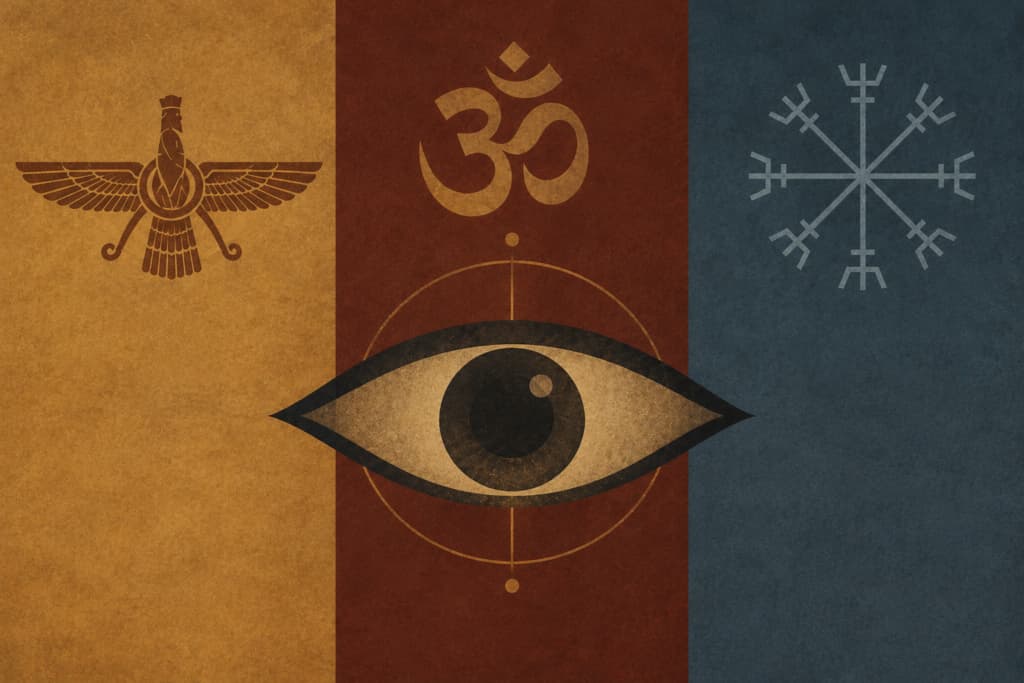
The Holy Prophet Muhammad, may peace and blessings of Allah be upon him, once stood before his Companions and declared that every prophet before him had warned his people against the Dajjal – the one-eyed liar, upon whose forehead is written the word kafir. (Sahih Bukhari, Hadith 3337; Sahih Muslim, Hadith 2933)
He went further, saying that between the creation of Adam and the coming of the Hour, no trial would be greater than this one. (Sahih Muslim, Hadith 2946)
If every nation truly received such a warning – and the Holy Quran insists on this principle, stating that “there was no nation but that there had passed within it a warner” (Surah Fatir, Ch. 35: V. 24) and that “for every nation is a messenger” (Surah Yunus, Ch. 10: V. 47) – then an intriguing question follows: Should we expect to find traces of this warning preserved, however faintly, in the surviving scriptures of other peoples?
This article sets out to answer that question – not as settled doctrine, but as a research direction I have been developing, built on a linguistic connection that appears to branch across Zoroastrian, Hindu and even Norse traditions and beyond.
One thing is confirmed, in all traditions there has always been a saviour figure in the latter days, Buddha, Krishna, Mahdi, Messiah, Saoshyant. Thus, we must be able to find its antithesis, the antichrist, the dajjal in other traditions too.
The Promised Messiah’s understanding of Dajjal
Any such investigation must begin with how Hazrat Mirza Ghulam Ahmad, the Promised Messiah and Imam Mahdi, on whom be peace, explained what the true meaning of the Dajjal was in the first place – because it is precisely this understanding that makes the comparative possible.
In mainstream Sunni thought, the Dajjal is generally awaited as a single individual, a physical antichrist figure. The Promised Messiah (as) instead read the ahadith as describing a collective force. Writing in Izala-e-Auham, he wrote:
“[…] The Dajjal is none other than the Christian clergy […] they are called Dajjal because of their great deceptions [dajl]” and elsewhere that the Dajjal “is the group of the European nations who have emerged with great power and have spread over the whole world”. (Ruhani Khazain, Vol. 3, pp. 370-473)
In Haqiqatul-Wahi, he interpreted the Dajjal’s strange “donkey” – the beast that moves like the wind and eats fire – mentioned in the hadith, as a prophecy of the railway and the steamship, and read the Dajjal’s blindness in one eye as spiritual blindness paired with an unmatched sharpness in worldly, material knowledge. (Ibid., Vol. 22, p. 41)
In Kitab-ul-Bariyyah, he sharpened the picture further, describing the Dajjal as having “two jaws” – Christian missionaries and European philosophers – with which it “devours people’s faith like a python”, ensnaring the ordinary and the intellectual alike. (Ibid., Vol. 13, pp. 252-253)
And in Anjam-e-Atham, the Promised Messiah (as) identified the “greatest Dajjal” specifically as the group that deifies a mere human being – the Christian clergy who attribute divinity and salvation to the cross. (Ibid., Vol. 11, pp. 46-48)
What matters for our purposes is this: once Dajjal is understood not as one man but as a universal, ideological force of deception opposed to divine truth, it stops being a concept unique to the Islamic tradition and starts looking like something other scriptures might independently describe under a different name. This is what the Holy Prophet (sa) told us, that every prophet warned about the Dajjal.
Zoroaster, Avesta and Druj
Zoroaster (also called Zarathustra) was a prophet of ancient Iran, traditionally placed by scholars anywhere between roughly 1500 and 600 BCE. He is regarded as the founder of Zoroastrianism – one of the oldest continuously practised religions in the world.
Zoroastrianism taught a stark moral universe: a spirit of truth and light locked in struggle against a spirit of falsehood and darkness, with every human being called to choose a side through their thoughts, words and deeds.
The faith was the dominant religion of the Persian Empire for well over a thousand years, before the spread of Islam gradually reduced its numbers; small Zoroastrian communities survive in Iran today, alongside the larger Parsi community descended from Zoroastrian refugees who settled in India.
The scripture of Zoroastrianism is called the Avesta, written in Avestan – an ancient Iranian language belonging to the same branch of the broad Indo-Iranian family that also produced Sanskrit. Within the Avesta, the oldest and most sacred section is a set of hymns called the Gathas, which scholars and Zoroastrians alike regard as the actual words of Zoroaster himself, as opposed to later material added by generations of priests. It is in these earliest hymns – not later commentary – that we find the concept at the centre of this article: Druj.
Many languages, including Hindi, Urdu, Latin, Greek and the Germanic languages, belong to the Indo-European language family. Linguists believe these languages developed from a common ancestral language known as Proto-Indo-European (PIE). Although no written records of PIE survive, scholars have reconstructed aspects of the language by comparing similarities in vocabulary, grammar and sound patterns across its descendant languages.
Same word, same meaning
In the Gathas, Druj is described as nothing less than a cosmic force of falsehood, standing in direct opposition to Asha, or “truth”.
In the Avesta, Yasna 30.3, part of the famous “Choice of the Spirits”, describes two primal spirits – one good, one bad – between whom “the wise have rightly chosen Asha [the truth], not so the foolish, who follow the Druj [the lie].”
Yasna 31.1 speaks of those who “through the commands of the Druj, destroy the world of Asha” while Yasna 32.3-5 condemns the Daevas (demons) as “the seed of Druj […] and of arrogance”, who have “defrauded mankind of the Good Life and Immortality.”
What is striking here is not just the concept but the word itself. According to Encyclopedia Iranica, Druj, in Avestan, means “falsehood”, “deceit”, “lie”, or “illusory/deceptive order.”
Dajjal, in Arabic, comes from a root that means the same thing. Arabic, like other Semitic languages, builds almost all its vocabulary from three-letter ‘roots’, each carrying a core meaning, around which different words are formed by changing the vowels and patterns.
The word Dajjal (الدجّال) derives from the Arabic root d-j-l (د-ج-ل), associated with the verb dajala. In Lisan al-Arab, the renowned Arabic lexicon compiled by Ibn Manzur, it is stated: “It is said: ‘Dajala’ when he lied, deceived and deliberately confused/falsified reality”.
Therefore, before any theory of historical connection even comes into it: Druj and Dajjal already mean the same thing.
The idea explored in this article is that these similarities may be more than coincidence: they may reflect a single original warning, conveyed by God through His prophets across different times and regions of the world, as suggested by the hadith cited at the beginning of this article.
Geographically, Avestan was spoken in ancient Iran – and of all the many branches of the Indo-European language family, which today stretches from Iceland to India, Avestan is the one whose homeland sat closest to the Arabian Peninsula. That proximity makes an ancient connection between the two languages of Arabic and Avestan far more plausible than it would be for, say, Old Norse or Sanskrit in isolation.
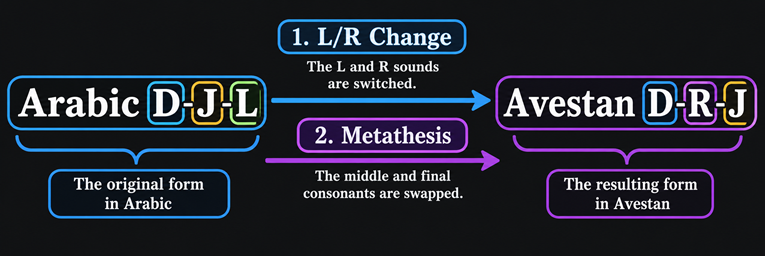
Under the principle pioneered by the Promised Messiahas in his book Minan-ur-Rahman – foundational to this idea – that Arabic is the umm al-Lughat, the Mother of languages, the Arabic root d-j-l would be the original, undecayed source, with Druj representing a later variant, reshaped by two processes well documented in historical linguistics: metathesis, where the order of consonants shifts as a word passes between languages, and the common l–r interchange found across language families. Apply both to the root of Dajjal, and what emerges is remarkably close to Druj.
Below is a simplified visualisation:
The most fascinating and exciting implication of this theory is that chain does not stop there. Persian – and, through it, Urdu – preserves an almost identical word to this day: دروغ (drogh), meaning simply “a lie.” Any Urdu speaker who has come across the word darogh goدروغ گو, “liar” in poetry or literature has already met a direct descendant of the very same Avestan Druj, carried down through Persian into a language spoken and understood by hundreds of millions of Muslims today.
Sanskrit preserves a near-identical word as well – druh – carrying, again, the very same meaning. So we have four language branches – Semitic, Iranian, Indo-Aryan, and, through Persian, South Asian vernaculars – all converging on one root and one meaning: the lie, and subsequently warnings of the very same Dajjal in other cultures, languages and traditions.
A shared antidote: The word against the lie
If Druj and Dajjal are one and the same warning, we might expect the divinley prescribed defence against each to be similar as well; and they are.
The Holy Prophet Muhammad, may peace and blessings of Allah be upon him, taught that whoever memorises the first ten verses of Surah al-Kahf will be protected from the trial of the Dajjal. (Sahih Muslim, Hadith 809a)
The Zoroastrian tradition preserves something strikingly parallel. In the Vendidad (Fargard 18), the divine guardian Sraosha interrogates the Druj, personified as a demoness, directly, asking who is capable of killing her. Her answer, recorded in Vendidad 18:43, is that the one who recites the Ahuna Vairya – the Yatha Ahu Vairyo prayer – without interruption “smites me with the best smiting […] kills me with the best killing.” She confesses that if the prayer is recited four times, it destroys the “pregnancy” of her evil designs.
In both traditions, the Great Deceiver is defeated not by force but by sacred recitation – the Quranic dhikr on one side, the Zoroastrian Manthra on the other. Both traditions insist that Druj/Dajjal is, at root, an ideological and spiritual threat rather than a physical one, which aligns precisely with Hazrat Mirza Ghulam Ahmad’s (as) description of clergy and philosophers who “devour people’s faith” through argument and influence rather than the sword.
The serpent with three heads
The Avesta does not leave Druj as an abstraction. It embodies her in the figure of Aži Dahāka, a three-mouthed, three-headed, six-eyed serpent. Yasht 5.34 calls him “the most mighty Druj […] created against the material world, for the destruction of the creatures of Asha”, while Yasna 9.8 repeats the same three-headed description, naming him “that most powerful follower of the Lie.”
Notably, Aži itself is simply the Avestan word for “serpent”, a word we will meet again, in almost identical form, in Sanskrit.
The parallel to the Promised Messiah’s (as) own language is difficult to overlook. Where he described the Dajjal as having two jaws – clergy and philosophers – swallowing faith “like a python”, the Avesta gives us an actual serpent of deception. And I theorise that the number of heads is not incidental. Hazrat Mirza Ghulam Ahmad (as) identified the “greatest Dajjal” specifically as the group that “deifies a mere human being” and attributes salvation to the cross – a direct reference to the defining Christian doctrine of the Trinity, God conceived as three-in-one. A three-headed serpent is, in effect, a mythological image of exactly this kind of threefold deification.
It truly makes one wonder. The very features of the Promised Messiah’s (as) interpretation: a python, a trinity, the greatest force of deception, all appearing independently in a Persian scripture as Aži Dahāka, the physical form of the Lie itself. Paired with the hadith at the start of this article, the case for this theory becomes hard to ignore.
Additionally, Islamic tradition holds that the Dajjal is presently confined, awaiting permission to emerge and roam the earth for forty days, sparing only Mecca and Madinah. (Sahih Muslim, Hadith 7028)
Later Zoroastrian cosmological texts describe an almost identical fate for Aži Dahāka. The Bundahishn (29.9) records that the hero Thraetaona was unable to kill the serpent outright, and so “bound him on Mount Damavand”, where he remains until “the end of the world”, at which point he “will be released from those bonds, and will again rise against the world.”
The Zand-i Vohuman Yasht (9.1-5) elaborates on this final release, describing Aži Dahāka breaking free to “swallow a third of mankind” and corrupt water, fire and vegetation, before the hero Keresaspa is resurrected specifically to strike him down. What is even more astonishing is that Christianity is in fact estimated to be the religion of a third of mankind today.
A deceiver chained and awaiting a permitted release, a period of catastrophic devastation and a promised saviour raised specifically to end him – the eschatological shape is the same in Islam, even where the names may differ entirely.
Echoes in the Vedas
The pattern does not end in Persia. The Rigveda of the Hindus of India preserves the very same concept – and, remarkably, close to the very same word – as Druh: deceit, harm, malevolence, standing in direct opposition to Rta, truth and cosmic order, in exactly the relationship Druj bears to Asha in the Avesta.
Rigveda 7.75.1 speaks of dispelling “the Druh [falsehood/malevolence], the hated darkness.” Druj, Druh and in Persian and in Urdu drogh are, in effect, one word tracked across three related languages, all landing on “the lie” and Dajjal is the same word again, one branch further back.
The serpent who embodies this Druh in the Rigveda is Vritra, “the Enveloper”, given the title Ahi. This is not merely a similar-sounding word to the Avestan Aži used for Aži Dahāka – it is the same word, inherited into Sanskrit and Avestan separately from their shared Indo-Iranian ancestor, both simply meaning “serpent.” Two entirely separate scriptures, then, use literally the same word to describe literally the same three-headed embodiment of the Lie. Rigveda 1.32.1-2 recounts how Indra “slew the Ahi (Serpent) […] lying on the mountain”, releasing the waters it had blocked.
The three-headed motif reappears explicitly, too, in the Vedic figure Viśvarupa, also called Triśiras – “the Three-Headed” – a being of deceit created in direct opposition to divine order, again inviting the same association with the threefold deification named as the mark of the greatest Dajjal.
And the hero who ultimately defeats the serpent carries a name that is not merely similar but linguistically identical across the two traditions: the Avestan Thraetaona and the Vedic Trita Aptya both derive from a root meaning simply “the Third.”
Whatever this figure represented to the earliest Indo-Iranian peoples, it survived, virtually unchanged, on both sides of the eventual Iranian-Indian religious divide.
Traces beyond Persia and India: Germanic and Norse tradition
The linguistic chain runs further still, into Germanic and Norse tradition. Druj, Druh and drogh all descend, most historical linguists agree, from a reconstructed root – dhreugh – meaning “to deceive” or “to harm through trickery.”
The same root surfaces, more distantly but still recognisably, in German betrügen (to cheat), and in Old Norse draugaz, |phantom” – the direct ancestor of Draugr.
A draugr, in Norse belief, is a specific kind of deception: a body that looks entirely human, walks and speaks, and yet is not truly alive – “an imitation of life”, as scholars of Norse religion describe it.
This is worth pausing on, because Islamic tradition describes something startlingly similar as one of the Dajjal’s own tricks. According to a hadith recorded in Sunan Ibn Majah, part of the Dajjal’s trial will be that he says to a Bedouin: “‘What do you think, if I resurrect your father and mother for you, will you bear witness that I am your Lord?’ The man agrees, and two devils then appear to him in the exact form of his dead father and mother, urging him: ‘O my son, follow him, for he is your Lord’”. (Sunan Ibn Majah, Hadith no. 4077)
Strip away the names, and the mechanism is identical: something that looks and speaks exactly like a person who has died, brought back not truly alive but as an imitation of life, deployed specifically to deceive the living into following a falsehood. The Dajjal’s counterfeit resurrection and the Norse draugr are, functionally, the same trick – described independently on opposite ends of the old Indo-European world.
One warning, many tongues
There are other candidates still to be examined properly, even those that may not be linked to the PIE root of deception – Apep, the serpent of chaos in Egyptian mythology, and Mara, the tempter of Buddhist tradition, among them – these all well could be indications towards the same Dajjal but need further research.
Taken individually, any one of these parallels might be dismissed. A shared root meaning “the lie.” A shared method of defeat through sacred recitation. A shared serpent, described in literally cognate words, with literally the same number of heads, tied to the same doctrine of threefold deification, described to be the greatest force of the same decption. A shared eschatology of chains and a promised release. A shared trick of false resurrection, performed by something that walks and speaks but is not truly alive. Coincidence, perhaps – but piled one on top of another like this, the word “coincidence” starts to carry more weight than one can comfortably bear.
What remains, at the very least, is a case worth taking seriously: that a warning given, according to the Holy Quran and ahadith, to every nation on earth, may not have vanished from most of them at all. It may simply have been waiting, in a word here and a myth there, to be recognised for what it always was: Dajjal.