
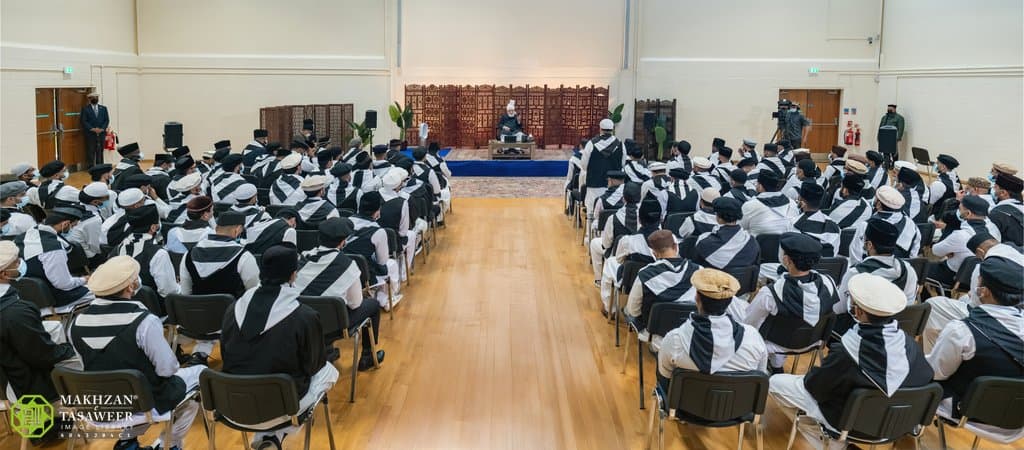
Islamabad, Tilford, UK, 18 April 2026: Students from Majlis Khuddam-ul-Ahmadiyya Germany were blessed with a mulaqat with Hazrat Mirza Masroor Ahmad, Khalifatul Masih V (aa).
During the mulaqat, the students had the opportunity to seek guidance from Huzoor (aa) on matters relating to military service, global conflict, hijrah, preaching in Europe, Wasiyyat, the tarbiyat of children, spiritual decline, education, career choices and trust in Allah.
Compulsory military service, loyalty to one’s country and the reality of modern wars
A question was asked regarding what khuddam should do if, in a state of war, a government compels men to defend the country, even though such wars may be the result of the government’s own past mistakes.
Huzoor (aa) explained that as long as a person lives in a country, loyalty to that country and obedience to its laws require that, if military service is compulsory, one should take part in it. If a person cannot do so, then the other option is to leave the country. Huzoor (aa) said that these are the two possible courses in such circumstances.
Huzoor (aa) then spoke about the nature of wars taking place in the world today. He said that such wars are not being fought for any noble purpose but are generally driven by greed, the desire to seize the resources of others or the wish to keep other nations suppressed. He referred to policies of powerful countries and regional powers and mentioned how territorial ambitions and the desire to control oil, uranium and other resources have fuelled conflicts. Huzoor (aa) said:
“This is the policy of America; this is the policy of Israel. The Israelis seek to expand their territories. For instance, they have occupied a large area of Lebanon and now they say that even if there is a ceasefire, they will not relinquish it. Similarly, there are other regions such as the Golan Heights and areas in Syria and Jordan that have been occupied. All of this stems from greed, which is the root cause of these wars. And as for Mr Trump in America, he seeks control over Iran’s resources – its uranium and oil. His stance is essentially: ‘Let us have these resources and then do as you wish.’”
Huzoor (aa) also referred to wars and unrest in various Muslim and African countries, observing that vested interests and the desire to control resources lie behind many of these conflicts.
Huzoor (aa) said that the Holy Quran teaches that one should not look greedily at the resources and wealth of others. (Surah al-Hijr, Ch.15: V.89)
He explained that where one lives in such countries, one must either fulfil the legal obligations of that country or leave. At the same time, Ahmadis should try to make people understand that such wars bring no benefit and only lead the world towards destruction.
Huzoor (aa) said that the First World War and the Second World War also demonstrated this reality and that in the present age, too, there is a severe lack of justice.
Tahrik-e-Jadid, Wasiyyat and the establishment of a new order
A question was then asked about the new order mentioned by Hazrat Musleh-e-Maud (ra) and whether the system connected with Wasiyyat and Tahrik-e-Jadid would begin after a future war.
Huzoor (aa) explained that Nizam-e-Nau refers to a new economic and social order for the world in which systems such as capitalism, socialism and other economic structures have been discussed. He said that Tahrik-e-Jadid was described as a precursor to the system of Wasiyyat, as it develops the habit of sacrifice among members of the Jamaat. Through smaller financial sacrifices, members become accustomed to giving in the way of Allah and this then creates within them a desire and readiness for the greater sacrifice required under the system of Wasiyyat.
Huzoor (aa) said that in Tahrik-e-Jadid, the financial sacrifice is comparatively small, whereas under Wasiyyat, a person may give a larger portion of their income and property, up to one-third. He explained that smaller sacrifices prepare a person for larger sacrifices and cultivate the spirit needed to take part in the wider system.
Huzoor (aa) further said that the system of Wasiyyat is a vast and strong system. It is not merely a financial arrangement; rather, it is a system that cares for widows and orphans, supports the propagation of Islam and enables service to humanity. Through its financial system, the arrangements for tabligh, literature, missionaries, schools, hospitals and other humanitarian projects can be strengthened.
Huzoor (aa) said that the question was not whether this system would begin before or after a war. He reminded the youth that he had been urging members for many years to enter the system of Wasiyyat, even when people did not necessarily see the possibility of major wars, though he had repeatedly warned that wars could take place. The matter, therefore, is not tied to war itself, but to the level of one’s faith.
Huzoor (aa) explained that if a person has accepted the Promised Messiah (as) in order to fulfil his mission, then they must understand what that mission was: to bring people closer to Allah and to fulfil the rights of His creation. The system of Wasiyyat serves both purposes. The more faith increases among Ahmadis, the sooner this system will become established in practice. He added that if the world is broken after war and this system is established, then those who survive and possess resources will be able to come under this system and help reconstruct the world.
Hijrah, religious freedom and the purpose for which Ahmadis left their homelands
Another student asked, from the Islamic point of view, when it becomes permissible for a racial, religious or ideological group to separate from an existing state [through migration].
Huzoor (aa) replied that the example before Muslims is that of the Holy Prophet (sa). He said that the Holy Prophet (sa) remained in Mecca for 13 years and endured severe persecution. The disbelievers of Mecca opposed Muslims religiously and their social and racial standards were extremely low, including the exploitation of slaves. There was also a vast ideological difference between the Muslims, who believed in the One God and the Meccans, who worshipped idols.
Despite all this, the Holy Prophet (sa) did not wage war against them in Mecca. Earlier, he had permitted some Muslims to migrate to Abyssinia, but he himself did not migrate until Allah commanded him to do so. When Allah’s command came, he migrated.
Huzoor (aa) said that in the case of a Prophet, Allah directly informs him when the time for migration has come. For others, one has to assess when circumstances have become such that migration is necessary in order to live in peace, free from racial discrimination and with religious freedom.
Huzoor (aa) then applied this to Ahmadis who migrated from Pakistan. He said that they migrated because they lacked religious freedom: they could not give the azan, say salam, recite the kalimah, call themselves Muslims freely or offer prayers without restrictions. For this reason, many migrated to Europe, America and other countries. However, Huzoor (aa) observed that after arriving in the West, many forgot the very purpose for which they had migrated and became absorbed in worldliness. They forgot Allah and His Messenger (sa) and only worldly pursuits remained before them.
Huzoor (aa) said that before expecting Allah’s help, such people should ask themselves whether they had fulfilled the purpose for which they migrated. Those who do fulfil that purpose and remain attached to Allah are rewarded by Him.
Huzoor (aa) explained that hijrah becomes justified when restrictions on religious freedom become severe. He also referred to the Quranic principle that those who are unable to migrate due to a genuine lack of means or closed routes are treated differently by Allah; but where people have the ability and resources to migrate in order to preserve religious freedom, they should do so. (Surah an-Nisa, Ch.4: V.99-101)
Turning to the current global situation, Huzoor (aa) said that the world today is filled with disorder. The Quranic description that corruption has appeared on land and sea applies to the state of the world. (Surah ar-Rum, Ch.30: V.42) In such conditions, he said, the duty of an Ahmadi is to become a person of courage and effort and to bring the world towards Allah with zeal. Since many have already migrated for religious freedom, they should now fulfil the purpose of that migration by working for a spiritual revolution.
Huzoor (aa) said:
“These are, however, secular states that claim to provide religious freedom – for now. But they will only allow that freedom as long as their own interests are not affected. When those interests are impacted, you will face similar treatment here as well. Then you will say, ‘Let us go to Africa or to some other country or to the Far East.’ When such difficult conditions arise, Allah the Almighty says that you should migrate. But then you have to see where in the world you can go. Everywhere there is disorder – ‘corruption has spread on land and sea.’ In such conditions, the duty of an Ahmadi is to stand firm like a person of resolve and, with passion, bring the world closer to God and bring about a transformation in the world, rather than saying we should migrate. All countries are now alike in this regard. There is no purely Islamic country, no purely Christian country, neither in Europe, nor in Africa, nor in America. Where will you go? This is the world we have and we must live in it and adjust within it. So now our task is to bring the world closer to Allah. You have already migrated for that purpose, so fulfil the purpose of that migration. Even now, you can do something.”
Speaking about Palestine with wisdom and working at the grassroots level
A question was asked about the difficulty faced in Germany when discussing the Israel-Palestine war. It was mentioned that politicians and the media often avoid criticism of the Israeli government due to fear of being labelled antisemitic and that critics are often dismissed under that label. The student asked how Ahmadis should convey the message of justice in such an atmosphere.
Huzoor (aa) advised that wisdom requires explaining to the world that what has happened in Palestine is oppression and has nothing to do with antisemitism. He said that references should be sought from those Jews themselves who have spoken against the injustices being committed. He mentioned that there are Jews in America, Europe and even within Israel who openly acknowledge the wrongs that have been done. Such references should be collected and presented so that the point is made through the words of those whom the audience will be more likely to accept.
Huzoor (aa) explained that this is a method of tabligh and public engagement. If Ahmadis simply say that this is what the Holy Quran says, people who do not accept the Quran or Islam may reject it. Therefore, in such circumstances, one should show them the statements of their own people and ask them to reflect on what solution should be adopted.
Huzoor (aa) instructed that efforts should be made in this regard. The youth should read the news, follow relevant material and collect references. He suggested that a social media cell should be established to gather comments and statements from prominent worldly figures and commentators regarding Palestine, Israel, Europe and America. This material could then be used effectively, presenting the words of their own people rather than merely stating what Ahmadis themselves say.
Huzoor (aa) further said that it is not the case that the German people are unaware. Whatever politicians or the chancellor may say, there are many among the German public who speak openly against the Israeli government’s actions and do not fear being labelled antisemitic. Therefore, Ahmadis should go to the public. Huzoor (aa) said that they are not going to convert the chancellor; rather, they should move the masses. When public opinion shifts, change will come of its own accord. He therefore advised the students to work at the grassroots level.
The tarbiyat of children begins with self-reform
A question was asked regarding which aspects should be given special attention in the tarbiyat of children in view of the present world situation.
Huzoor (aa) asked what attention would have been given under normal circumstances. When the questioner mentioned prayer, belief in Allah and studying Islam, Huzoor (aa) said that acting upon the teachings of Islam remains the same in all circumstances.
He explained that the Promised Messiah (as) had stated two great purposes: bringing people closer to Allah and fulfilling the rights of His creation. These are the two objectives upon which the tarbiyat of children should be based.
Huzoor (aa) emphasised that such tarbiyat cannot take place until parents and elders reform their own conduct. If a person quarrels with his wife, relatives or brothers, commits fraud, evades taxes or acts dishonestly, then he cannot properly train his children. He said that if parents reform themselves, the training of their children will also begin to take place naturally.
Huzoor (aa) said that the two essential purposes are attachment to Allah and His Messenger (sa) and the fulfilment of the rights of people. If this tarbiyat is placed firmly in the minds of children, then high moral qualities will also be produced. He referred to a sermon of Hazrat Khalifatul Masih IV (rh) about five fundamental morals and said that all of these are included within the broad and concise principles stated by the Promised Messiah (as). (Friday sermon [Translation], 24 November 1989, The Review of Religions, Vol. LXXXV, No. 1, January 1990, pp. 3-10)
The greatest spiritual disease is forgetting Allah
A student asked what, in Huzoor’s (aa) view, was the most dangerous spiritual disease among today’s youth and what remedy he would prescribe for protection from it.
Huzoor (aa) explained that the worst decline and moral condition existed in the time before the advent of the Holy Prophet (sa), when shirk had spread everywhere, including among Christians and Jews. The Holy Prophet (sa) came with Divine teaching. Thereafter, according to his prophecy, a period of decline came after the first centuries of Islam and then the Promised Messiah (as) was to appear. When the Promised Messiah (as) came, he too said that the world had again fallen into severe decline.
Huzoor (aa) said that the answer to the question lay in the points already being discussed: people have forgotten Allah and forgotten the rights due to His creation. When Allah is forgotten, spiritual disease increases; and when spiritual disease increases, moral decline follows. As a result, fraud, theft, lies and other immoralities spread.
Huzoor (aa) urged the youth to assess themselves. He asked whether they offer all five daily prayers and whether those prayers are offered merely in a hurried manner or with genuine supplication in ruku‘ and sajdah. “Do you also offer two nawafil in addition to the obligatory prayers? Fine, if you do not wish to offer voluntary prayers, do you at least fulfil the obligatory ones properly?” Huzoor (aa) referred to the hadith in which a man came to the Holy Prophet (sa) and asked about the obligations. When the man said he would do no more than the obligations, the Holy Prophet (sa) said that if he fulfilled even those obligations properly, he would enter Paradise. (Sahih al-Bukhari, Kitab az-zakat, Hadith 1397)
Huzoor (aa) said that students should first examine whether they wake for Fajr on time and offer Zuhr, Asr, Maghrib and Isha properly. The five daily prayers create discipline in a person’s life. Once discipline is established, attention turns towards Allah and towards fulfilling the rights of people. This improves spirituality.
Huzoor (aa) explained that people in today’s world have moved away from religion and from God because there is no longer any fear of Allah. An Ahmadi should always keep in mind that Allah is watching. Huzoor (aa) said:
“The greatest system of discipline in Islam is this: that you offer the five daily prayers. When a person becomes disciplined, attention is developed within him towards God and also towards the rights of fellow beings. Spirituality also improves. And for those in the world today who are far from religion and far from God, it is because no fear remains. There is no fear. […] If one realises that God is watching us, a person would not commit those evils.”
Huzoor (aa) compared this to how people avoid doing wrong when CCTV cameras are present, fearing that their actions may be recorded and seen. Huzoor (aa) said that Allah’s knowledge and observation are not limited like a camera fixed at one angle; Allah is watching from every angle at all times. If a person keeps this thought firmly in mind, spiritual diseases will not take root.
Huzoor (aa) said that many moral evils have become widespread, including drinking, fornication, immoral relationships, wrong friendships, theft and other forms of corruption. These exist not only in Western countries but also in countries such as Pakistan and other Muslim countries. If people truly believe that Allah is watching them, they will avoid such evils. Huzoor (aa) said that this is the remedy.
Students should excel and prepare to help rebuild the world
A question referred to Huzoor’s (aa) guidance that the world has already entered the era of a Third World War and that it may reach its peak in a couple of years. The student asked what effect this would have on students and what advice Huzoor (aa) would give.
Huzoor (aa) advised students to excel in whichever field they are pursuing and to strive to reach the highest level. He said that as the world suffers destruction, students will need to think about how they can help reconstruct it.
Huzoor (aa) said that students should focus on their studies. One effect of war may be that, after students graduate, job opportunities become much scarcer. In such circumstances, they will have to explore different means of livelihood. They may have to enter business, trade or innovate their own forms of employment. He said that they should think about how to create self-generated opportunities and how to progress despite difficult circumstances.
Huzoor (aa) added that not every place will necessarily be affected in the same way. Those who survive will then need to work for the progress of the world. Before that, however, Ahmadis must convey the message to the world.
Prayer, fear of Allah and avoiding harmful media protect faith in educational environments
A student asked how faith could be strengthened in schools and universities during an age of fitan [pl. of fitnah; i.e., strife or tribulations]. When Huzoor (aa) asked what kind of fitan were meant, the student referred to mixed gatherings and the environment of boys and girls studying together.
Huzoor (aa) asked whether the student himself had remained protected. When the student replied that he had, by praying and offering salat, Huzoor (aa) said that he should tell others the same method.
Huzoor (aa) explained that the five daily prayers should be offered and supplications should be made during them. He referred to the Quranic teaching that prayer restrains one from indecency and manifest evil. (Surah al-Ankabut, Ch.29: V.46) He said this is Allah’s claim and if prayer is offered properly, a person is saved from fitan.
Huzoor (aa) said that every Ahmadi, especially students and youth, should remember before every action that Allah is watching them. If they remember this, fulfil the right of worship and act upon the commandments of the Holy Quran, they can protect themselves from fitan and strengthen their faith.
He warned against wasting time watching inappropriate material on television, mobile phones, iPads, tablets and other forms of media. Such habits remove the fear of Allah and cause spirituality to decline. Huzoor (aa) said that the student had shared his own experience that Allah had protected him through prayer; therefore, this same method should be conveyed to others.
Mecca and Medina will be protected and Ahmadis must play their role through prayer
A question was asked about the warning of Hazrat Khalifatul Masih IV (rh) that anti-Islamic forces would attempt to conquer Mecca and Medina.
Huzoor (aa) said that such forces do indeed wish to reach Mecca and Medina. He referred to the series of Friday sermons delivered by Hazrat Khalifatul Masih IV (rh) during the Gulf Crisis, which are available in Urdu and English and said that in those sermons it was also stated that such forces would not ultimately succeed.
Huzoor (aa) said that the Promised Messiah (as) had also stated that such people would not be imposed upon true believers. Those sincere Ahmadis who remain attached to the Jamaat, strive to fulfil the mission of the Promised Messiah (as) and act upon the true teachings of Islam, will not be overcome by such forces, nor will Islam be defeated by them.
Huzoor (aa) then referred to the Quranic promise to the Holy Prophet (sa) that Allah would protect him from people and said that this protection continues even after his physical demise. (Surah al-Ma’idah, Ch.5: V. 68) Allah will also safeguard those Muslims who truly follow the teachings of the Holy Prophet (sa) and, insha-Allah, He will protect Mecca and Medina as well. Huzoor (aa) said:
“As far as the person of the Holy Prophet (sa) is concerned – regarding whether they might despoil Medina or, God forbid, do something to his tomb, etc. – I understand that what Allah the Almighty stated in the Holy Quran to the Holy Prophet (sa) that وَاللّٰہُ یَعۡصِمُکَ مِنَ النَّاسِ (‘Allah will safeguard thee against harm by people.’ [Surah al-Ma’idah, Ch.5: V.68]) – this continues even after his passing. It remains even after his demise.”
Huzoor (aa) said that the role of the Ahmadiyya Muslim Jamaat is to defeat these designs through prayer. Referring to Quranic prophecies concerning the Israelites, he said that those who transgress are removed and that in the latter case, this will not be through weapons or war, but through prayers. (“What does the Quran say about Israel and Palestine?”, www.alhakam.org) The role of Ahmadis is therefore to pray, strengthen their relationship with Allah and increase in spirituality. He said that if Ahmadis establish such a state, then, insha-Allah, they will play the role through which Islam will triumph.
Huzoor (aa) said that the matter ultimately returns to one central point: the relationship with Allah. Allah is the axis around which everything revolves; if one remains attached to Him, everything else will follow.
A teacher’s success lies in their relationship with Allah and good morals
A student training to become a teacher asked how he could preserve his Islamic values while teaching in the Western education system and, at the same time, be a fair and excellent teacher for all his students.
Huzoor (aa) said that the answer is the same for every role: whether as a teacher, student, husband, son, brother, office bearer or member of the Jamaat, the essence is to establish a relationship with Allah and to show good morals.
Huzoor (aa) advised him to read the Holy Quran and its commentary, to understand its commandments and then to act upon them. Once a person acts upon these teachings himself, he can then convey them to others. Huzoor (aa) said that this is the real work of a teacher: first to act oneself and then to guide others.
Huzoor (aa) referred to the following Urdu couplet of Hazrat Musleh-e-Maud (ra) from Kalam-e-Mahmud (p. 184), which expresses that what a student gains is from the wealth of the teacher:
شاگرد نے جو پایا استاد کی دولت ہے – احمد کو محمدؐ سے تم کیسے جدا سمجھے
Huzoor (aa) said that the teaching of Ahmadis is the same teaching brought by the Holy Prophet (sa). If one acts upon it, one can become a successful teacher, a successful student and successful in all the roles mentioned.
Tawakkul in career choices requires istikharah, prayer and practical decision-making
A student asked how tawakkul or trust in Allah, can be adopted practically, especially when making difficult career decisions and how one can know whether the right path has been chosen.
Huzoor (aa) explained that one should not expect revelation or necessarily wait for dreams. When making a decision, one should perform istikharah. He explained that istikharah means seeking goodness from Allah. One should pray that if a matter is better, Allah may create ease and facility in it; and if it is not better, Allah may place obstacles in the way and create unease in the heart.
Huzoor (aa) said that if the heart becomes content and inclined towards a course of action after prayer, one should place trust in Allah and proceed and Allah will bring good results from it. If, however, the heart does not find peace after praying regularly, including offering two nawafil daily for at least 40 days, then one should leave that matter and pray that Allah enables one to pursue what is better.
Huzoor (aa) said that sometimes people have several options and write, asking which they should choose. If he feels they are sincere in seeking advice and will act upon it, he sometimes advises them to choose a particular field and by Allah’s grace, they often find success. However, he said that people can also make such decisions themselves by praying to Allah and asking Him to guide them. If one option is better, Allah opens the heart towards it; and if it is not, He turns the heart elsewhere. One should then adopt that path with tawakkul.
Huzoor (aa) clarified that tawakkul does not mean waiting for a dream or revelation. Rather, one should pray, seek Allah’s help, observe where the heart is opened and then proceed with trust in Allah.
Higher education should produce humility and benefit humanity
The final question asked about the spiritual importance of acquiring the highest forms of knowledge.
Huzoor (aa) said that from a spiritual point of view, acquiring knowledge is a good thing. Allah has instructed believers to seek knowledge and there is a saying that knowledge should be pursued throughout one’s life. Therefore, a person should always continue acquiring knowledge.
However, Huzoor (aa) warned that if knowledge becomes a cause of pride or arrogance, then it is no longer true knowledge, but a form of ignorance. A person should acquire knowledge and then develop humility within himself. When humility is produced, that knowledge becomes beneficial.
Huzoor (aa) said that such a person will then share knowledge with others in a humble manner so that others may also benefit from what he has gained. Knowledge acquired in this way improves a person’s moral values; and when moral values improve, the fear of Allah also develops. Huzoor (aa) explained that spirituality and moral conduct are connected with one another. A person should therefore pray that Allah may increase his knowledge so that he may benefit from it himself and also benefit humanity. In this way, spirituality also increases.
Conclusion
At the conclusion of the mulaqat, the students had the opportunity to have a group photograph with Huzoor (aa), after which the mulaqat came to an end.
(Summary prepared by Al Hakam)