
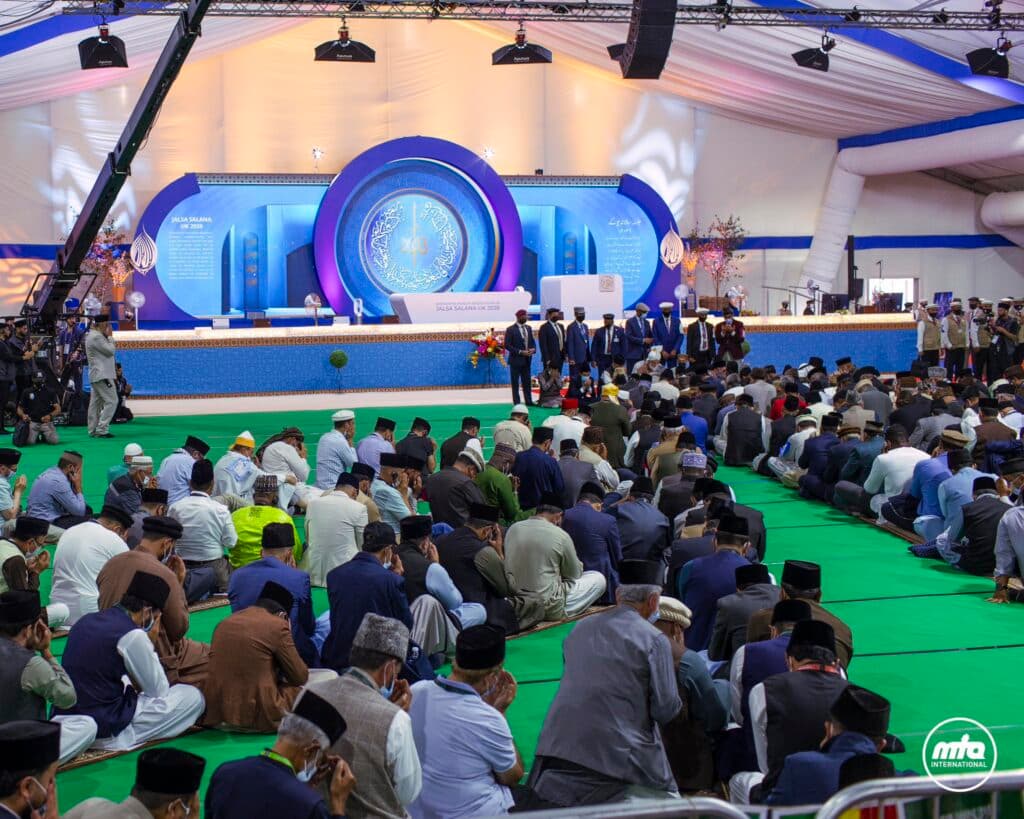
On Sunday, 26 July 2026, Hazrat Mirza Masroor Ahmad, Khalifatul Masih V (aa), delivered the concluding address of Jalsa Salana UK 2026 at Hadeeqatul Mahdi, Alton.
Huzoor (aa) arrived at the jalsa gah shortly before 4.15 pm and presided over the concluding session. The proceedings began with the recitation of verses 52 to 57 of Surah al-Nur by Feroz Alam Sahib, followed by their Urdu translation from Tafsir-e-Saghir.
Rafiq Ahmad Hayat Sahib, Amir Jamaat UK, then read out a message from His Majesty the King, congratulating the Jamaat on the occasion of the Jalsa. Faraj Odeh Sahib recited couplets from an Arabic qasidah composed by the Promised Messiah (as) in praise of Allah the Almighty and published in Karamat-us-Sadiqeen. Its Urdu translation was presented by Mir Anjum Parvez Sahib.
An Urdu poem composed by the Promised Messiah (as) on the excellences of Islam and the Holy Prophet (sa) was recited by Murtza Mannan Sahib. Thereafter, Nadimur Rahman Sahib, Secretary Talim UK, announced the names of Ahmadi students who had achieved academic distinction during the year.
Amir Sahib UK then announced that the 2026 Ahmadiyya Muslim Prize for the Advancement of Peace would be awarded to Mr Sompop Jantraka of Thailand.
Hazrat Amirul Momineen (aa) subsequently came to the podium, conveyed his salaam to everyone and commenced his address with the recitation of tashahhud, ta‘awwuz and Surah al-Fatihah.
The purpose of the Promised Messiah’s (as) advent
Huzoor (aa) began by drawing attention to the immense grace of Allah the Almighty in enabling members of the Jamaat to be born in the era of the true servant of the Holy Prophet (sa).
The Promised Messiah (as) had been raised to convey the true teachings of Islam to the world and bring about its revival and rejuvenation. One of the principal purposes of his advent was to establish the absolute Unity of Allah and eradicate every form of shirk – the association of partners with Him.
Huzoor (aa) explained that the Promised Messiah (as) came to remove the spiritual decline and moral corruption that had spread throughout the world and to cultivate true spirituality, sincerity and complete devotion to Allah. He sought to establish a Community of believers who would themselves remain free from every form of polytheism and strive to bring the rest of the world towards the worship of the One God.
The eradication of immorality was also among the purposes of his advent. The members of the Jamaat were therefore required to reform themselves and help save humanity from spiritual and moral ruin.
The conditions of bai‘at require practical transformation
Huzoor (aa) said that, in accordance with the command of Allah the Almighty, the Promised Messiah (as) established a Jamaat and prescribed conditions upon which its members would enter his bai‘at, or pledge of allegiance.
These conditions were not ceremonial statements. Every person entering the Jamaat pledged sincerely that, until the end of their life, they would abstain from shirk, falsehood, fornication, adultery, improper glances, transgression and every other form of sin. They also pledged not to allow themselves to be overcome by their carnal desires.
Spiritual reformation further required the observance of the five daily prayers according to the commandments of Allah and the example of the Holy Prophet (sa). Members of the Jamaat were expected to strive to offer tahajjud, invoke salutations and blessings upon the Holy Prophet (sa), seek forgiveness for their sins, remember the favours of Allah and constantly praise and glorify Him.
Huzoor (aa) reminded the Jamaat that a person who had entered bai‘at must not cause harm to the creation of Allah, whether through their tongue, their hands or by any other means. This obligation applied to the creation of Allah generally and to Muslims in particular.
A believer was required to remain faithful to God in every condition: in sorrow and happiness, adversity and prosperity. One must submit willingly to His commandments, remain steadfast when faced with hardship or humiliation in His cause and continue advancing rather than turning away when tested.
Huzoor (aa) added that members of the Jamaat must abandon arrogance and cultivate humility, cheerfulness, forbearance and meekness. The faith and the cause of Islam were to be held dearer than one’s life, wealth, honour, children and other loved ones. Believers were also required to devote themselves to serving the creation of Allah solely for His sake and to work for the benefit of humanity according to the abilities He had granted them.
Explaining the condition relating to obedience, Huzoor (aa) said that after entering bai‘at, a person must accept the teachings and commandments of Islam wholeheartedly. This commitment also required obedience to Khilafat, as the institution of Khilafat continued the mission of the Promised Messiah (as) in fulfilment of the promises of Allah the Almighty.
Merely identifying oneself as an Ahmadi was not sufficient. One could fulfil the right of bai‘at only by acting upon its conditions and bringing about a genuine moral and spiritual transformation.
Huzoor (aa) said that he had previously spoken and written extensively about the conditions of bai‘at, presenting references from the Holy Quran, the sayings of the Holy Prophet (sa) and the writings of the Promised Messiah (as). Nevertheless, these matters had to be repeated because the real objective was not simply to increase knowledge, but to act upon what had been taught.
Abstaining from every form of shirk
Turning to the first condition of bai‘at, Huzoor (aa) said that the Promised Messiah (as) required every member of the Jamaat to abstain from shirk until death.
This condition, when properly understood and observed, protected a person from numerous other sins. The Promised Messiah (as) had explained that the purpose of the advent of every Prophet was to deliver people from sin, create an aversion to wrongdoing and guide humanity back towards God so that human beings could fulfil the purpose for which they had been created.
Sin had many forms and branches. Even negligence towards one’s spiritual responsibilities could lead a person away from Allah. As an unfortunate person continued to descend into sin, they became increasingly distant from God until their life became filled with spiritual anguish, hardship and darkness – a condition resembling hell.
The true objective of human life was therefore to become wholly devoted to Allah and completely averse to sin. Huzoor (aa) emphasised that shirk was among the gravest of all sins and that believers must guard themselves against it throughout their lives.
The pledge taken by the Holy Prophet (sa)
Huzoor (aa) referred to the pledge taken by the Holy Prophet (sa) from his Companions at Aqaba. Hazrat Ubadah bin Samit (ra), who had participated in the Battle of Badr and was present at Aqaba, related that the Holy Prophet (sa) instructed the Companions to pledge that they would not associate anything with Allah, steal, commit adultery, make false accusations or disobey him in anything that was ma‘ruf.
Explaining the meaning of ma‘ruf, Huzoor (aa) said that it referred to whatever accorded with the Holy Quran and the teachings of the Holy Prophet (sa). The same understanding had been presented by the Promised Messiah (as) and his Khulafa. Thus, obedience in what was ma‘ruf did not imply that some commands of a Prophet or Khalifa could be contrary to Islam; rather, their guidance was rooted in the Holy Quran and the practice of the Holy Prophet (sa).
The Holy Prophet (sa) had stated that whoever fulfilled the pledge would receive their reward from Allah. If a person committed one of the prohibited acts and was punished for it in this world, that punishment could serve as an expiation. If the wrongdoing remained concealed, the person’s matter rested with Allah, Who could punish or forgive according to His wisdom.
Huzoor (aa) said that the conditions prescribed by the Promised Messiah (as) reflected the same fundamental moral and spiritual requirements upon which the Holy Prophet (sa) had taken bai‘at. Members of the Jamaat must therefore make every possible effort to avoid any action that violated their pledge and could attract the displeasure of Allah.
Recognising Allah as the source of every blessing
Huzoor (aa) cited a hadith narrated by Hazrat Zaid bin Khalid (ra) concerning an incident at Hudaibiyah. After rainfall during the night, the Holy Prophet (sa) led the morning prayer and asked his Companions whether they knew what their Lord had said.
The Holy Prophet (sa) explained that some of Allah’s servants had entered the morning as believers in Him, while others had rejected Him. Those who attributed the rain to the grace and mercy of Allah were believers in Him and rejected the supposed independent influence of the stars. Those who attributed it to a particular star had, in effect, believed in that star and rejected Allah.
Huzoor (aa) explained that this hadith illustrated how shirk could arise when a person regarded worldly causes as independent of Allah. Material means could be used, but a believer must recognise that their effectiveness and every resulting blessing ultimately came from God.
A person was not always aware of all their weaknesses and errors. Huzoor (aa) therefore urged the members of the Jamaat to engage frequently in istighfar and seek the protection and forgiveness of Allah.
Faith must be demonstrated through deeds
Huzoor (aa) reminded the Jamaat that Allah had promised the Promised Messiah (as) victory. That victory would certainly come; however, anyone wishing to share in it had to purify themselves, proclaim the Unity of Allah and embody it through their conduct.
Referring to the guidance of Hazrat Musleh-e-Maud (ra), Huzoor (aa) explained that no one could expect preferential treatment from Allah merely because they called themselves an Ahmadi. Relationship, lineage or religious designation alone could not save anyone.
The son of Prophet Noah (as) was not saved despite being the son of a Prophet. Likewise, the wife of Prophet Lotas was not protected by her relationship with him when she aligned herself with the disbelievers. A person therefore became worthy of being called an Ahmadi only through faith, obedience and righteous action.
Huzoor (aa) also referred to the advice of Hazrat Luqman to his son: that he must never associate partners with Allah, for shirk constituted a grave injustice. Allah continually bestowed favours and blessings upon human beings; to treat anyone else as equal to Him was therefore an immense act of ingratitude.
Obvious and hidden forms of shirk
Huzoor (aa) explained that freedom from shirk did not consist merely of reciting La ilaha illAllah while remaining neglectful of its demands. Believers had to protect themselves from obvious, hidden, subtle and even subconscious forms of shirk.
He lamented that some Muslims professed the Unity of Allah but nevertheless bowed or prostrated at shrines and believed that the occupants of graves could independently fulfil their needs. Some clerics described the powers and miracles of saints in a manner that elevated them beyond their true station.
The Promised Messiah (as) had been commissioned in this age to wage a spiritual Jihad against every form of shirk and establish a Community dedicated to the worship of the One God.
Although Ahmadis did not engage in overt idol worship, Huzoor (aa) cautioned that they must still examine themselves for hidden forms of shirk. Excessive reliance upon one’s wealth, intelligence, influence, employment, relationships or worldly resources could weaken one’s dependence upon Allah.
Only by cleansing themselves of such hidden tendencies could Ahmadis fulfil the right of their bai‘at and become true helpers in the mission of the Promised Messiah (as).
Truthfulness in a world sustained by falsehood
Huzoor (aa) then addressed the requirement to abstain from disorder, lying and falsehood.
He referred to an incident from the life of the Promised Messiah (as) involving legal proceedings connected with postal regulations. Although people commonly believed that they could not protect themselves in court without resorting to falsehood, the Promised Messiah (as) spoke truthfully. He acknowledged what had occurred but made clear that he had neither intended to harm the postal service nor knowingly violated the law. Allah the Almighty protected his honour and he was acquitted.
Huzoor (aa) contrasted this example with the condition of the contemporary world, where individuals and institutions frequently regarded lying as essential to success. Falsehood could be found in international affairs, national politics, social relations and legal disputes. Lawyers and litigants sometimes participated in fabricated cases and misleading statements.
As a result, trust had deteriorated to such an extent that when someone spoke the truth, others still assumed that some element of deception must be hidden within their words.
Members of the Jamaat were required to stand apart from this culture and establish the highest standards of honesty. Reliance upon falsehood revealed a failure to trust Allah, whereas a believer had confidence that truthfulness would ultimately attract His help and protection.
Praise of Allah and Durood Sharif
Continuing his guidance on spiritual reform, Huzoor (aa) cited the saying of the Holy Prophet (sa) concerning two phrases that were light upon the tongue, heavy in the divine balance and beloved to Allah. He drew attention to the importance of glorifying and praising Allah and urged the members of the Jamaat to make His remembrance an enduring part of their lives.
Huzoor (aa) also instructed Ahmadis to give particular attention to invoking Durood Sharif, salutations and blessings upon the Holy Prophet (sa). The increased remembrance of the Holy Prophet (sa) during the days of Jalsa should not end with the conclusion of the gathering; rather, it should become a permanent habit.
Referring to a hadith, Huzoor (aa) said that when a believer heard the muezzin calling the azan, they should repeat the words of the call and then invoke blessings upon the Holy Prophet (sa). Whoever sent blessings upon him once would receive mercy from Allah tenfold.
Believers should also pray that the Holy Prophet (sa) be granted the exalted station of wasilah in Paradise. The Holy Prophet (sa) had stated that whoever prayed for this would become deserving of his intercession.
Huzoor (aa) explained that by making Durood a regular part of their lives, Ahmadis would strengthen their relationship with the Holy Prophet (sa) and fulfil an important aspect of their pledge.
Taubah and istighfar
Huzoor (aa) then emphasised the importance of taubah, repentance and istighfar, seeking the forgiveness and protection of Allah.
He referred to the saying of the Holy Prophet (sa) that whoever remained constant in seeking forgiveness would be granted a way out of every difficulty, relief from every hardship and provision from sources they could not have imagined.
When people requested prayers for relief from affliction, Huzoor (aa) said that he repeatedly advised them to recite istighfar. The Promised Messiah (as) had also prescribed istighfar to those burdened by debt and to those praying for children.
Huzoor (aa) explained that istighfar did not merely mean asking for past sins to be forgiven. It also involved seeking Allah’s protection from the harmful consequences of previous sins and praying for the strength to remain safe from sin in the future. A person should pray not only for themselves but also for the spiritual protection of their progeny.
However, simply repeating the words of istighfar without reflection was insufficient. It had to arise sincerely from the heart and be accompanied by a genuine determination to reform. Allah accepted the repentance of a person until the final stage of life approached, but no one knew when death would come. Repentance and reformation could therefore not be postponed.
Establishing salat and Tahajjud
Huzoor (aa) said that genuine attention towards tahajjud could develop only when a person first became regular and conscientious in observing the five daily prayers.
He cited the saying of the Holy Prophet (sa) that abandoning prayer stood between a person and disbelief and shirk. A person who called themselves a Muslim but habitually neglected prayer placed themselves dangerously close to spiritual ruin.
Having pledged to struggle against shirk, members of the Jamaat had to safeguard their prayers. Huzoor (aa) instructed men to establish congregational prayer in mosques and prayer centres so that the houses of Allah remained populated.
Parents were also responsible for developing within their children a love and appreciation for prayer. Children should not merely be instructed to pray; they should be helped to understand why prayer was necessary and how it established a living connection with Allah.
Referring to the teachings of the Promised Messiah (as), Huzoor (aa) explained that a person should not remain satisfied with the outward movements of prayer. Some people completed the formal prayer hurriedly, as though discharging an unwanted burden and then made lengthy supplications afterwards. The formal salat itself, however, was the highest form of prayer and had to be filled with heartfelt supplication.
Prayer should become a source of delight – more desirable to a believer than the finest food or drink. It was a right owed to Allah and had to be offered beautifully, attentively and with its proper etiquette. When a believer did justice to prayer, Allah beautified their entire life.
Compassion, forgiveness and unity
Turning to the rights of creation, Huzoor (aa) presented the teachings of the Promised Messiah (as) concerning kindness, compassion and mutual love.
A true Jamaat could not be composed of people who harmed one another, spoke ill of others, searched for their faults or treated the poor and weak with contempt. Gatherings of believers should instead strengthen unity and cultivate love, sympathy, mercy and mutual respect.
The Promised Messiah (as) had observed that quarrels and grudges sometimes arose over the smallest matters. Opponents then seized upon these weaknesses, exaggerated them and used them to turn others against the Jamaat. If Ahmadis removed their own internal weaknesses and raised their moral standards, opponents would be deprived of such opportunities.
Huzoor (aa) said that strengthening the Jamaat required its members to increase in mutual love and compassion, overlook the faults of others and avoid harbouring grudges.
A person could not be regarded as a true Muslim until they loved and sympathised with others as they did with themselves. The Promised Messiah (as) had advised his followers to purify their hearts, show compassion to all humanity and wish no evil even for those who opposed them.
Instead of seeking revenge, believers should forgive. By showing mercy to those on earth, they became recipients of mercy from heaven.
The Promised Messiah’s (as) example of forgiveness
Huzoor (aa) referred to the false allegation of attempted murder brought against the Promised Messiah (as) in connection with Dr Henry Martyn Clark.
When the allegation was proved false, the court permitted the Promised Messiah (as) to pursue legal action against those responsible. Despite having opportunities to seek retribution, he declined to do so and demonstrated forgiveness and compassion towards his opponents.
Huzoor (aa) said that anyone who wished to establish peace in the world had to develop the same spirit of love, sympathy and forbearance. Ahmadis were required to live harmoniously not only among themselves but also with all humanity.
Moral reformation and the struggle against the Dajjal
In his concluding remarks, Huzoor (aa) explained that if members of the Jamaat fulfilled the conditions of bai‘at and brought about righteous changes within themselves, they would transform not only their own lives but also the wider society.
Through their conduct, they would spread the true message of Islam. Non-Ahmadis, non-Muslims and atheists would be compelled to recognise that Ahmadis sought both to establish the Unity of Allah and to uphold the highest moral values, thereby preventing humanity from falling into the depths of immorality and helping turn the world into an abode of peace.
In contrast, the forces of the Antichrist, or Dajjal, were striving to efface the name of Allah from the earth and spread disorder in every direction. In such circumstances, the Jamaat bore an immense responsibility to fulfil its pledge, resist these forces through faith, prayer and righteous conduct and pray that Allah caused their schemes to fail.
Huzoor (aa) prayed that Allah the Almighty enabled all Ahmadis to do justice to their bai‘at. He urged everyone to pray for the peace and security of Ahmadis throughout the world and for the peace and security of all Muslims.
He further prayed that every Ahmadi might be enabled to establish the Unity of Allah and play a prominent role in spreading peace and security throughout the world.
Huzoor (aa) then called upon everyone to join him in silent prayer.
Following the prayer, Huzoor (aa) announced that the attendance at Jalsa Salana UK 2026 had reached over 51,000. In addition, over 16,000 people had participated virtually from 117 Jamaat centres in 62 countries.
Everyone subsequently listened to poems recited by various groups. Huzoor (aa) then took his leave, bringing Jalsa Salana UK 2026 to a close.
(Report prepared by Al Hakam)