
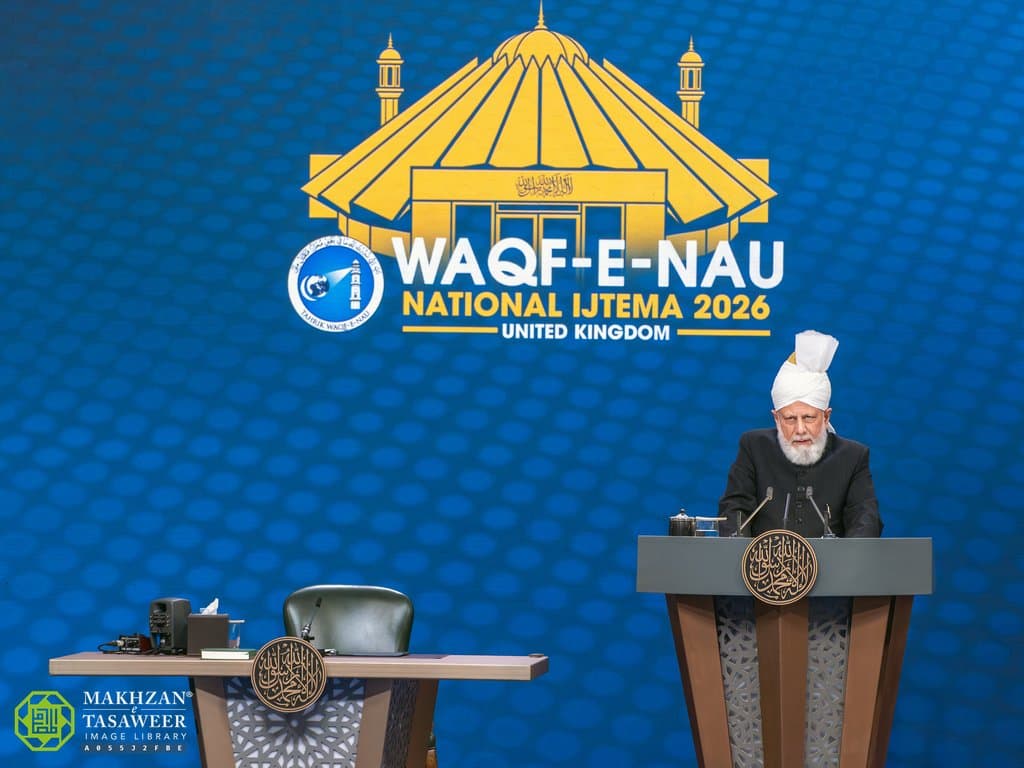
On Sunday, 26 April 2026, at approximately 5 pm local time, Hazrat Mirza Masroor Ahmad, Khalifatul Masih V, may Allah be his Helper, presided over the UK Waqf-e-Nau Ijtema 2026 at Islamabad, Tilford, UK.
After conveying assalamu alaikum, Huzoor (aa) invited Ehsan Ahmad Sahib to recite a portion of the Holy Quran – Surah ar-Ra’d, Ch.13: V.20-23. Ghaalib Khan Sahib then presented the English translation of these verses. Abdul Haye Sarmad Sahib subsequently recited an Urdu poem of the Promised Messiah (as), followed by its English translation presented by Frasat Cheema Sahib.
Hazrat Amirul Momineen (aa) then invited Abdul Quddus Arif Sahib, Secretary Waqf-e-Nau UK, to present the Ijtema report.
He expressed his gratitude to Huzoor (aa) for gracing the occasion with his esteemed presence and for the opportunity to hold the ijtema in Islamabad. He stated that the participants were divided into age-based groups, each participating in its respective activities. The sessions at the Ijtema covered topics such as the role of MTA International in tabligh and tarbiyyat, an introduction to Jamia Ahmadiyya UK, responding to allegations, and inspirational convert stories. The total number of male waqifeen-e-nau was 2144, which is 62% of the total number of waqifeen-e-nau. With guests, the attendance was a total of 2700.
Huzoor (aa) then took to the podium and, after reciting the tashahhud, ta‘awwuz and Surah al-Fatihah, Hazrat Amirul Momineen (aa) commenced his address. A brief summary of this address is presented below:
As waqifeen-e-nau, you hold a unique distinction that you are part of a group of people whose parents, prior to your birth, made a sacred vow to dedicate your lives to the service of the Jamaat. And then, having reached maturity, you have independently chosen to renew this bond. In this way, you have transformed that parental pledge into your own lifelong mission.
This is not a path of compulsion. Upon reaching an age of understanding, the Jamaat gives each member the option to either reaffirm the parents’ pledge or withdraw from the scheme. If you choose to leave, you are not guilty of any sin, nor should you be judged in such a way.
If you are open and honest, and say you are unable to fulfil your waqf, it is your right. Over the years, a number of people have expressed their desire to withdraw from the scheme, and they are excused. While they are allowed, they must not forget their responsibilities as Ahmadi Muslims and strive to honour the conditions of bai’at and the rights of Allah the Almighty and mankind.
Those who willingly renew the pledge must strive with complete sincerity to fulfil it, recognising that the standard of devotion which is expected of a waqf-e-nau exceeds that of other Ahmadis.
Huzoor (aa) said that, as this Ijtema is specifically for waqf-e-nau, he will outline the core values you must seek to instil in yourselves to fulfil your duties and become outstanding servants of the Jamaat.
Having reached maturity, many of you are now married and have children of your own, so you must recognise that now is the time to fully manifest and fulfil your pledge. Huzoor (aa) said he will outline the expectations of the Promised Messiah (as) about fulfilling our religious duties and attaining the ranks of true believers.
As waqifeen-e-nau, your mindset must be that you are the primary recipient of these instructions, and must strive to fulfil them with greater zeal and devotion than anyone else. If you do, you will live as true Ahmadi Muslims and fulfil your pledge as a waqf-e-nau.
The Promised Messiah (as) emphasised that his followers must manifest the highest moral standards and etiquette at all times. A person must never allow their emotions to overpower their speech or conduct, nor must they ever let them incite them to injure the feelings of others. He further explained that Allah desires for those who have associated themselves with him to be beacons of moral excellence for others to emulate.
Therefore, as waqf-e-nau, you must not only manifest such morals yourself, but also become catalysts for the reformation of others, too. While every Ahmadi must strive for this, the responsibility for waqifeen-e-nau is greater. As you have not only accepted the Promised Messiah (as) but also vowed to stand on the frontlines of service and to give precedence to your faith over all worldly matters.
If you fail to uphold your basic duties, the world will rightly wonder as to how it is that you claim to prioritise your faith but the standard of your worship remains poor, as well as your conduct. People will dismiss your claims as hollow and insincere. It is your duty to set a compelling, powerful example for others so they are naturally inclined toward you.
Furthermore, the Promised Messiah (as) instructed that our belief in the oneness of God (tawhid) must be unshakable. A true believer must be so confident in Allah’s power that it instils within him a fear that he must never commit an act that may displease Him. When the world looks in your direction, they should know that the followers of the Promised Messiah (as) are those who exhibit superior morals and are consumed by the awe of Allah’s greatness and mercy.
The Promised Messiah (as) said that his followers must excel in righteousness and taqwa. Every action must be governed by these two things. This is a theme, Huzoor (aa) said, that he often addresses in his Friday Sermons. The Promised Messiah (as) taught that taqwa is the essence of Islamic teachings and fundamental to our faith. Allah the Almighty commands us about the importance of taqwa in the Holy Quran on over one hundred occasions. The Promised Messiah (as) taught that righteousness requires our words and deeds to exist in complete harmony. If this is not the case, it means hypocrisy has entered our hearts, and we do not fear displeasing Allah.
You must all reflect upon whether you are truly striving to achieve these high standards. If you have exhibited moral weaknesses in the past, you must pledge from this moment that you will strive to bring about a spiritual transformation in your life. The doors to Allah’s mercy are always open to those who seek them. The Promised Messiah (as) explains that Allah has bestowed upon us many faculties and abilities, but they are not given to be wasted, and rather are for a noble purpose. We must use them in pursuit of goodness, and never for evil or immoral purposes.
Today, we often hear about the technological revolution that has taken place in recent decades. Yet instead of propelling humanity forward, these modern technologies all too often drive people towards vices and corrupting forces. The internet, social media, gaming and other platforms are fuelling a tide of immorality and misinformation. They are polluting minds and propelling young people onto a destructive path.
In the face of such destructive influences, you must exercise absolute self-control and discipline. Instead of surrendering your moral values, you must maintain control over your emotions and ensure your God-given abilities are used for good. Those who do so will be rewarded by Allah. In the Holy Quran, Allah says that surely success comes to the believers. For this success, salat is fundamental, as taught by the Promised Messiah (as). The prayers must be offered with complete sincerity, and the focus should be on Allah alone. They must not be rushed. When you begin every namaz, your mindset should be that you are entering the throne of Allah in order to present all your desires and needs before Him.
You should immerse yourself so fervently in prayer that tears naturally fall from your eyes as you submit and bow down before your Creator. Beseech Him for His help and mercy so that you may be among the righteous and that you are able to abstain from sin. This is the key to success, which leads to the acceptance of one’s prayers.
In today’s world, people are very quick to voice frustration and lament their misfortune without exhibiting patience or self-reflection. People are quick to complain about worldly desires that have not immediately been fulfilled; however, the Promised Messiah (as) taught us that our greatest concern over all worldly worries should be whether we are truly walking on the path of righteousness.
He taught that if a person is truly grief-stricken over their spiritual state and yearns for Allah’s love above all else, they will find that success and prosperity will flow toward them. The Promised Messiah (as) further stated that if a person strives to attain the pleasure of Allah, the definitive path to follow is that of the Holy Quran. By following its teachings, not only will such a person attain spiritual peace, but they will also win the hearts of their families, neighbours, peers and their wider societies.
Thus, always remember that the Holy Quran is our greatest and foremost guiding light. Immerse yourself in the study of the Quran and seek to act upon all of its Divine commands. Allah has clearly defined right from wrong. If you inculcate these Quranic teachings into your character, others will naturally gravitate towards you, and your words will have a powerful effect.
Sometimes, complexes emerge among young people that lead them to feel they must conceal their faith to fit in with society. However, remember that others will respect and value you if you are sincere in your faith and practice what you preach. Therefore, submerge yourselves in the Quran’s heavenly light and strive to act upon every one of its injunctions.
On another occasion, the Promised Messiah (as) stated that to have a strong and positive effect on the hearts and minds of others, you must first better your own state and make sure your actions are governed by righteousness. A person must always seek to eliminate their weaknesses and always seek instruction directly from the Holy Quran to discern right from wrong.
Furthermore, the Promised Messiah (as) urged his followers to pursue knowledge, teaching that true intelligence and understanding correlate directly with righteousness and that wisdom and foresight are unattainable without turning towards Allah. It is easy to claim to believe in Allah, but in order to prove that claim, we must turn towards Him at all times.
An atheist or non-believer may credit their hard work, intelligence and personal efforts for their achievements. Certainly, if they work hard, they will attain a degree of success. However, because they are bereft of divine guidance, their faculties can only take them so far. Hence, if an atheist and a sincere believer work in the same field, the believer who seeks Allah’s guidance and help will achieve far greater success.
In terms of our Jamaat, so far we have had only one truly outstanding example of an Ahmadi who reached the pinnacle of the scientific world, Dr Abdus Salam Sahib. In all his works, he drew inspiration from the Holy Quran at every step. Today, with the grace of Allah, many Ahmadis are excelling in academia, research and a wide range of professional disciplines. Their work is being recognised by their peers, and their contributions are having a positive impact in their respective fields.
Yet, there is much further to go. Our Jamaat must seek to produce many more people who, whilst bearing witness to the Glory of Allah, scale the peaks of human knowledge. It was during the time of Hazrat Khalifatul Masih III (rh) that Dr Abdus Salam Sahib won the Nobel prize. Huzoor (rh) himself had a great passion for learning and education, so he launched a scheme urging Ahmadis to excel in science and to strive to follow in the footsteps of Dr Abdus Salam Sahib.
Huzoor (rh) said that achieving this required Ahmadis to relentlessly pursue excellence in their fields whilst also striving to develop an intimate bond with Allah the Almighty. The believer who dismisses Allah’s help and believes his achievements to be a result of his efforts alone shall be guilty of hypocrisy. Hence, to succeed, a believer must act upon Allah’s commands and combine this with hard work and sincere prayer.
If an Ahmadi pursues knowledge in this way, they will witness Allah’s blessings rain down on them, and they will be granted success after success.
Regarding the pursuit of knowledge, the Promised Messiah (as) stated that some religious clerics believed that science led people away from God. The Promised Messiah (as) rejected this opinion categorically and said that human knowledge and enlightenment emanate from Allah, and hence, there is no reason to fear scientific discoveries. He urged his followers to learn modern sciences and affirmed that rationality and reason were entirely in keeping with the teachings of Islam.
The Promised Messiah (as) taught that believers should acquire scientific knowledge and not harbour any sort of anxiety or inferiority in this regard, explaining that reason and knowledge descended from Heaven as a form of spiritual light. He gave the example that when rain falls from Heaven, its effect depends on the soil it lands upon – if it falls on fertile ground, the earth benefits and produces fragrant flowers and rich crops. If it drops upon barren land, there is no result. The same is true, the Promised Messiah (as) said, with human intelligence. If a person sincerely believes Allah to be the Creator of the worlds and seeks to sincerely understand his creation, then Allah opens their minds in a way that enables them to surpass others. Their minds become a fertile ground.
The Promised Messiah (as) refuted those clerics who said science was dangerous and to be shunned, describing the souls of such clerics as trembling in the face of philosophy and modern research. They feared science because they did not understand it, nor did they possess the wisdom to know that it went hand in hand with the teachings of Islam. Hence, the Promised Messiah (as) urged his followers not only to pursue scientific knowledge but to harness their discoveries in support of Islam and to prove its truth.
This is a great challenge for all waqifeen-e-nau. Whereas atheists try to use science to disprove the existence of God, it is your duty to use it to prove His existence. Seek to dismantle the allegations laid against religion through the power of reason and rationality.
Regardless of your chosen path, you must strive to achieve its pinnacle. Thereafter, whenever you achieve success or make a breakthrough, proclaim to the world that the knowledge you gained was inspired by the Word of God, and that the practical manifestation of Allah’s teachings is revealed through science, nature and the world around us.
At the same time, never let the pursuit of knowledge breed arrogance or take you away from your faith. The Promised Messiah (as) warned that some people become so infatuated by their knowledge that instead of getting closer to Allah, they join the ranks of those who believe science and religion oppose one another. As a result, they focus purely on secular knowledge and distance themselves from God. Therefore, as waqf-e-nau, you must heed this warning and remain vigilant from all forms of pride.
Crucially, you must never miss any of the five daily prayers. You must read and study the Holy Quran on a daily basis, as well as read the books of the Promised Messiah (as) and other religious books. Moreover, the Promised Messiah (as) said we must adopt the highest moral standards within our homes. Thus, treat your family with love and compassion, and ensure that such an atmosphere remains in your home at all times.
Huzoor (aa) said that as the Ijtema draws to a close, he wishes to conclude by reminding us that the Promised Messiah (as) taught us that the key to attaining all forms of success and prosperity is righteousness. Strive to adopt this by acting in accordance with the commands of Allah at all times. Only then will we gain the nearness of Allah and the rewards and blessings of our faith. Only then will our homes be content, only then will we become true role models, and only then will we do justice to the pledge of waqf-e-nau.
At the end, Huzoor (aa) prayed:
May Allah the Almighty enable you to understand what I have said, and may you act upon it so that you fulfil the purpose of your lives and guide others towards Allah the Almighty. May you all prove to be a source of lasting benefit for all of mankind, and may you fulfil the demands of being a waqf-e-nau and serve the cause of Islam Ahmadiyyat with the utmost distinction throughout your lives. Amin.
Hazrat Amirul Momineen (aa) then led everyone in silent prayer.