
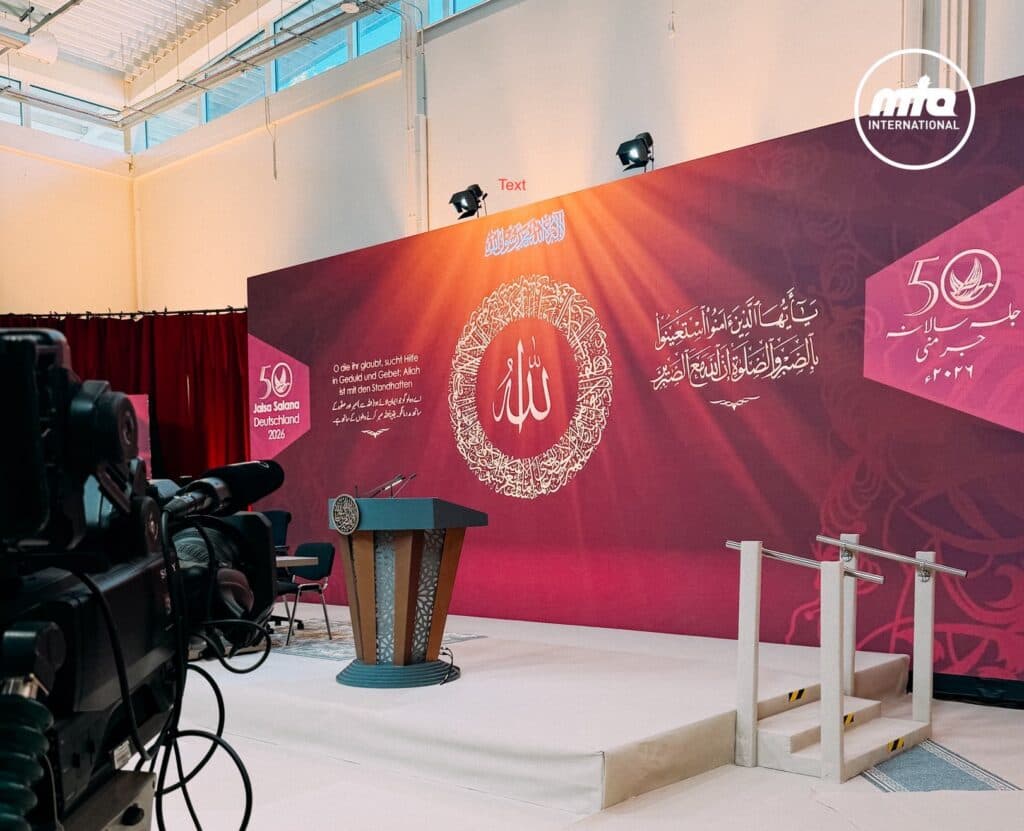
Islamabad, Tilford, 5 September 2026: At 11:30 am BST, Hazrat Mirza Masroor Ahmad, Khalifatul Masih V (aa), arrived at the venue set up in Islamabad for the purpose of addressing the Lajna session of Jalsa Salana Germany remotely.
Huzoor (aa) inaugurated the session by inviting Ayesha Mahmood Sahiba to recite the Holy Quran, from Surah al-Furqan, verses 64 to 70. The recitation was followed by its translation. Huzoor (aa) then invited Aneeqa Shakir Bajwa Sahiba to recite an Urdu poem of the Promised Messiah (as).
Huzoor (aa) invited Lajna Imaillah Germany’s Secretary Umur-e-Talibaat to announce the names of Lajna students who have achieved academic excellence over the past year.
Huzoor (aa) then took to the podium to deliver his address, a brief summary of which is as follows:
Huzoor (aa) began by saying that it is a great favour of Allah the Almighty upon the Jamaat that He has created among its women an awareness of the importance of seeking knowledge, so that they and their future generations may become recipients of His grace. At a time when the world is becoming increasingly absorbed in amusement and worldly pursuits, Ahmadi women should remain firmly committed to their pledge of giving precedence to faith over the world.
Huzoor (aa) said that the attacks and temptations of Satan and the Dajjal are widespread today and Ahmadis, including women living in Western countries, are not immune to them. At times, education and worldly success themselves can become means of temptation. Islam does not prevent women from attaining higher education or achieving success. Rather, it encourages the pursuit of knowledge and progress. However, alongside this, a believer must always remain mindful of the obligations and responsibilities prescribed by the faith.
Referring to the example of Hazrat Aisha (ra) and other eminent Muslim women of the early period of Islam, Huzoor (aa) said that they attained high spiritual standards as well as great religious knowledge. Their contribution was not confined to prayer and worship; their narrations and knowledge continue to assist Muslim jurists in understanding religious matters. At the same time, they understood their responsibilities and strove to fulfil them. They did not speak only of receiving their own rights but were equally conscious of discharging the rights owed to others. It is for this reason that they are remembered with honour in Islamic history.
Ahmadi women today, Huzoor (aa) said, should keep these examples before them and reflect upon their responsibilities towards their homes, their children and the moral and spiritual betterment of their families. If they feel that some men today are failing to fulfil their responsibilities, they should strive to raise a future generation of men and women who understand and discharge their duties properly.
Huzoor (aa) said that, in order to achieve this, Ahmadis must repeatedly study and keep before them what the Promised Messiah (as) expected of those who accepted him. Without acting upon his teachings, the purpose of being an Ahmadi cannot be fulfilled.
Referring to the teachings of the Promised Messiah (as), Huzoor (aa) said that the Promised Messiah (as) would say that a mere relationship with him is of no benefit if a person’s actions are not righteous. Alongside remembering and worshipping Allah the Almighty, believers must fulfil the rights of other people. High moral conduct does not mean showing goodness only to those who treat us well. Rather, even when someone wrongs us, we should be prepared to forgive them and treat them with kindness. Unless this spirit is developed, one cannot attain the true condition for which the Jamaat was established.
Huzoor (aa) emphasised that Ahmadis, both men and women, must strive to lay the foundations of peace and reconciliation, beginning within their own homes. He referred to the Promised Messiah’s (as) explanation that he had come for two fundamental purposes: to establish the Oneness of God and fulfil His rights through worship, and to create love and compassion between people so that believers become examples for others.
The transformation within the Companions, Huzoor (aa) explained, rested upon these principles. A person should desire for others the same good that they desire for themselves. He also referred to the Promised Messiah’s (as) teaching that one of the signs associated with the coming of the Mahdi was that hatred and rancour would be removed from people’s hearts. Therefore, those who have accepted the Mahdi must strive to remove such feelings from within themselves. These are among the qualities that make a person a true Ahmadi.
Huzoor (aa) then said that the world should never become the sole purpose of a believer’s existence; rather, worldly means should remain a servant to the higher objective of faith. Addressing those who had settled in Western countries, he noted that many had been granted better circumstances and greater opportunities than they had in Pakistan. However, many had originally migrated because they could not practise their faith freely. If, after reaching better material conditions, they allowed the pursuit of wealth and worldly comfort to displace religion, they would have lost sight of the very priority that should have guided their lives.
Huzoor (aa) referred to the Promised Messiah’s (as) warning that neither love of wealth nor love of one’s children should become a veil between a person and Allah the Almighty.
Turning to religious education, Huzoor (aa) said that studying the Holy Quran is essential for gaining knowledge of the faith and acting upon the commandments of Allah the Almighty. This study improves a person’s own moral condition and also equips them to take part in the propagation of Islam. Women should not assume that this responsibility belongs only to men. Particularly in the present state of the world, Ahmadi women should come forward and play their part in conveying the message that true salvation lies in turning towards God.
Huzoor (aa) explained that merely performing bai‘at is not enough. Referring to the Promised Messiah’s (as) teaching, he said that the outward pledge is only the shell, while its true essence lies in sincere action. This cannot be achieved without studying, pondering over and striving to understand the Holy Quran.
This responsibility, Huzoor (aa) said, belongs to women as much as it does to men. Lajna Imaillah has its own system for the religious education of women and regularly organises classes for the recitation and translation of the Holy Quran. Members should benefit from these opportunities, but the object should not be learning for its own sake. They should study with the intention of acting upon what Allah the Almighty has commanded and abstaining from what He has forbidden.
Huzoor (aa) added that the Holy Quran has given clear guidance regarding purdah and modesty. In the present age, such commandments are sometimes overlooked or treated as unimportant. Ahmadi women have a responsibility to learn these teachings properly and act upon them.
Huzoor (aa) then referred to the example of the Holy Prophet Muhammad (sa), whose entire life demonstrated that everything was for Allah the Almighty. The Promised Messiah (as), he said, repeatedly urged Muslims to learn their religion and teach it to others. Unless men and women bring about a genuine transformation within themselves, they cannot truthfully claim to have fulfilled the demands of their faith.
Huzoor (aa) stressed the importance of avoiding harmful company and remaining constant in prayer. In the modern age, harmful influences are not limited to physical company; television, the internet and other forms of media can also expose people to widespread immorality. To protect oneself from these influences requires prayer as well as a practical transformation in one’s conduct, similar to the change seen in the Companions of the Holy Prophet (sa). If there is no meaningful distinction between the conduct of believers and the wider world, others will have no reason to be drawn towards their example.
Referring again to the Promised Messiah’s (as) guidance, Huzoor (aa) said that the outward manifestation of a healthy spiritual condition is the observance of the five daily prayers. When women themselves give due attention to prayer and encourage their children and husbands to do the same, a wholesome environment can be created within the home which attracts the love of Allah the Almighty. These prayers, however, must be offered with their true spirit and not merely as a formality.
Huzoor (aa) said that only when Ahmadi men and women establish these qualities within themselves can they remain distinct while living in materially advanced societies. Only then can they truthfully say that they have fulfilled their pledge of bai‘at to the Promised Messiah (as), developed the identity of true Muslims within themselves and their children and played their part in raising the banner of the Holy Prophet (sa) throughout the world.
Concluding, Huzoor (aa) said that if Ahmadis merely follow worldly people, focus only on demanding their own rights and make the world their ultimate objective, then their claim of being Ahmadi carries no weight in the sight of Allah the Almighty.
Huzoor (aa) prayed that Allah the Almighty may enable all women, as well as men, to understand their responsibilities and fulfil the purpose for which they had gathered at Jalsa Salana.
Huzoor (aa) then ended the session with a silent prayer.
(Report prepared by Al Hakam)