

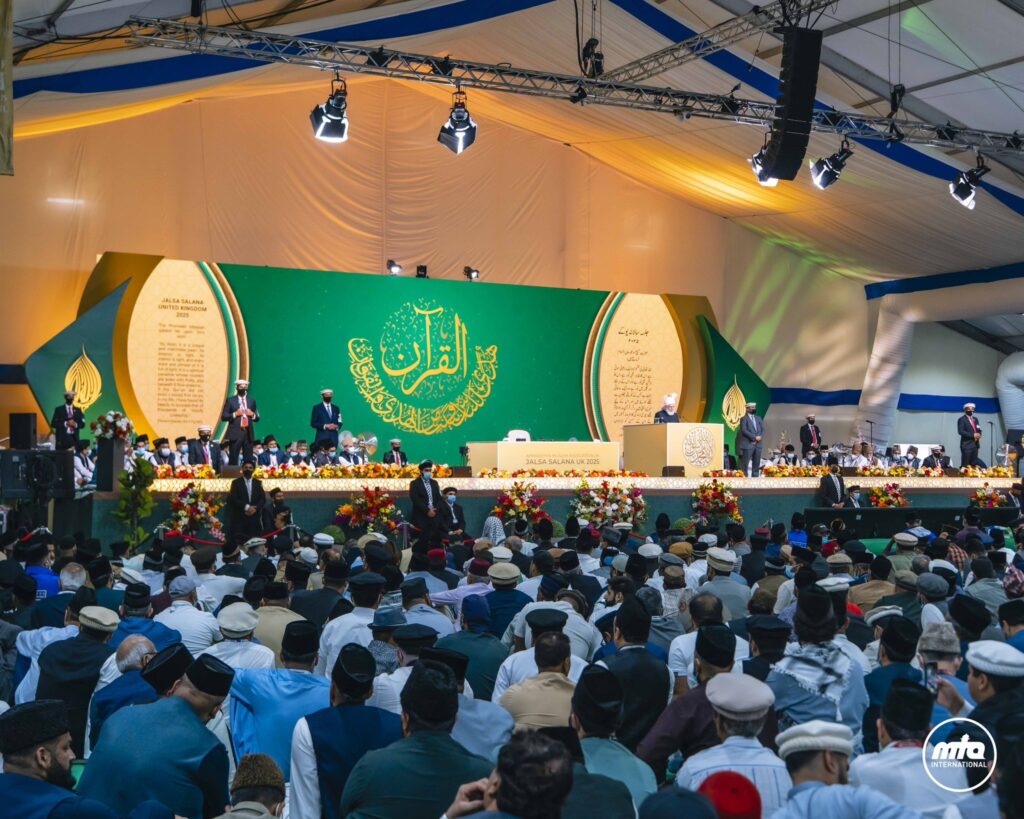
Hadeeqatul Mahdi, 25 July 2025: At approximately 4:30pm, Hazrat Mirza Masroor Ahmad, Khalifatul Masih Vaa hoisted Liwa-e-Ahmadiyyat, surrounded by flags of various nations representing the participants of the Jalsa, both physically present as well as virtually via MTA International. This was followed by dua (silent prayer), after which Huzooraa proceeded to the main Jalsa Gah for the inaugural session.
Huzooraa arrived on the stage and commenced the inaugural session by inviting Rashid Khattab Sahib for the recitation of the Holy Quran (Surah Al-e-Imran, Ch.3: V.103-108).
Following the Arabic recitation, Naseer Qamar Sahib was invited to present the Urdu translation.
After this, Huzooraa invited Ismatullah Sahib to present an Urdu poem of the Promised Messiahas on the subject of taqwa (righteousness). Then, Huzooraa invited Umar Sharif Sahib to present a Persian poem written by the Promised Messiahas on the topic of his divinely inspired claim, the translation of which was presented by Jawad Qamar Sahib.
Following this, Hazrat Amirul Momineenaa came to the podium and conveyed his salaam to everyone, and asked the congregation if his voice reached all the way to the back, since it didn’t during the Friday sermon earlier. Upon confirmation, he instructed the administration to take note, and began by reciting tashahud, ta‘awuz and Surah al-Fatihah and delivered his inaugural address, a brief summary of which is as follows:
Huzooraa began by stating that the current volatile situation of the world may seem concerning, but it should not be if the world only remembered that there is a Creator, Who created everything and everyone.
Despite giving humans the capability to distinguish between good and evil, it seems that most people are leaning more towards vice rather than righteousness, which is proven through the large number of atheists who are propagating satanic values without realising that they will be held accountable one day.
On the other hand, there are those who claim to believe in God and His divine teachings, but their actions contradict their supposed beliefs. This includes Muslim political leaders, who, due to their weakness in the physical world, are dependent on others and as a result, carry out their bidding. Despite being Muslim, they have given priority to the might of non-Muslim world leaders over God Almighty.
By accepting the Promised Messiahas, we should obey his teachings and try our utmost to bring the world towards the right path. This can only be done by acting on the teachings of the Promised Messiahas, and if we don’t follow through without actions, we’ll join the ranks of those Muslims who are only Muslim by name. To become true Ahmadis, it is imeprative to tread the path of taqwa. Only then can we spread the message of Islam to the world.
The Promised Messiahas states that God Almighty gave us the teachings of taqwa right from the beginning, through the Holy Quran. As such, the people of this community should make it a condition upon themselves to lead their lives with piety, simplicity and humility. Through this we can gain the strength to stand against the aggression and rage of others. Such aggressions only fester when someone gives themselves priority over others, but the people of this community shouldn’t belittle and insult each other. Such traits take a person away from righteousness and ultimately God, leading to a person’s destruction.
The Promised Messiahas states that people should respect each other and avoid insulting others because the result can be that such a person who does this turns out to be ill-fated later on in life. Hence, in accordance to the Holy Quran, in the estimation of God, the most honourable are those who have taqwa:
اِنَّ اَکۡرَمَکُمۡ عِنۡدَاللّٰہِ اَتۡقٰکُم
“Verily, the most honourable among you, in the sight of Allah, is he who is the most righteous among you.” (Surah al-Hujurat, Ch.49: V.14)
The Promised Messiahas states that God Almighty is always watching, so whilst keeping that in mind, we should endeavour to live with taqwa. This also brings about true knowledge, which is not just that of this world, but also of the Hereafter. Worldly knowledge on its own can become useless without divine knowledge. Hence, people should try to attain proper knowledge.
Huzooraa states that to tread the path of taqwa, we will have to follow the commandments of God Almighty, the instructions and example of the Holy Prophetsa, and the writings and teachings of the Promised Messiahas.
The Promised Messiahas explained that nur, in reality, is the knowledge revealed by God, which lights our path in such a way that without it, a person would be wandering in utter darkness, so much so that he would eventually fall into a well by accident.
In order to attain this nur, the Promised Messiahas states that we must make the effort ourselves. This would be done by implementing the teachings and commandments of God, His prophets, His books, and the Khulafa.
Huzooraa commented on the volatile situation of the world, especially of the ongoing conflict in Palestine. This will only continue and spread amongst other countries, unless the world realises what the Promised Messiahas wanted to impart to us, and fixes its ways.
When people ask why Muslims – and the Palestinians specifically – are going through such hardship, then the answer to that is that Muslims must remember their Creator and return to the path of taqwa, prostrating to their Lord in supplication.
Islam is being attacked from every direction, be it from atheists or other non-Muslims. It is the responsibility of Ahmadis to defend and serve Islam by attaining taqwa. It is not possible that without taqwa and by ignoring God’s commandments, we should expect to be worthy of the protection of God.
Even during the time of the Promised Messiahas, he highlighted that Muslim powers had become weak on the world stage. This applies to the current-day Muslim world as well, and unless Muslims improve their spiritual health and aim to attain taqwa, there can be no hope of improvement.
Huzooraa quoted chapter 35, verse 11 of the Holy Quran, and expounded upon it:
وَالۡعَمَلُالصَّالِحُ یَرۡفَعُہٗ
“[…] and righteous work does He exalt.”
Those whose faith is strong, their actions become more and more acceptable to God Almighty and they become the heirs of His blessings.
With regard to the conquests and successes of the noble companions of the Holy Prophetsa, it is obvious that it wasn’t due to worldly might or technology. The disorganised and sad state of the Arabs before Islam is obvious. However, God blessed the actions of those early believers so much that during the era of Hazrat Uthmanra, the dominion of the Khilafat reached an international stage.
It is our duty and purpose to spread the message of Islam to the world, but just by placing our hands on the hands of the Promised Messiahas or his Khulafa is not enough; we must improve our spiritual status, as well as of those around us including our wives and children. We should avoid mocking others, since that would only push them further away. Rather, we should be respectful in our dialogue and dealings with others. These are some ways to attain taqwa.
Huzooraa stated that if there is an atomic war, the destruction would be immense. So, in light of the teachings of the Promised Messiahas, members of the Ahmadiyya Community should focus on the remembrance of God. There are many people who write letters stating that they are so busy in their worldly lives and careers that they become complacent in offering their prayers and other acts of remembrance such as istighfaar. However, while fulfilling worldly obligations such as work is important, spiritual obligations should not be neglected.
The Promised Messiahas encouraged his followers to keep striving to attain taqwa, and despite facing opposition, which is inevitable, they should stand firm in their faith and continue to treat others with kindness and respect.
Huzooraa then instructed the congregation to pray that we are able to fulfil the expectations of the Promised Messiahas, and follow the teachings and commandments of God Almighty as presented to us through the Holy Prophetsa.
In the end, Hazrat Khalifatul Masih Vaa led everyone in silent prayer bringing the first day’s proceedings of the Jalsa to an end.
(Report prepared by Al Hakam)