
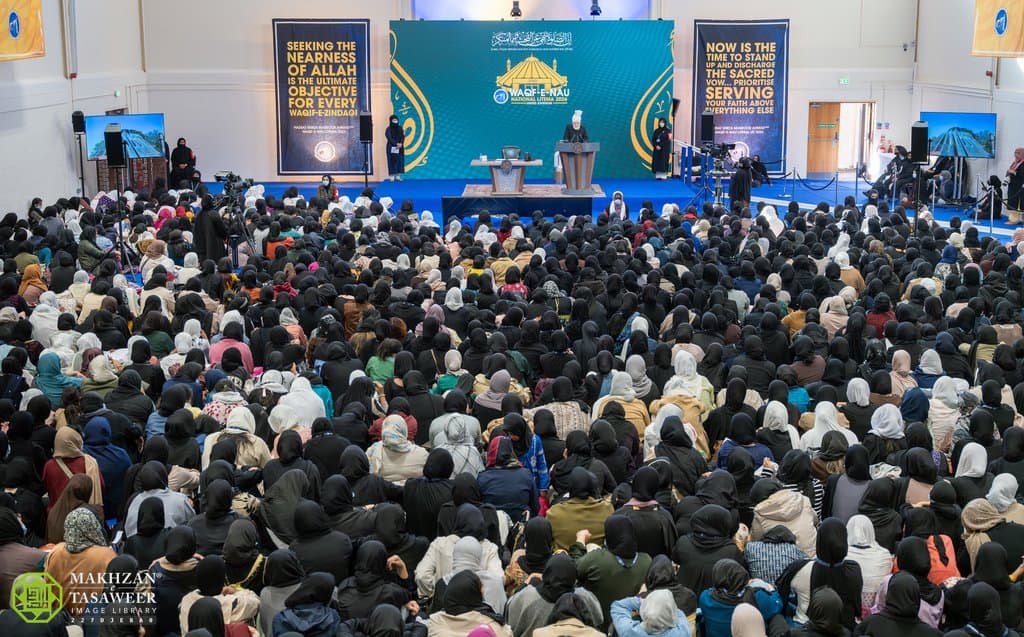
On Saturday, 25 April 2026, shortly after 5pm local time, Hazrat Mirza Masroor Ahmad, Khalifatul Masih V, may Allah be his Helper, presided over the UK Waqifaat-e-Nau Ijtema 2026, at Islamabad, Tilford, UK.
After conveying assalamu alaikum, Huzoor (aa) invited Sajeelah-Noor Teyeeb Sahiba to recite a portion of the Holy Quran – Surah Aal-e-‘Imran, verses 36-37. Mashel Chaudhry Sahiba then presented the English translation of these verses. Aylah Uddin Sahiba subsequently recited an Urdu poem composed by Hazrat Musleh-e-Maud (ra), followed by its English translation presented by Baariah Tahir Sahiba.
Hazrat Amirul Momineen (aa) then invited the Muavina Sadr Waqifaat-e-Nau UK to present the Ijtema report. She expressed her gratitude to Huzoor (aa) for gracing the occasion with his esteemed presence. Huzoor (aa) was apprised of the various workshops and activities conducted throughout the Ijtema, all aimed at enhancing the spiritual development and religious understanding of waqifaat-e-nau. The theme of this year’s Ijtema was “Salat – The Pillar of our Faith.” She further reported that this year’s Ijtema was attended by 1,700 participants, reflecting an increase of 321 from last year’s attendance.
Huzoor (aa) then took to the podium and, after reciting the tashahhud, ta‘awwuz and Surah al-Fatihah, Hazrat Amirul Momineen (aa) commenced his address. A brief summary of this address is presented below:
By the grace of Allah, nearly 40 years have passed since Waqf-e-Nau scheme was launched. Many of you are now in their 20s or 30s, and many have become mothers to a new generation.
Now an even greater responsibility rests upon your shoulders. You should not only live up to your pledge and act according to Islamic teachings, but you must also ensure the moral and religious upbringing of your children.
Although this is the duty of both parents, mothers generally spend more time with their children; thus, the responsibility upon them is greater.
Role of waqifaat-e-nau in shaping the future
As waqifaat-e-nau, you must continually strive to elevate your spiritual and moral standards, while also guiding your children so that they may become pious, excellent and beneficial members of society. In this way, you will play your part in safeguarding the future prosperity of the Jamaat.
Those who have grown up here and benefited from the educational system have attained a higher level of education than their mothers or grandmothers. This blessing carries with it a profound responsibility – that you must harness your knowledge and the opportunities you have received to enlighten and guide your children.
Strengthening faith within the home
You must empower your children to navigate the challenges of the present age while remaining anchoured to Islamic teachings. Sadly, many mothers write expressing their heartbreak that, as their children pass through adolescence, they begin to drift away from the faith and fail to maintain a close bond with the Jamaat.
Thus, keeping your children attached to their faith is your foremost responsibility. For this, you must ensure that your own bond with Allah the Almighty is unshakeable.
Offer salat with devotion and sincerity, and immerse yourself in the timeless wisdom of the Holy Quran. If your conduct is a living testament to your love for Allah and conviction in the truth of Islam, your children will naturally learn from your example.
Challenges in the West
Unfortunately, among those who have migrated to Western countries, this spiritual focus is often lacking. Rather than strengthening their bond with Allah, many become more concerned with attaining worldly rights.
Such frustrations often surface after marriage when domestic challenges arise. While genuine hardships and injustices must be addressed, you must never allow personal trials to eclipse your commitment to your faith. Your priority must be to cultivate a deep bond with Allah and instil a lasting love for Him in the hearts of your children.
Importance of religious knowledge
You must help your children acquire religious knowledge. Indeed, most of you – whether mothers, young adults or teenagers – must realise that attaining religious knowledge is fundamental to safeguarding your faith and that of future generations.
Do not imagine that tabligh is a duty reserved only for men. Islamic history testifies that, from the very beginning, Muslim women made monumental sacrifices for their faith. The example of Hazrat Aisha (ra) is often cited, as the Holy Prophet (sa) declared that half of faith can be learnt from her. Many companions, including men, sat before her to learn about Islam.
Defending Islam and addressing allegations
Thus, to take on this responsibility, women are required to speak and attend public events. As waqifaat-e-nau, you should strive to increase your religious knowledge in order to respond to baseless allegations raised against Islam.
One such allegation is that Islam denies rights to women. With full conviction, you should be able to respond that Islam recognised and granted rights to women many centuries before the modern world acknowledged them even to a limited degree. You should be at the forefront of defending Islam and illuminating mankind with its noble teachings.
Huzoor (aa) noted that, in the UK and elsewhere, Ahmadi women have effectively presented Islam with eloquence and clarity, leaving critics who falsely claim that Islam oppresses women silenced.
Purdah and public engagement
While observing purdah, Ahmadi women can present Islam’s true teachings and address allegations. Hazrat Musleh-e-Maud (ra), during his Khilafat, explained that women can defend Islam before men or in a public setting. He also gave the example of Hazrat Aisha (ra).
True concept of women’s rights
In recent times, the world has witnessed how, under the guise of freedom, certain Western powers have waged wars in which countless defenceless women have been killed or decimated, and their schools and institutions destroyed. Is this what is meant by granting rights to women?
From the outset, Islam unequivocally enshrined the principle of equality between men and women. No Ahmadi girl or woman should harbour any doubt – embrace your identity as a Muslim woman and recognise your God-given value.
Allah has prescribed certain roles for men and women according to human nature, yet ensured that their rights remain equal and just. In Islamic teachings, gender confers no superiority.
Islamic teachings on equality
Islam provides remarkable detail regarding equality. For example, the Holy Quran teaches that weaning a child is a mutual decision between husband and wife; it is not permissible for the husband alone or his family to dictate this matter.
Islam has also stipulated haq mahr [dowry] as a fundamental right to preserve the dignity and honour of women.
Similarly, the claim that Islam confines women to the home is utterly false. Women may pursue various professions, provided they observe purdah.
Mission of waqifaat-e-nau
Thus, as waqifaat-e-nau, it is your mission to enlighten mankind and convey these teachings to those unaware of them. Many of you are capable of addressing allegations against Islam; therefore, you should strive to increase your religious knowledge.
The best way to learn about Islam is to study the Holy Quran. Through it, you will understand your spiritual, civic and social responsibilities, and learn how best to fulfil your roles in society and family life.
Balancing education and faith
Many Ahmadi girls have attained higher education. Alongside your studies and careers, you must allocate time for religious learning. Only then will you truly embody the spirit of Waqf-e-Nau and be able to guide your children effectively.
Patience in family life
You should always act with patience and prayer. Domestic challenges may arise – for example, when a husband fails to fulfil his responsibilities. While addressing such issues, give precedence to faith over worldly matters and strive to resolve matters amicably with patience and trust in Allah. Always safeguard your family unit and prioritise the moral and spiritual upbringing of your children.
Sincerity and sacrifice
Every Ahmadi woman, especially waqifaat-e-nau, should exhibit humility. Whether performing duties or good deeds, never seek praise from others; rather, act solely to attain the pleasure of Allah.
At the heart of your waqf lies sacrifice. Fulfilling the obligations of worship is paramount. By prioritising faith, you will, insha-Allah, bequeath a legacy of piety, high morals and strong faith to future generations.
A higher purpose
Never forget that you have been born with a grand purpose – to lead the world back to its Creator. If people claim that you are restricted by your faith, prove them wrong. Show them your strength and declare confidently that you are liberated from materialism and moral decline.
Never underestimate yourself; strive to ignite a spiritual and moral revolution that transforms the world into a place of peace, love and prosperity. This is the jihad of our time.
Examples from history
History shows that women have always been at the forefront of sacrifice for their faith. For example, the Gospel of Matthew in the Bible records how women followers of Prophet Jesus (as) courageously went to his tomb after the crucifixion, while many male disciples remained in hiding. Their devotion and courage were exemplary.
Similarly, throughout Islamic history, countless women have made sacrifices for their faith. The scholarly contributions of Hazrat Aisha (ra) are well known, and many women served Islam in various capacities, including caring for the wounded during battles.
The duty waqifaat-e-nau
Now it is your duty to follow in their footsteps and be ready to make every sacrifice for your faith. This is the responsibility of every Ahmadi woman, especially those who have devoted their lives as waqifaat-e-nau.
Alongside secular education, strive to increase your religious knowledge by studying the Holy Quran, its commentaries and the writings of the Promised Messiah (as) and the Khulafa.
Guidance for nasirat
For the younger girls – the nasirat – you should also strive to excel in your studies and remain firm in your faith. You should never feel embarrassed about your religion.
If you are ever mocked for observing modest clothing, you may respond that others are free to mock as they wish, but they cannot weaken your beliefs or your religious practice. Explain to them that you have a higher purpose – to stand against the moral decline of the world and to bridge the gap between humanity and Allah the Almighty.
Be confident in yourself and in your identity. True peace and contentment lie in the nearness of Allah the Almighty, and to attain this, you must fulfil His rights as well as your duties towards humanity.
Prayer
Towards the end, Huzoor (aa) prayed:
May Allah the Almighty enable all of you to fulfil the pledge you have made to your faith throughout your lives. May you become those whose noble and righteous qualities manifest the truth and beauty of Islam for the world to see. Amin.
Hazrat Amirul Momineen (aa) then led everyone in silent prayer.
(Summary prepared by Al Hakam)