
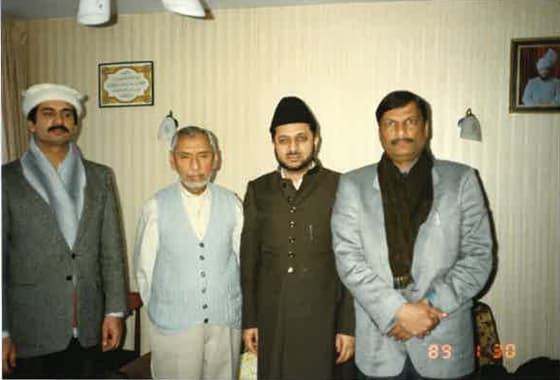
Chaudhry Hameed Ahmad Sahib was a devout Ahmadi Muslim who migrated from Qadian to Rabwah after the partition and was among the first wave of Pakistani immigrants to arrive in the UK in 1961. Yet his heart always remained attached to his motherland. He was a fearless, courageous and strong-hearted man who was extremely bold in upholding his belief in Ahmadiyyat. He was also lovingly known as Chaudhry Hameed Ahmad Lyallpuri.
His father, Chaudhry Ghulam Hussain Sahib, moved from Qadian to Lyallpur (now Faisalabad) in Pakistan after the partition and then to Rabwah where all his children were educated and worked. He had an electrical business and was also in charge of the management of the lands of Hazrat Khalifatul Masih II (ra), as well as its electrical work and construction.
Under the supervision of Hazrat Khalifatul Masih III (rh), he also managed and completed the construction work of the Degree College. He was also a judge (qazi) in the judiciary board.
There are many inspiring stories about Chaudhry Hameed Ahmad Sahib, one of which is that he was blessed with a dream in 1979 which foretold him that Dr Abdus Salam Sahib would be awarded the Nobel Prize for his ground-breaking work in science. The dream later came true and Dr Abdus Salam had Hameed Sahib to accompany him to the prize ceremony held in Stockholm, Sweden.

I therefore feel greatly honoured and fortunate to have the opportunity to share some memories of this great friend of mine. Hameed Sahib was a man of great qualities. He was a man of great courage, dedication, commitment, sacrifice and much more.
One of his outstanding qualities was his great love and respect for the Ahmadiyya Muslim Jamaat and the Promised Messiah (as). He was very bold – a man who could not tolerate hearing anything against the Jamaat. If somebody ever criticised the Promised Messiah (as), the Khalifa or the Jamaat, Hameed Sahib was perhaps the first person to jump in and answer the allegation immediately.
He had a great ability to explain something according to the level of understanding of the critic. If the critic was a scholar, Hameed Sahib knew exactly how to tackle them. He would conversely take them to such people who could explain the matter better than him.
By the grace of Allah, he was well-versed in comparative religious studies and had great knowledge. He had read books, listened to countless speeches and learnt from the Khulafa. I witnessed this myself; I remember always seeing him attending the question-and-answer sessions led by Hazrat Mirza Tahir Ahmad, Khalifatul Masih IV (rh).
Travelling together
Another one of his qualities which I personally experienced was his dedication to the service of the Ahmadiyya Jamaat. During the 1980s, I often needed to attend various events across the UK such as meetings, debates and question-and-answer sessions. Many people accompanied me from time to time during these trips. In fact, I had a long list of people I could call upon for such purposes and who were ready to drive me to my destination.
But one person I remember calling often was Hameed Sahib. Surprisingly, he was an untiring and energetic person. His health seemed to be good – he was quite strong and healthy.
Many times, I would be busy in the office and would remember very late in the evening that I needed to travel the next morning to some distant place like Scotland, Huddersfield, Bradford or Manchester. I would get worried about who would accompany me and drive the car. At such times, the first name that came to mind would be Hameed Sahib. I would call him late and ask whether he was ready to accompany me the next morning. He would always say, “Yes, I am ready to go.” He never declined.
Then the questions he would ask before leaving would be “When?” and I would say “Tomorrow morning.” He would say, “What time?” and I would calculate the time it would take me to get to his house in Langley and say something like “8 am” and he would say, “Okay.”
His next typical question would be to ask me how many days we would be expected to be away. Once, I asked him why he asked such a question. He replied that he had to tell his family he would not be at home for that period and he needed to pack appropriate clothing for that number of days.
He would never ask where we were going, what the occasion was or any other detail. I would be at his house at exactly the time I had given him. Upon arrival, I would see him walking along the pavement, already waiting for me and holding a small bag. The moment I arrived, I would get out of the car and meet him, after which he would immediately put his luggage inside and take the driver’s seat. He would start the engine, then ask the most important question: “Where are we going?” I would tell him our destination. He would say that was fine and we would then start our journey.
This was his classic style and something very special to me. He would not ask many questions – only the essential details. It was only during the course of our journey that he would ask about the type of occasion or meeting we were attending and I would explain accordingly.
He was an expert driver; he knew the roads and routes very well. He had already seen or visited most of the Jamaat mosques and mission houses around the UK, so without any guidance from me, he would know exactly where to go and would reach the destination on time. He did this without making any mistakes, without asking anyone along the way and without needing to consult any road maps or atlas books. I would always carry the address of our destination with me just in case.
He would never tire whilst driving or say that he was tired. He was quite ready to drive continuously if needed but I would ask him to have a short break every few hours. Only then would he stop at the service station. He was also a very careful driver; he knew all the road etiquette and we never experienced any incidents during any of our long journeys together.
Hameed Sahib was a very capable person with a lot of energy, strength and endurance – he always knew what needed to be done. For example, if my car was being used, he would check the oil and petrol. If anything was needed, then he would immediately stop at the first service station and top things up. He would also take care of other mechanical parts such as the brakes. If there were any shortcomings, he would immediately get them sorted out.
Throughout the journey, we would talk about many things such as politics, financial matters, domestic issues, world affairs or some of the queries and objections people sometimes raise about the Ahmadiyya Jamaat. Sometimes, he would relate stories from his lifetime of meeting other people. He had met my father as well, so sometimes he would share stories about my father and I would also do the same as I also knew and had met his father.
In short, it was pleasant to travel with him. He would be very informal and we would both be quite relaxed in each other’s company. Sometimes I would ask Hameed Sahib to bring someone along who could sit by his side and keep him company whilst I would be sitting at the back reading, writing, preparing my notes or perhaps taking a rest.
Travelling to Spain
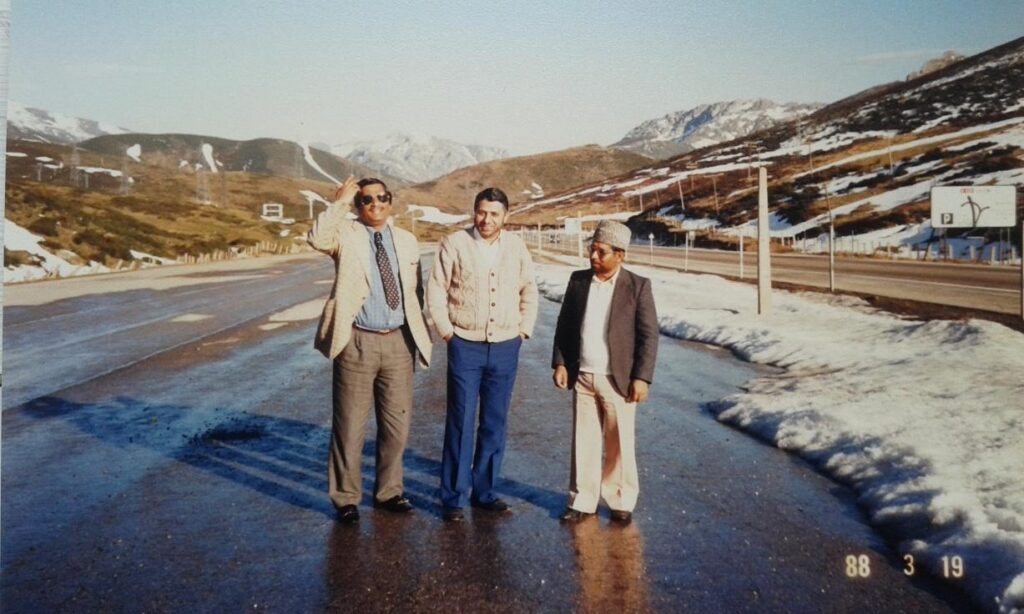
In 1988, we also went to Spain together when Abdul Sattar Sahib was the missionary there. We travelled around with a four-wheel-drive car and Hameed Sahib drove us to Malaga, Granada, Seville and Sierra Nevada. Towards the northern coast to Oviedo, we went to meet a family that had previously come to the UK to meet Hazrat Khalifatul Masih IV (rh).
There was also a lady there who had translated the Holy Quran beautifully from English to Spanish and back from Spanish to English. Huzoor (rh) has particularly said that such people are very good and should be preached to. We thought it better to go meet the family since they had been in contact. From there we went to Portugal.
Isle of Man
We also went to the Isle of Man in 1987 where I had to deliver a lecture at a school. The school had invited us to give a lecture and since we had to travel by air from London to the Isle of Man, which was quite a distance away and expensive, I proposed that we could instead dedicate two days to teach the entire school about Islam by dividing the children into groups. I would then go to each classroom and in this way each person in the school got the message of Islam.
Tolerating opposition
As I mentioned, Hameed Sahib could not tolerate the opposition or anyone speaking foul against the Jamaat. I remember that in 1973, the opposition to the Ahmadiyya Jamaat in Pakistan was very troublesome. On one occasion, whilst I was sitting in my office, Hameed Sahib came in with a very strong-looking bag. He looked around to check if anyone was in the room with me and then locked the door from the inside and sat in front of me.
It was clear from his manner that he wanted to say something very important and did not wish to be interrupted or disturbed. He was a man of great emotions and seemed very excited at that moment. He asked me whether anyone else was listening, to which I replied that we were completely by ourselves.
He expressed how disturbed he felt about the situation of Ahmadis in Pakistan and the profanities that were being directed at the Promised Messiah (as). He then asked me in confidence whether there was anyone who was outspoken in their opposition against the Jamaat whom I would want gone.
I’m not sure why he was so excited at the time – he was so full of emotions that he was finding it difficult to sit still. Maybe it was a speech he had heard or people he may have met or some newspaper he’d read that had caused these emotions to build up. I asked him to sit down, drink some cold water and calm down. I then began telling him how forgiving the Holy Prophet (sa) was; despite being persecuted, he never took any such action or asked any of his followers to do so either.
I also told him about the Promised Messiah (as) who advised patience in the face of persecution. The Promised Messiah (as) had never asked for the killing of anyone, as that matter was left entirely in the hands of Allah the Almighty. I gave the example of Lekh Ram who was very ardent in his opposition against the Promised Messiah (as). It was Allah alone Who arranged his downfall. There was no need for anyone to take any action whatsoever.
I asked Hameed Sahib whether he believed the ultimate end would be the victory of Ahmadiyyat, to which he replied he was very sure it would be. I then asked if that was the case, then why was he so worried about the opposition?
So, it took me at least one hour altogether to pacify him, cool him down, not be angry or take the law into his own hands. I explained how this was not our way and these ideas should be removed from his mind. I asked him to remain calm and steadfast and to just pray to Allah to do whatever He likes. Anyway, he drank the water and cooled down, and then immediately understood and agreed I was right, and confessed that he should not have become excited or even thought of such a thing. Hameed Sahib was a man who was prepared to stand up for the honour of the Jamaat and was ready to do everything, but he was also a very careful and understanding man, who could control his feelings when some advice was given to him. It was a special meeting and I cannot forget that incident.
Durham University
In 1983, I received a letter from Durham University, which is based in the north of the UK near Hartlepool. They were holding a religious gathering in which all the denominations of Islam were invited to speak on 40 questions they had prepared. They wanted answers from each denomination from their own religious perspectives. I was very happy as it was a great opportunity, so I immediately telephoned the programme’s director to thank him and accept the invitation.
Although I was prepared to attend, I did not want to keep him in the dark about the strong opposition we faced as Ahmadi Muslims. I told him about the likely reaction from other Muslims when it came to listening to our views. I wanted him to know our background and asked him to discuss this matter with his colleagues and take some time to consider this, as it might result in an unpleasant situation.
The next day, we spoke again on the telephone and the director confirmed that he had discussed the matter and that they were all still in agreement that we should attend the event as planned. He assured me that the event would run smoothly and that nothing unpleasant would happen. I replied that although it was unlikely to remain pleasant, as they were still ready to accommodate us, we would be ready to attend the event. After that, I began writing and preparing for the meeting with the missionaries’ help. Eventually, we typed a full document of all 40 questions and their answers.
Several people accompanied me to Durham University, including Hameed Ahmad Sahib. Among the missionaries were Mubarak Saqi Sahib, who was serving with me at the time; Mohammad Issa Sahib, the then missionary in Huddersfield; Dr Hameed Ahmad Khan Sahib from Hartlepool, accompanied by his son and four or five others. I had asked the latter to come prepared in case any incident arose because of the opposition that existed at the time. Altogether, our group consisted of around 12 people, if not more.
The meeting started and all the representatives spoke one by one. Surprisingly, none of them actually tackled the actual questions. They just gave their points of view differently – touching here and there but not answering the questions one by one. Still, the turnout was quite good – people were listening and the hall was full with at least 300 people attending the event.
But when it came to my turn, it was like a bombshell.
I stood up; they introduced the Ahmadiyya Muslim Jamaat and then me as the next speaker, the Imam of the Fazl Mosque. So I started with Surah al-Fatihah and began my speech. There were many non-Ahmadi Muslims in the audience and they kept quiet at first; I had spoken about the teachings of Islam from the Holy Quran and the shining example of the Holy Prophet Muhammad (sa). They listened quietly up to that point.
However, I then mentioned the Promised Messiah (as) at the end and explained our belief and how our Jamaat differs from others. I openly mentioned that we believe the Promised Messiah had come and that he was a subordinate Prophet after the Holy Prophet (sa) and not a law-bearing Prophet. At that moment, some of the audience started making noise. The organisers controlled the situation and told them to sit down. They also said that they would have the opportunity to ask questions later.
Anyway, they listened restlessly. I completed my lecture – I was the only one who answered the questions properly. As soon as it was over, they asked if anyone would like to say something and all the mullahs started objecting and creating disorder. The organisers tackled this somehow and although the meeting had finally ended, it was just the beginning of the abuse.
We continued talking to other people who came and gave their views. They began quarrelling and using foul language along with the usual allegations. It was just like a vulgar marketplace. All of them surrounded me and the other members of our group. At that time, I remember how Hameed Sahib made sure nobody came too close to me. Hameed Sahib was unique in our group – apart from being a brave and bold person, he was also very well-built. This was helpful because it was a serious situation and some of them appeared ready to fight or even cause physical harm.
There was one particular person who was very outspoken and he was just trying to find a way to jump on me and cause me some injury. This person was very excited and was about to jump on me to fight. At that moment, Hameed Sahib gently restrained the man and said to him, “You talk to me; I will explain this to you”. So, Hameed Sahib started a discussion with him and I don’t know what happened afterwards but he took that person away and dealt with him. I remember this incident very clearly.
The people at Durham University were very surprised by the hostility shown against us during this event. Later, I reminded the professor that I had warned him this might happen, though he had never imagined the hostility we experienced.
Meeting in Manchester
A similar incident to Durham happened in Manchester when we were invited by non-Ahmadi Muslims to attend one of their events. A person started abusing the Promised Messiah (as). I was trying to answer his questions calmly but the person was not ready to listen at all.
I remember that Hameed Sahib was also there on that occasion. He took hold of this person and said to me, “Imam Sahib, you don’t know these people. They are different types of people. I know their type so I am taking him away and I will be explaining this matter to him in his language, so leave him to me.”
So I started discussing with other people whilst Hameed Sahib took that person away. Later on, after the meeting had ended, I asked Hameed Sahib about the incident, to which he said, “I know their language, so when I replied to him in his language, then he was silenced.”
Hospital visit
Once, Abdul Karim Sahib, one of our missionaries, became seriously ill. He was in hospital and I think he had a serious problem with his stomach and ultimately the doctors had to operate and take one part of the stomach out due to an infection. I went with Hameed Sahib to the hospital near Tooting in London to enquire about his health.
I knew that his daughter had spoken to Hazrat Khalifatul Masih IV (rh) on the telephone and emotionally requested special prayers. Huzoor (rh) knew him personally and assured her that Allah the Almighty will give him health and life. Other people were also praying.
On another occasion when we went to the hospital, Abdul Karim Sahib’s condition was very serious and he seemed to be on the brink of death. Both of us stood by his bedside and prayed; that is the best thing that one can do since we couldn’t help in any other way. Four or five minutes after we arrived to see him, Hameed Sahib said he could not bear to see him like this and went outside. Hameed Sahib was a tender-hearted person as well – full of sentiment. I can’t recall the exact sentence he uttered as he left, but it was typical of his style. He said something like, “In three or four days, I’ll see his face.”
What he meant was that upon observing his condition, he thought Abdul Karim Sahib would die in a few days and he would now see his face at the funeral. With that small sentence, he went out and said, “I can’t stay; it’s too much for me.” I stayed there and then left some while after.
Sometime later, maybe one week or so afterwards, Abdul Karim Sahib came to the London Mosque to meet Hazrat Khalifatul Masih IV (rh). I remember vividly that he was walking quite fragily with a stick. There was perhaps an event being held at the mosque at the time, so both Hameed Sahib and I were leaving Mahmood Hall and Abdul Karim Sahib was just at the door and about to enter at the same time.
Upon seeing him alive, walking and dressed in normal clothes, Hameed Sahib said one sentence in Punjabi that I still remember. He just looked towards me, face full of surprise and said, “Lagda koi vich peygea ey,” meaning, “It appears that somebody has intervened.”
To me, that one sentence was something very great – a spontaneous expression meaning that somebody (i.e. Allah) has come in between him and death, as he was just on the brink of death. He immediately concluded that somebody had especially prayed for him, which is why Allah the Almighty had prolonged his life. That was something special and is something I can never forget.
May Allah elevate his status in paradise. Amin!