
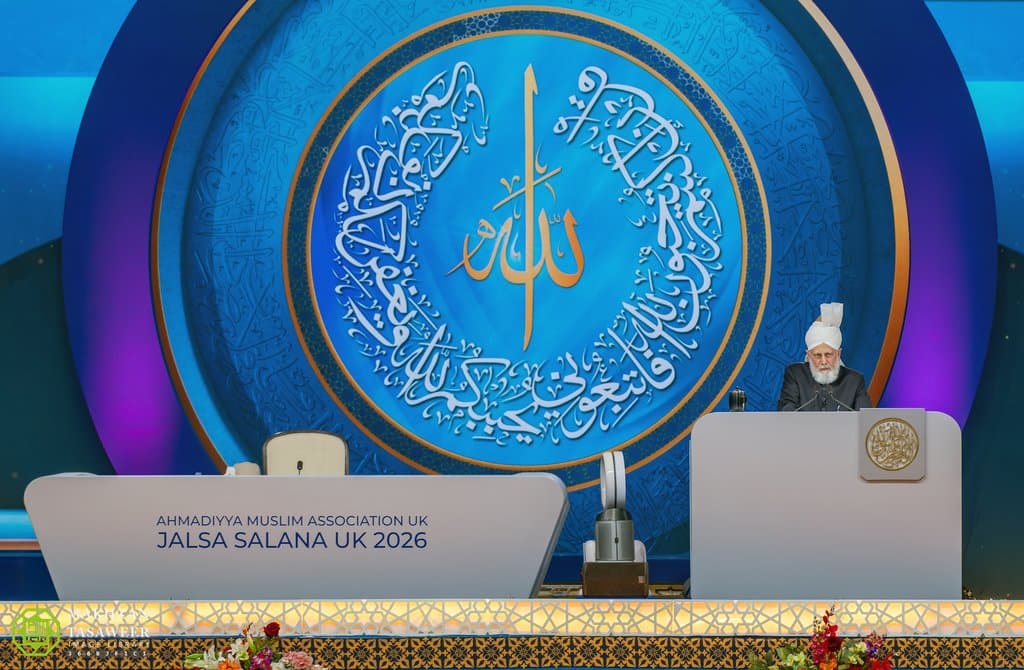
Hadeeqatul Mahdi, Alton, 24 July 2026: Shortly after 4:30 pm, Hazrat Mirza Masroor Ahmad, Khalifatul Masih V, may Allah be his Helper, hoisted the Liwa-e-Ahmadiyyat, encircled by the national flags of countries represented by participants attending Jalsa Salana in person and those joining through MTA International. Hazrat Amirul Momineen (aa) then led everyone in silent prayer before proceeding to the main Jalsa Gah to deliver the inaugural address.
Huzoor-e-Anwar (aa) arrived on the stage and commenced the inaugural session by inviting Ehsan Ahmad Sahib for the recitation of the Holy Quran (Surah al-Baqarah, Ch.2: V.1-8). He then presented the Urdu translation. After this, Huzoor (aa) invited Abdul Haye Sarmad Sahib to present an Urdu poem of the Promised Messiah (as) on the subjects of humility, righteousness and complete devotion to God. Then, Faris Naseem Sahib presented a Persian poem written by the Promised Messiah (as) in praise of the Holy Prophet (sa), the translation of which was presented by Kashif Ali Sahib.
Following this, Hazrat Amirul Momineen (aa) came to the podium and conveyed his salaam to everyone. After reciting tashahud, ta‘awuz and Surah al-Fatihah, Huzoor (aa) delivered his inaugural address, a brief summary of which is as follows:
The objectives of Jalsa Salana
Explaining the objectives of Jalsa Salana, the Promised Messiah (as) said that we hold this gathering so that the fear of Allah may be instilled within us and so that we may become examples for one another in righteousness, piety, tenderness of heart, mutual love and brotherhood.
It is for this very purpose that these gatherings are held and it is for this purpose that people assemble here. We must always remember that unless we strive with our utmost effort to attain this objective, our acceptance of the Promised Messiah’s (as) bai‘at is devoid of purpose.
Taqwa: The foundation of Islam
It should always be remembered that the foundation of Islamic teaching is taqwa (righteousness). Regarding taqwa, which is the fundamental objective, the Promised Messiah (as) expressed in one of his couplets:
ہر اِک نیکی کی جڑ یہ اِتّقا ہے
اگر یہ جڑ رہی سب کچھ رہا ہے
“The root of every good is righteousness. If this root is preserved, everything will survive.”
The second line of this couplet was revealed to the Promised Messiah (as) by Allah the Almighty as a divine revelation.
Allah the Almighty has, in various ways and through different means, repeatedly directed our attention towards taqwa.
Taqwa is essential for complete adherence to the Shariah and to the Holy Quran. It is essential for the proper observance of worship. It is essential for treating one’s wife with kindness in domestic life. Indeed, it is the fundamental prerequisite.
The honour and blessings of the righteous
Allah the Almighty further states that the most honourable person in Islam is the one who possesses taqwa. Allah the Almighty is the Friend and Helper of the righteous; indeed, He loves those who are righteous. Allah the Almighty has declared that the best outcome belongs to the righteous. He has also made taqwa a necessary condition for perfect obedience to the Holy Prophet (sa) and it is taqwa that completes such perfect obedience.
No matter how many slogans we raise or how often we proclaim that we belong to the Jamaat, have taken the bai‘at of the Promised Messiah (as), have perfect faith in the Holy Prophet Muhammad (sa) and possess complete faith and certainty in Allah, if taqwa is absent within us, then these slogans remain nothing more than slogans.
Taqwa is the key to success
Allah the Almighty has also declared taqwa to be essential for prosperity and success. He has promised those believers who adopt taqwa that He will open for them the doors of progress, deliver them from hardships, provide them with sustenance and bring ease into their affairs.
Allah the Almighty has repeatedly advised that if you have believed, then become perfect in taqwa. If you become righteous, you will also succeed in attaining nearness to Allah the Almighty.
If we wish to reform ourselves, if we wish to attain the nearness of Allah the Almighty and if we wish to become true Ahmadi Muslims in the real sense, then it is of utmost importance that we strive with all our strength to walk upon the paths of taqwa. Without taqwa, a person’s claim to faith is entirely hollow.
The Holy Quran and taqwa
Allah the Almighty states regarding the Holy Quran that this is a Book concerning which there is no doubt, a guidance for the righteous. Here Allah the Almighty clearly explains that one can benefit from His Book and His Shariah and derive true guidance from them, only when one possesses taqwa. Therefore, we should always keep before us the fact that without taqwa, a person has no standing in Islam.
The Promised Messiah (as) once stated that the Holy Quran itself has declared the ultimate purpose of its revelation to be the teaching of the paths of taqwa. The Holy Quran was revealed so that those who refrain from sin may be informed even of the subtlest forms of sin, enabling them to avoid evil deeds that are not apparent to every eye, but which can only be perceived through the microscope of spiritual insight.
Taqwa protects from even the subtlest sins
The reality is that when taqwa is present, we are able to avoid even the slightest sins. The fear of Allah is established in our hearts and we become those who truly attain the station and objective of walking in the ways prescribed by Allah the Almighty. Our attention is drawn towards those matters that Allah has forbidden, and likewise towards those matters that He has commanded us to fulfil. A person may claim as much as they wish that they are a Muslim and a believer, but if taqwa is absent, then such claims to Islam and faith are entirely hollow.
Allah the Almighty mentions in the Holy Quran that He has placed healing and mercy in the Quran for the believers, whereas for the wrongdoers it increases nothing but loss. Those who do not possess taqwa cannot receive guidance from the Holy Quran.
Guarding one’s gaze
Regarding the subtle paths of taqwa, the Promised Messiah (as) states that our Shariah and the Holy Quran command us to lower our gaze. If people were to act upon this command and develop such a state of taqwa, they would be protected from many major sins.
These are precisely the kinds of sins that, in today’s society, are leading people towards destruction and even some who profess faith become entangled in them. Modern media frequently presents programmes and films that inflame human passions and give rise to impure thoughts. For this reason, the Promised Messiah (as) advised that one should neither listen to the seductive talk of women nor expose oneself to circumstances that may become a cause of stumbling.
The Holy Quran: A complete guide for humanity
Allah the Almighty revealed the Holy Quran so that every individual may act upon it according to their capacity. By doing so, a person continues to advance along the paths of taqwa.
Some people ask why followers of other religions also claim that their faith is true. The reality, however, is that apart from Islam and the Holy Prophet Muhammad (sa), no other religion claims to have been sent for the whole of mankind. This claim belongs exclusively to the Holy Quran and Islam. The Holy Prophet Muhammad (sa) is the final law-bearing prophet, sent for all humanity. His Shariah is perfect, complete and full of guidance.
Those who adopt taqwa will find that this Shariah leads them upon paths through which both their worldly life and their Hereafter are reformed. No other religion makes such a claim.
Faith in the unseen and divine guidance
When a person acquires faith in the unseen, acts upon the teachings of Allah the Almighty, adopts taqwa and follows its finer paths, then Allah the Almighty Himself guides that person and grants them spiritual insight and true understanding (irfan). Allah then bestows such blessings upon them that it becomes evident they have acted upon His commandments. He grants them abundantly and illuminates them with His light. Such spirituality is not found in other religions; their spirituality has come to an end.
Salat and the grace of Allah
The Promised Messiah (as) states that the utmost a person can achieve through personal effort is to purify themselves, perform prayer in a state of cleanliness and strive to ensure that their prayer does not remain lifeless.
One should praise and glorify Allah to the best of one’s ability and fulfil all the outward requirements of prayer. However, it is not within human power to produce extraordinary love for Allah, profound humility, deep yearning, or a heart completely free from worldly impurities during prayer. A person can perform the outward actions of prayer, but exceptional love, humility, submission and the experience of beholding Allah cannot be created by human effort alone.
For this, it is essential to seek the grace of Allah and to ask for His help. Until this inner state is granted, a person cannot attain the spiritual condition that represents the highest state of a true believer.
Establishing prayer through taqwa
For this reason, Allah the Almighty states that the righteous are those who establish prayer. Something is established only when there exists the possibility of it falling. Yet human efforts alone are futile without the grace of Allah.
Allah the Almighty declares that the Holy Quran is a guidance for the righteous. As far as possible, one must strive, through taqwa, to establish prayer. If they believe in His Word, Allah does not leave them to rely solely upon their own efforts. Rather, He Himself supports them and a new spiritual state develops within their prayers – one that they could never have imagined.
This divine favour is granted because they believed in the Word of Allah and remained occupied, to the best of their ability, in fulfilling His commandments.
Reflecting upon the Holy Quran
Allah the Almighty further commands that we should strive to act upon the teachings of the Holy Quran. A temporary prayer, a brief moment of weeping, or offering one or two prostrations with humility is not sufficient.
To receive the guidance of the Holy Quran, it is necessary to recite it, understand it and reflect upon it. Only then will taqwa develop within a person. When taqwa develops, one attains the nearness of Allah. Through that nearness, good deeds erase one’s faults, a person undergoes a complete transformation and becomes one who is close to Allah.
Financial sacrifice as worship
The Promised Messiah (as) further states that financial sacrifice is also an act of worship. A person should spend, according to their capacity, from the wealth they love in the way of Allah in order to attain His nearness and seek His grace. This is why Allah the Almighty says that these are the people who spend out of what God has provided them. Merely giving some of one’s beloved wealth in the way of Allah is not the true excellence.
True excellence is to detach oneself from everything besides Allah, to the extent that one is prepared even to sacrifice one’s life in His cause. The provision that Allah has granted does not refer only to wealth. Rather, it includes every ability, talent and capacity that a person possesses. All of these should be devoted to His cause. When a person gives sincerely in the way of Allah, without any desire for display or recognition, Allah promises to bring such worship to perfection. That individual begins to experience a special delight in making sacrifices.
Spending wealth and offering other sacrifices are themselves acts of worship; worship is not confined to prayer alone.
The qualities of the righteous
The Promised Messiah (as) explains that the first quality mentioned regarding the righteous is that they believe in the unseen. This is the initial stage of faith: believing in realities that have not yet been witnessed. Included within the unseen are Paradise, Hell, the Day of Resurrection, Judgement Day and all matters that remain concealed.
At the beginning, the believer accepts these realities through faith. The promised guidance, however, is that this state is eventually rewarded. A person progresses from knowledge based on the unseen to direct spiritual witnessing. A time comes when those realities that were once accepted through faith become matters of personal spiritual experience. Hidden truths are unveiled before them, the manifestation of Allah appears before them, and the realities of the Hereafter become evident.
The second quality is that the righteous establish prayer. At times, their prayer may falter, but they continually restore it. A righteous person fears Allah and remains steadfast in prayer. Various distractions and anxieties cause prayer to weaken and Satan continually seeks to interfere. Nevertheless, the believer persists, repeatedly striving to re-establish prayer. This continual effort characterises the righteous.
Thereafter, Allah the Almighty grants them guidance and delivers them from a life of inner conflict and satanic whisperings. Through this Book – the Holy Quran – He raises them to such a spiritual station that prayer becomes for them like nourishment.
The spiritual delight of prayer
A believer should therefore offer prayer in the manner described above, until they begin to experience within it the same delight and joy that people ordinarily find in worldly pleasures. If we truly wish to attain taqwa, then this is the condition of prayer that we must strive to develop within ourselves.
The acceptance of prayer
If we wish to attain the standard of taqwa, draw near to Allah and witness the acceptance of our prayers, then we must understand an important reality. Many people ask why their prayers are not accepted. The answer is this: can we expect to attain the nearness of Allah merely by seeking worldly objectives, fulfilling worldly desires and offering only a few prostrations?
This can never be sufficient. Rather, we must develop within ourselves the intense longing for the worship of Allah that characterises a truly righteous person. When this longing is created, it becomes the means of receiving divine guidance and attaining the nearness of Allah. Only then will we begin to witness the signs of the acceptance of our prayers.
The true state of faith
Only when this condition is developed within us can we truly say that we are among those who have genuine faith. The Promised Messiah (as) states that when such a condition is attained, it is no longer the case that a person has to establish the prayer; rather, the prayer itself becomes established for them.
At that stage, everything they do is solely for the pleasure of Allah, free from all affectation and artificiality that had previously accompanied their efforts. The Promised Messiah (as) therefore advises that prayer should be offered with the utmost care and excellence, for prayer is the root and the ladder of all spiritual progress.
It is for this reason that it has been said that prayer is the mi‘raj (spiritual ascension) of the believer. The Holy Prophet Muhammad (sa) said, “The delight of my eyes lies in prayer.”
Purity and understanding the Holy Quran
The Promised Messiah (as) states that taqwa is essential for understanding the Holy Quran and receiving guidance from it. This is the fundamental principle and its very foundation. Allah the Almighty has stated regarding the Quran that none but the purified shall touch it. Such a condition is not attached to worldly branches of knowledge, for even a wicked and sinful person may acquire them.
The Promised Messiah (as) further states that until a person abandons their blameworthy moral qualities, they cannot attain high moral standards, for two opposites cannot coexist within the same heart.
The Holy Quran is guidance for those who possess taqwa, who are free from arrogance and who reflect upon the Word of Allah with humility and submission.
Purifying the heart and character
Advising his Jamaat, the Promised Messiah (as) said that Allah the Almighty loves the righteous.
Therefore, always yearn for the love of Allah and remember that all people are the servants of Allah. Do not oppress anyone, nor look down upon anyone with contempt. If even one person within the Community is morally corrupt, it affects the whole Community. Whenever the heart inclines towards anger, a person should examine themselves and ask from what source that anger has arisen and where feelings of resentment and hatred have come from.
Every individual should consider the extent to which their words and actions correspond. If they find that the two are not in harmony, they should realise that they are exposing themselves to the displeasure of Allah. If the heart is not pure, then no matter how much a person verbally justifies his actions, those words have no value in the sight of Allah. The real matter is the heart; the heart must be pure, not merely one’s verbal claims.
Some people outwardly appear very righteous and deliver excellent speeches, yet within their homes they do not treat their wives and children well and their wives are distressed because of them. Likewise, some women or men conduct themselves in ways that are contrary to Islamic teachings. Such people are not regarded as true believers in the sight of Allah. If they are not true believers, then taqwa cannot develop within them. Only when taqwa is established does the state of faith continue to grow.
Sincerity within the Jamaat
The Promised Messiah (as) states that members of the Jamaat should understand that they have come to him so that the seed may be sown from which they become fruitful trees. Every individual should examine their inner self and reflect upon their spiritual condition. If our Jamaat is one whose tongues speak one thing while their hearts conceal another, then its end will not be good.
When Allah the Almighty sees a community that is empty of sincerity and merely makes verbal claims, He is Independent and has no need of such people.
Although victory at the Battle of Badr had already been foretold, the Holy Prophet Muhammad (sa) continued to supplicate with great fervour and wept before Allah. Hazrat Abu Bakr (ra) asked why he continued to pray with such intensity when victory had already been promised. The Holy Prophet (sa) replied that Allah is Self-Sufficient and it is possible that divine promises may contain hidden conditions.
The blessings of taqwa
Allah the Almighty provides for the righteous in ways beyond their knowledge or imagination. He does not leave a righteous person dependent upon unlawful means to fulfil their needs. Some traders resort to falsehood in order to sell their goods, but Allah the Almighty declares that the righteous do not behave in this manner. Whoever places their trust in Allah, He becomes sufficient for them.
Among the blessings of taqwa is that the righteous are delivered from hardships and afflictions.
Listening with attention
The Promised Messiah (as) states that everyone should listen with full attention and deep reflection, because this is a matter of faith. Carelessness, negligence and lack of attention in matters of faith lead to very harmful consequences. Those who are negligent regarding their faith and do not listen attentively when they are addressed derive no benefit from the speaker’s words, no matter how beneficial those words may be.
Such people are those regarding whom it is said that they have ears but do not hear and they have hearts but do not understand.
The true purpose of attending Jalsa
Attending Jalsa can benefit us only if we gather here to seek the pleasure of Allah and to renew the pledge of bai‘at. We must resolve that we will leave this gathering determined to practise righteousness. The Promised Messiah (as) stated that his Jamaat has a particular need for taqwa, especially because they belong to and have entered into the bai‘at of one who claims to have been appointed by Allah.
Whatever forms of hatred, malice, shirk or excessive attachment to the world they may have possessed, they should free themselves from all such spiritual ailments.
The Promised Messiah (as) further stated that if you have entered into bai‘at with him, then you must strive to fulfil its true purpose. Only after attaining this objective can you become a truly beneficial person – not only for yourself, but also for your children, your future generations and your wider society.
Only then can you fulfil the very purpose for which Jalsa has been established.
Walk upon the path of taqwa
We must resolve that, insha-Allah, we shall strive with all our strength to reform our lives by advancing upon the path of righteousness. When this happens, then, insha-Allah, we shall attain the objective for which we became members of the Jamaat. Otherwise, there is no benefit in merely spending three days here, meeting friends, and returning home.
Certainly, one purpose of Jalsa is to meet one another and strengthen the bonds of brotherhood and friendship. However, the principal objective is that we become people who walk upon the path of taqwa, remain steadfast upon it and seek the pleasure of Allah.
Our prayers should also become a means of attaining the pleasure of Allah, and we should reach that spiritual station which Allah the Almighty grants to those who adopt taqwa.
Every action and every deed of ours should become a means of attaining the nearness of Allah and walking upon true taqwa. May Allah grant us the ability to do so.
Remembering Allah and praying for the world
During these days of Jalsa, we should greatly increase our remembrance of Allah. We should pray abundantly for ourselves, for the Jamaat, for the Muslim world and indeed for the whole world.
May Allah the Almighty enable mankind to recognise Him. May He also enable us to fulfil the objective of tabligh, to convey His message while walking upon the path of taqwa and may He provide every means of ease and relief for us as well as for the world, so that humanity may be protected from afflictions.
The proceedings of the first day of Jalsa Salana concluded with silent prayer led by Hazrat Khalifatul Masih V (aa).
(Summary prepared by Al Hakam)